




Abstract
Dear Editor,
I am writing to you in order to highlight some miscalculations in an article published in the journal of Technology in Cancer Research & Treatment, entitled; “SRS in Combination with Ipilimumab: A Promising New Dimension for Treating Melanoma Brain Metastases” by Khan, et al.1 These miscalculations changed the derived conclusion about median survival time, and adverse effects in the selected treatment groups. So, amending these miscalculations may help readers in future research decisions.
Dear editor,
I have a few comments on an article published in the journal of Technology in Cancer Research & Treatment, entitled; “SRS in Combination with Ipilimumab: A Promising New Dimension for Treating Melanoma Brain Metastases” by Khan, et al 1
1. A total of 6 studies were included in this meta-analysis. Mathew, et al. 2 is one of the included studies in which median survival time, the time at which fractional survival equals 50% for patients, in SRS+Ipi group and SRS-alone group, is approximately 8 and 5.1 months respectively (Figure 3 of Mathew, et al 2 ). While Khan, et al. 1 reported 5.9 and 4.3 months in SRS+Ipi group and SRS-alone group respectively for Mathew, et al. study (Table 1 of Khan, et al. 1 ).
This miscalculation can affect the reported hazard ratio (HR) for median survival time based on the following formula:
HR = 1/ (median survival in intervention group/median survival in control group)
The median survival time presented in Mathew, et al. 2 study is HR = 0.64, while Khan, et al. 1 reported 0.82 for the same parameter (Figure 2 of Khan, et al. 1 ).
2. Khan, et al. 1 also analyzed the adverse effects (intracranial hemorrhage, radionecrosis) in SRS+Ipi group and SRS-alone group for included studies. The following table represents the reported number of patients with intracranial hemorrhage and radionecrosis by Khan, et al. 1 for one of the included studies by Silk, et al. 3 ;
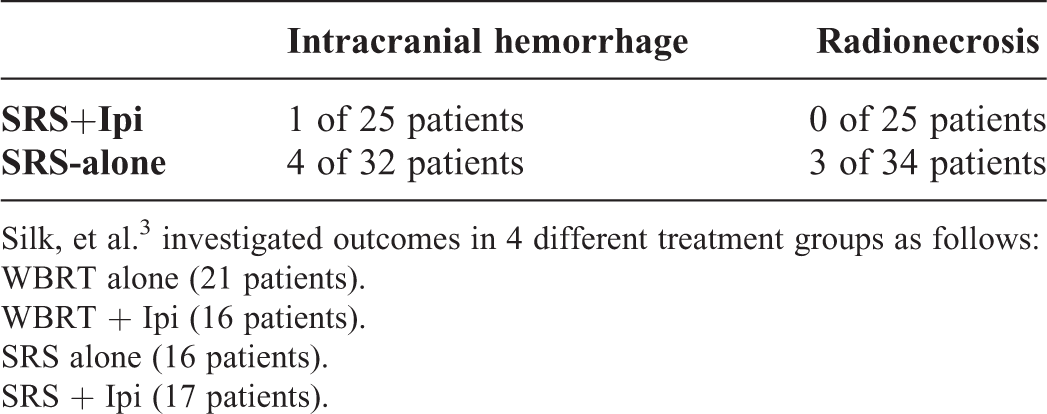
Silk, et al. 3 investigated outcomes in 4 different treatment groups as follows:
WBRT alone (21 patients).
WBRT + Ipi (16 patients).
SRS alone (16 patients).
SRS + Ipi (17 patients).
In the Silk, et al. 3 study, the median survival time data is available for all treatment groups, but adverse effects data is not available for individual treatment groups, because they just presented the adverse effects data for the radiotherapy-alone group (sum of patients in WBRT-alone and SRS-alone group) and radiotherapy+ immunotherapy group (sum of patients in WBRT + Ipi and SRS + Ipi group). Therefore, the exact number of patients with adverse effects (intracranial hemorrhage, radionecrosis) in SRS- alone group and SRS + Ipi is not available. In other words, the reported number of patients in the Khan, et al. 1 study for SRS + Ipi group is the sum of patients in WBRT-Ipi and SRS-Ipi group and the reported number of patients in the Khan, et al. study 1 for SRS-alone is sum of patients in WBRT-alone and SRS-alone group (Figure 3 of Khan, et al. 1 ).
This miscalculation changes the final results regarding the adverse effects in the selected treatment groups. Due to limited number of mea-analysis in this field, correcting these miscalculations may help researchers in the future research judgements.
Footnotes
Declaration of Conflicting Interests
The author(s) declared no potential conflicts of interest with respect to the research, authorship, and/or publication of this article.
Funding
The author(s) received no financial support for the research, authorship, and/or publication of this article.
