




Abstract
Renal cell carcinoma is one of the most common kidney cancer, which accounts almost 90% of the adult renal malignancies worldwide. In recent years, a new class of endogenous noncoding RNAs, circular RNAs, exert important roles in cell function and certain types of pathological responses, especially in cancers, generally by acting as a microRNA sponge. Circular RNAs could act as sponge to regulate the microRNA and the target genes. However, the knowledge about circular RNAs in renal cell carcinoma remains unclear so far. In the research, we selected a highly expressed novel circular RNAs named circMTO1 in renal cell carcinomas. We investigated the roles of circMTO1 and found that circMTO1 overexpression could suppress cell proliferation and metastases in both A497 and 786-O renal cancer cells, while silencing of circMTO1 could promote the progression in SN12C and OS-RC-2 renal cancer cells. The study showed that circMTO1 acted as miR9 and miR223 sponge and inhibited their levels. Furthermore, silencing of circMTO1 in renal cell carcinoma could downregulate LMX1A, the target of miR-9, resulting in the promotion of renal cell carcinoma cell proliferation and invasion. In addition, LMX1A expression suppression induced by transfection of miR9 mimics confirmed that miR9 exerted its function in renal cell carcinoma by regulating LMX1A expression. What’s more, miR9 inhibitor and LMX1A overexpression could block the tumor-promoting effect of circMTO1 silencing. In conclusion, circMTO1 suppresses renal cell carcinoma progression by circMTO1/miR9/ LMX1A, indicating that circMTO1 may be a potential target in renal cell carcinoma therapy.
Introduction
Renal cell carcinoma (RCC) is one of the most common kidney cancer that accounts for almost 90% of the adult renal malignancies. 1 Over the past several decades, the incidence of RCC increased with the rate of 2% every year. 2 Until now, the standard therapy for RCC is still surgery. The prognosis of RCC is still poor with a 5-year survival rate of 5% to 10%, despite the development of the surgical resection therapy. 3 What’s more, almost 20% to 40% of patients with RCC developed recurrence after treatment. 4 The mechanisms of metastasis and recurrence are still unclear and need more investigation.
Circular RNAs (circRNA) are a newly found class of endogenous noncoding RNAs that could regulate the expression of gene at the posttranscriptional level. Circular RNA has been reported to play important roles in cell function and various diseases. Compared to the linear RNA terminated with 5′ caps and 3′ tails, the circRNAs are closed loops without polarity. 5 Due to the loop structure, circRNAs are protected from endogenous RNA digestion.
Circular RNAs may regulate the expression of gene via acting as sponge of microRNAs (miRNA). 6 The functions of miRNA have been widely investigated in most of the disease and biological process.
It has been reported that circ-mitochondrial translation optimization 1 homologue (MTO1; hsa_circRNA_0007874/hsa_circRNA_104135) played important roles in cancer cells. CircMTO1 could act as the sponge of miRNA-9 to suppress hepatocellular carcinoma progression. 6 And cirRNA_0007874 (circMTO1) could reverse chemoresistance to temozolomide by acting as a sponge of microRNA-630 in glioblastoma. 7 Circular RNA circMTO1 could suppresses bladder cancer metastasis by sponging miR-221 and inhibiting epithelial-to-mesenchymal transition. 8 But the role of circMTO1 in RCC has not been elucidated.
In our study, we investigated the role of circMTO1 in RCC and found that circMTO1 suppressed the cancer progression by protecting LMX1A from miR9 regulation in RCC cells. In conclusion, our findings demonstrated the key function and mechanism of circMTO1/miR9/LMX1A signaling in RCC cell progression.
Materials and Methods
Cell Culture
Renal carcinoma cancer cell lines 786-O and 767P were purchased from ATCC cell bank (The Global Bioresource Center). SN12C and A498 cells were obtained from Type Culture Collection of Chinese Academy of Sciences. The 786-O, 767P, and GRC1 were cultured in RPMI-1640 with 10% fetal bovine serum (FBS; Gibco, Grand Island, New York). SN12C and A498 cancer cells were cultured in Dulbecco modified Eagle medium (DMEM) with 10% FBS. Caki-1 was cultured in McCoy’s 5A supplemented with 10% FBS, nonessential amino acid solution 1.14%, and stabile
Cell Proliferation Assay
In all, 3000 renal cells were plated in 96-well cell culture plates. After 24 hours of passage, we added 10 µL of CCK8 per well. The optical density (OD) value of 450 nM was measured 2 hours later. The ODs were detected routinely every day.
RNA Extraction and Quantitative Real-Time Polymerase Chain Reaction
Total RNAs were extracted by TRIzol Reagent (Thermo Fisher Scientific, Waltham, Massachusetts).We carried out quantitative real-time polymerase chain reaction (qRT-PCR) with SYBR kit (Roche Applied Science, Basel, Switzerland), according to the manuscript instructions. Complementary DNA was synthesized using the M-MLV Reverse Transcriptase synthesis kit (Promega, Madison, Wisconsin). Quantitative real-time polymerase chain reaction was carried out with Power SYBR Green PCR Master mix kit according to the manufacturer’s instructions (Applied Biosystems, Warrington, United Kingdom); 2−△△Ct methods were used to analyze the results. The PCR conditions were as follows: 95°C, 5 minutes; 95°C, 15 seconds, 40 cycles; 53°C, 30 seconds; 72°C, 35 seconds. The primers are as described previously. 9
Western Blot
Renal carcinoma cancer cells were trypsinization and lysated in NETN 150 buffer (0.5% NP-40, 20 mM Tris, pH 8.0; 150 mM NaCl, 6 mM EDTA). Protein of 20 µg was separated by sodium dodecyl sulfate polyacrylamide gel electrophoresis and transferred to the nitrocellulose membrane (Axygen, Tewksbury, Massachusetts). We used 5% nonfat milk for blocking at room temperature. The none sense control (NC) membrane was incubated with indicated primary antibodies at 4°C for at least 12 hours, followed by horseradish peroxidase–linked secondary antibody. Immobilon Western Chemiluminescent HRP Substrate kit (Millipore Corporation, Billerica, Massachusetts) was used for detection. The anti-p21 was obtained from Cell Signal (Sigma-Aldrich, St Louis, Missouri).
Silence and Overexpression of circMTO1
The circMTO1 targeted siRNAs and overexpression plasmids were from GenePharma (shanghai, China). Renal cell carcinoma cells were transfected with circ-MTO1 siRNAs or circMTO1 overexpression plasmids with Lippo3000 (Thermo Fisher Scientific), respectively, as described. 10 The transfection was carried out with Lippo3000 and selected by 500 μg/mL G418.
Wound Healing Assay and Invasion Assay
Cells were seeded into 12-well cell culture dishes at 100% confluence. We used 200-µL pipette tips to make scratches across the cell layers. The cells were washed with phosphate-buffered saline solution and then incubated in serum-free media for 24 hours. The photos of 0 and 24 hours were taken by the microscope. The gap length was calculated and analyzed.
Transwell assays with Matrigel were used to identify cancer cell invasion with different treatments; 1 × 10 5 cancer cells were placed in the upper chamber with DMEM without FBS. Then, 700 µL completed DMEM was added to the lower chamber. Remove the noninvasive cells off the upper side of the membrane after 48 hours. Subsequently, the membranes were fixed with 4% paraformaldehyde and 0.1% crystal violet.
Statistical Analysis
The results were analyzed by SPSS (SPSS Inc., Chicago, USA) and GraphPad Prism (La Jolla, CA, USA). All the results were shown as mean ± standard deviation. The difference between groups was calculated by Student t test. P < .05 was statistically significant. 11
Results
Circular MTO1 Inhibits RCC Cell Proliferation
To investigate circMTO1 expression level in RCC, we analyzed 7 RCC cell lines by qRT-PCR. The result showed that A498, 786-O, Caki-1, GRC1 had high expression of circMTO1, while SN12C, OS-RC-2, and 767P had low expression of circMTO1 (Figure 1).

Circular mitochondrial translation optimization 1 homologue (circMTO1) levels in different RCC cell lines. Quantitative real-time polymerase chain reaction (qRT-PCR) was carried out to identify the level of circMTO1 in SN12C, OS-RC-2, 767P, A498, 786-O, Caki-1, GRC1 renal cell carcinoma (RCC) cell lines.
We studied the role of circMTO1 in RCC by overexpressing circMTO1 in cancer cells with low expression of circMTO1; we also carried out gene knockout in cancer cells with high expression of circMTO1. SN12C and OS-RC-2 had lower expression of circMTO1, and we chose them to investigate the influence of circMTO1 overexpression. A498 and 768O had high expression of circMTO1, and we chose them to investigate the influence of circMTO1 silence. The results showed that silence of circMTO1 could promote the growth of A498 (Figure 2A) and 768O (Figure 2B). Overexpression of circMTO1 could suppress the growth of SN12C (Figure 2C) and OS-RC-2 (Figure 2D). The data showed that circMTO1 suppressed the cancer cell growth in RCC.

Circular mitochondrial translation optimization 1 homologue (circMTO1) suppressed renal cell carcinoma (RCC) cancer cell growth. A, Transfections of circMTO1 small-interfering RNA (siRNAs) and nonsense siRNAs were carried out in A498 cancer cell line. CCK8 was used to identify the cell growth at indicated time. B, Transfections of circMTO1 siRNAs and nonsense siRNAs were carried out in 786-O cancer cell line. CCK8 was used to identify the cell growth at indicated time. C, Transfections of circMTO1 overexpression plasmids and vector were carried out in SN12C cancer cell line. CCK8 was used to identify the cell growth at indicated time. D, Transfections of circMTO1 overexpression plasmids and vector were carried out in OS-RC-2 cancer cell line. CCK8 was used to identify the cell growth at indicated time.
Circular MTO1 Inhibits RCC Cell Migration and Invasion
We also identified the influence of circMTO1 on cancer migration and invasion. Silence of circMTO1 could significantly increase the migration and invasion ability of A498 (Figure 3A). Same results were obtained in 786-O cancer cell lines (Figure 3B). What’s more, the overexpression of circMTO1 could suppress the invasion and migration in SN12C (Figure 3C) and OS-RC-2(Figure 3D). Thus, these results suggested that circMTO1 suppressed RCC progression possibly by inhibiting cancer growth and metastasis.

Circular mitochondrial translation optimization 1 homologue (circMTO1) inhibited the migration and invasion of renal cell carcinoma (RCC) cell lines. A, Transfections of circMTO1 small-interfering RNA (siRNAs) and nonsense siRNAs were carried out in A498 cancer cell line. Wound assay and Transwell assay were carried out to test the migration and invasion abilities in A498 cells. B, Transfections of circMTO1 siRNAs and nonsense siRNAs were carried out in 786-O cancer cell line. Wound assay and Transwell assay were carried out to test the migration and invasion abilities in 786-O cells. C, Transfections of circMTO1 overexpression plasmids and vector were carried out in SN12C cancer cell line. Wound assay and Transwell assay were carried out to test the migration and invasion abilities in SN12C cells. D, Transfections of circMTO1 overexpression plasmids and vector were carried out in OS-RC-2 cancer cell line. Wound assay and Transwell assay were carried out to test the migration and invasion abilities in OS-RC-2 cells.
Circular MTO1 Binds miR-9 in RCC
As the research reported, circRNAs could serve as miRNA sponges to regulate expression of gene by interacting with miRNAs. In order to investigate whether circMTO1 exerts its growth inhibition through sponge activity of miRNAs, we carried out qRT-PCRs to identify the possible target messenger RNA (mRNA) which had been reported in human hepatocellular carcinoma (HCC). 9 We identified the expression of miR204, miR760, miR4476, miR6876, miR3686, miR152, miR3159, miR211, miR2182, miR15a, miR199b, miR9, miR223, and mir3156. The results showed that silence of circMTO1 could upregulate the level of miR9 and miR223 (Figure 4A), and overexpression of circMTO1 could decrease the expression of miR9 and miR2239 (Figure 4B). The qRT-PCR suggested that circMTO1 could act as sponge for both miR9 and miR223. It has been reported that circMTO1 acts as sponge for miR9 in HCC. We want to investigate whether circMTO1 suppresses cancer cell growth through the regulation of miR9.

Circular mitochondrial translation optimization 1 homologue (circMTO1) influenced the microRNA expressions. A, Transfections of circMTO1 small-interfering RNA (siRNAs) and nonsense siRNAs were carried out in A498 cancer cell line. qRT-PCR was carried out to identify the different microRNA expression in A498. B, Transfections of circMTO1 overexpression plasmids and vector were carried out in SN12C cancer cell line. Quantitative real-time polymerase chain reaction (qRT-PCR) was carried out to identify the different microRNA expression in SN12C.
Circular MTO1 Suppresses miR9 Level and Increases LMX1A Protein Level
Quantitative qRT-PCR assay showed overexpression of circMTO1 could downregulate the expression of miR9, while silence of circMTO1 upregulates the expression of miR9. We wanted to know whether circMTO1 was responsible for the regulation of miR9. We silenced circMTO1 in A498 (Figure 5A) and 786-O (Figure 5B), and then we carried out the rescue experiment in si-circMTO1 cells by transfection of circMTO1 overexpression plasmids. The results showed that silence of circMTO1 could effectively increase the level of miR9, and reexpression of circMTO1 could block the expression of miR7. Next, we carried out Western blot to search for the downstream of cirMTO1. We detected the expression of SOX2, 12 HOXA9, 13 MDK, 14 ANO1, 15 SMC1A, 16 FoxO3, 17 VEGF, 18 and LMXA1, 19 which had been identified as the target mRNA for miR9. We have not shown all the results in this article. The Western blot results showed that silence of circMTO1 could reduce the protein level of LMX1A in A498 (Figure 5C) and 786-O (Figure 5D); what’s more, reexpression of circMTO1 could rescue the expression of LMX1A (Figure 5C and D).
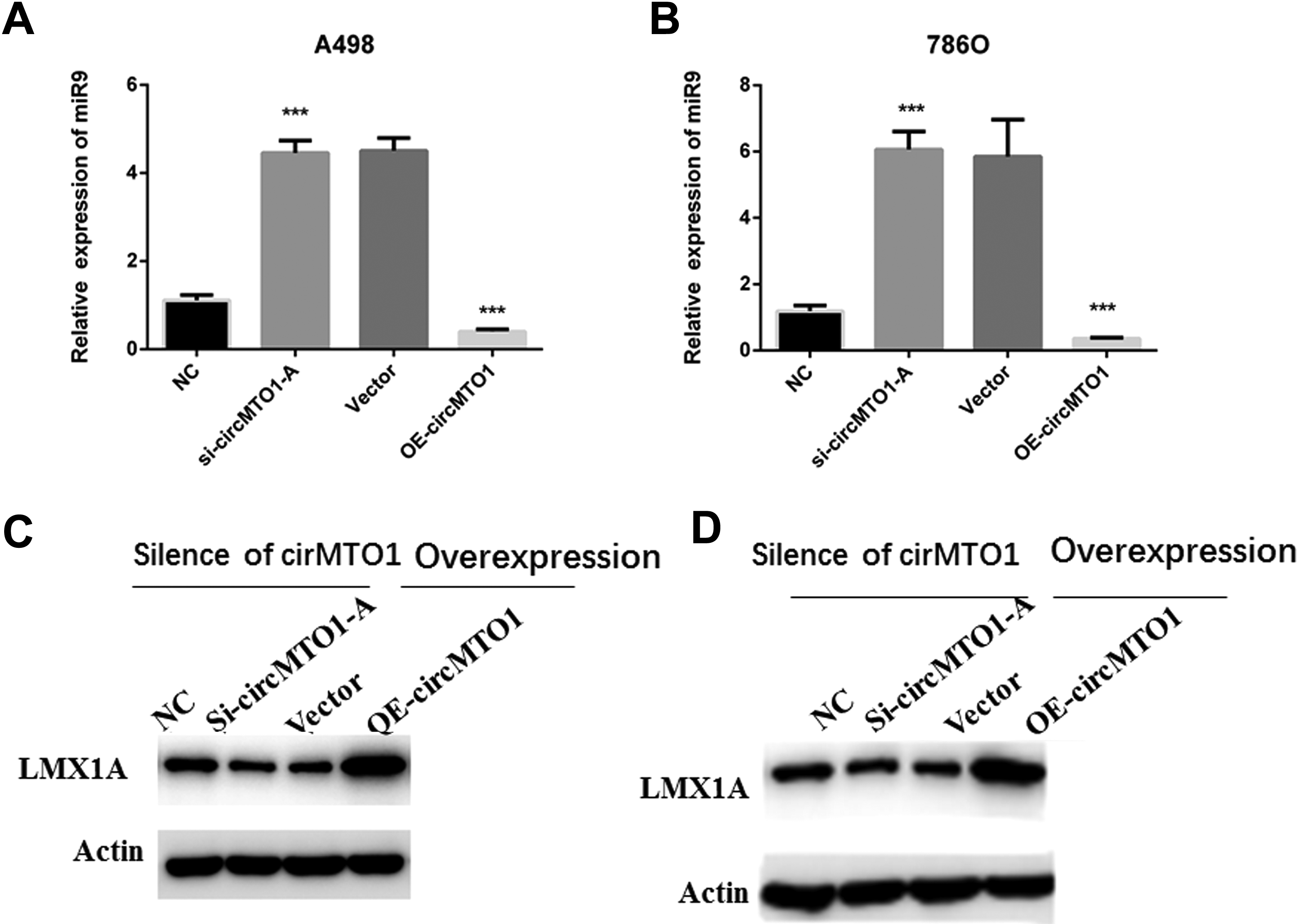
Circular mitochondrial translation optimization 1 homologue (circMTO1) decreased miR9 level and increased LMX1A protein level. A, CircMTO1 overexpression plasmids and vector plasmids were transfected in si-circMTO1 A498 cells. Quantitative real-time polymerase chain reaction (qRT-PCR) was carried out to identify the expression of miR9. B, CircMTO1 overexpression plasmids and vector plasmids were transfected in si-circMTO1 786-O cells. qRT-PCR was carried out to identify the expression of miR9. C, CircMTO1 overexpression plasmids and vector plasmids were transfected in si-circMTO1 A498 cells. Western blot was used to identify the protein level of LMX1A. D, CircMTO1 overexpression plasmids and vector plasmids were transfected in si-circMTO1 786-O cells. Western blot was used to identify the protein level of LMX1A.
Circular MTO1 Suppresses RCC Growth by Decreasing miR-9 and Upregulation of P21
In the further study, we carried out the following experiments to identify whether circMTO1 regulated the LMX1A through miR9. In A498 cells, transfection of miR9 mimics could also reduce the expression of LMX1A in cells with high expression of circMTO1 (Figure 6A). To confirm circMTO1/miR9/LMX1A signal pathway, we carried out the following experiment. We used miR9 inhibitor to treat si-circMTO1 A498 cells. The results showed that inhibition of miR9 could effectively rescue the circMTO1 silence-induced reduction of LMX1A expression (Figure 6B). Next, we investigated the function of circMTO1/miR9/LMX1A in RCC progression. CCK8 assay showed that silence of circMTO1 could promote the cancer growth, while inhibition of miR9 or overexpression of LMX1A could block the circMTO1 silence-induced proliferation suppression (Figure 6C). Wound assay and invasion Transwell assay were used to identify the influence on migration and invasion. The data showed that miR9 inhibition and LMX1A overexpression could block the suppression of cancer metastasis induced by circMTO1 silence (Figure 6D). These results suggest that circMTO1 may exert its antitumor effect through protecting LMX1A from downregulation by miR-9.

Circular mitochondrial translation optimization 1 homologue (circMTO1)/miR7/LMX1A pathway suppress the renal cell carcinoma (RCC) progression. A, A498 cells were treated with circMTO1 small-interfering RNA (siRNAs) or miR9 mimics. Western blot was used to identify the LMX1A protein level. B, A498 cells were transfected with circMTO1 siRNAs and then treated with miR9 inhibitors. Western blot was used to identify the expression of LMX1A. C, circMTO1 was silenced in A498 cancer cells. The si-circMTO1 cells were treated with miR9 inhibitor or LMX1A expression plasmids. CCK8 assay was carried out to measure the cell growth at 72 hours. D, Wound heal and invasion assay were carried out in the indicated cell lines to identify the metastasis of cancer cells.
Discussion
The function of circRNAs in cancer progression has attracted much attention currently. Because their expression and function in RCC development are still largely elusive, we investigate the circular RNA in RCC cell lines.
It has been reported that circMTO1 could play tumor inhibitory roles in HCC. 9 As circRNAs could regulate the oncogenic gene or tumor suppressive genes expression through different downstream molecular due to the different types of cancer or even different stages of cancer, 20 we want to figure out the effects of circMTO1 in RCCs.
At present, it is widely known that pre-mRNA could be transcribed into linear ncRNAs, but in fact, pre-mRNA can also be nonlinearly spliced into circRNA. 21 Circular MTO1 is nonlinearly spliced from the MTO1 pre-mRNA. There is no research reported whether circMTO1 influences the level of the linear transcript mRNA. The correlation between circMTO1 and linear MTO1 needs more investment.
In our research, we investigate the function of circMTO1 by overexpression and gene silence. The results showed that overexpression of circMTO1 could suppress the cancer growth and metastasis ability, meanwhile silence of circMTO1 promoted the cancer growth and enhanced metastasis ability (Figures 2 and 3). From the 2 sides, we confirmed that circMTO1 could suppress the progression in RCC.
The most common function for circRNAs is acting as miRNA sponge then forming the circRNA–miRNA–target gene mRNA axis. The deregulation of this axis may cause various diseases including cancer. 9 In our study, we first found the circMTO1–miR9–LMX1A axis was responsible for the RCC progression.
The results showed that silence of circMTO1 leaded to the upregulation of miR9, and the effects of si-circMOT1 were blocked by the miR9 inhibitor, indicating a negative regulatory relationship between circMTO1 and miR9. Additionally, si-cirMTO1 suppressed the LMX1A protein level which was mediated by miR9. The research reported that p21 was the target of miR9 in various cancer. 9,22,23 In our research, we also tested the expression of p21, but we did not find significant changes in p21 protein levels. We screened the possible target gene by Western blot. LMX1A protein level increased with overexpression of circMTO1 and decreased in accordance with the silence of circMTO1.
LIM homeobox transcription factor 1, alpha (LMX1A) is downregulated in human gastric cancer (GC), functioning as a tumor suppressor. 23 It has also been reported that hypermethylation-mediated reduction of LMX1A expression in GC. 24 In our research, we found that circMTO1 could regulate the protein level of LMX1A, and the results suggested that circMTO1 could be responsible for LMX1A regulation.
What’s more, we found that miR223 decreased when circMTO1was overexpressed, while miR223 increased when circMTO1 was silenced. The data suggested that circMOT1 could also be a sponge for miR223. The result needs more experiments to confirm, and we will carry more experiments to verify.
In our research, we investigated the function of circMTO1/miR9/LMX1A in RCC. Circular MTO1 could suppress the RCC progression by increasing the LMX1A protein level. CircMTO1/miR9/LMX1A axis could be a potential target for RCC therapy.
Footnotes
Authors’ Note
Our experiments did not involve patient and animal experiments.
Acknowledgments
Thanks to all the authors.
Declaration of Conflicting Interests
The author(s) declared no potential conflicts of interest with respect to the research, authorship, and/or publication of this article.
Funding
The author(s) received no financial support for the research, authorship, and/or publication of this article.
