




Abstract
Objective:
This study aimed to investigate the effect of circular RNA itchy E3 ubiquitin protein ligase on cell proliferation and apoptosis and to explore its target micro-RNAs in prostate cancer cells.
Methods:
Circular RNA itchy E3 ubiquitin protein ligase expression in human prostate cancer cells and normal prostate epithelial cells was determined by real time-quantitative polymerase chain reaction assay. Circular RNA itchy E3 ubiquitin protein ligase overexpression plasmids (circular RNA itchy E3 ubiquitin protein ligase(+) group and control overexpression plasmids group were transfected with PC-3 cells. Rescue experiment was performed by transfection of circular RNA itchy E3 ubiquitin protein ligase overexpression and micro-197 overexpression plasmids (circular RNA itchy E3 ubiquitin protein ligase overexpression plasmids/micro RNA (+) group) into PC-3 cells. Cell Counting Kit-8 and annexin V/propidium iodide assays were conducted to evaluate cell proliferation and apoptosis, respectively. Western blot was performed to determine the expressions of apoptotic-related markers.
Results:
Circular RNA itchy E3 ubiquitin protein ligase expression was decreased in DU 145, 22RV1, VCaP, and PC-3 cells compared to RWPE cells. In PC-3 cells, cell proliferation rate was reduced in circular RNA itchy E3 ubiquitin protein ligase overexpression plasmids group compared to control overexpression plasmids group at 48 hours and 72 hours. Cell apoptosis rate was elevated in circular RNA itchy E3 ubiquitin protein ligase overexpression plasmids group compared to control overexpression plasmids group at 48 hours, and Western blot showed the similar results. Micro RNA-197 but not micro RNA-31 or micro RNA-432 was the target micro-RNA of circular RNA itchy E3 ubiquitin protein ligase. In rescue experiments, cell proliferation rate was elevated, but apoptosis rate was reduced in circular RNA itchy E3 ubiquitin protein ligase overexpression plasmids/micro RNA (+) group compared to circular RNA itchy E3 ubiquitin protein ligase overexpression plasmids group, indicating that circular RNA itchy E3 ubiquitin protein ligase upregulation inhibited cell proliferation but promoted apoptosis through downregulating micro RNA-197.
Conclusion:
Circular RNA itchy E3 ubiquitin protein ligase upregulation suppresses cell proliferation but promotes apoptosis through targeting micro RNA-197 in prostate cancer. Our study may provide a new insight for the treatment of prostate cancer.
Keywords
Introduction
Prostate cancer is the most common noncutaneous cancer in men worldwide, which is diagnosed in approximately 1 600 000 cases and results in 366 000 deaths annually. 1,2 Although surgery could be curative for patients with prostate cancer at early stage and their 5-year survival rate is above 90%, approximately one-third of these patients would develop biochemically recurrent disease. 3,4 For solving this situation, androgen deprivation therapy is one of the most common and effective treatment for biochemically recurrent prostate cancer, whereas there is still high risk for these patients to develop castration-resistant prostate cancer, which is often accompanied with metastasis and even threatens life. 3,5 Therefore, exploring the underlying mechanisms that drive the initiation and progression of prostate cancer is of great importance for improving the management and prognosis in patients with prostate cancer.
Circular RNAs (circRNAs), which is a type of endogenous noncoding RNA that is formed by a covalently closed loop, play key roles in many biological processes including cell cycle, cell apoptosis, cell vascularization, cell invasion, and cell metastasis. 6 –12 Emerging studies indicate that circRNAs are differentially expressed in multiple cancers and are able to serve as potential regulators in oncogenesis or cancer progression. 13,14 As one of the most important circRNAs, circular RNA itchy E3 ubiquitin protein ligase (circ-ITCH), which locates on chromosome 20q11.22 and spans exons 6-13 of gene itchy E3 ubiquitin protein ligase (ITCH), is investigated in some previous studies that reveal its downregulation in various cancer cell lines such as colorectal cancer, esophageal squamous cell carcinoma, lung cancer, and hepatocellular carcinoma, and it is disclosed to have tumor-suppressive effect in these cancers. 6,15 –17 Furthermore, a few studies display that ITCH (the parent gene of circ-ITCH) is closely related to the initiation and progression of prostate cancer. 18,19 Taken together, we hypothesized that circ-ITCH might also participate in the pathology of prostate cancer, while little is known about the role of circ-ITCH in prostate cancer. 6,15 –17 Thus, we conducted this study to investigate the effect of circ-ITCH on cell proliferation and cell apoptosis and to explore its target micro-RNA (miRNAs) in prostate cancer cells.
Materials and Methods
Preparation of Cell Lines
Human prostate cancer cell lines including DU 145, 22RV1, VCaP, and PC-3 as well as human normal prostate epithelial cell line RWPE-1 were purchased from Cell Bank of Type Culture Collection of Chinese Academy of Sciences (Shanghai, China).
Cells Culture
All cells were cultured in incubators under 95% air and 5% CO2 at 37°C. In brief, DU 145 cells were cultured in 90% minimum Eagle medium (Gibco, California, USA) and 10% fetal bovine serum (FBS; Gibco, California, USA), 22RV1 cells were cultured in 80% Roswell Park Memorial Institute 1640 Medium (Gibco,, California, USA) and 20% FBS (Gibco, California, USA); VCaP cells were cultured in 90% Dulbecco modified Eagle medium (Gibco, California, USA) and 10% FBS (Gibco, California, USA); PC-3 cells were cultured in 90% Ham F-12 Nutrient Mix medium and 10% FBS (Gibco, California, USA); and RWPE-1 cells were cultured in Keratinocyte Serum Free Medium Kit (Invitrogen, California, USA).
Measurement of Circ-ITCH Expression and miR-197 Expression in Prostate Cancer Cell Lines
Expression of circ-ITCH and miR-197 in human prostate cancer cell lines including DU 145, 22RV1, VCaP, and PC-3 as well as human normal prostate epithelial cell line RWPE-1 was measured using real-time quantitative polymerase chain reaction (RT-qPCR).
The Effect of Circ-ITCH Upregulation on PC-3 Cell Proliferation and Apoptosis
The Circ-ITCH overexpression plasmids (Circ-ITCH(+) group) and control overexpression plasmids (NC(+) group; Shanghai GenePharma Bio-Tech Company, Shanghai, China) were transfected with PC-3 cells, and then circ-ITCH expression was measured by RT-qPCR at 24 hours. Subsequently, cell proliferation ability was detected using Cell Counting Kit-8 (CCK-8; Dojindo, Kyushu, Japan) according to the instructions of manufacturer at 0, 24, 48, and 72 hours after plasmids transfection. Then, cell apoptosis rate was detected using annexin V (AV) apoptosis detection kit with propidium iodide (PI; Sigma, Louisiana, USA) according to the instructions of manufacturer at 48 hours after plasmid transfection. Finally, expressions of cleaved-caspase 3 (C-Caspase 3) and Bcl-2 were measured by Western blot at 48 hours after plasmids transfection to validate the effect of circ-ITCH on cell apoptosis.
Target MiRNAs Validation
Potential target miRNAs of circ-ITCH in prostate was predicted using Circular RNA Interactome Database (https://circinteractome.nia.nih.gov/) and miRanda Database (http://www.microrna.org/microrna/home.do), and 3 candidate miRNAs (miR-197, miR-31, and miR-432) were chosen to validate after circ-ITCH overexpression plasmids transfection in PC-3 cells by RT-qPCR. Then, control overexpression plasmids were transfected with PC-3 cells as NC(+) group, circ-ITCH overexpression plasmids were transferred into PC-3 cells as Circ-ITCH (+) group, and circ-ITCH overexpression and miR-197 overexpression plasmids (Shanghai GenePharma Bio-Tech Company, Shanghai, China) were transferred into PC-3 cells as Circ-ITCH(+)/miR(+) group. At 24 hours after transfection, miR-197 and circ-ITCH expressions were measured by RT-qPCR. Subsequently, cell proliferation ability was detected using CCK-8 kit (Dojindo, Kyushu, Japan) according to the instructions of manufacturer at 0, 24, 48, and 72 hours after plasmids transfection. Then, cell apoptosis rate was detected using AV apoptosis detection kit with PI (Sigma, Louisiana, USA) according to the instructions of manufacturer at 48 hours after plasmids transfection. Finally, expression of C-Caspase3 and Bcl-2 was measured by Western blot at 48 hours after plasmids transfection to validate the attenuated effect of miR-197 overexpression on cell functions affected by circ-ITCH overexpression.
Process of Western Blot
Radioimmunoprecipitation assay buffer of 1 mL (Sigma, Louisiana, USA) was added to each group of cells on ice for 30 minutes and shook every 5 minutes for complete pyrolysis, followed by centrifugation at 16 000 rpm under freezing condition. After acquiring the supernatant, the total protein concentration was assessed by bicinchoninic acid kit (Pierce Biotechnology, Illinois, USA). Then, thermal denaturation was performed at 98°C for 5 minutes, and 20 μg proteins were added to sodium dodecyl sulfate polyacrylamide gel electrophoresis (Thermo, Shanghai, China). After electrophoresis was completed, proteins were transferred to polyvinylidene fluoride membranes membrane (Millipore, Massachusettsm, USA). The membranes were blocked with 5% skim milk at 37°C for 1 hour and subsequently incubated with the corresponding primary antibody overnight at 4°C and further incubated with the appropriate horseradish peroxidase-conjugated secondary antibody at room temperature for 2 hours. Finally, the bands were visualized by the Novex ECL Chemiluminescent Substrate Reagent Kit (Invitrogen, Shanghai, China). Antibodies used in Western blot are listed in Table 1.
Antibodies Used in Western Blot.

Abbreviations: HRP, horseradish peroxidase; GAPDH, glyceraldehyde-3-phosphate dehydrogenase; mAb, monoclonal antibody.
Process of RT-qPCR
Expression of Circ-ITCH was determined by RT-qPCR. The RT-qPCR process of circ-ITCH was as follows: First, total RNA was extracted by TRIzol Reagent (Invitrogen); second, the linear RNA in each sample of total RNA (1 μg) was digested by RNase R (Epicentre, Wisconsin, USA), and then the reverse transcription to complementary DNA (cDNA) using PrimeScript RT reagent Kit (Takara, Japan) was performed; third, RT-qPCR was conducted by TB Green Fast qPCR Mix (Takara), and qPCR amplification was conducted at 95°C for 3 minutes, followed by 40 cycles of 95°C for 5 seconds, 61°C for 10 seconds, and then 72°C for 30 seconds. The diminishment of linear RNA was confirmed by agarose gel electrophoresis. The RT-qPCR processes of miRNAs, glyceraldehyde-3-phosphate dehydrogenase (GAPDH), and U6 were as follows: First, total RNA was extracted by TRIzol Reagent (Invitrogen); second, reverse transcription to cDNA using PrimeScript RT reagent Kit (Takara) was performed with total RNA (1 μg) from each sample; third, qPCR was performed by TB Green Fast qPCR Mix (Takara), and qPCR amplification was performed at 95°C for 3 minutes, followed by 40 cycles of 95°C for 5 seconds, 61°C for 10 seconds, and then 72°C for 30 seconds. Finally, the results of RT-qPCR were calculated by 2−ΔΔ C t formula. Meanwhile, GAPDH and U6 were used as the internal references for circ-ITCH and miRNAs, respectively. The primers used in RT-qPCR are listed in Table 2.
Primers Applied in qPCR.

Abbreviations: circ ITCH, circular RNA itchy E3 ubiquitin protein; GAPDH, glyceraldehyde 3-phosphate dehydrogenase; miR, micro RNA; qPCR, quantitative polymerase chain reaction.
Statistics
SPSS Software version 22.0 (IBM, New York, USA) and GraphPad Software version 6.01 (GraphPad) were used for statistics in this study. Data were mainly presented as mean ± standard deviation. Comparison among groups was determined by one-way analysis of variance test followed by Dunnett multiple comparisons test. Comparison between the 2 groups was determined by t test. P < .05 was considered significant.
Results
Comparison of Circ-ITCH Expression Between Human Prostate Cancer Cell Lines and Human Normal Prostate Epithelial Cell Line
Compared to human normal prostate epithelial RWPE-1 cells, expression of circ-ITCH was decreased in human prostate cancer cells including DU 145 (P < .01), 22RV1 (P < .05), VCaP (P < .01), and PC-3 cells (P < .001; Figure 1). Besides, the numerically lowest circ-ITCH expression was observed in PC-3 cells; thus, we chose PC-3 cells to perform the subsequent assays.

Circular RNA itchy E3 ubiquitin protein expression in human prostate cancer cells and human normal prostate epithelial cells. Circular RNA itchy E3 ubiquitin protein expression was lower in various human prostate cancer cells including DU 145, 22RV1, VCaP, and PC-3 cells compared to RWPE cells. Comparison between 2 groups was assessed by one-way analysis of variance test followed by Dunnett multiple comparisons test. P < .05 was considered significant. *, P < .05; **, P < .01; ***, P < .005.
Effect of Circ-ITCH on Cell Proliferation and Cell Apoptosis in PC-3 Cells
After transfection with circ-ITCH overexpression plasmids at 24 hours, circ-ITCH expression was remarkably higher in Circ-ITCH (+) group compared to NC (+) group, suggesting the successful transfection (Figure 2). Moreover, cell proliferation rate was reduced in Circ-ITCH (+) group compared to NC (+) group at 48 hours (P < .05) and 72 hours (P < .01; Figure 3A), and cell apoptosis rate was elevated in Circ-ITCH (+) group compared to NC (+) group at 48 hours (P < .001; Figure 3B and C). Furthermore, expression of apoptotic protein C-Caspase 3 was increased in Circ-ITCH (+) group than that in NC (+) group, whereas antiapoptotic protein BCL 2 expression was decreased in Circ-ITCH (+) group compared to NC (+) group (Figure 3D). These data suggested that circ-ITCH upregulation repressed cell proliferation but enhanced cell apoptosis in PC-3 cells.

Circular RNA itchy E3 ubiquitin protein (Circ-ITCH) expression after transfection. Circular RNA itchy E3 ubiquitin protein expression was elevated in Circ-ITCH (+) group compared to NC (+) group after transfection with circ-ITCH overexpression plasmids at 24 hours. Comparison between 2 groups was assessed by t test. P < .05 was considered significant. ***, P < .005.

Cell Counting Kit-8, AV/PI, and Western blot assays. Compared to NC (+) group, cell proliferation rate was decreased in Circ-ITCH (+) group at 48 and 72 hours (A), whereas cell apoptosis rate was increased in Circ-ITCH (+) group at 48 hours (B-C). Besides, C-Caspase 3 expression was elevated, while BCL 2 expression was reduced in Circ-ITCH (+) group compared to NC (+) group at 48 hours (D). Comparison between 2 groups was assessed by t test. AV/PI indicates Annexin V apoptosis detection kit with propidium iodide; Circ-ITCH, circular RNA itchy E3 ubiquitin protein ligase; C-Caspase3, Cleaved-Caspase3. P < .05 was considered significant. *, P < .05; **, P < .01; ***, P < .005.
Expressions of Candidate Target miRNAs of Circ-ITCH
Assessment of candidate target miRNAs of circ-ITCH was performed to investigate the underlying targets of circ-ITCH in prostate cancer (Figure 4), and we found that miR-197 expression (P < .01; Figure 4A) was reduced, while expression of miR-31 (Figure 4B) and miR-432 (Figure 4C) was undifferentiated in Circ-ITCH (+) group compared to NC (+) group, indicating that it was miR-197 but not miR-31 or miR-432 that was the target miRNA of circ-ITCH in PC-3 cells.
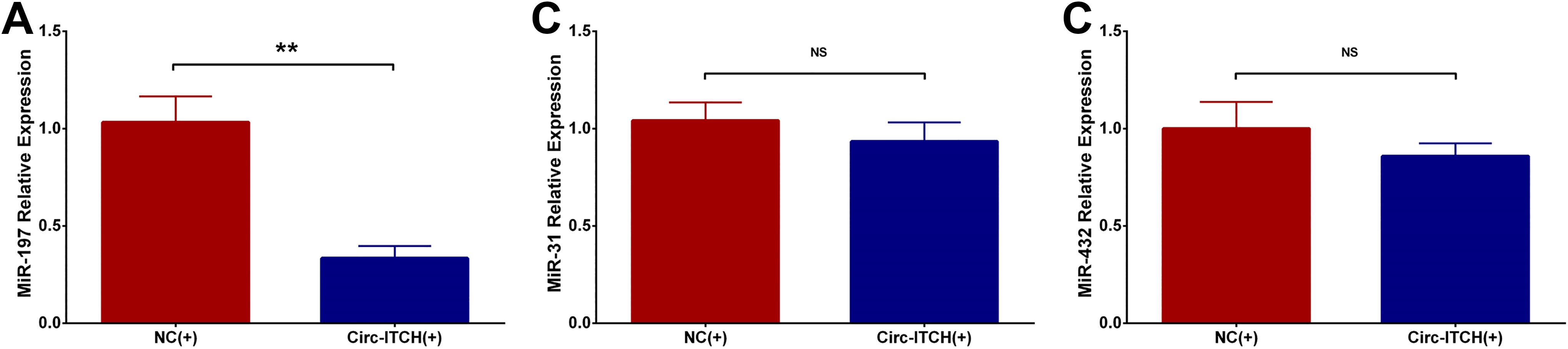
Detection of target miRNAs. MiR-197 expression (A) was decreased, while miR-31 expression (B) and miR-432 (C) expression were undifferentiated in Circ-ITCH (+) group compared to NC (+) group. Comparison between 2 groups was assessed by t test. Circ-ITCH indicates circular RNA itchy E3 ubiquitin protein ligase. P < .05 was considered significant. **, P < .01.
Rescue Experiments
We conducted rescue experiments to explore whether circ-ITCH regulated PC-3 cells via targeting miR-197. First, we detected the miR-197 expression in various prostate cancer cell lines, and we found miR-197 expression was elevated in prostate cancer cell lines including DU 145 (P < .001), 22RV1 (P < .05), VCaP (P < .001), and PC-3 cells (P < .001) compared to human normal prostate epithelial RWPE-1 cells (Supplementary Figure 1). After circ-ITCH overexpression and miR-197 overexpression plasmids were transferred into PC-3 cells, the RT-qPCR assay disclosed that miR-197 expression was lower in Circ-ITCH(+) group compared to NC (+) group (P < .001), while it was elevated in Circ-ITCH (+)/miR (+) group compared to Circ-ITCH (+) group (P < .001; Figure 5A). Besides, circ-ITCH expression was increased in Circ-ITCH(+) group compared to NC (+) group (P < .001), but it was undifferentiated in Circ-ITCH (+)/miR (+) group compared to Circ-ITCH (+) group (Figure 5B). Subsequently, CCK-8 assay displayed that cell proliferation rate was decreased in Circ-ITCH(+) group compared to NC(+) group at 48 hours (P < .01) and 72 hours (P < .01), but it was increased in Circ-ITCH (+)/miR (+) group compared to Circ-ITCH (+) group at 48 hours (P < .05) and 72 hours (P < .05; Figure 6A). Moreover, AV/PI assay disclosed that cell apoptosis rate was elevated in Circ-ITCH (+) group compared to NC (+) group at 48 hours (P < .001), and it was decreased in Circ-ITCH (+)/miR (+) group compared to Circ-ITCH (+) group at 48 hours (P < .01; Figure 6B and C). Additionally, apoptotic protein C-Caspase 3 expression was increased, but antiapoptotic protein Bcl 2 expression was reduced in Circ-ITCH (+) group compared to NC (+) group. Meanwhile, C-Caspase 3 expression was lower but Bcl 2 expression was enhanced in Circ-ITCH (+)/miR (+) group compared to Circ-ITCH (+) group at 48 hours (Figure 6D). These data suggest that circ-ITCH upregulation inhibited cell proliferation and promoted cell apoptosis through downregulating miR-197 in PC-3 cells.
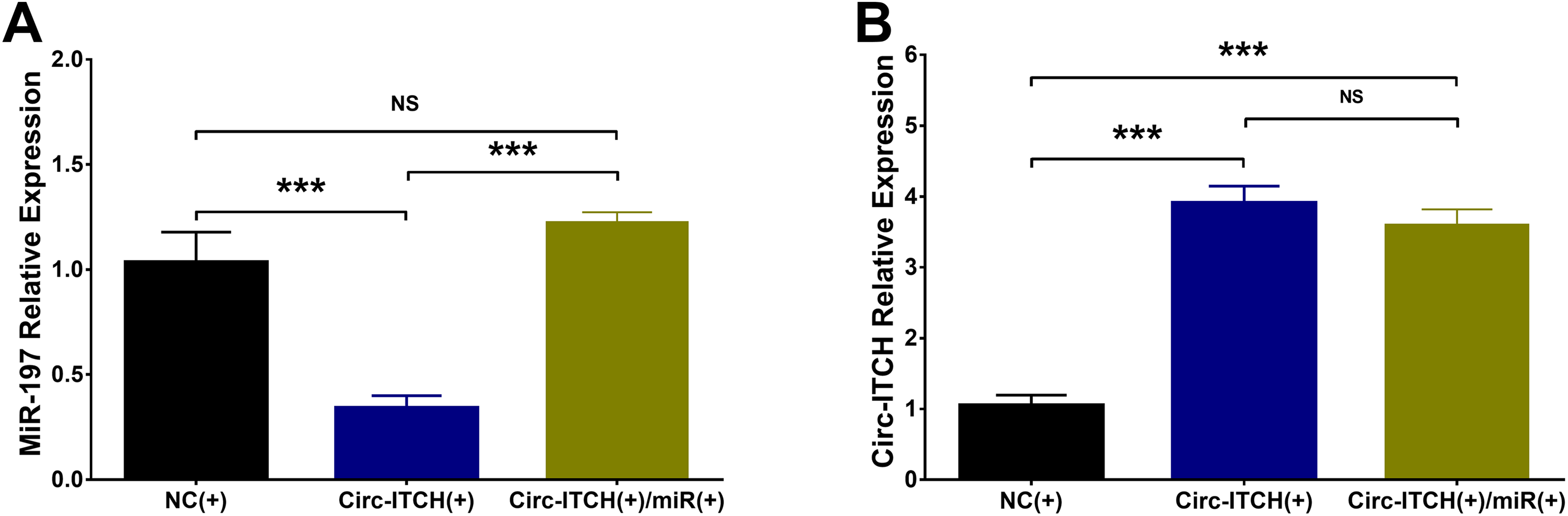
Expressions of miR-197 and circ-ITCH after transfection. The miR-197 expression was lower in Cicr-ITCH (+) group compared to NC (+) group but higher in Circ-ITCH (+)/miR (+) group compared to Circ-ITCH (+) group (A). Circular RNA itchy E3 ubiquitin protein expression was higher in Cicr-ITCH (+) group compared to NC (+) group but no difference of circ-ITCH expression was found between Circ-ITCH (+)/miR (+) group and Circ-ITCH (+) group (B). Comparison between 2 groups was assessed by t test. Circ-ITCH indicates circular RNA itchy E3 ubiquitin protein ligase. P < .05 was considered significant. ***, P < .001; NS, no significance.

Cell counting kit-8 assay, AV/PI assay, and Western blot assay in rescue experiments. Cell proliferation rate was lower in Circ-ITCH (+) group compared to NC (+) group at 48 and 74 hours, but it was elevated in Circ-ITCH (+)/miR (+) group compared to Circ-ITCH (+) group at 48 and 72 hours (A). Cell apoptosis rate was raised in Circ-ITCH (+) group compared to NC (+) group but lower in Circ-ITCH (+)/miR (+) group compared to Circ-ITCH (+) group at 48 hours (B and C). Expression of apoptosis marker C-Caspase 3 was decreased in Circ-ITCH (+)/miR (+) group compared to Circ-ITCH (+) group at 48 hours, while antiapoptosis marker Bcl 2 expression was enhanced (D). Comparison between two groups was assessed by t test. AV/PI indicates Annexin V apoptosis detection kit with propidium iodide; Circ-ITCH, circular RNA itchy E3 ubiquitin protein ligase; C-Caspase3, Cleaved-Caspase3; miR, micro RNA. P < .05 was considered significant. *, P < .05; **, P < .01; ***, P < .005; NS, no significance.
Discussion
In this study, we found that (1) circ-ITCH expression was lower in various human prostate cancer cells compared to human normal prostate epithelial cells, and circ-ITCH upregulation inhibited cell proliferation but enhanced cell apoptosis in PC-3 cells, and (2) rescue experiments identified that circ-ITCH upregulation repressed cell proliferation and promoted cell apoptosis via downregulating miR-197 in PC-3 cells.
Circular RNAs, which are a class of noncoding RNAs with covalently closed continuous loop, are initially misread into splicing errors that originate from splicing artifacts or gene rearrangements, whereas they are recently found to be common in mammalian cells and are crucial mediators in multiple biological processes, such as the sponge of miRNA, the regulation in transcriptional process, and interaction with RNA-binding proteins. 17,20 –26 Regarding the role of circRNAs in prostate cancer, some previous investigations have been performed. 27 –29 For instance, circ-SMARCA5 acts as an oncogene in prostate cancer through enhancing cell proliferation and inhibiting cell apoptosis. 27 In addition, a previous study discloses that circ-Mus musculus myosin light chain kinase (MYLK) promotes the cell proliferation, cell invasion, and cell migration but inhibits cell apoptosis by targeting miR-29a in prostate cancer cells. Meanwhile, this 28 and another study displays that circ_102004 overexpression activates EPK, JNK, Hedgehog, and Wnt/β-catenin signaling pathway and thereby facilitates cell proliferation, migration, and invasion in prostate cancer. 29 Thus, all these previous studies indicate that circRNAs might play crucial roles in the etiology of prostate cancer.
Circular RNA-ITCH, which is aligned in a sense orientation to the protein-coding gene ITCH, has effects on cancer cell activities such as cell proliferation and apoptosis according to some previous studies. 6,13,15,17 For example, a previous study displays that circ-ITCH represses the ability of cell migration but promotes cell apoptosis in bladder cancer cells. 13 Also, the cellular impact of circ-ITCH has been observed in papillary thyroid cancer cells, whose proliferation is inhibited but apoptosis is enhanced by circ-ITCH. 30 Moreover, it is also revealed that circ-ITCH influence diverse cell activities by mediating multiple genes or signaling pathways. For example, circ-ITCH acts as a tumor suppressor through sponging miR-124 and enhancing linear ITCH expression in glioma, and another study reveals that circ-ITCH inhibits disease progression through sponging miR-7 and miR-24 in bladder cancer. 13,31 These studies emphasize the influence of circ-ITCH on sponging some carcinogenic miRNAs. Besides, circ-ITCH results in inhibition of canonical Wnt pathway via downregulating phosphorylated Dvl3 and suppresses the oncogene c-myc expression, thereby represses cell proliferation in several cancers including lung cancer, esophageal squamous cell carcinoma, and colorectal cancer. 15 –17,32,33 These previous studies reveal the tumor-suppressive effect of circ-ITCH in several cancers, while little is known about the underlying mechanism of circ-ITCH in prostate cancer. In order to address this problem, we assessed circ-ITCH expression in various human prostate cancer cells and human normal prostate epithelial cells, which revealed that circ-ITCH expression was lower in human prostate cancer cells than that in normal prostate epithelial cells. Moreover, we conducted CCK-8 assay and AV/PI assay to investigate the effect circ-ITCH on cell proliferation and cell apoptosis, and we found that circ-ITCH upregulation inhibited cell proliferation but promoted cell apoptosis in PC-3 cells. Besides, the detection of circ-ITCH was performed 24 hours after transfection, and the expression of transfected circ-ITCH did not reach the maximum, while the expression of circ-ITCH after transfection in our study remarkably increased compared to the control, indicating the successful transfection of circ-ITCH. These results showed that circ-ITCH played a tumor-suppressive role in prostate cancer, which might provide evidence to deeper understanding in the mechanism of circ-ITCH in prostate cancer.
Increasing evidences have identified miRNAs as important regulators in many biological processes of cancers including prostate cancer. 34,35 With application of CircuLar RNA Interactome Database (https://circinteractome.nia.nih.gov/) and miRanda Database (http://www.microrna.org/microrna/home.do), potential target miRNAs of circ-ITCH in prostate were predicted. Furthermore, we found that 3 of the potential target miRNAs (miR-197, miR-31, and miR-432) were reported to be important regulators involved in the initiation and progression of prostate cancer; thus, we hypothesized that circ-ITCH might exert its functions in prostate cancer cells through regulating these miRNAs. 36 –38 To validate our hypothesis, we detected the effect of circ-ITCH on the expression of miR-197, miR-31, and miR-432, and we observed that only miR-197 expression was decreased by circ-ITCH upregulation, suggesting that miR-197 but not miR-31 or miR-432 was the target miRNA of circ-ITCH in prostate cancer cells. MiR-197, which is transcribed from the genomic region of chromosome 1p13.3, has been identified as a cancerogenic miRNA that is upregulated in several cancers such as lung cancer, pancreatic cancer, and hepatocellular carcinoma. 36,39 –41 A study reveals that miR-197 enhances cell proliferation and drug resistance in ovarian cancer cells through downregulating nemo-like kinase (NLK). 42 Furthermore, miR-197 is also reported to facilitate epithelial–mesenchymal transition and take part in cell invasion as well as cell migration in some previous studies; for instance, a previous study shows that miR-197 induces epithelial–mesenchymal transition and cell invasion via downregulating HIPK2 in lung adenocarcinoma cells. Besides, miR-197 promotes hepatocellular carcinoma cell migration by targeting KAI 1/CD82 and induces pancreatic cancer cell epithelial–mesenchymal transition via targeting p120 catenin. 40,41,43 In prostate cancer, a previous study discloses that miR-197 is overexpressed in castration-resistant prostate cancer, and its overexpression facilitates the disease progression through targeting Ras, Rho, and the SCF complex. 36 Thus, the previous studies show that miR-197 has cancerogenic effects in a variety of cancers, particular in prostate cancer. In this present study, we observed that circ-ITCH upregulation inhibited cell proliferation and enhanced cell apoptosis through targeting miR-197, and these results might contribute to supporting further exploration of mechanisms in prostate cancer, which could shed a light on the utilization of circ-ITCH as potential target in prostate cancer treatment.
In conclusion, circ-ITCH expression is decreased in prostate cancer cells, and its upregulation suppresses cell proliferation but promotes cell apoptosis through targeting miR-197 in prostate cancer. Our study may provide a new insight for the treatment of prostate cancer.
Supplemental Material
Supplementary_Figure_1_-_Added - Upregulation of Circular RNA Itchy E3 Ubiquitin Protein Ligase Inhibits Cell Proliferation and Promotes Cell Apoptosis Through Targeting MiR-197 in Prostate Cancer
Supplementary_Figure_1_-_Added for Upregulation of Circular RNA Itchy E3 Ubiquitin Protein Ligase Inhibits Cell Proliferation and Promotes Cell Apoptosis Through Targeting MiR-197 in Prostate Cancer by Yuan Yuan, Xiaogang Chen and Enying Huang in Technology in Cancer Research & Treatment
Footnotes
Authors' Note
Yuan Yuan and Xiaogang Chen contributed equally to this work.
Declaration of Conflicting Interests
The author(s) declared no potential conflicts of interest with respect to the research, authorship, and/or publication of this article.
Funding
The author(s) received no financial support for the research, authorship, and/or publication of this article.

Supplemental Material
Supplemental material for this article is available online.
Abbreviations
References
Supplementary Material
Please find the following supplemental material available below.
For Open Access articles published under a Creative Commons License, all supplemental material carries the same license as the article it is associated with.
For non-Open Access articles published, all supplemental material carries a non-exclusive license, and permission requests for re-use of supplemental material or any part of supplemental material shall be sent directly to the copyright owner as specified in the copyright notice associated with the article.
