




Abstract
Variant rs7034162 in NFIB was reported to be associated with metastasis of osteosarcoma in European cases with genome-wide significance. Our purpose was to replicate the association of rs7034162 with the metastasis of osteosarcoma in the Chinese population and to further characterize the expression level of NFIB in osteosarcoma tissues. A total of 321 patients were included in this study. Variant rs7034162 was genotyped for each patient using the Taqman genotyping assay. Fifty-two cases of tumor tissues and adjacent normal tissues were collected during surgery. The χ2 test was used to investigate the association of rs7034162 with the metastasis of osteosarcoma. The Student t test was used to compare the gene expression between patients with metastasis and those without metastasis. The messenger RNA expression level of NFIB was then compared among different genotypes of rs7034162 with 1-way analysis of variance test. Ninety-three patients were found to have metastasis. Patients with genotype AA had remarkably higher incidence of metastasis than those with genotype TT (34.4% vs 17.1%, P = .002). Patients with metastasis were found to have significantly higher rate of allele A than those without metastasis (53.2% vs 43.9%, P = .03). The messenger RNA expression of NFIB was significantly lower in tumor tissues of patients with metastasis than in those without metastasis (0.00035 ± 0.00017 vs 0.00063 ± 0.0025, P < .001). Compared to patients with genotype TT, those with genotype AA had remarkably decreased expression of NFIB (0.00033 ± 0.0014 vs 0.00067 ± 0.00037, P = .01). Single-nucleotide polymorphism rs7034162 was associated with metastasis of osteosarcoma in the Chinese population possibly via downregulation of NFIB. Further network analyses revealing the related pathways can help elucidate the molecular mechanism of distant metastasis in patients with osteosarcoma.
Keywords
Introduction
Osteosarcoma (OS) is a common primary malignant bone tumor with high mortality rates especially in the teenagers. 1 It is featured by the high rate of metastasis to distant sites, which acts as the main cause of death for the majority of patients with OS. 2,3 For patients with OS, the lung is the most common metastatic site. It was estimated that approximately 20% of the patients could have pulmonary metastasis at the initial visit. 2 For patients having OS without metastasis, the 5-year overall survival rate ranged from 60% to 70%. 4,5 By contrast, patients with metastasis were reported to have a very poor prognosis with the 5-year overall survival rate decreased to 11% to 29%. 6,7 To date, there has been debate over factors associated with primary metastasis of OS, including age, large tumor size, and tumor location. 8,9 A large international multicenter study of OS reported that none of abovementioned clinical factors was associated with metastasis. 10 Therefore, it is of critical importance to determine the effective biological markers associated with early prognosis. Moreover, identification of key genes and pathways leading to metastasis of OS can facilitate the development of more effective therapeutic targets.
It has been widely accepted that genetic factors contribute to the tumorigenesis of OS. 11,12 The emerging findings of susceptible loci associated with OS have provided insight into the diagnosis of this disease. Recently, the relationship between genetic variation and susceptibility to metastasis has been revealed in patients with OS. 13 -15 Huang et al 14 reported NAT2 polymorphisms are associated with OS risk and metastasis in Chinese population. Mirabello et al 15 performed a genome-wide association study (GWAS) on 935 patients with OS to determine the common germline genetic variation associated with the risk of metastasis. The single-nucleotide polymorphism (SNP) rs7034162 in NFIB was found to be significantly associated with metastasis in European cases with OS, which was successfully replicated in patients of African and Brazilian ancestry. Interestingly, functional role of this novel metastasis-associated locus was confirmed by subsequent in vitro experiments. 15
Considering the divergence regarding genetic architecture among different populations, replication studies are warranted to validate the role of NFIB variant in the metastasis of OS. In this study, we retrospectively reviewed a cohort of patients with OS treated in our clinic centers. The primary purpose of this study was to replicate the association of rs7034162 with the metastasis of OS in the Chinese population and to further characterize the expression level of NFIB in OS tissues.
Methods
Patients
A total of 352 patients with OS who received treatment in our centers between January 2006 and May 2018 were retrospectively reviewed. The diagnosis of OS was determined through a round-table discussion by a multiple disciplinary team comprised of a senior surgeon of bone tumor, a radiological specialist, and a pathologist. The inclusion criteria were as follows: (1) receiving no prior medical treatment before initial visit and (2) having completed the neoadjuvant chemotherapy. In all, 321 patients were finally included in the study. Six hundred age-matched healthy controls were recruited during routine physical exanimations. Demographic data were collected from the medical record of the patients, including age, gender, tumor location, presence of metastasis, metastatic site, histologic differentiation, and Enneking stages. This study was approved by the Ethics Committee of the Hospital. All the participants have signed the written informed consent for the collection of blood or tissue samples.
Genotyping Assay
From each patient, 2 mL of peripheral blood was collected and the genomic DNA was extracted with genomic DNA purification kit (Qiagen, Tokyo, Japan). The SNP rs7034162 was genotyped for each patient using the Taqman genotyping assay as described in previous literature. 12 The genotype was designated as AA, AT, or TT for each patient; 20% of samples were randomly sequenced to validate the genotyping results. A concordance rate of 100% was identified.
Tissue Expression of NFIB
Fifty-two cases of tumor tissues and adjacent normal tissues were collected during the surgery, which were then stored at −80°C directly. Extraction of total RNA was performed with a commercial kit (CWBio Co Ltd, Beijing, China). The relative expression of NFIB was quantified by real-time polymerase chain reaction on Roche Light Cycler 480 system (Roche Applied Science, Meylan, France) with the following primer 5′-AAAAAGCATGAGAAGCGAATGTC-3′ and 5′-ACTCCTGGCGAATATCTTTGC-3′. Glyceraldehyde-3-phosphate dehydrogenase was used as the internal control with the following primer 5′-GTCAACGGATTTGGTCTGTATT-3′ and 5′-AGTCTTCTGGGTGGCAGTGAT-3′. The amplification procedures started with an initial denaturation step of 95°C for 10 minutes, followed by 40 amplification cycles at 95°C for 10 seconds, annealing at 60°C for 20 seconds, and elongation at 72°C for 10 seconds. The relative expression of NFIB was normalized using the ΔΔCt method as reported previously. 12
Statistical Analyses
The data analysis was processed with SPSS version 19.0 (SPSS Inc, Chicago, Illinois). The Hardy-Weinberg equilibrium (HWE) test was performed for the controls. The χ2 test was used to investigate the association of rs7034162 with the development and metastasis of OS. The effect of 4 genetic models was examined, including the additive model, codominant model, dominant model, and recessive model. Odds ratio (OR) was calculated using the logistic regression model to evaluate the association. Specifically, values of 1, 2, and 3 were assigned to group with genotype TT, AT, and AA, respectively. The Student t test was used to compare the gene expression between patients with metastasis and those without metastasis. In addition, the messenger RNA (mRNA) expression level of NFIB was compared among different genotypes of rs7034162 with 1-way analysis of variance test. The statistical significance was set at P < .05.
Results
Demographic Data
Baseline characteristics of the patients are summarized in Table 1. For patients with OS, there were 187 males and 134 females, with an average age of 32.1 ± 15.7 years. The patients and the controls had comparable age and gender. Ninety-three patients were confirmed to have metastasis at the initial diagnosis or at the follow-up. Eighty-one patients had pulmonary metastasis, 6 had vertebral metastasis, 3 had hepatic metastasis, and 2 had brain metastasis. Most of the tumor were located in the thigh (42.1%). Fifty-eight (18.1%) patients underwent amputation surgery. One hundred sixty-five (51.4%) patients underwent complete resection of the tumor combined with prosthesis reconstruction. Other clinical features including histologic differentiation and Enneking stages are summarized in Table 1. There was no significant difference regarding age, gender, histologic differentiation, and tumor location between patients with metastasis and those without metastasis (Table 2).
Baseline Characteristics of the Patients.

Abbreviations: N/A, not available; SD, standard deviation.
Comparison of Variables Between Patients With Metastasis and Those Without Metastasis.

Abbreviation: SD, standard deviation.
Association of rs7034162 With the Development and Metastasis of OS
The frequency of rs7034162 in the cases and the controls is summarized in Table 3. The HWE test showed no deviation of genotype distribution in the controls (P > .05). There was no significant difference between the cases and the controls in terms of allele frequency and genotype frequency (46.1% vs 45.1%, P = .54 for allele A; 22.1% vs 19.7%, P = .67 for genotype AA).
Comparison of the Genotype and Allele Frequency of rs7034162 Between the Patients and Controls.

Abbreviation: CI, confidential interval.
The incidence of metastasis was compared among different genotypes to determine whether rs7034162 is associated with the metastasis of OS. As shown in Table 4, patients with genotype AA had remarkably higher incidence of metastasis than those with genotype TT (34.4% vs 17.1%, P = .03). Patients with metastasis were found to have significantly higher rate of allele A than those without metastasis (53.2% vs 43.9%, P = .03), with an OR of 1.46 (95% confidence interval = 1.03-2.05). The results of 4 different genetic models are summarized in Table 4. Statistically significant associations with the metastasis of OS were observed for the additive model, recessive model, and codominant model, respectively.
Association of rs7034162 With the Metastasis of OS.
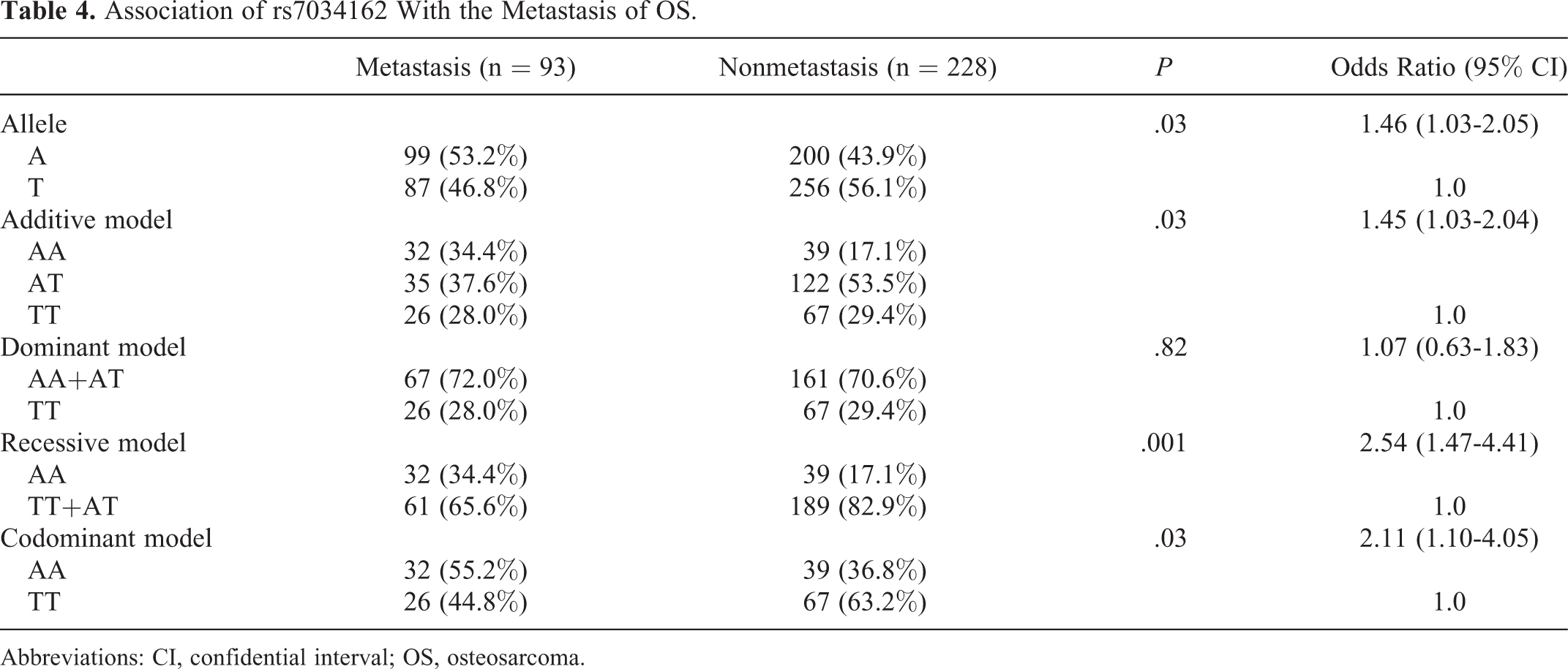
Abbreviations: CI, confidential interval; OS, osteosarcoma.
Expression of NFIB in OS Tissues
For the 52 patients included in the expression analysis, the mean age was 34.3 ± 17.5 years. Eighteen patients were found to have distant metastasis. As shown in Figure 1, the mRNA expression of NFIB was significantly lower in tumor tissues of patients with metastasis than in those without metastasis (0.00035 ± 0.00017 vs 0.00063 ± 0.00025, P < .001). By contrast, there was no significant difference regarding NFIB expression between the tumor tissue and the adjacent normal tissues (0.00053 ± 0.00029 vs 0.00061 ± 0.00031, P = .17). Patients with genotype AA had remarkably decreased expression of NFIB (0.00033 ± 0.00014) when compared with patients with genotype TT (0.00067 ± 0.00037) or genotype AT (0.00056 ± 0.00024; P = .03).

Expression of NFIB in OS tissues. A, The expression of NFIB was significantly lower in tumor tissues of patients with metastasis (n = 18) than in those without metastasis (n = 34; 0.00035 ± 0.00017 vs 0.00063 ± 0.00025, P < .001). B, Patients with genotype AA of rs7034162 had remarkably decreased expression of NFIB than those with genotype TT or genotype AT (P = .03).
Discussion
Distant metastasis can lead to failure of medical therapy and high mortality rate in patients with OS. 16,17 Investigation of the mechanisms underlying the metastasis of OS has been a widely concerned research topic. 18,19 In previous studies, high throughput profiling techniques have been used to identify potential pathways involved in the process of metastasis. 20 -22 To date, however, the molecular mechanism of metastasis in patients with OS remains insufficiently understood. As a powerful tool to investigate the genetic architecture of complex disease, GWAS has recently been used to unveil genes involved in OS metastasis. 15 The SNP rs7034162 in NFIB was the first variant that was reported to be associated with metastasis of OS with genome-wide significance. 15 In this study, we validated that rs7034162 was significantly associated with the incidence of metastasis in Chinese patients with OS. Patients with allele A was found to have a 1.46-fold increased risk of metastasis, which was comparable to the OR value as reported in the patients with European ancestry. 15 Moreover, we further confirmed that patients with metastasis had remarkably decreased expression of NFIB as compared with those without metastasis. Interestingly, recent studies revealed that NFIB could promote dynamic changes in the chromatin state of cancer cells and thus facilitate migration, invasion, and metastasis. 23 -25 Liu et al 24 reported that expression level of NFIB was significantly associated with tumor grade, prognosis, and chemotherapy response in patients with breast cancer. In a recent study, analysis of NFIB function in melanoma cells showed that it may play a broader role in metastatic spread of cancer. 26 Further investigations are warranted to determine whether NFIB can serve as a potential therapeutic target to prevent metastasis of OS.
In the current study, we also validated the regulatory capacity of rs7034162 on the expression of NFIB in OS tissues. Data from the Encyclopedia of DNA Elements showed that rs7034162 is located in a hypersensitivity region of DNAseI. 27 Mirabello et al 15 observed that rs7034162 is an expression quantitative locus in different OS cell lines. In line with their finding, we confirmed that genotype AA of rs7034162 was remarkably associated with a decreased mRNA expression level of NFIB in OS tissues. As mentioned earlier, allele A of rs7034162 was significantly associated with an elevated risk of metastasis in OS. Moreover, patients with metastasis had significantly deceased expression of NFIB in the OS tissues. Apparently, rs7034162 may potentially play a functional role in the metastasis of OS via the downregulation of NFIB. More studies can be conducted to elucidate the regulatory mechanism of rs7034162 on the transcriptional activity of NFIB.
The emerging findings of susceptible loci associated with OS in the past years have shed light on their role in the diagnosis and prognosis of OS. 28,29 Many SNPs were revealed to be associated with the susceptibility and progression of OS in different populations, such as rs1906953 in GRM4 gene and rs1061970 in COL1A1. 28,29 For the first time, we investigated the association between NFIB polymorphism and the development of OS in the Chinese population. Through case–control analysis, we found that although rs7034162 plays a role in the metastasis of OS, it was not involved in the carcinogenesis of OS. Consistently, there was comparable NFIB expression between tumor and normal tissues. These findings accentuated the contributing role of NFIB in the progression of OS, the possible mechanism of which is worthy of further research.
In this study, 2 limitations should be addressed here. First, due to the rare prevalence of OS, the sample size of patients included in the case-only analysis was relatively small, especially for those with distant metastasis. In the future study, more patients with OS need to be recruited to ensure a more reliable conclusion. Second, the mechanism underlying the influence of rs7034162 on the downregulation of NFIB remains unclear. More in vitro experiments such as luciferase activity assay and electrophoretic mobility shift assay can be taken into account in the future study.
Conclusions
The SNP rs7034162 was associated with metastasis of OS in the Chinese population. It functions as a risk factor in the incidence of metastasis possibly via downregulation of NFIB. Further network analyses revealing related genes and pathways will help confirm these results and elucidate the molecular mechanisms of distant metastasis in patients with OS.
Supplemental Material
Supplementary_Table_1 - Genetic Variant of NFIB is Associated With the Metastasis of Osteosarcoma in Chinese Population
Supplementary_Table_1 for Genetic Variant of NFIB is Associated With the Metastasis of Osteosarcoma in Chinese Population by Leilei Xu, Jun Ni, Yongjie Wang, Yang Dong and Shoufeng Wang in Technology in Cancer Research & Treatment
Footnotes
Declaration of Conflicting Interests
The author(s) declared no potential conflicts of interest with respect to the research, authorship, and/or publication of this article.
Funding
The author(s) disclosed receipt of the following financial support for the research, authorship, and/or publication of this article: This work was supported by the Nanjing Key Program of Medical Science and Technology Development (Grant No. ZKX14021).

Supplemental Material
Supplemental material for this article is available online.
Abbreviations
References
Supplementary Material
Please find the following supplemental material available below.
For Open Access articles published under a Creative Commons License, all supplemental material carries the same license as the article it is associated with.
For non-Open Access articles published, all supplemental material carries a non-exclusive license, and permission requests for re-use of supplemental material or any part of supplemental material shall be sent directly to the copyright owner as specified in the copyright notice associated with the article.
