




Abstract
In this meta-analysis, we investigated the association of methylenetetrahydrofolate reductase, vitamin D receptor, and interleukin-16 gene polymorphisms with the risk of renal cell carcinoma. We searched the PubMed and Cochrane Library databases up to July 1, 2017, and included 12 eligible case–control studies in our analysis. The vitamin D receptor ApaI A allele, ApaI AA and aa genotypes, BsmI B allele, and Fok1 FF genotype were all associated with the risk of renal cell carcinoma in Asian populations. However, methylenetetrahydrofolate reductase (rs1801133 and rs1801131), vitamin D receptor (TaqI and Fok1), and interleukin-16 (rs4778889 and rs11556218) gene polymorphisms were not associated with the risk of renal cell carcinoma. Our study indicates that the vitamin D receptor ApaI A allele, ApaI AA and aa genotypes, BsmI B allele, and Fok1 FF genotype are associated with renal cell carcinoma risk.
Keywords
Introduction
Renal cell carcinoma, one of the most malignant tumors, is associated with low survival rates because of resistance to conventional cancer therapies such as radiotherapy and chemotherapy as well as high degree of recurrence after curative surgeries because of distant metastases. 1,2 Therefore, there is urgent need for improved diagnostic and prognostic biomarkers that can accurately predict renal cell carcinoma progression. The etiology of renal cell carcinoma is not clear, and risk factors are not well established.
Many studies have shown that genetic polymorphisms in methylenetetrahydrofolate reductase (MTHFR), vitamin D receptor (VDR), and interleukin-16 (IL-16) are associated with the risk of renal cell carcinoma. 3 -7 However, some of the findings are contradictory. Arjumand et al reported that VDR BsmI (rs1544410) was associated with pathogenesis of RCC. 8 But, Yang et al showed that there was no correlation between VDR BsmI genotypes and RCC. 9 The MTHFR rs1801133, MTHFR rs1801131, VDR ApaI (rs7975232), VDR BsmI (rs1544410), VDR TaqI (rs731236), VDR Fok1 (rs2228570), IL-16 rs4778889, and IL-16 rs11556218 are polymorphisms associated with risk of prostate, lung, breast, and ovarian cancer. 10 -18
Many studies have identified MTHFR, VDR, and IL-16 gene polymorphisms in renal cell carcinoma. Therefore, we conducted a comprehensive meta-analysis to investigate whether the polymorphisms in the MTHFR, VDR, and IL-16 genes are associated with the risk of renal cell carcinoma.
Materials and Methods
Literature Search Strategy
We identified 73 articles after searching the PubMed, and Cochrane Library databases until July 1, 2017, with the following keywords: methylenetetrahydrofolate reductase OR MTHFR OR vitamin D receptor OR VDR OR interleukin-16 OR IL-16 and renal cell carcinoma OR renal cell cancer. Among these, we searched case–control studies that reported renal cell cancer outcomes and provided data regarding MTHFR, VDR, and IL-16 genotype distribution for inclusion in our meta-analysis. We excluded articles that were (1) reviews and editorials, (2) case reports, (3) did not report MTHFR, VDR, and IL-16 gene polymorphism or renal cell cancer outcomes, and (4) did not investigate the role of MTHFR, VDR, and IL-16 gene expression to renal cell cancer. If multiple publications were identified for the same data, we only recruited the latest paper for our final analysis.
Data Extraction
The following information was extracted from each eligible study by 2 independent investigators: first author’s surname, publication year, location of the study conducted, ethnicity, control source of the control group, and the number of cases and controls for MTHFR, VDR, and IL-16 genotypes. Any disagreements in the 2 sets of data were resolved by discussion.
Statistical Analysis
Statistical analyses were performed with the Cochrane Review Manager Version 5 (Cochrane Library, London, United Kingdom). In most cases, the pooled statistics were analyzed by the fixed effects model (Mantel-Haenszel method), but random effects model (DerSimonian-Laird method) was used to analyze data when P heterogeneity < .1. Data were expressed as odds ratios (ORs) and 95% confidence intervals (CIs) for dichotomous data. P < .05 was considered statistically significant for pooled ORs. I 2 was used to test the heterogeneity among the included studies. We conducted subgroup analysis when more than 2 included reports were available for analysis.
Results
Study Characteristics
The literature search yielded 73 studies with 72 from PubMed and 1 from Cochrane Library (Figure 1). Based on inclusion and exclusion criteria, 12 articles were identified for this meta-analysis. As shown in Table 1, 3 included studies reported the relationship between MTHFR gene polymorphism and renal cell carcinoma susceptibility. 3,19,20 All 3 studies analyzed MTHFR 677C/T rs1801133, 3,19,20 whereas 2 studies assessed MTHFR 1298A/C rs1801131. 3,19

Flow chart of study search and selection.
Effects of MTHFR Gene Polymorphism on Renal Cell Carcinoma Risk.

Abbreviation: MTHFR, methylenetetrahydrofolate reductase.
As shown in Table 2, 6 studies reported the relationship between VDR gene polymorphism and the susceptibility of renal cell carcinoma. 4,5,8,9,21,22 Among these, 2 studies analyzed VDR ApaI rs7975232, 9,21 whereas 4 studies each reported VDR BsmI rs1544410, 5,8,9,21 VDR TaqI rs731236, 4,5,9,21 and VDR Fok1 rs2228570 5,8,9,22 gene polymorphisms.
Summary of the Effects of VDR Gene Polymorphism on Renal Cell Carcinoma Risk.

Abbreviation: VDR, vitamin D receptor.
As shown in Table 3, 3 studies reported the relationship between IL-16 gene polymorphism and renal cell carcinoma susceptibility in Chinese population. 6,7,23 Among these, 3 studies reported IL-16 rs4778889, 6,7,23 whereas 2 studies reported IL-16 rs11556218 6,23 gene polymorphisms.
Effects of IL-16 Gene Polymorphism on Renal Cell Carcinoma Risk.

Abbreviation: IL-16, interleukin-16.
Association of MTHFR Gene Polymorphism With Renal Cell Carcinoma Susceptibility
The MTHFR rs1801133 (T allele as well as TT and CC genotypes) and rs1801131 (C allele as well as CC and AA genotypes) were not associated with renal cell carcinoma risk (Figure 2 and Table 4).

Association of methylenetetrahydrofolate reductase (MTHFR) rs1801133 gene polymorphism with renal cell carcinoma susceptibility.
Association of MTHFR, VDR, and IL-16 Gene Polymorphisms With Renal Cell Carcinoma Risk.a

Abbreviations: CI, confidence interval; IL-16, interleukin-16; MTHFR, methylenetetrahydrofolate reductase; OR, odds ratio; VDR, vitamin D receptor.
aBold values were significant.
Association Between VDR Gene Polymorphism and Renal Cell Carcinoma Susceptibility
The VDR ApaI A allele as well as AA and aa genotypes were associated with renal cell carcinoma risk in Asians (A allele: OR = 1.41, 95% CI: 1.15-1.72, P = .0007; AA genotype: OR = 2.25, 95% CI: 1.41-3.60, P = .0007; aa genotype: OR = 0.72, 95% CI: 0.55-0.94, P = .01; Table 4). The VDR BsmI alleles and genotypes were not associated with the risk of renal cell carcinoma (B allele: OR = 0.81, 95% CI: 0.60-1.09, P = .17; BB genotype: OR = 0.83, 95% CI: 0.65-1.05, P = .12; bb genotype: OR = 1.21, 95% CI: 0.79-1.85, P = .37; Table 4). In Asian population, B allele was associated with the risk of renal cell carcinoma, but BB genotype and bb genotype were not (B allele: OR = 0.68, 95% CI: 0.54-0.85, P = .001; BB genotype: OR = 0.68, 95% CI: 0.45-1.03, P = .07; bb genotype: OR = 1.35, 95% CI: 0.43-4.22, P = .60; Table 4).
The VDR TaqI allele and genotypes were not associated with the risk of renal cell carcinoma (t allele: OR = 0.74, 95% CI: 0.46-1.19, P = .21; tt genotype: OR = 0.84, 95% CI: 0.64-1.10, P = .20; TT genotype: OR = 1.16, 95% CI: 0.75-1.78, P = .50; Table 4).
The VDR Fok1 allele and genotype were not associated with the risk of renal cell carcinoma (f allele: OR = 1.05, 95% CI: 0.85-1.29, P = .64; ff genotype: OR = 0.99, 95% CI: 0.83-1.18, P = .90; FF genotype: OR = 0.91, 95% CI: 0.66-1.26, P = .57; Figure 3 and Table 4). In Asian population, FF genotype was associated with the risk of renal cell carcinoma (Table 4), but F allele and ff genotype were not. Furthermore, VDR BsmI f allele as well as ff and FF genotypes were not associated with the risk of renal cell carcinoma in Caucasians (Table 4).
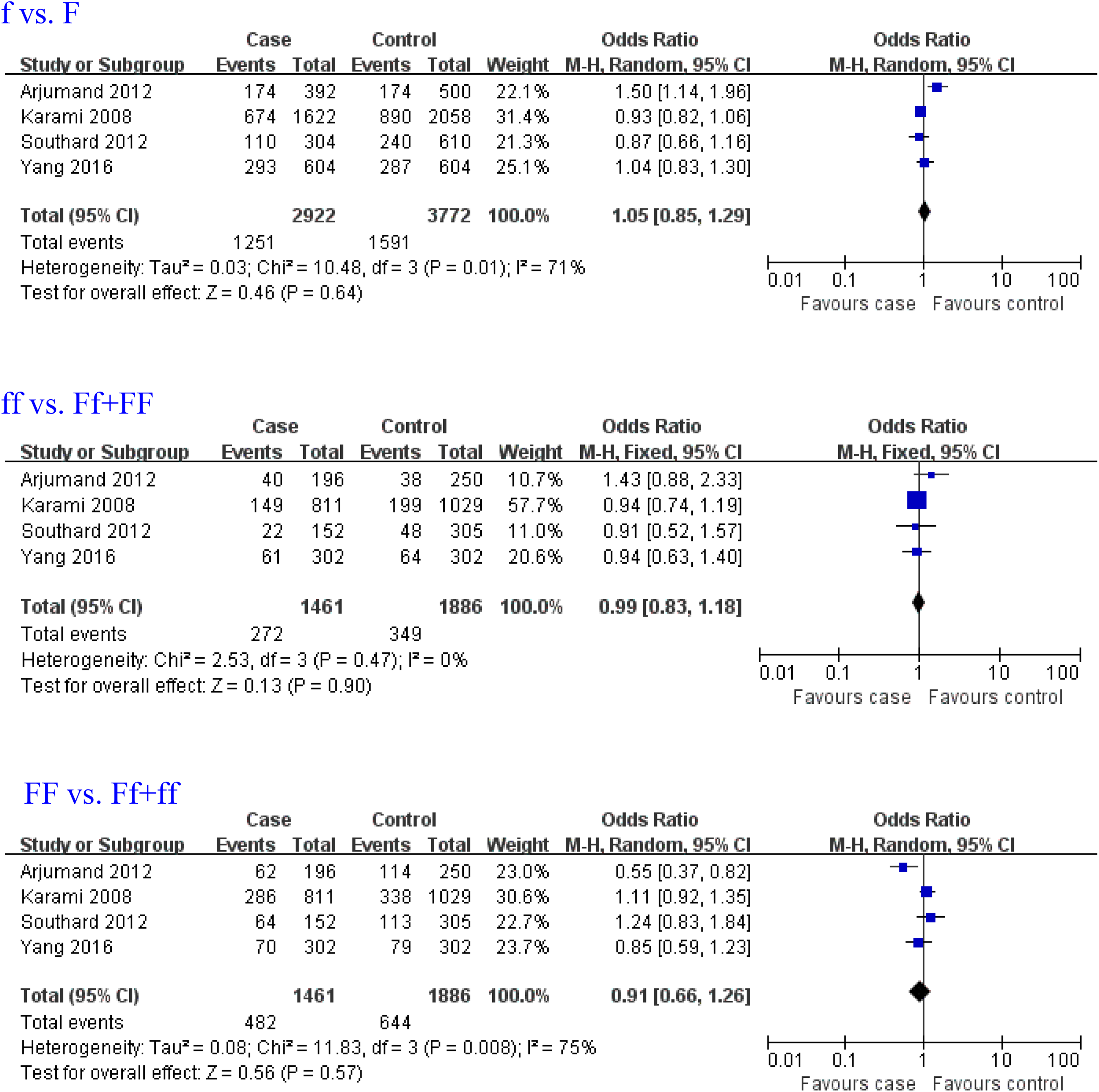
Association of vitamin D receptor (VDR) Fok1 gene polymorphism with renal cell carcinoma susceptibility.
Association of IL-16 Gene Polymorphism With the Susceptibility of Renal Cell Carcinoma
The IL-16 rs4778889 C allele and genotype were not associated with the risk of renal cell carcinoma in Chinese population (C allele: OR = 1.24, 95% CI: 0.66-2.33, P = .50; CC genotype: OR = 1.36, 95% CI: 0.38-4.79, P = .64; TT genotype: OR = 0.78, 95% CI: 0.40-1.50, P = .45; Figure 4; Table 4). Moreover, the IL-16 rs11556218 G allele, GG and TT genotypes were also not associated with renal cell carcinoma risk in Chinese population (G allele: OR = 1.11, 95% CI: 0.91-1.36, P = .30; GG genotype: OR = 1.25, 95% CI: 0.72-2.18, P = .42; TT genotype: OR = 0.89, 95% CI: 0.69-1.14, P = .36; Table 4).

Association of interleukin-16 (IL-16) rs4778889 gene polymorphism with renal cell carcinoma susceptibility.
Discussion
In previous studies, the gene polymorphisms have been associated with increased susceptibility of renal cell carcinoma. Our study indicated that MTHFR rs1801133 (T allele, TT and CC genotypes) as well as MTHFR rs1801131 (C allele, CC and AA genotypes) were not associated with renal cell carcinoma risk (Table 4). Since the number of included studies were small, further investigations are necessary to confirm these findings. The MTHFR, a central enzyme involved in folate metabolism, plays an important role in DNA synthesis and methylation that are relevant in cancer pathogenesis. 24 -26 Our findings suggest that MTHFR rs1801133 and rs1801131 gene polymorphisms do not affect DNA synthesis and methylation, and therefore, do not influence the onset of renal cell carcinoma.
The VDR BsmI, TaqI, and Fok1 gene polymorphisms are not associated with renal cell carcinoma risk in overall populations. Interestingly, VDR ApaI (A allele, AA and aa genotypes, BsmI B allele, and Fok1 FF genotype are associated with the risk of renal cell carcinoma. Ou et al conducted a meta-analysis and demonstrated that the ApaI AA genotype, BsmI BB genotype, Fok1 f allele, and Fok1 FF genotype were associated with renal cell carcinoma risk in Asians. 27 Our study was more robust as it included more studies than Ou et al. 27 Vitamin D regulates the cell proliferation, differentiation, and apoptosis in various tissues and plays a protective role in some cancer types. 28,29 We showed that VDR ApaI (A allele, AA genotype, aa genotype), BsmI B allele, and Fok1 FF genotype are associated with onset of renal cell carcinoma suggesting that these polymorphisms alter the activity of VDR.
Our meta-analysis also showed that IL-16 rs4778889 (C allele, CC and TT genotypes) as well as rs11556218 (G allele, GG and TT genotypes) gene polymorphisms were not associated with renal cell carcinoma risk in Chinese population. Interleukin-16 is a multifunctional pro-inflammatory cytokine, which is associated with many complex human disorders as it plays a critical role in regulating cellular homoeostasis. 30 Our study demonstrates that IL-16 rs4778889 and rs11556218 gene polymorphisms did not alter IL-16 function and therefore was not involved in the onset of renal cell carcinoma.
Our study demonstrates that the VDR ApaI (A allele, AA and aa genotypes), BsmI B allele, and Fok1 FF genotype are potential indicators of renal cell carcinoma risk in Asians. This needs to be confirmed by large-scale studies in future. Furthermore, the association of haplotype blocks of those genes with renal cell carcinoma needs to be investigated.
Gene disfunction could induce the disorders of cell growth and differentiation, and it can lead to the out of control of cell proliferation and apoptosis which affects the susceptibility of RCC. The MTHFR, a critical enzyme in the metabolism of folic acid, converts 5, 10-methylenetetrahydrofolate acid into 5-methyltetrahydrofolate and is a key importance for the homocysteine metabolism. 31,32 The active form of vitamin D acts as a steroid hormone and binds to the VDR. Vitamin D receptor mediates many genomic and nongenomic effects of vitamin D. 33 This receptor is expressed in most cell types including cells in kidney. Interleukin-16, a multifunctional pro-inflammatory cytokine, plays a critical role in regulation of cellular functions such as homoeostasis and affects the secretion of tumor-related inflammatory cytokines. 30,34 The current evidences indicated that MTHFR, VDR, and IL-16 take part in the pathogenesis of cancers.
The limitations of our study include small sample size, limited statistical power, heterogeneity of enrolled cases, variable study designs, and various interventions. These may have affected the statistical results and hence need to be regarded cautiously and confirmed in the future.
In conclusion, we demonstrate the association of VDR ApaI A allele, AA genotype, aa genotype, BsmI B allele, and Fok1 FF genotype are associated with the risk of renal cell carcinoma in Asians.
Footnotes
Authors' Note
Tianbiao Zhou and Hongyan Li contributed equally to this article.
Declaration of Conflicting Interests
The author(s) declared no potential conflicts of interest with respect to the research, authorship, and/or publication of this article.
Funding
The author(s) disclosed receipt of the following financial support for the research, authorship, and/or publication of this article: This study was supported by Guangzhou Medical Key Discipline Construction Project (2017-2019).