




Abstract
In an 1816 letter, Peter Stephen Du Ponceau expressed his enthusiasm for a feature of many American Indigenous languages, coining the term polysynthesis to describe it. He failed to recognize that the people he called “savage” had their own philosophies of language, ideas that would incite provocative challenges to the limitations of Enlightenment humanism. So too does Euro-Western posthumanism and new materialism, in ignoring Indigenous ontologies of language, remain trapped in the worldview that language is separate from matter. Using a new approach to Critical Discourse Analysis (CDA) to analyze Du Ponceau’s correspondence allows for both an exacting critique of colonizing worldviews and a method for “unearthing” the desires that emerge, through language, from matter. This innovative method offers a space for non-Indigenous philosophies to consider, without appropriation and with respect for the incommensurability of Indigenous ways of knowing, the possibility that even settler languages emerge from the Earth itself.
Keywords
Introduction
Peter Stephen Du Ponceau could not contain his enthusiasm. In an 1816 letter to John Heckewelder, missionary to the Lenape and Du Ponceau’s mentor in the grammatical structures of Native American languages, the French-born lawyer-linguist effused over a verbal form that “combines itself with the pronoun, with the adjective, with the adverb; in short with almost every part of speech” (Heckewelder & Du Ponceau, 1819, p. 415). Later he coined the word polysynthesis to describe this structure, common in Indigenous American languages, in which clauses are formed of interconnected inflectional morphemes rather than isolated words (Heckewelder & Du Ponceau, 1819, p. 433). The term continues to be used in linguistic typology to characterize languages on a cline from isolating (e.g., Mandarin) to analytic (e.g., English) to synthetic (e.g., Latin) to polysynthetic (e.g., Munsee and Unami, the languages of the Lenape that Du Ponceau was studying). In his correspondence with Heckewelder, Du Ponceau acknowledged his strong feelings about these forms: All this, my dear sir, is combined with the most exquisite skill, in a perfectly regular order and method, and with fewer exceptions or anomalies than I have found in any other language. This is what really astonishes me, and it is with the greatest difficulty that I can guard myself against enthusiastic feelings. (p. 415)
Du Ponceau’s enthusiasm seems to have been kindled by the limitations of his worldview. “And it is in the languages of savages that these beautiful forms are found! What a subject for reflection, and how little do we know, as yet, of the astonishing things that the world contains!” (Heckewelder & Du Ponceau, p. 417) One of the astonishing things that the world contains, of which Du Ponceau admitted he knew little, is that the speakers of the language he was studying would have been able to offer (had they been asked) their own ontology of language, which would have offered an even more mind-boggling subject for reflection.
In this article I address a similar enthusiasm, and a similar oversight, in the new materialist and posthumanist scholarship of the 20th and 21st centuries. The possibilities that “objects too have agency” (Latour, 2005, p. 63) and that matter is “vibrant, vital, energetic, lively, quivering, vibratory, evanescent, and effluescent” (Bennett, 2010, p. 112) have recently been posed as some of the astonishing things that the world contains, as worthy a subject for reflection as the possibility that savage languages might display complex new ways of thinking. The more obvious parallel with Du Ponceau’s approach is the critique levied against new materialist research for its systematic “exclusion of Indigenous knowledges” (Kibler, 2024, p. 2). Du Ponceau’s thinking remained trapped in his failure to acknowledge that the people he called “savage” had philosophies that would incite provocative challenges to the limitations of Enlightenment humanism.
So too does Euro-Western posthumanism, in ignoring Indigenous ontologies of language, remain trapped in the worldview that language is separate from matter. In this article, I offer a way for non-Indigenous scholars to consider, without appropriation and with respect for the incommensurability of Indigenous ways of knowing, the possibility that human languages emerge from the Earth itself. This shift in Euro-Western ontologies of language requires a reversal of the posthumanist and new materialist rejection of the postmodernist “linguistic turn.” I propose a way of doing Critical Discourse Analysis that allows for both an exacting critique of colonizing worldviews and a method for “unearthing” the desires that emerge, through language, from matter. Using this method to analyze Du Ponceau’s correspondence with Heckewelder will reveal not only the colonialism of his linguistic philosophy but also the desire for a linguistics of matter that can be read as voiced by the Earth itself.
Language and Matter in Posthumanism
An important critique of posthumanism and new materialism is that Western scholars have laid claim to ideas about the agency of matter and the interconnectedness of human and more-than-human worlds without citing the extensive bodies of Indigenous research that address these topics. Indigenous scholar Zoe Todd describes witnessing Bruno Latour (2013) discuss Gaia without once mentioning the Inuit philosophy of Sila, explained in detail by Inuk scholar Rachel Qitsualik (1998, cited in Todd, 2016, p. 5). Indeed, Latour emerges as one of “the strongest and most influential authors in the emergence of new materialism” in Kibler’s (2024, p. 16) citation analysis, contributing to the colonialist and sexist nodes of “new materialism’s power grid” (2024, p. 3), which replicates the exclusion of Indigenous authors and philosophies. As she explains: Counter to its intentions, new materialism showed an inability to fully see and hear land and the multiple nations of Indigenous communities, many of which hold philosophies, practices, and knowledge bases with extensive explanations and contexts regarding material agency. (Kibler, 2024, p. 32)
This “inability” to recognize the Indigenous philosophies of matter, as Ravenscroft points out, problematically extends to the retheorizing of the human that lies at the center of the posthumanist project. “The ‘human’ assumed under post-humanism,” she writes, “remains the Western liberal subject, not put under erasure as the ‘post’ in its name promises” (2018, p. 357).
As important as it is to acknowledge the dismissal of Indigenous scholarship, it is also imperative to investigate the philosophical and ideological limitations that such an exclusion imposes. In bypassing Indigenous ways of knowing, both posthumanist and new materialist thought rely upon the same type of colonizing philosophies of language at the heart of Du Ponceau’s work. Specifically, the civilized-savage binary in 19th-century thought foreshadows an analogous binary in 21st-century scholarship between language and matter.
This divide reveals itself in Barad’s (2003) complaint that language has become “more trustworthy than matter” (2003, p. 801). This claim relies upon an unexamined assumption about the distinction between human language and the material world, which is made explicit in Pennycook’s posthumanist applied linguistics. “Human language,” he insists, “is indeed a remarkable achievement that has been central to human development” (2018, p. 87). “Indeed” works here to signal two widely held assumptions: that human language is unique to humans, and that it is an “achievement.” The question that remains unasked is, whose achievement is it? If “the very practices by which the differential boundaries of the ‘human’ and the ‘nonhuman’ are drawn are always already implicated in particular materializations” (Barad, 2003, p. 824) then it is essential to entertain the possibility that “human language” may be, simultaneously, a property of the exceptional human and a product/practice of the material world.
Language and Matter in Indigenous Thought
Such a perspective may be as difficult for contemporary authors to entertain as it was for Du Ponceau to imagine that Indigenous peoples have their own linguistic philosophies. As Kalter points out in her analysis of how 19th-century linguistic theory was influenced by the study of Native American languages, “we are restricted by a lack of direct evidence in answering the question of what theories of language speakers of Native American languages held. They were never asked” (1999, p. 127). Indeed, Du Ponceau formed his reflections upon Lenape language structures without ever having met a speaker of Munsee or Unami. But even if such a meeting had been arranged, his worldview was unlikely to have been able to accommodate an Indigenous ontology of language. As Meissner points out, “what is untranslatable about Indigenous languages is often what is incommensurate about Indigenous worlds” (2023, p. 850). One important element of these worlds is the indissoluble relationship between human languages and matter.
The possibility that “language arises from the land just as humans do” (Ferguson & Weaselboy, 2020, p. 1) remains incommensurate with the Eurocentric notion of human language as at the pinnacle of evolutionary advancement. As Inuk writer and scholar Tommy Akulukjuk explains in correspondence with Derek Rasmussen, Indigenous ontologies locate language at the beginning of an evolutionary cycle, not at the end. As he writes, “the land (and sea) evolved a language to communicate with (and through) human beings, namely an Indigenous language that naturally ‘grew’ in that area over thousands of years of interaction between the elements, and the human and plant and animal beings” (Rasmussen & Akulukjuk, 2009, p. 285). It is clear from Akulukjuk’s description of this process that the language that evolved in Nunavut is not the type of communication that linguists like Pennycook are prepared to accept are used by non-human agents. Language, Akulukjuk is arguing, precedes humans.
Euro-Western conceptions of language become a sticking point as well for posthumanist understandings of agency. Barad’s (2003, 2007) “agential realism” requires an analysis of “discursive practices,” which, to be truly posthumanist, must distinguish between discourse and language. “Discursive practices,” Barad contends, “are not speech acts, linguistic representations, or even linguistic performances […]. Indeed, they are not human-based practices” (2003, p. 821). Barad’s “indeed” functions similarly to Pennycook’s above, to affirm the unchallenged assumption that linguistic activity is the unique endowment of human beings.
Watts’s analysis of current research that attempts to be “progressive in terms of introducing the role of non-humans into Euro-Western thought” (2013, p. 28) reveals that even these accounts of agency remain bound to the “taken-for-granted conceptualization of nature and culture,” where “humans are uniquely distinct from nature in their capacities” (2013, p. 29). These assumptions, she explains, reveal the inability (or unwillingness) of Western scholarship to take Indigenous ontologies seriously. In Indigenous ways of knowing language is not distinct from matter, nor is it a distinctly human capacity, an expression of distinctly human agency. “Land is primal,” explain Ferguson and Weaselboy—“it comes first of all. All other things—human beings, other-than-human beings, languages—arise from it” (2020, p. 2). Language not only emerges from the land and the “intentionality” of the land (Watts, 2013, p. 30), but it also serves as a “key medium or conduit by which a (human) being may also connect with Land” (Ferguson & Weaselboy, 2020, p. 2). In the same way that Du Ponceau ignored the Indigenous knowledge systems that would challenge the presumption of a divide between savage and civilized, so too has contemporary research ignored the Indigenous knowledge that would challenge the presumed language/matter binary.
Incommensurability
That said, revising Euro-Western ontologies of language offers its own set of ethical challenges. As Hird et al. argue, “posthumanism must converse with its settler colonial foundations (and all of its inherent racism and sexism) to reckon with rather than reconcile Indigenous knowledges and land rights” (2022, p. 4, my emphasis). Decolonizing posthumanism, they argue, is impossible “insofar as humanism’s legacy is integrally tied to ideologies of colonization” (p. 4). Euro-Western attempts to move beyond the language/matter binary must resist the colonizing urge to superficially adopt or adapt Indigenous ontologies of language and instead confront the limitations of a settler worldview.
Indigenous scholarship offers insights on how Western researchers might navigate these limitations. Tuck and Yang propose “an ethic of incommensurability” (2012, p. 28), which requires “relinquishing settler futurity, abandoning the hope that settlers may one day be commensurable to Native peoples” (p. 36). Meissner argues that the inextricable link between Indigenous knowledge and Indigenous philosophies of language requires a multi-faceted understanding of incommensurability. What she calls “impassible incommensurability” emerges from the perspective that “the hermeneutic resources of Western epistemic communities [are] inflexible and unaccommodating of Indigenous experiences. Concepts captured in the English language cannot be recaptured in Indigenous languages on these views because they are metaphysically inconsistent” (Meissner, 2023, p. 861). This form of impassable incommensurability may explain why posthumanist and new materialist thought remains bound to the assumption of a language/matter division.
Indigenous ontologies of language that recognize languages as emerging from the land may be incommensurable not only with Western thought, but with Western languages themselves. Paul J. Meighan describes the difference between settler and Indigenous languages in terms of the legacies the former carry. “Non-endangered languages, such as English,” he explains, “carry legacies of imperialism, assimilation, and colonialism, and can be easily decontextualized or disembodied from historical context, land, and place” (Chiblow & Meighan, 2022, p. 207). The legacies of these languages have material and sociopolitical consequences, notably, as Meighan points out, “the disembodiment of language can make it easier for land and the earth to be exploited” (Chiblow & Meighan, 2022, p. 207). Bastien makes a similar observation in her comparison of the English language with the Blackfoot language Siksikaitsipowahsin. Colonial language is not equipped, she writes, to recognize “Niitsitapi [Indigenous people] and their experiential relationship with natural phenomena” (2004, p. 128). Concepts in the English language, she argues, “facilitate the perception of natural phenomena as a world that can be manipulated” (2004, p. 130).
Hauch uses the term “linguistic natures” to describe the idea that settler languages have different ontologies than Indigenous languages. In his discussion of the Mapuche in southern Chile he explains that the Mapuche speak both Spanish and Mapudungun, but the two languages do not have the same status. “It is highly inappropriate to use Spanish in certain contexts,” Hauck explains, “above all for particular rituals that mandate the use of Mapudungun” (2023, p. 15). While Spanish is the language of white people, disembodied and dislocated from a particular place, “mapudungun is not conceived of as the language of a particular group of people such as the Mapuche but rather as the dungun (language/speech) of the mapu, the land itself” (2023, p. 15). Individual languages can thus have different natures that correspond to incompatible ontologies beyond language.
The idea that fundamental differences between settler and colonial languages affect human relationships with the natural world troubles the distinction Barad (2003) makes between language and discursive practices, which is essential to their project of understanding matter as agentive. What we learn from Indigenous ontologies of language is that languages are always already infused with discourse, which includes ways of seeing the world, ways of relating to the world, and ways of acting within it. The intention among Euro-Western researchers to see matter as agentive is blocked by their own languages and discourses, which are incommensurable with those Indigenous ontologies that conceive of no divide between language, matter and agency.
Language, Desire, and the Earth’s Agency
One of the ways of navigating incommensurability, Meissner proposes, is “the abandonment or radical retooling of colonial languages” (2023, p. 865). A question worth asking at this point is how deeply entrenched is the language/matter divide in Euro-Western discourses? Consider what Bastien describes as the sacred relationship between language and the material world in Indigenous ways of knowing: Speaking is connecting to all of creation, and through language one touches, relates, connects, and participates with the powerful force of the universe. The mysterious force or Ihtsipaitapiiyopa [the Source of Life] moves through language. It touches, connects, and lives through words as it makes life move. (2004, p. 140)
Unlike Indigenous languages, which are connected to an integrating spiritual force, settler languages are infused with the colonizing impulse to gain control over matter. In the process, they produce a persistent discourse of human consciousness as separate. As Bastien points out, “Eurocentred concepts are often abstract distinctions contextualized within the philosophical orientation of the colonizer” (2004, p. 128). More specifically, “concepts such as ‘person’ or ‘individual’ do not evoke the experiential connections to the sacred that the Siksikaitsipowahsin equivalents do (Bastien, 2004, p. 128). Settler languages produce discourses of separateness, making it impossible to access the interconnectedness of material and human consciousness.
If non-Indigenous societies have produced, through their languages and discourses, isolated subjects, disconnected from the materiality of their bodies and beyond, then posthumanist and new materialist research cannot afford to take up Barad’s rejection of the linguistic turn in her posthumanist call to arms (“Language has been granted too much power” (2003, p. 801)). Non-Indigenous scholars have a responsibility not to reject linguistic analysis, but instead to develop rigorous methodologies for critically examining the discursive construction of the self in Eurocentric texts.
The method I propose (Clark, 2016) is a form of grammatical analysis that starts from the postmodernist position that discourse produces the subject. It goes further, though, to argue that “discourse produces both the subject and the desire for an alternative structure—one that allows the subject/self/individual to be differently conceived” (2016, p. 8, my emphasis). In this previous work I used “desire” in Levinas’s sense. As Levinas points out, the Cartesian cogito, the rational thinking self, whose very existence is dependent upon his thinking, cannot conceive of anything beyond what it can think. To take up one’s ethical responsibility to the other, however, is to recognize that the other exists outside and beyond the cogito. It is to contemplate something beyond self and its knowledge. For Levinas, to take such a step requires moving beyond thought and into desire. (Clark, 2016, p. 8)
I proposed that desire be understood “as the desire for new discursive constructs—new forms of social structure that welcome, encourage and celebrate ‘otherness’” (2016, p. 8). One way of approaching Meissner’s proposed “radical retooling of colonial languages” (2023, p. 865) is to engage in a form of discourse analysis that both identifies how the Euro-Western rational subject is produced and how the desire for an understanding that goes beyond rational thought.
Eurocentric perspectives on desire “beyond rational thought,” as Eve Tuck points out, focus on the unconscious. The question of desire for Deleuze and Guattari (1990), for instance, centers on the unexpected, unplanned and unintentional. In her “break up” from Deleuze, Tuck proposes a desire informed by Indigenous knowing and lived experience, which moves beyond individual human rationality (the cogito) and toward a longing for wisdom. Such a desire, she explains, “accumulates wisdom, picking up flashes of self-understanding and world-understanding along the way of a life” (2010, p. 645). Tuck’s desire is transpersonal—an assemblage of wisdom that transcends Eurocentric individuality. The method for discourse analysis I have developed is designed to reach beyond the individual to uncover some deeper desire for transformative social structures, which includes understanding selfhood in a new light.
What did not occur to me in my previous work, but that strikes me as too compelling to ignore now, is the possibility that the desire I found to be observable through close grammatical analysis of texts may originate from the Earth itself. This thought led to questions like “What if we think of human language as developed by the Earth itself, as part of the Earth’s agentive evolution?” (Clark, 2025) Such a perspective would bridge the Deleuzian idea of desire as unconscious with Tuck’s revised version, where desire is a wise assemblage of insights on self and world. The incommensurability of Indigenous ways of knowing may prevent Euro-Western selves from having access to such an assemblage of wisdom, but inaccessibility does not nullify the existence of such wisdom. Even non-Indigenous communities, which do not have access to the generational knowledge of first peoples that Tuck describes as linking past and future (2010, p. 646), can nevertheless experience desire for such a wisdom. This desire may remain unconscious in the discourses produced by Euro-Western languages, but a desire-informed Critical Discourse Analysis can reveal the wisdom, agency and transformative possibilities offered by the Earth itself.
I would urge posthumanist and new materialist research to expand their understandings of materialist agency such that even Euro-Western thought, which so far has not allowed for the possibility of a language emerging from matter, might consider the idea that the Earth’s agency includes the production of human language. Here I will invite scholars to go even further by imagining that the Earth produces not only the separate self as constructed through human language, but also “the desire for an alternative structure—one that allows the subject/self/individual to be differently conceived” (Clark, 2016, p. 8). I will demonstrate how looking closely at the grammar of Du Ponceau’s colonizing discourse of the early 19th-century can shed light on the colonizing discourses that remain unproblematized in 21st-century posthumanist and new materialist thought. More importantly, the analysis will reveal how non-Indigenous scholars can move beyond the language/matter binary imposed by a Euro-Western theoretical heritage.
Method
Du Ponceau’s Letter 20 (21st August 1816)
Du Ponceau’s correspondence with Heckewelder was published in 1819 by the American Philosophical Society, which Du Ponceau had joined just under 20 years prior. In 1811, he proposed the founding of the Historical and Literary Committee of the Society, “for making researches into & collecting materials for the History of the United States & of Pennsylvania in particular or any other plan for accomplishing the same object” (American Philosophical Society, 1884, p. 429). Du Ponceau was appointed corresponding secretary when it was finally established in 1815. He was encouraged to contact retired Moravian missionary John Heckewelder because of the latter’s “intimate knowledge of the American Indians, their usages, manners and languages” (Heckewelder & Du Ponceau, 1819, p. 355). The Committee’s original interest was in Native American customs, but when Heckewelder sent a manuscript of Zeisberger’s Grammar of the Delaware Language, the focus shifted to languages. In the process of translating the Grammar from German to English, Du Ponceau “was struck with the beauty of the grammatical forms of the Lenape idiom” (Heckewelder & Du Ponceau, 1819, p. 356). The published correspondence charts Du Ponceau’s enthusiasm through his questions and new theories Heckewelder’s answers inspired.
In a letter dated 31st of July, 1816 (Letter 16), Du Ponceau situates American Indigenous languages as beyond the synthetic/analytic classification: In these various classes I have not found a place for the Indian languages, which richly deserve to form one by themselves. They are “synthetic” in their forms, but to such a degree as is not equalled by any of the idioms which I have so denominated, and which are only such in comparison with others where analytic forms prevail. That they deserve to make a class by themselves cannot be doubted. (Heckewelder & Du Ponceau, 1819, p. 401)
In his 30th of August letter (Letter 23), Du Ponceau coins the term “polysynthetic” (Heckewelder & Du Ponceau, 1819, p. 430, 433). Here I treat a letter that falls between these, Letter 20, dated 21st August 1816, where he expresses his amazement that “it is in the languages of savages that these beautiful forms are found” (Heckewelder & Du Ponceau, 1819, p. 417). I will argue that Du Ponceau’s stated desire to know more about “the astonishing things that the world contains” (p. 417) can be mapped against a “possibility for transformation” (Clark, 2016 p. 38), hidden within the grammar of his letter, for a new Euro-Western ontology of language that makes possible a linguistics of matter.
A New Approach to CDA
I analyze this letter using my innovative approach to Critical Discourse Analysis (CDA), discussed above, where “the priority is not the exploration of a social problem or oppressive ideology, but rather the discovery of as-yet-unimagined new forms of social structure” (Clark, 2016, p. 1). This method asks the following questions of a text, designed to be answered by grammatical analysis: What is the shape of the social structure here? What is the desire for an alternative structure? What are the “selves” that are textually constituted here and how might they be otherwise constituted? What are the possibilities for transformation here? (Clark, 2016, p. 49)
Here I will be asking these same questions of Du Ponceau’s Letter 20, positing the idea that “the desire for an alternative structure” and “the possibilities for transformation” emerge from the Earth itself. Like most forms of CDA, my method draws upon Systemic Functional Linguistics (Halliday, 2014), which understands meaning as clause-based and organized simultaneously according in three levels: as message, as exchange and as representation. These three layers of meaning correspond to what Halliday calls the “metafunctions” of language, each of which can be analyzed according to a different system: textual (thematic analysis), interpersonal (modal analysis) and experiential (transitivity analysis).
I explore each of these three metafunctions in my analysis of Letter 20. I examine transitivity (experiential metafunction) to address the question about the shape of the social structure Du Ponceau relies upon. I use both transitivity and modal analysis (interpersonal metafunction) to make claims about the “desire for an alternative structure” (Clark, 2016, p. 49). Thematic analysis (textual metafunction) offers insights about the selves the text produces. Finally, I return to modal analysis to explore “the possibilities for transformation” (Clark, 2016, p. 49).
Analysis
The Colonization of Language
The point of the methodology I have just described is to identify the desire for a new social structure and the possibilities for transformation. The first step in the analytic process, though, is to identify “the shape of the social structure here” (Clark, 2016, p. 49)—in other words, the structure as it is prior to the transformative possibilities. A close grammatical reading of Letter 20 reveals a shape in which language is understood as a commodity that can be exploited and colonized.
At the start of the letter, Du Ponceau marvels at the phenomenon that he will later call polysynthesis: “The verb, among the Indians, is truly the word by way of excellence. It combines itself with the pronoun, with the adjective, with the adverb; in short with almost every part of speech” (Heckewelder & Du Ponceau, 1819, p. 415, emphasis in the original). After drawing upon examples from the Zeisberger’s Grammar to illustrate this point, he admits his astonishment that this grammatical form is superior in terms of “skill” and “regular order and method” (Heckewelder & Du Ponceau, 1819, p. 415) to all other languages he has studied.
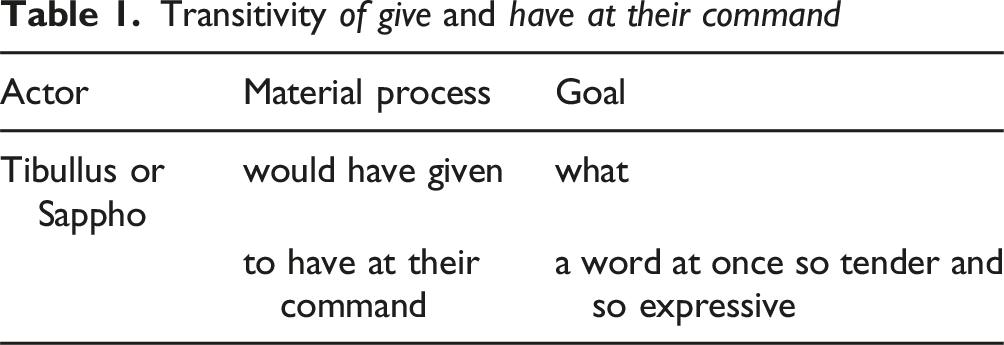
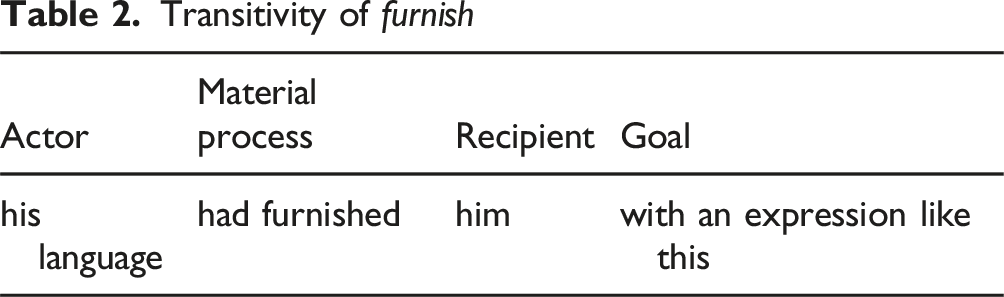
Du Ponceau certainly recognized that Indigenous linguistic superiority over Western languages was a radical claim. Rather than equivocate, he drives home the point by invoking classical Latin poet Tibullus, ancient Greek poet Sappho and contemporary Irish poet writing in English, Thomas Moore: but permit me to ask you, my dear sir, what would Tibullus or Sappho have given to have had at their command a word at once so tender and so expressive? How delighted would be Moore, the poet of the loves and graces, if his language, instead of five or six tedious words slowly following in the rear of each other, had furnished him with an expression like this, in which the lover, the object beloved, and the delicious sentiment which their mutual passion inspires, are blended, are fused together in one comprehensive appellative term? (Heckewelder & Du Ponceau, 1819, p. 417)
It is worth noting, however, that in order to express his appreciation for Indigenous languages, Du Ponceau must conceive of them as commodities that theoretically could be exploited by Western poets. His use of the verbs give, have at their command and furnish illustrate this point. Systemic Functional Linguistics describes verbs as processes, which “are construed as a configuration of components of three types: (i) the process itself; (ii) the participants in that process; and (iii) any circumstantial factors such as time, manner or cause” (Halliday, 2014, p. 105). Processes are of different types, including “happening, doing, sensing, saying, being or having” (Halliday, 2014, p. 213), and each of the different types of process allows different types of participants. The participants permitted in the grammar of a mental process like see, for example, are a human or human-like Senser and the Phenomenon that is being sensed. Give, have at their command and furnish are all material processes, or processes of doing and happening, which permit as participants actor (the one who is doing the process) and goal (the one who is affected by the process) among others. Material processes separate the actor from the goal.
Transitivity of give and have at their command
Transitivity of furnish
Du Ponceau’s exclamation that “it is in the languages of savages that these beautiful forms are found!” (Heckewelder & Du Ponceau, 1819, p. 417) further illustrates the structure of the Western worldview, which isolates grammatical features from the wider ontological context. As Meissner explains, “Language, very rarely, in Indigenous contexts refers to the morphological abstract entity constituted by phonemes and grammar; rather, language is a complex, socially constituted system of relating to one another that changes radically depending on context” (Meissner, 2023, p. 856). The idea that specific, commodifiable structures can be isolated such that they can be “found” in what Du Ponceau describes as an “astonishing” place is consistent with the critiques of settler languages and Western philosophies of language that have been levied in Indigenous scholarship. The image is of a separation between humans and language, where linguistic structures can be understood as commodities to be “found” within Indigenous languages and transferred to Western poets for their use and “command.”
Desire: A Linguistics of Matter
The method for grammatical analysis that I am drawing upon requires looking beyond the “shape” of a given social structure, for “traces of a desire for a less oppressive world—indeed, these traces might point to a new way of imagining the social world altogether” (Clark, 2016, p. 35). The Eurocentric perspective discussed above, where desire is individual and unconscious, will take us some way in this endeavor, but not far enough. Du Ponceau’s letter to Heckewelder reveals his personal desire to know more about “the astonishing things that the world contains!” (Heckewelder & Du Ponceau, p. 417) This personal desire offers an inroad to a transpersonal desire, one which “accumulates wisdom” (Tuck, 2010, p. 645) and that I am proposing emerges from the Earth itself. In Du Ponceau’s case, this desire is to learn and embrace (even though Du Ponceau himself remained unaware of them) Indigenous ontologies of language.
I turn now to the “traces” in Letter 20 that point to a desire for a worldview whereby language is “infused with spirituality,” which Meissner describes as an Indigenous ontology. “Some Indigenous theorists,” she explains, “conceive of Indigenous knowledge/language systems themselves as animate, not in a metaphorical sense, but as living, dynamic forces, infused with spirit that must be tended to and cared for” (2023, p. 853). The desire for such an ontology shows up in Du Ponceau’s argument that Indigenous polysynthesis surpasses Latin and Greek, synthetic languages which are understood to be superior to “the modern mixed dialects which at present prevail in Europe” (Heckewelder & Du Ponceau, 1819, p. 417).
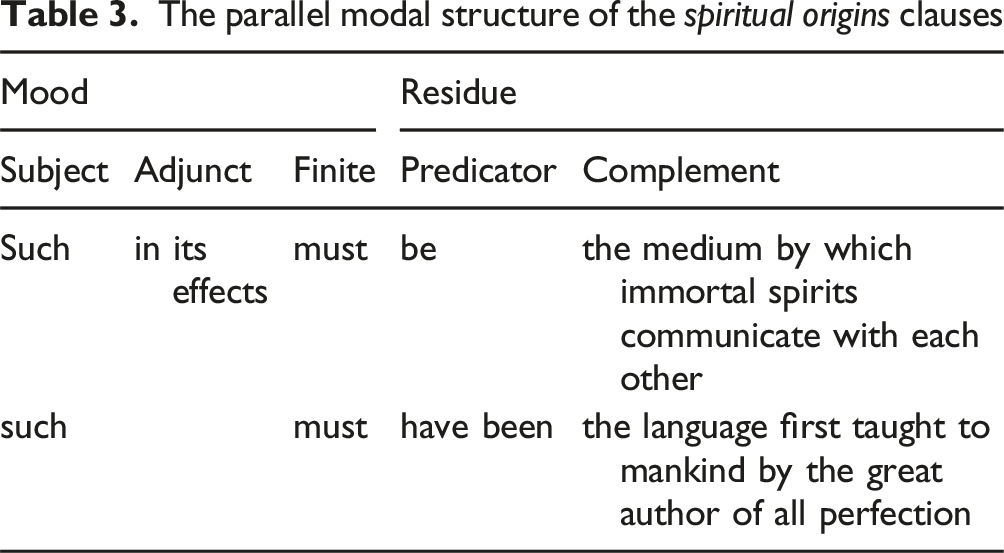
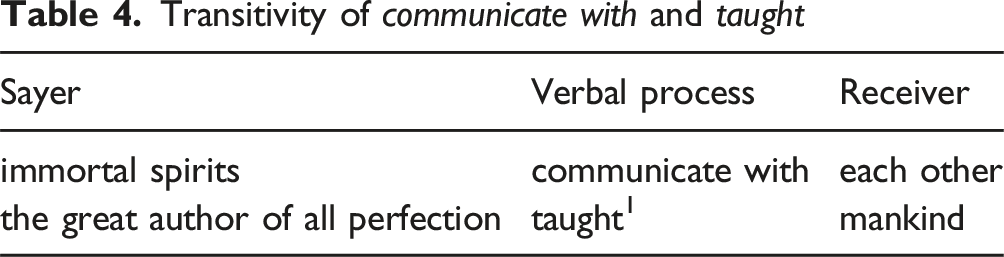
Of the polysynthesis of Indigenous languages, Du Ponceau writes: To me it would appear that the perfection of language consists in being able to express much in a few words; to raise at once in the mind by a few magic sounds, whole masses of thoughts which strike by a kind of instantaneous intuition. Such in its effects must be the medium by which immortal spirits communicate with each other; such, I should think, were I disposed to indulge in fanciful theories, must have been the language first taught to mankind by the great author of all perfection. (Heckewelder & Du Ponceau, 1819, p. 417)
The parallel modal structure of the spiritual origins clauses
Transitivity of communicate with and taught
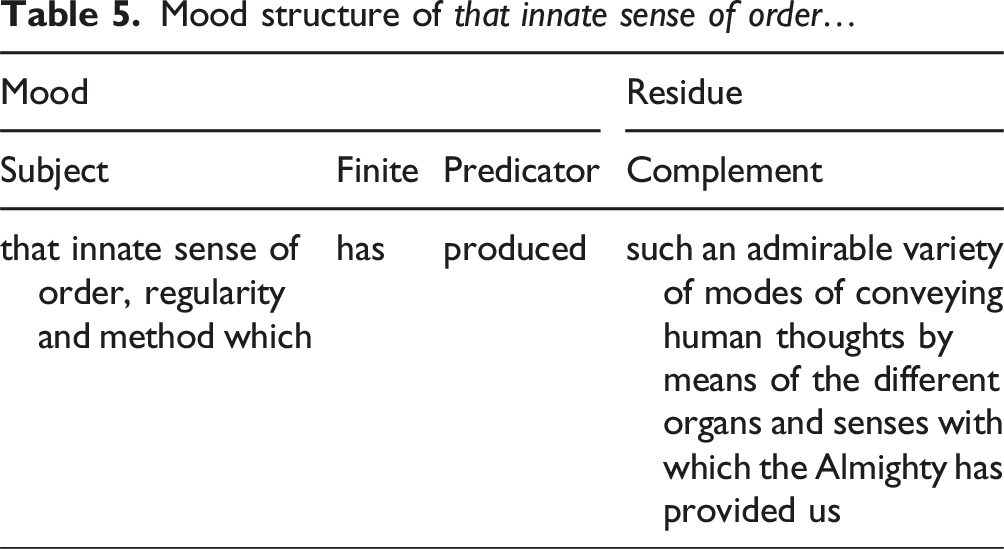
Du Ponceau’s invocation of immortal beings here, though, has little similarity to the Indigenous spirituality Meissner describes, which is not supernatural but natural—embodied, land-based “living, dynamic forces” (2023, p. 853). That said, I would argue that the traces of a desire for a linguistics of matter—an ontology where language emerges from the Earth itself—can be seen later in Letter 20, after Du Ponceau has positioned his argument in favor of the beauty of Indigenous languages in relation to other Enlightenment scholars. These elegant shades of expression shew in a very forcible manner the beauty and copiousness of the Indian languages, and the extent and the force of that natural logic, of those powers of feeling and discrimination, and of that innate sense of order, regularity, and method which is possessed even by savage nations, and has produced such an admirable variety of modes of conveying human thoughts by means of the different organs and senses with which the Almighty has provided us. (Heckewelder & Du Ponceau, 1819, p. 421)
This burdensome and convoluted sentence offers some revelatory contradictions. The first can be identified with the adverb even, which functions in a similarly mitigating way to the cleft sentence earlier in the letter: “And it is in the languages of savages that these beautiful forms are found!” (p. 417) On the one hand, Du Ponceau considers it surprising that even the savage nations possess an innate sense of order, regularity, and method. He depicts, on the other hand, this innate sense of order belongs uniquely to the beauty and copiousness of the Indian languages.
Mood structure of that innate sense of order…
Transitivity of the material clauses in that innate sense of order…
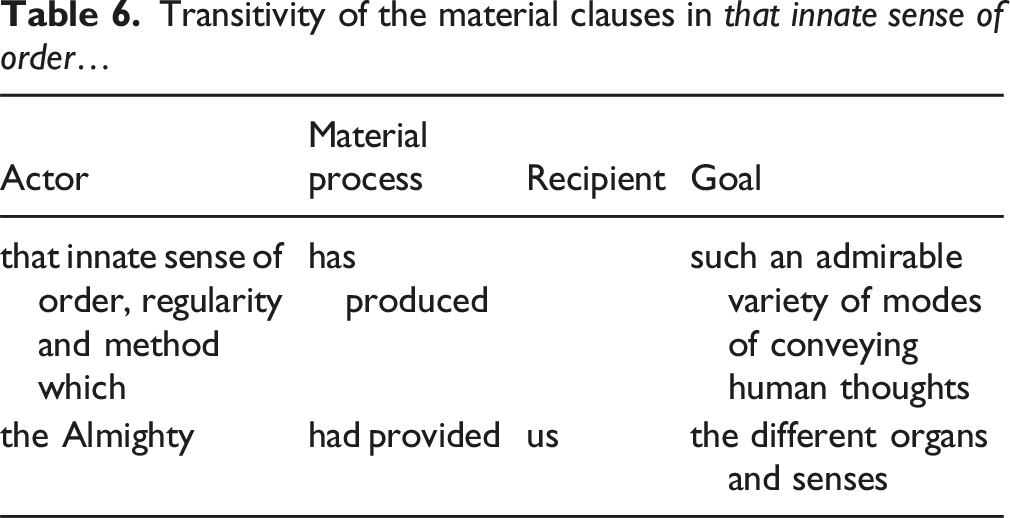
Whereas earlier the great author of all perfection previously was depicted as transmitting polysynthetic language to humans, now all the Almighty is providing is sense organs. The participant who is now responsible for the production of these languages is a natural force, that innate sense of order, regularity and method. The originator of language is no longer a Eurocentric deity, but the force of that natural logic. The trace of a desire here, I would argue, is that language, which was once understood as provided by a divine spirit, would now be recognized to be produced by the “innate” structuring forces of matter. The desire, not explicitly stated, but seeable in the grammatical structure, is for a linguistics of matter, where language emerges from the natural world.
New Possibilities for Euro-Western Ontologies of Language
This desire for a linguistics of matter can be explored in more depth by addressing the final two questions of my analytic framework: “What are the ‘selves’ that are textually constituted here and how might they be otherwise constituted? What are the possibilities for transformation here?” (Clark, 2016, p. 49) In this section, I will demonstrate that the textually constituted “selves” are Euro-Western and Indigenous languages, understood by both Du Ponceau and contemporary scholars as having irreconcilably different “linguistic natures” (Hauck, 2023). The transformative potential is in Euro-Western linguistic ontologies admitting the possibility that even settler languages emerge from matter, from the Earth itself.
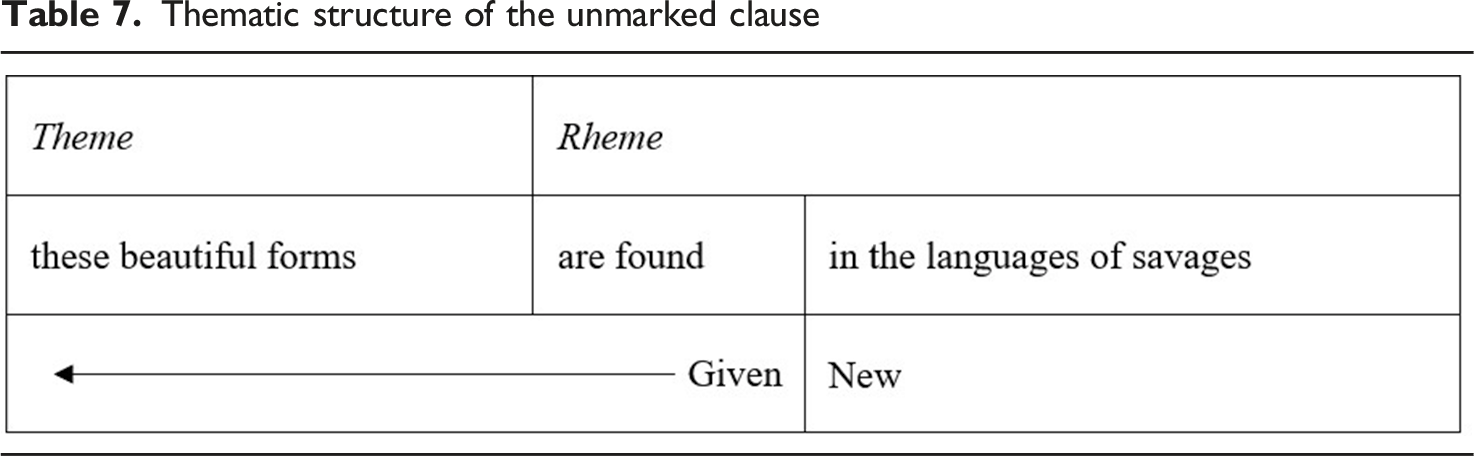
Thematic structure of the unmarked clause
Thematic structure of the predicated theme
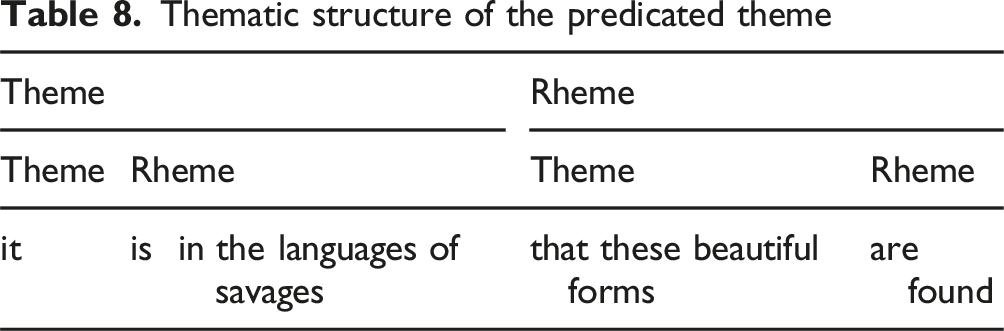
As I mentioned above, Du Ponceau’s racist “astonishment” is reliant upon the assumption of a savage/civilized binary. Such a binary supports a further implicature in his statement that these beautiful forms are not found in the languages of “the civilized.” While he is unwilling to admit the possibility of a connection between the sophistication of Indigenous languages and the sophistication of Indigenous philosophies, he does foreshadow Hauck’s (2023) claim that different languages can be understood as having different “linguistic natures.”
His musings on how a poet writing in English would have been delighted to be furnished with such a language, discussed above, seems at first glance to underscore his claims about the clear distinctions between “savage” and “civilized” languages. How delighted would be Moore, the poet of the loves and graces, if his language, instead of five or six tedious words slowly following in the rear of each other, had furnished him with an expression like this, in which the lover, the object beloved, and the delicious sentiment which their mutual passion inspires, are blended, are fused together in one comprehensive appellative term? (Heckewelder & Du Ponceau, 1819, p. 417)
Modal Structure of the Hypotactic Projection
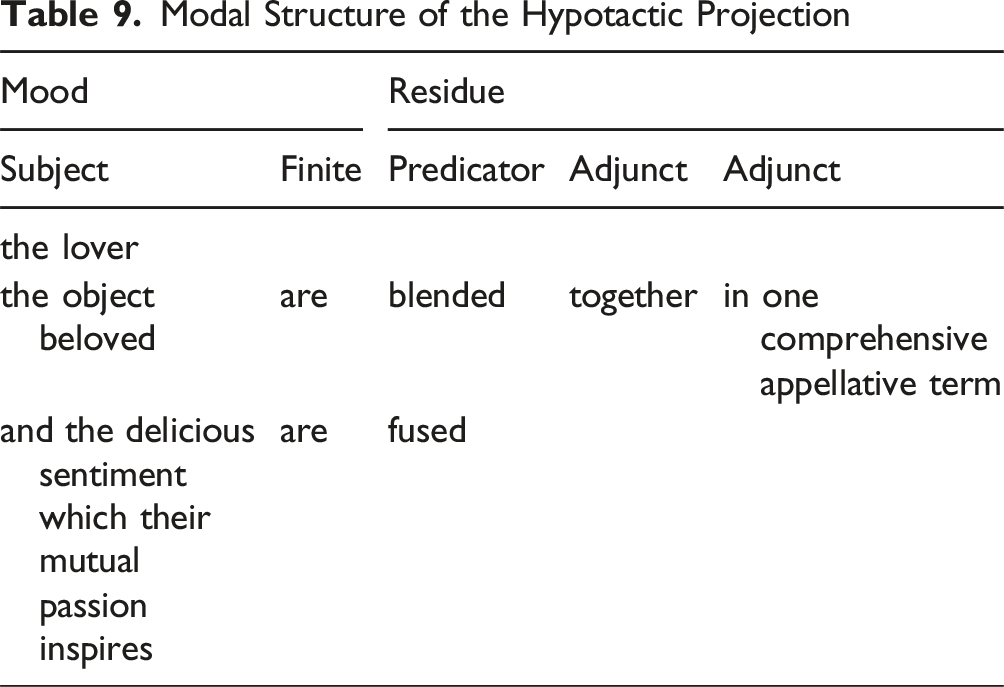
While Du Ponceau’s message emphasizes the separation between Indigenous and settler languages, the grammatical structure of his comments offers the possibility of a similarity between them. Such a possibility is too important, admittedly, to rest on this bit of grammatical analysis, but this unnoticed similarity between Indigenous and settler languages offers a fruitful opportunity to challenge settler ontologies of language, including the assumption of a language/matter divide. Challenging such an assumption requires being open to the possibility that all human languages—both Indigenous and settler—emerge from the Earth.
To explore this further, it is worth looking again to Watts’s discussion of Place-Thought in Haudenosaunee and Anishnaabe cosmologies. “Place-Thought,” she explains, “is based upon the premise that land is alive and thinking and that humans and non-humans derive agency through the extensions of these thoughts” (Watts, 2013, p. 21). Despite the new materialist and posthumanist commitment to recognize agency beyond human agency, place-thought remains irreconcilable with Euro-Western metaphysics, where, as Watts points out, “the idea of ‘society’ has revolved around human beings and their special place in the world, given their capacity for reason and language” (2013, p. 21). But if a desire to embrace non-Western ontologies of language can be traced within Eurocentric texts, as I have attempted to show here, and if we can allow for the possibility that such a desire emerges from the Earth itself, then it is worth allowing for the possibility of a communicative agency beyond human rationality. It is worth holding space for the idea that all human languages (including settler languages) are of the Earth.
Conclusion
Peter Stephen Du Ponceau’s astonishment that complex linguistic structures can be identified in the “languages of savages” offers a historical illustration of how the colonizing subject was centered in 19th-century discourses. In both political and scholarly arenas, the debate centered upon a single contested point—whether uncivilized peoples could develop sophisticated languages.
While we might expect the influence of postcolonial scholarship to destabilize this savage/civilized binary, it remains unchallenged in contemporary scholars who reflect upon Du Ponceau’s legacy in the field of linguistics. Gray, for instance, notes that Du Ponceau “foreshadow[ed] modern linguists’ rejection of any correlation between a language’s expressive potential and the social, cultural, or racial background of its speakers” (1999, p. 158). But this “foreshadowing” is better described as backward-looking. In bypassing Indigenous ways of knowing, both Du Ponceau’s work and new materialist/posthumanist thought rely upon colonizing philosophies of language. I have argued that the civilized-savage binary in 19th-century thought foreshadows an analogous binary in 21st-century scholarship between language and matter.
I have focused on this moment in linguistic history, where Du Ponceau confesses his enthusiasm for polysynthesis without considering the Indigenous ontologies from which this form emerges, as an invitation for non-Indigenous thinkers to pause. Regardless of how seemingly willing Euro-Western scholars are to expand beyond the colonizing worldview of humanism, such an effort remains impossible if it refuses to engage seriously with Indigenous ways of knowing.
And yet, as Hird et al. emphasize, such engagement “comes with a strong cautionary note” (2022, p. 16): Just as colonial forces have (and continue to) extract and remove Indigenous objects (including flora, fauna, people, and other “goods” such as tobacco, clothing, dream catchers, and so on) and settler colonial forces sanction this theft while also simultaneously occupying Indigenous territory (including universities occupying unceded Indigenous territories), so too does scholarship—including posthumanism—fetishize and otherwise “incorporate” Indigenous knowledge. (2022, p. 16)
The method I have illustrated in this article for analyzing the grammatical structure of colonizing discourses offers a means of critically acknowledging the limitations of settler language and discourse while allowing for the possibility that language (all of it, including grammar) is of the Earth. Such an approach would eschew any parallels between Indigenous and settler languages/knowledges, while simultaneously allowing for the possibility that the Earth can speak its desires through the grammatical structure of English and other settler languages. While a history of colonization has deprived English speakers of direct access to the Earth’s messages, rigorous, open-minded analysis can reveal the transformative possibilities that emerge through the discursive production of the Euro-Western self. Serious posthumanist and new materialist research needs to reconsider the transformative possibilities in the “linguistic turn” they have tried so hard to reject.
Footnotes
Author’s Note
For the purpose of open access, the author has applied a Creative Commons Attribution (CC BY) license to any Author Accepted Manuscript version of this paper, arising from this submission.
Acknowledgments
I would like to express my gratitude to the anonymous reviewer who offered generous and insightful guidance and suggestions for this article.

Ethical Considerations
This project has been reviewed and approved by the Ethics Research Committee of Sheffield Hallam University.
Consent to Participate
There are no human participants in this article and informed consent is not required.
Funding
The author received no financial support for the research, authorship, and/or publication of this article.
Declaration of Conflicting Interests
The author declared no potential conflicts of interest with respect to the research, authorship, and/or publication of this article.