



Abstract
In an attempt to exceed the constraints of academic writing and dominant approaches to inquiry, we expand in this article on an emergent arts-based methodology that utilizes voice and orality: critical podcasting methodology (CPM). We first review the paradigm of arts-based research that grounds CPM. Next, we introduce podcasting as a form of critical research and CPM as one possibility for a radical form of inquiry and knowledge creation. Following, we explain how the tenets of CPM (critical reflexivity, the dialogic spiral, voice, counternarratives, and public pedagogy) have manifested to varying degrees in our own podcasting project, Unboxing Social and Emotional Learning. We also offer considerations in the form of open-ended questions for those who are interested in conducting their own CPM projects. By sharing with transparency and humility about our ongoing podcast methodology, we hope to inspire others to value and engage with the rich possibilities that can come through podcasting.
Keywords
In academia, knowledge is highly valued in written form above all others (oral, visual, performative, emotive, embodied). The written word can render tremendous critical, creative, and relational insights, and yet it can also constrain what comes to be recognized as knowledge, research, and inquiry (Honan et al., 2018; Smith, 2012). Even while crafting this article, we experienced both the excitements and constraints of writing as we brainstormed how to best frame our work and articulate our emergent podcasting methodology. Writer’s block reared its ugly yet ubiquitous head, and a lead author (Melvin) turned to a common strategy of combating it: setting up a time to talk verbally with one of the other authors, Emma, about how to structure and think through the manuscript. Talking in an organic, free-flowing way helped significantly, and he remarked that “I wish a journal could just publish our podcast or an audio file of our thoughts. I might have writer’s block, but I don’t have a speaker’s block!” Indeed, it can be a decolonial act to speak a story (Mafile’o et al., 2022).
We include this personal example to show how critical podcasting methodology (CPM), the focus of this article, is not a topic we write “on” or “about” but intimately with and through, something we developed in connection to our own daily lives and affective experiences. We entered this methodological pursuit with frustration of academia’s dependence on writing, and yet, to conform to institutional norms and embrace the possibilities that can come through writing, we write. The purpose of this article is to explain with/through writing something that departs from the academic tradition of writing: our emergent iteration of CPM, as developed by Brandon (Edwards-Schuth, 2023) in a previous project. In what follows, we explain more about the emphasis on the written-word in academic research and the need to expand beyond it (for instance, through podcasting), then review how the broad and eclectic paradigm of arts-based research (ABR) enables such an expansion. We discuss CPM as an arts-based methodology that strives to be accessible, educational, and egalitarian, overcoming some of the limitations in dominant social and critical research methodologies (Edwards-Schuth, 2023). We also illustrate how CPM can be used, drawing from our own podcasting project, and end with considerations for enacting CPM as an intentionally imperfect yet ongoing tool for democratizing research.
Departing From the Written-Word Hegemony of Academic Research
Critiques of academic writing are not new but can be found in the work of many critical scholars, including those who build from Black and Indigenous perspectives. For instance, Māori scholar Linda Tuhiwai Smith (2012) argues that knowledge and representation follow a hegemonic Western tradition that prioritizes “the written text (seen as expert and research-based) over oral testimonies (a concession to indigenous ‘elders’)” (p. 46). This prioritization emphasizes rules and facts as the most admissible evidence of valid research, within evaluative frameworks presumed to be value-neutral. Environmental philosopher David Abram (1997) also discusses how the written alphabet has shaped Western ideology, including the positioning of the world as an abstract field of objects waiting passively to be named and represented by humans. Elaborating on the history of this dominance and how it originated particularly from the colonization of the Americas, decolonial theorist Sylvia Wynter (1984) writes that “New World peoples … lacked Letters and written monuments to their history. The fact that they offered humans as a sacrifice to their gods proved that they Lacked Natural Reason” (p. 35). That is, “the nineteenth century’s re-ordering of the episteme … posited the ‘civilized,’ defined by its having a written literature, against the ‘primitive,’ defined by its lack” (Wynter, 1984, p. 45). Writing is unjustly seen as exemplary of objective reason and as the primary—and most valid—way to document knowledge (Abram, 1997). Academics are thus expected to produce knowledge and to be judged in this way: writing manuscripts to publish, viewing journals and books as the most prestigious outlets for written work, achieving a high publication count, having one’s written work be cited widely to demonstrate influence, and so on (Gannon, 2018).
We struggle with this preference for the written form for multiple reasons, in addition to the reproduction of a Eurocentric worldview: (1) research is often locked behind a paywall through publishing companies that charge consumers for use, which then necessitates access to academic libraries that purchase subscriptions, but it is difficult to access these libraries if you are not affiliated with a university and even then, not all academic libraries have access to all produced materials; (2) academic articles and books are often dense and written for highly specialist audiences, sometimes inaccessible to even specialists in other fields and certainly inaccessible to lay audiences; and (3) although the written word has its own ways of evoking tone, emotion, layered meaning, and embodied presence, it can also have a sense of linearity and finality or fixedness on a page, especially when adhering to academic standards (Honan et al., 2018). Furthermore, by prioritizing the written word over other modalities to generate and share research (e.g., oral dialogue), one dimension of knowing is constantly repeated with little room for anything else.
Taken together, these concerns underscore the need for orality/spoken words in and as research (Magnat, 2018). Although we recognize the irony in publishing a written article about the need for non-written texts, we embrace it more as a strategic paradox, positioning writing as a means to amplify and advocate for oral knowledge creation. By turning to podcasting as a critical form of research, co-inquirers can gather and generate stories, information, and knowledge to engage a variety of audiences. As Eden Kinkaid and colleagues (2020) write, “hearing the emotion and tone in a speaker’s voice may evoke different affective engagements between the audience and the research content” (p. 2). Furthermore, audio as the chosen medium has pedagogical and prefigurative potential for embodied listening (Harada, 2019) which can “serve as a source of knowledge about the logics at work in classrooms—racism, heteropatriarchy, feminism, masculinism, ableism, colonialism—supporting transformation of classroom expectations beyond imposed norms” (Hanrahan & Billo, 2024, p. 1492). And although video can produce affects similar to audio, the rising popularity of podcasts combined with the accessibility inherent in listening rather than watching allows listeners to “background listen” or listen during commutes transcends visual limitations of video. Audio, particularly podcasts, offers additional dimensions which traditional written works may not be able to convey as effectively, though need not be a replacement, while also contributing to more accessible multimodal learning.
Podcasts can be created by almost anyone, made on any topic and for any purpose (e.g., entertainment, news, educational and community engagement), and accessed on a variety of platforms (e.g., Spotify, Apple Podcasts). Although not all podcasts are constructed as research, podcasting can unlock another realm of research possibilities and products (Kinkaid et al., 2020; Rogers & Herbert, 2020; Smith et al., 2021). We describe and demonstrate this potential in the current article. The next section explains how arts-based research, a paradigm in which we situate CPM, offers alternatives to the representational logics that continue to dominate the standards and conventions of not only positivist research but also critical and constructionist forms of empiricism (Vannini, 2015). By approaching research as a process of creating and eliciting ways of knowing and being, rather than just relaying and reproducing them, new and renewed possibilities are opened for what can “count” as inquiry (Leavy, 2020; Renold, 2025).
Arts-Based Research as a Way Out of the Quantitative–Qualitative Binary
Arts-based research (ABR) departs from the quantitative versus qualitative binary of research, focuses on generating and deploying rather than purely representing knowledge, emphasizes participatory approaches to inquiry, and offers a foundation or “home” for CPM. Regarding the first point, research methodologies are typically characterized across a divide of “quantitative” versus “qualitative,” one of the first major distinctions students are taught to make in introductory research methods courses. This divide generally follows the paradigms of (post-)positivism and interpretivism/constructivism (Denzin & Lincoln, 2018). However, scholars have contested the usefulness of this dualistic categorization for over a century, arguing that it can flatten each paradigm into homogeneous assumptions when in fact there is rich variation—not just in terms of specific methods but also overarching (onto)epistemological stances—within each broad label (Denzin & Lincoln, 2018).
Characterizing research using this divide can also ignore the unquestioned similarities between dominant methods of both quantitative and qualitative inquiry, including the representational mission to gather empirical data from sources external to the researcher and then “apply” analysis that will reveal pre-existing truths about the world (even subjective or constructed worlds) contained within those sources (Vannini, 2015). Representational logics also present researchers, participants, data, and analysis as separate and discrete categories. Various orientations to inquiry have pushed against this separation, for example, by offering overlapping approaches to post-qualitative inquiry (Renold, 2025), ABR (Leavy, 2020), and participatory research (Burns et al., 2021)—each of which have important differences but forefront the co-created, nonlinear, and entangled ways in which knowledge and realities are configured. CPM, which draws from a variety of critical, arts-based, and participatory principles, is made possible by these push-backs against conventional research, particularly ABR as a growing paradigm (Edwards-Schuth, 2023).
Arts-based research—also known variably as a/r/tography, critical arts-based inquiry, and practice-based research, among other terms—emerged in the social sciences in the 1990s/early 2000s (Leavy, 2020; Sinner et al., 2006). ABR encompasses a very broad range of inquiry with no single dominating epistemology or methodology, although it does tend to reject positivist practices. As an “aesthetic intersubjective paradigm” (Chilton et al., 2015, p. 1), ABR aligns more with postmodern, poststructuralist, and critical paradigms of research that focus on sensory, (kin)aesthetic, and imaginative means of knowledge production (Gerber et al., 2012). Arts-based researchers generate work through a variety of media, including but not limited to literary writing, poetry, photography, film, multimedia, sculpting, painting, drawing, dance, music, and theater (Leavy, 2020). What moves art into arts-based research is the goal of systematically or intentionally channeling that art (in any stage of a project, from the identification of a research problem or purpose to generating artifacts, analyzing, interpreting, presenting, or provoking) into creative, empathetic, relational, and/or dialogic means of creating new or renewed worlds, connecting the personal/micro to the collective/macro (Leavy, 2020).
Just a couple compelling examples of ABR include a multi-year collaboration between a sculptor, oceanographer, and group of activists to embody the materialities of plastic waste and urge the general populace to confront anthropocentric destruction (Corcoran & Jazvac, 2020) and a critical health researcher’s investigation of dance or “dancing the data” (Carter, 2020, p. 2) as an embodied method of inquiry to explore her role transitions as a nurse. ABR is often less concerned with what research is and more on what research can do—how research can act on the world—and with which groups of individuals (including more-than-human beings) it can engage (Leavy, 2020). There are many lively debates in and about ABR as it continues to grow (Barone & Eisner, 2012; Gerber & Siegesmund, 2022), and new ways in which it is manifesting in and outside of academic institutions. We now turn to podcasting as a potential manifestation, in which collaborative oral dialogue can be pursued as a way of knowing.
Podcasting as a Form of Arts-Based Research
Created in the wake of the iPod in the early 2000s, podcasts have grown tremendously in its popularity and potential over the past two decades, owing partly to the rise of 21st century technologies and their convergence with traditional forms of media (Markman, 2012). For instance, Really Simple Syndication (RSS) feeds allowed for easy subscription to audio files so podcast subscribers could automatically receive episodes as they are published, and the launch of podcast-specific apps (particularly the addition of podcasts to Apple iTunes in 2005) enabled wider accessibility and greater dissemination of podcasts. Podcasts also tend to be interdiscursive spaces where old and new media, grassroots and corporate interests, and producers and consumers all intersect: Consumers are treated not just as spectators but as part of an active and participatory community, and the lines between producers and consumers are blurred (Madsen, 2009; Markman, 2012). In this sense, podcasting is largely considered user-generated content and the medium allows creators to shift across time and space, which may contribute to its popularity. Indeed, given its unique characteristics as a decentralized, widely accessible medium much like guerrilla radio, podcasting can be a potent site for social organization (Bernico & Dettloff, 2019) and for transforming social narratives (Bernico & Dettloff, 2019; Weber, 2022), among other uses. Today, podcasts are audio communication enjoyed by independent amateur producers (e.g., researchers, bloggers, and radio enthusiasts) and traditional media outlets (e.g., NPR, Canadian Broadcasting Corporation) alike.
In recent years, scholars have also begun to take notice of podcasts (as an end-product) and podcasting (as a process) as objects of research. Researchers have examined, for instance, the pedagogical uses of podcasting (e.g., Edirisingha & Salmon, 2007; Hew, 2009; Hill & Nelson, 2011; Rockhill et al., 2020), the storytelling potential of podcasting (e.g., Weber, 2022), how podcasts are spaces of participatory culture (Ferrer et al., 2020; Markman, 2012), and how podcasting can be used to advance social justice (Ferrer et al., 2020; Rogers & Herbert, 2020; Smith et al., 2021). In a departure from podcasting as a vehicle or tool for achieving particular goals, Markus Lundström and Tomas Poletti Lundström (2021) contend that podcasts can also be artifacts for thematic analysis and field sites for ethnography. They suggest that “podcast ethnography” can be conducted in three stages: (1) explore the podcast from a particular social field, (2) engage with it reflexively, and (3) examine it for typologies and themes. Furthermore, Kinkaid and colleagues (2020) developed what they call “podcast-as-method” (p. 78) for investigating how a podcast can serve as a means of producing, in their context, geographic knowledge on social and environmental issues. They argue that “podcasts present new and largely untapped opportunities to build empathetic understanding and polyvocal dialogue amidst a diversity of viewpoints and stakeholders” (Kinkaid et al., 2020, p. 89). Despite the production demands of conducting podcasts (e.g., needs time, planning, and goals; requires a level of technical expertise; needs marketing and community-building), podcasting as a method can nevertheless provide a polyvocal means of generating, analyzing, and presenting data. They also expand what “counts” as data and challenge the divide between researchers, participants, and audiences or recipients of knowledge.
Situating podcasting further in the arts-based research field, there are other examples highlighting how it can facilitate dialogical and relationship building spaces for political change through disrupting the status quo. Amea Wilbur and colleagues (2022) discuss how the method of podcasting for their podcast as an arts-based podcast-making project displayed the importance of emotional and participatory elements which emerged. In the midst of the COVID-19 pandemic, Robert Barbino, Bianca Herlo, and Malte Bergman (2022) facilitated a podcast workshop as an arts-based research method, exploring the intercultural, participatory, and empowerment possibilities in digital spaces for communities during those particularly precarious times. In a more experimental direction, Samuel Clevenger and Oliver Rick (2021) utilize lo fi soundscapes and interview audio together to create an arts-based podcast as an alternative to text-based publishing formats. In all of these instances, podcasting takes on a critical role in arts-based research, as a medium for dissemination as well facilitating spaces to explore emergent emotional, dialogical, and experimental practices.
In summary, podcasts in academic literature have most often been studied as texts that can be analyzed and, more recently, as possible podcasting methods for doing research. A more detailed methodological framework, however, that maps podcasting within onto-epistemological and axiological foundations is missing (Edwards-Schuth, 2023). Certainly, dialogue always contains power dynamics and social identities, and these dynamics can influence, co-opt, or even weaponize the dialogic aspect inherent to podcasting (Rogers & Herbert, 2020; Rose-Redwood et al., 2018). We thus contend that a rigorous methodological framework for podcasting is necessary to be purposeful with this medium as a means of research. In the following section, we detail critical podcasting methodology (CPM; Edwards-Schuth, 2023) as one possibility for a radical form of inquiry and knowledge creation.
What Is Critical Podcasting Methodology?
Critical podcasting methodology (CPM) is a research methodology and pedagogical tool developed by Brandon, one of the current authors. CPM draws from ABR (what he terms “critical arts inquiry”), critical ethnography, and action-based research to co-generate knowledge, community, and social change (Edwards-Schuth, 2023). Like ABR, CPM “intersect[s] and merge[s] … art and research for the intention of advancing social justice” (Edwards-Schuth, 2023, p. 85) and positions researchers as needing to overtly engage in political activism. CPM is informed by critical ethnography (e.g., Madison, 2020) in that it enables participants (who are also researchers, breaking the researcher/participant binary) to look both inward and outward, to consider ethical implications, and to emphasize storytelling and relationships when producing a podcast. Lastly and relatedly, as in action-based research, critical podcasting requires collaborative dialogue, participatory decision-making, and maximal participation of people (co-researchers and the audience). CPM is thus a bricolage (Denzin & Lincoln, 2018), a mixing of methods of inquiry and diverse theoretical and philosophical perspectives that also include Education Sound Studies, Qualitative Sound Methods, and Narrative Radio (Edwards-Schuth, 2023). CPM has five interrelated tenets: critical reflexivity, the dialogic spiral, voice, counternarratives, and public pedagogy.
The
Emphasizing
Voice as a tenet in CPM acknowledges that these diverse perspectives may not necessarily find their way to a consensus. Conflict consensus (Rose-Redwood et al., 2018) arises among the hard disagreements present in discussions between groups that may not be able to reconcile differences. This acknowledgment of the reality of dissensus allows for perspectives to truly have their space, without an expectation for the myriad voices involved in a discussion to warp into forms that concur with one another or even “meet in the middle.” In the context of a podcast, but specifically amidst podcasting, because the whole conversation is recorded, the entire process of formulating ideas that contribute to knowledge-building is laid bare to researchers and listeners alike. In this way, podcasting can be a legitimate form of research itself, and the research produced holds complex and multifaceted layers of voices that together form new knowledge, without necessarily merging into a singular conglomeration of perspectives.
Dominant narratives prevail throughout so many spaces, from academia to social media, supporting systemic oppression (e.g., white supremacy, ableism, sexism). In CPM,
Lastly,
Notably, any given podcasting project may have a slightly different balance of these key tenets of CPM, such as dialogic spirals existing only in their absence (e.g., through conflict consensus) or podcasters having to code-switch strategically in conservative contexts (Edwards-Schuth, 2023). No two CPM projects need to or should look identical. With this in mind, we next exemplify CPM as the methodology framing our own podcasting project and discuss how CPM can be further developed based on our experiences with it.
Conducting Critical Podcasting Methodology: The Unboxing Social and Emotional Learning Podcasting Project
Our podcasting project grew out of informal conversations on Zoom as we met through a combination of conference networking and pre-existing relationships within and across institutions. Our group, which has ranged from five to eight members during the 3 years of the project, is located across the U.S. Pacific Northwest, U.S. Midwest, and two Canadian provinces. We connected through a critical commitment to create and share work and ideas around social and emotional learning (SEL), a phenomenon in education and educational research that promotes the development of social and emotional competencies (e.g., self-awareness, self-regulation, empathy, perspective taking, conflict resolution; Durlak et al., 2022; Weissberg et al., 2015). SEL has become a major buzzword around the world (Cipriano et al., 2023). Despite its growing prevalence and its intentions to foster learning beyond strictly “academic” categories, SEL often manifests in whitewashed, colonized, and anthropocentric ways that reinforce rather than loosen the hierarchies that rank and constrain human and more-than-human beings (e.g., Camangian & Cariaga, 2022; Simmons, 2019; Stearns, 2019). For instance, a recent critical review of the Ohio SEL standards and the Collaborative for Academic, Social, and Emotional Learning competencies found that these frameworks completely “ignore racism, ableism, and other oppressions; privilege civility over productive conflict; and focus on behaviors over emotions, especially when expressed by Black, Brown, dis/abled, and queer people” (Clark et al., 2022, p. 131).
From our stances as scholars across various disciplines and positionalities (e.g., teaching and teacher education, human-animal studies, gender studies, critical discourse studies, and even former SEL program development), we agree with these critiques and wonder how we might unpack and potentially reimagine the concept and practice of SEL. We expand on the critical scholarship on SEL by using dialogue as a legitimate form of knowledge creation to explore SEL from diverse social identities and distinct interdisciplinary perspectives. This is where we draw on CPM to guide our work. Ultimately, we question whether the term and the codified phenomenon of “SEL” should be overhauled or even abandoned entirely to make room for other ways of fostering the social and emotional dimensions of humanity. Our project is guided by three groups of dynamic research questions, which we plan to address in upcoming publications: (1) How does critical dialogue serve as a form of knowledge production and knowledge sharing around SEL? What methodological, pedagogical, and practical possibilities are opened by modalities including podcasting and storytelling in conjunction with more traditional scholarly writing? (2) What primary concerns with SEL emerge through discussion? How do we draw from our own knowledge and lived experiences to form a basis for these concerns? (3) What possibilities for valuing and fostering social and emotional aspects of humanity, which may not be captured under the label “SEL,” emerge from our knowledge, ideas, and lived experiences?
From the beginning, we worked consciously against the power hierarchies that are often created in academic and creative projects alike. This did not mean eschewing any kind of defined (albeit dynamic) roles that would benefit the structure of the podcast, like designating one member of the group as the primary facilitator for each episode, but it did mean thinking carefully about ethics and power amidst the planning. Indeed, although each episode was guided by one of us as the facilitator, any of us had the freedom to lead any episode if we wanted to. We were also free to attend as many or as few recordings as we wished and as our lives allowed, and most members of our group were consistently present for recordings. We intended for the overall feel of our podcast to be conversational, as if we were chatting over coffee or a meal or like we were in a book club of sorts. The planning for each episode was generally expected to be completed one week prior to recording, so all group members had ample time to review the outline, read and think about the topic, and prepare comments or talking points. Once the planning was completed, we would meet via Zoom to record the episode. Each episode generally began with a recap of the purpose of the podcast and an invitation to reflect on how we were advancing our methodological and pedagogical goals. A discussion related to the topic of the episode would ensue, structured by the questions or talking points identified in the planning of the episode and which often included reading one or more shared articles (academic and public-facing). We could each chime in as we pleased or felt compelled to, building off each other’s contributions. It helped that we had developed rapport with each other in-person and over a few months of brainstorming the project. With a larger group, there was competition for the mic at times, but this fit the liveliness of our conversation and we took care to ensure that everyone got a chance to speak by checking in with each other. Some collaborators would also write comments in the chat, so their thoughts did not get lost. When we were quiet or less responsive, often one person would try to stimulate conversation by asking a question or moving to another planned talking point. Recordings lasted approximately one hour and were later transcribed by Emma, who would then share the transcription with the entire group to review and make sure it felt authentic to all involved. Recordings were then edited and uploaded to our hosting site on a rolling basis. Editing mostly consisted of cutting out long pauses between speech to produce a more natural sounding conversation and improving the sound quality of the recording. Editing decisions were at the discretion of our two editors/producers, but we did check in regularly with each other throughout the recording process and made bigger decisions by consensus (e.g., podcast name, logo, scripted intro/outro). See Figure 1 for an example of the podcasting process for one episode and how the tenets of CPM are interwoven throughout the process. At the time of writing this article, we have published nine episodes in Season 1 of our podcast, Unboxing Social and Emotional Learning, and we are wrapping up recording episodes for Season 2. Sample Podcasting Process for One Episode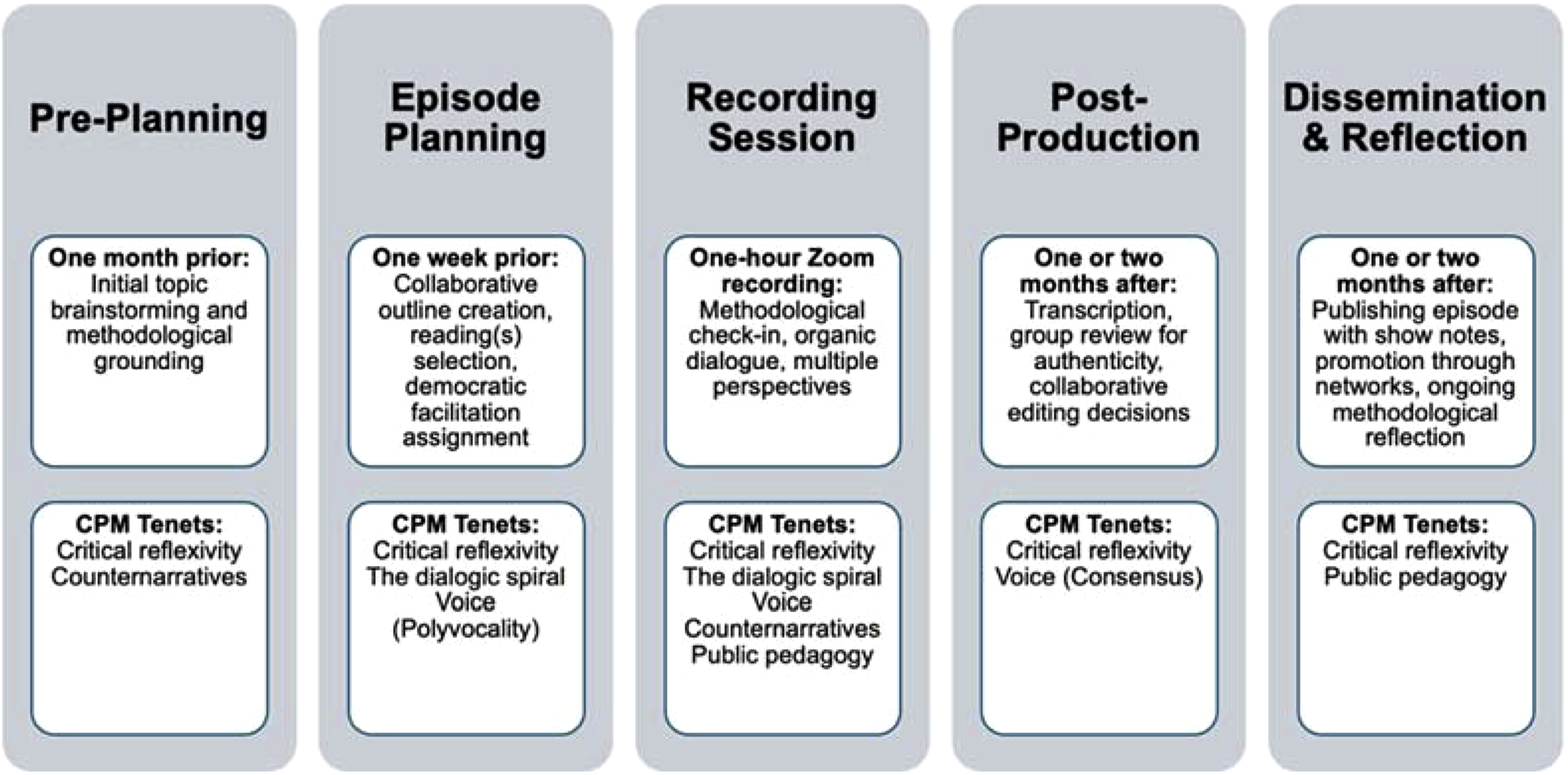
As we look back on the origins of the project, consider our current moment, and plan for its future, drawing from CPM offers a flexible scaffolding in multiple directions: for strengthening our own project, for illustrating what CPM can offer, and for inspiring others to pursue their own critical podcasting projects. Part of this involves considering how our podcasting project aligns with the five key tenets of CPM, some more than others. Figure 1 illustrates the podcasting process for one episode including how the tenets of CPM are interwoven throughout.
Critical Reflexivity
As discussed, critical reflexivity prompts researchers/podcast co-creators to pay ongoing attention to their own entangled identities in relation to the podcasting process. For us, this occurred in planned, unplanned, and ongoing ways. Because we constructed the podcasting project as research, we created a “researcher agreement” in lieu of a research ethics board protocol to be transparent on how the project was to be conducted. If we were to understand ourselves as collectively the researchers and the participants (breaking the usual binary constructed in “human subjects research”), we still wanted to ensure that ethical engagement was explicit and ongoing. The episode topics came from ideas that we were already interested in and comprised a range of thoughts around SEL, including its relationship to social crisis, multispecies entanglements, and cultural appropriation, as well as implications of SEL with systems of oppression (e.g., neoliberalism, settler colonialism, politics) and with culturally-shaped aspects of identity and relationships (e.g., understandings of “self” and “social”). Our creation process proceeded on an episode-by-episode basis, rather than planning out, recording, and editing all episodes in bulk/in phases. We would first meet to discuss the upcoming episode to be recorded the following month. We kept notes of our meetings as well as the planning of each episode (i.e., title, date/time of recording, purpose, relevant but optional readings, reminder about the methodology of the podcast, and outline). In this way, we intentionally practiced a democratic structure and production process.
One specific way in which critical reflexivity occurred was during the first few minutes of each episode, when we made it a habit to share a few methodological and/or theoretical principles or ponderings with listeners. This included briefly explaining how podcasting can count as research in Episode 1 and situating the podcast within a “pedagogy of discomfort” (as conceptualized by Boler, 1999, and also aligning with Edwards-Schuth's call for discomfort as a necessary part of CPM) in Episode 2. We also wanted to be transparent with listeners about our own intersectional identities (e.g., in terms of race, gender, sexuality, and non/indigeneity) and about our positions of power as academics—particularly how we might work to break down academic gatekeeping and liberate knowledge throughout the podcast. Sometimes this work was uncomfortable, as podcasting provided us with the opportunity to re-listen to ourselves and contemplate not only what we were discussing, but also how we were discussing it. During the transcription for Episode 3, “SEL and Neoliberalism,” Emma noted as she transcribed that she had, at least from her own perception as the episode facilitator, “totally took the conversation away from what Jinan had posed about interventionism and neoliberalism … In re-listening, it feels like I kind of plowed over that. Just an insight for the sake of reflection and the podcast-as-research process!” The group discussed this noticing at the beginning of the recording for Episode 4, working to demonstrate to listeners the kind of humility and emotional reflexivity we hope to instill in others, especially when talking critically about SEL. Even though Jinan expressed that she had not actually felt “plowed over” by Emma, we work to maintain a practice of self-awareness and group check-ins as the project unfolds.
The Dialogic Spiral
The tenets of CPM often overlap in practice, as we argue was the case in Episode 5, “SEL and the Social.” In this episode, our reflexive theoretical/methodological offering at the start of the recording pertained to the notion of the “dialogic,” bringing up the dialogic spiral tenet of CPM (San Pedro & Kinloch, 2017). Emma, as the episode facilitator, shared takeaways from an article that contrasts dialectic learning with dialogic learning (Wegerif, 2008). Dialectic learning, drawing on Lev Vygotsky, focuses on how people come to a shared understanding, whereas Mikhail Bakhtin’s notion of dialogic learning entails remaining open to the many layered voices and differences carried into any conversation. The goal of the latter is not to rationally work toward a shared internalization of meaning but to practice an ongoing and playful creativity toward relational possibilities. As Emma described in the episode, dialogic learning means “staying open to the unexpected, letting things mean more than one thing, leaving room for difference.” We agreed that our podcasting feels more dialogic than dialectic, with Adishi commenting how “that’s also the intent of the project” and then inviting a segue into considering how SEL could become more dialogic. The conversation then moved into our intended topics for the episode, but with this explicit, reflexive, and dialogic foundation of connecting our theoretical and topical ponderings to our own practice.
Another way in which the dialogic spiral wove its way through our practice was through the fluctuations in our conversation that would sometimes take us into unplanned directions. For example, in Episode 6, “SEL and Settler Colonialism,” Melvin asked a question about whether/how SEL could move away from treating growth as a one-directional and linear measurement, instead seeing it as something that can happen sideways and outside of planned educational trajectories bound to colonial norms. Emma responded to this question by sharing connections to her own and to a friend’s teaching philosophies, before referencing an article (Aukerman, 2007) recommended a few months prior by a mutual friend of several of the co-hosts. The article is about reading comprehension, not SEL, but pushes against the idea that “comprehension” is interchangeable with “correctly interpreting the status quo meaning of a text.” Although Emma described this example as “a little bit tangential” to Melvin's question, it serves as an example of the organic, relational, interdiscursive, and dialogic ways that our episodes unfolded (not to mention engaging with Melvin's question about nonlinearity in a meta sense, as a nonlinear answer!).
The fluid nature of our dialogue was one of the most enjoyable aspects of the project as we picked up and built on each other’s lines of thinking, taking on the warmth, expression, and nuances that a co-created discussion of sociality and emotionality demands. Edwards-Schuth (2023) notices that this can be seen as a “collaborative autonomy of what is discussed and where it goes… [a] following together of where [it] go[es] dialogically” (p. 107, emphasis in original).
Voice
Acknowledging the ways in which the five tenets of CPM are interconnected, Edwards-Schuth (2023) refers to the dialogic spiral as “the process in which relationships are built, Voice(s) is utilized, and counter-narratives are shared” (p. 101). Polyvocality, the component of Voice that emphasizes multiple viewpoints, tones, and narratives even within a single text or topic, was evident throughout our podcasting project. This occurred between us, as we each offered perspectives about SEL based on our own varied life experiences and positions in relation to it. For instance, Jinan sometimes brought up her previous collaboration with a school district in developing a restorative justice approach to SEL, and Adishi drew from her knowledge as a South Asian woman in sharing her concerns about how SEL can appropriate practices from yoga and mindfulness in ways that flatten, distort, and romanticize political and historical nuances associated with these practices. Polyvocality also occurred within each of us, since we all contain myriad subjectivities and perform different versions or ‘genres’ of ourselves (e.g., our tones and vocabularies sometimes shifted from academic theory, as a lecturer might deliver to a group of students, into shared laughter as one of us delivered a joke in reference to a familiar meme on social media).
Conflict consensus, which entails agreement on the “conditions of possibility” (Rose-Redwood et al., 2018, p. 114) for dialogue despite hard and possibly irreconcilable differences within that dialogue, was prevalent in our podcast mostly through its notable absence. Although we had a collaborative crew of hosts, there was not much dissent or constructive conflict within our various conversations. Our stories tended to resonate with each other, building on each other’s points without deeply challenging them. For example, in Episode 2, “SEL and Social Crisis,” we agreed that there are many social crises occurring at the moment (e.g., mental health crisis, systemic oppression, environmental destruction, climate change) and that SEL can be positioned as a tool to help combat, cope with, or resist them (e.g., Jagers et al., 2019). We brought up many examples to illustrate how SEL actually depends on there being a crisis to resolve. Our conversation about SEL and its relationship to social crisis primarily involved us elaborating on this dependency through different ideas and connections, as opposed to one or some of us challenging the claim or disagreeing with it entirely. In this manner, it sometimes felt like we were in a small “echo chamber” where we agreed with each other. Perhaps this is the result of our group sharing a number of premises about SEL, which led to the creation of the podcasting project in the first place. Or perhaps it is consequential of our experiences in the academy or how some academics speak to each other (e.g., “Thank you for your comment. I agree with X and to build on it, I think Y.”).
Regardless of us frequently agreeing with each other, we were still able to learn from each other and our polyvocal contributions. We do not necessarily view this overarching agreement as a success or a necessity, since creating a “conflict-free” space was not our goal, but we also do not view it as a failure to elicit uncomfortable dialogue (conflict consensus, which occurs at the point when the only agreement is that there is indeed a disagreement, typically emerges from an intensified level of tension that may be unlikely for the content and purpose of our project). The presence or absence of conflict need not attribute a particular value, as this would take away from the dialogical and community-building praxis at the heart of doing CPM.
Counternarratives
Just because there was little conflict among us does not mean we shied away from speaking critically against particular manifestations of SEL. As the title of the podcast suggests, our central purpose was to [redacted word—part of podcast name] or “unsettle” some of the dominant assumptions about SEL that are rarely problematized at a deep level. In Episode 1, “Starting the Conversation: Critical Dialogue Around Social and Emotional Learning,” Tonje brought up “how much weight or power or importance is in that term, ‘SEL.’” She continued: Because yes, we want what [SEL] is to evolve and to better meet the needs of children and youth and educators and society, but then when we have so much weight put into this term, it’s like it’s taken on a life of its own.
Tonje expressed concern about how people sometimes want to “strictly define [SEL] in one way” that becomes “kind of impenetrable.”
“Let’s take a step back,” said Jinan in that first episode, and think about “whose lives” and what “life skills” we are centering when we practice SEL. Brandon asked, “who gets to decide the molding [of students], and for what ends?”
These early snippets of dialogue, followed by many others, display an awareness of the hegemony of dominant narratives and our mission to provide counternarratives throughout every episode. In Episode 2 discussed previously, we contemplated ways of thinking about “crisis” not as an impetus for re-establishing “normalcy,” but as an urgent call for more radical social change. A dominant focus of SEL is to address, control, and (self)-regulate social and emotional crises, but what if we leaned into phenomena of crisis with an awareness of the etymology of “crisis,” meaning “decision point” or “turning point”? In Episode 3, “SEL and Neoliberalism,” we drew from feminist, decolonial, and antiracist perspectives to provide counternarratives to the idea that endless productivity, efficiency, and self-improvement should be lauded as educational (and social-emotional) goals. These counternarratives continued throughout our nine episodes.
Illuminating counternarratives requires a conscious habit of questioning (Giroux, 2000; Ladson-Billings, 1998), and posing questions remains a strong emphasis—and call to action—of our podcast. Those working within the field of SEL can benefit from the counternarratives illuminated across the episodes, so as to better identify and grapple with sociocultural hierarchies. Exposing counternarratives also ties in with the final CPM tenet of public pedagogy and the need to make these dialogues and critiques more publicly accessible.
Public Pedagogy
Lastly, although we produced a publicly/freely available podcast about SEL, we continue to reflect on how accessible our work is and how many listeners we were able to reach in a public pedagogy style. We published our podcast episodes and show notes on Buzzsprout, a platform dedicated to podcast hosting. We chose Buzzsprout because it is a relatively inexpensive platform, it provides a website for our podcast, and it pushes content to a number of popular sites that index and stream podcasts including Spotify, Apple Podcasts, Podcast Addict, Pocket Casts, and Overcast. It also has other features (e.g., soundbites, subscriptions, analytics), but we have not yet engaged more deeply with them as this project is our initial foray into podcasting. Using these features, including sharing other products (e.g., videos, episode transcripts, selected quotes) and linking to social media platforms (e.g., Instagram, TikTok, YouTube), may be useful for disseminating our podcast in the future. Furthermore, while we work to include public news and opinion articles as part of our podcast dialogue, academic literature is frequently featured in planned and unplanned ways across the episodes. This makes sense because our entire group comprises academics, but there is no guarantee that listeners will be able to access or understand the references we are making. We also did not openly and intentionally reach out to communities and listeners in order to directly bring them into our discussions. We created an email address that listeners could contact, but we did not receive any messages except for one individual who emailed us with positive feedback following a conference presentation.
In sum, we moved into Season 2 of the podcast with stronger attention toward our purpose and audience, conceiving of our audience not as an object that we consider when making production choices but as a group of people that can be brought into the fold in some way. There are a number of ways that audience participation can be captured and analyzed (e.g., platform analytics, listener comments, social media interactions). We are novice podcasters and still disseminating our podcast, so we instead imagined who might engage with our work and tried to dialogue with them. We did this by shifting the focus of Season 2 into something more interview-based, inviting guests from a variety of stakeholder positions—moving outside of academia to connect with nonprofit organizations, K-12 districts, and activist groups—to discuss SEL-related topics with us. Even though we consider all collaborators to embody identities of educator, researcher, and activist, including a wider group can help to not only liberate but also create resources and knowledge beyond the walls and jargon of higher education. Including guests, however, required us to adapt CPM to focus on the guests’ ideas and work as enriching our own. We each invited a guest to be on the podcast and bookended the season with reflective episodes that included only the co-hosts (the first episode recapped the history of this podcast and Season 1 as well as framed the purpose of Season 2; the last episode will reflect on the “themes” and insights across the interviews and related it back to our CPM project). This additional layering of interviewing benefited from engagement with research on interviews as a method of data generation (e.g., Fontana & Frey, 1994; Marshall & Rossman, 2016). We conducted these interviews in a semi-structured way where the episode’s facilitator (i.e., the co-host who invited the guest) introduced the episode and the guest, then coordinated the asking of questions. Looking back on Season 2, we find that having more structure helps us to prepare for each guest (e.g., reading about them and their work) and to maintain the flow of each episode. This structure extends to coordinating the technical aspects as well (e.g., guest releases, processing honoraria, completing show notes, sending audio files to the editor). Having guests also helps situate the podcast in the broader SEL community and listeners can hopefully see and feel themselves to be represented through the guest, which increases the podcast’s pedagogical value. Listeners can engage diverse perspectives and multiple ways of thinking about SEL, connect abstract concepts (e.g., from Season 1) to real-world examples to deepen understanding, and participate in collaborative learning as ideas about SEL are co-constructed, contextualized, and debated.
Considerations for Enacting Critical Podcasting Methodology
We now move away from drawing connections between our own project and CPM to offer a set of more general considerations, both production-oriented and rigor-oriented, for enacting CPM as an emerging methodology.
On Podcast Production
Guiding Questions for a Critical Podcasting Methodology Project
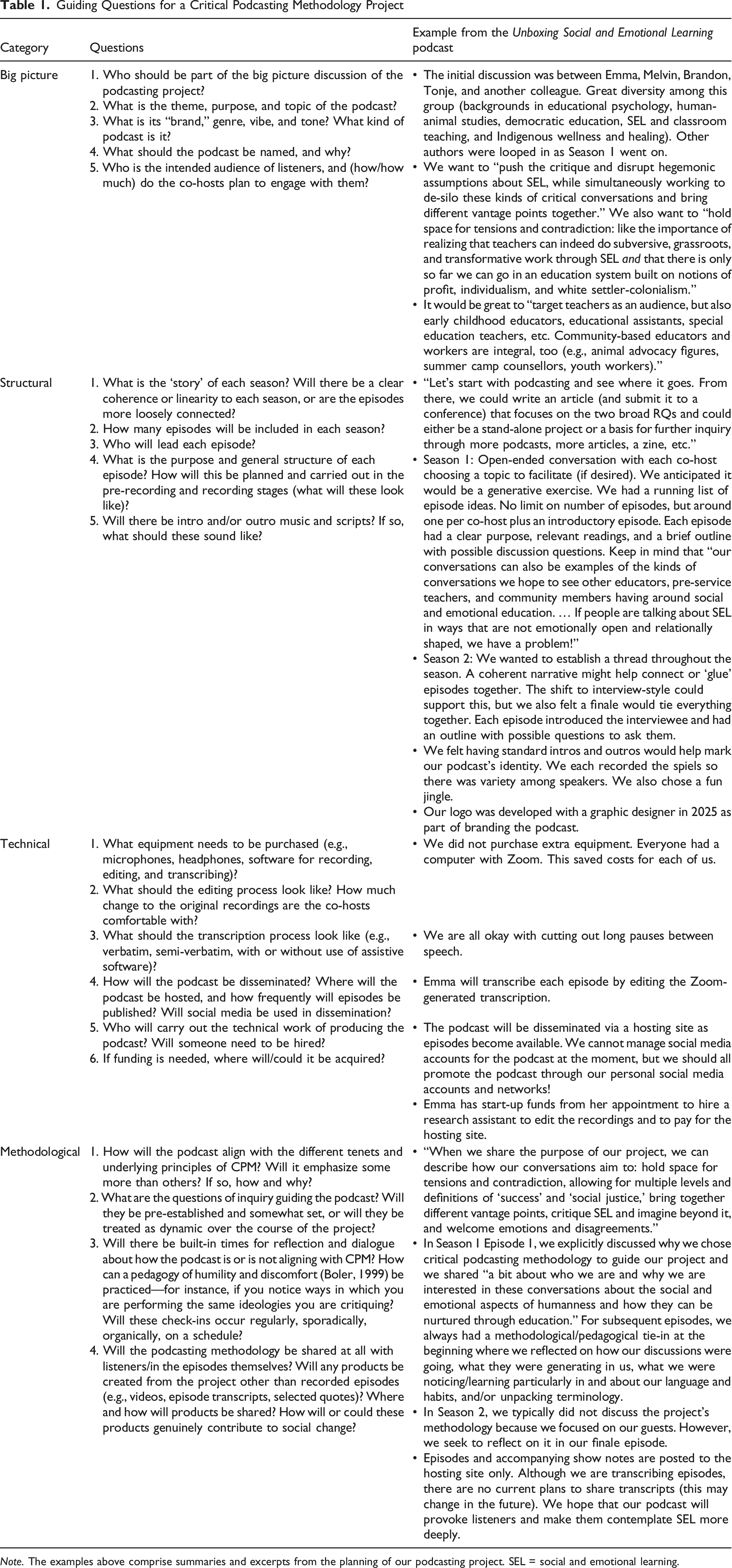
Note. The examples above comprise summaries and excerpts from the planning of our podcasting project. SEL = social and emotional learning.
On “Rigor”
By presenting CPM as a legitimate form of research, questions regarding the rigor, trustworthiness, or evaluability of its quality may arise. Indeed, what makes for a “good” CPM project? What should one look for to determine if researchers were faithful to using CPM? In contrast to foundationalist lists of criteria focused heavily on representational accuracy and consistency (see Leavy, 2020, or Marshall & Rossman, 2016, for summaries of debates on the “validity” of qualitative research), we contend that CPM—and qualitative/arts-based research in general—may be better situated within a set of flexible and contextual “criteria” or critical questions that forefront ongoing ethical engagement and alignment between the inquiry’s means and ends. Sarah Tracy (2010), in offering what she calls “eight ‘big-tent’ criteria for excellent qualitative research” (p. 837), uses the cheesemaking metaphor of “mouthfeel” (p. 839) to describe this alignment, declaring that it would for instance be nonsensical to judge a parmesan cheese based on the purpose of a good brie (or a CPM project based on the purpose of grounded theory or phenomenology). Her eight markers of ‘good quality’ research are: worthy topic, rich rigor, sincerity, credibility, resonance, significant contribution, ethics, and meaningful coherence (Tracy, 2010). Each of these markers is broad and subjective by design, intended to spark meaningful thought and dialogue among researchers rather than to quantify, categorize, or police inquiry itself. Thus, we believe that a “good” CPM project is not one that uses the tenets as a template or a strict checklist. Rather, a “good” CPM project to us is one that strives to apply the tenets as best as possible and that maintains critical attention to the ethics (beyond institutional review board approvals), purpose, means, and alignment of the work. The rigor in CPM is thinking not just about what the project “is,” but what it does in the world and who/what it impacts.
Embracing the public pedagogy tenet of CPM, our podcast as a published public series is a recorded “archive” or text, documenting the dialogical community-building which emerged among co-hosts and invited guests. While certainly making ripples in the SEL educational research community, more time and ongoing exposure will be factors in the “impact rigor.” Like other qualitative research, especially arts-based research, where political change is explicitly the intended outcome and purpose of the research, rigor manifests as praxis toward prefigurative social change—practicing desired future relationships and perspectives in the here-and-now (Raekstad & Gradin, 2020).
Limitations and Methodological Contributions
Although this exploration of CPM offers valuable insights, several limitations merit acknowledgment. Our podcasting project initially began as a reflective exercise among colleagues and evolved into a more systematic methodological endeavor, which may have influenced our early planning and execution decisions—what Lather (1986) describes as the iterative nature of developing openly ideological research approaches. Additionally, as novice podcasters working across two seasons over 3 years, we had limited experience with podcast promotion and dissemination strategies, making it difficult to assess the full impact and reach of our work. Our primarily academic positionalities, while bringing critical perspectives to SEL discourse, may have constrained our ability to fully embody the public pedagogy tenet of CPM, particularly in reaching broader community audiences beyond educational research circles (Giroux, 2000).
These limitations notwithstanding, our work demonstrates that the podcast itself functions as both product and process—a methodological tool that simultaneously generates, documents, and disseminates knowledge through inquiry methods that blur traditional research boundaries (Richardson, 2003). Unlike traditional research where methodology remains largely invisible to audiences, CPM makes the research process transparent and participatory, embodying a post-qualitative approach that collapses conventional boundaries between data collection, analysis, and dissemination phases (St Pierre, 2017). The recorded conversations become data, analysis, and public engagement all at once, creating what Koro-Ljungberg and MacLure (2013) term “emergent methodologies” that resist fixed categorization. This methodological transparency allows listeners to witness knowledge-making in real time, participate in ongoing dialogue, and potentially adapt our approaches for their own critical inquiries. In this way, podcasting transcends its role as mere dissemination vehicle to become a legitimate form of inquiry that can inspire methodological innovation across disciplines.
Conclusion
The hegemonies of the written word and the quantitative/(post-)positivism versus qualitative/interpretivism binary have plagued academic research long enough. In camaraderie with the many others who have worked to disrupt the Eurocentrism of this hegemony and this binary (Abram, 1997; Honan et al., 2018; Magnat, 2018; Smith, 2012; Wynter, 1984), we advocate for valuing a more diverse range of knowledge production methods (like oral dialogue) as potential forms of research. Humans are storytellers by nature, and oral traditions are important and necessary for the transmission and transformation of cultures around the world (Smith, 2012). There is as much to be told and said as there is to be written. ABR has taken on this mission for decades (Barone & Eisner, 2012; Leavy, 2020), promoting visual, auditory, and kinesthetic methods of connecting micro-level experiences or phenomena with macro-level systems, structures, and activism. Through its focus on eliciting and deploying knowledge through participatory means, ABR exceeds the dichotomous positivism/interpretivism options for research and opens new possibilities for embracing the repetition and suppleness of oral storytelling.
Critical podcasting methodology (CPM), as the focus of this article, is a more recently conceived approach to inquiry that builds as a bricolage with and from ABR in addition to critical ethnography, action-based research, and other sound-based and narrative-based fields (Edwards-Schuth, 2023). Our purpose has been to expand on Brandon's introduction of CPM by explaining how its five tenets of critical reflexivity, the dialogic spiral, voice, counternarratives, and public pedagogy have manifested—to varying degrees—in our own podcasting project, Unboxing Social and Emotional Learning. As we have illustrated through our own work, orality can generate critical and constructive dialogue that can be analyzed and broadcast as knowledge. CPM as a methodological framework is also adaptable to different kinds of podcasting (e.g., a discussion among a smaller or larger group of co-hosts, interviewing guests as a group). By sharing with transparency and humility about our own ongoing podcast methodology and offering considerations in the form of open-ended questions, we hope to inspire others to value and engage with the rich possibilities that can come through podcasting as a form of critical research.
Footnotes
Acknowledgments
The authors would like to thank the two anonymous reviewers for their generative feedback on a previous version of this manuscript.
Funding
The authors received no financial support for the research, authorship, and/or publication of this article.
Declaration of Conflicting Interests
The authors declared no potential conflicts of interest with respect to the research, authorship, and/or publication of this article.
Author Biographies
 ).
).