




Abstract
This article develops the concept of Critical Knowledge Interventions (CKIs) as a framework for understanding how anti-essentialist research enacts relevance—not by aligning with external standards, but by intervening in regimes of intelligibility. CKIs consist of three interrelated components: undoing dominant knowledges, redoing alternatives, and a normative driver (epistemic, ethical, political, or emancipatory). Drawing on Discourse Theory, Governmentality Studies, and Assemblage Thinking, the article illustrates how interventions differ in form, force, and orientation. CKI provides scholars with a vocabulary for analyzing and designing critical research as situated epistemic practice, foregrounding relevance as something enacted rather than assumed.
Introduction
Critical scholarship has long challenged the assumption that knowledge is objective, universal, or politically neutral, emphasizing instead its entanglement with power, history, and social structures (Foucault, 1980; Haraway, 2013; Harding, 1991). While traditions of critical theory have often relied on epistemically foundational claims, the notion of critique in this article is grounded in anti-essentialist perspectives. It focuses on the situated practices through which research enacts relevance, rather than appealing to universal standards or norms. From poststructuralist Discourse Theory (Glynos & Howarth, 2007; Laclau & Mouffe, 1985) to feminist epistemology (Alcoff & Potter, 2013; Code, 2018) and decolonial critiques (de Sousa Santos, 2015; Mignolo, 2009; Smith, 2021), and from Science and Technology Studies (STS) to assemblage thinking (Deleuze & Guattari, 1988; Law, 2004; Marcus & Saka, 2006), diverse strands of thought converge on the view that knowledge is contingent, constructed, and politically situated. Despite differences in orientation and purpose, these traditions share a commitment to anti-essentialism—a refusal to treat analytical categories, identities, methods, or truths as fixed or natural (Braidotti, 2013; Butler, 2011).
Yet as these anti-foundational epistemologies have gained ground in critical research and the interpretive social sciences, many scholars still find themselves operating within academic social systems structured by mainstream criteria of rigor and relevance—standards that presume stable methods, objective distance, and universal applicability (Denzin, 2009; Guba & Lincoln, 1994). These frameworks often remain ill-equipped to account for research that is grounded in situated knowledges (Haraway, 2013), political commitments, or epistemic justice (Fricker, 1999; Medina, 2013). In this context, traditional markers of scholarly value—such as objectivity, generalizability, and neutrality—lose their “explanatory power.” Instead, new conceptual vocabularies are needed to articulate what makes critical work matter: not in spite of its political and epistemological commitments, but because of them. Recent critiques within post-qualitative inquiry echo this concern, emphasizing how conventional methodological benchmarks often obscure the ethical and political dimensions of knowledge work (MacLure, 2013; St Pierre, 2021).
This paper introduces the concept of Critical Knowledge Interventions (CKIs) as a meta-theoretical framework for articulating how critical research enacts relevance. CKI are not methods or techniques, but a conceptual lens for identifying how anti-essentialist scholarship intervenes in regimes of knowledge and power. They make visible how critique operates—how it destabilizes dominant formations (undoing) and reconfigures possibilities for knowing and relating (redoing).
At the same time, CKI functions as a vocabulary for designing research that is deliberately disruptive, situated, and generative. Positioned at the intersection of epistemology, methodology, and critique, the CKI framework recasts critical scholarship not just as interpretation, but as intervention—normatively driven, epistemically situated, and politically consequential.
In this sense, the CKI framework operates both analytically, as a way of reading existing research, and strategically, as a guide for designing future critical scholarship. Rather than aligning with external standards of objectivity or utility, CKIs enact relevance through connecting the research to four normative drivers. This framework highlights how scholarship can deliberately reshape the politics of intelligibility—that is, whose realities, voices, and worlds are rendered knowable and legitimate. It resonates with recent work on epistemic disobedience and knowledge plurality (Bhambra, 2020; Mignolo & Walsh, 2018), and foregrounds critique as a situated, performative act. In what follows, I illustrate how this form of knowledge interventions is enacted across three anti-essentialist traditions: Discourse Theory, Governmentality Studies, and Assemblage Thinking.
While recent contributions such as Thinking with Theory in Qualitative Research (Jackson & Mazzei, 2022) have foregrounded the value of thinking with theory in qualitative inquiry, this article focuses on a prior question: how critical research enacts relevance in the first place. Rather than centering the application of theory in analysis, it develops the concept of CKI to examine how anti-essentialist research participates in the contestation and reconfiguration of epistemic regimes.
As such, CKI is both an analytical framework for interpreting existing studies and a reflexive orientation for designing new ones. It enables scholars to identify how critique unfolds through particular knowledge practices, and to strategically articulate the stakes and intentions of their own interventions in relation to regimes of intelligibility. By tracing convergences between Discourse Theory, Governmentality Studies, and Assemblage Thinking, the paper offers a composite vocabulary for understanding how critical research enacts knowledge interventions. These traditions are not only theoretical lenses but also practical exemplars of how research can undo dominant truths and redo alternative realities. The CKI framework synthesizes these dimensions into four normative drivers—epistemic, ethical, political, and emancipatory—not as properties derived from particular traditions, but as analytic orientations for diagnosing how critique is enacted and for guiding the design of future interventions
Recent work has further emphasized the urgency of these concerns. For instance, scholars in post-qualitative and decolonial traditions argue for rethinking knowledge not only in terms of method but as a site of ontological struggle (Mignolo & Walsh, 2018; St Pierre, 2021). These interventions reflect a broader shift in critical inquiry: away from methodological foundationalism and toward creative, situated, and politically committed forms of knowing. Mazzei (2016), for example, challenges representational assumptions in qualitative research and proposes voice as an affective, distributed, and emergent force. This paper contributes to that shift by developing a conceptual vocabulary for how such knowledge practices become epistemically and politically relevant through CKI.
The concept of Critical Knowledge Interventions (CKIs) does not claim to introduce a new epistemology or to break radically with established anti-essentialist traditions. Its foundations lie firmly in relational, poststructuralist, feminist, and decolonial thought — traditions that have long insisted on the constructed, situated, and power-saturated nature of knowledge. What CKI contributes, however, is a conceptual vocabulary for articulating how critical research enacts relevance through situated epistemic interventions.
Rather than offering a method or normative program, CKI provides a way of describing and reflecting on what many critical scholars already do: destabilize dominant formations of meaning while assembling alternative ways of knowing and relating. The framework’s dual structure—undoing and redoing—gives analytical traction to these interventions, and the four normative drivers (epistemic, ethical, political, and emancipatory) offer a way to make the stakes of critical research legible without reducing them to utility or consensus.
In this sense, CKI aligns with and contributes to post qualitative inquiry by helping scholars name the interventions they perform—not as fixed outcomes, but as deliberate, normatively charged movements within contested fields of intelligibility. While it does not seek to replace theory, it does seek to make critical theory actionable as both analysis and design. The value of CKI does not lie in offering a novel ontology or methodology. Rather, it lies in helping researchers ask better questions: What exactly does this critique do? Whose world does it help unmake? What futures does it enable? And on what terms do we claim that this intervention matters?
The remainder of the paper is organized as follows. Section 2 elaborates the conceptual challenge of defining “relevance” in anti-essentialist scholarship and frames it as a problem of epistemic justification. Section 3 traces how three major theoretical traditions—Discourse Theory, Governmentality Studies, and Assemblage Thinking—enact knowledge interventions through distinct yet overlapping modalities. Section 4 develops the core conceptual contribution of the paper: a framework of four normative drivers that articulate how and why interventions matter. Section 5 discusses the methodological implications of treating research as knowledge intervention and reflects on how the “double gesture” of critique can guide the design and evaluation of critical scholarship. The conclusion returns to the stakes of this project and suggests future directions for conceptual and empirical engagement.
Relevance and Anti-essentialist Epistemology
Relevance is a deceptively simple concept—especially for scholars working within anti-essentialist traditions. In mainstream policy and social science contexts, relevance is typically equated with instrumental utility, measurable impact, or alignment with institutional priorities. This framing presupposes a stable epistemic foundation: that knowledge can and should be evaluated according to universal standards of truth, objectivity, or generalizability (Gibbons et al., 1994). For critical researchers, however, such criteria not only fail to capture the political and ethical stakes of their work—they often obscure the very interventions that make it relevant. Anti-essentialist traditions—including poststructuralism, feminist epistemology, postcolonial and decolonial critique—challenge this framing at its core. They argue that categories such as “problem,” “solution,” and “impact” are not neutral descriptors, but effects of historically situated power/knowledge formations (Foucault, 1991; Haraway, 2013; Smith, 2021). From this perspective, what is considered “relevant” knowledge depends not on objective standards, but on which regimes of intelligibility dominate—and which are suppressed.
The concept of CKI responds to this epistemological impasse. Rather than rejecting relevance altogether, it redefines relevance as something enacted: as a situated intervention in contested fields of meaning, authority, and possibility. CKI provides a language for diagnosing how critical research intervenes in epistemic regimes—and for strategically justifying those interventions based on their normative orientations. This requires moving beyond reactive critique and asking: what formations of knowledge require disruption? What alternatives are being assembled? Who gains intelligibility, voice, or agency as a result? Relevance, in this view, is neither external nor fixed, but must be enacted through deliberate acts of epistemic reconfiguration.
This poses a dilemma for critical scholars. On one hand, they reject the, often quasi-positivist criteria of mainstream research evaluation. On the other, they still seek to defend the importance, urgency, and transformative potential of their work. What is needed, then, is not just a critique of dominant standards of relevance, but a way to rethink relevance itself: to understand it not as a given, but as something enacted through epistemic intervention.
The anti-essentialist examples of this paper—Discourse Theory (Laclau & Mouffe, 1985), Governmentality Studies (Foucault, 1991; Rose, 1999), and Assemblage Thinking (Deleuze & Guattari, 1988; Marcus & Saka, 2006)—all implicitly grapple with the politics of relevance, even if they do not always name it as such. Each approach interrogates how dominant epistemic formations are stabilized, and how they might be disrupted or reconfigured. Yet across these traditions, the question remains underdeveloped: how can critical research make a claim to relevance without appealing to foundationalist logics? While these traditions carry different ontological implications, this article foregrounds the epistemological dimension of anti-essentialism—focusing on how critical research practices render knowledge relevant through situated interventions.
This is the fundamental question of this paper. I argue that relevance in anti-essentialist scholarship can be addressed and assessed through by using the language of CKI—a concept that urges scholars to actively take responsibility for how and why they reshape the field of intelligibility from a situated, strategic and normative position. Relevance, in this view, is not to hold a mirror up to the world, but to gain traction in a political and epistemological struggle over what can be seen, said, and known.
This raises a further question: how do the core anti-essentialist traditions themselves perform such interventions in practice? The next section traces how Discourse Theory, Governmentality Studies, and Assemblage Thinking enact the double gesture of destabilizing existing epistemic formations while constructing new ones—offering insight into the modalities through which critical scholarship intervenes in the field of knowledge.
Traditions of Critical Knowledge Interventions
If critical research enacts relevance through intervention, then understanding how particular traditions intervene becomes central. This section examines how three influential anti-essentialist approaches—Discourse Theory, Governmentality Studies, and Assemblage Thinking—perform knowledge interventions that exemplify the double gesture at the heart of the CKI framework: the simultaneous destabilization of dominant regimes of intelligibility and the rearticulation of alternative ways of knowing and relating. In these brief illustrations each exemplifies, in distinct ways, what later will be developed as a “double gesture” of CKIs, the simultaneous destabilization of dominant knowledge formations and the construction of alternative ways of seeing, knowing, being and acting.
Discourse Theory: Rearticulating the Political
Discourse Theory, as developed by Laclau & Mouffe (1985), offers a robust conceptual framework for understanding how knowledge interventions engage politically. Central to their approach is the idea that social reality is constituted through discourse—meaning is not given, but constructed, contested, and rearticulated. As such, discourse is never fully fixed but stabilized temporarily through hegemonic articulations that present contingent arrangements as necessary or natural.
A discursive intervention, therefore, is not about representing a pre-given reality but about transforming the conditions under which reality is rendered intelligible. This is where the double gesture becomes operative: an intervention first disrupts or deconstructs dominant articulations (undoing) and then rearticulates social imaginaries in ways that open up new political possibilities (redoing).
A paradigmatic example of a Critical Knowledge Intervention can be found in Ernesto Laclau’s On Populist Reason (2005), where he radically reconfigures how populism is understood within political theory. Rather than treating populism as a pathological deviation from democratic norms—a view deeply entrenched in liberal political thought—Laclau reframes it as a general political logic through which collective identities are constituted. The intervention he performs is not aimed at refining existing descriptions of political reality, but at unsettling the epistemic assumptions that render certain forms of politics intelligible while pathologizing others.
The undoing in On Populist Reason targets the discursive formations that portray populism as irrational or dangerous. Laclau destabilizes this framing by showing that all political formations depend on contingent articulations around signifiers whose meaning remains open. His concept of the empty signifier illustrates how unity is never given but constructed through equivalent chains that gather together diverse demands under a common banner. Through this gesture, he breaks down the presumed neutrality of liberal political categories and exposes their ideological function.
The redoing in Laclau’s intervention consists in rearticulating the very conditions under which political subjects and collectivities become possible. By asserting that antagonism, hegemony, and discursive struggle are not threats to democracy but its very substance, Laclau reopens the space of the political. This move does not provide a prescriptive model for populist politics, but it enables new ways of imagining and enacting collective agency. As such, the intervention operates on the level of conceptual reconfiguration: it makes room for political subjectivation where liberal theory sees only distortion.
The normative motor driving this intervention is primarily epistemic and emancipatory. Epistemically, it redefines what counts as legitimate political thought and action—what is politically intelligible. Emancipatorily, the intervention affirms the contingency of the social and the openness of political identity, resisting closures that foreclose alternative futures. It is not the formulation of new norms that drives the intervention, but the reclamation of contingency as a condition of collective agency.
Seen through the CKI framework, Laclau’s work performs a critical intervention that makes populism thinkable in new ways, not by stabilizing its meaning, but by demonstrating its structural necessity within any political order. It thereby reorients the field of political theory itself. At the same time, the framework also clarifies what the intervention does not do: it leaves the ethical and material implications of populist subjectivation largely unexamined. That is not a flaw, but a boundary—one that CKI as a framework helps make visible. It enables us to read not only what an intervention accomplishes, but where its limits begin.
Governmentality Studies: Problematization and Rationality
Governmentality Studies, rooted in the work of Foucault (1991), offers a powerful analytic for understanding how knowledge operates as a form of power. Rather than focusing on overt domination, this approach examines the subtle ways in which knowledge configures what is thinkable, doable, and governable. Knowledge here is not a neutral tool but an active force in shaping subjectivities, norms, and institutions. The central methodological gesture is problematization—a practice of rendering the seemingly self-evident into objects of critical inquiry by tracing how certain phenomena come to be understood as problems that require intervention.
A compelling example of a Critical Knowledge Intervention grounded in governmentality studies is found in Tania Murray Li’s The Will to Li (2007), where she analyzes how development operates as a rationality that renders political questions technical. Drawing on Foucault’s analytics of government, Li examines how poverty, land tenure, and indigeneity are problematized through expert knowledge, bureaucratic procedures, and interventionist logic. Her work does not aim to disprove development as ineffective, but to question the epistemic and political formations that make it appear necessary, neutral, and governable.
The undoing in Li’s intervention consists in her diagnosis of “rendering technical” as a governmental technique. By showing how deeply political and contested issues are framed as administrative or technical problems, she destabilizes development discourse from within. This undoing is epistemic in form: it exposes how knowledge practices obscure the very relations of power and history they claim to address. Rather than simply denouncing development outcomes, Li interrogates the knowledges and categories through which development knows its objects—and renders them actionable.
The redoing in her intervention is more modest, but nevertheless significant. While Li does not propose a new framework for development practice, she reconstructs the field of intelligibility in a way that foregrounds resistance, contradiction, and alternative life-worlds. She traces how indigenous actors maneuver within and against development regimes, enacting forms of agency that defy the rationalities imposed upon them. This redoing is diagnostic rather than prescriptive, but it reintroduces political complexity where technocratic clarity had prevailed. It invites the reader to imagine development otherwise, even without offering a programmatic alternative.
The normative motor driving this intervention is primarily epistemic and political. Epistemically, Li challenges the authority of expert knowledge and calls attention to how problems are constituted through particular ways of seeing and knowing. Politically, she foregrounds the exclusions and silences produced by development discourse and brings into view the actors and struggles that are rendered invisible or irrational within its frame. An ethical or emancipatory register is not thematized explicitly, though her attentiveness to the violence of abstraction and the conditions of subaltern life carries an implicit ethical charge.
Through the lens of CKI, Li’s work enacts a situated intervention into the regimes of intelligibility that govern development. Its strength lies not in offering alternatives, but in epistemologically shifting what counts as a problem, who is authorized to speak, and what forms of life are rendered knowable. At the same time, the CKI framework helps illuminate what remains unresolved: the generative dimension is latent rather than elaborated, and the ethical stakes, while present, remain indirect. By distinguishing between what is undone, what is rearticulated, and what normative force animates these moves, CKI allows us to grasp the specificity of Li’s intervention—its contribution, its orientation, and its limits.
Assemblage Thinking: Tracing Emergence and Redistribution
A third example of a Critical Knowledge Intervention can be found in the work of Stephen Collier and Aihwa Ong, particularly their influential introduction to Global Assemblages (2005). In contrast to totalizing critiques of neoliberalism or globalization as coherent systems, Collier and Ong propose an analytic that foregrounds heterogeneity, partiality, and situatedness. Their focus on how policies, norms, technologies, and forms of expertise are assembled in specific contexts constitutes a deliberate break with structuralist and universalist modes of explanation. This is a clear epistemic undoing: their intervention challenges the dominant impulse to explain global transformations through singular logics, whether economic, cultural, or biopolitical.
Rather than treating neoliberalism as a unified ideological or institutional project, Collier and Ong show how it takes form through contingent combinations of elements—legal reforms, market devices, bureaucratic techniques, and affective investments. This analytical move destabilizes inherited categories and reorients attention toward the complex and uneven processes through which governance is enacted. In doing so, it interrupts the reproduction of binary frameworks such as global/local or state/market, and instead traces the specificity of assemblages in formation. This undoing is not only deconstructive; it is diagnostic, seeking to make visible the workings of power at multiple, intersecting scales.
The redoing in their intervention lies in the proposition of an alternative analytic sensibility. Rather than offering a new model of explanation, this sensibility calls for a mode of inquiry that attends to emergence, mobility, and situated articulation. It invites researchers to resist explanatory closure and to remain attuned to how forms of governance are reconfigured in specific settings. The redoing here is epistemological and methodological: it generates new ways of knowing and studying global phenomena without prescribing normative outcomes.
The normative motor animating this intervention is primarily epistemic. Collier and Ong seek to displace dominant ways of knowing by emphasizing multiplicity, contingency, and contextual specificity. There is also an ethical impulse—though implicit—in their sensitivity to how policy and expertise operate unevenly across space and population. However, political and emancipatory dimensions remain largely underarticulated. Their focus on complexity and emergence offers little guidance on how assemblages might be contested, transformed, or normatively evaluated. This is not a flaw of the framework itself, but a reflection of the type of intervention it performs.
Viewed through the lens of CKI, Collier and Ong’s work constitutes a critical intervention that reorients how global governance is conceptualized and studied. It enacts relevance not through generality or prescriptive clarity, but through methodological reframing and epistemic innovation. At the same time, the CKI framework helps identify the boundaries of this intervention: it highlights the limited development of political stakes and the absence of explicit ethical or emancipatory commitments. This is precisely what CKI as an analytic affords—it enables us to see not only what a research intervention does but also how it does it, and where its force and silence reside.
These examples were not selected to represent entire fields, but to demonstrate how distinct strands of anti-essentialist thought enact epistemic interventions through different conceptual and methodological strategies. These three illustrations—drawn from discourse theory, governmentality studies, and assemblage thinking—demonstrate how critical scholarship can intervene in regimes of intelligibility through distinct but comparable modalities. Each example enacts a double gesture: an undoing of dominant epistemic formations and a redoing that reconfigures what is thinkable, sayable, and actionable. Yet what becomes equally clear through the CKI framework is that interventions differ not only in form and orientation, but in intensity, ambition, and normative transparency. Laclau redefines the political itself, but leaves its lived effects and ethical consequences underdeveloped. Li destabilizes development rationalities and reopens space for political complexity, but does not elaborate the generative dimension. Collier and Ong displace totalizing critique through methodological innovation, yet remain largely agnostic to the political and emancipatory stakes of their analysis.
The critical force of CKI lies not only in its capacity to map such variations, but in its ability to pose questions that sharpen the demands we place on critical research: What kind of undoing is being performed—and for whom? What forms of redoing are imagined, and which are foreclosed? Which normative registers are activated, and which are silenced? In this sense, CKI is more than an interpretive lens; it is a tool for immanent critique, capable of identifying the absences, evasions, and contradictions that haunt even the most well-intentioned critical interventions. It invites researchers to not only ask how knowledge matters, but to take responsibility for how it intervenes—and with what stakes.
Normative Drivers of Relevance in Anti-essentialist Research
If the double gesture—of deconstructing existing knowledge formations and proposing new configurations—is the defining mode of intervention in anti-essentialist research, the question arises: what makes such interventions worth doing? Not every act of disruption or rearticulation is inherently relevant. Relevance in this context must rest on deeper normative and epistemological grounds—reasons why intervening in a particular knowledge formation is not just possible, but necessary and urgent.
To address this, I identify four interrelated normative drivers that help anchor the relevance of knowledge interventions: epistemic, ethical, political, and emancipatory. These drivers clarify why certain formations of knowledge demand interruption, and what is at stake—intellectually, socially, and materially—in transforming them. They are not metrics or criteria in a conventional sense, but diagnostic lenses that guide how interventions can be assessed and justified within anti-essentialist scholarship.
Importantly, these drivers are not tied to specific theoretical traditions. While the following examples draw from Discourse Theory, Governmentality Studies, and Assemblage Thinking, the drivers themselves can be mobilized across a wide range of epistemological frameworks. A single intervention may activate one or more of these dimensions depending on its context, intention, and stakes. Each driver represents a normative orientation toward what makes knowledge matter: how it is produced, what effects it has, what spaces it opens or forecloses, and what futures it opens doors towards. Crucially, these drivers are often at work simultaneously, reflecting the entangled nature of critique and transformation in situated research practices. The following sections elaborate each normative driver, illustrating how they illuminate the stakes and value of intervention.
Epistemic Driver: Intervening in Regimes of Truth
The epistemic driver of relevance stems from a commitment to disrupting what Foucault (1980) referred to as regimes of truth—those institutionalized systems of knowledge that present particular configurations of meaning as objective, neutral, or inevitable. Within anti-essentialist research, epistemic interventions matter when they expose the historically contingent, socially constructed, and politically saturated nature of what is taken as “truth.” This is not a call to abandon truth claims altogether, but to scrutinize the conditions under which some truths become dominant while others are excluded, marginalized, or rendered unintelligible.
Knowledge interventions, from this perspective, are epistemically relevant when they make visible the assumptions, categories, and logics that underwrite hegemonic worldviews. For example, Laclau and Mouffe’s (1985) critique of essentialist political categories such as “the working class” or “the people” is epistemically significant not simply because it destabilizes fixed identities, but because it reveals the contingent discursive operations through which these identities are constructed, sustained, and rendered politically effective.
Assemblage thinking contributes to this effort by tracing how seemingly coherent entities—like “the global,” “the state,” or “the subject”—are assembled through heterogeneous elements and practices. Such analysis expands the epistemic field by asking how knowledge is made, through which alliances, technologies, and affective investments. Similarly, work in Governmentality Studies shows how practices like measurement, classification, and expertise function as epistemic technologies that do not merely represent reality, but actively shape it.
In all of these cases, the epistemic driver is not concerned with replacing one truth with another, but with unsettling the very authority of closure—reopening space for alternative knowledges, suppressed narratives, and marginalized ways of knowing. It is this pluralizing impulse that marks the epistemic dimension of relevance in anti-essentialist scholarship: not the accumulation of more knowledge, but the expansion of what can be known, by whom, and on what terms.
Ethical Driver: Making Visible the Consequences of Knowledge
The ethical dimension of knowledge intervention concerns the lived consequences of dominant epistemic formations—how they shape the possibilities of recognition, voice, and action for different subjects. Whereas the epistemic driver focuses on how knowledge stabilizes what can be known, the ethical driver asks: what are the effects of knowing in this way, and for whom? This concern aligns with feminist, postcolonial, and Indigenous critiques that have long emphasized the violence embedded in categories and frameworks that present themselves as neutral or objective (Haraway, 2013; Simpson, 2020).
Ethical relevance, in this context, is not simply about moral intentions or normative declarations. It emerges through critical attention to the exclusions, silences, and misrecognitions that dominant knowledge practices produce—often unintentionally. An ethical knowledge intervention makes visible the human and more-than-human stakes of how knowledge is formed, circulated, and applied. It foregrounds responsibility for knowledge’s effects without presuming the possibility of pure or innocent scholarship.
A powerful example of ethical intervention can again be found in Tania Li’s The Will to Li (2007). Her analysis shows how development discourse constructs “improvable subjects” by positioning certain populations as lacking, deficient, or in need of transformation. These framings are not merely descriptive; they carry ethical weight by delimiting what forms of life are considered valuable, governable, or disposable. Her work invites scholars to recognize how efforts to “help” or “improve” often obscure asymmetries of power, erase local knowledge, and reproduce dependency.
The Ethical driver, then, aims to not simply critique—they call for care: care in how we represent others, in how we name problems, and in how we position ourselves as knowers. This includes reflecting on the conditions of our own research practices, institutional affiliations, and discursive habits. It means asking not only what knowledge says, but what it does, and who bears the cost.
In anti-essentialist scholarship, ethical relevance is enacted when research refuses the abstraction of lives into categories and instead stays attentive to complexity, entanglement, and consequence. Such work acknowledges that knowledge is never innocent, and that ethical responsibility is inseparable from epistemic action.
Political Driver: Dislocating the Order of the Possible
The political driver of knowledge intervention is concerned with how epistemic formations help structure the field of political possibility—what Laclau and Mouffe (1985) describe as the “hegemonic order.” Within this order, meaning is temporarily stabilized, identities are fixed, and the range of viable political claims is circumscribed. Knowledge becomes politically relevant when it dislocates this stability, unsettling the frameworks that determine which actors can speak, what demands can be voiced, and which futures can be imagined.
From this perspective, political interventions do not merely critique existing power arrangements; they reconfigure the symbolic terrain on which struggles are fought. They alter the terms of intelligibility—reshaping how problems are defined, who is seen as a legitimate political subject, and what counts as a credible claim. For instance, when Laclau (2005) reframes populism not as a deviation from democratic reason but as a political logic rooted in the formation of collective identities through equivalence, he expands the field of political articulation. Populism is redifined into the core of the political. This move is not only conceptual, but strategic: it opens space for rethinking coalition-building, representation, and political agency beyond liberal norms.
The political driver thus emphasizes the strategic potential of theory to rearticulate power relations—not necessarily by prescribing action, but by changing what is sayable and doable. As Mouffe (1999) argues, the task of critical theory is not to withdraw from politics but to engage in agonistic contestation: reconfiguring the symbolic boundaries of what constitutes the political, the public, and the just.
Assemblage thinking contributes to this project by decentralizing agency and drawing attention to the distributed nature of power. It enables political interventions that do not rely on sovereign actors or ideological coherence, but instead mobilize affect, infrastructure, and spatial arrangements as sites of contestation. Likewise, governmentality studies show how political authority is exercised through dispersed techniques—making possible interventions that target not the state as such, but the epistemic norms that govern its logic.
In all of these cases, the political driver of relevance lies in the recomposition of the possible: expanding the imaginary through which alternatives to the present can be articulated. Political knowledge interventions are not necessarily oriented toward policy change or consensus formation. Instead, they make space for dissensus, for the unsettling of dominant logics, and for the emergence of new political subjectivities. Relevance here means refusing the closure of meaning and insisting on the contingency—and contestability—of the social.
Emancipatory Driver: Opening Paths for Justice and Becoming
The emancipatory driver of relevance foregrounds the transformative aspiration of critical scholarship—its capacity not only to critique existing knowledge formations, but to open up new modes of living, relating, and becoming. While anti-essentialist traditions often express caution toward universalizing claims or prescriptive blueprints, many theorists nonetheless insist that critique must be oriented toward conditions of justice, freedom, and transformation (de Sousa Santos, 2015; Deleuze & Guattari, 1988; Fraser, 2014). This normative impulse does not emerge despite anti-essentialism, but from within it: from a recognition that if knowledge is constructed, it can also be reconstructed otherwise.
Emancipatory relevance is enacted when knowledge interventions help render alternative futures thinkable and actionable. It is not about offering utopian solutions, but about amplifying cracks in the present—moments where dominant logics falter and new arrangements begin to emerge. Assemblage thinking is particularly generative here, as it emphasizes becoming over being, and transformation over essence. Its ontological orientation toward multiplicity and motion resonates with an epistemological commitment to tracing how alternative futures are made thinkable and actionable. What matters, then, is tracing and supporting those movements that escape capture, that forge new associations, desires, and social formations.
Importantly, the emancipatory driver also calls for imaginative labor. It asks scholars to do more than deconstruct—to actively engage in the speculative and constructive task of mapping potentialities. This can mean identifying the conditions under which other worlds are being built, often in the margins, and making them visible as sites of knowledge and agency. It can also involve experimenting with modes of thought and practice that deviate from dominant epistemologies—modes that emerge from feminist collectives, Indigenous resurgence, queer world-making, or climate justice struggles.
Deleuze and Guattari (1988) emphasize the idea that to write is to become, not to be—an insight that also applies to theorizing. To theorize from an emancipatory position is to risk imagining the world differently, without guarantees. Emancipatory interventions are thus not defined by finality or correctness, but by their capacity to unsettle the present and orient thought toward what is yet to come.
Four Normative Drivers of Knowledge Intervention.
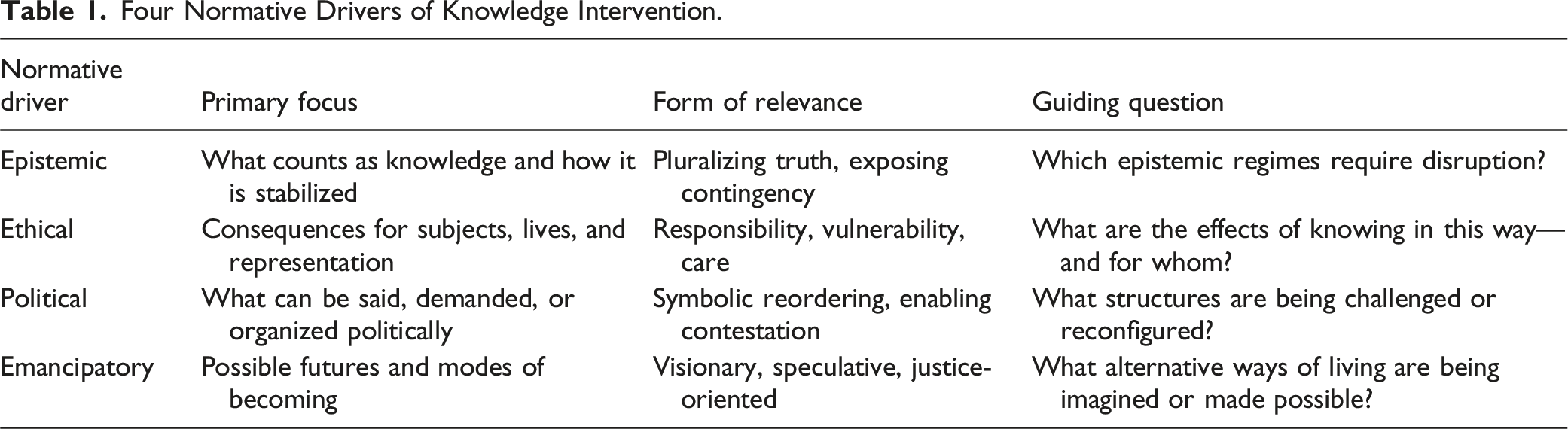
While the four normative drivers often overlap in practice, it is crucial to maintain their conceptual distinction. This is especially true for the political and the emancipatory orientations, which may appear similar but operate in different registers. The political driver refers to interventions that contest existing power relations, often by exposing exclusion, marginalization, or asymmetries within dominant epistemic regimes. It includes forms of solidarity with ongoing struggles—research that positions itself alongside social movements, marginalized communities, or critical traditions, not to represent them, but to amplify, support, or complicate their claims. It works within a given regime of intelligibility, aiming to redistribute power or expand recognition.
In contrast, the emancipatory driver seeks to break with or move beyond dominant frames altogether. It is oriented toward ontological openings: new ways of knowing, being, and relating that cannot be fully captured within existing categories. Emancipatory interventions often involve speculative, decolonial, or radically relational imaginaries that challenge the very terms of political subjectivity and epistemic legitimacy. Where the political driver unsettles hierarchies within the frame, the emancipatory one gestures toward the possibility of another frame entirely.
Methodological Implications: Designing Research as Critical Knowledge Interventions
To understand how anti-essentialist traditions make knowledge interventions possible, we must first specify the kinds of moves these interventions involve. Despite their different ontological commitments, each of the three traditions engages in practices that either dismantle existing epistemic structures or build new conceptual and analytical frameworks. These practices can be clustered into two broad modalities: destructive and creative.
Destructive Moves: Deconstruction, Problematization, Deterritorialization
Destructive interventions aim to disrupt the epistemic infrastructures that render certain categories, identities, and social arrangements as self-evident, rational, or necessary. In Discourse Theory, this takes the form of deconstruction—a practice of exposing the internal tensions, exclusions, and contingency within hegemonic discourses (Laclau & Mouffe, 1985). The goal is not to disprove a discourse on empirical grounds, but to demonstrate its temporariness, thereby opening it to contestation and rearticulation.
In Governmentality Studies, the parallel practice is problematization, a Foucauldian method that historicizes and denaturalizes taken-for-granted concepts by asking: how did this become a “problem”? (Dean, 2009; Foucault, 1991). Problematization reveals the political and epistemic conditions under which categories such as “risk,” “development,” or “governance” acquire coherence and authority.
Assemblage Thinking engages in deterritorialization, a Deleuze–Guattarian move that disaggregates seemingly stable entities into dynamic constellations of heterogeneous elements (Deleuze & Guattari, 1988). This practice dissolves the boundaries of fixed categories by tracing the affective, material, discursive, and relational forces that constitute them. Rather than critique from an external standpoint, deterritorialization intervenes by unmaking coherence from within.
Importantly, these destructive gestures are not acts of nihilism or negation. They serve a generative function: to loosen the grip of foundationalist assumptions and create space for alternative epistemic arrangements. Jackson and Mazzei’s (2022) argue that such moves allow the researcher to “stay with the trouble” of ambiguity and multiplicity. Rendering the familiar strange is not the endpoint, but the condition for imagining otherwise.
Creative Moves: Articulation, Reconfiguration, Reterritorialization
Creative moves build on the disruptions introduced by destructive moves, but go further: they assemble alternative ways of knowing, relating, and acting. If the destructive gesture clears space, the creative gesture populates that space with new epistemic possibilities. In anti-essentialist research, this creative dimension is not a return to stable foundations or normative certainty, but a strategic rearticulation of meaning that remains open, contingent, and situated.
In Discourse Theory, this process is captured by the concept of articulation—the act of forging new chains of meaning by connecting previously unlinked signifiers (Laclau & Mouffe, 1985). Articulation is a political and epistemological practice: it does not simply describe reality, but constructs it. By rearticulating key terms (e.g., “democracy,” “populism,” and “the people”), researchers and political actors make possible new forms of subjectivity, identification, and collectivity.
In Governmentality Studies, creative moves often take the form of reconfiguration—a reassembling of rationalities, technologies, and subject positions that opens up space for non-hegemonic practices of governance or resistance. Scholars like Tania Li (2007) and Nikolas Rose (1999) show how power operates not just by repression, but by shaping what can be thought and done. By mapping alternative assemblages of power/knowledge, researchers illuminate cracks in the apparatus—moments where counter-conduct becomes possible (Foucault, 2007).
In Assemblage Thinking, the creative gesture is described as reterritorialization—the recomposition of disaggregated elements into new constellations (Deleuze & Guattari, 1988). Reterritorialization is not about returning to fixity, but about assembling novel relational formations that generate new affective, material, and discursive capacities. This approach embraces emergence and heterogeneity as epistemic values: knowledge is made through connection, not containment.
Together, these creative practices foreground the constructive potential of critique. They show that anti-essentialist scholarship does not stop at denaturalization; it builds alternative epistemic landscapes. This is where the intervention in CKI becomes most tangible: not in the rejection of dominant forms alone, but in the proposal of new vocabularies, frames, and imaginaries through which to apprehend the world.
Relevance as the Normatively Driven Double Gesture
As discussed throughout this paper, the concept of relevance in research is often framed in instrumental or externally imposed terms—defined by metrics of policy impact, institutional alignment, or coherence to mainstream methodological rationalities. In contrast, this framework redefines relevance as something enacted through what has been called the double gesture: the simultaneous undoing of dominant epistemic formations and the redoing of new configurations that open alternative horizons of intelligibility, agency, and becoming.
However, not every instance of deconstruction or rearticulation is, in itself, meaningful or valuable. To avoid the trap of empty formalism or relativism, it becomes necessary to ask: What makes this gesture worth doing? Why should this particular formation be unsettled, and why is this alternative configuration desirable? These are not merely epistemological questions—they are normative ones. And it is precisely here that the four normative drivers introduced in Section 4 become crucial.
The epistemic, ethical, political, and emancipatory drivers do not exist alongside the double gesture as optional supplements; rather, they are what animate, orient, and justify it. They provide the critical force and evaluative criteria for distinguishing between interventions that merely rearrange the discursive furniture and those that meaningfully engage with the stakes of knowledge, power, and justice. • The epistemic driver ensures that the double gesture contributes to the pluralization of knowledge—making visible the contingency of dominant regimes of truth and expanding the field of what can be known, by whom, and under what terms. • The ethical driver injects a sense of responsibility into the gesture, foregrounding the consequences of knowledge and the need to attend to the exclusions, silences, and violences that certain epistemic arrangements enact. • The political driver gives the gesture strategic orientation, focusing on how interventions dislocate the symbolic order, align with situated struggles, and amplify contestation within existing regimes of intelligibility. • The emancipatory driver propels the gesture toward transformation—not in the sense of prescribing a utopia, but in opening paths toward alternative modes of life, relation, and becoming that exceed the dominant horizon of recognition.
In this view, relevance is not a property of critique per se, but a relational and situated effect produced when the double gesture is normatively driven—when undoing and redoing are undertaken with explicit attention to the epistemic systems being challenged, the ethical implications of representation, the political configurations at stake, and the emancipatory potentials being activated.
This reconceptualization also responds to a persistent tension in critical scholarship: the risk of falling into an endless loop of deconstruction without recomposition, or conversely, of prematurely stabilizing alternatives without sufficient disruption. The normative drivers provide a compass for navigating this tension—not prescribing content, but orienting the gesture toward interventions that matter.
Thus, to be relevant, critical scholarship must not only perform the double gesture—it must do so in a way that is accountable to the normative terrain in which knowledge is made and contested. Relevance, then, is neither given nor guaranteed. It is a strategic and ethical accomplishment, enacted through interventions that are reflexive, situated, and driven by a commitment to epistemic justice, ethical care, political contestation, and emancipatory becoming.
Conclusion: Relevance Beyond Foundations
This paper has argued that anti-essentialist approaches to social science, such as Discourse Theory, Governmentality Studies, and Assemblage Thinking, share a commitment to Critical Knowledge Interventions understood as double gestures. These interventions unsettle taken-for-granted truths while assembling new conceptual possibilities. Relevance, in this view, is not about mirroring reality but about participating in the ongoing struggle over meaning, order, and possibility.
To pursue relevance without foundations is not to abandon the quest for impactful research. It is to recognize that impact is not measured by fidelity to external standards, but by the capacity to intervene in and reshape the contours of the social and the sensible. Anti-essentialist scholarship, when practiced with this ethos, does not retreat from the world. It reengages it—critically, creatively, with care and accountability.
By introducing the concept of CKI, this paper has offered a language through which scholars can name and defend the value of their work—not despite its political and epistemological commitments, but because of them. The framework of four normative drivers clarifies what is at stake in critical research: the epistemic task of disrupting dominant regimes of truth, the ethical imperative to attend to the effects of knowledge, the political strategy of dislocating hegemonic orders, and the emancipatory horizon of enabling alternative futures.
This framework is not prescriptive. It does not offer a fixed method or formula, but an invitation—to think reflexively about what critique does, and to imagine how it might do otherwise. Future work might explore how this vocabulary can be operationalized across contexts, disciplines, and research designs. It might also investigate how CKIs unfold in practice: how they are received, resisted, or reappropriated. This also opens the door to further dialogue with contemporary frameworks such as post-qualitative inquiry (St Pierre, 2011), distributed agency (Mazzei, 2016), and decolonial critiques of epistemic infrastructure (Bhambra, 2020).
In an academic landscape increasingly dominated by demands for impact, metrics, and methodological clarity, the challenge is to sustain spaces for speculative, critical, and transformative thought. Using the language of CKI is a way to meet that challenge trough deliberate strategy and articulation—by reclaiming relevance as a situated, plural, and ethically charged act. In this spirit, critical scholarship does not merely analyze the world as it is; it participates in its becoming.
Footnotes

Funding
The authors received no financial support for the research, authorship, and/or publication of this article.
Declaration of Conflicting Interests
The authors declared no potential conflicts of interest with respect to the research, authorship, and/or publication of this article.