



Abstract
Women of Color feminists have engaged in archival practices and alternative ways of knowing, despite their continued erasure in mainstream knowledge production. This paper presents the archival and epistemological contributions of ordinary Black and Mexican women. Drawing on artifacts, narratives, and reflective notes, we explore the archival practices and saberes/ways of knowing of maternal figures in our families. In doing so, we aim to challenge traditional notions of archival collection by (1) validating the archival practices of women of Color; and (2) showcasing the knowledge systems that these practices engender. This work contributes to archival, feminist, and educational scholarship that redefines who gets to author history and how that history is remembered. Moreover, as educational scholars, we offer pedagogical insights for social justice-oriented educators seeking to integrate and affirm Black and Chicana/Latina women’s histories in their classrooms.
Introduction
In mainstream historical narratives, the voices, experiences, wisdom, and knowledge systems of women of Color, 1 particularly Black and Chicana women, have historically been overlooked in the dominant archives that shape our collective understandings of the past. Despite this erasure, women of Color have long engaged in subaltern ways of knowing and archival practices – methods that not only preserve histories but also create alternative epistemologies that challenge conventional views of whose knowledge is deemed valuable. Their everyday acts of remembering, often passed down through oral traditions, cooking, music, rituals, and other cultural practices, provide a rich and nuanced counterpoint to the traditional written records that dominate historical archives (Espinoza et al., 2018; McKittrick, 2021; Sharpe, 2023; Zepeda, 2022). Most importantly, these practices affirm that these communities have histories worth remembering, documenting, and teaching. This paper builds on these efforts by centering the contributions of ordinary Black and Mexican women. Specifically, the authors center maternal figures within their families, and explore the ways in which their archival practices and saberes (ways of knowing) provide critical insights into our understanding of history, identity, and resistance.
Drawing on artifacts, personal reflections, and notes, we explore the archival practices of Black and Mexican maternal figures, specifically grandmothers, who act as bearers of family and community histories. The central questions guiding this exploration are twofold: (1) How do Black and Mexican maternal figures use archival practices to demonstrate that Black and Mexican descent communities have histories worth remembering and learning?; and (2) How do traditional conceptions of history shift when Black and Mexican maternal figures serve as the bearers of history? Through this exploration, we aim to contribute to a broader project of remembrance, reclamation, and visibility that seeks to affirm the knowledge, histories, and experiences of marginalized communities as central to our understanding of the past and our approach to liberation and education in the present (e.g., Caswell, 2021; Espinoza et al., 2018; James-Gallaway, 2022; Levins Morales, 1998a; MacManus, 2020; Peréz, 1999; Sharpe, 2023).
In this paper, we center ordinary women to advance critical, multidimensional, and relevant forms of history-making. In the groundbreaking volume entitled All the Women Are White, All the Blacks are Men, But Some of Us Are Brave: Black Women’s Studies, Hull, Bell-Scott, and Smith (1982) underlined the importance of interrogating and theorizing ordinary women of Color. They argue Naming and describing our experience are important initial steps, but not alone sufficient to get us where we need to go. A descriptive approach to the lives of Black women, a ‘great Black women’ in history or literature approach, or any traditional male-identified approach will not result in intellectually groundbreaking or politically transforming work. We cannot change our lives by teaching solely about ‘exceptions’ to the ravages of white-male oppression. Only through exploring the experience of supposedly ‘ordinary’ Black women whose ‘unexceptional’ actions enabled us and the race to survive, will we be able to begin to develop an overview and an analytical framework for understanding the lives of Afro-American women (pp. xxi–xxii).
Their poignant comments ring true for women of Color writ large. This emphasis on the ordinary is central to our work, as the grandmothers we elevate were ostensibly ordinary women. Yet their enduring lessons about archival practice and history-making continue to reverberate long after their transition from this earthly realm. Our grandmothers’ collective foresight and refusal to accept dominant narratives about their unimportance or lowly place in the world remind us that ordinary women can leave extraordinary impressions on people’s lives and consequentially intervene in the conventional course of history.
We begin by establishing the key constructs that ground this paper. Next, we each share our personal narratives. Through these narratives, we offer an analysis of the central themes that emerge across our narratives. We conclude by discussing the broader significance of this manuscript in challenging dominant historical discourses and contributing to archival, feminist, and educational scholarship. We argue that the everyday embodied practices of Black and Chicana/Latina women – such as preparing meals, celebrating traditions, performing rituals and navigating economic and social constraints –contribute to a larger historical narrative that often remains invisible or overlooked in dominant discourses.
Conceptual Framework
To create the conceptual framework that grounded this project, we combined three concepts created by Black women and Chicanas. They are cultural intuition, the historian as curandera, and rebellious methodologies. Together, they allowed us to reflect critically and reflectively on our grandmothers, examining their respective and collective relationships to the history-making process, particularly for “ordinary” people.
Delgado Bernal’s Cultural Intuition
Many women of Color scholars understand the significant ways experiential knowledge shapes the research one produces. Delgado Bernal (1998), in fact, gave us language to articulate “the unique viewpoints Chicana scholars [like herself] bring to the research process” (pp. 555–556), which she termed cultural intuition. This concept helped us appreciate how those routinely excluded from the academy—like our grandmothers—furnish some of the most important insight into the history-making process. As the name suggests, this awareness is somewhat instinctual to Chicana researchers and, we would argue, to women of Color researchers more broadly who hail from racially marginalized communities and whose perspectives and experiences are shaped by structural, intersectional oppression. Cultural intuition’s foundation is in Chicana feminism, which shares multiple propositions with Black feminism (Combahee River Collective, 1979), including a commitment to racial justice and coalition building.
Cultural intuition is composed of four specific sources (Bernal, 1998). Arguably, the most foundational source is personal, which Delgado Bernal describes as stemming from a researcher’s background and colors how one conducts research. Aligning with our efforts here to build multiracial and multiethnic coalitions for racial justice, Delgado Bernal recognized that acknowledging and integrating one’s past life experiences and “ancestral wisdom” (p. 564) is linked to tenets of Black feminism. The second source of cultural intuition is the existing literature on a topic, inclusive of academic and non-academic writing. These writings offer context for how one’s work aligns with, challenges, or extends what is arguably known. Third, professional experience and practice provide researchers with crucial, concrete experience on which to base or evaluate the knowledge they claim to be generating. This insight can support or refute purely theoretical claims that lack applied or empirical relevance. Last, the analytical research process involves a host of iterative, non-linear steps that aim to “deconstruct the epistemology of the participants and use it as the basis for the entire project” (Pizarro, 1998, p. 74 as cited in Bernal, 1998). It involves constantly making comparisons, asking additional questions, reflection, and reflexivity. Respecting the perspectives and experiences of one’s research participants is integral to conducting ethical research that prioritizes humanization.
Levins Morales’ “Historian as Curandera”
As a Chicana scholar of Jewish heritage, Levins Morales drew on her research (Levins Morales, 1998a, 1998b) about the ongoing “disease” of historical erasure that silences peoples of Color, especially women of Color, to offer a medicinal remedy Levins Morales (1998c). Viewing history as an occasion for healing through counternarrative, Levins Morales promoted the notion of a curandera historian, one who seeks to “restore to the [deliberately] dehistoricized a sense of identity and possibility” (p. 1). The goal of such histories is not simply to document the past, but to take on a “medicinal” quality that “seek[s] to re-establish the connections between peoples and their histories” through an unrelenting interrogation of power, oppression, resistance, dispossession, and creativity (p. 1).
Levins Morales’ article (Levins Morales, 1998c) lays out 15 steps she posits curandera historians should take in writing and doing history. Although space constraints prevent us from explicating each of them here, suffice it to say that these steps center on deconstructing and exposing the imperial claims embedded in extant historical narratives. Next comes revising these claims in a way that positions the structurally subjugated as consequential historical actors with agency who resisted oppression. She also asserted the need to make broad connections between a specific actor’s or people’s history and others around the globe fighting similar battles. Additionally, she emphasized the need for open reflexivity in relaying history and ensuring the people, whose history one has written, have easy access (both physically and intellectually) to the work. Although Levins Morales is speaking largely about Puerto Rican women, she underlines that her claims are applicable to oppressed peoples of Color more widely. Her larger body of work (Levins Morales, 1998b) highlights the contributions of African American women, namely, Ida B. Wells-Barnett, and the fundamental part of Africa and thus Blackness in the human creation story. Such inclusion indicates Levins Morales’ endorsement of cross-racial solidarity, which undergird our efforts in this manuscript.
McKittrick’s Rebellious Methodologies
Rebellious methodologies, which human geographies scholar McKittrick (2021) rooted in Black and anticolonial struggles against gendered-racial oppression, require a commitment to disassociate from methodologies incapable of holistically seeing Black peoples. McKittrick describes rebellious methodologies as “a method that demands openness and is unsatisfied with questions that result in descriptive-data-induced answers” (p. 5). McKittrick’s project is based largely on the practices of Black peoples, whom she contends “have always used interdisciplinary methodologies to explain, explore, and story the world” (p. 4) in thinking and writing against hegemonic forces seeking to subjugate them. Setting out to learn from Black practices of living—from Black experiential knowledge—she demonstrates how “employing interdisciplinary methodologies and living interdisciplinary worlds, black people bring together various sources and texts and narratives to challenge racism” (p. 4). Ultimately, McKittrick offers an unconventional way to “do” research that unsettles disciplinary rigidity inconsistent with the way many peoples of Color live.
Much of McKittrick’s (2021) exploration is constructed on the principles of coalition building and solidarity with other communities of Color struggling under domination. This endeavor represents a form of “sharing” that although difficult and terrifying can “breach the heavy weight of dispossession and loss” (p. 7). She casts rebellious methodologies as more of an acknowledgment of the historic work Black communities have virtually always done than as a “discovery” of the same; this work and commitment to living in the face of death—metaphorical and literal—stands “embedded with all sorts of liberatory clues and resistances” (p. 7). Advocating for “sharing” not “as an act of disclosure but instead [as a] signal … [of] collaboration and collaborative ways to enact and engender struggle,” McKittrick and her work exemplify a commitment to the broader decolonial struggle that recognizes the central role of women of Color from a multitude of racial and ethnic communities.
In Concert
To construct our conceptual framework, we integrated these three concepts in the following way. Applying these four sources of cultural intuition (Bernal, 1998), we interrogate and celebrate the unconventional history-making practices of our grandmothers. By drawing on our personal history, relevant scholarship, professional experience as educators, and careful research analysis, we honor their legacies (Bernal, 1998). Levins Morales (1998a) concept of curandera historians informed how we examined our grandmothers’ engagement with the history-making process. Her discussion of the social commitment underpinning this unconventional approach to history-construction allowed us to excavate and appraise our grandmothers’ lives and influence on history; we were able to do so by cherishing their personhood and considering how in elevating them, we destabilized prevailing constructions of the past that have historically written them out or refused to register their importance. Taking up the mantle as curandera historians (Levins Morales, 1998a) permitted us to evaluate the healing or medicinal qualities inherent in recasting our grandmothers’ lives as historically significant. McKittrick’s rebellious methodologies (2021) helped us do justice to our grandmothers’ lives by giving us a roadmap for incorporating a range of lenses and techniques that crossed various disciplinary and field-specific boundaries, guiding how we treated their memories, stories, and archival practices. She provided us a way to appreciate and theorize the multifaceted work of our grandmothers as a rebellious, interdisciplinary enterprise that defies traditional logics of the academy, encouraging us to draw on the array of tools needed to honor their legacies while refusing the restrictive conventions often imposed by disciplinary boundaries. This framework of cultural intuition, the curandera historian, and rebellious methodologies enabled us to critically appraise the work of our grandmothers and consider how their ordinariness bolstered their archival practice.
Inquiry Process
This project began in summer 2024 when the first two authors met to brainstorm the directions for the paper. During this initial conversation, ArCasia, the second author, suggested inviting Delandrea, the third author, to join the project. Subsequently, the three authors met in fall 2024 to discuss the paper’s purpose, research questions, goals, and future directions. During this initial meeting, we engaged in a reflective dialogue regarding the types of artifacts we wished to use to describe the archival practices of our grandmothers. For example, Jasmin, the first author, described listening to stories of her grandmother via her mother’s retellings that provided insights into her grandmother’s experiences as a piece of artifact.
In the second meeting, we explored emerging perspectives and conceptual frameworks that could inform our analysis of our artifacts. We collectively identified three texts that would serve as conceptual anchors in dialogue with our artifacts. At this time, we also decided to employ personal reflections as a method to describe the archival practices of our grandmothers and understand the cultural, social, and political contexts these are embedded in. Drawing from our meeting notes, the first author then developed a list of reflective prompts to guide our analysis of our artifacts. These prompts included questions such as: How did the maternal figures in our families use archival practices to demonstrate that our families have histories worth remembering and learning? How has the process of engaging with these artifacts and practices informed your understanding of historical events or societal changes? After each author completed their reflection, we reconvened to share and discuss each other’s reflections, at which time we began making connections about the emerging themes. These were later synthesized and shared with everyone to make sure the interpretations were mutual.
Positionality
We are three women of color faculty in the field of education, all currently based in Texas. The first author, Jasmin, is a Chicana teacher educator whose interdisciplinary scholarship focuses on the development and implementation of ethnic studies courses in secondary settings. Born and raised in Chicago, Illinois to parents from Guerrero, MX, she grew up separated from much of her extended family, seeing her grandmother only during winter breaks. This distance from her familial roots fueled a personal and scholarly desire to explore her lineage. The second author, ArCasia, is a Black woman historian of education and teacher educator whose research focuses on African American struggles for education justice, particularly the racialized-gendered dimensions of intersectional racial justice struggles. Until the beginning of elementary school, she was raised by her great-great grandmother, who served as the sole caretaker of her mother virtually from birth. The third author, Delandrea, is a Black social studies educator whose work focuses on the disruptive pedagogical practices of teachers with an emphasis on Hip Hop Pedagogies and critical economics. As a Texan growing up in a tight-knit family, when she was younger her grandmother watched after her when her parents needed help and as she got older she enjoyed spending time with her grandmother when she was in town.
The first author met the second author at a professional conference when both scholars were in graduate school. Their bond developed further once both accepted tenure-track positions at the same institution. The second author and the third author met via alumni networks from a higher education institution both attended at different times; this alumni network placed them at the same reception during a professional conference, where they met. Their shared network and common professional service helped them maintain a connection that the second author drew on in recommending the third author to the first author for this project. The second author felt this connection was fitting given the interests the first author shared regarding the broad aim of the project. All authors have a vested personal and professional interest in feminist perspectives generated by women of Color and their influence on teaching and learning broadly conceived.
Reflections on Our Grandmothers’ Archival Practices
In the three reflections below, we, the authors, present an analysis of our respective grandmothers’ labor relative to the process of knowing and making history via subaltern archival and remembering practices. These representations position our maternal figures as important intellectuals who contributed to constructions of the past that subverted mainstream notions of historical significance. In other words, as ostensibly ordinary Black and Mexican women, they took history into their own hands, often unwittingly, making declarations about the sacredness of Black and Mexican life. We recognize that their doing so represented a radical act that destabilized the dominant racialized-gendered order, which sought to maintain elite white male supremacy as the status quo. In offering these reflections, we integrate the three propositions of our conceptual framework, namely, cultural intuition (Bernal, 1998), the historian as curandera (Levins Morales, 1998a), and rebellious methodologies (2021), alongside concepts germane to individual narratives. The goal of these reflections is to furnish a celebratory yet critical appraisal of our grandmothers’ treatment and vision of the past and their capacity to intervene within it, situating them as capable historical thinkers and practitioners of the very histories from which hegemony has long erased them or within which hegemony has distorted them.
Before we turn to our individual narratives, we pause to reflect on the role that our mothers played in shaping our interpretations. Although this paper centers the archival practices of our grandmothers, we recognize that our mothers were essential intermediaries in this process. The first author’s mother shared stories about her grandmother to help “fill in the gaps” created by only seeing her once a year growing up. Through platicas, the first author’s mother became a vital transmitter of memory, ensuring that her grandmother’s practices and presence were kept alive. The second author’s mother served as a conduit between her grandmother, Ms Mack, and herself, priming the second author to perceive the ordinary importance of their grandmother’s unconventional approach to preserving Black history. Having been raised by Ms Mack, the second author’s mother had firsthand knowledge of their grandmother’s wisdom and holistic vision of Black humanity as documented in the obituaries and photographs Ms Mack archived. The third author’s mother worked as a sort of archeologist. While digging through the garage, she recognized and cataloged items of importance. Instead of discarding the notebook, she acknowledged the weight it carried and what it might mean to the third author and her father. Collectively, their actions serve as a reminder that the people who find and keep history are just as essential to its preservation as those who create it.
Doña Galdina, La Leyenda
My grandmother had a way of telling stories that could make anyone stop and listen. With every word, she intricately constructed a narrative interwoven with memories, emotions, and vivid details. Abuelita Galdina or as others called her, Doña Galdina, was not just a storyteller; she was a keeper of memories, a weaver of legacies, and a protector of tradition (Figure 1). Photograph of Doña Galdina, Jasmin’s grandmother.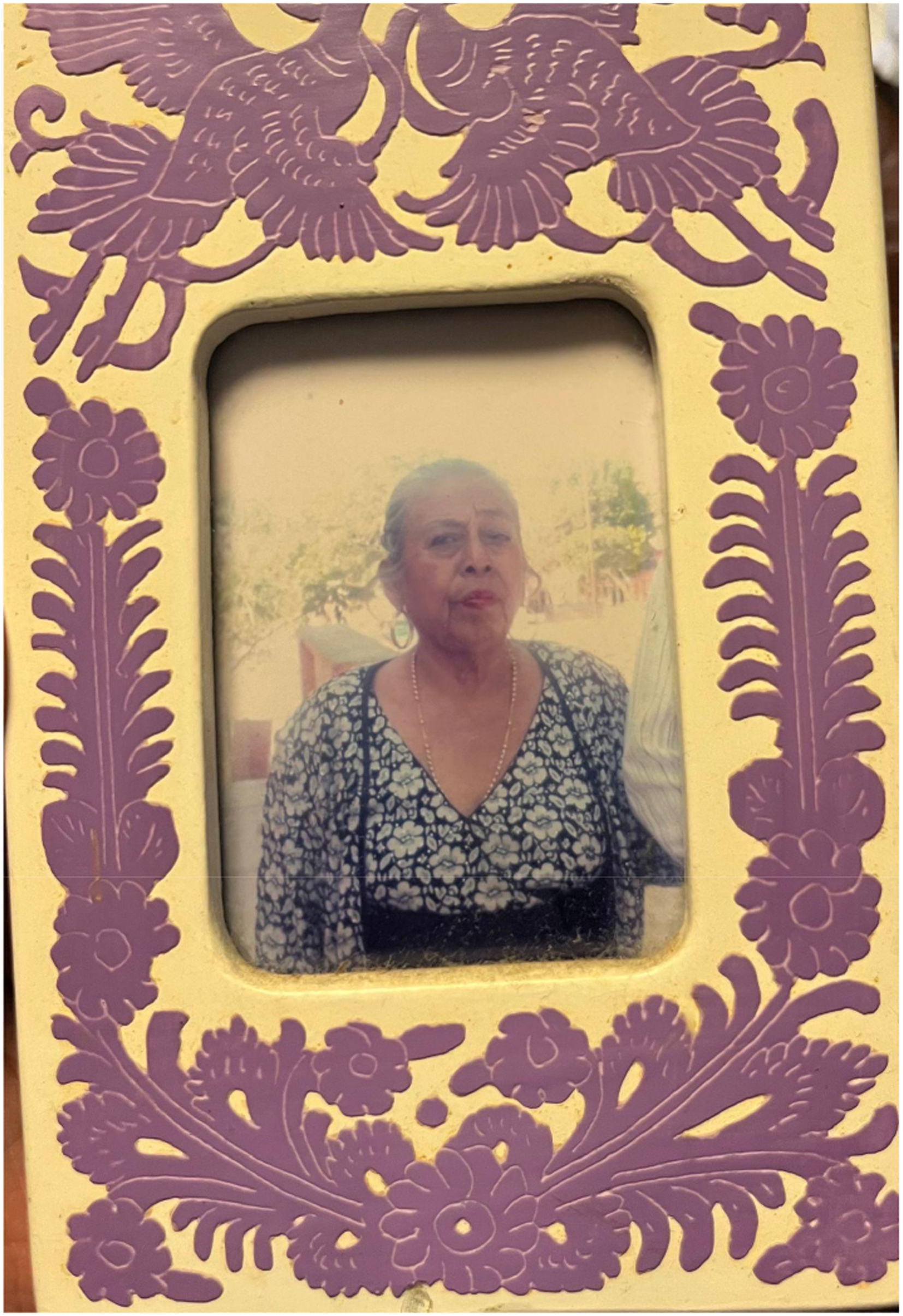
My (maternal) abuelita’s (grandmother’s) name was Galdina Vargas Fabian. She was born in 1939 in a small town called Coacoyula in the state of Guerrero, Mexico. She was the daughter of Cirenio Fabian Ramirez and Nolberta Gomez Fabian, and one of six children. Abuelita was the mother of six children with my grandfather, Brigido Vargas, a man whose quiet strength was complemented by her sharp wit and fierce energy.
Every year, my abuelita would commemorate Dia de los Muertos (Day of the Dead). For my abuelita, this was not just a holiday – it was a sacred act of remembrance, a way to reconnect with those who had passed, and a moment to bridge the spiritual realm with the living. According to Mesoamerican beliefs, the deceased return to visit the living on November 1st (Zepeda, 2022). For my grandmother, the ofrenda (altar) was ceremonial. It was both an offering and invitation for the souls of the deceased to return and visit family members once more. It was often adorned with photos, food, drinks, and flowers.
In the weeks leading up to November 1st, she would carefully curate an ofrenda in her living room, filling it with offerings for the dearly departed. My grandmother, meticulous in her preparations, would rise early in the morning to visit a neighbor’s house where they had the machinery to make pan de muerto (Day of the Dead sweet bread). Sometimes, my mother, as a young girl, who was eager for a taste of pan dulce (sweet bread), would tag along and help my grandma. She enjoyed it because it gave her a chance to sneak in a bite of the sweet pan dulce. When they returned home, they would carefully place the fresh bread on the ofrenda for each loved one along with other food items, including fruit and vegetables that were believed to be consumed by the dearly departed. In addition, my grandmother would sew garments – table covers – to place on the altar, a symbol of love and devotion to the departed. The altar itself included her parents, her lost child, and, later, her siblings and in-laws.
On November 1st, my grandmother would take these offerings – bread, fruit, flowers and more – to the cemetery. There, at the burial site of her loved ones, my grandma would place each item with reverence, saying an improvised prayer for the relatives who had passed – one that seemed to come straight from the heart, as if the words were just for them. It was a moment of quiet reflection, but also one of storytelling. During this time, my abuelita would recount the lives of those who had gone, weaving tales about them into the present moment.
My mother remembers one particular story that fascinated her as a child. My abuelita would recount the tale of her uncle, a man rumored to be a brujo (witch). “Algo extraño” (something strange), she would say, her eyes narrowing, as she recalled how he had the power to shapeshift into an animal, how he had cursed a man who had wronged him, rendering him disabled. Although my grandmother never truly believed in these powers, she shared these stories of the deceased as a form of keeping the memory of her family alive.
Beyond the ofrenda and the storytelling, my grandmother served as a central figure in preserving traditions. Navidad (Christmas) was no exception. Between December 16 and 24, my abuelita organized posadas, a religious tradition celebrated in Mexico that commemorates the journey of Mary and Joseph as they sought shelter prior to the birth of Jesus. During the period of Las Posadas, my abuelita would gather family and friends to share a communal meal, sing traditional carols, and break piñatas 2 that she and other women in the community made. This tradition not only provided an opportunity for a religious celebration but also served as a moment for preserving important values. These gatherings reinforced the values of family, faith, and collective memory, over materialism and individualism, which often overshadow Christmas celebrations in capitalist-driven societies. Today, collectivist values continue to guide my family’s dynamics.
But my abuelita was not just a keeper of traditional practices. She was the creator of new ones, too. With her keen intellect and entrepreneurial spirit, she consistently emphasized the importance of self-sufficiency, particularly for her daughters. She encouraged my mother and her sisters to “tener un oficio para que no se mueran de hambre” (to acquire a trade or skill so that they would never face hunger). This was uncommon in the early 1960s, an era when the majority of Mexican women were expected to remain within the domestic sphere, tending to household duties and caring for children. Yet my abuelita challenged conventional norms. At around 26 years old, she enrolled in “clases de alfabetización,” where adults were taught how to read and write, and soon after, she sought additional courses. While some may say this was a commendable act of the time, her pursuit of education drew criticism from townspeople, who saw these ambitions as distractions from her caregiving responsibilities.
Her entrepreneurial spirit was also met with skepticism. When my grandfather emigrated to the U.S. to work for a season, she started laundering for others in her hometown. Then, she became a self-taught seamstress. Over time, she grew her efforts and eventually established a small clothing business from her home in Coacoyula. Through her own example, she advocated for education – even when she had limited formal education – and self-sufficiency, urging her children to pursue a postsecondary education and become independent. As she often said, “por si te sale huevón el esposo, no tienes que depender de él” (in case your husband is lazy, you do not have to depend on him); this adage reflected her belief in women’s autonomy. While my grandfather contributed primarily to the family’s income, it was my abuelita’s relentless determination and work ethic that ensured her children’s future. Thanks to her efforts, my mother and several of her siblings pursued higher education, becoming the first generation to earn a postsecondary degree and forge a new path for future generations.
Asserting Black Life’s Value
The distinct social position of Black Americans in the U.S. has historically informed their unique relationship to death, which emphasizes robust commemoration. Critical social work scholars have acknowledged “that many African Americans tend to be accepting of death,” viewing it “as a natural part of life where death is seen as a transition” (Collins & Doolittle, 2006, p. 958), “a bridge that brings the deceased to a better place, a home going to an eternal abode” (p. 962). One integral part of the celebration occasions is the obituary that includes the program of events and the distinct “booklets” that “look like what white people would call ‘memory cards’ or ‘mementos’ offered by funeral homes” (Ye, 2011, p. 104). This “souvenir of the deceased” (p. 104) is a “significant artifact” (p. 105) of African American life, and it is often composed of a “personal archive of photographs … a page or pages of photographs of the deceased and of the family, friends, and relatives of the deceased … a visual life story of the dead” (p. 105).
In many Black communities, it is common to save one’s obituary after their homegoing celebration, which is what we call the events typically referred to as funerals (Collins & Doolittle, 2006). This ephemeral document regularly outlives its temporary significance as simply a program for the ceremony that took place. My great-great grandmother, Ms Laura Mack, whom I called Grandmama, did what many Black grandmothers do—she collected these obituaries, and if she was unable to attend the homegoing celebration herself, you could count on her asking those who could attend for one. I knew that this woman, who had a significant hand in raising me and who raised my mother as her primary caregiver, would undoubtedly catalogue this document to preserve the memory of the individual who had transitioned from this life to the next (Collins & Doolittle, 2006).
In 1917, Ms Laura Mack was born in the east Texas county of Madison to a large, loving family. Like one third of Black Texas residents, her family owned the land on which they lived and farmed, distinguishing them greatly from most other Southern African Americans (Reid, 2007). This relative material advantage and her completion of all available education coursework did little, however, to counteract the historical forces that sent so many Black girls into white people’s homes to clean them as domestics. Before the 1940s in the rural South, true secondary education, high school in particular, was out of reach for most Black children given the systemic underfunding of Black public education and the deindustrialized, rural nature of Southern life (Anderson, 1988). Cleaning white people’s homes and tending to their children was the plight of many like my grandmother (Shaw, 1996). Looking back, I can see how the close look of her vocation –which she held for seven plus decades– exposed her to the ways of white people, showing her how they perceived Black people. Stated differently, her job showed her what white people were really like –who they really were and how they really felt– and one of the lessons she gleaned from this intimate contact was their perception of Black people. With this insight, she stood more capable of sharpening her resolve to undermine dominant perceptions of the worth of Black life. As a domestic laborer, she learned firsthand that white people placed little value on Black life. I contend that one of the ways she chose to counter such perception was through her obituary collection practices, which affirmed Black life.
This preservation of obituaries is one of the many ways Black women labor as proverbial archivists who preserve community history. In employing the forethought and intentionality to request and store such documents, Black grandmothers like mine were countering hegemonic ideas about whose history was important enough to maintain a record of and whose lives were worth remembering, acting as a curandera to bring healing through history as a sort of medicine (Levins Morales, 1998a). When Grandmama transitioned from this earthly life, she left behind scores of these obituaries—because she believed that regular Black people’s lives were important enough to remember. These materials illuminate the lives of people she knew to varying degrees. In doing the work to maintain these records of life, she was communicating the idea that this person’s life had meaning—even if no one else recognized it. Most of the obituaries she kept were those of ordinary people whose life and accomplishments were unlikely to be of broad interest. Those she maintained with the most fervor, as one might imagine, belonged to our family members. Because her conception of family was quite broad, she went about gathering many obituaries that in many ways subverted the prevailing narrative about her family’s historical value. In this act, she employed what McKittrick (2021) considers a rebellious methodology, reaching far beyond the academy to interrupt assumptions about Black life as inconsequential. This catalogue she kept of quotidian Blackness stands as a powerful testament to the ways Black maternal figures have always been about the work honoring Black life—even in the face of literal or figurative death that would see our lives end prematurely or be rendered insignificant (Hartman, 2007; McKittrick, 2011) (Figure 2). Laura M. Mack holding ArCasia in Waco, TX, circa 1990.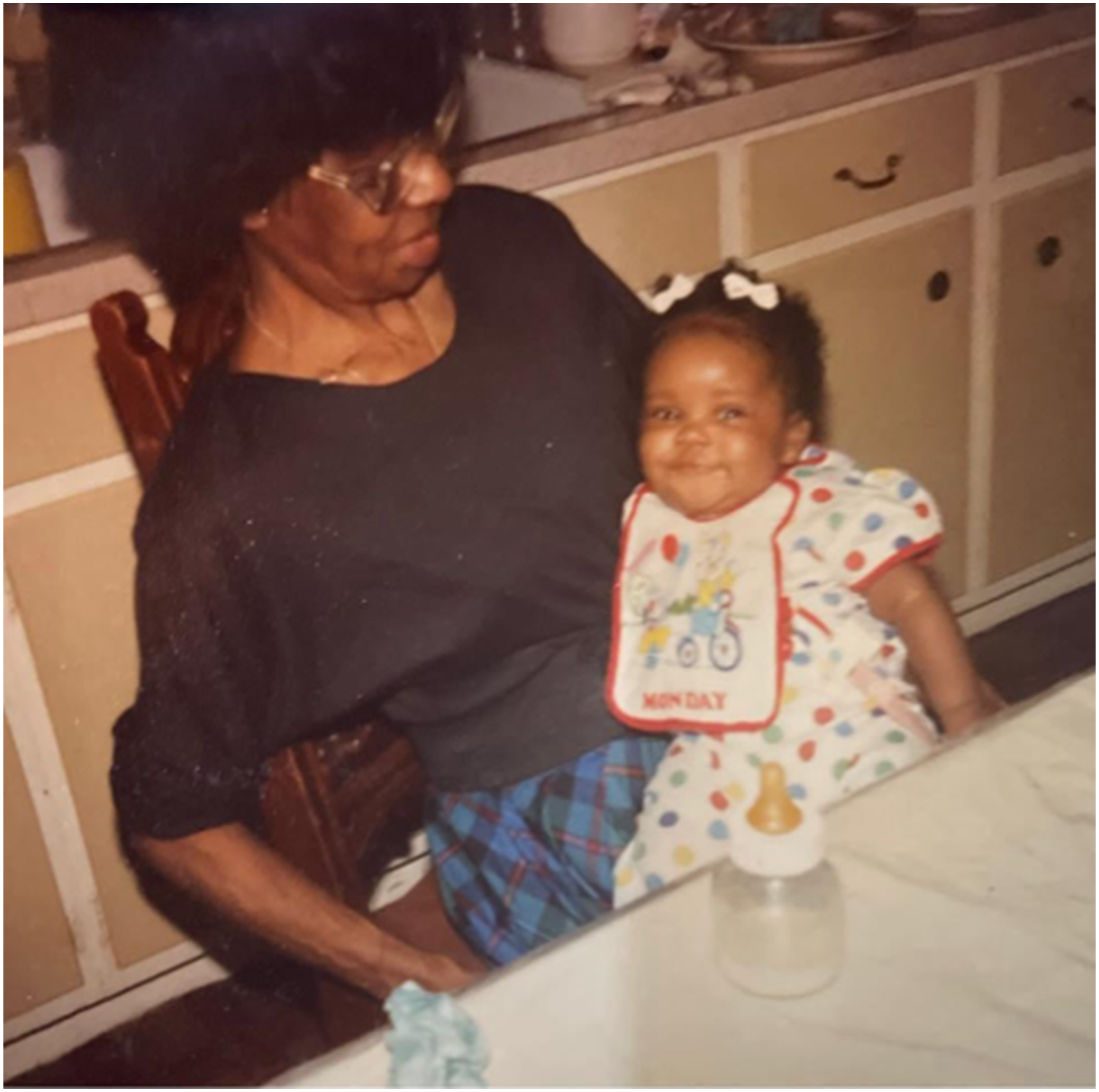
Sometimes, Grandmama happened to be a person of focus in family photographs, fodder for an obituary, complementing her commitment to salvaging the memory of Black life. In the background of a photograph in which I, an infant of a few months, am sitting on her lap, circa 1990, there are dirty plates on the counter framing a sink full of more dirty dishes. When I asked my mother to contextualize the scene of the photograph, she explained that my grandmother, dressed in a stylish black blouse hugging her petite figure and a blue and green plaid shirt, was feeding me. Being dressed this way suggests to me that she did not have to work the day on which this picture was taken because on a normal workday, she was donned in a crisp, bright white uniform of pants and a short-sleeved blouse that zipped close—the uniform she wore to clean white people’s homes for a living. In an outfit akin to what I remember her wearing to the doctor, one not quite nice enough for church, she was never one to go to sleep with a dirty kitchen.
This woman always had dishes to clean because people were always at her home eating. It is very likely, then, that the day this picture was taken was one of the many days she cooked for our whole family, paying to do so from the meager wages she earned as a domestic laborer. That was her happy place—in her kitchen cooking for her family. Those close to her knew this. Witnessing her state of tranquility taught us that family was important—that our family was important. Many of my earliest memories are centered on her home and around meals she cooked–around big holidays with endless dishes that have come to be my favorite.
Many of my memories of my great-great grandmother involve her preparing meals. And though I can’t recall her seeking to make a pointed effort to capture photographs of these moments, I think she was laboring in a way that encouraged us to impress in our memories mental images of not only the scene, but how being and breaking bread together made us feel. My cultural intuition (Bernal, 1998) tells me she knew that even the best of photos couldn’t necessarily capture that kind of magic. It is something you experience and get to hold on to. It’s something deeply fulfilling that larger society tells us Black people shouldn’t have access to and can’t enjoy. It is a radical act of subversion: to be Black and dare to enjoy your life.
Grand Recipes for a Grand Lady
I moved back home recently resulting in a purge of my parents’ garage—a catchall of family memorabilia. The garage had become an exceptionally large receptacle for things thought to be too precious to throw away but too old to keep in the house. Amongst the clutter were the historical records of my paternal grandmother, Doris McNeil. My grandma, born the seventh of November 1932, grew up in Kendleton, Texas. She was one of seven children, all of whom grew up and left the small town for bigger cities. She had raised my daddy and uncle by herself, and her death hit my daddy hard. As a result, he struggled to part with the tangible pieces of her existence and her possessions made their way to my parents’ garage, which was already full of paraphernalia from my brothers, parents, and me. With my return we needed the space back, and one Saturday, my mama decided it was time to clean out the garage (Figure 3). Photograph of Doris McNeil, Delandrea's grandmother.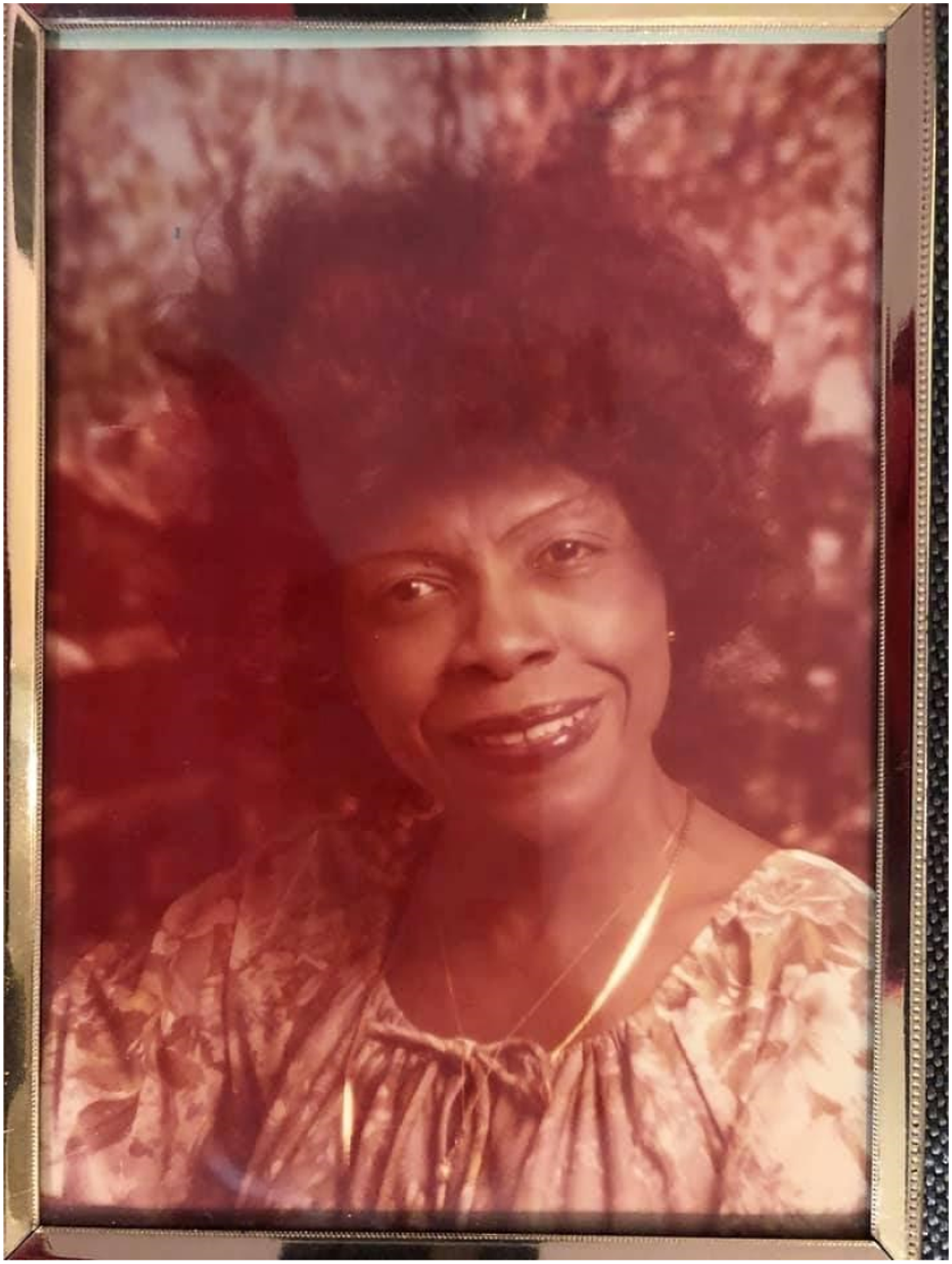
During one purging spell, I was sitting in the kitchen when my mama emerged with a small notebook. “I think this was your grandmother’s.” Intrigued, I opened it, “Mama, look!” Delicately written recipes, in my grandmother’s handwriting, sectioned off by categorized tabs on pages that had yellowed from age (probably as a result of being in a garage in the Texas heat) (Figure 4). Photograph of Delandrea's grandmother’s cooking journal.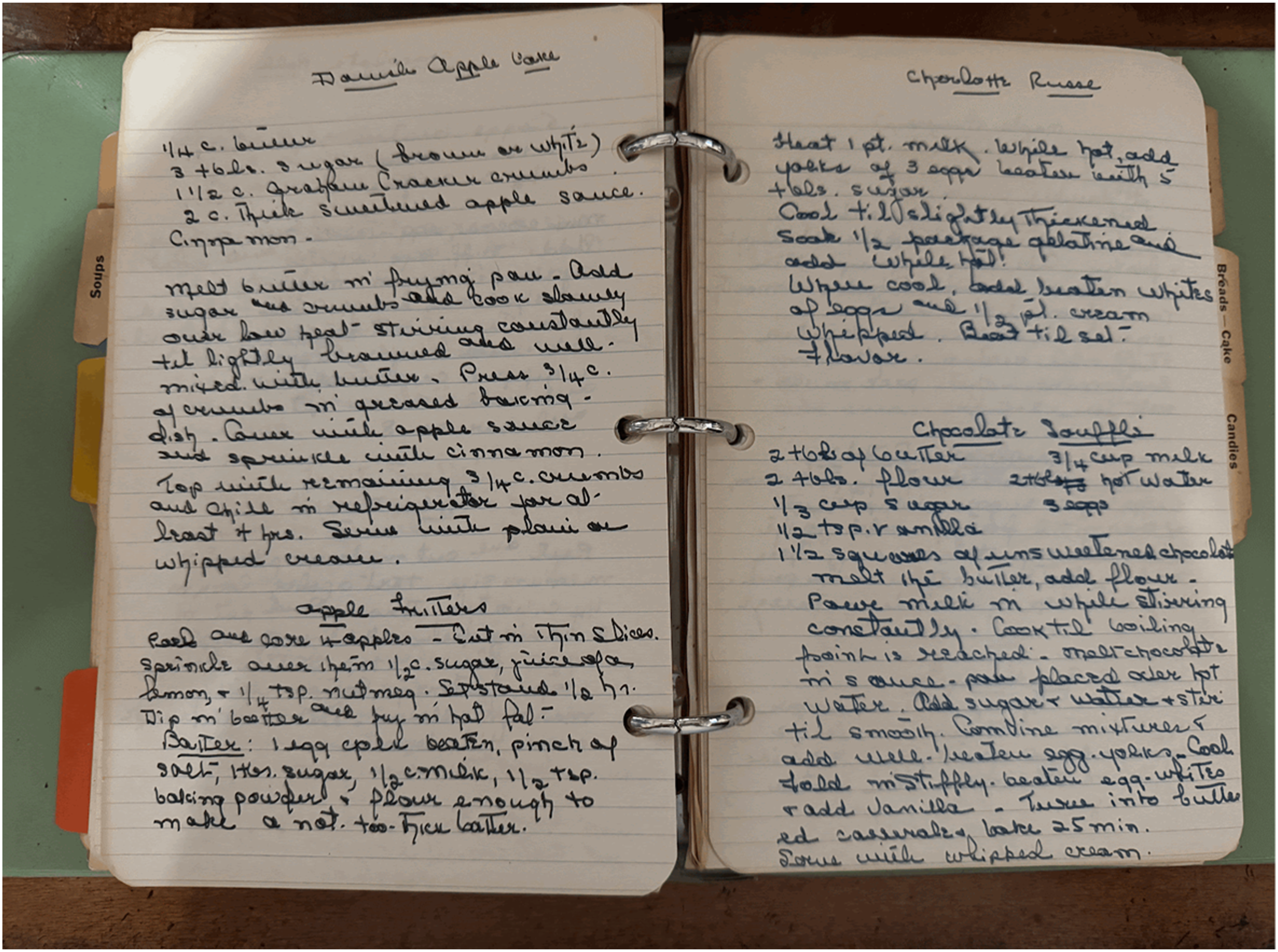
My grandma loved to cook. She was the person that taught me how to make a dump cake because I wanted to contribute something easy and yummy to our usual Christmas fare. You take a box cake, fruit, and all the other ingredients on the box and dump it in a bowl—“It’s just that easy!”, she would tell me. She also had the best 7Up cake recipe that my uncle has refined to perfection, but with a lot more ingredients. Her cooking advice didn’t stop at desserts either. She was the first person to show me that people put sugar in their grits, and she made delectable roasted chicken. I also think she might’ve put a pinch of sugar in most of her dishes because they always had a kind of subtle sweetness to them, even when the dish was meant to be savory. Perhaps she is where I got my sweet-tooth from. And if you didn’t like something, she was convinced you would love the way she cooked it. Usually, she was right!
This cookbook seemed like a fitting find when I thought about my time spent with her. Yet what was interesting about this recipe book was that I had never seen her make the dishes recorded inside it. Recipes for “Glazed Orange Pork Chops,” “Deviled Crab,” and “Chocolate Soufflé” were carefully written and organized with meticulous detail to indicate the kind of meal it was. The dessert section contained the most recipes which made sense because she loved to bake. Even so, as I flipped through the pages, I wondered why she had chosen to preserve these recipes with such intention. What had drawn her to these recipes? What stories existed between the pages? Why had she held on to this small binder when, to my dad’s and my knowledge, she hadn’t cooked from it? (Figure 5). Photograph of Delandrea’s grandmother’s notes of dessert recipes.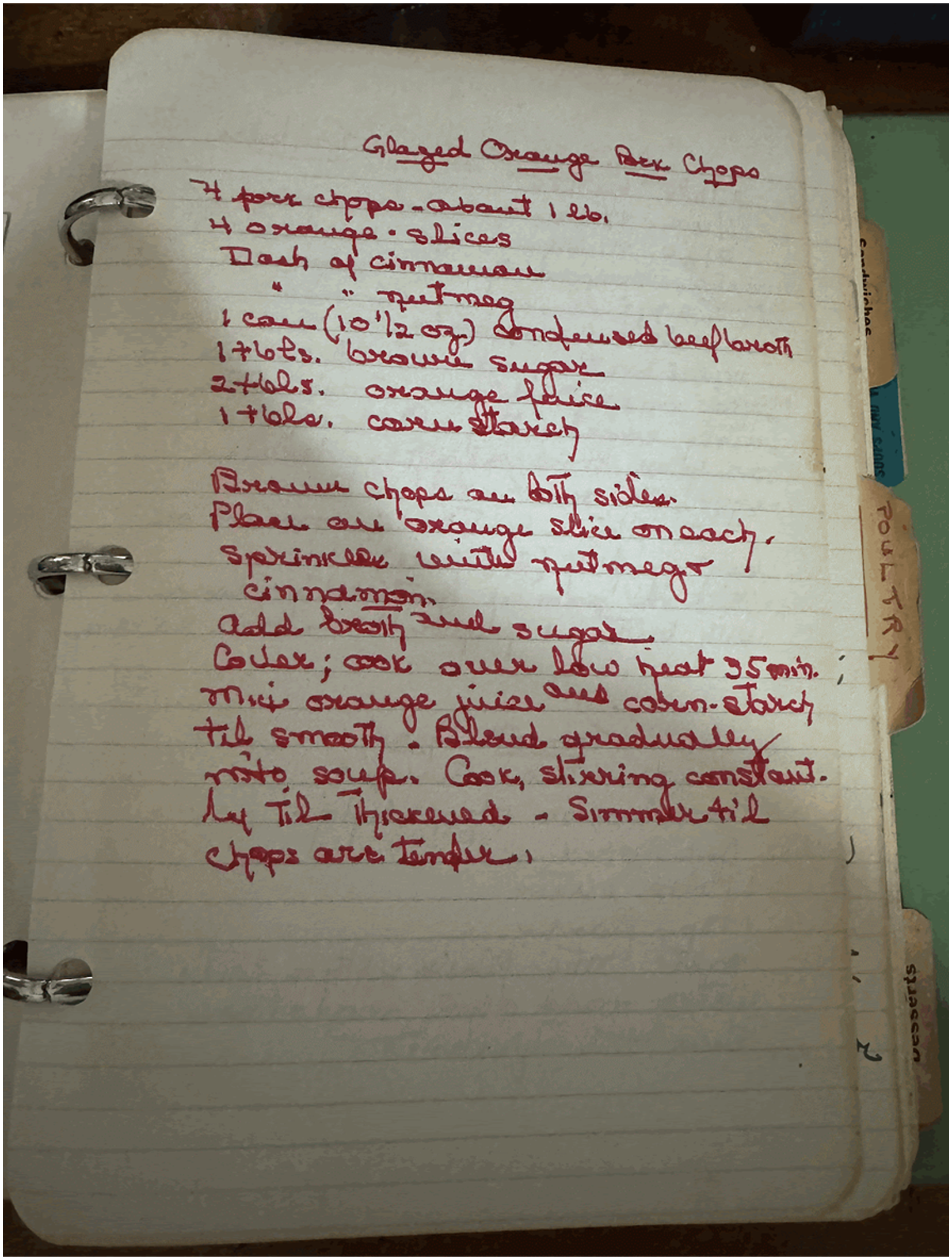
The longer I sat with the book, the more my memories of her set in with a greater sense of clarity. She loved fine things from food to clothing to cars to jewelry, and the things she left behind demonstrated her exquisite taste. One of the most distinctive memories I have was going to the NM (Neiman Marcus) Café after shopping for back-to-school clothes. The servers knew her name, and as we ordered from a lunch menu that included the fanciest dining options I had ever had at the time, I remember thinking that she was in her element. My grandmother lived in South Dallas, in a federal housing project, in an area of the city many of the people who shopped at Neiman’s had probably never been. So, even though I knew where we had driven from to get here on the North side of Dallas and the servers did not, it didn’t matter because this was my grandma’s place; she belonged. And as I stared at the recipe book, it reminded me of the lavish fare at that café.
It also reminded me that my grandma would always find a way to carve out space in places that were by all other measures inaccessible to her. As a sitter for wealthy adults, she encountered the ways wealth lived and moved about the world. And though she lived in a South Dallas housing project and ran-up her Neiman’s credit card, you would never know she did not have financial wealth. She knew how to act the part while making the image of wealth look better. She made sure you noticed her. If she wanted something, she was going to get it. If she was unable to buy the things out right, she would create it—crafting together her own sense of luxury. She did it all the time with her outfits. Mixing and matching expensive and inexpensive items to create her own fit and she taught me to do the same. She carried herself with grace and in a way that screamed expensive—a walking paradox of “Money talks and wealth whispers” as she tangibly had neither.
It would be easy to dismiss her want for finer things as avarice. Yet, as McKittrick (2021) argues, “black people are interdisciplinary actors” that engage in various unconventional practices to reveal ways of knowing and belonging that reject the narrow boxes that seek to confine them” (p. 5). My grandma’s desire for nice things was born out of this methodology. She understood that while money could provide care, it did not prevent loneliness. Spending significant time with her clients, she formed close relationships with many of them. On one occasion, she received a burgundy Cadillac from a client with whom she had developed a strong bond. She valued that car as a symbol of achievement. These wealthy families were capable of providing more but what mattered most to her was the work itself. Her affection for luxury items was not driven by a covetous need for wealth but by the belief that her hard work merited the ability to acquire things she liked, despite societal expectations. Expectations rooted in a historical narrative that made it clear that Black people, even more so Black women, were not entitled to own or have access to fine things. The fancy items she bought were therefore a reflection of an affluence not tied to money but to her resilience and drive, of her rightful sense that she should be seen and acknowledged by the world around her.
Lessons Our Grandmothers’ Legacies Taught Us
In this section, we discuss the meaning we gleaned from the reflections we presented as guided by our conceptual framework. The fresh insights at which we arrived by reviewing our grandmothers’ subversive archival practices indicate the relevance of the concepts we selected and, as applied, the vital work ordinary Black and Mexican women as bearers, creators, and curators of history.
In intangible ways, Doña Galdina’s historical preservation efforts uncovered new forms of remembrance, tradition, and knowledge. The memory of the altars she designed and her storytelling comprise what Cotera (2015) calls the decolonial archive, a form of reclaiming Indigenous histories and cultural practices that the first author, Jasmin, continues to keep alive. Furthermore, these acts of remembrance went beyond honoring the past; they were also a way of teaching the living. Her stories were more than anecdotes – they imparted lessons in resilience, identity and perseverance (Anzaldúa, 1987; Bernal, 1998). She joins other Mesoamerican women and Chicana activists who blend cultural memory and wisdom to guide their families in ways that go beyond formal education while simultaneously resisting hegemonic forces that aim to undermine their humanity (Bernal, 2018; Espinoza et al., 2018; Levins Morales, 1998a). Doña Galdina’s archival practices centered on the enduring storytelling tradition that animates many communities of Color. She passed on stories that allowed the first author to “imagine new geographies of liberation” (McKittrick, 2021, pp. 8–9). To put it simply, she was a scholar in her own right, navigating, obscuring, and reshaping the boundaries of gender, culture and archival practices.
This reflection exercise uplifts the power of proudly ordinary people who have been given a very difficult lot in life and have, nonetheless, done extraordinary things (Hull et al., 1982). Drawing on the cultural intuition (Bernal, 1998) that Ms Mack, the second author’s (ArCasia) grandmother, passed on and leaning into the lessons she taught prepared the second author to honor them and her. In Ms Mack’s commitment to preserving the paper-based commemorations of Black people’s lives and routinely taking the time and effort to plan, shop for, prepare, and clean up after cooking large scale meals over which her family could commune, this Black woman was declaring that all Black lives matter. Finally, recognizing the radical work she was doing has compelled the second author to in the decades coming, garner even deeper meaning from Ms Mack’s casually wondrous ways. This honoring practice is a medicinal form of healing that historians as curanderas undertake (Levins Morales, 1998a). It is evident that she was and her memory continues to be important because despite everything—the many obstacles life threw in her way as a Black woman domestic—she was dedicated to making a meaningful life that involved crafting and caring for a family. Such an act within a society that systematically devalues Black living represents a decidedly rebellious methodology that is ordinarily radical (McKittrick, 2021; Quashie, 2021).
The third reflection illustrates that traditional metrics are unable to appreciate the self-importance women of Color audaciously employed to stake their claim to a robust life. Much like the small notebook of recipes, Doris McNeil’s life appeared small. However, when one digs deeper within the pages to peel back the pieces of her life, one discovers Ms McNeil, the third author’s (Delandrea) grandmother, was authoring a world larger than the confines of societal imaginations (McKittrick, 2021). She collected and kept things like her recipe book to author her existence through the narrative of grandeur she embodied. She built this large and abundant life in the face of dehumanization that refused to register a working-class Black woman’s life as valuable (Arena, 2011). As the third author rummaged through recipe book’s the pages attempting to find her grandma’s voice, she was reminded of Levins Morales, 1998a call to embrace the messiness of evidence from the past, to use the evidence to track what is missing or silenced stories, and to illuminate lives of marginalized people. Through this book, the third author was reminded that her grandmother’s stories, even the ones she has yet to learn about, are a part of her because Ms McNeil got to be a part of her life. A life made visible by the legacy Ms McNeil left within the people and things she created. A life that took up space, that was noticed, that changed the people around her.
These analyses culminate to underscore the brilliance and courage that comprised our grandmothers’ will to craft representations of the past and live lives teeming with meaning and nuance. Bundled in ostensibly ordinary packaging, these Black and Mexican women confronted the circumscribed reality society imposed on them, daring to undermine the expectations of inferiority they and their histories embodied. Applying a framework capacious enough to detect their subversive resolve, we venerated their humanity and collective commitment to preserving a past commemorating the preciousness and sacredness of Black and Mexican life.
Embodied Histories: Grandmothers as Guardians of Knowledge, Memory and Tradition
In this paper, we explore the archival practices and ways of knowing of ordinary Black and Mexican women, particularly our grandmothers. Turning our gaze inward, we examine how our grandmothers engaged in memory keeping through storytelling, culinary traditions, record-keeping, and domestic labor. Through our reflections, we illuminate how their labor and lived experiences challenge dominant narratives, asserting that Black and Mexican women’s histories are actively written through their caregiving, wisdom, and everyday movidas (moves) (Espinoza et al., 2018). In doing so, we argue that history is not solely preserved in written archives but is embodied in kitchens, homes, and sacred spaces where traditions and memories are upheld and passed down.
Culinary traditions, often considered “women’s work,” function as a form of cultural archiving and memory making. ArCasia, the second author, for instance, recounts how her great-great grandmother, despite earning a “meager wage,” prepared large-scale meals for her extended family. These meals, however, were more than physical nourishment. They became moments of connection that ultimately strengthened familial ties. Through food, then, ArCasia’s grandmother not only nourished her loved ones but also upheld traditions that sustained community resilience in the face of systemic oppression. Similarly, Delandrea, the third author, grandmother’s culinary practices exemplify how food operates as an expression of care, love and historical consciousness. Her grandmother’s handwritten cookbooks, along with her own recollections of the savory desserts she made, showcase the ways in which recipes and food gatherings strengthen the transmission of cultural memory and recipes across generations. In this way, culinary practices function as both acts of care and cultural preservation.
In addition to culinary traditions, our grandmothers play a central role in upholding spiritual and religious traditions. Jasmin’s, the first author, abuelita (grandmother), for instance, curated an altar each year on Dia de los Muertos (Day of the Dead), to honor deceased relatives. With care, she carefully arranged offerings on the altar that reflected her love and commitment to preserving the memory of those who had passed. This ritual not only served as an act of remembrance but also as a bridge to ancestral practices deeply rooted in Indigenous traditions. Likewise, her efforts to organize posadas underscores the role of grandmothers in sustaining collective traditions through religious observance and communal gathering. Through these engagements, grandmothers actively shape and transmit cultural knowledge, ensuring the persistence of ancestral practices across time.
Their daily practices also bucked traditional gender norms. They often extended beyond societal expectations, demonstrating agency and resilience in the face of structural challenges. The grandmothers of ArCasia and Delandrea were economically independent, single Black mothers who stretched their modest resources to provide for their families in ways some two-earner households struggle to accomplish; their determination to ensure ends met and their loved ones’ needs (and many of their wants) were met illustrates their refusal to depend on men for provision. Their everyday efforts to be seen and valued – by way of their clothes, economic strategies, and self-sufficiency – reflect a desire for dignity and quality of life that transcended their economic circumstances. Despite economic constraints, our grandmothers strategically navigated class boundaries. Delandrea’s grandmother, for instance, had “exquisite taste” in clothing, cars, jewelry, and treated herself and her loved ones to a “lavish fare at a café,” signaling a sense of status and self-worth that transcended material wealth. Put differently, her ability to claim luxury, despite living in a society that undervalued(s) Black women, illustrates how Black women construct their own narratives of power and agency, rightfully carving out space for themselves, within their constrained material realities. Similarly, Jasmin recounts how her grandmother offered her daughters consejos (advice) about being self-reliant and earning a postsecondary degree. Her own wisdom and intuition were pivotal in securing the future of her children (Bernal, 1998). Finally, ArCasia describes how her grandmother’s experience working in white people’s homes reinforced her commitment to preserving the memory of African Americans. As such, their labor did more than sustain their families – it created new lessons, pathways, portals, and legacies for future generations.
Through their everyday practices, our grandmothers wove together legacies that extend beyond their lifetimes. Their storytelling, artifact collection, and preservation of traditions reflect the intricate ways they contributed to cultural memory and historical continuity. Storytelling serves as an essential method of remembrance and teaching. Jasmin’s recounting of her grandmother’s stories offer a rich example of how Mexican and other women of Color use storytelling as a medium to remember the dearly departed, impart enseñanzas (teachings), and resist oppressive material conditions they face. Although Jasmin did not hear these stories firsthand, the passing of these stories through her mother exemplifies how wisdom and memory of elders are passed down for future generations to inherit. Similarly, ArCasia describes her grandmother’s practice of carefully collecting obituaries of family members who had passed. This not only reflects her grandmother’s commitment to remembering the deceased, but also speaks to the remarkable ways Black women have engineered methods to “invent and reinvent knowledge” about Black life (McKittrick, 2021, p. 5). Finally, Delandrea’s discovery of her grandmother’s cookbooks and recipes unveils another layer of memory work. These artifacts were more than culinary instructions. They are intimate and cultural artifacts that offer a glimpse into the ways her grandmother sought to archive her life. Delandrea notes, her recipes and handwritten notes are embedded with tradition and cultural markers that the author continues to take up in her own cooking and baking.
Altogether, these practices and teachings reveal that the everyday lives of our grandmothers were consequential. They were intentional, filled with purpose – leaving behind legacies that continue to influence us today. Their archival methods –whether through oral traditions, written records, or embodied rituals – illuminate what McKittrick calls, “interdisciplinary methodologies” that help us understand history-making beyond the confines of traditional archives. These alternative forms of knowledge production allow us to “explain, explore, and story the world, because thinking and writing and imagining across a range of texts, disciplines, histories, and genres unsettles suffocating and dismal and insular racial logics” (McKittrick, 2021, p. 4). Put differently, centering ordinary women in archival work “changes the landscape,” revealing new perspectives to longstanding questions that have already been asked (Levins Morales, 1998a, p. 2). Thus, we build on archival scholarship by foregrounding an interdisciplinary methodology as a legitimate form of knowledge production that destabilizes hegemonic and masculinist archival approaches.
Furthermore, this paper contributes to feminist and educational scholarship (Bernal, 1998; Bernal et al., 2006; Dillard, 2000; González Ybarra & Player, 2024; Hurtado, 2003; Kynard, 2010; Villenas, 1996), recognizing that merely documenting the oppressive experiences of women of Color is insufficient. As Cindy Cruz reminds us, “our narratives of lived experience must be understood as both constructed and material and understanding that constructiveness is most important in the development of agency” (Cruz, 2019, p. 147). In other words, foregrounding the practices and ways of knowing of ordinary women of Color not only disrupts prevailing dominant paradigms, but also serves as a critical feminist intervention, one that weaves agency, resistance, and solidarity into new frameworks for understanding history and power.
Implications
The power to author history and our collective memory lies in the archives. Yet, as Troulliot (1995) argued, traditional archival spaces were built with intentional erasures and silences. The narratives at the center of this erasure or silencing are thereby imagined by others in order to fill in the gaps (Gilliand & Caswell, 2016). This reality demands a fundamental shift in how we approach historical analysis. Rather than merely acknowledging the exclusionary tradition of the archives (Fuentes, 2016), we must engage and validate methodologies – like those highlighted in this paper. The archival practices of our Black and Mexican grandmothers remind us that these voices, these historical records, often exist in close proximity to our memories and the everyday items left behind. Thus, we must take the lives of these women—women of Color, Black, Brown and Indigenous—seriously as we begin to piece together their stories.
This shift also has pedagogical implications, particularly for history and social studies education. If we are to truly challenge archival exclusion, we must teach our students to critically engage with the materials and histories that traditional archives have suppressed, distorted, or omitted. Furthermore, given the current political environment, in which the state is in the active process of performing epistemicide (de Sousa Santos, 1998) or suppressing and ommitting the histories of marginalized communities from the archives, it is important to remind students of the capacity of familial historical records to honor the collective public memory of oppressed peoples. Through our work, we must honor the nuance and complexity within the stories of women of Color and teach our students to do so as well.
Additionally, our grandmother’s stories demonstrate the power of archives to act as pedagogy, and their efforts to reclaim, reimagine, and affirm their own humanity provides us with a subversive epistemic lens that we carry with us. Their work taught us how to assert ourselves as Black and Mexican women, the power of community, and the importance of preserving our stories. These Black and Chicanx/Latinx pedagogies of home unsettle canonical notions of knowledge production (Delpit, 1998; Garcia & Delgado Bernal, 2021), and were passed down to us through their archival work. Similarly, students walk into schools bearing the knowledge their grandmothers, mothers, families, and larger communities have left for them through the various forms of archival work. By centering the archives of home in the classroom, teachers can build bridges for Black and Chicanx/Latinx students to create places where students feel seen.
Finally, as we seek to illuminate the historical narratives and practices of women of Color, we must consider the broader implications of this work for racial justice and coalition-building. Our engagement with these alternative archive methodologies is not just an academic exercise; it is an act of what Lugones (2003) calls “faithful witnessing” or the deliberate choice to listen to each other’s stories, travel across time and space, link acts of resistance to contemporary struggles for justice, and ultimately reimagine an-other world (Collins, 2009; Cruz, 2019; Leonardo, 2009; Matsuda, 1991; Reagon, 2015). By centering the archives of women of Color through our pedagogical praxis, we can create pathways to construct bridges to other marginalized peoples, to find solidarity, and resist oppression.
Conclusion
The lives and ways of knowing of ordinary women of Color remind us that history is not confined to official archives but something lived, embodied, and passed on through generations in ways both visible and unseen. Our grandmothers were protagonists and historians in their own right. Their stories, rituals, and artifacts demonstrate that the past is not static but a continuous thread woven into the present, shaping identities, relationships and communities. By centering their knowledge and archival practices, we not only reclaim histories that have been marginalized but also affirm alternative ways of understanding and documenting the world. In doing so, we honor their legacy and continue the work of shaping a more inclusive and liberatory historical record.
Footnotes
Declaration of Conflicting Interests
The author(s) declared no potential conflicts of interest with respect to the research, authorship, and/or publication of this article.
Funding
The author(s) received no financial support for the research, authorship, and/or publication of this article.
