




Abstract
This critical qualitative policy research study examines the intersection between policymakers’ neoliberal kindergarten reforms and children figuring themselves as learners within a publicly funded schooling community. Engaging in this examination of the biopolitical kindergarten space, which is shaped by standardized teaching and learning experience designed to prepare kindergarteners for the high-stakes reforms that await them in later grades, creates the opportunity to consider whether school spaces are designed to prepare the next generation of democratic citizens. It also provides insight as to how critical qualitative policy researchers can investigate as well as propose tangible policy responses through their work that seek to change the current era of policymakers schooling children through their neoliberal reforms.
Keywords
Children across the globe are educated in neoliberal systems that are ultimately designed to promote “entrepreneurship and the capitalization of life through learning” (Simons & Masschelein, 2008, p. 413). This occurs by framing the market as the “truth” and is the “power of society” and of schooling (Foucault, 2007, p. 148). In doing so, children learn in public school systems that they “are ultimately responsible for their own successes and failures, which become a result of their own resilience, namely, their capacity to adapt to the neoliberal market-based order” (Mavelli, 2017, p. 495). This is done through engaging in learning activities that require students to foster “individual-based competences such as self-discipline, resilience, and continuous self-development” so that they not only succeed in school but are also prepared to attain “employability” within the larger society (Brunila et al., 2019, p. 115). This neoliberal “privatization and marketization of schools and districts at the macro level” has led to alienated and fragmented classroom spaces where “knowledge and teaching are reduced to a mechanized sequence of discrete items and acts” (De Lissovoy & Armonda, 2020, p. 1).
Yet, the kindergarten classroom itself, and the impact of these reforms on this space, often goes understudied. Instead, researchers often examine how the curriculum is changing (Bassok et al., 2016; Brown et al., 2019b), how children are making sense of schooling (e.g., Brown & Barry, 2021; Seçer & Çeliköz, 2017), or they explore how children are finding moments to engage in democratic practices (Brown et al., 2019a; Lees et al., 2021).
What is needed are a critical qualitative policy studies that seek “to understand how power and ideology operate through and across [political] systems of discourse, cultural commodities, and cultural texts” of kindergarten classrooms (Denzin, 2017, p. 12). Such investigations can challenge, and ultimately, offer insight into how to transform the structures, be it social, political, cultural, economic, and so on, “that constrain and exploit humankind” so that “restitution and emancipation” can occur for these kindergarteners (Guba & Lincoln, 1998, p. 209).
In this article, I examine these issues through investigating how kindergarten students discuss their roles as students within the classroom. I do so to identify how they are internalizing policymakers’ neoliberal reforms and taking on the biopolitical “conduct of conduct” of schooling (Foucault, 2007). Specifically, using a case study methodology (Thomas, 2021), I investigate how a classroom of kindergartners in Texas speak about the discourses that establish specific norms which relate to various aspects of the kindergarten classroom, and how their statements also relate to their descriptions of what it means to be a kindergartener. Examining their comments about the biopolitical kindergarten space creates the opportunity to consider whether school spaces can be designed to prepare the next generation of democratic citizens. It also offers the chance to highlight how critical qualitative policy researchers can investigate as well as propose tangible policy responses through their work that seeks to change the current era of policymakers schooling children through their neoliberal reforms.
Conceptualizing the Biopolitical Kindergarten Space
If brief, neoliberalism is a form of governance where the “democracy of citizens” is replaced with “a democracy of consumers” (Giroux, 2003, p. 203). As such, public school classrooms across the globe become spaces that educate students in the practices of consumerism (Brown, 2015; Yang et al., 2022). To make sense of the space of the kindergarten classroom and how kindergarteners learn the conduct of conduct within these spaces, I turn to Foucault’s conceptions of the biopolitical.
Foucault’s Biopolitical Exercise in Subjectivity
The subjectivity of kindergarteners occurs in relation to the neoliberal biopolitical framing of schooling they operate in daily. As such, their subjectivity is “constantly dissolved and recreated in different configurations, along with other forms of knowledge and social practices” within the kindergarten classroom (Foucault, 2002, p. 118). To be clear, for Foucault, “The subject is a form, not a thing, and this form is not constant, even when attached to the same individual’ (p. 118). Thus, kindergarteners are “in a constant movement across different practices that subjectify them in different ways” (Rose, 1996, p. 35).
In terms of the process of early education, this biopolitical focus on subjectivity leads to a vision of childhood as a “phase in life in need of a physical and moral environment to secure an optimal and healthy development” of the population (Simons, 2006, p. 526). As Cliff and Millei (2011) pointed out, children and their bodies are framed as “a resource, where the aim of government is to control the health and welfare of the population in such a manner that overall productivity can be increased” (p. 352). Thus, as children enter public school systems, which typically occurs in kindergarten in the United States (Education Commission of the States, 2023), these governing agencies “seek to shape, and to incite the self-formation of, the comportments, habits, capacities and desires of particular categories of individuals towards particular ends” (p. 1642). Specifically, within the neoliberal kindergarten, students are “constituted as agents whose actions in economic markets produce desired outcomes” (Huxley, 2008, p. 1640).
Within my analysis, it is important to point out that governance, as it relates to issues of biopower within their kindergarten classroom, is a productive process where power “produces reality; it produces domains of objects and rituals of truth,” such as the rituals associated with being a successful kindergartener (Foucault, 1995, p. 194). Public schools in general and the kindergarten classroom I refer to in this case study specifically generate a series of norms that students are to internalize and govern their own selves in relation to as they move through the school day (Foucault, 1991; Rose, 1990). This biopolitical process of schooling centers on managing the “conduct of conduct” among its students so that are productive and attain the credentials needed to earn the income and other resources required to participate in the market (Ailwood, 2008; Foucault, 2007). Thus, “not only are students posited as units of productive potential, but they are also understood as embodying consumptive potential” (Slater & Griggs, 2015, p. 443).
In this and other investigations (e.g., Brown, 2009; Brown et al., 2022), I continue to return to Foucault’s conceptions of power, biopower, subjectivity, and so on because, over the years, as Slater and Griggs (2015) noted, “neoliberal reformers have displayed a surprising tolerance to opposition.” They have deployed “duplicitous performances of acquiescence to public demands for educational change as a way of softly shackling transformative political potential, while subtly entrenching standards-based reform in what appear to be comparatively benign policies and curriculum standards” (p. 456). Thus, while neoliberal policies have come and gone (e.g., the No Child Left Behind Act), schooling across the globe is still centered on the economic principle of providing children with the credentials needed to become earners and consumers within the markets that define society (Ailwood, 2008; Rose, 1996).
The Space of the Classroom
The focus on this article is on the space of the kindergarten classroom. For Foucault, power flows through space of the kindergarten classroom and impacts the subjective construction of students in an infinite number of ways (Foucault & Miskowiec, 1986). To unpack how these kindergarteners speak about the space of the classroom, it is important to recognize that “space is not a thing but rather a set of relations between things” (Lefebvre, 1991, p. 83). For Lefebvre, space exists across three dimensions: the physical/perceived space, the metal/conceived, and the social/lived (Riveros & Nyereyemhuka, 2023; Soja, 1989). Across these dimensions, power is at play, and space can oppress or confine students and/or limit their access to resources (Butler & Sinclair, 2020; Soja, 2010). Thus, the kindergarten classroom is a biopolitical space where kindergarten students “are perceived and perceive themselves and others as spatial beings” (Jones et al., 2016, p. 1130); spatial beings who take on the “ideal neo-liberal subject is an economic being—homo economicus, self-interested and competitive, independent and self-reliant, an informed consumer constantly calculating for every aspect of life what is in her or his best interests” (Moss & Roberts-Holmes, 2022 p. 97). Furthermore, within this neoliberal space, teachers and students are to focus on issues of “performativity, attendance, targets and test results” (Cudworth, 2015, p. 86).
Democratic Education
To counter this neoliberal framing of early education any within early childhood education, many advocate for the implementation of democratic practices (e.g., Roberts-Holmes, 2021) and policies (e.g., Moss, 2017). As Moss (2015) notes, these neoliberal discourses that emphasize markets, credentials, and individualism “can be disrupted, childhoods can be less regulated, and there are alternatives and resistances” (p. 236). For instance, Johansson and Emilson (2016) employed Mouffe’s (2005) political theory to make the case that early educators should view moments of conflict and resistance within the early learning classroom as opportunities to explore such democratic values as “solidarity and how to support each other, and also to learn about meanings of exclusion and inclusion” with children (p. 32).
For this article, I frame democratic education, as I have done elsewhere (e.g., Brown, 2021a) through the belief in the collective space of the classroom that moves away from “the normative individualized concept of agency where self-interest and individual choice are privileged,” and instead, think about this construct relationally through the social acts and interactions of students and their teacher(s) where agency emerges through and exists because of the relationships that exist with others (Clark & Richards, 2017, p. 135). While neoliberal reforms seem inevitable (De Lissovoy, 2019), Foucault points out that the ever-changing relational nature of power creates “a plurality of resistances” (Foucault, 1978, p. 96), and as such, opportunities exist to consider how kindergarteners can engage in and embody democratic practices within their neoliberal kindergarten classroom space.
A Limited Theoretical Orientation
Before moving into how I conducted this critical qualitative policy (CPQ) study, I must note that I understand Foucault failed to analyze as well as position his investigations into “the rationalities, strategies, plans and practices of discipline and government in Europe” in relation to its “inventions and experiments in the government of the ‘colonial other’” (Huxley, 2008, p. 1652). As many have pointed out, neoliberalism is a racist project (Giroux, 2003; Lipman, 2011) that “exacerbates the racialization of space by exploiting and augmenting the status property of whiteness” (Blaisdell, 2020, p. 156). As Tuck (2013) contends, “Indigenous and anti-colonial scholars” have long recognized that “neoliberalism as only the latest configuration of colonial imperialism” (p. 325). However, in conducting in the larger study this work emerged from, which examined stakeholders’ sensemaking of kindergarten (Brown, 2021b), I did not seek to understand how these stakeholders, including the kindergarteners themselves, described the racial project of kindergarten, which is a shortcoming of my work and a point I return to later in this piece.
My Critical Qualitative Policy Lens
I position this case study as a CQP research study. To engage in CQP research requires the researcher to recognize that the goal of inquiry is not simply to evaluate the clarity of identifying a policy problem or proposing the correct policy solution. Instead, as Dumas and Anderson (2014) pointed out, the goal is to produce policy knowledge that is “useful in framing, deepening our understanding of, and/or enriching our conceptualization of policy problems” (p. 8) as well as to highlight “what we do not yet know,” which helps move all of us “a step closer toward illumination of the problem itself” (p. 11). For those who engage in CQP research, “Policy is viewed as something to be critiqued or troubled rather than accepted at face value” (Young & Diem, 2018, p. 79).
Within this empirical process, CQP researchers seek “to understand the complex connections between” the issue they are investigating “and the relations of dominance and subordination in the larger society—and the movements that are trying to interrupt these relations” (Apple, 2019, p. 276). CQP researchers do this because, as Batiste (2008) notes, “All peoples have knowledge, the transformation of knowledge into a political power base has been built on controlling the meanings and diffusion of knowledge” (p. 500). Because of these power dynamics that exist within policy, it is important that CQP researchers conduct “research with rather than on the children and of treating children as an important and relevant source for a deeper and more nuanced understanding” (Hod-Shemer et al., 2018, p. 185). In this case study, how kindergartners speak about the discourses that establish specific norms which relate to various aspects of the kindergarten classroom and considering the connections between these statements and what it means to be a kindergartener can illuminate how these children are internalizing the neoliberal discourses that policymakers employ through their reforms to shape the kindergarten classroom.
Research Methods
According to Thomas (2021), case studies have a boundary that frames what is being studied while employing an analytical lens to make sense of what is under investigation (p. 23). For this study, my boundary is a kindergarten classroom, and I employ Foucault’s conception of the biopolitical neoliberal space to as an analytical lens to engage in this CPQ investigation. Specifically, in this case study, I examine two research questions: How do kindergartners speak about the discourses that establish specific norms which relate to various aspects of the kindergarten classroom; and How do these statements also relate to their descriptions of what it means to be a kindergartener? By examining the biopolitical kindergarten space, my focus is twofold: (a) to consider whether school spaces are designed to prepare the next generation of democratic citizens; (b) to highlight how critical qualitative policy researchers can investigate as well as propose tangible policy responses through their work that seek to change the current era of policymakers schooling children through their neoliberal reforms.
Kindergarten Context
Kindergarten in Texas, like most states in the United States, is not compulsory (Education Commission of the States, 2023); children do not have to be enrolled in school until age six. The cutoff date for entering kindergarten in Texas is that children must be age 5 by September first of that academic year. In terms of school governance policies, state policymakers implemented a range of neoliberal, high-stakes standards-based accountability reforms to which school personnel must adhere. For example, state-mandated assessments of students’ academic achievement begin in Pre-K, requiring assessment of their Pre-K through grade one students’ emergent literacy skills three times a year using a state-approved standardized assessment measure.
In these kindergartener’s school district, as I have documented elsewhere (e.g., Brown et al., 2019a; Brown et al., 2021), school personnel use students’ test scores to evaluate teacher and school administrator effectiveness. Furthermore, students who perform poorly across the school year are typically provided with a range of literacy interventions to support their growth and development. The kindergarten teacher and her Pre-K through grade 12 colleagues were also expected to follow the district’s learning progression documents and pacing guides. These documents organize district curricula and textbooks into a yearly sequence that teachers are expected to follow so that students are taught the necessary content needed for district and state accountability measures. These documents provide teachers with daily, weekly, and monthly guidelines for instruction that link instructional materials, including the district’s grade-level curriculum, with particular state-mandated Pre-K–12 content standards in each of the core subject areas. In addition, Pre-K–12 teachers were required to employ a standardized report card that documents students’ academic performance and personal development 4 times throughout the year. Such a report card measures each students’ performance in relation to the state and district expectations as outlined in the state of Texas’s Essential Knowledge and Skills (TEKS) for kindergarten 1 and district documents.
Participants
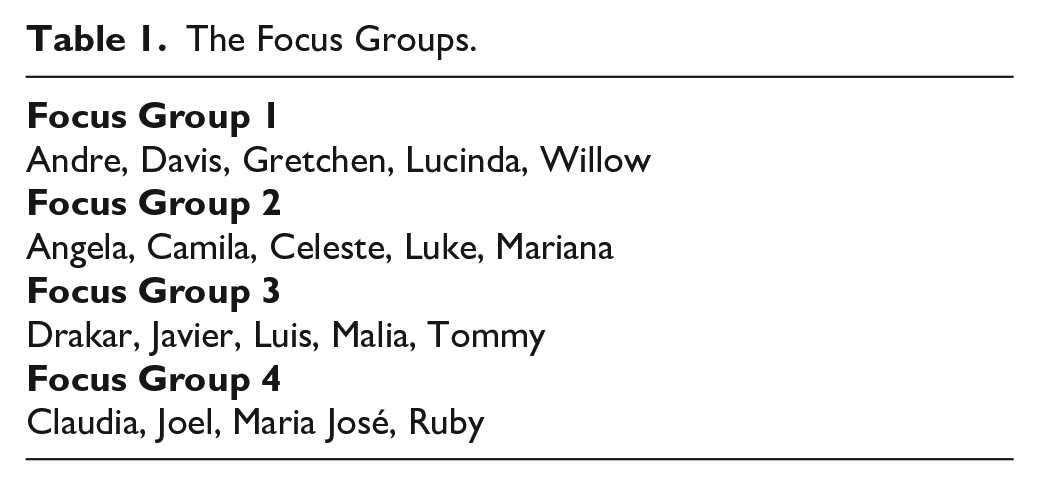
For this case study, I spoke to 19 of 21 kindergarteners in a single kindergarten classroom. This was done through conducting four focus groups (all names are pseudonyms); two students were absent the day of the focus group interviews (see Table 1). Using state policymakers’ descriptors of students, the student population of the classroom in the video is 77% economically disadvantaged 2 ; 18% African American, 60% Hispanic, and 22% White.
The Focus Groups.
The kindergarten population at the school level, which was comprised of eight kindergarten classrooms, was 77% economically disadvantaged; 22% English Language Learners (ELLs); 18% African American, 60% Hispanic, and 22% White. At the state level, during the 2014–2015 school year, 60.4% of kindergarteners in Texas were economically disadvantaged, 17.1% ELLs, 12.4% African American, 3.6% Asian, 51.3% Hispanic, and 30% White.
Data Collection
Data collection for this study included interviewing the four focus groups of kindergarteners to gain their understandings of the specific norms that relate to various aspects of being in kindergarten and how those statements relate to their descriptions of what it means to be a kindergartener (Brown & Barry, 2021; Brown et al., 2019b). The children were asked to explain many of the activities they engaged in across the day (see Figure 1 for their daily schedule). In addition, they were asked such questions as: Why do you go to kindergarten?; What are you supposed to learn in kindergarten?; What’s your favorite thing to do in kindergarten?; If you could change anything about kindergarten, what would you change? In addition, multiple data artifacts (Merriam & Tisdell, 2016), such as documents detailing the classroom schedule, school policies and procedures, state policy documents, and memos were collected, analyzed, and interpreted to document this kindergarten context.
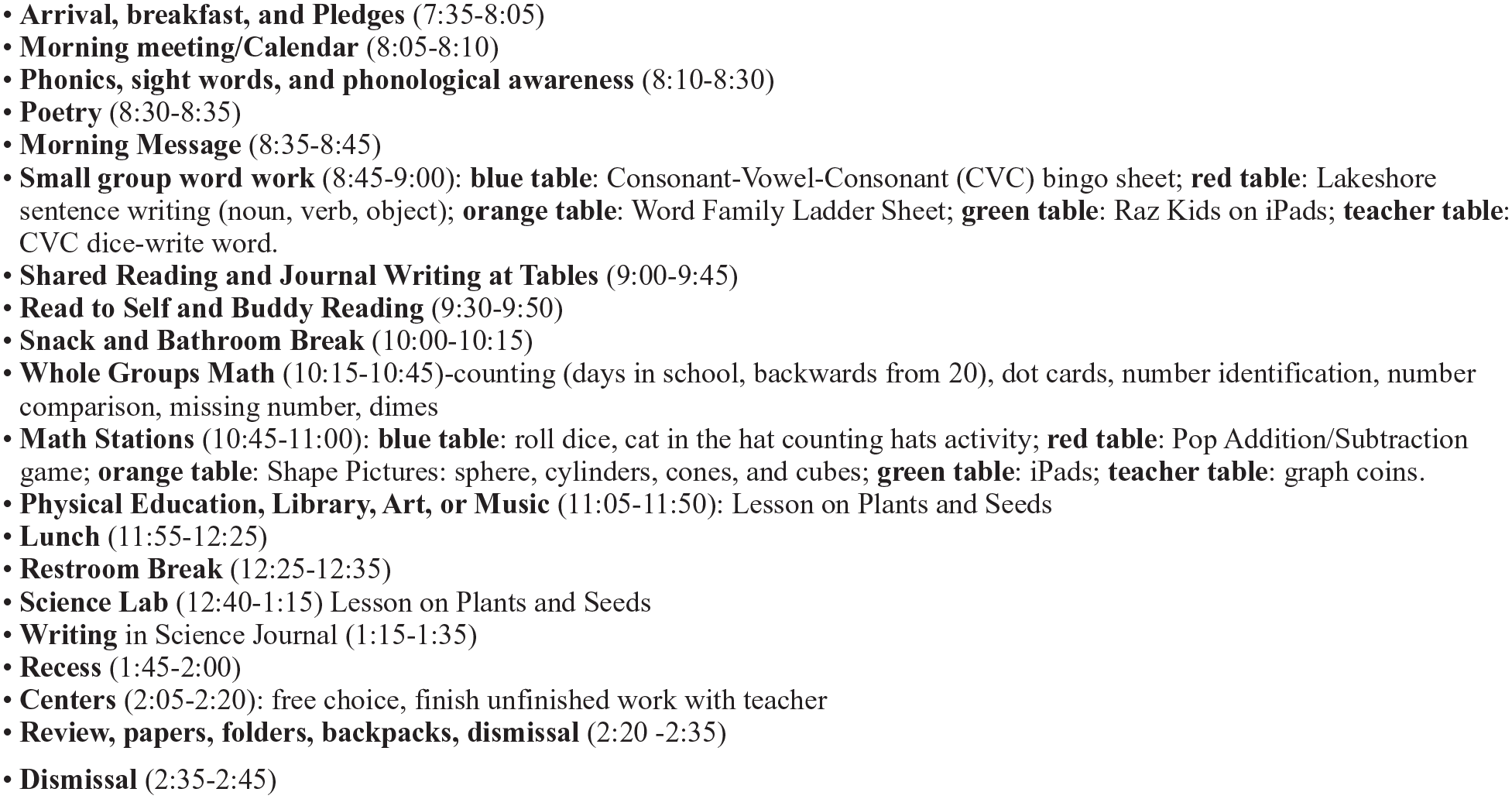
The Kindergarteners’ Daily Schedule in the Video Shared with Them.
Data Analysis
Data were analyzed following a three-step process (Merriam & Tisdell, 2016). First, the focus group interviews were transcribed and analyzed deductively using a set of codes that were based on the constructs of children as social agents, sensemaking, the purpose, and processes of kindergarten and inductively through codes reflecting ‘‘issues that [had] come up within [the] reading of the data’’ (Graue & Walsh, 1998, p. 163). Second, the coded data was then analyzed using the constant-comparative method to develop themes that emerged in relation to the two research questions (Erlandson, 1993). This required me to go through the coded data repeatedly and compare coded elements from the interviews, field notes taken in the focus group interviews, and memos with each other to generate a set of categories that reflected the essence of the coded data in relation to the research questions (Thomas, 2021). These categories, such as workspace, smartness, and being entrepreneurial, revealed how these kindergarteners spoke about the discourses that established specific norms within their classrooms and what it means to be a kindergartener. I then read these categories against the coded data in search of contradictory evidence. Finally, using my CQP framing of the biopolitical space of the kindergarten classroom, I generated two overarching themes and a several subthemes that spoke to the two research questions (Merriam & Tisdell, 2016).
Findings
The Classroom is a Space to Get Smarter
When analyzing the data in relation to my first research question, how these kindergartens spoke about the discourses that established the specific norms which relate to various aspects of the kindergarten classroom, the students consistently defined their actions and the workspace itself as a place where they were engaging in a series of activities to get smarter. The discourses they employed typically fell under one of three subcategories I developed in my analysis of the data: “Working to Get Smarter,” ‘Non-Sense Activities to Get Smarter,’ and “Testing to Show Your Smartness.” As Robertson (2010) noted, “education spaces are dynamic geometries of power and social relations” (p. 22), and in this study, power within this space and the social relations tied to the kindergarten classroom revolved around smartness.
Working to Get Smarter
The neoliberal biopolitical goal of schooling is to prepare future citizens, which requires teachers and their classroom contexts to produce “docile bodies” where students are “taught socially acceptable codes for behaving instead of having the opportunity to experience expressing themselves politically” (Bartholdsson et al., 2014, p. 210). Within this kindergarten classroom context, the primary socially acceptable code the students identified that they were learning was that this space is a place to become smarter, and to become smarter required the kindergarteners to work. For example, when asking Drakar, Malia, Tommy, Javier, and Luis about why they engaged in different types of work across the day in their classroom, such as learning sight words, Tommy responded, “So we can get smarter,” and I replied, “Why?,” which Drakar responded to this question by saying, “So we could read them in a book.” I then said, “Okay, so you’re doing this work so you can read the words in a book.” Drakar answered, “Yes, we’re working on them to read.” Luis added, “We’re working because that’s what people at school do, they work.” Within this conversation, these students were framing their actions of learning sight words as work that would lead them to become readers (see Figure 1). The repetition of this process of engaging in such activities as learning sight words is a process of “training” the students in how to read, but underneath such an activity is “the aim of creating docile bodies (both children’s bodies and their future adult bodies), that is, bodies that work cooperatively within this institutional context and become good citizens and pliant members of the social order” (Bartholdsson et al., 2014, p. 210). As Luis noted, they are in school to work because “that’s what people at school do.”
In talking to a different focal group of students about using the sight words on the wall in their writing within the kindergarten space, which included Ruby, Maria José, Joel, and Claudia, Claudia stated that they are there “so we can know the words,” which Ruby added, “So we can get smarter in our writing.” Claudia responded to Ruby’s statement, “Yeah, so we can get smarter, like if we want to use a different word that we don’t know, we can know the word by looking there.” Such sentiment around using sight words in their writing was also echoed in Mariana, Camila, Angela, Celeste, Luke’s group. Luciana pointed out, “We use those words when we write,” and Angela replied, “Because we want to get smarter, we write those words.” Celeste then added, “We do that because we want to get smarter.” Combined, these students consistently associated the work they did, be it learning and/or using sight words, with the act of becoming smarter. Such a sentiment illustrates Jones et al. (2016) point that, “Space is political and the ways that children’s bodies and place produce space is political and constitutive of how children and young people are perceived and perceive themselves and others as spatial beings” (p. 1130). In this study, these students perceived themselves as workers who were engaging in schooling activities because, as Angela and Celeste both stated, “We want to get smarter.”
Non-Sensical Activities to Get Smarter
Within this space, which the students identified as one designed to get them smarter, was a collection of phonological awareness activities that focused on students’ understanding of letter–sound relationship rather than actual words. For example, students were asked to sound out three letter non-sense words and then blend them together (e.g., making the “l” sound, short “e” sound, and “m” sound, and then say, “lem”). Such acts reflect Ball’s (2003) idea of “performativity,” which is a “a technology, a culture and a mode of regulation” that informs students as to what is of value in the classroom and what must be done to demonstrate one can engage in such acts (p. 216). When asked about these activities using non-sense words, Luke stated that those were “infant words, because even though they are not real words, they’ll help us read.” Camila added, “They help us learn.” When asked, “What do they help you learn?,” Luke replied, “They help us learn to sound out words, which helps us read.” Celeste added, “They help us get smarter.” By positioning these students “docile bodies” so that they would engage in non-sensical activities that focus on skill development, these students learned through the “processes of the activity” that such work will help “transform” them into readers (Foucault, 1995, p. 136)
Testing to Show Your Smartness
Within the process of engaging in a range of learning activities to become smarter was the use of testing within the kindergarten classroom. For these kindergarteners, testing was not a concern, but rather, a part of the “work” found within the kindergarten classroom. Such work demonstrated to their kindergarten teacher and/or the computer how smart you were. For example, the students had an online reading program they used in class during reading centers on the class tablets. As Celeste pointed out about this software, You pick out whatever book you want and then you just read it. And then, at the end of the book. you do a quiz. If you get an answer wrong, you can just go back and do it again. Then, once you pass the test, you can go on to the next book.
According to Celeste, part of the process of reading is passing a quiz after reading the book so that students can move on to the next book. Essentially, as Ball (2003) pointed out, this neoliberal system required students to themselves put the necessary “inputs” into their tablets so that they can attain the required “outputs” on the quiz to move forward in their reading (Ball, 2007, p. 28).
In another group, Claudia stated, “[The reading software] is where you can read, get tested, and then, you know what to read next.” As De Lissovoy and Cedillo (2016) contend, the “power in neoliberalism . . . asserts itself by constructing an enclosed ideological universe which is maintained through everyday rituals and practices” (p. 3). This ritual of engaging in this reading software through reading, completing a test, and then read the next book reinforces an enclosed ideological universe where reading is about completing one activity, taking a test, and then moving on to the next activity.
For their report cards, students also had to take a different reading test on the classroom computers, and when asked about that test, Javier stated that the “tests were easy.” Luis added, “You just read and do the computer activity.” Drakar added, “Then, you finish, and the next person goes. It’s easy.” Again, the ritual of testing is part of the conduct of schooling, and this act appears to simply reinforce to the students that they are learning to read, progressing in that reading, and again, becoming smarter. Such a ritual reflects Blaisdell’s (2020) point that the “spatial practice in schools becomes narrowly centered on acquiring a very specific form of property,” which in this case was the process of reading, and in turn, students documented the “acquisition of that capital in very specific ways” through testing; this in turn, creates a classroom dynamic where “the purpose of the classroom is centered on the curriculum as property” where “the worth of the students themselves is based almost solely on their acquisition of it” (p. 155). Thus, within the space of the kindergarten classroom, the capital students stated they needed to possess is “reading,” and by attaining this capital, they will become smarter.
Attaining the Entrepreneurial Life
When analyzing the data in relation to my second research question, how do these students’ statements relate to their descriptions of what it means to be a kindergartener, their statements often reflected Ailwood’s (2008) framing of a neoliberal school environment where students go to school to learn so that they can then earn and be able to consume in the larger market. Specifically, they discuss this entrepreneurial lifestyle in relation to “Embodying a Capitalistic Drive,” and within that, they spoke about the process as one where they were “Finding Pleasure in Learning to Conduct an Entrepreneurial Life.”
Embodying a Capitalistic Drive
While the first theme reflected how these kindergarteners spoke about their classroom as a space where they worked to get smarter by engaging in a range of activities across their day-to-day existence, this second theme centers on how these students were positioning themselves in relation to the future. In particular, the students were looking forward to moving on to the first grade and then into their lives beyond school where they become workers in the larger world. For example, when discussing why students go to kindergarten, Ruby answered, “Because you need to learn,” and Maria José added, “To get smarter.” Claudia then added, “It’s the first thing we do before 1st grade, and then 2nd grade, and 3rd grade, and then 5th grade, and then you may go to 10th grade when you pass 9th grade, and then college.” Maria José responded to Claudia by saying, “Right, you go to kindergarten to learn so that you can then become a teacher or a cop or a fireman or whatever you want to be when you grow up.” Joel added, “Or a gardener, but I want to be a dog helper.” Across these statements, these students are embodying the biopolitical belief that they are “ultimately responsible for their own successes and failures, which become a result of their own resilience, namely, their capacity to adapt to the neoliberal market-based order” (Mavelli, 2017, p. 495).
This embodiment of “entrepreneurship and the capitalization of life through learning” was also reflected in conversation between Andre and Davis (Simons & Masschelein, 2008, p. 413). Andre told me that children go to kindergarten “because we passed Pre-K.” Davis added “because we learned everything the teachers told us to.” Andre responded, “The teachers are helping us learn and to get us to first, and second, and third and fourth grade and . . . high school.” Davis responded, “Yeah, they’re helping us now go to first grade.” Again, these students frame being a kindergartener in relation to moving on with their lives by learning “everything the teachers told us to.” Such statements demonstrate how these students appear to be embodying the belief that school is a place where you develop a certain set of skills and competences required to move to the next phase of schooling so that they can become successful in and out of school (Brunila et al., 2019).
Finding Pleasure in Learning to Attain the Entrepreneurial Life
Within the biopolitical kindergarten classroom, where children learn the conduct of conduct of schooling, Blaisdell (2020) noted that “the oppressive nature of school space is hidden” (p. 154). In terms of these kindergarteners’ statements about their kindergarten classroom, they appeared to frame these neoliberal processes and curricula as being normal and necessary to move forward in life. Moreover, in many instances, they described how among all the work they were doing there were rewards within the process of schooling that they enjoyed and looked forward daily. For example, with the online reading software that students referred to when talking about testing, it appeared part of the reason they liked completing the reading tests was because, as Luke pointed out, “The [name of software] is fun. You get more stars the more you read, and then, you get to decorate your robots, which is so fun.” By reading a book, Luke was learning that he could then decorate his robots, and receiving such a reward for his work led Luke to note that they activity was “so fun.”
Other activities that seemed to create pleasure for the students included free-choice centers, which occurred at the end of the day (see Figure 1). Andre noted that “centers are exciting because we can do anything.” Lucinda added, “I can’t wait until the end of the day. We get centers, and I get to do what I want.” Gretchen added, “I like them too.” Again, like the reading software, the students looked forward to be rewarded for making to the end of day of their work, and that point, they were provided with the opportunity to engage in activities where, as Willow as pointed out, “I get to do what I want.”
Finally, every day, the students rotated through the curricular areas of physical education (PE), library, art, or music. They had PE twice a week, and for many students, as Luciana commented, “We love PE! It’s our favorite! We get to play, like with balls.” Celeste added, “I can’t wait for PE, we can play tag.” Luke continued, “We just love PE, just because it’s just so fun.” Within that group, Mariana countered, “I like library best,” which Celeste and Luke responded with a simultaneous, “Noooo.” Yet, Mariana pointed out, “I like it the best because I like to read.” Angela then responded, “Sometimes I like library and music too.” Within governing systems, like kindergarten, “each individual has a place, and each place has its individual” (Foucault, 1995, p. 143), and within the place of kindergarten, it appeared these students’ statements were embodying the entrepreneurial belief in being rewarded for one’s work with activities and/or opportunities that they deemed as fun. For them, being rewarded with choices or opportunities to play seemed to keep them engaged with as well as enjoy the biopolitical field of kindergarten.
Discussion
Because it is “important . . . to explore children’s views on and attitudes” about schooling (Habók & Babarczy, 2018, p. 61), the purpose of this case study was to examine how these kindergartners spoke about the discourses that established specific norms across the various aspects of the kindergarten classroom and then consider how their statements related to their descriptions of what it means to be a kindergartener. Examining these responses using a CPQ research perspective rooted in Foucault’s biopolitical lens of space illuminated how the dynamics of this political space led these students to take on a conduct of conduct rooted in work that was to make them smarter so that they could succeed in school and in life. This is significant, because as Jiménez-Alonso and Loredo-Narciandi (2016) noted, “subjectivity is not a natural or ahistorical category, but depends on practices and techniques that make sense only within a given social and cultural context and at a particular historical moment” (p. 719). In this current era of the neoliberal kindergarten, these students are seeing themselves as subjects within the market of school, and the purpose of school is to prepare them for the later life in and out of school by providing them with the skills and knowledge required to succeed. Thus, the political discourse of neoliberalism being embodied by these students becomes the norm by with they will live their lives, a lifestyle where they are always focusing on becoming rather than being (Qvortrup, 2009). In doing so, it appears the market of school is a place where children individualize themselves and do not learn about the collective whole, which is the knowledge needed to thrive in the larger democratic society. By fracturing children into individualized being, this neoliberal space smothers their ability to learn how to function collectively so that they can support each other as a community (Johansson & Emilson, 2016).
These findings also demonstrate that being a kindergartener for these students meant attaining an entrepreneurial life where they will be rewarded for their hard work. Such rewards made schooling fun and a place where these students wanted to be. While for the moment there appeared to be a sense of pleasure and desire among these students to continue within the neoliberal framework of schooling, Keddie’s (2016) foreshadows the danger in becoming “children of the market” (p. 110). For the secondary students Keddie (2016) studied, continually constructing oneself as a success within the market of schooling created a never-ending sense of anxiety that required them to constantly work to “be worthy” within the given “parameters of success” within schools (p. 109). As Foucault (2007) noted, this neoliberal system of governance “play[s] a regulatory role at every moment and every point in society” (p. 145). As such, what appears to be occurring within this given environment is the creation of a policy landscape that slowly shackles the “political potential” of these students to becoming entrepreneurial individuals through what appears to be the “benign policies” and practices of kindergarten, which again, eliminates the opportunity to learn to become an engaged democratic citizen (Slater & Griggs, 2015, p. 456).
Implications
This case study reveals how these kindergarteners are being softly-shackled (Slater & Griggs, 2015) within the space of the neoliberal classroom to a biopolitical framing of schooling and life. Such findings demonstrate the need for them, their teachers, and those who work within the political space of schooling, which is a space that appears “to produce control, indoctrinate, colonize, and discipline young bodies/minds,” to develop classrooms, schools and school policies that “produce and actively cultivate creativity, curiosity, and social critique” among all students (Jones et al., 2016, p. 325). As Foucault (1982) noted, “power is exercised only over free subjects,” which means that “individual or collective subjects . . . are faced with a field of possibilities in which several ways of behaving, several reactions and diverse comportments, may be realized” (p. 790). Thus, as Davies (2005) pointed out long ago, all of those working within systems of public schooling must provide students as well as their teachers, which were not the focus of this study, with a “doubled gaze” that assists them in being “critically literate, to become citizens at once capable of adapting and becoming appropriate within the contexts in which they find themselves and as responsible citizens capable of critique” (p. 13). Such literacy would not only teach them how to question “what” it is they are learning within schools but also assist them in learning how to work together as a community to interrogate what is being done to them, their classmates, their teacher, and their larger communities. For example, rather than simply framing the act of learning to read through mastering a series of skills, Wynter-Hoyte and Smith (2020) demonstrate how teachers and teacher educators in early childhood classrooms can foster critical studies that foster a more democratic learning community. Specifically, these first-grade teachers and teacher educators worked to implement a curriculum that disrupted anti-Black violence through engaging children with African Diaspora literacies, and in doing so, they created a more democratic classroom community that assisted children in developing and fostering positive racial, gender, linguistic, and community identities. From a student perspective, Payne et al. (2020) reveal how children within an early childhood learning center sought and can facilitated more democratic learning communities within their classrooms. Through their work, they demonstrate that when given the opportunity and space by their teachers, children can “advocate for themselves as full citizens of the school community, capable of defining the landscape for their purposes” (p. 23).
At a more global level, Moss and Roberts-Holmes (2022) remind us that “neo-liberalism is eminently resistible . . . neo-liberalism is eventually replaceable” (p. 98). Thus, there is a continued need for critical policy and educational scholarship that illuminates and dismantles the logic of neoliberalism, which seeks to convince all who participate that there are no alternatives (De Lissovoy, 2018). Engaging in such work would require stakeholders to work collectively to reveal the soft-shackling of policy as well as offer alternative visions of schooling rooted in the democratic needs of the communities being served (Brown et al., 2019b). As Molla (2021) noted, this could be done by problematizing these policies that shape the neoliberal kindergarten space through “unmask[ing] hegemonic discourses . . . that keep the disadvantaged in conformity with their conditions—to expose how the dominant class installs its own values as the common sense of society as a whole” (p. 9). Such acts of problematization (Freire, 1972) could create the space needed to consider how educators could take advantage of as well as foster the communal competencies of students who seek to create learning spaces that they want to be a part of (e.g., Lees et al., 2021). For example, Slater (2020) recently critically analyzed the Dyett High School Hunger Strike and the Detroit Teacher Sickout movements to illustrate how local school actors/communities within the United States are critiquing and seeking to transform the impact of policymakers’ neoliberal reforms on their schools. Slater contends such examples demonstrate that it is through these acts that the “advocates of regressive policies and reactionary politics, must by now be aware that the future of their precarious project is under threat. The neoliberal reign over education and society cannot hold. The opposition is assembling” (p. 87).
Finally, thinking beyond the questions asked in this study and the data that were generated, there is a need for more work that reveals how the space of the kindergarten classroom is “a site for the reproduction of spatial injustice, namely, as a site that has the potential to perpetuate inequitable access to social resources” (Riveros & Nyereyemhuka, 2023, p. 674). Such spaces have “differential impact and asymmetries of violence and harm” on students, and such harm persists “as the normative order of the settler state” (Grande, 2018, p. 169). Thus, as Nxumalo (2016) contends, work is needed to interrupt these everyday moments within kindergarten classrooms and “to make visible the colonial resonances and flows of power that circulate through everyday life” of being a student within these neoliberal systems of education that engage in “settler colonial practices” (p. 650).
Limitations and Issues of Trustworthiness
The investigation discussed in this article addressed a limited set of issues with children in one kindergarten classroom (Yin, 2018). Interviewing children in other schools or states may have produced a different set of findings than reported on in this study (Wolcott, 1994). Furthermore, this study included perspectives from children who attended a kindergarten program emblematic of current, U.S., public kindergarten classrooms. Perspectives from children in alternative kindergarten classrooms (e.g., play-based and child-centered) may have produced a different set of findings than reported on in this study (Yin, 2018).
To address these and other issues of trustworthiness, such as a small sample of kindergarteners (Merriam & Tisdell, 2016), several strategies that qualitative researchers typically engage in to enhance the trustworthiness of their work were employed (Erlandson, 1993): member checking, triangulation, and peer debriefing (Merriam & Tisdell, 2016). For instance, triangulation across data sources was achieved through comparing children’s statements across the focus group interviews to ensure children were making similar statements in relation to the research questions (Merriam & Tisdell, 2016).
Conclusion
In all, this case study demonstrates that these kindergarteners’ perspectives provide “immense, largely unutilised potential” for considering not only the impact of policymakers’ neoliberal reforms on their classroom spaces but also how education advocates can work to challenge and disrupt the neoliberal policies that define the conduct of conduct found within the kindergarten classroom (Phelps et al., 2014, p. 34). At a basic level, these students want to be in their school spaces with their classmates (Brown & Barry, 2021). As such, it is the responsibility of those who shape and enact the current neoliberal structuring of schooling to resist such reforms and seek policy changes that put forward a democratic vision of schooling that create equitable classrooms for all students. 3
Footnotes
Declaration of Conflicting Interests
The author(s) declared no potential conflicts of interest with respect to the research, authorship, and/or publication of this article.
Funding
The author(s) disclosed receipt of the following financial support for the research, authorship, and/or publication of this article: The authors would like to thank the Spencer Foundation Small Grants Program (Reference # 201700116) and the Big XII Faculty Fellowship Program for their support of this study.
