




Abstract
In this autoethnographic text, the author reflects on his grandmother’s life and embeds it into the broader societal and historical developments of her generation. Although the author’s grandmother was not a person of public interest, her life story leads right into the heart of many significant events and turning points of the history of the 20th century in Germany and beyond. Listening to the story of her life can serve as a starting point for writing a counter-history that investigates how the center of historical events looks like when viewed from the periphery.
Introduction
When a person dies, a whole world falls silent. An inner world full of memories fades into black. The embodied experience of a lived life vanishes.
When my grandmother died, my world fell silent. She had always been there for me—although she lived some 500 km away. She sat beside me on the floor when I was a child, played with me, and joked around with me. She went on summer vacation with my family. From my teenage years onward, I visited her at least once a year for a week. In the meantime, we regularly talked through telephone. For the last two years of her life, she moved to an older adults’ home in the city in which I had grown up and where my mother still lived, which gave me the opportunity to see her more often. And then, one day—she was gone.
At the end of one of my last visits, when she had already realized that she had only little time left, she looked at me and said, “Thank you for everything.” I wanted to return the thanks, but I could not. I had a lump in my throat and felt unable to speak. So, I just nodded and tried to smile. It took me a year after her death until I felt that I was able to start writing this text. It took me a year until I had understood what it was that I wanted to say. Except for the people she was close to, my grandmother was not an important person. Quite the contrary, her voice always was a voice from the periphery, a voice often hardly articulated and most of the time ignored. As I realized when thinking about her life, however, listening to her voice, that is, listening to the story of her life, paradoxically leads right into the heart of many significant events and turning points of the history of the 20th century in Germany and beyond.
In other words, my grandmother’s life story can serve as a starting point for writing a counter-history (cf. Rockhill, 2017) that investigates how the center of historical events looks like when viewed from the periphery. A voice from the periphery is not a peripheral voice. This does not only apply to my grandmother. In making my grandmother’s story heard, I want to make other, similar stories heard as well. Hence, I will crosscut telling my grandmother’s life story with historical and sociological research about the environments and the societies she lived in to achieve the balance between personal and cultural experience that is usually sought for in autoethnographic texts (e.g., Ellis et al., 2011; Poulos, 2021). As far as my grandmother’s life is concerned, I drew on four sources:
Autobiographical notes about the first two decades of her life my grandmother wrote in 2008 after I had asked her to do so.
Three hours of audio recordings from talks I had with her about her life in 2017. I have transcribed these recordings and slightly edited them for readability.
Official documents about her life that she kept and that we as a family inherited when she passed away.
Talks with my mother, one of her four children, which helped to fill some gaps and to explain certain events that I could not make sense of based on the available information alone.
Embedding my grandmother’s story into the broader societal and historical developments of her lifetime was an interesting intellectual and emotional journey for me. On one hand, writing this text brought her closer to me: It was a way of continuing bonds with her, of connecting her to my daily life as an academic scholar. On the other hand, the attempt to contemplate about her life against the background of the time in which she lived also increased the distance: It gave me a new perspective, an outside view on a life that is deeply connected with my own.
Growing Up in the “Third Reich” (1934–1945)
My grandmother was born as Walburga Pfeiffer on March 19, 1934, in Krekollen (today: Krekole), a small village with about 600 inhabitants in the German province of East Prussia, as the oldest child of Franz (b. 1906) and Martha Pfeiffer (b. 1914). As a result of Germany losing World War I, East Prussia was an exclave separated from mainland Germany through the Polish Corridor at the time of my grandmother’s birth. Whereas the inhabitants of East Prussia were largely Lutheran, Warmia (German: Ermland), the region within East Prussia in which Krekollen is located, was—as my grandmother’s family—predominantly Catholic, making it an enclave within the enclave (cf. Poschmann, 2009). Back then, Warmia was a rural area dominated by agriculture, in which much of modern technology was still absent. For instance, most work on the fields was carried out by horses, whereas cars and motorcycles were a rare sight. My grandmother remembered her parents’ house being “very simple. No running water, no bathroom, no toilet inside the house” (Autobiographical Notes). In many ways, daily life still resembled what it had been in the 19th century rather than what it was about to become during the 20th century. Given that the rhythm of life and work in an agriculturally structured area was very much dictated by the seasons, it does maybe not come as a surprise that my grandmother’s earliest childhood memories revolve around snow: I remember snow very well. Sometimes there was so much snow that we could not get out of the front door. The front door opened outwards. Then someone had to climb through the window to clear the door from the snow. When it snowed in winter, there was snow for weeks, even months. [. . .] The sleigh rides were great. One of the farmers would come along with his sleigh and two horses at the front and then attach all the other sleighs to the back. (Audio Recordings)
Overall, for the first years of her life, my grandmother recalled having had a relatively happy and undisturbed childhood. She learned to ride a bike and played with other children of her age. She liked going to school and had a good relationship with her younger brother Reinhold (b. 1936) and especially with her father who was the village’s tailor: My father was a very kind person. [. . .] My father had beautiful hair. There was a bench around the tiled stove [in the kitchen]. [. . .] And when my father sat on the bench in the evening, I would stand on the bench and comb his hair and plait it. I always had a lot of fun doing that. I couldn’t do that with my mother, she was more distant. (Audio Recordings)
This all sounds normal and innocent—maybe all too normal and innocent? When my grandmother was born, Adolf Hitler and the National Socialist German Worker’s Party (German: Nationalsozialistische Deutsche Arbeiterpartei [NSDAP]) were already in power for about a year. When she was two years old, the Reichstag unanimously enacted the antisemitic and racist Nuremberg Laws, and when she was five, Germany began World War II by invading Poland. So can growing up in a totalitarian regime be normal and innocent?
In a certain way, it can: Living as much in the periphery of Germany as my grandmother and her family also meant living far away from the center of political action and mass mobilization. In other ways, it cannot: There is no escaping from totalitarian regimes—not even in a small village in the middle of nowhere. For instance, my grandmother remembered seeing a lot of swastikas and Hitler portraits in various places such as at school. She also remembered having to raise her right arm and to say “Heil Hitler” when greeting others. “That’s how it was for me as a child,” my grandmother told me. “You just had to do it that way” (Audio Recordings). You just had to do it that way. To me, this has always been one of the scariest aspects about living in a totalitarian regime: that people become unable to see that the totalitarian state of things is not the normal state of things. This particularly applies to children like my grandmother who are born into a totalitarian regime, that is, who have never experienced anything else and who are unknowingly accustomed to an inhumane ideology (cf. Keim, 2005).
Arguably, this did not apply to her parents, my great-grandparents. Although the National Socialist past was—as in many German families (Welzer et al., 2002)—never discussed much with my great-grandparents while they were still alive, there are two pieces of evidence suggesting that they must have felt at least some sympathy toward the regime—just like millions of other Germans who hoped that the National socialist reign might bring prosperity and stability after the economic and societal crisis in the last years of the Weimar Republic (Grüttner, 2015). On one hand, my great-grandfather Franz Pfeiffer became a member of the NSDAP in 1937 (see Figure 1), indicating that he was probably not an early supporter but that he had nevertheless come to terms with the totalitarian rule. On the other hand, my grandmother remembered that her family owned a cushion with a Hitler portrait printed on it that my great-grandmother burnt in the oven right before they fled from the Red Army—probably because she thought that the soldiers from the Red Army would show less respect for their house and the belongings that they left behind when assuming that the owners had sympathized with National Socialism.
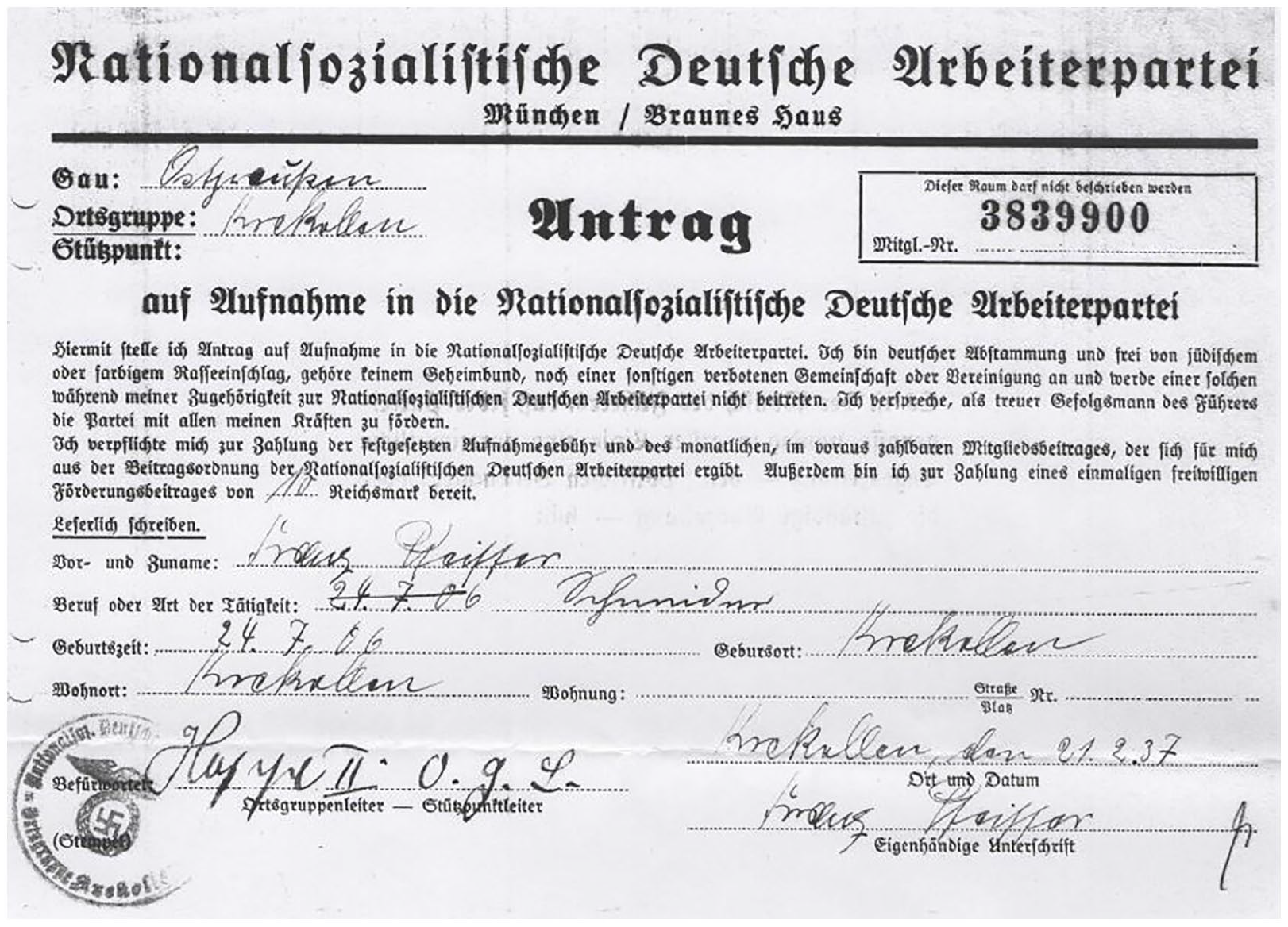
My Great-Grandfather Becoming a Member of the NSDAP.
Being a Refugee (1945–1953)
For most of World War II, East Prussia was affected by the battlefield operations only to a relatively limited extent. The strategic bombings of the Allied forces were focused on the Western parts of Germany that were easier to reach and more important from an industrial and economic point of view—and the Eastern Front was located deep in the Soviet Union. For those who were—other than the Jewish members of society, for instance—not directly exposed to Nazi terror, life in East Prussia often continued relatively normal. Up to a certain point. In my grandmother’s case, it began with my great-grandfather being drafted as a soldier. Him being gone left a huge void: I often cried when he wrote. I think he was home twice during the war. Once because his father had died. And once again when I saw him as a soldier. He was in uniform. I still remember the exact image of him walking out of the front door and we waved, and he had to go to war again. (Audio Recordings)
Without much preparation or warning, the rest of normality disappeared on January 30, 1945: They said: The enemy, the Russian is coming. The church bells rang, too. For us, this meant: Get ready to flee quickly. Freezing cold, lots of snow. Dress warmly. Only very little luggage. Important: something to eat. In tears, my mother packed a small suitcase. (Autobiographical Notes)
Reading these lines always makes me shiver. Because I can feel how my grandmother’s world collapsed in those days and hours. Because these lines breathe the despair, uncertainty, and fear that she must have felt at the time. But also because this text, which was written more than half a century after the events, contains some unpleasant traces of Nazi propaganda. When quoting the orders that the officials in the village gave, my grandmother uses the collective singular (“the Russian”), echoing a way of speaking that was frequently utilized in Nazi jargon to mark entire groups of people as seemingly evil and dangerous entities (“the Russian,” “the Jew,” or “the enemy”).
The evacuation of several million people from East Prussia in the time between January and April 1945 was poorly organized and chaotic (for an overview, see Hahn & Hahn, 2010). Based on the German government’s “no retreat” orders, evacuation plans were delayed until the Soviet forces had entered or were about to enter the areas to be evacuated, exposing civilians to the extremely cold and unfriendly weather conditions and the atrocities of war, causing a humanitarian catastrophe. Similar to my grandmother, who was fleeing with her mother and brother, many people in East Prussia had no other option but to cross the frozen Vistula Lagoon (German: Frisches Haff), always in danger of dying either because of braking through the ice or because of being attacked by low-flying Soviet aircraft. My grandmother developed pneumonia, hallucinated, and was unable to continue walking for a few days; her mother was injured by a shell splinter on her hand. Finally, my grandmother reached Gotenhafen (today: Gdynia), a city close to Danzig (today: Gdańsk), where they managed to embark on a ship that was supposed to bring them westward. After a while, the ship hit a mine: What happens? Afraid of drowning. The crew tried to calm hundreds of people. [. . .] Lifeboats were deployed. Then, it was our turn. We were shaking all over. (Autobiographical Notes)
After being rescued from the sinking ship and arriving at the island of Rügen, the flight continued until the Soviet army reached the barn where my grandmother, her mother, and her brother had found shelter together with other refugees: Several Russians stormed into the barn. Unbelievable things happened; we children had to get out. I do not want to describe it any further. (Autobiographical Notes)
With this horror, the horror of war ended for my grandmother—for others, it continued for some more time. In total, World War II cost about 60 million lives. Some six million Jews, 500.000 Roma and Sinti as well as 250.000 people with disabilities were systematically murdered. Countless cities were bombed to the ground, large areas of land were devastated. Children lost their parents and parents lost their children. People’s lovers, friends, and neighbors were killed.
Together with her mother and brother, my grandmother found refuge with a farmer’s family in Zarnewenz, a small village in the very northwest of the Soviet occupation zone, which would become the German Democratic Republic (GDR) in 1949: My mother was given a room together with the two of us. We were at a loss and didn’t know what to do next. We were weak and exhausted. [. . .] There was rarely a hot meal. We went begging, always a difficult step. (Autobiographical Notes)
Most of the time during the first months and years after the war, my grandmother was too exhausted and frail to walk to the school, which was located in the next village 4 km away, so that she never graduated. Nevertheless, the situation gradually improved at first. When my grandmother had recovered a bit, she started working in the farm’s kitchen and garden, whereas her mother and brother worked out in the fields. They even started earning some money. After the formation of East Germany and West Germany as two independent states, however, the situation in the border region got more tense: In May 1952, Zarnewenz became part of the newly established restricted zone (German: Sperrzone), a 5-km-wide zone along the Inner German border in which only people with a special permit were allowed to live and work. In this zone, and even more so in the 500-m-wide protective strip (German: Schutzstreifen), military control was drastically increased and affected daily life (Diedrich, 1998). About one month later, the farmer family, with which my grandmother and her family had gotten along quite well, was expelled from the restricted zone during Operation Vermin (German: Aktion Ungeziefer). This forced resettlement was aimed at removing—allegedly—“politically unreliable” people from the critical area along the Inner German border (cf. Thüringer Institut für Lehrerfortbildung, Lehrplanentwicklung und Medien, 2003). Together with the general lack of a perspective for a better future, these events led my grandmother and her family to evaluate alternative options: We often asked ourselves: Do we want to go on living like this? No. We wanted to try to change something. (Autobiographical Notes)
Under the pretext of wanting to visit the dentist, my grandmother, her mother, and her brother were given permission to leave the restricted zone. They seized this opportunity to travel to East Berlin by train. From there, they took the subway to West Berlin. For my grandmother, this was a memorable moment. Not only because she was extremely nervous and afraid to be caught but also because she had spent her whole life living in small villages and this was the first time that she ever was in a big city: I had never seen a subway before. It all happened so quickly. As soon as you got on, the doors closed and then you were travelling underground, and everything was dark. It was like a dream. It was incredible. (Audio Recordings)
As indicated by a document that was used during the emergency admission procedure (German: Notaufnahmeverfahren) for refugees from East Germany, my grandmother arrived in West Berlin on December 18, 1952 (see Figure 2). With their decision to leave East Germany, my grandmother and her family were not alone. Far from it. Between the formation of East Germany in 1949 and the building of the Berlin Wall in 1961, almost three million people fled from the GDR to West Germany, which was about one sixth of the GDR’s population (Effner & Heidemeyer, 2005; Grau & Würz, 2016). The reasons were manifold. Whereas some, as my grandmother’s family, left because they were hoping for a better and more prosperous life in West Germany, others left because they disagreed with the political order and felt persecuted or because of personal reasons (e.g., other members of the family already living in West Germany).
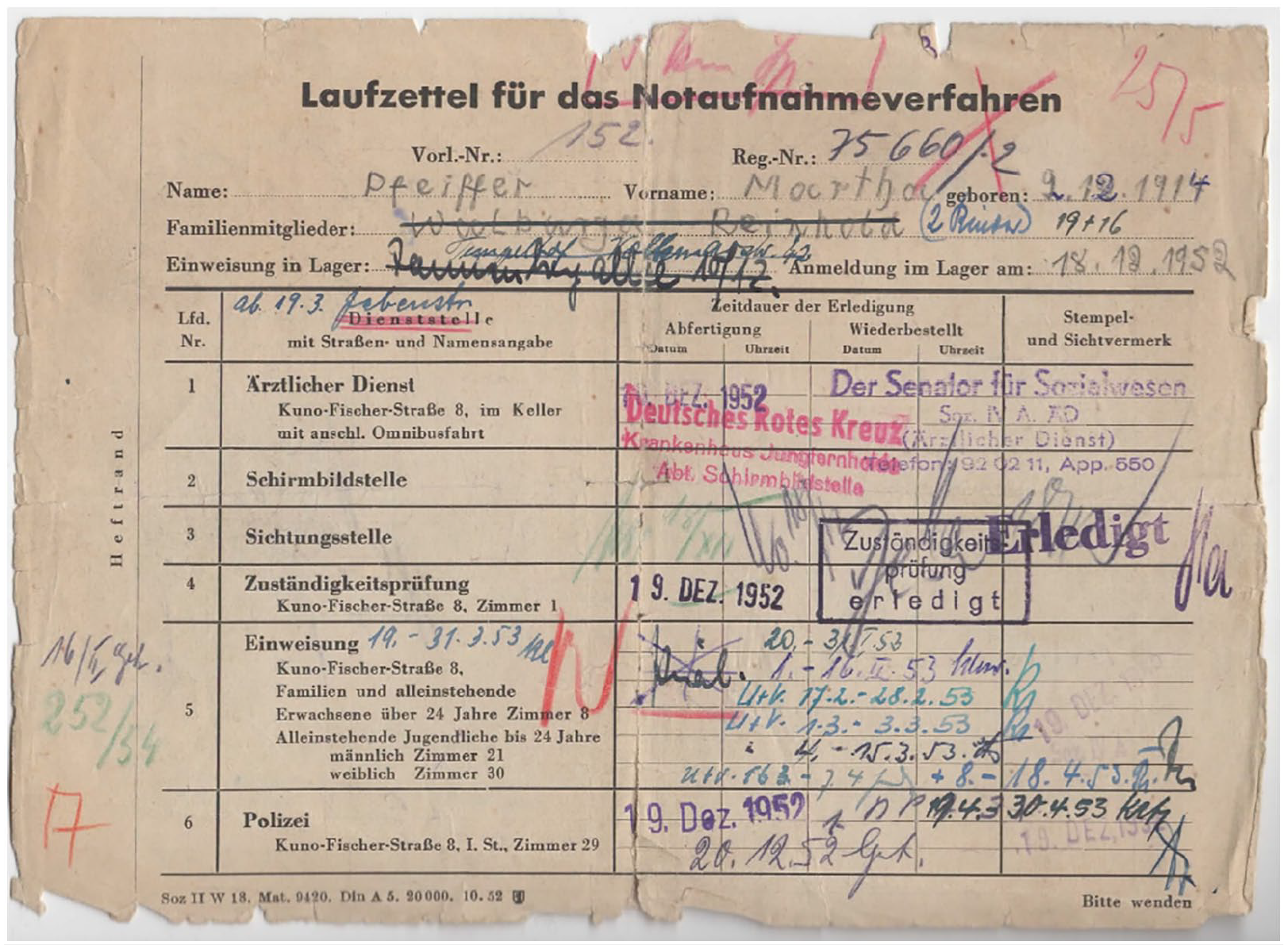
My Grandmother as a Refugee From the GDR in West Berlin.
Building a Life and Being Married (1953–1989)
Coming to West Germany also enabled my grandmother to get in touch with her father. Until then, the family had only known that he had been a prisoner of war in France. Now, they learned that he had been released and was living in West Germany for a couple of years already. The way her father reacted to the attempt to reunite the family was deeply traumatizing for my grandmother: He declined and filed for divorce. In a letter, he also told my grandmother that he thought she was old enough to take care of herself: I had some kind of nervous breakdown [after reading his letter]. I think I fainted and was really ill again. The doctor said it was a nervous breakdown. [. . .] But that was just the way it was. There was nothing you could do. (Audio Recordings)
My grandmother never quite understood what made her father—whom she had felt so close to in her early childhood days—behave this way and what kept him from returning to his family. She never asked him about it directly, not back then when she got the letter and not in the years and decades following. She must have felt that this is something she cannot talk about with her father. It was another thing in her life that she had to accept. In fact, her family’s case was not that rare after all (cf. Jähner, 2019; Ramelsberger, 2015). In the first years after World War II, the number of divorces and the tensions within families increased drastically. The long time that the families had spent apart had led to mutual estrangement. The children had grown up, the mothers had taken an increased responsibility for their families, and the fathers did not return home as celebrated heroes, but as losers, traumatized by the war, and possibly having committed crimes themselves.
My grandmother took her life in her own hands: She found herself a job as a housemaid and nanny for a family of seven in Gemen, North Rhine–Westphalia, where she stayed for about two years. One day during this time, at a dance event, she met her future husband, my grandfather Siegfried Schreiber (1933–2020), who worked as a coal miner. It was definitely not love at first sight, at least not for my grandmother. Quite the opposite. She found my grandfather boastful and had the impression that he was pretending to be more than he actually was. But he was persistent, and she did not know how to get rid of him. And then, she was pregnant. Having received no sex education at all, my grandmother must have been naive about sexual matters in a way that is hard to imagine today. And once she was pregnant, she got no support from her mother or anyone around her. For many people at the time, being a single mother was simply unimaginable: In around three quarters of marriages in the 1950s, the bride was already pregnant (cf. Schildt, 2007). The pregnancy sealed my grandmother’s fate: She married my grandfather in November 1955. About sixty years later, I reflected upon the situation and possible alternatives with her:
You would have needed someone to take you by the hand and to show you how things work . . .
Yes, right from the start, when your grandfather came to the house for the first time. That someone would have explained things to you. [. . .] I don’t know. I had no idea, I didn’t know anything and just slipped into it. It was a must: This is how it has to be now and if you don’t obey, you will be kicked out or something like that. (Audio Recordings)
It did not take my grandmother long to understand that the marriage had been a mistake. About half a year into the marriage, my grandfather took a pancake she had baked and smashed it against the wall saying it was not to his taste. When my grandmother got up and told him that she would pack her things and leave, he laughed at her and told her that she had nowhere to go. Sadly, this was true. Her mother would not have taken her back and support services, such as women’s shelters, did not yet exist in Germany. So, my grandmother stayed. She stayed with a husband who had—like so many other people from their generation (Bode, 2004; Kuwert et al., 2007)—also experienced a traumatizing childhood and youth: My grandfather was an illegitimate child who grew up with a foster family during the early years of his life. As he lived in Silesia, he also fled at the end of World War II. However, he dealt with his traumas in a completely different way than my grandmother: Whereas she mostly bottled them up, he acted them out—a gendered pattern that can be observed until today (cf. Kucharska, 2017).
It was not only my grandmother who suffered under my grandfather: Between 1956 and 1963, my grandmother gave birth to four children, two boys and two girls. My grandfather was violent, both physically and psychologically. Although beating one’s own children was seen as a legitimate educational practice at the time (cf. Müller-Münch, 2012), my grandfather’s behavior went beyond the normal level. For instance, he beat one child with a wooden coat hanger until the coat hanger broke. Before doing so, he asked the other children whether they would prefer to watch or whether they would rather stand outside the room and hear the cries through the closed door. When he was gone for a longer period, he would tell his children that he had installed cameras in the apartment and that he would watch them. In addition, he also was an alcoholic. Once on Christmas, he got so drunk that he fell into the Christmas tree. And when he was running out of alcohol, he would wake up his children in the middle of the night to send them to the pub around the corner and get him something to drink. It must have been horrible. Nevertheless, it took my grandmother more than thirty years until she finally got divorced in 1989.
From today’s perspective, do you sometimes regret that you didn’t file for divorce earlier?
Sometimes I would have wanted to. But I didn’t because of the children.
Have you thought about whether it would have been better for the children if you had divorced earlier, and they hadn’t always been exposed to my grandfather?
I didn’t really think about that at all. Everything would have had to be completely different. Where should we have gone? It wasn’t as if there had been a possibility. There was nothing there. You just noticed from year to year, as the children grew older, that it became more and more difficult. That he made more and more nasty remarks and whatnot. (Audio Recordings)
Of course, there were women in a situation like my grandmother who filed for divorce. However, many did not. Not only because getting divorced was still frowned upon far into the 20th century but also because the legal situation clearly disadvantaged women. Until the so-called Equal Rights Law (Gleichberechtigungsgesetz) was passed in the Federal Republic of Germany in 1956, the husband had the right to decide whether his wife was allowed to go to work or not (cf. Dribbusch, 2008). He also had all the family’s capital at his disposal, including the share that the wife had brought into the marriage. Twenty years later, as a result of the Marriage Law Reform, “the dominating traditional fault principle [. . .] was replaced by the concept of irreparable breakdown of the marriage as the sole ground of divorce” (Müller-Freienfels, 1979, p. 187). Ultimately, this also meant that the economically stronger partner always had to pay alimony to the economically weaker partner, regardless of whose “fault” the breakdown of the marriage had been, reducing the economic pressure for women who wanted to divorce. And, incredibly enough, it was not until 1997 that marital rape was outlawed (Kieler, 2003).
However, it would be wrong to portray my grandmother as a victim only. For one thing, because she could be a hard and distanced mother herself. She beat her children as well, although without the kind of excessive violence and sadistic pleasure that my grandfather showed. And when the children complained that they had been unrightfully punished at school, for instance, she merely shrugged her shoulders and said, “Well, you will know what you have done wrong.” Then again, my grandmother was not simply a victim because she also was a woman who was striving to explore and defend her own spaces of freedom. To give but one example and rather untypically for a woman of her generation, she bought herself a moped with which she drove quite far from the village in which she was living to the forest to collect blueberries, without ever telling anyone where the secret spots for finding them were precisely. Without any doubt, the biggest moment of self-determination and self-emancipation was the moment in which she finally decided to get divorced: Your grandfather had spent several weeks in a rehabilitation clinic. I had used this time to talk to a lawyer. Upon his return, I was waiting for him by the window. I knew that I had to do it now. Now or never. He was very friendly when entering the apartment, pretending to be enthusiastic about seeing me again. It was all very unnatural. Maybe he sensed something. I told him right away that he can save his breath, because I am getting a divorce. (Personal Recollection)
1
At first, my grandfather did not believe that my grandmother was serious. When he finally understood that she indeed was, he pretended to have a heart attack. My grandmother picked up the telephone and said that she would call an ambulance, which immediately cured his symptoms. Telling this story always put a slight smile on my grandmother’s face. It was her late triumph.
A Life of One’s Own? (1989–2022)
“A woman must have money and a room of her own if she is to write fiction,” Virginia Woolf (1929/1935, p. 4) famously claimed in her feminist essay A Room of One’s Own, which was published a couple of years before my grandmother’s birth. For the first two thirds of her life, my grandmother did rarely have money or a room of her own. She was also not interested in becoming an author of fiction. Just like any other human being, however, she was interested in becoming an author of her own life, in narrating her own story (cf. McAdams & Olson, 2010). Finally, having not only a room but also an apartment of her own gave my grandmother the desired space for doing so.
The Meaning of Home
My grandmother’s life was a life on the move. When the war came to East Prussia, she fled westward. When life turned out to be unbearable in the GDR, she went to West Berlin from where she was sent to North Rhine–Westphalia. When she married, she moved in with my grandfather. When he stopped working as a coal miner, the family relocated to the very southwest of Baden-Württemberg. And when going to an older adults’ home became inevitable, she packed her things once more. Interestingly, she never returned to any of the places where she had lived before. Even after the fall of the Iron Curtain, she did not make any attempt to visit Zarnewenz or Krekollen. She never went to Berlin again and she never felt the urge to visit the cities in North Rhine–Westphalia, where she had spent several years.
What would be the point of going back? I do not know anyone there anymore. And I guess that things must have changed so much. The cities and villages probably look so different after all these years and decades. I have also heard that my parents’ house in Krekollen does not exist anymore. That it was destroyed during the last moments of the war. (Personal Recollection)
In other words, my grandmother would have been unable to find what she would have been looking for. The home that she lost at the end of World War II was not only a physical place but certainly also a psychological one. In a sense, a refugee remains a refugee forever (see, for example, Hunt, 2010). This is maybe also why my grandmother was empathizing with the refugees who were seeking asylum during the so-called European migrant crisis in 2015: I remember what it was like for me back then when we knocked on strangers’ doors to ask for something to eat or something to drink. We were told so often to go back to where we came from. When I see these people who are fleeing from war, I see people who need help. (Personal Recollection)
Despite all this, I never had the feeling that my grandmother was lost in the world. Some signs of home remained, often related to sensory impressions: There were two linden trees in the garden in front of the [parents’] house. I love the scent and the tea to this day. (Autobiographical Notes)
Interestingly, my grandmother also avoided being away from home for more than a week. Whenever she went on vacation or traveled to visit her children, she tried to stick to this self-set limit. One might take this as a habit or personal preference without deeper meaning. However, I believe that this would be a mistake: Experiencing that she had an apartment of her own also reassured my grandmother that she had a life of her own.
Understanding Oneself and Understanding the World
My grandfather told my grandmother that she was “born stupid and has not learned anything since” (Audio Recordings). During the more than thirty years of their marriage, he repeated it so often that she finally believed it herself. From a theoretical perspective, this is a form of epistemic injustice or more precisely hermeneutical injustice (Fricker, 2007), that is, a situation in which an individual doubts that their perspective is worth being heard and that they can take part in processes of understanding and meaning-making. Especially after her divorce, the family encouraged my grandmother to strengthen and develop her own voice. Sometimes, it worked. Although writing and reading always remained difficult for my grandmother due to her lack of formal education, she was nevertheless willing to write the autobiographical notes from which I have quoted here. One of my uncles took these autobiographical notes, typed them on the computer, added some pictures and further information, and printed a small booklet that was distributed in the family. This recognition meant a lot to my grandmother. Sometimes, however, it did not work. For instance, I remember several conversations in which I tried to explain to my grandmother in simple terms how the internet works. She listened and then stated that she will never properly understand this. I am sure that she could have understood but that she had decided right when I started talking that this is something that goes beyond her limits. At times, I found this intentional self-restriction frustrating and hard to accept—although I knew that it was deeply rooted in her experiences and the way she had lived her life.
Importantly, these experiences and the way she had lived her life also gave her some kind of situational wisdom (cf. Grossmann, 2017) that allowed her to cope with new situations and the hardships of getting older:
How are you?
One needs to be content the way things are.
Well, you could also complain . . .
That wouldn’t change anything either, would it? (Personal Recollection)
One needs to be content the way things are. She repeated this sentence so often that it can be considered her life motto. It contains the hope that one can be happy even in the face of the most adverse circumstances. It contains the idea that one should better adapt to reality instead of trying to change things that cannot be changed and, on a more implicit than explicit level, it also contains a strong sense of responsibility, the willingness to accept one’s duties, and one’s fate. However, this makes my grandmother sound more serious than she actually was. She could also be playful and creative: During one of my first visits after she had moved to the older adults’ home, she took a puppet on her lap that she had kept for decades and jokingly talked to it. “So now we are here,” she said. “We have come such a long way. What are we going to do now? We are going to make the best out of it, won’t we?” Then, my grandmother changed her voice, pretending that the puppet replied to her. “Yes, yes,” the puppet said. “This is how we have always done it. This is how we will do it now.”
A Female Life, a Difficult Life
A female life in a patriarchal society can be difficult not only because of male dominance but also because of a lack of female solidarity (cf. Chira, 2016). My great-grandmother showed such a lack of female solidarity not only when my grandmother got married but also when she filed for divorce.
She said: “As you have taken it for so long now, you also could have taken it for longer.” In reply, I said [sarcastically]: “Thank you. That is such good advice.” (Audio Recordings)
Overall, however, my grandmother was lucky in this respect. She did not have many but lasting friendships. She had women by her side who supported her in standing up to my grandfather at least occasionally. For many years, she had a friend with whom she met for lunch and for an extended walk once a week until walking became gradually more difficult for my grandmother. She also developed close ties with a couple for whom my grandmother ran the household for more than two decades and who appreciated my grandmother’s presence not only as an employee but also as a person.
Whereas my grandfather had a number of other partners after the divorce, my grandmother stayed single for the rest of her life. Sometimes I thought that was unfair. Sometimes I would have wished for her to find a man who accepts her as a person, who is kind to her, who shows her what love and partnership can mean. In retrospect, I have to admit that this was rather my hope than my grandmother’s dream, rather my imagined future for her than the story she wanted to write for herself. Her singlehood was a personal choice that probably rather increased than decreased her well-being (cf. Girme et al., 2023): She did not have a desire for a partner. She was happy that she could finally decide for herself how she wanted to live. She was not interested in being bound to a person who could potentially interfere with the way she had organized her daily life.
Instead, my grandmother chose to focus her attention on her children and (great-)grandchildren. This was the new role that she found for herself, a role from which she drew meaning and satisfaction: Everyone I know says to me: “You have such good, intelligent, and well-educated children.” They were born from nothing and still turned out so well. [. . .] I just think I did the best I could. (Audio Recordings)
Being freed from the daily chores and the continued conflicts with her husband, she was able to show more affection and became more relaxed with herself and the people around her. Of course, that does not mean that everything was sunshine and happiness. But after all these years and decades, my grandmother’s life had finally entered a state that could be described as normal. It was the kind of normality that my grandmother had been missing since her childhood.
Coming to an End
Every story comes to an end. To be remembered, it needs to be passed on. It needs to be told. My grandmother was not an outgoing person, not a person who spoke up. This makes it easy to miss that she actually had a voice, a voice that is worth listening to. An individual voice telling an individual story and, at the same time, a voice like many unheard others.
Four days before she passed away, I sat beside my grandmother’s bed and read a book to her. She had her eyes closed and looked as if she were asleep. When I asked her whether she wanted me to continue reading, however, she nodded slightly. It was a very peaceful afternoon, a quiet but intimate moment between the two of us. I took her hand and held it in mine. Thank you for everything, kleines Ömachen.
Footnotes
Declaration of Conflicting Interests
The author(s) declared no potential conflicts of interest with respect to the research, authorship, and/or publication of this article.
Funding
The author(s) received no financial support for the research, authorship, and/or publication of this article.
