




Abstract
This article explores moments of pedagogical disruption as children from an urban school encountered an exhibition titled “We Change the World” at the National Gallery of Victoria. In conversation with radical traditions of anti-colonial scholarship, we elaborate children’s disruptions of the gallery as a space of didactic transfer and common ownership of cultural artifacts and knowledges. We then analyze artworks created by children in the wake of their experiences at the gallery, offering alternative propositions for learning to share the world in ways that break with dominant conceptions of museum education, national collections, and the commons.
Keywords
Introduction
We are riding the tram downtown to the National Gallery of Victoria, our arms and shoulders overloaded with camera bags, audio recorders, and art materials. Jostling into the crowd moving toward Federation Square, we merge with a quivering line of children crossing from the train station. The children meeting us at the gallery are from a mixture of white settler, settler of color, new migrant, and refugee families who attend an inner city, K–12 public school with a history of alternative education informed by Reggio Emilia pedagogies. As a relational practice of continuous reciprocal exchange and meaning making, the school’s adoption of Reggio Emilia is designed around a porous relationship with the broader environment and community (Rinaldi, 2021). As part of this approach, the school encourages children to work collaboratively with teachers, researchers, artists, and community members such as ourselves to develop creative projects exploring issues of interest and relevance in their own lives.
This article elaborates on an ongoing research collaboration with this school focused on how children are collectively sensing and desiring change under conditions of social, political, and environmental unrest. Our collaborative project explores the role of art in cultivating and expressing the changes children would like to see in society, in public institutions and structures of power, and in the world at large. As one of fifteen collaborations with children seeded through the Local Alternatives research platform since 2017 (see www.localalternatives.org), we invited children to explore how art and design influence and contribute to social change through artworks that employ decolonial and environmental justice frameworks. Focusing on an exhibition titled “We Change the World” at the National Gallery of Victoria, our emergent and participatory approach to this project builds on and contributes to anti-colonial, arts-based methodologies in educational research which engage children as active researchers, artists, educators, and knowledge producers (Ansloos & Wager, 2020; Rousell & Cutter-Mackenzie-Knowles, 2023; Diversi & Moreira, 2012; Hickey-Moody & Horn, 2022; McMillan, 2023; Nxumalo, 2019). By working with children as artist-researchers, and acknowledging, as Tuck and Yang (2019, p. xiv) note, that children are not too young or removed to confront colonial harms, we aim to generate new potentials for educational thinking, art making, and curriculum development as children encounter artworks underpinned by radical theories of change.
How might hegemonic narratives of change be transformed as children reroute the conceptual and pedagogic affordances of the gallery through their own experiences, interpretations, and interventions? How can child-led encounters with anti-colonial artworks help to address the “narratives of avoidance” (Diversi & Moreira, 2012) that persist in settler colonial education?
This article grapples with these questions by following a series of emergent encounters between children, artworks, and radical traditions of Black and Indigenous scholarship and activist thought. Using what we term a methodology of anti-colonial encounters, our approach involves actively thinking with and through the many ways that children disrupt the “call to order” (Harney & Moten, 2013) of public institutions which perpetuate the white possessive logic of the settler colonial state (Moreton-Robinson, 2015). Working and thinking with children as artist-researchers enables us to be guided by their modes of engagement and pedagogic address, and invites us to learn from their own ways of reckoning with the logic of whiteness which continues to dominate public institutions within settler colonial nations (Ahmed, 2009; Bhattacharya, 2019; Jain & Akomolafe, 2016; Sriprakash et al., 2022).
We come to this work as artists and researchers who form part of a white migrant and settler demographic within the Australian national context. David (Author 1) is of mixed European heritage and was born on lands originally inhabited by the Algonquian tribes along the north-east coast of the Americas. He electively migrated from the United States as a young adult and has since lived and worked on unceded Peramangk, Kaurna, and Bundjalung Country in Australia and the lands of Ngāti Hau in Aotearoa New Zealand. Today, he lives on unceded lands of the Wurundjeri-Woi Wurrung language group of the Eastern Kulin Nation, close to the Merri Merri (or “very rocky”) creek. For the past decade, he has worked collaboratively with children, young people, and communities to co-create responses to environmental and social justice issues across diverse educational contexts, and he brings this community-led ethos and methodological orientation to this research.
Kelly (Author 2) is a white settler of mixed European heritage. She was born and raised on unceded Jagera and Turrbal lands before locating to the unceded lands of the people of the Wurundjeri-Woi Wurrung and Boon Wurrung language groups in adult life. Inhabiting the position of white settler in so-called Australia is also to inhabit and reckon with the ongoing violence of whiteness and its carceral cultures of control. Much of her work as an artist and academic has focused on how this carceral culture operates through institutional and bureaucratic violence. Like David, she often works collaboratively with communities, advocates, and activists on justice-focused issues and contexts that employ contextual approaches to ethics and creative practice.
In undertaking this work, we acknowledge that this project takes place on the unceded lands of the people of the Wurundjeri-Woi Wurrung and Boon Wurrung language groups of the Eastern Kulin Nation. We acknowledge that these lands were stolen by European colonizers and continue to be forcibly held by the settler colonial state. We also acknowledge our own positionalities as migrant and settler artists, educators, and researchers who have not only been taught whiteness from birth, but have also benefited from the privilege that the identification of whiteness bestows under the settler colonial regime. We acknowledge, as Gamilaroi scholar Michelle Bishop (2021) highlights, that the dominance of whiteness in education flourishes by design, not by nature, and that as white-identified settlers and migrants we continue to be unearned beneficiaries of this design.
In the sections that follow, the paper unfolds a series of vignettes which function as open-ended stagings of anti-colonial encounters between diverse childhoods, artworks, practices, and theories. Our positionalities as white settler and migrant people within the Australian context directly informs our critical encounters with whiteness as a logic of (dis)possession throughout the course of this paper, and shapes both the methodological and conceptual angles that the project follows. This dramaturgy of encounters draws equally on speculative, poetic, and critical renderings of the logistics of whiteness (Carter & Jocson, 2022; Sheridan & McManimon, 2023) and the counter-possibilities offered by children in conversation with anti- and decolonial thought (Nxumalo, 2020; Nxumalo & Cedillo, 2017; Walter, 2022). Importantly, while our positionalities shape our angle of approach, our focus throughout this article is on following and learning from children’s encounters with anti- and decolonial works of art. Throughout the article we alternate between the terms ‘anti-colonial’ and ‘decolonial’ in alignment with how particular artists and authors frame their own work. When referring to our own methodological and pedagogical work we use the term anti-colonial. By following how children encounter and respond to these works, we hope to contribute to emergent and collective forms of inquiry focused on unlearning the imperial logics of public institutions (Azoulay, 2019), and specifically, how children can guide anti-colonial work through their own intersectional positionalities and wider ecologies of experience (Hickey-Moody & Horn, 2022; Murris, 2020). 1
Sensing Change
Sitting on the floor with 35 children between the ages of 7 and 9 in one of the gallery’s education studios, our collaboration begins by sensing the changes coursing through our bodies: pulsations of blood, the influx and efflux of breath, fleeting and elongated durations of feeling and thought. We ask the children where and how they sense change happening in the world. One child says they sense change as a vibration that moves through everything all the time. Another says they can feel these vibrations coming up through the floor; another says it flows like water; others feel it in the migratory movements of animal populations, shifting climate and weather patterns, and the rhythmic pulses of life in the city. A litany of changes begins to accumulate as children extend their sensations of change from their bodies out into the world at large: “Climate change”; “asteroids and meteors”; “coronavirus”; “suicide”; “Ukraine getting bombed”; “car accidents”; “pollution”; “time”; “space travel”; “new babies being born”; “koalas getting burned up”; “airplane crashes”; “movies getting made”; “animals being extinct”; “bushfires raging”; “losing your memory”; “bias”; “racism”; “people cutting down trees”; “people taking land”; “land clearing”
We explain that we are here to work together as artist-researchers, exploring how works of art can generate different sensations and understandings of change in the world. Rather than relying on gallery educators and curators as experts who will teach how the artworks are made and what they might mean, we invite children to approach the gallery as a creative laboratory for exploring different ways of sensing and responding to change at the level of bodily affects and sensations (see also Rousell et al., 2020; de Freitas & Rousell, 2021, for related approaches to gallery education). We hand out digital SLR cameras, Zoom audio recorders, and wearable GoPro cameras as change-sensing devices and invite the children to freely explore the We Change the World exhibition as researchers searching for forces, flows, resistances, and resonances of change.
The Science of Whiteness
How might children’s sensations and articulations of change help reckon with the irreparable losses wrought by colonization, and the pervasive logic of white possession that both calcifies and erases alternative possibilities for educational life? In her book Out of the Clear (Manning, 2023), Erin Manning describes the logistical clearing of lands under colonization as a “genocide of relations” (p. 8). She argues that this clearing of relations provides the conditions for a metaphysical distance from the world to be established. This distance establishes the possibility of property, of ownership over all that has been cleared. Subjectivity is reduced to the bounded individual. Change is reduced to probability. Value is reduced to calculation. World is reduced to possession: In the clearing, man is revealed as the loss of relation. Humanism is born here, in the empty space of the stolen land, in the vast expanse of the 1+1, the infinite regress of nothing-in-between. (Manning, 2023, p. 16)
With the clearing comes a need for someone to manage the loss, the emptiness, and the distance. Manning terms this the role of the “mediator.” The mediator comes to collect, judge, evaluate, and redeem all that is left in the clear. Artifacts are collected and held “in common.” Credits and debts are parsed out. Entitlements are decided. Victims and perpetrators are identified. Blame is laid in its rightful place, and Man is redeemed and abjured from evil.
Manning’s concept of the clear builds on Stefano Harney and Fred Moten’s recent book All Incomplete (Harney & Moten, 2021), which conceptualizes this ongoing process of clearing and distancing, collection and mediation, as a “science of whiteness.” Whiteness, as Harney and Moten write, is not a marker of race as physiognomic, genetic, or cultural difference, but a logistics “that begins in loss and emptiness” (p. 16), a logistics that brings race into existence as a technology of distance, determination, possession, calculability, and monetization. Whiteness is defined by a logistics of distanced calculations that “gives the illusion of a free-standing subject” (p. 15), a subject whose status is determined by the invention of race as a social technology that thrives in the clear. Once birthed by the technology of racialization, the white, free-standing subject can survey the loss of the clearing from a distance, parsing out and collecting the remains according to a naturalized hierarchy of being while planning its next logistical operation to secure mastery (Singh, 2017). The science of whiteness is simply the science of loss, and all that profits in the wake of the genocide of relation. Within settler colonial states, public institutions such as schools, universities, galleries, museums, libraries, and hospitals can be understood as both mediators and receptacles of what is left in the clear. They are structured according to the science of whiteness (Sriprakash et al., 2022) and function to mediate the white logistics of continuous acquisition, improvement, and self-possession as the presuppositions on which notions of “society,” “community,” and “the commons” are formed (Harney & Moten, 2021).
White Lies Matter
Aboriginal artist Richard Bell also teaches about the logistics of whiteness as we follow children’s explorations in the National Gallery of Victoria. A member of the Kamilaroi, Kooma, Jiman, and Gurang Gurang communities, Bell has a long-standing artistic practice dedicated to an immanent critique of whiteness from within the clearings and mediations of the institutional art world. To practice immanent critique, as Manning and Massumi (2014) write, is to “inhabit one’s complicity and make it turn—in the sense in which butter ‘turns’ to curd” (p. 87). Bell’s work curdles the whiteness of the institutional gallery space by turning it inside out, reworking it back on itself. He urges us out of the clear and back into the teeming indeterminacy of relation, resisting the artificial transparency of a world that can be grasped, held, known, represented, possessed, and mediated at arm’s length.
During our workshop one of Bell’s paintings, The Truth Hurts (Bell, 2020) is curdling the atmosphere of the gallery as a child gyrates back and forth in front of it (Figure 1). Captured by a roving GoPro camera worn by another passing child, her movements elaborate an improvised choreography that ruptures the gallery’s expectations of distanced contemplation and didactic transfer. Bell’s painting is composed entirely of a subtle palette of white shades, almost indistinguishable from one another. Slight variations in tone and texture outline a gridded pattern of white dots, spirals, concentric circles, and wandering lines. Emerging from this patterning, and just barely discernible from the white cube of the gallery, are the words “White Lies Matter.” These words fold and congeal against the stark whiteness of the gallery walls. The child’s dance sidles up and down, back and forth, sometimes facing the painting and other times turning sideways, backwards, all the ways around. Her movements convey the sense of a transversal, quivering form of attention that somehow sees the painting without interpreting it according to discursive categories. MacRae and MacLure (2021) describe this as a mode of “haptic vision,” akin to what Tina Campt (2017) terms the “quiet frequency of touch.” Rather than reading and interpreting Bell’s painting through language, the child dances its haptic field.
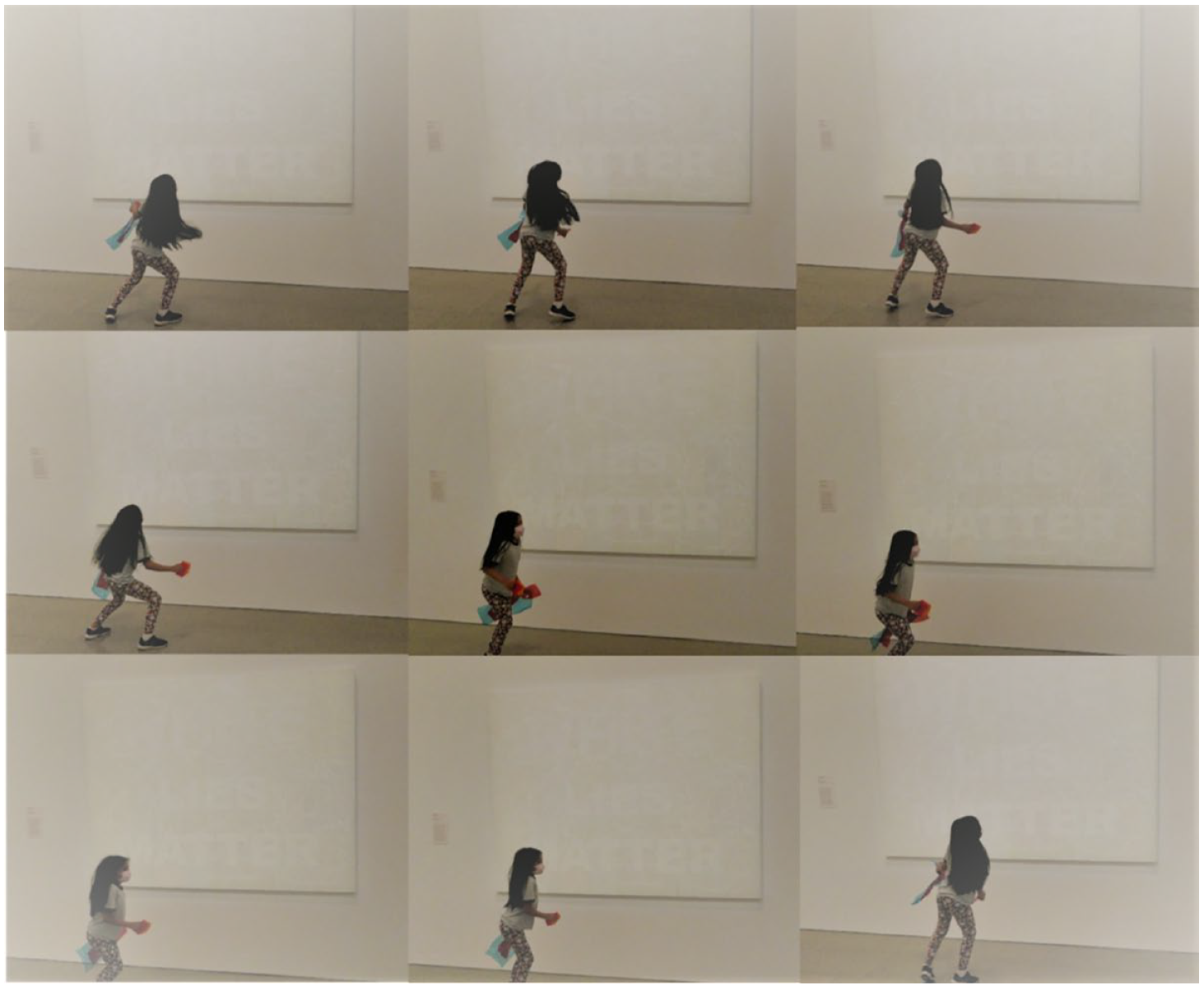
A child dancing in front of Richard Bell’s ‘The Truth Hurts’ (2020) during our Sensing Change workshop at the National Gallery of Victoria.
The white walls of the gallery curdle even further as security and attendant museum educators hover closely around the dancing child. They are ready to intervene if her body makes physical contact with the painting, a touch that would complete the haptic circuit of the curdling atmosphere she has summoned into existence. Here, the encounter between Bell’s The Truth Hurts (Bell, 2020), the dancing child, and the hovering security guards exposes the mechanisms through which the science of whiteness maintains its spatial and temporal authority (Todd, 2015). By turning the museum’s claim to collective ownership back on itself, Bell teaches us to be wary of the white lies that invent, categorize, and eventually come to possess “Aboriginal Art” (Bell, 2002). His work shows how whiteness freezes the joys and horrors of life and lays them out for analysis at a comfortable distance, apportioning what has been lost through the gesture of commoning as a sleight-of-hand move to innocence, universal beneficence, and historical neutrality (Tuck & Yang, 2019).
Last the Blast
Just a few steps away another group of children agitates wildly, arms raised and fingers outstretched, in front of Susan Cohn’s Last the Blast (Cohn, 2006). Photographed by another child’s roving camera, their hands become entangled with the image of a deadly bomb blast and the offering of a bomb-proof necklace designed to preserve and convey messages after the moment of death. The children seem fascinated by the necklace and accompanying depiction of chaos and disaster, an artwork that registers its complicity in systems of violence and the desperate hope that some sentiment of self might survive the annihilation of the body. Similarly, in her book Potential History: Unlearning Imperialism, Ariella Aisha Azoulay (2019) frames art galleries and museums as places where “imperial violence is not secondary to art but constitutive of it” (p. 59). In this text, Azoulay traces the origins of cultural institutions as derived from practices of severing relations according to the imperial logic of plunder. Constitutive of imperial practices more broadly, she argues that it was the rapid accumulation of stolen goods that generated the need for museums, galleries, and other archival regimes rather than any genuine desire for the collective care of cultural artifacts and knowledges. Just as a camera shutter captures a limited view by slicing an image from time and space, Azoulay (p. xvi) observes that galleries and museums operate as “imperial shutters” that separate people from objects, lands and waters, ecosystems, and communities. She suggests that this severing of relations is what constitutes the concept of the commons in settler colonial societies. For Azoulay, what is designated as the commons are simply the ruins that are left once relations have been annihilated, cleared out, and the imperial shutter has closed.
We recall how the museum educators gathered all the children in the hall before they entered the exhibition, instructing them firmly not to touch any of the artworks in the gallery because “they belong to everyone.” In settler colonial societies, it is typical for national archives and collections to be positioned as common repositories of shared resources and wealth. These narratives present the institution as a resource that belongs to everyone, is accessible to all, and is therefore everyone’s responsibility to protect. According to this logistics of whiteness, all that has been dispossessed must now be repossessed under a common law of so-called “public” ownership of artifacts, archives, histories, and institutions. “How to fill the emptiness?” Manning (2023) writes. “How to create an account for all that is lost and yet claimed?” (p. 16). In the gallery, it is now the white claim to innocence, neutrality, and common ownership that comes to mediate the clear.
Goenpul scholar Aileen Moreton-Robinson (2015) conceptualizes this as the “logic of the white possessive,” a mode of rationalization which materializes as a continuous defense of the fragility of white claims to dominance and ownership of sovereign Indigenous lands. As Sriprakash et al. (2022) elaborate in their book Learning Whiteness, the logic of the white possessive is itself a project of racialization that is taught, learned, and perpetuated through the pedagogies of the settler colonial state. Rather than being linked to any innate or inherent attribute, the white possessive is a mode of occupying and defending the seizure of space and time in ways that make white privilege and superiority feel comfortable, natural, commonly shared, perhaps even inevitable (Hawkman & Diem, 2022).
Azoulay (2019) argues that museums and galleries sustain and defend the white possessive through a commoning of what has been lost. She asks us to refuse the claim to common ownership and instead “defrost” the violent histories of dispossession inherent in museological objects, spacetimes, and logistics (p. 84). In the gallery, we see this kind of defrosting taking place through the polyvalent gestural dynamics of children’s encounters with Last the Blast (Figure 2). Instead of a distanced and didactic contemplation of human brutality from the Archimedean point of the neutrality of the commons, we see children rising up and throwing themselves into the “visual frequency” of the image as bodies inseparable from the violence it portrays (Campt, 2019). What would it mean to disown the commons claimed by the cultural science of whiteness, while simultaneously acknowledging our complicity in its (re)possession? What manner of educational practices might live in the wake of a dispossession of the commons (Harney & Moten, 2021), as a radical refusal to claim (and be claimed by) any common right to property or propriety?
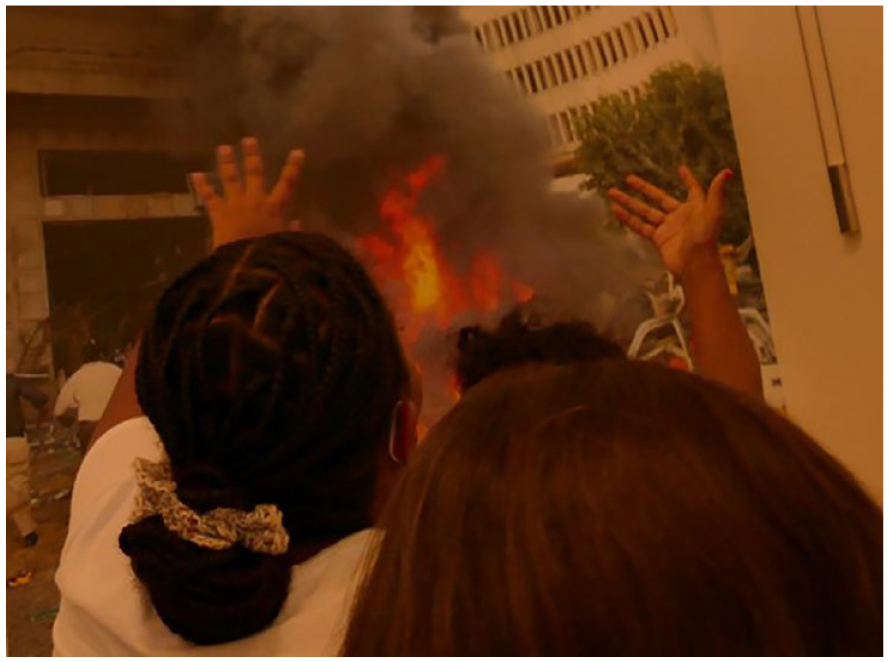
Children encountering Susan Cohn’s ‘Last the Blast’ (2006) during the Sensing Change workshop at the National Gallery of Victoria.
Heala
From across the gallery, Hannah Brontë’s installation Heala (Bronte, 2018) calls the children into a womb-like environment of color, light, and sound. Lured by a bass-heavy hip-hop soundtrack that bleeds and echoes through the gallery, the children gather around a circular projection on the floor. Large orange drapes fall from the ceiling, enveloping the children as they seek comfort in the glowing orange shadows. A woman’s voice speaks to us from within this place of refuge. “The first colour you see in the womb is orange. It’s the tissue in the womb mixed with the light of the world outside. The first sound you hear is your and your mother’s heartbeat entwined. Then there is water” (Bronte, 2018) (Figure 3). In a circular projection which fills the middle of the space we see a group of women gathering in water, dancing and rapping to a soundtrack based on the artist’s heartbeat. By centering relations that are practiced in the orange shadows of the womb, the artist seeks to resist the logistics of whiteness that regulate and dispossess women’s knowledges and bodies as connected to earthly processes. This rendering of the relations of waters, lands, and kin refuses the body-world separation of whiteness that creates and mediates distance (Manning, 2023, p. 31). The children attune with ease to the installation and gather in the orange structure—a refuge from the austere organization of the gallery outside. From inside the embrace of this work, a child narrates their sensations of change into the audio recorder: . . . its about some people, like, babies being born. Indigenous women. Nature. Water. Some pictures. Eyes, heart and ears. Now the people are hitting the water, and they are walking through the water, and they are splashing this person, I am sitting on the side of all of them, inside this big circus tent that looks so cool! And they are lying down and banging water, and it’s hip-hop singing, and now they are lying down in water, and there is a change in climate. And now a mum is feeding a baby girl or boy. And they have seashells on them, and their clothes, covering them. One of the people singing is pregnant, and she has seashells, and she’s lying down in the water with her tummy showing. (Audio recording, March 15, 2022)
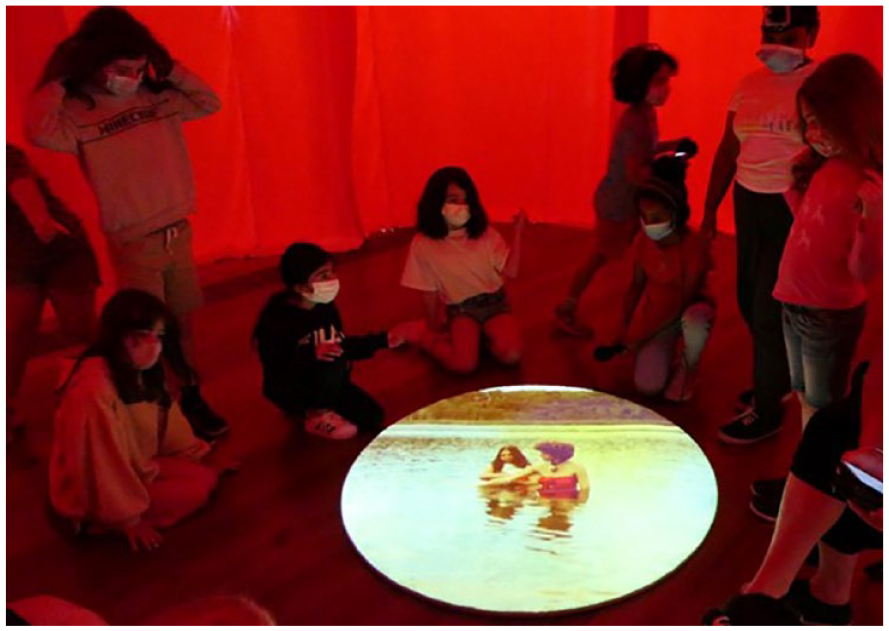
Children gathering around Hannah Bronte’s ‘Heala’ (2018) during the Sensing Change workshop at the National Gallery of Victoria.
The children’s audio recording offers an account of how Heala spills them out of the clear, opening a reparative space in the gallery for regenerating the fleshy world of relations. By refusing and repairing the imperial clearing of relations, Bronte’s Heala “moves with the anarchic share of existence that keeps giving life” (Manning, 2023, p. 28). Later in the day, the same child who spoke into the audio recorder draws their interpretation of Brontë’s work on an A4 piece of paper. The image shows an infant emerging from a womb-like form. She tells us that Heala was her favorite work in the gallery because babies are the changes she loves most in the world.
Remain
What remains in the clear? This is the question asked by Iranian artist and activist Hoda Afshar and her collaborators—a group of men seeking asylum in Australia who remained on Manus Island in Papua New Guinea following the closure of the immigration detention center in 2017. Toward the end of their exploration of the gallery, we encourage the children to sit next to an artwork where they can sense change occurring. We hand out packs of cards which we had printed with concepts, images, and ideas related to each of the works in the gallery. As constellations of overlapping words and images begin to cover the floor, the children initiate conversations about these encounters. The children speak into the audio recorder they brought along as they discuss Afshar’s work: I have got “truth telling.” I think this video is truth telling because it’s telling the truth. Oh, I accidently took a photo of my foot. The reason I have chosen truth telling is because this video is telling the truth. “Feeling.” I think this video is feeling because it says, I’m feeling sad, I’m feeling scared. It says I’m feeling many things. “Faith.” This is full of faith, hopefully this guy has the faith to do it. “Deferential.” What does that even mean? “Political.” I’ve heard this word before, but I don’t know what it means. “Island.” They are on an island. “Injustice.” I know what justice means but I don’t know what injustice means. “Remain.” This is what remains in the dark world. And we’ve got “politics.” What? “Poetics.” What even is that. And why is he carrying a fish? (Audio recording, March 15, 2022)
Afshar’s collaborative video installation Remain (Afshar, 2018) speaks to the injustice of mandatory offshore detention in Australia—a set of carceral policies designed to create what Georgio Agamben (1998) calls “bare life,” a life controlled by state powers that seek to strip all forms of expressive life. And we’ve got politics (Figure 4). What? Poetics. What even is that. And why is he carrying a fish? The performances of the men in Afshar’s video work rupture the expectation of “bare life” through the sharing of politics, poetry, sovereignty, and justice. Injustice. I know what justice means but I don’t know what injustice means. What does it mean to know of justice but not of injustice? Justice without injustice typifies the collective amnesia of whiteness. It separates justice from the plunder and destruction of the world and “speaks from a place it has never had to truly encounter because its role is only to order things apart” (Manning, 2023, p. 18). Sriprakash et al. (2022) describe the ongoing “injustices of learning whiteness” through narratives of avoidance that are perpetuated by the pedagogies of the colonial state (p. 85). In/justice. A linguistic deception where justice seeks to distance itself from the more inconvenient presences of injustice. Afshar’s collaboration with the men who remained on Manus Island highlights this separation. Here, the tropical beauty of Manus Island is ruptured with songs of longing that literally call into view the missing syllabic bridge that allows justice to exist without injustice. Faith. This is full of faith, hopefully this guy has the faith to do it. Afshar’s choreography brings the men into poetic relation with the institutions mediating the clear. The men stand with faith in the emptiness of the clear. Remain. This is what remains in the dark world. To reckon with whiteness is to face the commons of destruction and loss of relation. This is what remains in the clear.
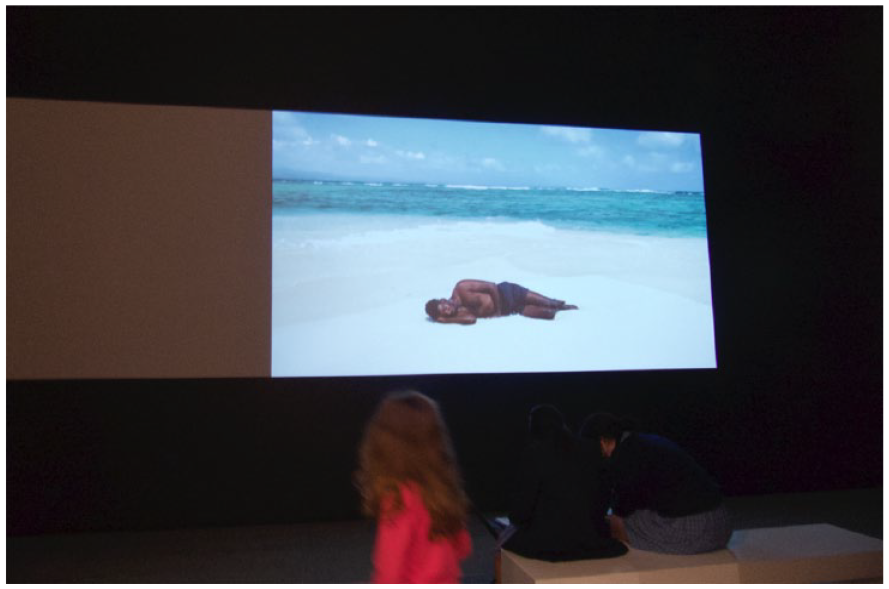
A child encountering Hoda Afshar’s ‘Remain’ (2018) at the National Gallery of Victoria.
A Pedagogy and Curriculum of Anti-Colonial Encounters
Three months after these critical encounters in the gallery, we found ourselves mingling with children, local families, fine art students, and academics in an exhibition of children’s art spread across two floors of our university’s Art in Public Space Gallery. In the months leading up to the show, our partner school had dedicated two project sessions per week for children to conceptualize, develop, create, and curate artworks based on their own concepts and sensations of change. Children used umbrellas hung from the ceiling of their classroom to devise and map out the key thematic concepts for their exhibition: sharing resources, being healthy, the environment, respect, and war. Overall, the question of how we learn to share the world (O’Donnell, 2022) emerged as a resounding refrain which the children took up across a range of concepts and creative practices.
In creating their own artworks about sharing the world, children were encouraged to select media and materials (painting, video, animation, photography, montage, sound) and compose their own artist statements to express concepts and values underpinning their work. Teachers worked as supportive facilitators for the children’s practices and ideas throughout this process. We also visited the classroom at various stages to hear from the children about their creative development and provide various degrees of technical and curatorial assistance. We then worked with children individually and in groups to curate their works into a cohesive exhibition design which reflected their conceptual and practical intentions for the work. These arrangements fit consistently with the school’s commitment to relational pedagogic models. As an inner urban public school designed with and for different communities of students and their families, the school has a unique history of child-led, culturally responsive, and “world-centered” (Biesta, 2021) approaches to curriculum and pedagogy.
The opening of the “Kids Make Change” exhibition marked our project’s transition from a series of emergent methodological experiments into a pedagogy and curriculum of anti-colonial encounters led by children’s critical and creative responses to the exhibition at the National Gallery of Victoria. As we continue to think through the children’s works and the concepts and values they elaborate, we in turn encounter new sets of questions and propositions. How do children’s artworks open different ways of sensing and sharing the world outside the white logistics of possession and ownership? How might these works bear witness to the intensive differential that animates the grounds between migrant, displaced, and settler experiences of sharing, gathering, and (dis)possession?
Entering the first floor of the exhibition, the first work we encounter is a photographic montage titled “No War” (Figure 5). Printed images of war-torn environments and communities are juxtaposed in tense angular formations, cutting into one another without regard for the formal continuity of the individual image. What emerges from this graphic interplay of surfaces is a plural cry for peace which confronts the viewer with the incommensurable truths of suffering, resistance, displacement, and death. While documentation of the abject horror of war has been widely critiqued in photography and media studies (see, for instance, Kozol, 2014; Reinhardt et al., 2007; Rosler, 2004; Sontag, 1977, 2004; Zelizer, 2010), this particular encounter with the imagery of war registers the concerns of some children who may have lived experience of war and conflict and may have either volunteered or been forced to migrate due to cultural and political violence. This gives the montage a voice and a power that is diffracted through complex crossings and intermixtures of experience (Glissant, 1997), highlighting the differential between those who have lived through the trauma of war and those who have not (Watson et al., 2022). This differential becomes especially palpable as the families of children enter the exhibition and encounter these works.
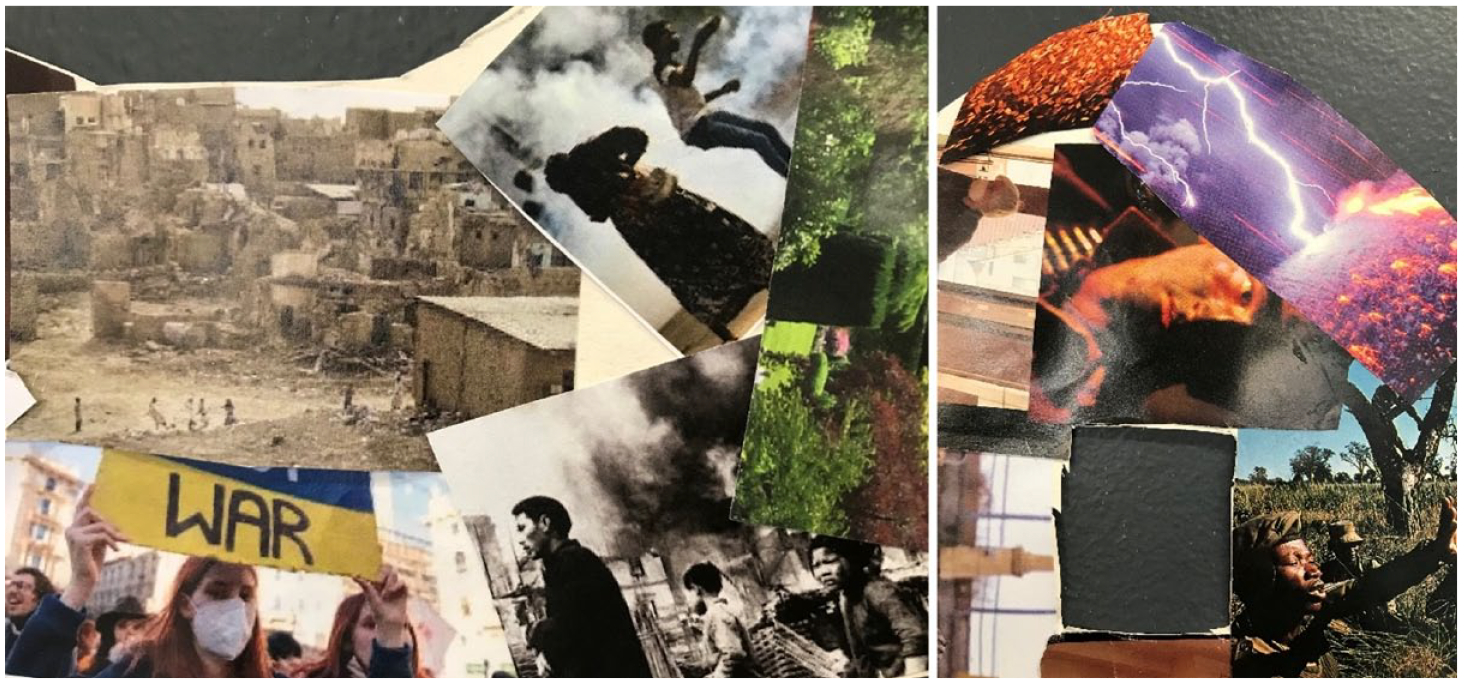
A Child’s Artwork Developed in Response to Their Experiences in the National Gallery of Victoria and Exhibited as Part of the Kids Make Change Exhibition at RMIT’s Art in Public Space Gallery.
As we travel upstairs, we encounter a vibrant gallery space with multiple projections, sound installations, sculptures, and installations. To our right are four sound pieces. Visitors are encouraged to use the headphones to listen to the various sound works, which range from experimental works sensing environmental and cosmological change to urgent and direct social commentary. One such piece, titled “War is Bad,” features a child rapping to a frenetic bass line: War is bad, it makes everyone mad! War is bad, it makes everyone sad! We need peace, let the fighting cease! Rest in peace, we want to be released! Released, released, released!
The urgency of the child’s voice cuts through the audio track and transforms the atmosphere of the gallery for the listener. The infinite and relentless loop of the short rhyme, coupled with the child’s demand to be released, refuses simple resolutions and interpretations. This work helps us imagine and cultivate ways of sharing the world through relation in the aftermath of destruction and conflict. As this young artist explains, being released equates with being free from violence, and this freedom is understood as a form of relation beyond ownership and possession. This sonic encounter reverberates through the other works in the gallery, each proposing unique ways of sharing the world from the point of relation. The children guide visitors through the works and in doing so share the practices and processes of sensing, moving, and relaying change.
On the other side of the gallery, a paper mâché panda created by four children appears to languish in the space (Figure 6). Stripped of context the panda is reduced to a visible semblance, a transient monument to its own disappearance (Berger, 1980). This wounded and excluded life, what Agamben might call “bare life,” responds to the accelerated extinction and decline in species diversity resulting from habitat destruction. This work urges us to confront the ruinous commons of the clear through a stark representation of the violence of land clearing endemic to development and progress narratives. The work demonstrates how children make art in the inherited ruins of relation, showing us how the imperial shutter freezes relations and annihilates life. In this exhibition there are no mediators to fill in the gaps, provide context, or didactically explain all that has become opaque and unclear (Manning, 2023, p. 16). The children bypass any mediating explanation and instead focus on the distance created by extraction, leaving us to grapple for meaning in the emptiness of the clear.
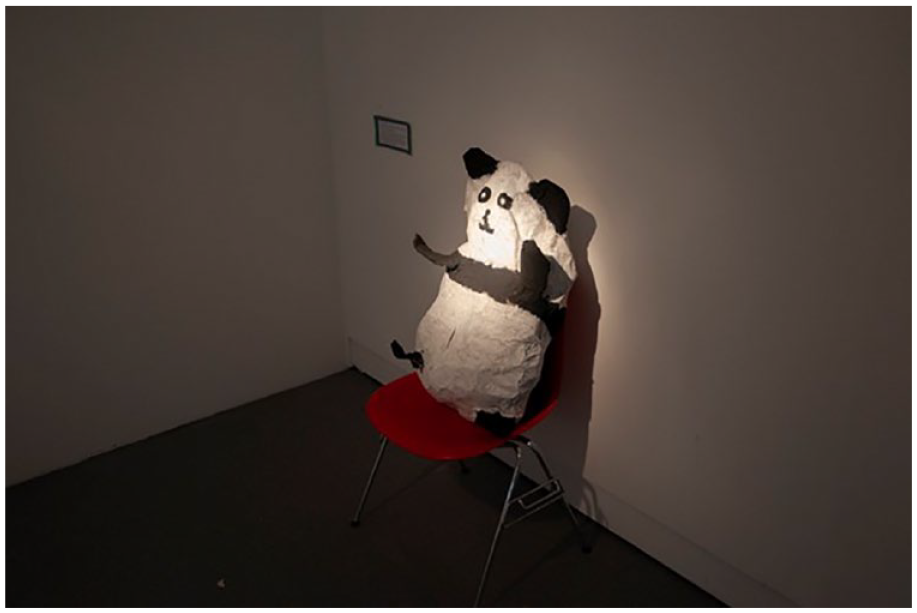
A Group Project Developed in Response to a Visit to the National Gallery of Victoria and Exhibited at RMIT’s Art in Public Space Gallery.
In a nearby corner of the exhibition, a sculpture of a tree sits delicately against the wall (Figure 7). Constructed from branches, bark, and leaves gathered from the school grounds, the sculpture integrates these found materials with brown paper, cardboard, sticky tape, and paint. The merging of these materials embraces the disorder of competing worlds and material hierarchies to unite human and nonhuman modes of existence. The sculpture conveys a sense of repair, an intention to lovingly blend disparate materials without erasing their difference. It is a proposition that suggests that “we are in this together” and that making kin might extend into a radical rethinking of learning to love the materials of destruction (Braidotti, 2020). This fusion of materials and approaches challenges idealized and narrow views of what constitutes “nature” and creates space for experimental forms and concepts to emerge that explore how we might learn to love (in) the ruins. As Manning (2023) writes, “to live in the encounter, to allow ourselves to be changed by it, is to be continuously undone, and to be sensitive to all that comes alive in that undoing” (p. 23). The children’s sculpture rejects hierarchies that separate human and nonhuman materials, and instead generates possibilities for beauty and repair. These examples illustrate how the children pursued concepts and strategies that connected to their intensive experiences of sensing change in a rapidly transforming world.
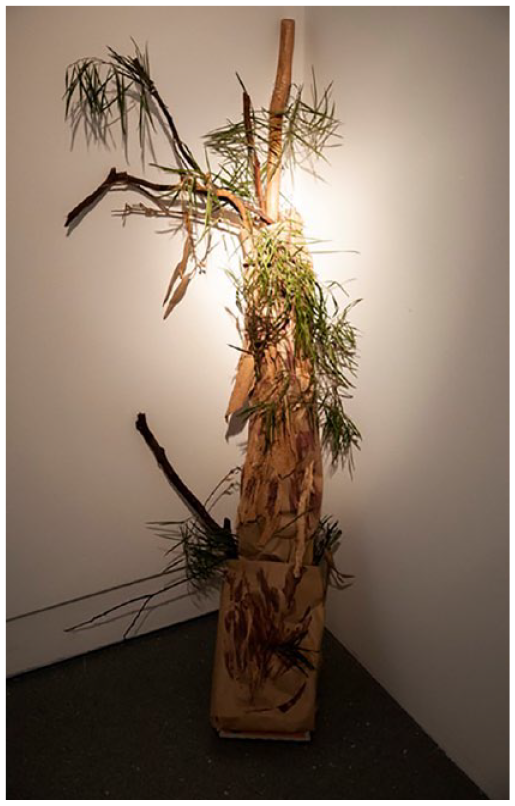
A Sculpture Developed by Two Children in Response to a Visit to the National Gallery of Victoria and Exhibited as Part of an Exhibition at RMIT’s Art in Public Space Gallery.
A colorful montage of images and botanical samples also catches our eye in the upper floor of the gallery (Figure 8). This offers yet another example of how children pursued concepts and strategies of artistic production predicated on the sharing of worldly difference and pluralist intermixture. As part of a larger montage of images and found plant materials created by three children for the exhibition, the image conveys a nonhuman ecology of aesthetic textures, differentials, and exchanges which disrupts conventional accounts of hierarchical divisions between forms of life. As the children’s image in Figure 8 elaborates, sharing the world is also to be shared: to be gathered and dispersed with and through so many others we will never know or understand: Indeed, the condition of our ability to share is that we are shared. In other words, we are not individuals who decided to enter into relations with or through the commons. The commons cannot gather us. We are already gathered, as we are already dispersed and interspersed. (Harney & Moten, 2021, p. 122)
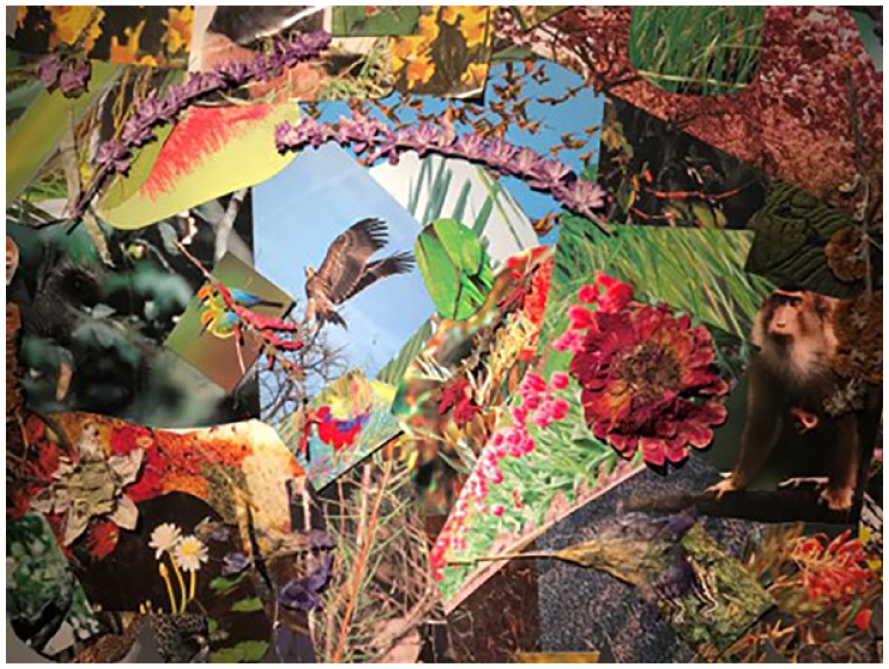
“Sharing the World,” Detail of a Collaborative Artwork Created by Children for the Sensing Change Exhibition at RMIT’s Art in Public Gallery.
The children’s creative propositions for sharing the world run counter to the desire for sameness and closed identity that powers settler colonialism, white supremacy, and the purist demand for the assimilation of difference (O’Donnell, 2022). This involves a commitment to what Denise Ferreira da Silva (2016) terms “difference without separability,” as a kind of fundamental orientation toward ontological pluralism and heterogeneity that the children’s work conveys. Their work asks us to question what it might mean to inhabit sharing as a being of relation which is never separable into calculable quantities (Manning, 2023), invoking practices of sharing the world without trying to grasp, own, or extract its constitutive elements. Yet we also note how constitutive elements of each artwork articulate their own mixed and dispersed identities within the fluid mosaics of the compositions. As O’Donnell (2022) writes, sharing the world does not mean giving up the possibility of a singular and cohesive sense of self or identity, but rather, accepting that our selves are always already gathered and interspersed with so many others.
Conclusion: Archipelagic Teaching and Learning
Our project’s commitment to a child-led methodology and pedagogy of encounters offered a unique opportunity to experiment with an alternative model of school–university–gallery partnership which centers children’s situated experiences and aesthetic responses to critical issues of social and environmental injustice. By giving children the opportunity to sense, conceptualize, design, create, and exhibit their own works of art within a public university gallery space, they were also invited to create a new curriculum driven by their own social histories, contexts, urgencies, desires, sensations, and concerns for change. This approach of following children’s encounters with anti-colonial and decolonial artworks, and generating insights by connecting these encounters with philosophical texts, builds on our own positionalities and histories of practice as artists and researchers. Over many years of relational work with many different communities, we have learned to listen closely and not interfere when children and young people are articulating their experiences, imaginings, and desires for change. This is a very different approach to work that treats children as subjects or even participants of research, because it is ultimately children who come to drive the research process itself. Our role, as artists and researchers, is to help create the conditions for these encounters to emerge, follow their protean movements, and connect these movements with current theoretical and methodological discussions across various fields of research and practice.
What emerges from this particular set of methodological and curricular encounters is a series of dynamic images, texts, sculptures, sound works, films, and animations which give expression to children’s collective desire to share the world without (re)possessing it. Through their encounters in the public gallery and creation of their own exhibition, children composed a visual and conceptual language that expresses their pedagogical experiences, understandings, and desires for change under sustained conditions of ecological, cultural, and political violence. By working through a methodology and pedagogy of encounters, our task as researchers has been to follow the spontaneous practices that children initiated through this research, while simultaneously plugging these movements back into our own close readings in process philosophy, anti- and decolonial theory, and radical Black studies. Part of this role involves becoming sensitized to our own discomfort as white-identified scholars who are entering, often uninvited, into discussions of Indigeneity, Blackness, and decolonization. We believe it is important for white-identified scholars, such as ourselves, to register the uneasiness of passing through thresholds where whiteness is a marker of destruction and irreparable loss rather than a marker of privilege and dominance.
In grappling with these complexities, we remain particularly invested in how children’s calls for new means of sensing and sharing the world intersect with scholarship in radical Black (Harney & Moten, 2021), anti-colonial (Sriprakash et al., 2022), decolonial (Nxumalo, 2020), feminist (Federici, 2018), posthumanist (Braidotti, 2020), and Indigenous studies (Moreton-Robinson, 2015), and how these intersections might eventually fold into regenerative forms of curricular and pedagogic exchange. Perhaps we offer no more than a fragile thread or conduit for connecting children’s imaginings and articulations of change with these radical traditions of thought. As O’Donnell (2022) writes, a pedagogy and methodology of encounters can be understood, after Eduard Glissant, as archipelagic in structure. It is like a gossamer string of islands shot through with infinite crossings and relays of cultural, geographical, and ecological relations which are nonetheless always held together by the opaque depths of the sea. This attunement to opaque differences and connections across geographies and cultures means that an archipelagic approach to teaching and learning is “decentred, provisional, and quivering, uncertain of itself . . . It offers an immanent, fragile, provisional, experimental, gentle, and creative way of thinking that is born of encounter, sustains becoming, and begins with relation” (p. 681).
A curriculum and pedagogy that begins with relation will always run counter to a curriculum and pedagogy of whiteness as structured and imposed by the settler colonial state. To name and sustain a pedagogy and curriculum of relations is to acknowledge “that by virtue of being alive one is always necessarily in relations of exchange with others and the world, even if one pretends otherwise” (O’Donnell, 2022, p. 16). Thinking and working in solidarity with other culturally responsive, place-based, and anti-colonial pedagogies (Diversi & Moreira, 2012; Nxumalo, 2019; Pillow, 2019), a pedagogy and curriculum of encounters begins with relations with/in culture and place and the shifting intermixtures of perspectives that compose an educational community. From there, it invites us to cultivate ways of sharing the world which depart from the calculative apportioning of experience defined by the logistics of whiteness (de Freitas et al., 2022). As children in this study teach us through their own creative processes and works, relation is not simply a line of connection between two or more bodies nor the distance between two points (Harney & Moten, 2021), but a quivering angle of variation which cannot be counted, apportioned, or owned. We see this angle of variation weaving itself through the works created by children in the wake of their experiences in the gallery, and it is this tentative inclination toward sharing the world which we are following into our next series of projects involving children, artworks, and public institutions.
Footnotes
Declaration of Conflicting Interests
The author(s) declared no potential conflicts of interest with respect to the research, authorship, and/or publication of this article.
Funding
The author(s) received no financial support for the research, authorship, and/or publication of this article.
