




Abstract
Privileged (in various forms, but especially class) people use egg or sperm donation and take other reproductive measures to achieve parenthood at all costs. Infertility issues for heterosexual partners and those who use donor eggs and sperm outside of heteronormative relationships has evolved into a type of entitled desperation and racial/ethnic/able-bodied form of eugenics, both further complicated by the cultural milieu of the post-Dobbs decision era. To illustrate how these rhetorics of infertility operate within broader neoliberal and racialized discourses, we critically consider three themes: first, we contend that fertility issues should become theorized through reproductive justice theory, particularly as class/race/nation divides donors from recipients, through forms of capitalistic endeavor as a rational enterprise; second, we review how “infertility” has become rhetorically important in the U.S. cultural milieu in critical communication and cultural studies; and finally, we argue that donor rhetorics represent a form of neoliberalism situated within racial/ethnic able-bodied eugenics and an inability to conceive, which results in emotional, physical, and financial cost to the self and society.
Introduction
Years after “spicy” nights and invasive fertility treatments failed to make me a mother, I found myself in a somewhat formulated setting–catalog shopping. Although other options existed, I longed to carry, and understood legally, any baby I birthed was mine irrespective of genealogy. I sifted through black and white pages of egg donor applications detailing height, weight, eye color, health history, educational status, personal statements, pictures of 5-year-old children, and finally genealogical heritage. My Eastern European and Jewish heritage, largely responsible for my brown hair, eyes, and olive skin, was central to my choice and one I would gladly sacrifice for height. My selection was financed by the privilege of loans I feared I would never be able to repay. My life’s most significant purchase required me to lay my future in the hands of corporate medicine and a young donor in need of money. Months later, as I juggled my two infants, my mother-in-law struggled to find resemblance between her family and my brown eyed, brown haired, and olive-skinned daughter. My tears prepared me for a lifetime of the invasive questions masked in innocence, “do twins run in your family?” (Rae Lynn)
After a divorce preceded by years of unsuccessful attempts to have a baby the so-called natural way, I also found myself looking for a donor, albeit in my case, a sperm donor. At the time, the two main sperm banks, Fairfax and California Cryobanks, supplied pages of possible donors. I could select from criteria such as hair color and texture, eye color, height, weight, body mass index, a self-reported medical history, educational background and grade point averages, ethnic and/or racial background, languages spoken, and almost anything else a sperm donor purchaser might desire in the search function. While my sperm donor was not nearly as expensive as Rae Lynn’s egg donor, the whole cost of infertility plus sperm donor treatments was astronomical and not covered by my health insurance. Questions about my daughter’s father have abounded though, and I find myself explaining to her teachers, her friends’ parents, and others about procedures and processes that normative heterosexual families never have to navigate. In the end, my daughter and I look enough alike (light skin tone, brown hair, and brown eyes) that I don’t have to explain to strangers, but questions remain about her father. (Stacey)
These two brief fragments from our own experiences with donor sperm and eggs reflect our somewhat unique and very personal perspectives on one aspect of the infertility and donor sperm/egg industries. However, we find the cultural milieu in a post–Roe v. Wade world to be even more problematic than what we experienced 10 plus years ago. In June 2022, when the Supreme Court opinion overturned Roe v. Wade, little was mapped out or even mentioned about the ways in which this decision would affect various types of assisted reproductive technologies. Since the Dobbs v. Jackson Women’s Health Organization (hereafter referred to as Dobbs) decision, questions also loom about the fate of more than 1.4 million cryopreserved embryos, among many other reproductive matters (Bailey, 2022; Lawmakers v. The Scientific Realities of Human Reproduction 2022; Cohen et al., 2022; Halleman et al., 2022). State abortion bans do not mention reproductive technologies, but many states, such as the proposed (but failed) Nebraska’s Legislative Bill 933, seek to impose personhood laws that give fertilized eggs, embryos, and fetuses the same rights as those already born. Similar laws have been proposed in South Carolina, Oklahoma, and Colorado. Furthermore, “Missouri, Kentucky, and Arkansas do not distinguish between fertilization that happens in the womb and fertilization that happens in a laboratory” (Halleman et al., 2022). Thus, an embryo, even those not implanted or in utero, possibly could not be destroyed or donated for research because it would cause the termination of the life of an unborn child, which, in some states, is a Class IIA felony, punishable by up to 20 years in prison.
If these embryos are declared human lives by the stroke of a governor’s pen, their destruction may be outlawed . . . What will be the fate of abandoned embryos, of the people who “abandon” them, and more broadly of IVF centers in these jurisdictions? (Bailey, 2022)
The fate of reproductive technology, and embryos specifically, remains uncertain. RESOLVE, a national infertility organization, warns that state legislation “may include language that is unclear or specifically targets in vitro embryos” (Fight for Families, 2023). RESOLVE gives several examples of how legislation might restrict the ability to do genetic or other medical testing on embryos, freeze embryos, move frozen embryos across state lines, and destroy embryos. Over the coming years, both state and federal courts will likely be flooded with plaintiffs arguing for and against the legality of assisted reproductive technologies. “Dobbs creates a unique moment of political will to embrace reproductive justice advocacy,” explains Northeastern professor of law and health sciences, Katherine Kraschel. After Dobbs, Kraschel (2023) details, “conservative states may be mobilizing to limit access to assisted reproduction by controlling embryo disposition.” The traditional discourses of reproductive rights are ineffective with reproductive justice advocates who engage in conversations about fertility as part of a broader context that includes the experiences of women of color and transgendered folks, with equity, social justice, and human rights as a centralizing framework (Ross et al., 2017).
In what follows, we engage in sensemaking of some forms of assisted reproductive technologies, that is, donor sperm and donor eggs, as a type of capitalist enterprise in which privileged individuals purchase sperm and egg donors to address infertility as attempts rooted in neoliberal capitalism. We begin with an overview of a reproductive justice framework, then an overview of critical scholarship on infertility, and conclude by engaging in a critical analysis of donor sperm and eggs industries to explore how reproductive justice frameworks could recenter discussions about infertility and the ways in which purchasers think about donor sperm and eggs.
Reproductive Justice as an Alternative Framework
Reproductive justice is a full programmatic shift in the way we understand reproductive issues for all people and communities (Johnson & Williams, 2015). The focus is access and the privileged embedded in the rubric of choice (Simpson, 2022). The need to turn to reproductive justice then, is essential to address the needs of all people facing reproductive matters, especially in the post-Dobbs decision era. More than a coalition of activist groups, reproductive justice is a framework and theory for making sense of fertility and infertility by choice or by circumstance. At the core of Reproductive Justice is the belief that all women have: “1. the right to have children; 2. the right to not have children and; 3. the right to nurture the children we have in a safe and healthy environment” (National Black Women’s Reproductive Justice Agenda, n.d.).
Importantly for our project, reproductive justice theory (RJT) is situated as an intersectional framework, with the capacity to challenge heterogeneous myths of womanhood as white, economically privileged, and heterosexual (Ross et al., 2017). Rooted in the struggles of women of color as well as trans and nonconforming gender folks, it bypasses the traditional binary of abortion debates to “demand for recognition of our full reproductive and human rights” (Dubriwny & Siegfried, 2021, p. 188). Advocates center people of color and illuminate structural inequalities—such as housing, food insecurity, affordable health and childcare, and job insecurity—that affect reproductive health care and access (Dubriwny & Siegfried, 2021; Jaworski, 2009). Carolette Norwood (2021) explains, Reproductive platforms that advocate for “choice” and “access” without taking into account poverty; the lack of health care; and importantly, the structural factors that collectively create vulnerability, disadvantage, and ultimately health disparities for women of color, omit from consideration a more attentive, nuanced understanding of race, class, and sexuality. (pp. 718–719)
Centering systemic oppression disrupts a flawed system of reproductive “choice,” by illuminating justice for people who, by nature of their class, race, gender, sexuality, nationality, and environment, are all too often denied “choice” (Murphy, 2017).
The RJT is an intersectional shift in the way we understand reproductive issues for people of color and their communities (Johnson & Williams, 2015). This framework broadens the focus on reproductive “choice” to emphasize access and the relationship of reproductive health care to other social justice struggles, and challenges heterogeneous myths of family and parenthood as white, economically privileged, and heterosexual. Reproductive justice has also gained traction among critical communication scholars who explore how such themes are circulated within our societies (de Onís, 2012, 2015; Dubriwny & Siegfried, 2021; Fixmer-Oraiz, 2019; Harper, 2021; Hernández, 2019; Hernández & De Los Santos Upton, 2018, 2020; Wang, 2021; Yam, 2019, 2020). The framework offers “open source code” (Ross et al., 2017, p. 10) for scholars and activists to consider how its critical edges might connect to other issues of social justice, for example, in considering questions of fertility. One of the founders of the reproductive justice framework, Loretta Ross (2017) explains that, as a theory of practice, reproductive justice challenges the false binaries and false solutions and helps “comprehend how the American empire uses and misuses bodies, especially the bodies of people of color” (p. 71).
Just as women of color have critiqued and retheorized feminism, so too have they transformed reproductive discourses. Through the nexus of intersectionality, women of color have elevated the feminist positions of reproduction to RJT. Understanding how white supremacy has used bodies of color as sites of community control to build a heterosexual white middle-class population is essential. Researchers from various areas, including digital communication (Sitto & Lubinga, 2021), health communication (Hernández, 2019; Hernández & De Los Santos Upton, 2020), media studies (Jaworski, 2009), rhetoric (Dubriwny & Siegfried, 2021; Johnson & Williams, 2015; Murphy, 2017; Yam, 2020), and technical and professional communication (Harper, 2021; Wang, 2021) theorized about the possibilities of reproductive justice. Although distinct in interest areas and methods, reproductive scholars have overwhelmingly supported a framework of reproductive justice because it moves away from choice toward an intersectional social justice praxis that provides the condition of possibility to (a) reject flawed white, Western, liberal models of motherhood, and (b) increase opportunities for coalition building that highlight the matrices of structural impacts that effect the reproductive access. For example, Tasha N. Dubriwny and Kate Siegfried (2021) support a reproductive justice lens, championing its intersectional praxis, arguing that late-term abortion narratives should be considered through a framework of systemic inequality, rather than one that racializes the construction of “good mothering.” Later abortion narratives, they argue, “circulate in a terrain of racial and economic privilege” and reproductive justice creates the possibility “that the narratives develop an idealist rhetoric of self-sacrificing maternity that emerges from an orchestration of racialized discourses of good motherhood and the gendered liberal political tradition” (Dubriwny and Siegfried, 2021, pp. 187–188).
Catalina (née Kathleen) M. de Onís (2012, 2015), among others, champions reproductive justice for creating the conditions of possibility for productive coalition building. From another perspective, Leandra Hinojosa Hernández (2019) argues that reproductive justice is a productive framework through which to understand family separation at the U.S./Mexico border and, in so doing, could illuminate the ways that feminist theories can come together to advocate against gender reproductive violence. Hernández and De Los Santos Upton (2020) extend this argument by considering Latinas who advocate that a reproductive justice lens would enable a coalition between health and Latina/o/x/e communication scholars to respond to reproductive injustices on the U.S.–Mexico border. Mollie Murphy (2017) also advocates for reproductive justice on the grounds that it has the potential to highlight how environmental toxins affect reproductive threats and health. Casting the maternal body as synecdoche to produce a feminist disruption in fetal rights rhetoric, Murphy champions reproductive justice as a framework that throws into focus the ways environmental and feminist activists converge. Michelle Jarman (2015) challenges the ways that disability is problematically leveraged in abortion debates to advocate for merging critical disability and reproductive justice: the reproductive justice movement has been built on collaborating and building coalitions across differences and understanding the perspectives of diverse communities in an effort to map out political strategies that support the needs of all women, but this kind of relationality is rarely championed in mainstream pro-choice discourse. (p. 48)
Although many are now championing a reproductive justice framework, scholars, including Laura Briggs (2022), caution against ignoring the history of groups such as the Committee to End Sterilization Abuse and CARASA (Committee for Abortion Rights and Against Sterilization Abuse) that worked with Puerto Rican, Native, and Black activists in the 1970s to pass laws and regulations against sterilization abuse and global women’s movement and those who risked their lives in the 1970s and ’80s in places like the Philippines, Argentina, and El Salvador to insist that feminists qua feminists—and women as mothers—had a role to play in defying authoritarian regimes. (p. 6)
The disavowal of these groups places a U.S.-centric/Global North veil over the international fight for reproductive justice by recentering reproductive justice as a purely U.S. invention.
In the 20th and 21st centuries, infertility has become connected with reproductive justice, intensive mothering rhetorics, postponed parenthood, and privileges of middle- and upper-class white nuclear families (e.g., O’Brien Hallstein, 2008; Takhar & Pemberton, 2019). Robin E. Jensen (2015) explored early discourses of infertility, starting in the 1930s, emerging from a period of medicalization for childbirth in the 19th century. She argues that, even from this early era, infertility was centered far more often on women, rather than men. Synthetic approaches to infertility were developed to treat women through medicalization. Using terms such as “anxious reproduction” and “fertility nostalgia” to address these privileges, Takhar and Pemberton argue that modern-day fertility treatments create a sense of “liberatory potential” and a bootstrapping mentality that trying hard enough will produce desired outcomes that still permeates infertility treatments today.
Citing reproductive justice as a framework for understanding maternity/paternity, Natalie Fixmer-Oraiz (2019) writes about “Republican motherhood” and the making of patriotism through children (especially sons) where “women of means are encouraged to pursue motherhood at any cost, to spare no expense, and to enlist extensive, even experimental, reproductive technologies as necessary in order to secure future prospects of becoming a mother” (p. 60). “Republican motherhood stands in stark contrast to the maternal histories of indigenous women, black women, and poor white women in conditions of servitude in the United States” (Fixmer-Oraiz, 2019, p. 6), such as through plantation systems, Native boarding schools, selective immigration practices, focused efforts to sterilize women of color, and non-heteronormative relationships. In this vein, motherhood, nation, and national security have become intertwined concepts, which can mean that motherhood is always secondary to a child’s or fetus’s life, in which pregnancy and parenthood are policed in communities and within the state/nation. As such, reproduction also becomes surveilled and policed in much the same way. We argue here that the employment of assisted reproductive technologies have come to shape the biopolitics of reproduction, motherhood, and parenthood. Along those lines, sperm and egg donor rhetoric engage in forms of futuristic racial eugenics through the selection of donor characteristics, as we illustrate in what follows. These processes, as critiqued through a lens of reproductive justice, uphold normative narratives related to Republican motherhood, rooted in capitalist and neoliberal structures related to the construction of the family in politics, medicine, health care, and so forth. As both of us have participated in the process of buying eggs and sperm from donors, we base our analysis on some of our own anecdotal experiences, along with analysis of how such donors are marketed on egg and sperm sellers’ websites. We each studied the largest and most publicized donor bank websites and drew on our own experiences. In an attempt to hedge against personal attachment, Rae Lynn, who used donor eggs, analyzed donor sperm marketing and Stacey, who used donor sperm, analyzed donor egg marketing.
The relevance of reproductive justice and this analysis is heightened with the passage of Dobbs. Whereas abortion is still legal in theory, the buying and selling of eggs, sperm, and embryos are at risk without federal protections. Now that states are regulating abortion and considering personhood laws, an embryo, in some states (such as is the current case in Louisiana) could be considered a person at the point of conception (Letterie & Fox, 2023). Thus, the practice of selective elimination, embryo stem cell research, or destruction could be prosecuted as murder. “Dobbs paves the way for states to go even further, prohibiting embryonic stem cell research and other reproductive practices that involve foreseeable damage to embryos” (Letterie & Fox, 2023, p. 2). Dobbs’ attack on assisted reproductive technology highlights the challenges people will face purchasing eggs and sperm, (even when they are purchasing from outside the United States) because U.S. clinics and doctors have good reason to fear legal prosecution. A reproductive justice framework is multifaceted to make sense of the complexity of circumstances that a pro-choice framework cannot accommodate. There is little doubt that Dobbs will significantly change egg and sperm donation processes as the risk to donors and doctors increases. Such increases will certainly disproportionately affect those with already limited income and access.
Banking on Donors
To better understand how infertility rhetoric functions as it relates to donor industries, we first note that donor industries can market to queer communities who want to have children, but may not be infertile, yet rarely do. As heteronormativity pervades societies around the world, donor sperm and egg industries are targeting a particular infertile body—namely, a heterosexual one. As José Esteban Muñoz (2009, and many others) have argued, ideas of futurity are often rooted in heteronormative reproduction forms. The idea of having children has historically required a heterosexual relationship of some sort, with the very notion of children rooted in the idea of futurity. Donor egg and sperm companies offer possibilities for different forms of reproduction, even while such marketing is rooted in heteronormativity, that is, having children has historically and socially been viewed as the purview of heterosexual family life. These websites make the case for their services through a variety of rhetorical practices that include a few brief examples that we explain in this section.
Stimulating Superior Sperm
Although sperm donation is physically easier on the male body than the egg donation process, both often involve invasive forms of egg extraction from either the female donor or sperm donor recipient undergoing IVF procedures. Even so, involved parties are willing to play a role in this neoliberal exercise, albeit with different forms of desire, desperations, and power imbalances (the excellent podcast, The Retrievals, Burton et al., 2023, explores these dynamics in riveting detail). For sperm donors, they might earn US$100 for a sperm sample, but that process is relatively simple. Consciously or not, the donor is also complicit with an age-old population exercise in which their genetics and race are deemed qualified for the future. This privileging of planned breeding, eugenics, gained popularity during the 20th century and was used as a form of “racial improvement.” Eugenics is the scientifically erroneous and immoral theory of “racial improvement.” . . Eugenicists worldwide believed that they could perfect human beings and eliminate so-called social ills through genetics and heredity. . . The most well-known application of eugenics occurred in Nazi Germany . . . They implemented a campaign of forced sterilization that claimed at least 400,000 victims. This culminated in the near destruction of the Jewish people, as well as an effort to eliminate other marginalized ethnic minorities, such as the Sinti and Roma, individuals with disabilities and LGBTQ+ people. (Nation Human Genome Research Institute, n.d.)
This “scientific” racism is an ideology used to future the superiority of white Europeans often at the expense of enslaved peoples. In the United States, women from various backgrounds, often non-white and/or poor women, were raped and forced to breed, were sterilized, used as experiments, and required to wet nurse white children, among other horrific abuses. These long histories of gendered and racist practices have shaped the reproductive legacies and logics in the current cultural milieu. We argue here that the current marketing and selling of donor genes emerges from and builds upon those racist logics in which sperm and egg buyers select genetic features of their donors.
Gynotec, a Netherlands-based sperm bank, for example, prides themselves in providing “high-quality,” “Best Products–Best Price” sperm that can be transmitted through their “Mona Lisa Aspiration Needle” as an advanced technology. This company promotes the production of an internationally acclaimed “work of art,” visualized on their webpage as a smiley, white baby with lit-up eyes (Gynotec, 2022). Their numerous white baby images appear as models for the international audience and low-cost products (Gynotec). The “quality” of the product is a continued theme in donation rhetoric. Similarly, hailed as the best of sperm banks, the Los Angeles–based California Cryobank is the United States’ largest sperm bank has high semen standards. Through “our stringent donor qualification process,” this Cryobank prides itself on its selectiveness: less than 1% of all applicants make it into our program. Why are we so picky? Because being a California Cryobank donor means being the best. While some banks charge extra for their more “desirable” donors, we consider all our donors to be “premium” level, each possessing excellent health histories and unique individual interests and talents. (Cryobank, 2022)
In addition to sperm, this Cryobank requires a blood specimen to ensure their donors are free of sexually transmitted diseases and meet the highest quality standards. Their website images show presumably a man of color with lighter skin and a headset ready to take orders, yet five of the six other images display white children and families, along with one non-white woman advertising a sibling registry (Cryobank, 2022). Together, these images suggest that people of color service the bank that creates high-quality white families who then bask in leisurely activities. Happiness and leisure are general themes of the donation process narrative.
Because those purchasing donor sperm and eggs can select so many phenotypic markers as part of the process, the emerging implications for baby-making form racial, ethnic, and other types of eugenics. Ole Schou, the owner of the Denmark-based Cryos, the world’s largest sperm bank, notes that most of his donors are popular because they are “Danish donors [who] are tall, fit, athletic young men” and likely white, blonde, and blue-eyed (Manzoor, 2012). Yet Schou wanted to expand his enterprise outside of Denmark so he could expand his “diversity.” “If we want to help women in different parts of the world,” he argues, “we need to be able to access non-Danish sperm” (Manzoor, 2012). Schou’s “charitable” rhetoric, similar to so many others, is geared toward a needed infertile mother-to-be, with the assumption that all sperm and egg buyers are looking for donors who look similar to them as the parents-to-be. “I am simply the middleman,” he boasts, “between the young men who want to donate sperm here and the women out there who want to have babies” (Manzoor, 2012). In addition to race, those buying sperm or eggs can shop a catalog by height, weight, ethnicity, eye/hair color, education, blood type, religion, and caste. At some banks, prospective parents can purchase an audio recording of a donor talking about his personal interests or buy a donor’s creative expressions, such as songs or poetry.
The industry has also streamlined the process, making it as easy as online shopping: “It felt like shopping on Amazon,” one sperm shopper noted, “We chose the donor and clicked to place the sperm in a cart. Once payment was made, we were told it was being flown to our clinic” (Manzoor, 2012). Thus, similar to most shopping experiences the quality assurance is the responsibility of the producer giving the donee an easy experience. Based on personal experience, I (Stacey) resonate with this online shopping experience, but also remember feeling like it was an online dating website, in which you never get to meet your “match” or “date,” and the stakes are much higher, as the intended effect is pregnancy. While these banks advertise quality, their explanation of what makes “quality” pertains to the genetic health and purity of their semen and their ability to help add a desired baby to the population. Websites for companies that sell donor sperm and donor eggs suggest that the process is easy and successful.
Excelling in Egg Genetics
While donating sperm is ostensibly noninvasive and donating eggs is a more complex physical undertaking, it also includes significantly more cost, financially, emotionally, and physically. Women between the ages of 21 to 32 years, with a body mass index between 18 and 30, and a high school education can donate her eggs to earn US$8,000 to US$10,000 (Seattle Reproductive Medicine), whereas the purchaser may pay double that amount to cover the medical procedures and related services. Donors usually take multiple shots of follicle-stimulating hormones enabling the ovaries to produce multiple eggs for an egg extraction cycle. The donee also takes numerous injection cocktails (in my case, [Rae Lynn] five shots a day for 6 weeks) to stop ovulation and sync up with the donor’s cycle. The donor is sedated, her ovaries probed, and eggs are medically retrieved and blended with sperm. With 12 hours advance notice, the donee then uncomfortably waits in stirrups with several medical staff for the lab to provide her a promising test tube embryo. That was certainly not the baby-making experience I (Rae Lynn) had anticipated. My medical insemination room had a window that opened to a lab filled with dozens of medical workers with hundreds of test tubes. Similar to the drive through, they yelled my name when my “order was up.”
In marketing such extracted eggs for sale, for example, the Asian Egg Bank based in San Diego, California, asks, “Will my baby look like me if I use a donor egg?” The blog post on this company’s website attempts to warn potential buyers that, because of the lack of genetically shared DNA from a donor egg, a child conceived in this way may neither look like nor resemble the mother, but that it’s important for couples to understand that nothing is definitive—giving birth to a child naturally doesn’t ensure they look like you and using a donor egg doesn’t automatically mean your child won’t resemble you at all. Particularly if you and the donor are the same ethnicity, there’s a strong chance the baby will still resemble you. (Asian Egg Bank, 2019)
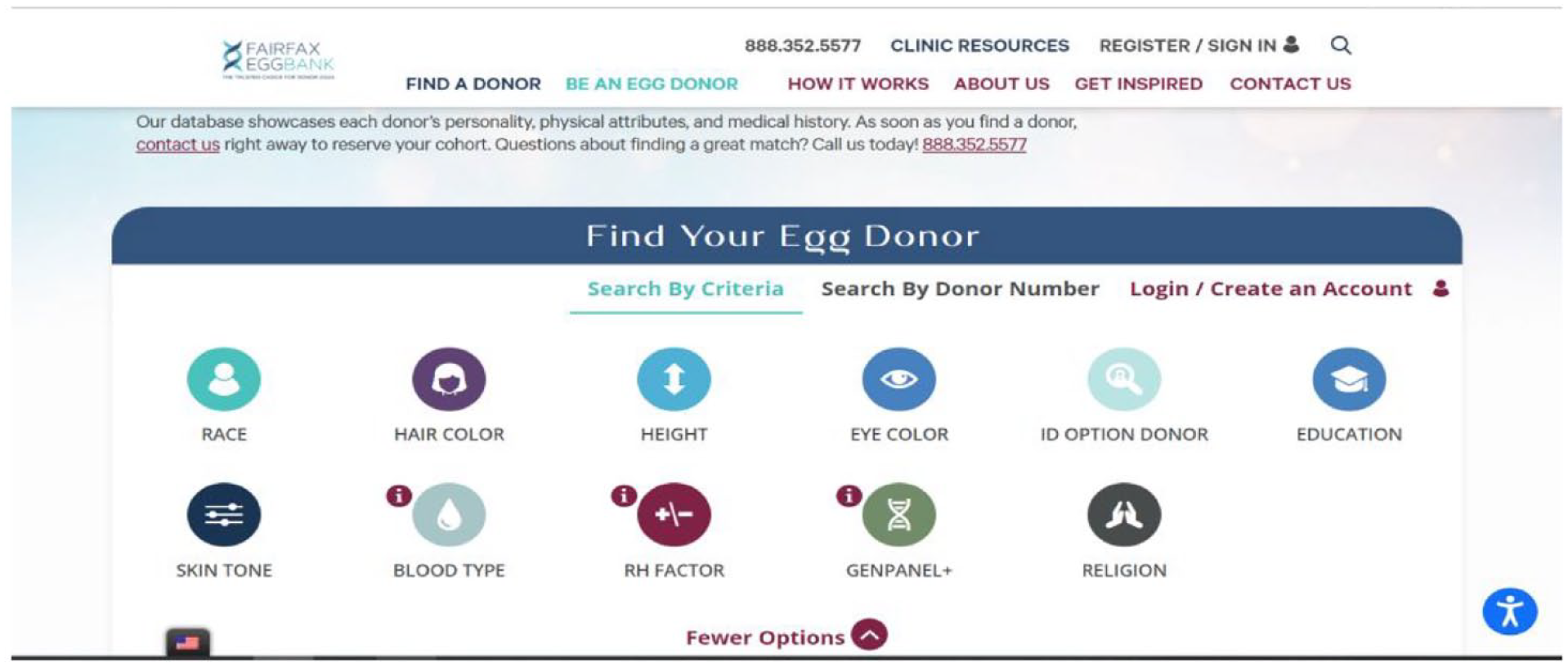
While a caveat is provided, the essence of this post suggests that the very reason for the Asian Egg Bank’s existence is to create opportunities for ethnic/racial similarities between children and parents. Fairfax Egg Bank similarly allows search criteria along ethnic/racial lines, as Figure 1 illustrates, with “race” being the very first category offered. Similarly, West Coast Egg Donation seeks to provide profiles of perfection in health: When it comes to matching intended parents with the perfect egg donors, we understand that the health and safety of your family is of the utmost importance. Our egg donor candidates undergo a comprehensive screening process in order to help ensure a positive experience and a healthy baby. Our clients are given access to an in-depth egg donor database containing a myriad of full, detailed profiles. (West Coast Egg Donation, 2022)
Although none of these websites suggest that infertility treatments or having a baby with donor sperm/eggs is easy, many of these websites do suggest inherent success. For example, the Las Vegas Egg Donation’s website makes this claim: “Become a parent in five steps,” which include making a profile and selecting a donor, consulting with “case managers,” writing up legal paperwork, preparing for in vitro cycles, and getting excited once expecting a baby (Las Vegas Egg Donation, 2022). These steps make the process seem relatively easy; however, each step is quite complicated, requiring extensive financial, temporal, and emotional investment. Another website from Egg Donor America (2022) also suggests facility and diversity in selecting an egg donor: Search our database to view Donors who have batches of frozen eggs ready for immediate shipment. If you do not find your ideal Donor currently in our egg bank, you may select a Donor from our inventory of over 600 Donors. We will retrieve, freeze and ship a batch of her eggs to your fertility center at no additional charge.
For women experiencing infertility, donor eggs fertilized as embryos before implantation may or may not be successful, meaning that many women may endure several rounds of these steps in the hopes of becoming pregnant themselves or with a surrogate. Queer folks may also pursue different versions of this process; gay men, for example, may find themselves using a surrogate and/or donor eggs to become parents.
Such websites can also hint at women’s debility through infertility, for those people unable to use their own eggs. The Rocky Mountain Fertility Center’s web page opens with “Life’s Little Miracles Happen Here,” and continues down the page to note, “the team of specialists offer the highest level of care for patients suffering from endometriosis, polycystic ovary syndrome (PCOS), recurrent miscarriages, low sperm count, hormone problems, and other causes of infertility” (Rocky Mountain Fertility Center, 2022). Even in articles about egg donation, this suggestion lingers: “Egg donation frequently benefits women who cannot use their own eggs for various reasons, including ovarian failure, avoiding congenital anomalies in the fetus, or advanced age” (Leonard, 2019). The constant messaging about bodily failure after being inculcated for years about how women are supposed to be baby-carrying bodies, loving mothers, and heteronormative in relational matters often causes anguish, anxiety, and emotional insecurity, not to mention the focus solely on women, when other folks might also use egg donors, such as single men, gay men, transgender folks, and others in queer relationships.
Conclusion
In our brief review of donor sperm and egg websites that traffic in healthy, beautiful (often white) babies, we find these appeals to the fantasy of parenthood to be deeply problematic, even as we participated in some ways within these very narratives ourselves to have our own respective children. While we both “suffered” from infertility problems within our heterosexual relationships, we view these narratives within the framework of reproductive justice to critique the neoliberal, capitalist market structures in which a “need” for parenthood is constructed and fulfilled by these sperm and egg banks. As consumers can select criteria such as race (as self-reported), phenotypic markers that could be connected to race (hair color and texture, eye color, and ethnic background), and various health factors that also could be connected to race, this form of eugenics baby-making demonstrates just how much race matters. Our reading of donor capitalism highlights how, and in what ways, population decisions highlight the many ways in which the Supreme Court Dobbs decision has implications that adversely affect already marginalized populations. Recognition of the Dobbs decision as a verdict simply affecting people in need of abortion is just the type of narrow reading that reproductive justice warns against. The increasing regulation, or the possible elimination in some cases, of assisted reproductive technology is a direct product of Dobbs. Reproductive justice, as a theoretical framework, upholds the matrices that can make sense of the complex implications Dobbs has on the marketing of eggs and sperm.
Understanding infertility, donor egg and sperm industries, and the eugenics of such practices, we can also see how complications emerge in a world in which life is defined at the moment of conception, whether it is in a physical body or medical lab. We each had several more embryos than we used to conceive our respective children; and, after paying hundreds of dollars monthly for microscopic freezing, we both later donated those “excess” embryos for research, a choice that may no longer be possible in a post-Dobbs world. Notably, in North American culture, it probably is not that surprising that to produce a child, one would want to have “excess” embryos as a way to ensure the entitled sense of success our society has come to expect when paying substantial sums of money for services. The excess then, is a way to overcome the cruel optimism of fertility treatments and those seeking surrogates. As Lauren Berlant (2011) asks, “Why do people stay attached to conventional good-life fantasies—say, of enduring reciprocity in couples, families, political systems, institutions, markets, and at work—when the evidence of their instability, fragility, and dear cost abounds?” (p. 2). We might add to Berlant’s list the idea of family and baby making, and the cruel promises of the good life in the nuclear, independent, well-off (white) familial structure in U.S. American society. Reproductive justice as a theoretical framework helps reconnect people and communities across intersectional lines and to consider the deeply problematic nature of these donor bank rhetorics in an uncertain post-Dobbs era related to abortion politics and court decisions.
Footnotes
Declaration of Conflicting Interests
The author(s) declared no potential conflicts of interest with respect to the research, authorship, and/or publication of this article.
Funding
The author(s) received no financial support for the research, authorship, and/or publication of this article.
