




Abstract
The contemporary yoga industry is entangled in many contradictions. While yoga is intended to be an inclusive, liberatory practice, its contemporary iterations enact exclusion through an industry that often privileges able-bodied, affluent, white women. As a yoga scholar-practitioner who embodies these identities, I am troubled by how my teaching and studies of yoga further replicate power imbalances. In this article, I interrogate privilege and power as they emerge with yoga pants. I draw upon Barad’s cutting together-apart in a diffractive auto/ethnography. I make literal cuts through the fabric of my yoga pants, as reflections, reactions, and interview transcripts make figurative cuts through self-image, body-image, and feminine norms. I consider how this methodology materializes an entanglement of affective forces, power, and critical feminist academia that is useful in exploring possibilities for change. This inquiry does not conclude, but rather acknowledges an imperfect and ever-evolving interrogation of embodied power as it shapes intellectual inquiry, and spaces of yoga practice.
Introduction
In 2013, Lululemon Athletica was sued by investors for concealing product defects that made their black yoga pants transparent. The sheer fabric contradicted the company’s claims that their clothing could withstand many years of wear and tear, leading to a recall that dropped sales by 17%. Amid the turbulence of this lawsuit, Lululemon founder Chip Wilson blamed women’s bodies for the problems with the see-through yoga pants. He claimed that “frankly, some women’s bodies just don’t actually work [for the yoga pants]” (ABC News, 2013). Afterall, yoga pants are not designed for everybody, they are designed for lean “yoga bodies.” Since then, Lululemon increased the range of sizes that they sell their yoga pants in, and ultimately the lawsuit against Lululemon Athletica was dropped. Yet, the insidious idealization and shaming of diverse female forms are still etched in the company’s history.
This shaming of some bodies and idealization of others is but one of the deep contradictions in which the yoga industry is enmeshed. Messages of empowerment mask the exclusionary nature of white feminist neoliberalism (Lavrence & Lozanski, 2014). While studios, gyms, magazine covers, and Instagram pages may claim that yoga is for everybody, representations of yoga bodies in Organisation for Economic Co-operation and Development (OECD) countries are predominantly thin, young, white women (Bhalla & Moscowitz, 2019). Representing yoga based on normative standards of whiteness and affluence enacts exclusion in yoga practice (Bhalla & Moscowitz, 2020). Expensive clothing, classes, and homogeneous “yoga bodies” exclude poor, big-bodied, disabled, men, and women of color from yoga’s potential well-being benefits (Webb et al., 2020). Yet, according to today’s contemporary well-being discourse everybody should practice yoga, and to practice yoga well should wear yoga pants.
Yoga pants are among the many material things in my teaching and practice of yoga which trouble me. While the yoga industry replicates power imbalances, yoga itself was intended as a practice of liberation. To find spiritual liberation, according to ancient yoga teaching, practitioners should detach from the material world (Iyengar, 1996). Renouncing material possessions is one of the tenets of ancient asceticism (Denton, 2004). Yet, in my experience yoga pants have turned into a pervasive and expected uniform for contemporary yoga teachers and practitioners in OECD countries. I have become troubled by both my avowal and disavowal of these yoga pants. I have become troubled by the contradictions of simultaneous approval and disapproval of the yoga I teach, and the feminine norms that my yoga teaching replicates.
I am a white-affluent-able-bodied-educated-cis-straight-woman-yoga-teacher. My identity embodies and exerts hegemonic power, despite whatever good intentions I may hold. Claiming to care about equity in yoga is not the same as enacting it. I am certain that in the twelve years I have been teaching yoga I have made “spiritual bypassing” permissible. Welwood (1984) coined this term to explain the phenomenon of using spiritual practices like yoga to avoid psychological pain, trauma, and tension. The “yoga-for-all” discourse enacts spiritual bypassing by maintaining the invisibility of oppression through white-dominated yoga spaces and products (Peacock, 2021). Peacock (2021) elaborates that the tense inequities of the yoga industry can begin to soften if and when whiteness, privilege, and power are made visible. Auto/ethnography can serve this purpose as it articulates the gradual process of coming to see one’s own whiteness (Warren, 2001).
In this article, I interrogate my own power and privilege through a critical feminist new materialist auto/ethnography with yoga pants. By integrating seemingly contradictory theory and method, I attempt to subvert the agency of my privileged identities in constructing knowledge, and shift attention to be able to illuminate, understand, and visibilize where power resides. Specifically, I will engage with yoga pants through various techniques to understand how materials of yoga practice resist and replicate harmful norms.
Below, I will first disentangle the socio-political and theoretical tension of feminist new materialist auto/ethnography. Then, I diffract literature, theory, reflections, interviews, and yoga pants, through a narrative. The literal yoga pants and conversations about yoga pants cut through my relationship with them to highlight new possibilities for understanding embodied power. I position this inquiry as a launching point for possibility, diving deeper into a lifelong critical engagement with power flows.
Possibilities of Auto/Ethnography
The “/” I use in auto/ethnography is a deliberate, and perhaps political, choice. “/” denotes a split, calling into question the self/society binary of dominant ontologies (Reed-Danahay, 2021). It likewise recognizes the plurality of experiences in yoga spaces, situating my experience as a white, able-bodied woman as only one of those experiences. Furthermore, it recognizes multiple contradicting yet co-existing identities, meanwhile acknowledging the inter-relatedness of personal experience and cultural phenomenon. The “/” matters. It materializes the spaces of intra-action that are often overlooked in reflexive work.
Yoga is a practice of self-study (svadyaya). The Bhagavad Gita, a foundational text of yoga philosophy, states that “yoga is a journey of the self, through the self, to the self” (Radhakrishnan, 1993). This epistemological grounding of yoga is thus complemented by research methodologies that prioritize understanding the self. Ethnography has been lauded as a useful methodology that can advance yoga studies due to how it captures complex cultural phenomenon by placing the researcher as an active agent in the research process (Bevilacqua, 2020). In this sense, ethnography is auto/ethnographic (Mitra, 2010). Yet, skepticism around self-study as a valid research approach renders it less actively claimed, despite being essential to ethnographic processes.
Auto/ethnography challenges dominant research methods. It does so by privileging subjective, embodied knowledge (Reed-Danahay, 2021). Scholars argue that positioning affective and lived experience at the forefront of knowledge production can transform academic spaces (Custer, 2014). Engaging with deep emotion, and communicating affective knowing through publications and creative work, involves a robust combination of practice and theoretical engagement (Adams et al., 2021). When focused on individual experience, research becomes entangled with social, political, and cultural content that cannot be separated from the research process. For example, Black feminist scholars use auto/ethnographic methods to explore anger and channel emotion into a productive force for political resistance (Griffin, 2012). Griffin (2012) traces anger as she deepens her connection with Black feminist autoethnography (BFA). Her reflections navigate academia and pop culture, making connections between bell hooks, Tyler Perry, Louisa May Alcott, and Tyra Banks. This unapologetic and beautifully evocative autoethnographic work merges the embodied reality of contemporary U.S. culture with theory that often is siloed to the academe. The transformative nature of auto/ethnography is not just emotional or intellectual, it is political and activist because it can rupture academic gatekeeping.
While auto/ethnography can disrupt dominant norms, it can also replicate the power structures it seeks to dismantle. Ellis and Calafell (2020) articulate auto/ethnography’s position as a social-justice informed method, meanwhile making a call for greater recognition and attention to whiteness within the field. Specifically, they articulate how white scholars are often not subject to the same methodological critiques as scholars of color (Ellis & Calafell, 2020). For example, auto/ethnographic inquiry is critiqued for easily falling into a trap of solipsistic navel gazing that lacks theory and intention to create change (Panta & Luitel, 2022). white auto/ethnographic work is less subject to being considered “me research” than the same methods would be for scholars of color. This double standard enables white scholars to claim methodological lineages without robust engagement with how whiteness shapes processes of inquiry. Considering the self as porously entangled with material, social, and political contexts is thus essential in producing effective, transformative auto/ethnography (Tolich, 2010).
Scholars interested in yoga as a site of social and political resistance often draw upon auto/ethnography. The journal Race and Yoga intentionally publishes work that showcases the experiences of Black, Brown, and Indigenous yoga scholar-practitioners (Berger, 2018; Blu Wakpa, 2018; Cameron, 2019; Hassan, 2020). Similarly, queer, self-proclaimed “accidental yoga scholars” draw on embodied politics in critiquing postcolonial localized yoga (Ballard et al., 2016). The collection, “Practicing Yoga as Resistance; Voices of Color in Search of Freedom,” while not exclusively auto/ethnographic, clearly places individual identity as an essential agent for transforming yoga spaces from within (Hagan, 2021). I hope to contribute to this body of work by critically engaging with my practices as a yoga through an orientation to auto/ethnography that takes response-ability.
Diffractive Auto/Ethnography
Diffractive methodology (DM) is an approach to research situated in feminist theorist Karen Barad’s (2007) “ethico-onto-epistemology.” This theory positions ethics, phenomena, and the apparatuses of research as inextricably entangled. Barad expands upon Haraway’s (1992) description of diffraction as a critical praxis methodology that makes a difference. Haraway (1992) considers diffraction as a response to reflective practices as a representational technique in social sciences that is a passive and pervasive trope for knowing that “mirrors.” Barad (2007) similarly positions diffraction as a necessary evolution of reflection (p. 89). While reflection is representational and mimetic, diffraction enables differences to emerge with/in phenomena yet without absolute seperation (Barad, 2007). A diffractive approach to research thus should not just reflect or represent, but also explore difference and new ways of understanding phenomena.
In a creative method of diffraction, Brice and Thorpe (2021) draw upon Barad’s method of “cutting together-apart.” Cutting together-apart is a diffractive diffraction that “troubles the notion of dicho-tomy” by suggesting that “cuts” do not produce absolute seperations, but rather reconfigure patterns with/in assemblages(entanglements) (Barad, 2007, 2014). Brice and Thorpe (2021) interpret this in their method as literal cuts through printed texts, images, and activewear that are then re-assembled literally and figuratively. Collecting, cutting, and collaging these materials sparked discussions between researchers and participants about the activewear phenomenon, body exclusivity, and feminity (Brice et al., 2021; Brice & Thorpe, 2021). Their work is diffractive in that through a process of engaging differently with materials and research processes they, “will certainly never know activewear in the same ways” (Brice & Thorpe, 2021, p. 17). Brice and Thorpe (2021) are deeply entangled with the processes of their research, yet do not explicitly situate this work with/in auto/ethnography.
Since DM sits within a theoretical frame that privileges the agency of the material world, it may seem contradictory to employ a diffractive auto/ethnography. While Barad’s ethico-onto-epistemology seeks to step away from anthropocentrism, auto/ethnography centers around the personal, lived experiences of human beings. Yet, posthumanist auto/ethnography holds potential for re-configuring notions of self as stable, singular entities, in favor of a relational self emergent from interactions between human and non-human entities (Brisini & Simmons, 2021). I consider this methodological tension as vital when considering auto/ethnography from positions of privilege. By understanding whiteness through DM, the singular nature of this identity is exposed in relationship with practices and materials of day-to-day life. This may further help to advance the social justice prerogatives of auto/ethnography by visibilizing where and how power resides. The creative possibilities of self-study in posthumanism may be able to confront power through a “rejection of the undue privileging and centering of humans, rather than an effort at debasing or denying them” (Brisini & Simmons, 2021, p. 355). In turn, locating this power may help to destabilize it.
Posthuman auto/ethnographies explore the various possibilities for transformative identity work. Warfield (2019) argues for the making of posthuman auto/ethnography as her feminsit posthuman values were “jarred” by academic and technological constraints. Emails, conversations, student feedback, conference talks, and reflection are tied together demonstraing a concept of researcher beyond a singular subject (Warfield, 2019). She argues that through feminist posthuman auto/ethnography, she is able to re-conceptualize her identity as a methodologist that de-centers academic, privileged selfhood. Similarly, Wilde (2020, 2022) grapples with multipe selfhoods of the “posthuman-I.” Wilde argues that storytelling creates opportunities for acknowleding and articulating the “self” as entangled, distributed, and emergent. Accordingly, posthuman auto/ethnography becomes a method of critical praxis that enables an un-learning of “problematic aspects of self” (Wilde, 2022). The methodological tension of theory and praxis thus enable new possibilities for interrupting, challenging, and transforming dominant identities.
I attempt to adapt the concepts of diffraction and cutting together-apart as a new materialist method of auto/ethnography. New materialisms often draw upon diffraction to explore the agency of matter beyond their representational capacities (Fox & Alldred, 2015; Truman, 2020). To do so, DM draws on a wide range of methods. For example, object-interviews center conversation around specific, seemingly mundane, “things” that appear in day-to-day lives (Nordstrom, 2013). Other approaches utilize collage to situate the mutually constitutive thinking-feeling-doing with magazines (Safron, 2019). Creating-with words, images, and materials without strict form become a material expression of affective and embodied experience (Bozalek et al., 2021). In these explorations, the boundary between subject and object becomes blurred, as both the human perception of “things” and the “things” themselves are formed through their intra-action. As an auto/ethnography, this is an opportunity to understand my privileged identities in new ways, as I am (re)created with yoga pants.
Inspired by Barad’s (2014) cutting together-apart of poetry, theory, and reflection and Brice & Thorpe’s (2021) cutting together-apart of active wear, I attempt to move away from prescriptive method and do research differently. Object-interview excerpts, reflections, observations, and literal yoga pants will be cut together-apart with theory and reaction that are then presented through a narrative. Writing through narrative is a feature of much auto/ethnographic work, a constructed “tactic for material change” that is impliciply part of the subject of inquiry (Pelias, 2021). Writing is thus both an analytic task and a technique for producing new data that is theoretical in nature (St. Pierre, 2018). The narrative you are about to read can thus continue to be diffracted, particularly as personal, evocative, and uncomfortable “data” intra-acts with readers. It cannot be finished. I sit with the discomfort of such a task.
A Diffractive Narrative With Yoga Pants
Collecting
Brilliant! These scholars are brilliant! Brice and Thorpe (2021) asked themselves and others to bring in articles of no-longer-used activewear for a research project. They reflected on their embodied and visceral attachments to the items of clothing. As an active activewear wearer, my clothes mean something to me. How cool to bring them into a research process itself. How smart. I found a glow. “Glow” refers to moments wherein theory, data, and the researcher come together in affective wonder-full moments (MacLure, 2013). The strong affective response that I had to their research pulled me in. Captivated me. Challenged me. Moved me to look at my rotation of yoga pants. What do they mean to me? What do they do to me? What do I do to them? How do we create each other?
I rifled through my neatly organized, folded, series of yoga pants, pulling out a few pairs. The ones with holes in the seams that simply could not be corrected because of the stretchy fabric. The ones that had stretched out and now barely clung to my hips and so I had to keep pulling them up throughout yoga class as I was teaching. The ones with the panel on the side that I one day saw as I walked past a mirror and noticed the hint of cellulite and decided that they were no longer suitable. The ones that I impulse purchased from a sketchy website after a breakup. The ones with the waffle texture that claimed to reduce cellulite and enhance the shape of the buttocks, but really, just rode up my butt crack and were too uncomfortable to wear. I pulled them out and threw them on the floor.
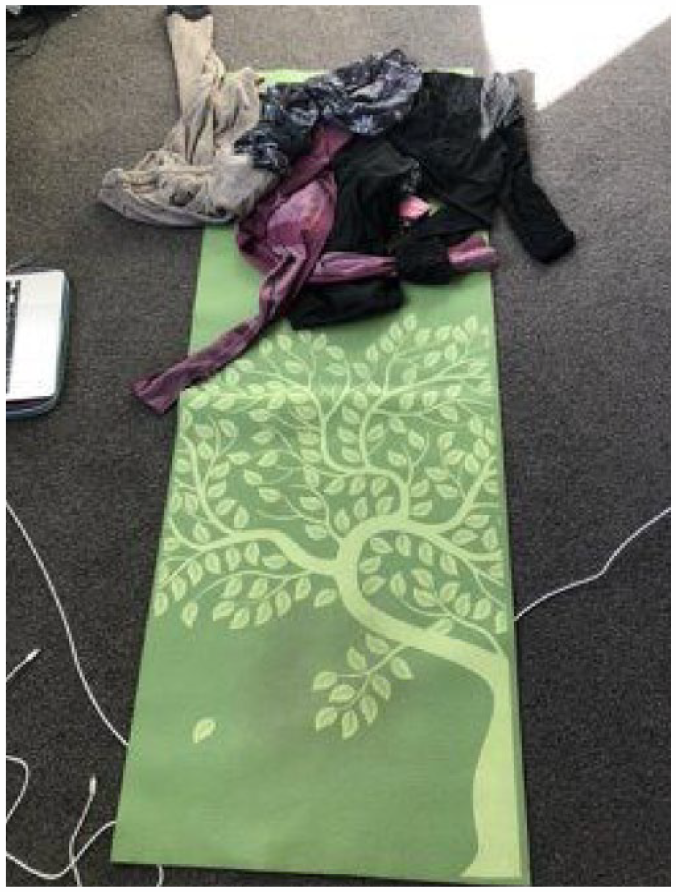
The Yoga Pant Pile. Own work.
There they sat in front of me, a pile of fabric that had touched and been touched by my legs hundreds of times. Looking at them deliberately, feeling them deliberately, was different than wearing them and feeling the fabric passively on my body. Baradian theorizing imagines the past, present, and future as threaded through one another, and non-linear (Barad, 2013). What they refer to as “spacetimemattering” is a temporally boundless interaction of human and non-human. I wear the yoga pants through time, and their touch, smell, and look transport me to other times, and sometimes, a time that has not even happened yet.
Excerpt from interview, May 2023
Eve: I’m not rich enough to buy from LuluLemon, but I can dream!
Yes! Girl! You can dream! Wait . . . maybe that’s not the right dream to have. I cringe listening back over the interview recording when we both laugh after Eve says this. When I asked her about the clothing she wears for yoga classes Eve thought she didn’t have much to say. While she regularly attends yoga classes, she doesn’t buy into yoga’s consumer culture. She practices only in the university gym. Yet, she always wears stretchy-tight yoga pants. They don’t really matter to her, they’re just the clothes that she has. But then again, the expensive, idyllic LuluLemon pants so pervasive in yoga spaces are an aspiration, some link to the future when affluence can manifest.
I don’t own LuluLemon yoga pants either.
The yoga apparel market is worth a whopping $23 billion (Smith, 2022). In Aotearoa/New Zealand, a pair of LuluLemon yoga leggings costs between $125 and $209. Helllooooooo capitalism! The industry thrives on telling women to embrace an idealized type of body, and that aesthetic is accessible by paying for it. Yoga, and its associated apparel, act as technologies of femininity, controlling a female form based on hegemonic standards (Strings et al., 2019). Women are aware of the stickiness of the athletic wear industry (Brice et al., 2023). Aware of how the industry enacts perfect feminity, perfect yoginity. Perfect and rich and thin and white.
Reflection, March 2023
I put on my favorite pair of yoga pants this morning. The ones that have the firmer fabric that subtly hides my cellulite. I check myself out in the mirror as I roll out my mat in the studio. DAAMMNN I look good, remembering how an ex-boyfriend said I should only wear yoga pants because they are like “push-up bras for asses.” Toxic. But maybe he was right?
I’ll wear the yoga pants because they make me look good, sexy, tight, toned, thin, white. I wear them on dates, and the label “yoga instructor” on my dating profile typically results in a series of sexualized questions. Oooooooh, yoga instructor, I bet you’re really flexible *winky face* Incredibly rich and incredibly flexible and forever young and an object of desire. I can afford to buy those fancy yoga pants that push-up my ass. But I won’t buy the expensive ones.
No way.
Nah-ah.
I’m not buying into an industry that has shamed, blamed, and excluded people. Not me of course . . . but other people. I’m a white person with morals. There’s no way I’ll buy into it. No way . . . no way . . .
Reflection, August 2023
I bought a pair of LuluLemon yoga pants today. I had a gift card from my 30th birthday, but still had to fork out an additional $35. So expensive. But damn are they comfortable. So soft. And when I wear them, I feel like I look good. And I feel like a “real” yoga teacher. I know that it has nothing to do with it really. But still. I feel like somehow, now with this label, my students will see me as a legit teacher. The other students in classes when I practice will see me as part of their click. Now I’m an insider.
It’s only now, talking to other teachers about their yoga pants that I have found yoga friends. We giggle about our LuluLemons. I am a hypocrite. Though I’m more compassionate toward my new friends. I’ve bought the yoga pants. I need to stop my research. It’s all over. My theoretical frame tells me that conforming and resisting can exist at the same time. So why do I feel like they can’t? The pants are only stretchy because the fabric is tense.
Excerpt from conversation, August 2023
Sola: I don’t want to like their yoga leggings, but I do.
At least I am not alone. We talked about how soft the fabric is, and how good it feels to put them on and feel ready for yoga. But we wear these pants all the time.
Like, literally, all the time.
I’m wearing them right now.
And probably also when you, dear reader, read this.
When we spoke about all the yoga things, Sola expressed that she feels her teaching yoga is a vocation. She is determined to bring more representation to yoga spaces. She sees her role as a short-Japanese-mum-yoga-teacher as being a model for what yoga can be. The yoga pants do something for her, to prove that she belongs. She is one of the few teachers whose class I attend regularly. Yoga needs her. I need her.
Excerpt from interview, April 2023
Sola: But I didn’t go in buying everything new and everything great. Which yeah, I was quite scared to do it and I was like, well, just like everything else, I’m just not gonna be able to follow through with it. Not important. I can’t spend money on myself.
The branded yoga pants that Sola now wears enable her to belong in a space that she didn’t think she would be able to break into. She believes in herself now, at least when she is wearing the yoga pants, when she stretches into her teacher identity. Even if we don’t feel we belong, at least we can look like we do. Somehow less of an imposter . . . and more . . . Fitting into the industry and liking this thing that is opposed to how we think about yoga, free and able and flowing.
Excerpt from interview, May 2023
Eve: It kind of feels like um, it’s strange compared to like jeans or like cargo pants or whatever, where it feels like you’re more ready for the day. Or like, when I put these on I know I’m going to do something active. It’s kinda strange how it’s in your head, it feels like more comfortable and ready to go and do something.
The yoga pants are motivational. They say get-up and go! I can slide into these yoga pants and feel like I’m going to do something good for me. Even if I don’t actually do anything active, I could do something active if I was wearing them by default. Ready for anything. Free. Able to move. The touch of the fabric evokes. The relationship between fabric and skin brings up emotions and memories (Woodward, 2016). For me, and perhaps for Eve, another young thin white woman, those are good memories. Memories of feeling active, strong, beautiful, empowered.
Because they fit my body, I look good in them. Because I look good in them, I feel good in them. When I find a pair that does not look or feel good, I put them in the pile I’m collecting so I can cut them up and then feel better about myself. I’m only putting aside the yoga pants that make me feel powerless. Cutting up the ones that make me feel less than my perfect yoginity.
Reflection, February 2023
I said something while I was teaching today that struck me. I asked my students to draw their awareness to the seams of their legs. The seams. I’m certain I’ve used this phrase before. But legs don’t have seams. Pants have seams. Seams that get imprinted into the flesh when I aspirationally buy a pair of yoga pants one size too small. I have turned their legs into yoga pants. Their yoga pants into legs. They are one and the same. I’ve turned their bodies into an over-priced product that encourages the female form to be . . . . like me? . . . Our legs are being seamed into a technology of femininity, confining our energy, reducing the space we can occupy. But also creating a space to occupy.
I moved the pile of yoga pants into a trashbag that sat in the corner of my room for months. As the pants sat there, they accumulated memories, stories, feelings, questions, inquiries, problems, embarrassing stories. Collecting possibility. They were going to become something. But not yet. Paralyzed.
Pākehā paralysis?
Pākehā is a word in te reo Māori (the language of Indigenous people of Aotearoa/New Zealand), that refers to fair-skinned European settlers. Pākehā paralysis means,
Emotional and intellectual difficulties that Pākehā can experience when engaging in social, cultural, economic and political relations with Māori because of: fear of getting it wrong; concern about perpetuating Māori cultural tokenism; negative previous experiences with Māori; a confusion about what the ‘right’ course of action may be. (Hotere-Barnes, 2015, p. 41)
Have I mentioned I’m an American teaching yoga in Aotearoa/New Zealand? Doing research on yoga in Aotearoa/New Zealand? While I am not Māori, my identity as Pākehā interacts with Māori. Diffracts and develops as I speak more and more with my Māori colleagues. I have a response-ability to attend to how my whiteness is pākehā-ness. In 1840 Te Tiriti o Waitangi was signed, a founding document stipulating a collaborative governance between colonial settlers and Indigenous people (National Library of New Zealand, 2022). But Te Tiriti o Waitangi is not just a document, it’s a contract between two partners. It matters. I wrote a whole section in my PhD proposal on how my research fulfills the university’s Te Tiriti obligations. Where is it now?
White privilege emerges again.
Like and unlike Barad.
Ravenscroft critiques Barad for failing to mention Indigenous knowing in Meeting the Universe Halfway (Ravenscroft, 2018). I haven’t either. Hokowhitu critiques “new materialisms” for being part of a theoretical “turn” that is an act of colonialism by failing to acknowledge the lineages of Indigenous materialisms (Hokowhitu, 2021). Is my inquiry colonial?
My privilege resides in what I have chosen not to talk about. It resides in the fear of talking about it now, here, rather than editing to seem like a responsible critical scholar. At the same time, I have neglected my origins as a Californian, an American, with my own inherited lineage of colonizing, oppressing, and failing to acknowledge Indigenous peoples of America. I haven’t talked about the various Black activist and Queer activist yoga initiatives around the world. While the intention of this work is to make moves for social justice and health equity, good intentions also remain untouched and waiting to be remembered.
The yoga pants are still there in the corner of my room.
Waiting for me to be ready. Slowly, I added in new pairs as they became too worn to be used. Added in new pairs as I felt too worn by them. The bag they were in was full to the brim. Stretched. Tense. I was packing to leave for a vacation and I picked up the bag to access something. The bag ripped, and the yoga pants spilled out. Too much holding, they were ready to change. Prompted by tension into transformation.
Cutting, Together-Apart?
I started by cutting them at their seams. At the spaces that hold them together. And as I cut through them they opened up into something new. Something new for me. And they occupied a bit more space than they did before I started cut-cut-cutting them into strands.
Excerpt from Interview, July 2023
Claire: It would be pretty intimidating if you’ve never done yoga before and then you went to a studio that everyone was wearing branded yoga clothes. It would make it seem very inaccessible. I think sometimes that’s a thing I have with yoga is and maybe what we’re talking about with like kind of me wanting to or needing to go to a class to get a deep practice is that we’ve been able to do that is a privilege. I feel like yoga or meditation is sort of set up so you can do it regardless of where you are. And there was that kind of breaking boundaries and breaking walls for like where who can practice and what that practice can look like. But the reality of like practicing in a deep way all the time is that it’s very expensive and it’s very like looking a certain way. To fit into that, which is a certain amount of investment.
The yoga pants restrict access. Are the pants themselves intimidating? Or are the bodies that wear them intimidating? Is it a neoliberal uniform that creates a violent army of yoga snobs judging those who aren’t wearing the yoga pants? Am I intimidating? Even if I say hello to every single person who walks into the room? I’m not scary, I’m just American. United States-ian. Californian.
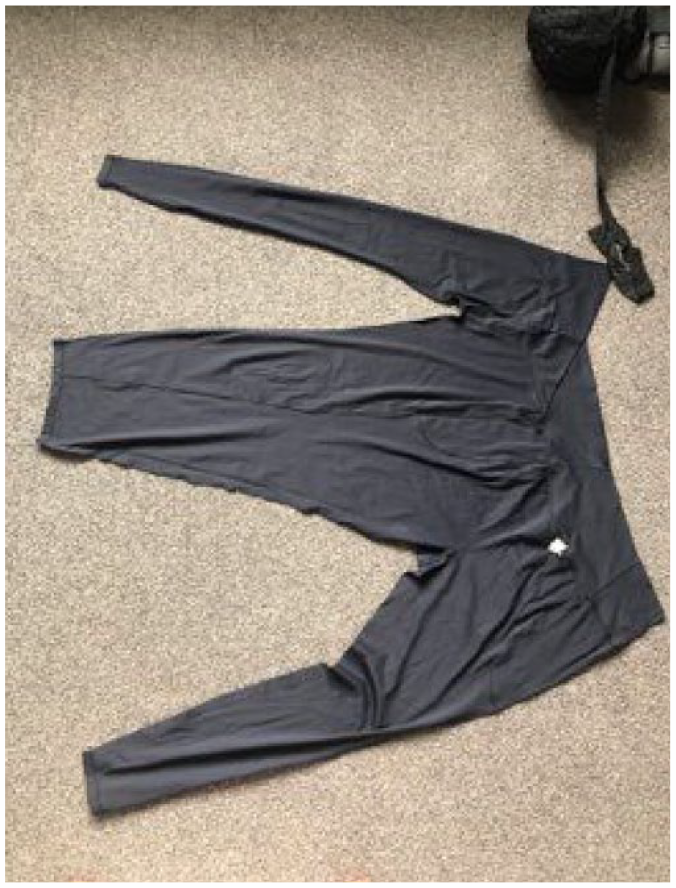
Yoga Pants Cut at the Seams. Own work.
People notice when students don’t wear the tight-fitting clothes. I notice, and I feel fear. Afraid that I am going to do something wrong. There is that pesky Pākehā paralysis again. I might say something wrong that upsets the yogi who is probably more into the peace-love-yoga-urban-hippie-vibe than this upper-middle-class LuluLemon wearing PhD Candidate. I’ve only ever had conflict with other white yoga teachers. Yoga-teacher paralysis. Cut. Cut. Cut.
Excerpt from interview, June 2023
Anne: Interesting at the retreat because talking to like the woman who led the retreat was very careful to dress only in white. That was sort of how she let things go. A lot of the other participants were conscious of not wanting to wear bright colors to like disturb people’s senses and that sort of thing.
Only in white. White clothes, white walls, white people yoga studio. Blank slate, empty canvas, pure light. My clothes should consider other people. I rarely do that though. I just consider me. How do I look when I wear them. How do I feel. It’s not thoughtless. It’s just not thoughtful. It becomes thoughtful when I intellectualize it. In the real world it doesn’t have to be able to prove itself.
Excerpt from interview, May 2023
Lucilia: I have like a bit of a hard time because I need to wear hijab, so I need to at least make sure that my clothes are loose enough. But then again . . . the one that I have most often is in my pajamas. Thing is, you go to yoga classes in your pajamas and then people see . . . So I try to find clothes, but I’m still not sure like which brand to choose here, which place to buy stuff.
The brands don’t exist. They do not create for every body. And it creates an awkward air of un-knowing and discomfort and not belonging. But Lucilia doesn’t seem too bothered by it. She shrugs it off. She comes to yoga class anyways. Her pajamas become her yoga pants, like how my yoga pants have become my pajamas. I wrack my head thinking if I’ve ever seen a hijab in LuluLemon. Maybe?
But really, I’ve never looked.
Excerpt from interview, June 2023
Anne: I might sort of sneer a little bit, just because I’m older. I see [what they wear] and they are comfortable and that’s fine. I think coming from a dance background I can see the utility of seeing what your muscles are doing, you know. I think people sort of giggle, especially the young ones, about their LuluLemon clothes and stuff. I don’t care about the fact that you can see people’s bodies, that’s what we’re here for.
Yoga to see and feel the body. I suppose so. In ancient times the postural prowess of yogis signified status, power, mysticism, and evoked fear (White, 2009). Back in the day there weren’t yoga pants at all, or even clothes at all. In my current teaching there is utility in seeing people’s bodies. I’m embarrassed that I had not really considered it before. Seeing bodies is a bit about safety, seeing the potential of movement to cause hurt. But seeing can also be harmful. There’s nothing as special as opening your eyes after a rejuvenating savasana and being greeted by the reflection of a ballsack in the mirror. How does that diffract?
Excerpt from interview, May 2023
Seraphina: I have been in the class where you just see like men in very short shorts. And so it’s great that I can see the alignment of the legs. I just don’t want to see like genitalia coming up. And that’s just, part of it, that’s just my morals.
I guess I have no morals then. I wear crop tops and have definitely had a few camel-toe moments while teaching. The moral virtue of clothing. I think I want to be seen. I want to be ogled a little bit. Because I can be. I can be empowered by the ogle. I can be seen as a young, appropriately curvy, bendy woman with a small waist because that is what I am . . . for now . . .
While I can, I want to be seen for my normative beauty, so that I can be seen as even more incredible for not only being a pretty young white incredibly flexible woman with flowing long blonde hair. I’m also a complex insecure manic depressive lonely woman who wants to make the world a better place. But those “flaws” are only okay to be seen if my perfections are seen first. So, when I teach, I wear my yoga pants and my crop top as I talk about how yoga saved me from depression.
Excerpt from interview, August, 2023
Jake: It’s my etiquette, I guess. I am conscious that being a man in what’s now predominantly a female space, where a lot of women have been harmed by men over time in their lives, and you know, there’s this whole kind of lack of awareness of that by a lot of men, so I try to dress reasonably modestly, you know, so I’m not gonna wear anything too tight, too sexy.
I almost don’t know what to make of it. I am not shocked, but pleasantly surprised at a male yoga teacher acknowledging the etiquette and moral component of deliberate dress. Maybe there is hope for the world afterall! Modesty is a principle of yoga, and I’ve been conditioned out of it. I’m a good yoga teacher . . . I think . . . But being a good yoga teacher isn’t enough as a woman. I only feel like a legitimately good teacher when I’m dressed like one. When I look like one. When I look like I could pop into a casual handstand at any moment. But really, I can’t. I could be more modest. I can be. I have been. My yoga pants get looser, and looser, and then I put them aside to be cut apart.
Excerpt from interview, April 2023
Yoga student: I don’t do leggings
Those words cut through me. Ooookay then. Me neither. Defensive. Well get on board! She’s 20, I’m 30. Listen to meeeeee. Yoga student described herself as a “basic white girl” a few times as we spoke, is her not wearing leggings basic? Anti-basic? Unrelated to basic-ness at all? Her acknowledgment of this identity suggests to me that she is not basic, she is thinking critically. The yoga pants don’t make her feel the way they make me feel. She wants to see her legs, not the yoga pants. To me, they are one and the same. Her approach to her yoga clothes defies my logic, and even if it is just for a moment, I stop seeing the pants as my white privilege.
Then I see them again and again as essential to my body.
Reflection, July 2023
I looked at myself in the mirror. The appearance of my body the only possible steadying force. Just keep looking at yourself Liz, my vision blurred and I began seeing a black aura around my yoga pants. My body was expanding or . . . maybe . . . were my yoga pants expanding and my body shrinking . . . where was I? I felt nothing, noticed nothing . . . I looked at myself and only saw a steady shape. In body and out of body at the same time.
Yoga pants do different things, for different people, in different spaces, at different times. My crusade to deconstruct the yoga pants seems like a manifestation, and exertion of my single-minded concept of the yoga pants as privilege. A singular concept of privilege. Like them, my whiteness does different things, for different people, in different spaces, at different times. Does whiteness always exert power? Yes . . . probably . . . maybe . . . yes . . .
As I cut through the seams of another pair of pants, they are encouraging me to keep going with my project. With each snip through the ridiculously stretchy fabric I hear my participants words. I cut, and cut, and cut, and think, and think, and think, and feel, and feel, and feel and I am reminded of the little moments. The things they said that I had forgotten. The things that I’ve said that I’d forgotten.
I become the yoga pants that I wear.
I un-become the yoga pants that I am cutting apart.
In the most literal sense, removing those pants from my closet has removed them from my mundane daily ritual of getting dressed. They have stopped mattering on a daily basis. I pulled out the pants that I thought were exerting power over me. Making me feel less-than perfect white femininity. I make the decision that they are the “bad” pants. The ones that made me feel less beautiful, less perfect, less young. But I kept the new ones. I re-exert my identities by choosing what I can get rid of, and what I should keep. Choosing what to cut through. Shredding them up . . . inadvertently? Now I wear looser pants, sweatpants, and the LuluLemon leggings that I currently wear as I write this.
Have I just displaced my focus on whiteness from the daily practices that I have, and rather into some retroactive creative intellectual project? Am I every deliberately interrogating my privilege anymore? I read and re-read what I’ve written. It’s all navel gazing I am sure. It’s not good enough. It’s not enough. Never enough. But it’s something.
Reflection, August 2023
Is this wasteful? I’m just taking these pants aside, not using them, not giving them to somebody else. I’m just using them selfishly for the purposes of my own research. Is that even diffractive?
As I spoke with Seraphina about my process of collecting yoga pants, she seemed a bit surprised about the number of yoga pants I had. Apparently, not all yoga teachers have at least five pairs of yoga pants. I’m going to classes and sweating and accidentally bleeding period into them all the time. If I don’t change them every day, they begin to smell. Owning so many pairs of yoga pants is itself a privilege. Here I am wasting them for creativity. For my degree. For my gain. Meanwhile, saying that I’m trying to interrogate the problematic yoga pant phenomenon.
Becoming
The yoga pants have been cut up into threads. Uneven, imperfect, jagged, lopsided, stretchy threads. I cut them impatiently, impulsively, with intention. I tie their ends together, wrapping them up. Re-shaping them into a ball that holds less space than they did before, even though from end-to-end the yoga pants are now longer than they had ever been.
The ball of yoga pant skein sits on my bedroom floor. I lift and move it and it is dense. Heavy. Full of the weight of my questioning. The weight of my power, the weight of uncertainty. How is it going to become?
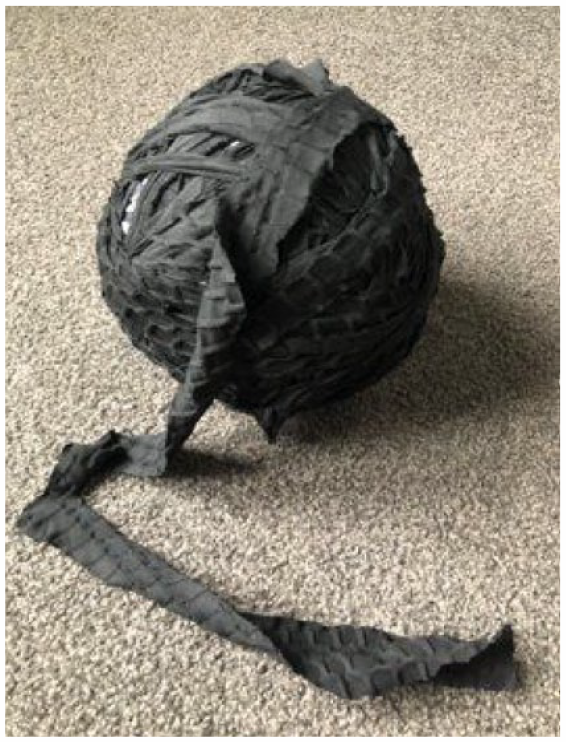
The Skein. Own work.
Should it become?
Barad (2007) discusses “becoming” as a process of materialization (p. 180). The yoga pants materialize with my humor, guilt, shame, arrogance, selfishness, shock, defensiveness, compassion, frustration, and awe. These same affective forces, written through me, materialize with cis white able-bodied aesthetic femininity. As Barad (2007) says, “it is not so much that I have written this book, as that it has written me” (p. x). The yoga pants have written me. Other people’s relationship with yoga pants have written me. In this process of auto/ethnographizing-with, yoga pants materialize embodied privilege in my process of critical feminist inquiry. Materialized an embodied privilege that I did not know before.
This writing began with a conflict. I presented a lawsuit and literature to create an argument around yoga pants as part of an enactment of exclusion, without having experienced that exclusion myself. I pre-supposed embodied power through intellectual critique that is invisibly shaped by my whiteness. With the diffractions, I come to see the yoga pants as more than a trope of white femininity. Intra-acting with Eve, Sola, Anne, Seraphina, and YS cut through a singular concept of the yoga pants to reveal their possibilities as technologies for motivation, belonging, safety, and resistance. Intra-acting with Lucilia, Claire, and Jake cut through a singular concept of the yoga pants as invisibly enacting power. There is a greater awareness of the hegemonic norms perpetuated by the yoga pants than I had initially thought. Through DM, my privileged thinking was challenged, resisted, by its embodiment.
But I haven’t written about embodiment hardly at all, despite my embodied power being the premise of this work. I have written with embodiment. Through embodiment. Maybe, power is embodied, but it doesn’t realize that it is embodied. Through DM, and relational (re)conceptualization of self, how it is embodied day to day becomes clearer.
Similarly, the diffractive cuts are shaped by my identity. In a diffractive analysis of students’ ill-/well-being, Lenz Taguchi and Palmer (2013) analyze the “cuts” of their process as predominately situated with/in whiteness. Fox and Alldred (2023) further argue that diffractive analysis is a highly researcher-centric approach, with the decision of which cuts to make, and which to include in publication, bound to the affect and identity of the researcher.
Why have I made these particular cuts?
Why these particular transcripts?
Why these reflections?
They have glow.
They evoke something. A memory, a text, a feeling, a jolt.
They are instances where I felt able to move beyond merely discursive critique of power. They are intra-actions where I felt like I was, could, or should be, thinking-with, rather than critiquing from an external, authoritative position as a feminist scholar. Stepping away from critique is a feature and interest of scholars in the field (Murris & Bozalek, 2019). DM and thinking-with yoga pants, Eve, Seraphina, Lucilia, Sola, Anne, Claire, Jake, YS, various texts, theory, memories, and moments from my academic history cut through a dis-embodied, singular, academic, white feminist, “knowing” of power flows.
I did not know when I began, but this diffractive auto/ethnography with yoga pants has placed my academic self-hood in conversation with my real-life, yoga-teacher self. The scholar and practitioner meet. Critical Yoga Studies has been overwhelmingly developed by scholar-practitioners. Some of whom, argue that these two identities are at-odds with each other, in a relationship that cannot be reconciled (Di Placido, 2023). I too feel this tension, but it is a dichotomy that I resist. Perhaps optimistically, I consider DM as an approach to understanding the mutually constitutive scholar-practitioner. Such a re-conceptualization more clearly enables power, privilege, and whiteness to be seen. Visible. To stop being see-through, like those recalled LuluLemon yoga pants.
Together-apart.
Like Brice and Thorpe (2021), I endeavored to disrupt knowledge patterns as yoga pants, affect, discourses, memories, human experience, and theory come together through writing and creating. Endeavoring to know the phenomenon differently. Through this inquiry I certainly will not know yoga pants the same again. I will not know myself the same again. I will not know critical feminist new materialism the same again. I will not know the culture of the OECD yoga industry the same again. For now, existing as a white-cis-straight-able-bodied-educated-affluent-female-yoga-teacher-scholar-in-training means holding an intellectual awareness of power and privilege that is good-hearted, compassionate, curious, forgetful, aspirational, siloed, and needing to be practiced more.
I pause as I read the recent work by Fox and Alldred (2023). They suggest that DM does not provide a way to “evaluate the effects of observation on events” (Fox & Alldred, 2023, p. 99). I agree that the effects of DM cannot be measured in the intellectual sense. Not when siloed to the scholar. But perhaps, as they are entangled with the scholar-practitioner. Diffractive auto/ethnography can create opportunities for identity work that illuminates power, that cuts power together-apart and into a skein of yoga pants, ready to make change.
I have stretched myself.
Felt things. Thought things. Done things.
Un-certainly.
This stretching evoked more tension than I thought existed. It is not done. Still just becoming. Like the yoga pant skein, it is imperfectly prepared. It is stripped down and tidied up but with loose ends. I could crochet it. I could unravel and re-ravel it until eternity. I could wrap it around my body and become a yoga pant mummy. We could be woven together. My mind flutters with a becoming.
Footnotes
Declaration of Conflicting Interests
The author(s) declared no potential conflicts of interest with respect to the research, authorship, and/or publication of this article.
Funding
The author(s) received no financial support for the research, authorship, and/or publication of this article.
