




Abstract
This article plays with research-creation possibilities to interrogate data, data trails, and their becomings in qualitative inquiry. It arises through the inspiration of the authors’ experiences in experimenting with data-trails: a specific mode of thinking-doing for speculative research-creation possibilities. By placing these experiences alongside conventional discourses and protocols of research practice, the article ponders on a series of ethico-onto-epistemological questions about data becomings. We wonder about how qualitative researchers find and trace interconnected data? We approach this timeless question and adopt the concept of bridge/bridging to help us in considering the ontological sites that such data-trail research-creation possibilities afford.
Keywords
Data-Trail Trials: Unruly Tales of Data Becomings
This article re-turns—in Baradian (2014) terms (i.e., arises in interconnected and rhizomatic ways from)—our experiences with data-trails: a form of research becoming(s) experimentation. Data-trails are a sort of experimental research/pedagogic practicings that we have engaged in with colleagues during conference workshops (Fairchild et al., 2021), and with students in teaching classrooms. In essence, data-trails are a productive form of research/pedagogical praxis for exploring ideas and for interrogating idea(l)s of conventional research practice and creation of relational data. In practice, during data-trails carried out in the past, we scatter data points relating to a theme or concept (in this case the concept of bridge and bridging) and invite participants to enter into a form of relation with these data-trails. Our trails of data extend beyond the bounds of the conference/teaching room and participants follow these trails, walking and choosing items that speak to them, before meeting at a pre-arranged space removed from the scattered data—what we have come to term the assemblage stations—wherein they (re)assemble their found data points in some form of collage. The act of entering into relation with data-trials and (re)assembling found data points expresses and materializes a kind of simulated research process. At the assemblage stations, with relatively little direction from those of us who organize the data-trail event, participants create narrated relations that convey their own thinking about, and their choosing and synthesizing together with, the data. Although the data-trail events adopt a shared provocation—a theme or concept that loosely animates the data points—participants have a great deal of latitude in interpreting/storying that theme. For example, in the past we have held research method, migration, sustainability, seduction, and autopsy as themes for provocation in data-trails.
In the current article, we explore the unruly excess in thinking-doing (research) otherwise (Osgood et al., 2020) when data-trail processes are connected with the theme of bridge/bridging which we undertook in preparation for a planned conference. Rather than providing a straightforward account of data-trail as a method, we outline some of our practices when thinking-doing data-trails and their creations. The article takes at least three forms of practice along its becoming. Leaning into the rhizomatic nature of our writing mode, these forms do not necessarily happen in strict sequence: they are, in themselves, becoming(s). The three forms of practice you will encounter are:
some description of practices that evoke the nature of data-trails using our experiences of research-creation;
entanglements between the concept(ual architectures) of bridge/bridging and data-trails, and the ethico-onto-epistemological quandaries that such entanglements help to unfold about traditional qualitative research praxis;
forms of data-trail in which we loosely scatter some of our own “data-points” related to bridge/bridging.
Taking the form of practice-based minor gestures (Manning, 2016), or as non-representational methodologies (Vannini, 2015) and barely noticeable data micro-accretions (slight agitations, irritations to the smoothed norm of data), our writings in this article foreground, interrogate, and re-assemble different bridge/bridging formations through their entanglements with the ethico-onto-epistemological questions animated by data-trails and our interactions with data. These processes of thinking-doing data and research otherwise highlight some of the trialing intertextualities, limits, and liminalities of trailing and bridging data in mainstream (qualitative) research practice (Fairchild et al., 2021).
Data-Trail Re-Turnings
Here we invoke some of the richness of the ordinary affects (Stewart, 2007) that data-trails have produced in our academic life, and which inspires the present article. We do so in rather poetic form, re-turning two particular instances that prompt and move this article in foregrounding data (trails). These are two scenarios, or micro-events, that evoke our data-trail research-creation experimentations and enliven these current reflections:
Data-Trails: Conceptualizations in Progress for Thinking-Doing Research Uncertainly
Our data-trail experimentation workshops emerge from and contribute to our wider thinking-doing-affecting around interrogating and disturbing the AcademicConferenceMachine (Benozzo et al., 2019; Fairchild et al., 2021) and in thinking otherwise (Osgood et al., 2020) about knowledge production–type events. In these workshops, after 15 min during which the participants collect objects/images/words from the data-trails, they are invited to juxtapose the data they have chosen. New data connections are created through three-dimensional assemblage stations. In each of our experimentations with data-trails thus far, what we call the participants (as well as ourselves) have managed to co-create connections and interpretations that were wholly unforeseen: unplanned connections between object-researcher-image-researched-text-affect that insist on recognition. We hold that these data-trail experimentations offer a time-condensed exemplification of research praxis more generally. Certainly there are direct parallels with research that uses found data, and it has clear parallels with those many research traditions in the social sciences that take a subjective perceptual approach in observing, interpreting, and (re)narrating sociocultural phenomena. Moreover, we hold that these data-trail experimentations offer iconoclastically promiscuous learning moments in which a concept which is (over-/under-)researched might be explored/exploded by accessing that concept in a disorderly and undisciplined way. Indeed, we also suggest that these research-creations offer opportunities for participants to reflect on (or diffract) their existing/emerging knowledge about research process and praxis itself.

While our data-trail events unfurl themselves as simulations, they also provoke a host of questions about modes and mores of praxis in more conventional research. The literature on conventional research practice is replete with protocols and trialing properties that focus on tracking, trailing, and collecting data. For example, myriad qualitative research discourses address audit trails, and other forms of detailed descriptions that delineate those strategies and step-by-step processes for data and research husbandry (Bowen, 2009; Schwandt, 2007; Wolf, 2003). These kinds of data trails are utilized in research not only as architectures of accountability, but also as guides, helpful introductions, scaffolding techniques, and ways to train novice researchers into (correct and specifically) disciplined ways of knowing (Cutcliffe & McKenna, 2004; Koch, 2006).
Coupling conventional discourses and practices of research process with our two instances reported above, we are inspired to sit with some of the ethico-epistemological questions that attach to those trails that are expounded for data/research husbandry in more conventional research practices. More provocatively, we ask: What is at stake in qualitative researchers’ desires when tracking and tracing data? This broad question breeds a slew of sub-questions. For example, how, why, and when might one create an audit trail of one’s data (and the techniques by which it is generated and treated)? What might become data and when? In what ways are data manipulated and represented so that they fit with, or reflect, conventional data-trail protocols? Who creates data trails, and for whom? Who is best served in and by the disciplinary sedimentation of such data trailing protocols?
Data-Trails Meet Bridge/Bridging
The questions of epistemology and ethics that are agitated through our data-trail experimentations were animated yet further in planning for a conference on qualitative methodology in Psychology that had as its theme Creating Bridges. In our planning a data-trail event for this Creating Bridges Conference, the above questions coupled in promiscuous ways and generated new provocations on data as they became entangled with the concepts of bridge/bridging. These concepts snarled in fecund multiplicity as they twisted and (un)raveled in intra-active productivity, and entreated us to think ontologically with data-data-trial-bridge/bridging excess. These entanglements produced a whole other set of ideas, images, incitements, and affects that re-enlivened our thinking-doings on data-trails, allowing us to work creatively and messily in the mass of ideas as they took shape.
In this article then, we take bridge/bridging as a concept to engage with(in) the ethico-onto-epistemological sites and modes of inquiry that data-trails as research experimentation affords. Bridge/bridging appears in our thinking in both its material and metaphorical forms: as a(n architectural) ways of thinking about and with(in) the world that leads us to imagine otherwise, as well as along(side) the planes of our ethico-onto-epistemological meanderings. In adopting bridge/bridging as an ontological orientation of entanglement with data-trails, we explicitly bend toward the Deluezo-Guattarian-inspired practicings of Concept as Method (Lenz Taguchi, 2016) which informs Colebrook’s provocation to engage in “the pedagogical process of learning from and with the concept” (Lenz Taguchi, 2016, p. 214). Pondering (with/in) such ethico-onto-epistemological entanglements engages research practices in ways whereby “. . . differentiations can be created that might deterritorialize the concept and accomplish reconfigurations with the purpose of resisting normalizing practices” (Lenz Taguchi, 2016, p. 214).
In thinking about and with bridge/bridging then, we also look toward the notion of strut—those bracing components of bridges that compose and (con)firm up the structure of such spanning architectures. Without struts bridges become impossible, unfunctional, and unusable architectures. Struts, often invisible from the bridge, carry, create, and enable bridge and bridging. In addition, we take license with “strut,” both as a constituent part of bridges and as a homonym that connotes a particular form of movement: to strut, in this sense, is to walk with bluster, with a swaggering comportment. We hold this melange, this unholy mess of concepts so as to take an undisciplined meander along, and from, expected and more acceptable paths of (research praxis) thinking. Thus, we bring data-trails forward in yet slightly different ways in this exercise. Like its temporary companion concept “bridge/bridging” in this article, data(-trails), for us, do not function as roads or fixed paths filled with street signs. We are interested in exploring how, instead, the entanglements of these concepts might bring things (matter, subjects, events, processes) together in unanticipated and speculative yet productive ways. Thinking bridge/bridging (as material artifact, as concept, as discursive site and mode of doing) with(in) the doings of data-trails create a riotous force field for the dissolution of more established conventions for data and for data trails; this vital collision of metaphysical meandering, frays and unravels our thinkings into less-known, in-progress, conceptualizations. Bridge/bridging folds our past experiences in teaching and conferencing using data-trails with further, as yet unknown, thinking. Within these bridge-data-trail-connections intentionality is not removed but is, instead, happening on the same plane as other entities such as objects, space, thoughts, doings, and, and, and . . . .
Concepts such as bridge or strut are always becoming through processes of relations. Concepts develop relations to other concepts situated in proximity. “Every concept relates back to other concepts, hence, the discussion of visuality ends up in a cluster of concepts” (Bal, 2002, p. 51). Concepts coincide, condense, and accumulate: they are centers of vibrations and resonation (see also Bal, 2002).
Likewise, data in qualitative research form relations; it functions as a relational force connecting/bridging information, theories, researcher perspectives, lives, materialities, concepts, experiences, and many thinkable and unthinkable elements and energies. To trace these relations, scholars may create bridges; conceptual, material, social, economic, and political forms and spaces of connections. Some scholars, from postpositivist and interpretivist traditions, describe the bridges (conceptual, analytical, methodological, theoretical) that they create on data. Such connective bridging fixes their beginning and ending coordinates, and documents the intentionality of those individuals who are creating, building, and using the bridging trails to create data samples, corpora, as well as in constructing information used as data. Our purpose, coming from the post-traditions, is to approach data-bridges as virtual spaces for data potential, and data relationality as data-trail possibility and as data possibility. Data bridging of this kind can connect information, individuals, and matter in novel and surprising ways; it temporarily materializes novel (data) relations. However, such connective materiality may only emerge temporarily and appear occasionally stable through the events it creates, and through its functions. Moreover, such bridges and bridging might not be easily traceable, repeatable, or even identifiable. Equally, it might give rise to connections that are undesirable, that ought not to be thought of or seen. As a corollary to such bridging relationalities, data become and are recognized and, even more so, data produce. In such unstable milieus, researchers might not be able to pinpoint exactly what is being produced, where such connections come from, and when or if they might be useful or understood by others. Nonetheless, one could argue that bridge/bridging-data-trails are productive and generative concepts with which to think (otherwise) about data relations and even more.
Furthermore, our data-trail thinking with bridges/bridging foregrounds our attempts at becoming with/in the betweenness of things, namely, embracing the fluidities and uncertainties that might produce themselves with the coming together of different concepts and materialities. We propose that data-trails—and especially in their intersections with bridges/bridging—open up the possibility for conjuring how new connections, relations, and ontologies might be thought or awakened, or through which (data) relations create themselves. We suggest that by attending to bridge/bridging and its entanglements with the betweenness-es of data trails (and data-trails), unexpected data relations become and emerge beyond prediction, since any and all directions, formations, and connections become possible when opened to the wilded and wilding (Halberstam, 2020) praxis of immanent thinking-doing (Manning & Massumi, 2014). Bridges can be no trails or no roads; they can become nothing, lead no-where, but these spaces of no-thing can also form unlimited possibilities of/for connections and data to relate.
Bridging the Bridges
In our data-trail events, data materialize in unexpected ways with(in) academic spaces—rather than through their more usual forms and formats, that is, in the shape of words appearing in transcripts, or on a slide on a big illuminated screen (in the classroom or in the conference hall)—spaces in which the lighted screen is the apotheosis of ocularcentric knowledge production. Instead, data-trails materialize a conglomerate of things and create an agentic assemblage that influences, forces, conditions, and makes possible experimentations in knowledge production spaces. In Bennett’s (2010) terms, these processes and practices form agentic assemblages (or human-non-human assemblages) that are made up of, ad hoc groupings of diverse elements, of vibrant materials of all sorts. Assemblages are living, throbbing confederations that are able to function despite the persistent presence of energies that confound them from within. . . . The effects generated by an assemblage are, rather, emergent properties. (pp. 23–24)
Taking seriously the agentic vitality of materiality as it entangles in multiplicitous assemblage, data-trails become a flow of connection: a relationality of effecting-affecting-doing by nonhuman and human agents. What might this idea of agentic assemblage as effected in data trails and events produce when it entangles with bridge/bridging and strut/strutting?
Data-Trail Struttings: (Un)Picking Bridge/Bridging Formations
Having set out some of the ways by, and in, which our thinking-doing is provoked with(in) the entanglements of data-trail bridge/bridging, we change the rhythm of our writing in this next section. Here we set out—somewhat akin to a data on/in/with/for trail—a series of “data-points” relating to bridge/bridging that bring data together and into relation. Our data-points may seem at odds and/or uneven, consisting of images, pieces of (fanciful) writing in a variety of forms, and a series of questions. Thus, the next sections present an increasingly fragmented series of “data-points” with which the reader can think about data(-trail) becomings through, and with(in), the concept(ual architecture(s) of bridge/bridging. Data bridge/bridgings offer temporal structures for data to become visible and materialized. The data-points that make up this section are intended as an invitation to you, reader, to engage with this data-trail on bridge/bridging in your own ways. Each data-point is set out between bridge icons. However, feel free to mix and match images-text-questions as your own lines of flight soar.

Bridges are structures and technologies of capital. They enable the controlled flow of goods and services and facilitate stable trade routes. They ensure the stable supply of raw materials and labor; they ease logistics in distributed assembly and distribution chains for goods and services, and they provide entry and on-going access to (new) markets. For some, bridges are capital structures joining trails! They can be built for stable transport, for safe passage and for reliable mobility. They may allow access to, and exploration of, the other side and, importantly, they allow a return. Looked at from a techno-engineering-aesthetic realm, they continue to inspire awe and wonderment in their ability to span and condense those obstacles that the natural environment might put in the way of passage. They could be seen as emblems of (hu)man’s achievement and might be a symbol of (hu)man’s triumph over nature. As such, and at the same time, they are architectures of nation-building (Griffiths, 2000). In this, bridges are manifestations and symbols of state power whether of the modern kind or, indeed, of the more imperial and (neo)colonial kind. Bridges are a key part of the infrastructure that binds communities (internal and external) together, especially in nation-state building. Simultaneously, bridges can act as pinch points for national bordering, for the controlled and surveillanced entry into territories. And, as part of warfare, a nation’s military might can be exercised in the control of bridges either in making progress into enemy territory or in hampering the progress of the enemy into territories already claimed. However, what is often occluded in such (material and/or symbolic) narratives of nation-state building are the acts and practicings of dispossession and disempowerment that are imposed on some through such (enforced) in/ex/clusions. In what ways are these processes also happening with data and within research?
Our brief (re)casting of some of the presences and characteristics of the techno-engineering-physical/material “Bridge” above is, of course, only indicative—a mere starting point which, we’re sure, our readers can develop along their own lines of flight. In a similar way taking seriously how “bridge” has, additionally, been harnessed in a seemingly unending range of rhetorical/conceptual ways, further extends/explodes the ways in which we might work with this concept. In Lakoff and Johnson’s (1980) terms, “bridge” is a dead metaphor; a pervasive linguistic and embodied enactment whose use is barely noticeable when facilitating or encouraging the closure of gaps of any type and/or in surmounting any kind of barrier that might otherwise hinder understanding or rapprochement. Bridge (building) is the ultimate rhetorical glossing mechanism; a metaphoric overpass to better awareness and understanding—something that also happens in the context of data sense-making. Bridges appear and then become invisible in various contexts: in dental practice, in information processing, in peace-building, in theory-building, in money (on each euro banknote there is a bridge), in finance (e.g., bridging loans) and, and, and . . . Bridge/bridging as a concept is especially pervasive in educational and pedagogical contexts in relation to the development of inter- and cross-cultural knowledge, skills, and attitudes (Skrefsrud, 2020). Likewise, it is part of the rhetoric of research, particularly in trans-/cross-disciplinary research, which creates bridges between different disciplines and thus between data fields and across data folds. What (data) bridges span your everyday knowledge production practices?
As both physical structure and rhetorical device, bridge/bridgings are seen as stable sites of connectivity and flow; they span borders, boundaries, limits, and obstacles; they provide safe passage and are often proffered as architectures of encounter, of knowing and of (re)conciliation. However, they also force a particular pathway, an often narrow and direct route; their stability and rigidity provide a fixed course, an overpass from the obstacle(s) that might otherwise impede progress and connectivity. Bridges are positioned as pathways of contact and communion between places, peoples, ideas, and data that might otherwise (wish to) remain separate and distinct. Bridges enforce a coupling of formerly independent coordinates and compel connection between entities and data that might otherwise (wish to) remain separate. The rhetoric and symbolism of connection attaching to bridges and what needs to be “bridged” is often offered as a simplistic and simplifying antidote to the historically nuanced and deeply felt divisions that maintain and sustain (local) communities and data. Bridge/bridgings require and assume fixed and stable abutments on either side of their route. Equally, there is the (erroneous) assumption that bridging opposing sides is merely a matter of establishing and then extracting fixed ideas about the opposite side, thus facilitating a flow of crossings and passings—in understanding, in knowing “the other” and potentially unknowable data. In effect, bridges/bridgings are hailed as the ideal architectures by which opposing sides (of data) can be stitched together in some utopian idea(l) of unity and oneness. For example, Ivo Andrich’s novel The Bridge on the Drina reminds us of the connection between two opposing areas whose opposition has been historically characterized by armed conflicts. This example suggests real ethical issues on the role of bridge/bridging which might appear also in data bridging.
A bridge is, itself, an assemblage. And, in thinking bridge/bridging-assemblages, we are attracted by the idea of suspension. The data-trail-bridge/bridging assemblage creates space-time-matterings (Barad, 2007) that are (sometimes) not simply accessible from below. The bridge and the strut support and suspend; they are constantly waiting for something above and/or below. The bridge needs solid structures and vacant spaces: the vacant spaces let bodies of air, water, affect, and sensation pass through. The bridge rests on the earth, but goes upward and gradually lets water, air, and human be(com)ings pass through. The bridge is fixed and in suspension and can only become through its intra-active relationality with other human-non-human entities. As a parallel, in research practice, onto-epistemology imposes a kind of architecture of how to do research and create data in some specific and disciplined ways. However, such onto-epistemological protocols do not tell us the whole story—and that is particularly the case with stories that strategically resist conventional forms of research capture.
There are some data differences that ought not or cannot be bridged. We are reminded here of de Sousa Santos’ (2018) ideas about the “abyssal lines” of knowledge and knowing the Other in neo- or postcolonial contexts, and of the epistemicide involved in trying to establish—more likely imposing!—forms and practices of knowledge as “bridges” (on)to the colonial subaltern. As de Sousa Santos asserts, “Being on the other, colonial, side of the abyssal line amounts to being prevented by dominant knowledge from representing the world as one’s own and in one’s own terms.” (de Sousa Santos, 2018, p. 6). In giving serious consideration, thus, we might need to be less pioneering and, equally, more critical about the ways in which we invoke bridge-building as a metaphor for communing with(in) “the other.” This is particularly the case when thinking about, and/or enacting, idea(l)s of data (comm)unity without proper appreciation for the differences, and the very real material inequalities, that are in-built despite our desires for bridging divides. Or, at the very least, we might need to consider carefully how bridges/bridgings are offered as passes and passings of difference. Perhaps such bridge/bridgings should be held as speculative, highly tentative, and temporary structures. It is perhaps unnecessary to say that we ought to hold and host critical appreciations of—and a greater degree of humility toward—the architectures of knowing and knowledge of “the other” to which one’s learning and data may belong.
Bridges unite. But this process is a double-edged sword. They also colonize and extract; they can deplete power and, at the same time, they can also represent occasions for promiscuously fecund contaminations. What does bridge/bridging do when we make/enforce entry through our/their (force)field? In what ways do we insist on bridge/bridging in safely extracting our(their?) data? In what ways, and for whose benefit, do we contaminate worlds during data analysis bridge/bridging? Or, in what ways are we contaminated by the flows of such bridge/bridging efforts in research practice?
Bridges provide a way, a true path, a pass. Concomitantly, bridges occlude full sight of the underpass—a minor route seemingly much less important and/or traveled; a site of shadowed danger and/or of freedom from more normal regulation. What of the “under-belly” of bridges: places in the shade and shadow, the umbra; places cruised because they are not wholly visible, not always part of the plane of surveillance.
Evicted. Expelled. Determined leavings from cosy distress. Temporary shelter under the overpass that stretches beyond. Bridge’s affordance of dry, open, (un)safe homeness. Temporary home that’s more and yet less than. Freedom’s sleepy roughness begs existence outside the sham of the norm; the shame of not being so. Sheltered Nook. Nuked normalcy. Hunker. Hide. Shammed shame. And this homeless home—a perverted failure of capitalist success—rubs shoulders with other perversions. Cruise, cruise. Queering public space with bodies already queered by cis-hetero regulation. Partnered secrets rippling and riffling with shots in the dark. Rip, RIP. Torn, used play. Condom foil wrap, fag-butt, spoiled seed. Light darkness. Mincing strut. Sashay. The pleasure of looking. Roaming recces. Furtive scrutinies. Sideways scans. Playing interest. Probing inquiries. Data. Chancy luck. A lucky lock. Look-out look out. Look out! The feel of eye made good against pillar and post. Steadying strut. Grab, grope. Rub, poke. The force. Another intersection. Data. Multiple enjoinments. Fuck, that’s hard. Oh, that’s good.
In what ways do such queer fascinations with, and que(e)ring twists of, bridge/bridging perspectives speak to ideas of researcher and researched; the sites and locations of the research gaze and of (legitimate) knowledge? What productions might these and other queer lookings and b(l)indings construct and intensify as (imagined) data—data formations that might resist, refuse, confuse expected and acceptable knowings?
Where Trolls Belong. (Doug Wildman, Creative Commons)
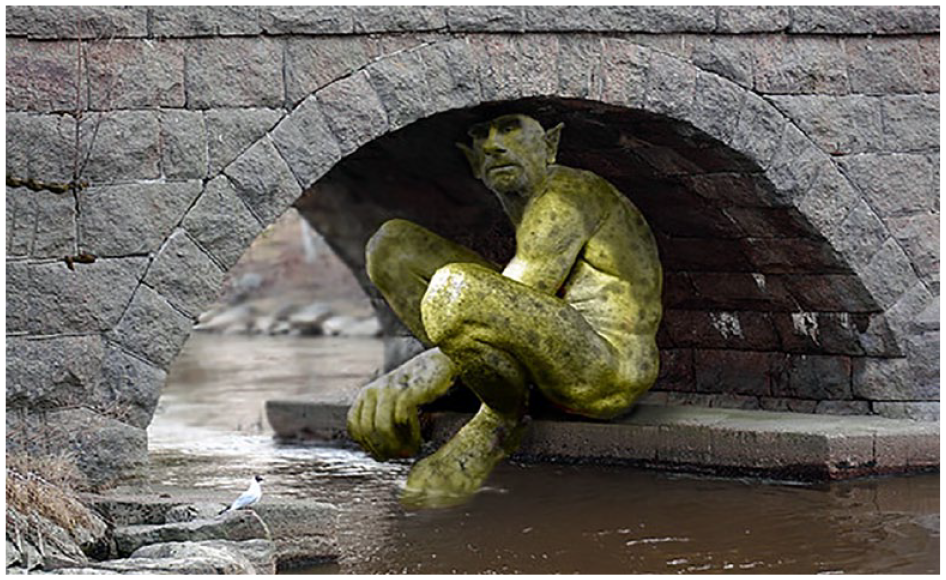
Bridge/bridging ponderings provoke questions and queries about how, in the realm of fairy/folktale—especially the more sinister pre-Grimm brothers and Disney versions of such tellings—bridges act as sites of data foreboding and danger. Bridges are crossings under which trolls and other nefarious beings live, waiting to pounce. What might this folkloric trope presage about data? Might it be a reminder that encountering and attempting to cross bridges, to go beyond one’s own data territory, is a risky kind of traveling? In what ways might the trope signal an ethical data “stop!” (or at least pause) for those intending to seek their fortunes in mining data in far-flung fields?
Bridge to Nowhere, Belhaven Bay
Source. Lynne Kirton: https://commons.wikimedia.org/wiki/File:Bridge_to_nowhere,_Belhaven_Bay_-_geograph.org.uk_-_219872.jpg.
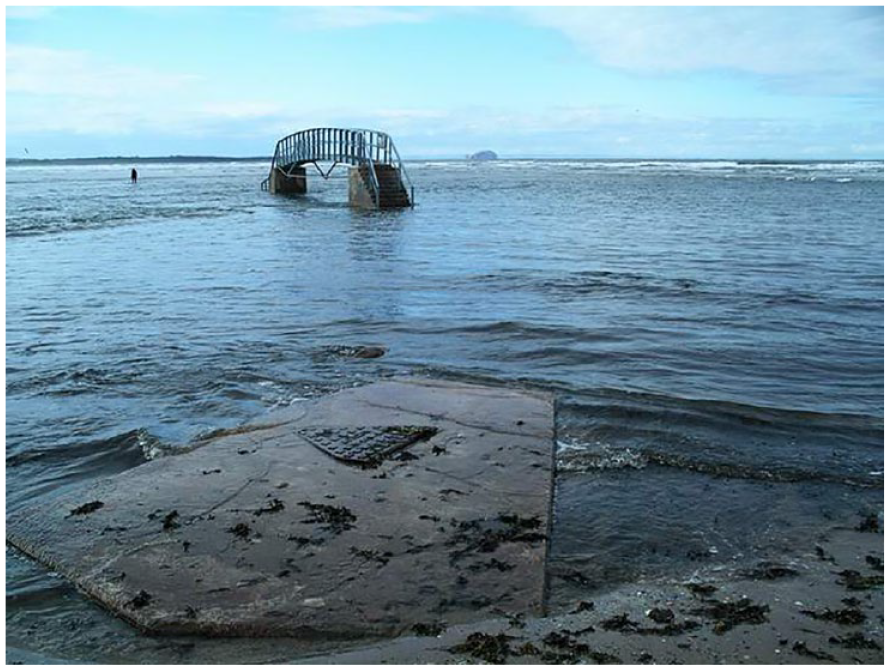
In the context of our promiscuous bridge/bridging-data-trail voyagings, what ethico-onto-epistemological questions might surface in thinking about a data “bridge to nowhere”? What research structures do we erect and then, moving onto the next exciting project, leave to rot? What happens later to those data trails that we so mindfully engineer in justifying our immediate research curiosities? What data returns as the flotsam and jetsam of another careering change of research/paradigm direction?
Grandville, a 19th-century French illustrator, takes us traveling in(to) time with his pre-Surrealist world-bridging (non)sense. We wonder what animated his fanciful imaginings? We wonder how (un)related his musings might be to some contemporary (equally fanciful) thinking-doings about inter-planetary movements? Was this just a 19th century form of imagining space travel/tourism? Was he also thinking about the exodus from one Anthropocenic mess by bridging to the virgin territories of other planets? Was he thinking about how to bridge to other realms so that yet other worlds could be exploited and used for their extractive potential?
Grandville: Illustration From “Another World”
Source. Available at the Public Domain Review, https://publicdomainreview.org/essay/grandville-visions-and-dreams.
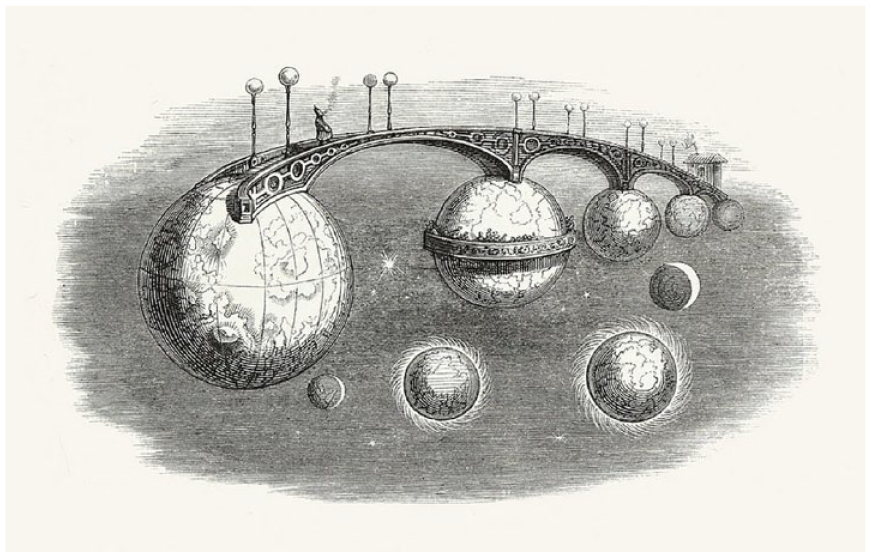
In what ways might Grandville’s quixotic bridge/bridging imaginings propel us in (re)thinking what matters and comes to matter through our data and research endeavors?
Another bridge collapse! Given that the modern condition is evinced by “man’s” [sic] mastery over nature, in what ways might this kind of catastrophic event spectralise and make manifest a broader set of anxieties relating to the failure of modernity itself? The tragedy invokes a neurotic insistence to find out what caused THIS failure, not least as a way of shoring up the idea that bridges—such modernist and monumental architectures—more generally, will continue to “work.” (Of course, such soul searching often depends on the type of bridge and where in the world such catastrophes happen.)
San Francisco-Oakland Bay Bridge Collapse, 1989
Source. Joe Lewis, 2006. https://www.flickr.com/photos/californiawatch/5572600044 [Creative commons license].
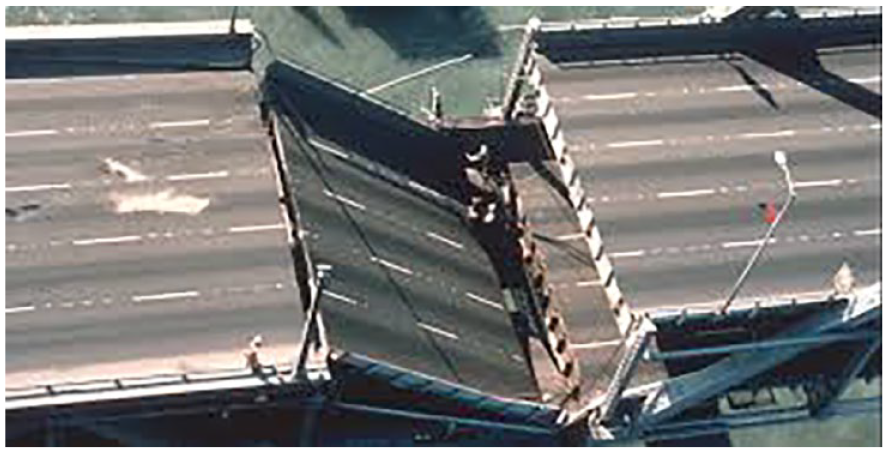
What might the collapse and subsequent soul searching in the face of such bridge/bridging break-downs conjure for our current research practicings and data corpora? Going along with our fanciful bride/bridging data-trail struttings here, what insights to data becomings, to data-trail constructions, might become apparent. What fissures in conventional research architectures appear and widen through our bridge-bridging data trails?
“Life-Preserving Coffin”—Complete With Breathing Holes and Easy-to-Open Lid to Be Used in Cases of the Doubtful Dead
Source. Christian Henry Eisenbrandt, 1843. https://www.archives.gov/. https://commons.wikimedia.org/wiki/File:Eisenbrandt_coffin.jpg#filelinks.
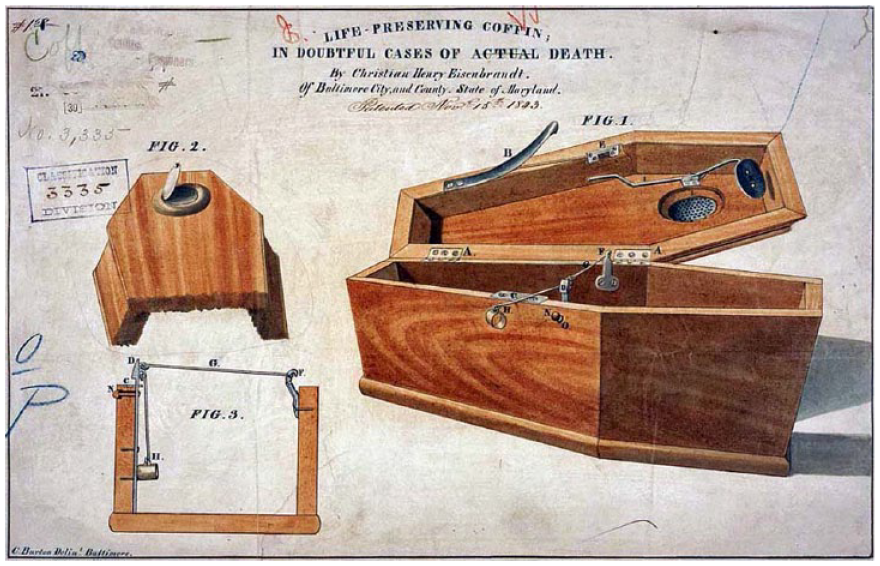
One line of flight occasioned by our bridge/bridging data-trail ruminations—even if it is more obscure, less obvious than others—is provoked by Eisenbrant’s 19th-century invention of the life-preserving coffin. This “invention”—read here as providing a bridge between life and death—conjures and explodes western hegemonic thinking about the borders and boundaries of life and living, and equally about the lengths we might make to overcome and span such limits and liminalities. The “life-preserving coffin” evinces a slew of arrogant (hyper)modernist concerns and compulsions: an egoistic cling to life, a desire to master even death. And, if our wanton bridge/bridging struttings can invoke a puncture in the ultimate boundary between life and death, then what might also be produced if this seriously playful conceptual deliberation attunes to the borders of more amorphous realms? In place of life/death, what might become possible when we think bridge/bridging alongside wor(l)ds that conjure heal/hurt, health/sickness, care/disregard, love/hate—and all of these in the context of data? What can bridge/bridging produce when thought with(in) wor(l)ds in which “serve,” “‘share,” and “supplicate” are imagined as the binary dominant? How might thinking/doing bridge/bridging afford a turn-around, an (re)orientation in which these (now) dominant wor(l)ds feature as desired and preferred data economies? Surely these are wor(l)ds that are equally not unrelated to the ethico-onto-epistemological concerns that we ought to hold for research practice? It might be in thinking in and toward such affirmative and affective relational data bridges/bridgings, in thinking otherwise through the slip and slide of data, that more hopeful data bridge/bridging becomings take shape in and for our research endeavors? For example, what data trails might be necessary for us to conjure a moment of break from the wor(l)d of the rigidly known? What bridge/bridging wor(r)lds might hail us in our research endeavors to engage more wholly with those realms of the yet unknown—realms that defy knowing and knowability but that offer a different kind of peaceful (un)knowing? There’s something here in this series of provocations, animated by our ethico-onto-epistemological musings with bridge/bridging, that have the potential to (re)shape, or at least hint toward, (an)other-world (possibilities). There is a host of seriously playful linguistic and conceptual navigations here that might yet be mined or minded in imagining alternative ethico-onto-epistemological trails by which research practices might be differently held, and held accountable.
Based on her book “Worn: A People’s History of Clothing,” Sofi Thanhauser (2022) writes about sewing as a practice of bridging into and for a future. She argues that “Sewing bridges generations, but it also bridges future and past selves. Sewing something for yourself implies belief in a future self.” Thanhauser’s reference to sewing here threads another set of thinkings that stitch together text and material textures that insinuate space-time connections through acts of sewing and making clothes. Her text speaks eloquently of a mode of doing-wor(l)ding that renders “bridge” so alluring, so rich and vital as a form of recognizing the connectivities within which our (mundane) practices of life and living occur. However, other thinking-doing meanderings might be woven along the stitching lines that Thanhauser sets out here and that proliferate in ways not quite so obvious. They raise the specter of how our (desire for) knowing as research practitioners stitch us (up) into well-known data trails; shroud us in the stillness of knowing with (dead) certainty. And, in thinking with(in) our bridge/bridging data-trail struttings, perhaps we can lose ourselves from such striations—or at least, begin to appreciate what is at stake in the construction and repetition of conventional data trails? Perhaps it is most likely in riotous and unruly play that such conventions can be, more explicitly, held to account?
Virtual Data-Trails (in Qualitative Research)
In this article then, we have played with(in) bridge/bridging data-trail affordances and wonder at what is at stake, and what might become possible otherwise, when conventional research (data) trails are held up for examination. We suggest that the mode of thinking-doing research through data-trails that (in this instance) entangles with bridge/bridging insists that a concept like bridge becomes less stable: bridges here emerge, bridge and blend into each other, or they insist on divergence, and separation. Representationally, we have presented a series of (bridging) struts which, collectively, are meant to puncture and open out for question those data and trails that are revered and propounded in/for conventional research practice. Our writing struts then—minor gestures of bridging—enable us to play and experiment with/in this mode of data-trails: we pick, gather, bricolage, and relate with data. Our intention and conceptual co-relatings here offer alternative readings about data creation, data trailing, so as to foreground the endless possibilities, uncertainties, and movements always and already present in data processes and relations (Koro-Ljungberg & Maclure, 2013). At the same time, we hope that these struts, this fanciful strutting, incite the vitality of data (bridge) and data’s relationality.
Our contribution attends to the (an)architectures (Halberstam, 2019) of bridge/bridging: we contemplate the pass, the overpass, the underpass in the context of data, data construction, and (re)creation. We adopted such a pose to highlight what might happen, what might be at stake, and what becomes more readily appreciable about conventional research practices when working with data in such an experimental and less regulated onto-epistemological milieu. Our thinking-doings here lean into those many other ontological turns that challenge established forms of knowledge production and normative structures of interactional exchange within those hegemonically accepted research processes which are more readily associated with conventional research processes and traditional data practices.
The two instances reported at the beginning of the article provided an impetus for us to think with concepts to re-interpret the interesting collisions, the sullying brutalities of border and boundary that we noted during our experimental research/pedagogic practices of data and trails in the contexts of sustainability and of migration, respectively. We think with bridge/bridging to (re)think—more likely “unthink”—accepted ideas of data, research and their associated trails. In our thinking-doing, and likewise in our writing here, we acknowledge our own ethico-onto-epistemological entanglements with/in what we present here. The researcher is intrinsically imbricated in the research and is not at all an independent observer (Carey et al., 2022) adopting an ontological lens of domination—bridge—and/or a fixed epistemological way of approaching reality—bridging. Nevertheless, our engagements with these data-bridge-trails are a reminder that bridges are things; they have thing power and only make sense, they only take on the nature of bridge, in relation to other things (space, politics, bodies, modes of transport, rights of pass/age, data), including the human, the more-than-human, and the other-than-human. In the sense that they span and spare particular geographical coordinates, they are themselves coordinates in other assemblages of things and ideas—of goodness, of culture, of nation, of progress, and so on.
It is perhaps apposite to close with de Sousa Santos’s (2018) explorations and analysis of the end of the cognitive empire that leans on the concept of Corazonar. This concept is clearly a complex and multiple[icitous] one, but for our purposes here in thinking with bridges/bridgings, the following might be worth further consideration: Corazonar is the act of building bridges between emotions/affections, on the one hand, and knowledges/reasons, on the other. Such a bridge is like a third reality, this is to say, a reality of meaningful emotions/affections and emotional or affective ways of knowing. Actually, corazonar is both the bridge and the river it bridges since the mix of emotions/knowledges keeps changing as corazonar evolves together with the struggle. As corazonar evolves either warming up or cooling off may occur, but there is always change.
Footnotes
Acknowledgements
The authors thank the anonymous reviewer who encouraged our focus on showing rather than talking about a postqualitative approach.
Declaration of Conflicting Interests
The author(s) declared no potential conflicts of interest with respect to the research, authorship, and/or publication of this article.
Funding
The author(s) received no financial support for the research, authorship, and/or publication of this article.


