




Abstract
In this article, we share a curated version of a Zoom meeting in which we come together-apart to articulate our experiences of the diffractive review process. In the later part of the dialogue, we turn toward imagining the possibilities for creatively exploring ways to represent how the ideas from this collaborative process travel with us, into our everyday lives. We discuss the ethical and political response-abilities in such diffractive collaboration and respondings, and in so doing, different author perspectives, positionalities, and productive tensions and knots, come to the fore. In so doing, this article connects the first part of the issue—the nodal points (author manuscripts)—with the final part of the issue (diffractive respondings), and provides insight into our collaborative and diffractive process.
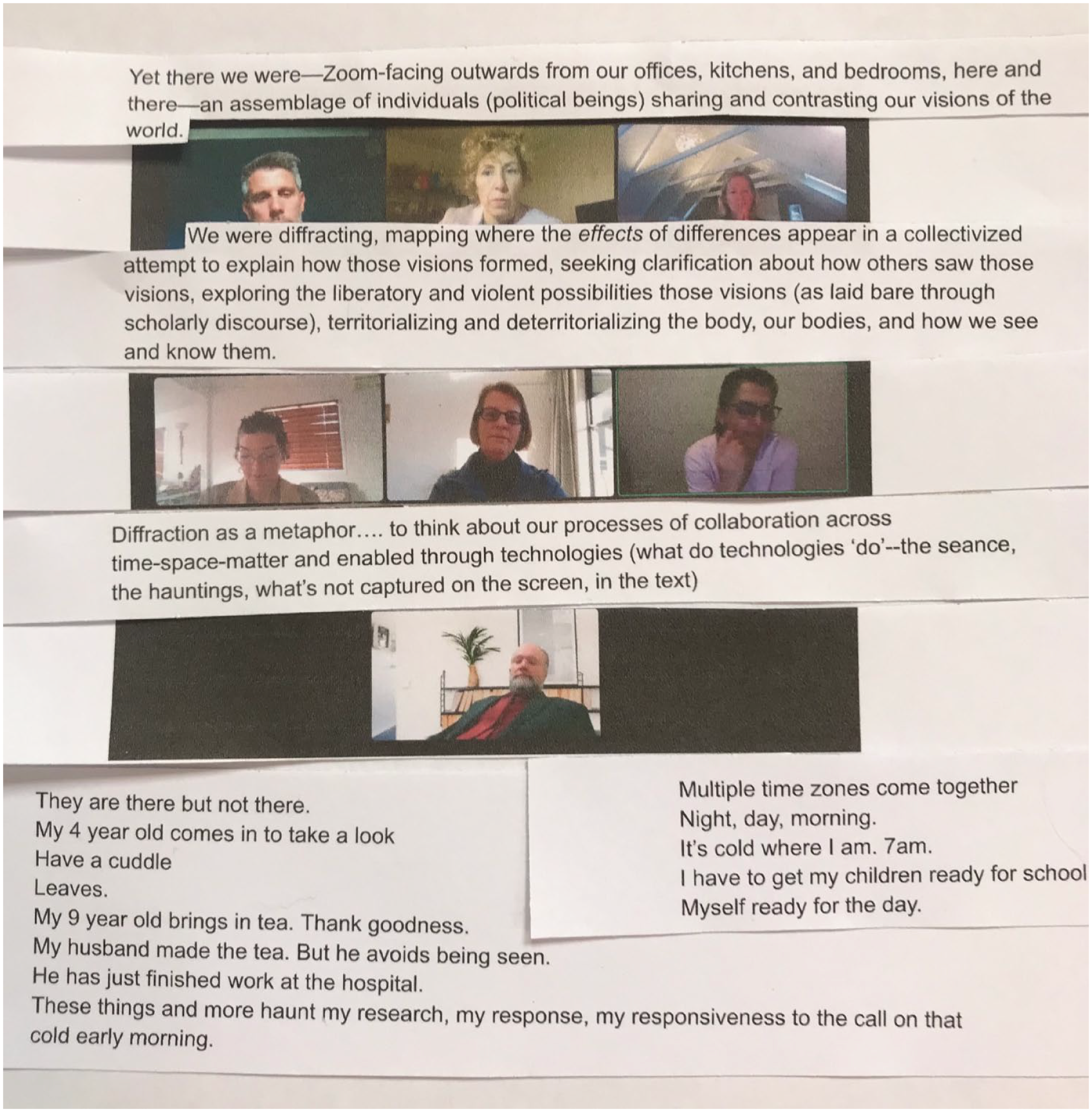
The Diffractive Zoom Meeting.
The following dialogue brings together expressions from a Zoom meeting held on May 8, 2022, and subsequent comments and reflections from all collaborators of this special issue. Herein, we reflect upon the experiences of the diffractive review process and ponder the possibilities and politics of creating respondings to the various papers, the process and the product of this special issue. 1
I thought we might start with a bit of an unpacking of the process that we’ve all been on together, in terms of submitting your papers for peer review, and what that felt like for you. I’m sure that’s really different for different people at different stages of their careers as well who have had more of this experience. While Josh and I have been reading and engaging with the papers, we haven’t got “skin in the game” in quite the same way, as we’re not having people then read our own papers. So, I’m aware that while I might think it’s been a wonderful process, it might have felt really different for others in the group. And I thought we might just unpack that process a little bit if people want to, to comment on what it felt like to read other people’s papers, while they’re reading your own paper. And also, to consider this in comparison to the blind review process we’re all familiar with, because we’ve been trying to diffract the Special Issue process, and part of it was this different way of reviewing each other’s papers.
I’m happy just to start us off. It was so refreshing to have this kind of peer review process, which is much more about engagement with ideas and intellectual generosity, rather than just centered on critique and having to explain yourself again. So, I think it’s been really productive. There are so many interesting threads across all the papers. But you know, I’m speaking from my subject position, which is probably different from Erin here in our team as it’s her first publication. But it’s been a fantastic process to engage our early careers in the process of doing intellectual work differently.
Yes, it’s interesting to think about the different perspectives, for example those who are the authors of the paper who are receiving this feedback, and then also, when you review someone else’s paper, and you know people know who you are when you say that, and you can bring yourself into the review in a different kind of way.
I just wanted to speak about that because, especially lately, there’s been so many reviews coming in. And I really felt the generative aspects of this process, that kind of responsibility to help make the papers better. So that was pretty cool and different, this idea of reading a paper and looking at just the good parts of it, not really looking to bring it down, you know, because when you’ve got a whole big list and you’ve got to make decisions: accept, revise and resubmit, reject. So, I think it was a really good process in that way.
That is such an interesting point Adele, because we did take out that whole element of revise and resubmit or reject. Papers were invited following a conference plenary session, so it was more a process of how we can support the authors—who are our collaborators on this project—and their papers and have that conversation that hopefully is constructive. To paraphrase Iris van der Tuin (2011), reading-reviewing “diffractively breaks through the academic habit of critique and works along affirmative lines” (p. 22). Certainly, some papers got a lot of feedback from quite different perspectives, so I’m interested to hear how you–as authors–processed that.
I can kind of jump on it here. I’m in the third year of my PhD. Obviously co-authoring with Simone and Adele was amazing, just the intellectual generosity! When I initially looked at who was on the special issue, I thought “oh no, what are my supervisors playing at?” But then the feedback came in and it was really generative and to have such senior academics commenting on the paper was really generous. And it’s been really exciting to engage with everyone’s work. Now I’m a bit nervous to do a special issue that isn’t diffractive!
Thank you so much Erin. There are certainly key differences between a diffractive special issue—or rather our version of a diffractive special issue, because I’m sure there could be lots of different versions as well—and a more standard, special issue and the process.
Because we are all kind of working in more or less the same field, I kept making connections between what I was reading, and the way others are approaching those concepts and understanding the same methodology as what I did in my own work. So, I tried to kind of make the connection between these things. And I think it was really helpful for me, and I also received very generative and constructive feedback on my paper. And also, I really liked reading the comments, and I was thinking, “Oh, my God, I can kind of write another paper through all these comments and feedback.” And also, I was thinking, part of my creative responding might be a diffractive engagement with the comments on my paper, because there was a lot to think about, and to talk about.
I think I was going to say exactly what Shiva said! First of all, very, very thoughtful and useful comments on our paper. And, you know, what I experienced, which is what I always experience when you get a good review is like, “yeah, I want to write about that too,” but I’d have to double the word limit so I can explore those things (laughing)! This then leads to Shiva’ point, which is, maybe some of these things that come up in the review process that we can’t shoehorn in might be the starting point for conception of more iterative diffractive papers later. It would be interesting to then collaboratively write those things with the people who made the major critiques, and then have those people also co-author those with us.
That’s an excellent suggestion Jerry. Let’s definitely keep that possibility in mind as we think about what is next for our collaborative, diffractive processes. I’d be quite interested to also hear from people in terms of how reading papers through other papers changes the review process, and the review experience. For me, sometimes I’d sit down and review two papers in a sitting. And so just by happenstance that a couple of those papers when I’ve read them together, amazing things came out as I read them through each other, with ideas bouncing off each other. For example, I read Jerry and Mary’s paper alongside Pirkko’s, I was bouncing back and forth between those, and bringing similar and different theoretical ideas into dialogue. And on another day, I was reading Shiva’s paper alongside Erin, Simone and Adele’s, with fascinating ideas about feminist new materialist methodologies, and particularly moving methods by and with women, speaking back to each other, but from radically different contexts. In this way, it was very stimulating and exciting to read those papers through each other. I wonder if that changed the review process, which is usually reading and commenting on one paper on its own? And sometimes in a special issue, people will review each other’s papers, but usually these papers are siloed in that they ultimately standalone. But in this way, the papers are co-emerging through the review processes. So I am wondering if anyone’s got any thoughts on reading those papers through each other and how that might have changed the review process or what we’re about to embark upon next?
I think the fact that we were all writing towards the same prompt, and ended up doing things very differently in some circumstances, changed the way I think I experienced reading other people’s essay. If you’ve been an editor of a journal, you understand that it’s always a struggle to get reviewers that are actually germane to the piece that you need reviewed. And in this case, it’s kind of prepackaged, because all of us are on board for the theme, all of us are wrestling with it in our own way. And so, I think it just sort of naturally gives rise to more, well I don’t want to say sympathetic because it wasn’t all just “pats on the head,” but readers were much more appreciative of what it is that’s been wrestled with here, and a shared commitment to a particular kind of literature as opposed to sometimes the disciplinary posturing that can happen in some review processes. So, I think the review process was definitely shaped by the fact that we’re all doing this in parallel.
Yes, it certainly wasn’t all “pats on the back,” some of it was very stimulating, challenging and engaging feedback. From my perspective I see that as an act of generosity, but I recognize that academic feedback can feel very differently. At times, I received peer feedback that can feel like a kick to the stomach sucking all the wind from your lungs, other times it can sting like a slap to the face. And typically, when you submit to an editor and reviewers, there’s always that very real risk that your paper will be rejected. We all write into this context of vulnerability, of being bruised, scarred even, by reviewer comments and editorial decisions. But in this process, we’re in this together, and we’re all coming through it together, it’s something a little bit different. But personally, I don’t think it compromised the quality of the review process, by peer reviewing and being known to each other. In this way, I see strong parallels with Murris and Bozalek’s (2019) writing on diffraction, critique, and response-able reading of academic texts. As reviewers, we embarked on a process of reading-through the texts and opened ourselves to the possibilities of “being affected and affecting” the papers and our collaborative project (p. 881). Instead of “responding as a distanced other,” we engaged with the papers “as part of the lively relationalities of becoming-with the text” (p. 881). As reviewers, we did not see ourselves as “outside of, or, in a position of superiority” to the papers we were reading, but rather “creating new relations through mutual constitution” of text, reader, reviewer, editor and author, “becoming-with texts and being transformed by them” (p. 881).
This maybe comes back to a couple of points that others have made. I would read each paper, and if you read a couple at a time, as Holly was saying, you’re sort of reading them together and through each other. But also, if you’ve read the feedback that’s been offered for the given paper that you’re currently reading, you’re also sort of sounding out, “well, this makes sense to me, but it didn’t seem to make sense to reviewer A or B, or C,” or “Oh, this doesn’t make sense to me, but everybody else seemed to be fine with it.” So, I was I was having to come back to my own understanding of everything from theory to ontology and epistemology, only to then kind of make sure that if I was going to put a comment that I thought was going to be helpful, I wasn’t going to steer someone in the wrong direction. If two or three or four people have already steered them in a different direction, then I had to rethink how I was going to respond. So, I thought that the diffractive process was happening in both ways in terms of the relationship between the papers themselves, but also between how I perceived each piece relative to how others who had come before me in terms of feedback, and seeing others’ responses as well. So that was super interesting to me, because you usually just sit down with one paper, hammer out your reviews, let it fly, and that’s it. But I was really having to be aware of what I thought all of you were thinking about the papers as I was reading.
Yeah, that’s right, we’re also seeing behind the scenes and other reviewers responding to the papers. And sometimes I felt a little bit naughty doing that, but it was also fascinating to read other people’s responding to a paper. I wonder how much that shaped up what I ended up saying?
I wanted to say something actually, about what I’ve found really interesting was how in this process, there was a collective emergence of ideas. Because you will all recall, we started from an abstract in the conference, and then we had some comments and feedback during the conference and the presentations. And then we started writing and thinking about and materializing some ideas, but then again within the diffractive reviewing another layer of collective thinking emerged. So, I think the whole process was kind of a collective emergence. And I think maybe after the revision, it’s not only one or two of us thinking about reviewing one paper, it’s all of us thinking. So maybe for each paper that we had, we were all kind of an author of that paper, because we were all kind of involved and engaged with the papers, with each other’s papers. So, I think that’s layering of authorship and thinking together and collectivity. I think that’s very interesting.
Yes, absolutely! I think in this process it’s a little bit more visible, right? In our work there’s always (or usually) a community behind these ideas—you share ideas with colleagues over a coffee, or you get some feedback when presenting at a conference. Sometimes you get really interesting and thoughtful feedback, but other times we receive difficult feedback from our peers, reviewers, editors. So, there are often lots of different “things” that our ideas diffract from, but our process has been different in that we are simultaneously mapping these intra-actions. But your point around the conference presentations, and then that whole process since then, is a really important one, because it didn’t just start with the special issue, and our ideas have been co-emerging since the early stages of imagining the conference session.
I was just thinking about the whole notion of the “death of the author,” and how this process is similar to the process where my colleagues and I wrote the Glossary for Doing Postqualitative, New Materialist, and Critical Posthumanist Research Across Disciplines (Murris, 2022), where we worked together on diffractive pieces. And really, I think it’s all about the entanglement of ideas. And this process shows that up, that our work is fundamentally produced through those entanglements, it’s not us as these little atomistic individuals with these ideas popping out of their heads. It’s the generative process, and for me it’s made that more explicit. I’m thinking about the kind of processes of reading, writing and moving and how those ideas, connecting with certain ideas as a reviewer, or as an author reading reviews, takes me on a particular trajectory, or I travel with the ideas and then they do things to my thinking and connections. So, there’s something about writing through, thinking about the diffraction in terms of: What does that entanglement do? It’s an intellectual project for all of us. We’re talking about the collective, but in a very dispersed sense. And then thinking about how we might actually write that. Just thinking of Jerry’s earlier point, maybe a diffractive piece is writing with kind of, with and against, or in relation to, the ideas that moved us in that process, because we can’t cover everything. It’s like, “okay, what’s the way to start something compelling?” And, when I was reading Jerry and Mary’s paper, it really took me to this art exhibition that I’d seen on Indigenous art and this whole question of the void, and that paper then took me on a journey elsewhere, and it was an embodied movement. So I’ve been thinking about all of those ideas.
Mary just left town, and before she left we had a conversation about that particular concept of the void and that particular exhibit. I responded immediately to your comments Simone, and this was really generative. We’ve got like half a paper written just between these conversations we’ve been having since, but we would need another half a paper to do these ideas justice.
But maybe that’s the stuff that we can work within the creative respondings? And so this is the moment where we can start brainstorming together as to the possibilities for the second part of the issue, our creative respondings. Those could be our attempts to make sense of, to represent, the process that we’ve been through together. And like Simone said, these ideas have traveled with us, whether it is to an art exhibition or walking the dog, and what does this mean in relation to movement? We have been living with these ideas, and we have been moving with/moved by these ideas. And, and I’m really grateful for each of you for sharing such wonderful papers. Here I should mention an email conversation with Mary before she left on her travels, where she posed the important question of what might a diffractive special issue “look like”? What happens if we have our papers as nodes, and then these respondings diffract from them? Of course, there are so many possibilities. We’ve probably all got an idea of what a standard Special Issue looks like with the papers organized in a particular sequence. But in the second part of our issue we have an opportunity to respond creatively, and these may be our efforts to reflect/represent the process that we’ve been on together. Or there might be one paper (a nodal point) with different internodes and tendrils that have come off it? There really are so many possibilities, it is somewhat dizzying. Mary asked if we can include hyperlinks within our respondings, and Pirkko and Annouchka, who are both very creative in their ways of representing ideas, might have something completely different to contribute here. So, this is our opportunity to brainstorm together, or for you to share your thoughts on the possibilities for the creative responding part. And while we have lots of possibilities, we’re also somewhat constrained by the special issue as a one-dimensional, linear document.
I am thinking of Barad’s early essay on diffraction, about diffracting diffraction. And the structure of that paper, they make arguments about quantum mechanics and diffraction and about social analysis, and bring those together. But then as the article continues, it breaks into smaller and smaller pieces as it goes on, down to almost one liners towards the bottom. And in this way, it actually follows a diffraction pattern. Right, from big pieces, to entanglements of different parts of the analysis. And then it gets smaller and smaller and reverberates in smaller and smaller ways. Barad doesn’t try and wrap it up, and in this way the whole piece structurally performs the kind of diffractive process in almost a way, that it’s so isomorphic that it’s almost a little camp, but it’s clear they’re not intending it that way. But when you said this early on, and now after having done the review process, the idea of having the main papers, then the response parts, and maybe different sort of combinations of us as authors, writing smaller sort of pieces that aren’t so much rebuttals, as they are spin offs, like Mary, Simone and I writing about that exhibit that you cited in your review of our paper, and maybe doing 2000 words on that. And then somebody else, you know, some other group of people doing 1000 words on something else, and then maybe get it down to 500 words. And then having it structurally look like a diffraction pattern, but also conceptually be one because it is people working through the relationship to that idea.
Thank you, Jerry. I also love that paper from Barad (2014). As I recall it, they advanced a diffractive approach in their writing style, exploring the production of difference, by focusing on a historical moment in feminist theorizing with Trinh Minh-Ha’s 1988 presentation in Santa Cruz. This moment was then “dispersed/diffracted” throughout the paper (p. 169) as Barad (2014) brought together feminist writings on difference with physicists’ understandings of diffraction. It offered a fascinating illustration of cutting together-apart writings from feminist scholars such as Trinh Minh-ha, Gloria Anzaldúa, and Donna Haraway with events in physics that led to the development of the concept of diffraction. As you highlight Jerry, this paper is “in effect performing a diffraction experiment of diffraction” (Barad, 2014, p. 181), bringing together (and apart) different disciplinary insights and feminist ways of knowing across time and space. I agree with you Jerry in that it could be really exciting to think of our diffractive methodology as a process of becoming, a “cutting together-apart (one move) in the (re)configuring of spacetimemattering” (Barad, 2014, p. 168).
I’m really hoping that we can use the space in our special issue for the multiplicities of respondents, and to then “show rather than tell” the diffractive patterns of our process. I’m acknowledging that others may like to represent these ideas in a range of ways. For example, I’ve seen Pirkko do amazing conference presentations through dance, and I wonder if she may want to represent aspects of this process through movement. Annouchka’s areas of expertise are in theater, so she might like to do something creative with voice or visuals in ways that I can’t even imagine. We’ve also got possibilities of connecting with other collaborators, such as artists, if we feel that might help us further explore ideas. I’m really excited by all these different ideas for how we might cut together-apart the diffractive review, or the diffractive Special Issue process. And because we’ve got lots of different inputs into that, from the conference, from the emails, from the responding to emails, from the reviewing, even to this Zoom call, we might come together to think about what happens when we live and travel with those ideas, and I love that this could look multiple ways from different perspectives.
I wonder if the process for starting this might be to write into a shared doc, thinking about ideas that we’re potentially exploring. Jerry, Mary, and I’ve got something we can play around with and we can see how that goes, but there might be other things that emerge. For me, it’s about taking that notion of pushing against representational practice, and drawing out what those ideas do in this process we’ve been through, and what those ideas do is different for everyone here. How did those ideas move us, connecting or resonating in particular ways? How do they disrupt, disturb, the excess of the ideas, a bit like Erin’s notion of the ‘kinesthetic excess’ (see Nichols et al., 2023). And what do we do with that? And how is it productive and creative, prompting us to explore ideas in different ways and to write through them? And we could also use other creative modalities as well.
Yes, that is a great way forward Simone. I will set up a Google Doc where people can add their ideas and respond. As academics, many of us are drawn to the written word. But I wonder if we might explore other ways of knowing and communicating how have we traveled with these ideas, or how have they traveled with us? Sometimes I find it helpful to take photos with my phone, and I wonder if each of us could have a little project to try, over the next few days, to capture three to five images of things that our ideas have bounced off as we travel from this meeting, whether it be into the boxing ring (for Erin), for a walk with the dog (for me), into your classroom, onto the stage, during your commute to work, or to your children’s soccer practice (for Josh). Maybe this could be a fun way to bring the objects and matter into it, and if we bring these images together, perhaps there’s something in those that we can explore? This could be around the process, but also particular ideas, bouncing off different papers, in terms of moving methodologies and movement and matter. Or perhaps it’s around the politics of knowledge, construction, and production and representation? While many of us will be drawn to the words on a page, what those words look like could be really creative, they might take the form of poetry, or it might be words from our emails and conversations. How might we embark on cutting together-apart the diffractive special issue as process-product?
I was also thinking about materializing the process. I’m thinking about word clouds, you know, maybe we can think about each paper with a word cloud, or using software like Coggle for brainstorming. I am interested to think about how we might materialize these ideas, these connections, how we can kind of map them on the special issue? Maybe we could use the word cloud to help us in connecting us. Another thing is that I’ve been participating in European Qualitative Inquiry (ECQI) and they using Miro interactively, allowing people to engage in the conference and the talks and everything, using their own avatar. So, I’m thinking about the ways that we can materialize connecting our ideas into each other, maybe mapping them somehow representing them or materializing them in, in a special issue using color and pictures.
That is so interesting Shiva. I wonder, if we put all of the text of the papers or our emails, for example, or the text from this recorded conversation into a word cloud, what would come out? What happens if we then cut the word cloud apart, and if we then move with that? I’m also wondering if there are particular ideas as you’ve written and read papers through each other, that have co-emerged or that might be valuable to collaborate on exploring further? I definitely saw interesting ideas co-emerging across Erin, Simone and Adele and Shiva’s papers, and across Jerry and Mary and Pirkko’s papers. Do you see something in there that “glows” that you might like to explore more in collaboration?
I definitely saw something with Shiva’s paper and with Erin’s on boxing. Erin’s collaborative paper explored the creation of this particular space, and who was in the space who wasn’t in the space, in this fighting space. Then with Shiva’s work, doing interviews on the street, the phone is there. So that’s something different. The interviewer is not there (in person), which changes the dynamic in really interesting ways. So, there was something interesting in the methods about being there and not being there and being filmed and not being filmed.
And that bounced off Annouchka’s paper for me in terms of the séance and the digital and who’s there and not there and, and the hauntings of who’s not there.
Yes, just like this meeting now, we’re all in different places, and who I can be right now is different to who I might be able to be in my office without hearing my children and we have to leave in a minute to do the school drop-off. The mobile technology and video have brought different spaces into each other so powerfully, so that really blurring space as well.
And even the Google doc space/s that we’ve been working with for this special issue, is another example of technologies as co-actants in our collaborative process.
But what is the purpose of the responding? I mean, I know we sort of implicitly know what we’re trying to achieve. But I guess I was thinking, is it through these respondings we’re trying to show the reader the capacities for this type of approach as a collective, as a special issue with a group of scholars working in and through these things together? Is it that we are offering comment on the process through these respondings? Or is it that this is an exhibition of the process? I think it’s both but it’s probably more the second, right? Or what does everybody else think about that? Because I could see myself sort of responding in a way where I was like, “this process worked this way for me. And here’s what the take home message is based on my experiences,” or it could simply be, here’s where I am now with my thinking about this particular thing as I express it in my art, or whatever might be, in reference to all these things, which you’ve been reading over the past 100 pages of this special issue. And so I’m wondering which of those two is it that we’re trying to achieve?
Yeah, to me, part of the answer to that question lies with what our underlying understanding of diffraction is as a practice of social analysis. Because my understanding is that diffraction, the way Barad uses it, is not just a juxtaposition for brainstorming purposes. It’s a kind of juxtaposition that highlights the indeterminacy of a phenomenon and our moral and political responsibility in the representational process, but it also draws attention to the way we’re not the only agents operative in that process. So, it highlights the materiality that is shaping meaning, and it also highlights the fact that materiality isn’t essence. There’s not one material truth out there that we just document and then we’ve done our job. There are multiple ways to represent it. And there’s not a way to resolve those. So, it does seem to me that, hopefully, there’ll be a preparatory sort of passage in the special issue that talks about diffraction and quantum diffraction, and that would give me a way to answer your question as to what we are trying to achieve with the diffractive analysis.
You’re raising some excellent points here Jerry in that we are all coming with different understandings and interpretations of diffraction. And I think it’s also helpful to go back to why we’re doing this, why we’re trying to diffract the special issue. It’s not just for a fun brainstorming activity, there is a politics to knowledge construction. And Barad talks about boundaries of knowledge and how those are produced and reproduced. And hopefully, through this special issue, diffracted, we can collectively say something about the “special issue” as a form of knowledge, prompting us (and hopefully readers) to ask what are the dominant kinds of boundaries that are produced around journals and special issues, at times reinforcing quite siloed ways of working. And even when we do come together, it’s often still in this kind of ordered and structured way. And, I am thinking here of Simone’s previous ideas around authorship and the “death of the author” and all of these different kinds of hauntings in the academic process. And hopefully the final part of our special issue can be a celebration of the multiplicities here. So, there might be some pieces which are responding to the diffractive process that we’ve been on. Others might be ideas emerging through reading papers together, because that’s something distinctive of the process as well. We are bounded by the structures of a special issue, but also we have an opportunity to extend that, and I hope there is a politic to that, in the end, when people read the special issue from front to back, and go, “hmm, maybe we can think differently about how we collaborate and bring ideas together”. And, coming back to the points made earlier about the agency of technologies is pretty interesting, as digital technologies have been co-participants in this process with us, whether it’s a zoom call, whether it’s the Google Docs, or the digital conference that brought us all together in the first instance. While we have the bounding of the special issue as physical object, I also hope we can be really generative and not limit us by that, because the whole point is to actually try and stretch those out, even if just a little bit.
Just a thought. There are like other major pieces of work, major collaborations where people deliberate together and they’re written by people all over the world where they literally argue over what is going to get included, but they would never engage with something like this. And the same with some other very major pieces of non-academic work, where it is big collaborations and people’s ideas coming together through this kind of wrestling. I just think that our special issue could perhaps contribute in mentioning that these things are happening all the time. People are collaborating on many different projects, bringing different disciplines and ways of knowing together, but often not with that purposeful or critical view of what they’re doing, or the role of technology and all of these things. Often these things—the agency of technologies, and power dynamics and affects of these sorts of collaborations— are taken for granted in that final piece of work. So in this way, the final product appears as just a thing, but actually is a sometimes ongoing process of grappling and an affective encounter. This conversation has just made me think of people I know that are involved in those kinds of collaborative projects but they don’t engage in feminist, quantum physics.
So often the focus is on the product, although some of those processes are quite diffractive and generative. But, in our special issue, we are actually spending time in the process. And I hope that can be conveyed in the special issue. I’m wondering if we might all be willing to engage in a little bit of homework, bouncing off Shiva’s idea around the word cloud, or what happens when we bring our voices together and then how might we diffract that? I’m wondering if we each write a rough paragraph, just our respondings to today’s meeting and ideas that come from it. And then maybe we could try to capture some images on our phone, and we can just drop those images into the Google Doc and see what comes out from this. What do we notice differently? What ideas travel with us beyond the Zoom call? What sits with us when we go about our day, when we wake up tomorrow and have a coffee or tea? These don’t need to be beautiful words or images, but it might lead to a creative process in which we are inspired to play with these ideas further.
Erin, Simone, and I had talked about maybe some sound recordings in the gym, as a different set of tools or a diffraction of the ideas that have been described on the page.
Yes, so while you’re [Holly] talking about images, we’ve been thinking about sound in Erin’s work in the boxing gym, where sound is really important for women to embody movement differently, and what their sounds do, grunting and all the things that are not aligned with the feminine subjectivity. What do these sounds do? So, just thinking about kinesthetic excess and what escapes the page, which again is the same theme I picked up in Jerry and Mary’s paper in terms of the void, excess and affect. But it’s the absent present, and what does it do? And why is it important politically to talk about it in terms of Indigenous knowledge can be thought of in relation to the void (and astronomy as in the art exhibition I went to). And you know, what cannot be easily materialized through language, this is always our dilemma, isn’t it? I think this is a process that gets us thinking about that, as well as the materializing process. So talking about technology and language, it’s that tension, this acknowledging that knowledge is uncertain. And what we’re producing is not some kind of stabilized truth.
There’s certainly a possibility, I think it comes back to Jerry’s point earlier, there’s a whole other paper that we could write, and maybe the later part of the special issue is an opportunity to explore some of those ideas, to write (record, represent) things that we couldn’t say, verbally or couldn’t fit in within the constraints of a paper, there might be ideas that we want to take over and creatively explore in the final part of the issue.
I was also thinking about what Simone said about escaping the page. As I mentioned in my paper about the trans-materializing of space as well as the moments, maybe we could use technologies to further explore these ideas. I don’t know how long we can keep a Padlet, but maybe we can produce a collective padlet and we put some images, videos, sounds and the hyperlinks to the Padlet. This might give us an opportunity to bring in colors, images, voices, videos, and I can also put some of my walking videos there as well. But I don’t know how long we can keep the Padlet for…
It’s interesting Shiva and Erin that both of your papers have the video recordings as part of your process and what escapes the page as those were part of the process, then we can have images but we don’t get that movement. Bouncing off Annouchka’s paper, it is fascinating to consider the hauntings of who’s there and not there, what’s on the page, what’s not on the page, what’s in a special issue, what’s all the stuff that is not included or not talked about? Maybe, part of our respondings is actually the hauntings, the absences, what’s not on the page, and our various attempts to explore ways to represent some of that?
Also, how the movement is there but not there. The movement that never stops, it’s always you just changing the movements and space, you just go from here to there. And I think that’s very interesting.
I really liked that because our papers still have quite a structure that we’re following. Hopefully you can’t hear the building work that is taking place right under my office! (laughing) So, perhaps we focus on thinking about where those ideas take us and how we’re moved by them. And then with how we write, we’re reading-writing with that movement and flow of ideas in mind, and how those trajectories of ideas interact with other ideas.
And I think we can maybe in the introduction, or in the creative responding, we can consider how we were thinking about the reader, they’re changing their space, so they are kind of coming out of the text, going into another space whether that is via the Padlet or walking video or a fighting video, so I think they’re also having a diffracted being in/becoming/experiencing with the special issue.
I think that speaks really nicely, like something that kept emerging as I read across the pages, and particularly with yours, Shiva, was that tension that we wanted this diffractional research to do something, but we weren’t trying to resolve what it was doing, which are those excesses of movement. We were both exploring how to research the actual-virtual with the video, and I found that really generative to know this is an issue—or rather a tension—for other people as well.
Okay, so how do people feel about writing a paragraph, or taking photos, to try to reflect/represent/evoke how the ideas from this conversation travel with us into our days, into our different spaces of movement for work, home, leisure? What do these ideas bounce off, diffract from? Could we explore the visual medium as well? If I opened a Google Doc, and we just each drop in three to five images? I don’t know if we need to read the text alongside them. Maybe the images can speak for themselves, or…
I’ll do whatever you ask, but I don’t have any idea what photo I would take.
Maybe that’s the point. . .
I’ll admit that the pictures are the scariest part of the homework for me.
Yeah, if I’m thinking about the whole idea around the void from the papers and the exhibition, then taking a photo of the stars would be great, but not sure I can capture that with my camera. I don’t know what I might do with the visuals that I’m writing through, but I appreciate that it can be a good useful method depending on what kind of entry point we’re using.
I think it connects with elements of Shiva and Erin’s papers, and also Annouchka’s writings on the hauntings of technologies—what is there and not there. I acknowledge it might be outside our comfort zone, I’m just trying to give us some prompts to go beyond the verbal written text.
I appreciate the idea of the arts-based research beyond the text, but coming back to Josh’s question, beyond the text to what end? So, it’s not just departure for departure sake, but departure with a futurity toward which the particular entanglement tends. How are we doing that in a way that’s responsible to our context, as opposed to discipline. I don’t think the upshot of posthumanism and new materialism is simply breaking old forms. There’s something much more affirmative about it, much more materially committed. And so it would help to have some direction about like, “okay, so if we’re doing this besides simply breaking with past practice, what is the was the upshot? Or was the ethical purpose or political purpose of our representational activity?”
Great questions Jerry. I think I was just trying to encourage us to lean into the process of how we might come to know together, because we’re all in our little video boxes here, and we’ll all going to our offices and will write away and, and is there a way that we can actually bring these ideas together across time and space and matter? And I acknowledge that this is risky because maybe it leads to nowhere, but maybe it actually helps us come together in a differently collaborative way of knowing here. So unfortunately, I can’t give you a definitive answer as to where does it go? What’s the point? Does it lead us nowhere? And yes, that’s always the risk, maybe it leads us nowhere, or maybe it actually brings us together in terms of co-authors in a special issue to know each other differently, to know where we write from and think from differently, our places that we write, and move and think from, and where our work has each come from? Maybe there’s a way to diffract across time, space and matter through more creative embodied modes of representing our individual and collective thinking. I acknowledge that this can feel like a strange space to step into, and in a way, it is an act of trust in us (as collaborators) and in this process. But the question of ‘what’s the point’ is really important, and I can honestly say that embarking on a process into the unknown together might lead to something wonderful, but there is also the risk that it won’t. But yes, I agree Jerry, there always needs to be a responsibility and a politic to it.
A long time ago, I gave a bunch of my friends’ wrist compasses to replace wristwatches. And the basic idea was that people should wear those for a week. And because we all live in these compartmentalized spaces, where in my office I do my office thing, when I’m at home I’m behaving in one way, and when I’m somewhere else I’m familiar with each of the spaces and have relation with it, but I don’t connect the spaces. So, we live temporally where our time is all connected, but our spaces aren’t connected. The idea was to get the wrist compass and figure out which way is north, and how your bedroom is oriented in relationship to your office space and in relationship to your favorite coffee table at the local coffee shop. So, you get a kind of unified sense that all those things are part of this unified space. And, so it might be interesting in that way to have us all take pictures of some part of our process, I don’t know if it’s north, south east west, in a way that kind of unifies the fact that we’re all sort of doing things in a place. And the relationship between those places are part of a shared world, materially, like we are physically a part of the same related space, but it doesn’t come across at all in these Zoom windows. That could be the kind of connectivity, like when I’m writing, here’s what North looks like. Or, you know, when I’m writing, here’s a map, and here’s where we all are. And sort of, you could do the hyperlinks where click on the map, as it takes you into Eugene, Oregon, where I’m at, flip it over to where Josh was at and where you’re at. And, I don’t know, that would unify us all in a similar sort of spatial topography.
I think I don’t want to make too concrete a direction here, but I really think the idea of kind of thinking together-apart or thinking apart-together as the theme of this next step in some ways, if we want to just take it as that, because I think if we try to kind of use this next space or phase to sort of say, the material, the materialism sort of expresses itself, I don’t think we’re going to achieve as much as we might think. Whereas I think Holly really nailed it, in my view anyway, this is sort of about the constitution of knowledge. What this process does for us is it allows us to connect in ways where we see and understand things through these papers that we’re reading and kind of diffracting upon and giving feedback on all these things. And I think to Jerry’s point as to what is it about that kind of coming together apart, well it has to, in some ways, be rooted in the apartness, which we are spatially, temporally disconnected from one another. We’re all anchored to different parts of the world and our lives and the people in our lives and our identities and all these things. And so if the images and paragraphs that we’re about to create are really just our sort of take on that together-apart thinking, that’s a really cool next step, at least, I would think so because then that actually sets it all up for everything that comes after that, which is kind of us looking back on what we did, and then artistically representing where that process took us.
I’d also like to think about the agentic role of technologies in our coming together-apart, because I think that’s an interesting theme that’s co-emerging through a few of our papers. But also, to think about movement, and the hauntings, and the important politic of who’s there and not there and how that’s engaged with in the places in which we live and the lands in which we write from and those relationships with processes of colonialism and racism, and neoliberalism.
My picture ideas went from zero to 100 in the last three minutes. Well, I don’t know if that’s a litmus test for making progress, but at least for me, here I am in Florida on stolen land, but also looking eastward knowing one of you is there sort of in a place that is where you’re confronting other things. And as you said, the modem here is connecting us and this computer and the screen.
Yeah, what happens when we step out of these boxes and we switch off and we say our farewells, but we still travel with these ideas and I go to check on my son who’s vomiting in his room right now (and I’m glad those sounds are not coming through into this Zoom meeting). The sounds of the people cutting down the trees outside, the construction work under Simone’s office, of Adele’s children getting ready for school. These are small acts of vulnerability, sharing a little bit of ourselves a little bit about these places, and how we move between these places, and how these ideas, your ideas, our ideas, travel with me. This is a shared experience, and I’m really grateful to share ideas with people across time and space, enabled by these technologies. So, maybe as we take those photos, it’s a little gift to each other, or a little sharing of ourselves or the places or the objects which we interact with, with these ideas that we’re now traveling with, together-apart. So maybe Josh, you’re right, maybe it is those together-apart ideas that we turn to in the final phases of this process?
I really liked the idea of us exploring ways all of us are writing from on top of stolen lands, or many of us are, in Eugene, in Australia, in Florida, in New Zealand, and not be silent about that and use that as one sort of spatially unifying material aspect of what’s up in our work and take responsibility for that.
And I’m in my gym, and I’ve just read the Muay Thai boxing paper, and I’m thinking about masculinity and gender, and the sounds and the physicality, I am hearing, feeling these things slightly differently because I’ve just read this paper that’s on my mind. So, the lens and sensory dimensions of who I am in my gym here in Florida kind of get changed in a slightly different way, just by the encounter of the paper itself on Muay Thai boxing in Australia. Your ideas are still there with me when I see and feel that type of physicality. I think this is making a whole lot of sense.
Okay, so how about we take some images of our day-to-day lives as we traveled with ideas from our particular papers and the process, and how they intra-act with people, places, objects, and technologies in our different locations in the world. If we share these in the Google Doc with any accompanying writing that feels right for us, then this is the next phase in our coming together-apart as collaborators on this special issue. And we can just see what materializes from that. But hopefully, it’s something to do with the politics of coming together- apart. And through collaboration across time, space, matter, we are always coming back to the question (the unresolved tension) of what’s the point of this? And what is the politics of this? And how is this a form of response-ability to processes of knowledge construction?
Just to conclude this conversation for now, from my perspective, and I think Holly would agree, that one of the most rewarding parts of the process thus far has really been just to have such earnest engagement from you all throughout the process and kind of taking it on and exploring with us what that might look like.
Footnotes
Declaration of Conflicting Interests
The author(s) declared no potential conflicts of interest with respect to the research, authorship, and/or publication of this article.
Funding
The author(s) received no financial support for the research, authorship, and/or publication of this article.

Notes
Author Biographies
Shiva Zarabadi holds a PhD in education, gender, feminist new materialism, and posthumanism from UCL Institute of Education, and an MSc degree in sociology from London School of Economics and Political Science (LSE). She is a visiting lecturer for MA and BA modules in sociology, education, and research methods at UCL Institute of Education and University of Westminster. Her research interests include feminist new materialism, posthumanism, and intra-actions of matter, time, affect, space, humans, and more-than-humans.