




Abstract
This article will examine the 1980s magazine The End first published in Liverpool by young people following 2 years of Margaret Thatcher’s Conservative election victory in 1979. The End editors and contributors have previously been discussed within popular culture, but there is a lack of academic consideration of the magazine itself. The End has been absorbed within the wider “Casual Cultural” appraisal—soccer subcultures of fashion and “terrace culture.” The End stands alone as it embraced the difficult life experiences of school leavers and endeavored to apply a humorous and acidly sarcastic twist to the dull consequences of unemployment and economic recession. This paper will explore the social, economic, and industrial landscape at the time of The End’s inception and capture the thoughts and motivations of those who first published the magazine. An exploration will examine the devastation of one industry as a representation of many businesses and manufacturing plants in Liverpool that relocated or ceased trading in the early 1980s. It explores the multi-layered texture and observational humor within The End.
The End Issue 9, 1982.
Introduction
1981 was a significant year for Liverpool combining celebrations with destruction. Liverpool FC, in the final at Parc des Princes, Paris, were crowned European Champions for the third time and were welcomed home with an open top parade. The city celebrated the Royal Wedding with Prince Charles and Diana Spencer. Rioting had started in the major conurbations across the country, Toxteth being Merseyside’s contribution to inner city mayhem and Peter Hooton (vocalist of the band The Farm) and Phil Jones would add to the importance of this momentous year. The beginning of The End.
The End was a pre-cursor to the “Lad Mag” era of the 1990s and has been widely acknowledged as offering signposts for subsequent publications but there were significant thematic and material distances within. The End’s editors and contributors have stressed it was far removed from the blatant sexism and consumerism maintained through titles such as Loaded, Nuts, and Zoo of the 1990s and 2000s. One contributor to The End, Mick Potter, put it clearly, “a magazine like Loaded was a nineties nationwide equivalent of The End. Loaded wasn’t funny, The End was funny.” 1 Indeed, glossy “new lad” magazines at this stage hinted at light pornography, covered with plastic coatings suggesting its link to overt pornographic magazines and top shelf, out of reach material. This certainly was endorsed by the Labour Member for Parliament (MP) Claire Curtis-Thomas, and highlighted by Coy and Horvath (2011), “presented a bill to Parliament in 2006 attempting to restrict their display in shops” and the then Prime Minister (PM), David Cameron, argued that lad’s mags were “fuelling a culture of youth violence.” Hegarty et al. (2018) have also maintained that “lad mags” offered a predatory attitude toward women combined with other “laddish traits” such as “excessive drinking.”
Steve Redhead (2012) attributed the emerging “Casual Youth” culture developing within the soccer season 1977-1978 and “Merseyside was the birthplace” of this “casual” drive. The importance of footwear, jackets, hairstyle, music and devotion to a soccer team were the pre-determinates for the rising of the Manchester Perry Boys, the London “Chaps” and Liverpool “Scallies”; other towns and cities soon had their own identity. This article will not follow this interconnected devotion to “terrace” happenings and fashion importance that was indeed a measure of The End’s rich fabric and design, but it will endeavor to champion the true, all-embracing spirit and innovation of this magazine that was published in difficult times.
Toward the 1980s
The early 1960s brought the incessant screams of “Beatlemania,” and the warm encouragement of wide-ranging employment opportunities. Harold Wilson’s (Labour PM 1964-1970) later call of the “White Heat” of industry and technical innovation that would sustain all, “and seek to project the Labour party as a dynamic and modernising force” (Crines, 2014, p. 128) with the promise of a worthwhile future. However, the “heat” had turned down as the 1970s came into view and by the end of that decade it was freezing with discontent. Guadeloupe is a place that has been long forgotten as a symbol for the demise of the Labour party in January 1979. Following an international conference, PM James Callaghan continued to enjoy his winter break and booked his wife and himself on a sightseeing tour to Barbados. Straight from arrivals, an impromptu press conference was arranged against the advice of close confidants, but the PM was in combative mood. Any suggestion of dereliction of duty and lack of concern for the country’s travails was due to the jealousy of a handful of journalists. Crisis What Crisis? headlined The Sun—he actually said, “I don’t think other people in the world will share the view that there is mounting chaos” (Shepherd, 2009, p. 43). Leader of the opposition Margaret Thatcher saw a chance to portray herself as a PM in waiting, and as Hay (1996) has commented, she proposed a formidable response if the Conservatives won power—withdrawal of social security payments for strikers who did not participate in a secret ballot. At that time, the bins were unemptied and the deceased unburied. Callaghan’s self-inflicted wound resulted in the newly elected Margaret Thatcher quoting St Francis of Assisi at 10 Downing Street on May 4, 1979; she promised to turn the tide of discord, doubt, and despair.
Designed by Saatchi and Saatchi’s advertising agency, The LABOUR ISN’T WORKING billboard poster was an effective and influential determinant for the Conservative party victory in 1979. Depicting a long queue of well-dressed unemployed people waiting patiently to enter an Unemployment Office, tellingly, the unemployed presented in the poster “were in fact members of Hendon’s Young Conservative Association” (Delaney, 2015, p. 50). The poster was effective across the country but not so in the city of Liverpool. Indeed, the archetypal Liverpudlian Tory-phobe emerged prior to Margaret Thatcher’s rise to leadership and eventual role as PM from 1979 to 1990. David Jeffrey (2017) has argued that it was a “perfect storm” and a weather forecast that was dominated by the Liberal Party, initially in 1973. The Liberals were seen as the primary opposition to Labour with their effective use of “pavement politics” that concentrated on local issues and endeavored to entice Conservative voters who were dissatisfied with Edward Heath’s (1970-1974) government. It would seem that some prospective voters in Liverpool were anti-Conservative, prior to the battle cry of “Thatcher out.” Nevertheless, as Hughes (2020) has pointed out, Liverpool remained predominately Labour following the election in 1979 but in contrast the local newspapers were in full support and headlined the victory on Friday June 4. The Saatchi and Saatchi campaign was successful to a certain extent, but it fell to Robert Parry MP, who represented Liverpool Scotland Exchange, to warn of the calamitous and dreadful times ahead for Liverpool and its work force and gave warning that the unions would not accept the “reduction of living standards of people in Merseyside” (Hughes, 2020, p. 24).
Opportunity Knocks
The Youth Opportunities Scheme (YOS), first introduced under the James Callaghan’s Labour government in 1978, provided a platform for the newly formed Conservative government and they took the opportunity to expand the existing structure to be entitled the Youth Training Scheme (YTS) in 1983. To highlight the situation in Liverpool, Mr David Alton (Liberal MP Liverpool Mossley Hill) set the scene in parliament, February 24, 1981: Is the Minister aware that at one Liverpool employment office where more than 11,000 people under the age of 19 were registered as unemployed, only 24 vacancies had been notified by the Liverpool careers officer? Will he tell the people of Liverpool whether he believes that youth opportunities programmes and all the rest are any substitute for long-term employment prospects? Will he say whether he is prepared to go on perpetuating a situation in which the best-educated kids are on the dole queue? (see Note 2)
Nevertheless, there were a few successes to be found, as Hughes (2020) tells of a participant who “found a placement outside the classroom, one based out of the docks where a schooner was being built called the Spirit of Merseyside. The opportunity gave him a sense of purpose that few his age were afforded” (Hughes 2020, p. 162). Certainly, he was lucky compared to the fortunes of others on the scheme.
If there was an example, that is, a signpost of demise of this northern city, Tate and Lyle sugar refinery is a signal name and representation of those industries that abandoned its employees in Liverpool. The Tate and Lyle plant closing in 1981 sticks like “Golden Syrup” in Merseyside’s collective mind, and the same year of The End’s inception. The people who were employed at the plant lived close by and this area was described as a “city within a city.” The morning of January 22, 1981, 90-day redundancy notices were issued and 1,570 jobs were lost. The fighting spirit and determination of employees fought the decision made by the Board of Directors but to no avail and the plant closed on April 22. 3 The refinery was losing out to mainland European plants producing sugar beet but it felt like something more, something important was lost to the south of England, as the Silverton Plant in London remained open for business and solidarity was not evident between the two plants. The factory in Liverpool, as Ron Noon has pointed out, “was at a distinct cost disadvantage as transport was required to take the cane sugar from the waterfront warehouse to the factory on Love Lane.” 4 Robert Parry MP (Liverpool Scotland Exchange) proposed that a high-tech, small-scale plant should be built on the Mersey, but it fell on deaf Tory ears. It was “the end” of Tate and Lyle on Merseyside, but for the Scotland Road Exchange residents the spirit of this proud community remained.
All the Prime Minister’s Men
In 1981, the Chancellor of the Exchequer, Geoffrey Howe was concerned about Mr Heseltine’s Merseyside Report. Following his fact-finding mission in response to the riots, Howe was determined to get one particular point to PM Thatcher prior to Heseltine’s review.
5
In August 1981, Howe conceded that Liverpool must be viewed as a city that required financial planning and considerate management of future investment, but not in a manner its citizens would recognize as positive, or as Parker and Atkinson (2020) have put it, that the city “be left to rot.” Indeed, this special consideration was expressed with some trepidation by the Chancellor, and the words “managed decline” and much needed financial investment for Liverpool was like making “water flow uphill” and should be wisely spent elsewhere for a greater return. Communiques such as these were discussed and written privately and cautioned, they remained so. An additional letter to the PM (September 4, 1981) continued with a caution: “Should we go rather for managed decline”? “This is
Lord Michael Heseltine endeavored to offer assurances that his interest in Liverpool was not a response to the Toxteth riots. The majestic Albert Dock, today home to Tate Modern, Museums, restaurants, and apartments, was due to be demolished when the Conservatives won power in 1979, but “this was a building of huge significance and it was going to be knocked down—I stopped it”;
7
there was a forceful pride in his voice as he conveyed this, and all political colors would offer a hand covered sigh of relief when you visually embrace the waterfront today. There was a counter argument and the notion that Heseltine’s projects for Merseyside were cosmetic rather than substantial in terms of real jobs, as Crick (1997) has pointed put out that Councilor George Brunford was not impressed; “lots of trees were planted” but little was done for the unemployed and many remained on the “scrapheap.” Nevertheless, one of the prominent moments of Heseltine’s time in Liverpool was a “Magical Mystery Bus Tour” but with a serious intention. He invited a number of prominent industrialists and financiers to join him in Merseyside but there was little uptake, and Heseltine recalled this clearly: A number of assets in Liverpool were owned by the banks and institutions and they were all based in London. We will hire a bus and we will ask the chairmen of the various institutions to come to Liverpool. After the first couple of days my letter was sent out and nothing happened. I have a disaster on my hands here. But then they came in, one by one. (see Note 7)
Heseltine was not asking for money; he wanted each institution to send their brightest managers in order that they study the problem and to construct a development program to tackle the issues on Merseyside. Heseltine continued—“But what was fascinating to me was the number of people on that bus that said to me I was born in Liverpool but had gone to London. It was a very formative experience for me” (see Note 7).
Following visits to industrial waste lands and crumbling housing estates, some on the tour were visibly shocked at what they had observed; whole streets with doors crashed in with one solitary occupant who was disabled left an indelible mark on the touring party. One of the more experienced members, Brian Corby, was used to inner city life as a man from the Prudential and he was aware and surprised with Heseltine’s reaction to what he observed. Following that trip, Corby was certain that the minister came away with the feeling that something must be done: “I think it was quite a revelation for him that day” (Crick, 1997, p. 226).
This was the social, political, and industrial landscape that synthesized a catalyst for The End. The magazine provided a platform to convey some caustic “scouse” wit; get something off your chest; write some poetry in response to your lot and see it published; offer music reviews and nightclub appraisals, or generally “take the piss” out of what was deemed “OUT and IN” in a fashion-conscious world. One young man from Cantril Farm in Liverpool led the way.
Beginnings: Time for Action
In the late 1970s, Kirkby College offered a range of educational and practical courses for the “school leaver” and two young men, at 16, would take up the offer as apprentice bricklayers in 1978. Phil Jones and Steve Rotheram (Liverpool Metro Mayor, 2017-present) became friends soon after. For Jones, music became an obsession and remains an important constituent of his DNA—conversations become detailed and infectious speaking with him today and his passion set root at an early age. At the age of 15, he would hot-foot into the city center, Eric’s in Mathew street was the intended destination to meet bands, help them with their gear off the coach, and convince them to get them in as he was too young—he was successful on many occasions. On a trip to Eric’s the intention was to meet The Specials but as the bus came to a stop it was another group, Madness, who disembarked. The band bought beers and got him into the gig.
The Idea of a fanzine soon emerged, and Time for Action was established but as Jones related, “it was the moment I introduced Steve to The Jam, that moment changed his life” 8 and the obsession resulted in the fanzine. They decided to write, as Punk was still relevant and there were a number of new wave publications available. With basic carbon copies and staples to bind, the fanzine was put together and included gig write ups, record reviews, interviews, and social commentary and the publication sold well at venues they attended including The Jam gig in Mountford Hall and a number of bands at Eric’s. In order to harness material for the publication, they busied themselves between bands and venues and most were genuinely willing to engage and respond to questions. The B-52s produced a worldwide hit entitled “Rock Lobster”; they were interested, they asked questions about the fanzine, and they wanted to know everything about Liverpool. Phil Oakey, lead singer of The Human League, was difficult to track down, as he was busy skateboarding around Eric’s and practiced his moves. UB40 were in contact for some time and sent demo-tapes before the band had signed to a label and stated they “loved the fanzine.”
For Jones, Time for Action was an important moment and as popularity spread brought the attention of major record labels to promote their new artists. Polydor saw the value of sending Jones pre-release demo singles and this was a source of great satisfaction and pride. “Getting The Jam singles before anybody else was my proudest moment, two weeks before release” (see Note 8) and included “When You’re Young
“It happened and then it went” was Jones’s heartfelt appraisal of Time for Action, the short-lived three issue publication provided a monumental impact on his life and introduced him to a new world of creativity, writing, musicians, and scallies that make up life’s rich pageant. Then Peter Hooton came along.
Editors: “The End” Hopes to Try and Get Liverpool Out of Its Present Rut 9
John Lennon (1940 He [Jones] was only 16 or 17 at the time, I thought he was a genius—to put something on a page at the time was brilliant, knowing Phil gave me the idea to do something else that was not just music and incorporated all aspects of our lives. (see Note 10)
Political philosophy also played its part in the creation of the magazine. Another inspiration for The End was an anarchist magazine, which Hooton purchased in Probe Records in the city. The central theme and focus of that edition was the worldwide celebration of the Charles and Diana royal wedding, which it duly “ripped apart” recalls Hooton; “it was so cruel, but it was funny.” A plan for The End formulated in Hooton’s mind with the notion of “what if we had a magazine that was just as vicious and satirical which could be read by the masses?”
Mick Potter possessed a valuable set of transferable skills. Initially, Potter thought of himself as a salesman, “a glorified paper seller,” as he described himself with candid honesty. Potter experienced inherent working-class shackles in full force and accusations that the magazine was not written by their own hands. In response to his own written contributions, there was a disbelief, mainly by residents and malcontents in Scotland Road, where accusations and suspicious probing questions were asked “you didn’t write that, who wrote it?”
The End even proved a way of overcoming the widespread football violence and intercity rivalry that typified the era and which was identified by Thatcher as a social evil.
11
On an away visit to White Hart Lane, Tottenham Hotspur’s football ground, Potter brought with him a heavy bag containing copies of The End to sell to opposing supporters who wished to buy. Potter was originally singled out to sell copies due to his considered forceful style and sales technique, but his verbal negotiating skills and speed of thought came to the fore at Tottenham. Surrounded by two tribes, one his own, he found himself in the middle of a push and shove with fists and legs that endeavored to land on the opposition. Appealing to fans of Tottenham that he had no wish to fight, just to sell a copy of The End—holding his bag open: a few said what is it?—“it’s a football magazine. A ‘copper’ said to me what have you got there?” And I said “I’m trying to fucking stop the fight” and I would walk up the Tottenham fans and they were obviously wary and I said “I don’t want to fight you, I just want to sell the magazine. And I end up getting pulled by this copper”—it was bizarre. (see Note 1)
Public Recognition: The Peel Effect
John Peel (1939
Prior to this, the Editors sent Peel a letter and challenged him to an interview—Hooton recalled it was “a rude letter, it was a tactic we used, but he agreed” (see Note 10). The team offered some suggestions for him and basically sent him a letter that totally attacked the DJ, complaining that “Georgian folk music is not popular on the estates of Liverpool and John, you want to get out of your Ivory Tower” (see Note 10). Peel said he read the letter and thought “you cheeky bastards”; however, he did elaborate later in less colorful language in a TV interview—“it combined everything you would have wanted in a magazine. I not only admired Hooton, Potter and the rest of them, I wanted to be like them” (see Note 12).
Key Themes of The End: Capturing Working Class Youth Culture
The End tackled various themes and characters representing everyday life and interviewed celebrities of both local and national significance. Instead of detailing the wide-ranging pieces within the magazine, this article provides a snapshot of what was on offer including regular features. Twenty issues were published from 1981 to its ending in 1988.
Political Caricature
The second issue was discussed and formulated but it was lacking something. Phil Jones’ experience and keen eye for what the “public wants” was aware that photographs had been taken to complement a story but “it needed something else.” Mick Potter had the answer, “What about cartoons?” The magazine featured a number of cartoons, some depicting the everyday frustration of unemployment (Figure 1), questioning dubious social interactions (Figure 2), others were politically charged. In conversation with John Potter, the illustrator is proud of several pieces. His own political stance, including the others, was to solidly stand with the Labour Council who were not the greatest of friends with Thatcher’s government. As previously highlighted, the local newspapers were accused of entertaining and embracing the Tory line, as John Potter tells it: We did a piece on how the local paper, The Liverpool Echo, instead of attacking the Tory Government and what they were doing to the city was little more than an apologist for the Tories. In particular, the attacks on the Labour Council. (see Note 13)
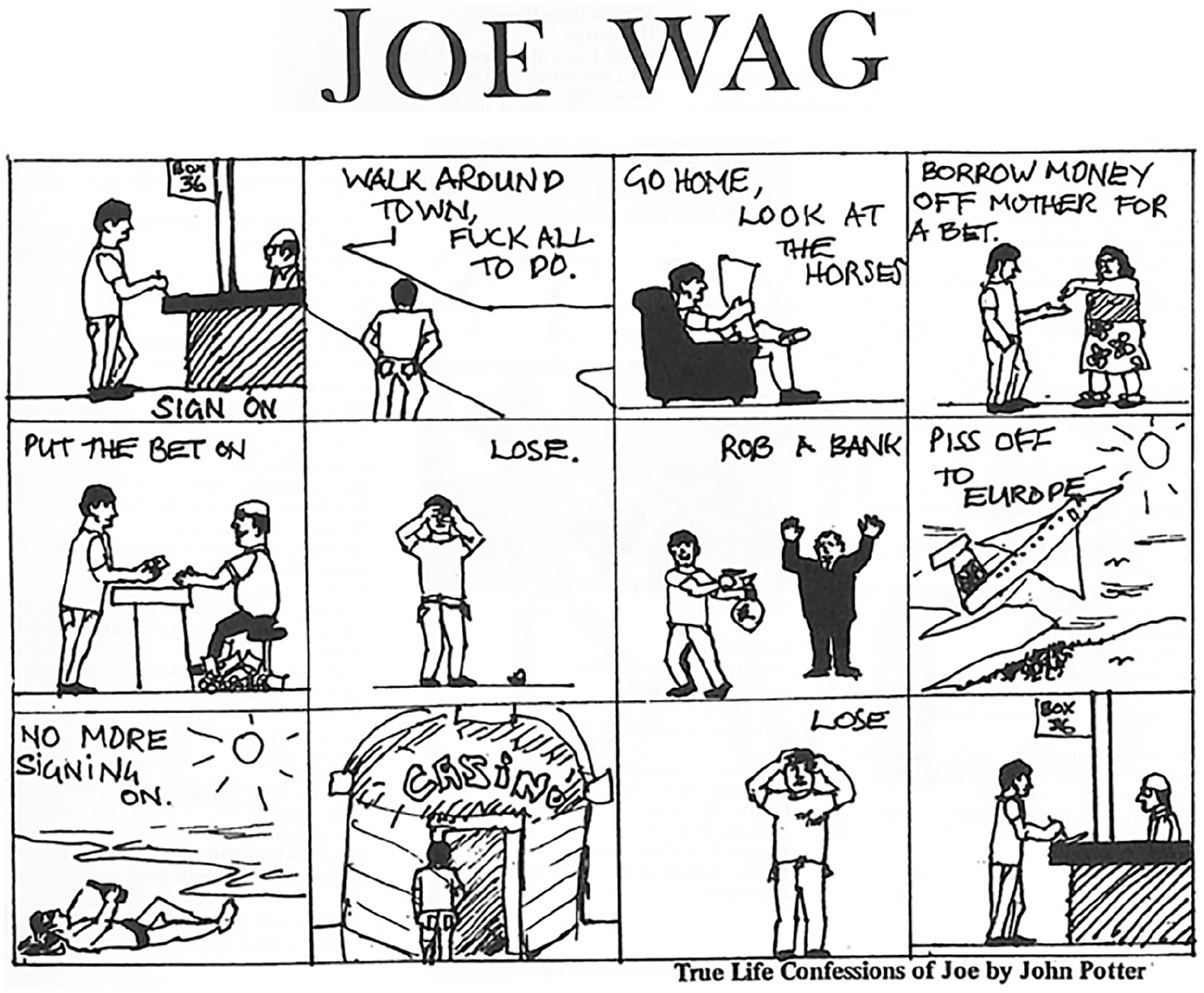
The End, Issue 8, October 1982.
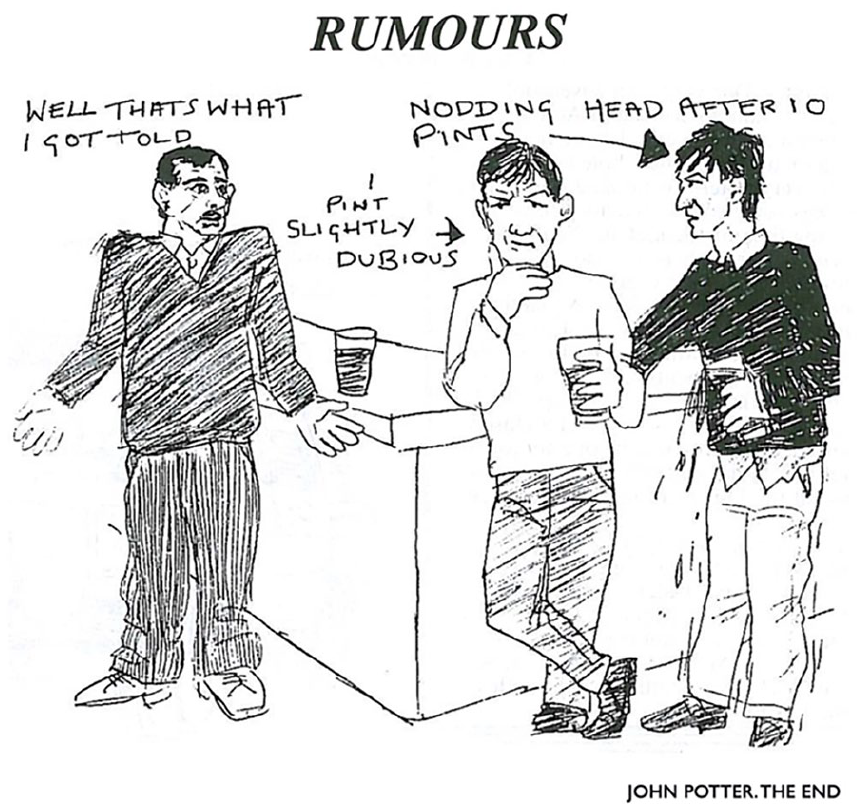
The End, Issue 14, April 1984.
In response, The End crowd got to work and John Potter conveyed the illustration was “right on the nail.” Within an interview with Terry Fields MP, the Q and A revealed the disdainful attitude toward the local press, constantly referring to their lack of support for the Council, and perpetuating negative views as their primary concern was to make money for the rich press barons who controlled them; “Who owns the press and the media? It’s the same people who are responsible for making people redundant.” 14 John Potter illustrated a Number 10 Downing street in flames (Figure 3) and Derek Hatton (Militant firebrand and ex-Firefighter) with Terry Fields MP (ex-Firefighter), urging Margaret Thatcher to jump from the building onto the safety net that was the Liverpool Echo.
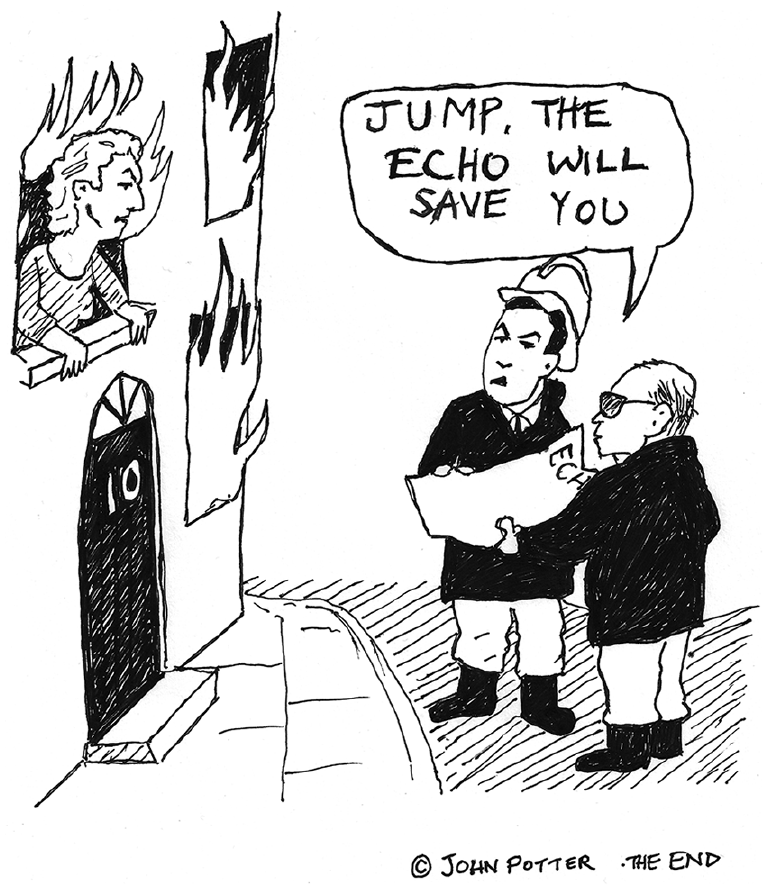
The End, Issue 17, February 1986.
Commentary on Specific Events: Toxteth Uprising. (Issue 2: December 1981)
Riots, looting and destruction of property took center stage in April 1981, first Brixton South London, Toxteth on Merseyside, and then Salford in Manchester. Margaret Thatcher’s initial response was this was a pure act of vandalism and a crime inflicted on businesses and shop owners. When Mrs Thatcher took a guided tour through Toxteth (Liverpool 8) she was not best pleased and directed criticism toward the locals. In her view, there was plenty to be done, their gardens and walkways were a mess and what was required was a little more self-respect for their environment and the riots were nothing more than wanton criminality and destruction. For Mrs Thatcher, what was lacking was a “sense of community—including the watchful disapproval of neighbours—is the strongest such barrier” (Thatcher, 1993, p. 146). Law abiding and socially considerate people have always lived in Toxteth and a positive community spirit has remained within the area. Indeed, forming “Neighbourhood Watch Schemes” sounded like a good idea, but who will they be watching? The culprits were young men “whose high animal spirits” needed to be “kept in check”—who’s high spirits? For Toxteth residents, the “spirits” of the local constabulary required a dilution of some sort, as Chief Constable Kenneth Oxford also took a “watchful disapproving eye” over Toxteth.
Bishop David Shepherd and Archbishop Derek Worlock were in no doubt that the Police were culpable in not establishing good relations with those living within Liverpool 8, to the point they were disastrous, as if handling the area as an active training course in victimization and brutality. Leroy Cooper was stopped and arrested, and a community “uprising” brought a violent response to Oxford’s constabulary. Heseltine and the Liverpool 8 Defense Committee met and as Crick (1997) has stated, the minister “was deeply disturbed” as it was “clear that some local police were guilty of racism and brutality” (Crick, 1997, p. 225). Following the meeting, Heseltine hosted a dinner at the Adelphi Hotel. Kenneth Oxford was the main guest and discussions with the Chief Constable exhibited his undesirable indifference to the problems that stared directly in his face. “Why was there no community Policing? Wasn’t it inevitable that regular use of stop-and-search powers would eventually cause trouble?” (225). Following the dinner at the hotel Heseltine possibly concluded that one of the problems he needed to address was indeed sitting in front of him.
The End, within their 1981 newsflash article, adopted the acidic caustic approach so indicative of their writing to portray the Police as out of touch, ignorant and biased in their views toward all they encountered. Taken from a law-and-order point of view, in the Police’s eyes, it was old age pensioners who started and indeed encouraged the disturbances in the summer of 1981. Following a night at the Bingo, one suspicious looking pensioner was arrested and this “sparked everything off.” As the crowd exited the Bingo Hall and witnessed the pensioner trying to cross a zebra crossing, they waved their sticks in protest. However, the Police made their move to what a Local Tory MP, with the assigned derogatory name Nicholas-le-Snyde, believed was a measured and proportionate response. This individual who was a fully paid-up member of an extremist pensioners club “intent on the destruction of democracy and law and order.” 15
Social Class Commentary: Country Folk Don’t Understand. (Issue 14: April 1984)
The End’s criticism of the English upper-class pursuits was offered with a humorous twist. In one article, the introduction reads: “It’s around this time of year that all those so called do-gooders ie., country folk, will be up in arms, because once again it is Cat Coursing Season” (Issue 14). The article mimics the traditional rural event of Fox Hunting led by the “Master of Hounds” and followed by mounted enthusiasts. The End sardonically described a hunt with complementary urban, working-class traditions. In time honored fashion and satirizing the “stirrup cup” refreshment prior to the chase, the T.H.U.G.S (The Honorary United Gentleman Society) partake of a few sherries on Kirkdale waste ground and the chase begins. The cat is a cunning feline operator, taking refuge from the hunt under a pool table in an “ale house” and later as the chase continues, within an old lady’s bag. It was the excitement of the chase that mattered, and this excitement would lead to a “terrible” thirst, so the map provided co-ordinates for liquid refreshment. A Pub in the Everton area fits the bill. But disruption was encountered on a previous hunt as Barristers, Cabinet Ministers, and MPs all make up the “motley crew” of “Anti- Cat Course crusaders.” Cat Coursing enthusiasts just want to be left alone and enjoy traditions that were handed down by their forefathers. The Hunt comes to a sad and abrupt end, as the Crusaders entice the cat into their cars with “fresh salmon and large baskets of fluffy white pillows.” The main purpose “was to spoil our little bit of fun.” 16
Ins and Outs
The “ins and outs” column was the mainstay and popular pillar throughout The End publications and the purpose of which was to offer an unfashionable take on fashion, combined with various thoughts that can be summed up as “everyday” happenings, celebrity mishaps, unfortunate diseases, uncontrollable urges and embarrassing outbreaks. The “ins and outs” lists are endless, a sample include:
Getting up off your arse and doing something; Hard toilet paper; Going to handsome lessons; Going to parties you’re not invited to.
Having no.26 on your door when you live at no.132; Tourists looking for The Cavern; Hairy toes; Trying to get fit; Ash trays on motorbikes.
Poetry: Working Class Voices, a “Raw Naked Truth”
What can be gleaned from the conversations from all who contributed to The End is that it was of a time, their time, a response to adversity and bitterness that comes with unemployment, the insecurity of a work scheme and the uncertain future when an apprenticeship has ended. Phil Jones articulated his frustration on completion of his Bricklaying course—“I was on the scrapheap at 19, I went for interview after interview, but I was done.” But something and things kept them going. Jones explained: we wanted to make it funny and it was a despondent time and we wanted to take the piss. We didn’t want to sit there and be miserable about it and if you’re going to focus on the trauma that was taking place let’s do it in a funny way. The poetry page was a platform for this. (see Note 8)
The poetry section gave The End an opportunity to scout for talent and encourage people to contribute to what was sometimes a “page filler.” As Sparkes (2012) has suggested, “bits and pieces” of true-life experiences and memories can be expressed “through poetic forms and vignettes.” The poetry section provided the platform to articulate the social world that was identifiable with the cold brutality of an employment landscape that offered little hope, nor a prosperous future. A range of themes, political, social, and familial occurrences were detailed with great skill. From political figures, such as Margaret Thatcher to the ordinary “Me Ma’s soup” was evident across all issues. Politics of the day were grappled with and interwoven with the sadness of unemployment and poetry became the lightning conductor to vent feelings of frustration and a raw naked truth—“Hard times no money nothing to do/The jobs aren’t there, the chances are few” wrote Joe Wagg signaling what many young people were experiencing. Family life was expressed in a dark poem of domestic violence depicting a frustrated father unhappy with his lot and a son that will grow up like his dad—“I’ll be the King of my Kingdom in my little own pad.” An indication of households as “mini principalities” in working-class worlds.
While Mick Potter was watching a football match and standing on the Kop (Liverpool FC), a fellow supporter shuffled up to Potter and inserted paper in his pocket and a word in his ear—“here’s a couple of poems, use them if you want to but don’t print my name.”26 It would seem that working-class denial of the ability to forge and construct the written word with confidence was something to be hidden and not championed. It was published. Who penned these poems is difficult to ascertain, as some poets declared the requirement for anonymity—word plays, name mixtures such as “Anne Observer” and “Cybil Liberty” were employed. Indeed, there was “wit” attached to many, and a close reading of an untitled poem (see Appendix) will convey the authentic working-class voice that permeates and infuses each issue.
The vehicle of the poem allows the writer to express themes and subject matter through a spoken narrator which is not closely connected to themselves. What may be considered taboo to the young working class, poetic form offers another landscape to convey thoughts and emotions. A verbal, conversational approach to human frailties would arouse suspicion, ridicule perhaps, exposing their inadequacy and emotional limitations within working-class culture and its social norms. Alternatively, poetic form provides a protective shield when the young working class dares to delicately trespass onto middle-class sensibilities. Nevertheless, the poems are heartfelt, truthful, and punchy, as the writing is in simple strong terms and far removed from allegory and symbolism employed by the professional poet.
An untitled poem introduces PM Thatcher and there are intimations of the Bible in the rhythm and language as the PM cares for her flock. Tellingly, the poem is setting up a biblical irony with Thatcher, standing outside an empty factory with no hope—“She leadeth me beside still factory’s.” A moral, true shepherd leads the flock to still pastures where they can feed and be healthy, but this poem is working on the opposites of what a true shepherd would do. Biblical language within The Lord is My Shepherd 17 created the structure to expose themes of exploitation of the working classes, the frustration of unemployment, the disconnect from a worthwhile life and to speak for those in similar circumstances amid the inherent rage expressed with humor—“I wish I were a dog and Thatcher/ A TREE.”
Conclusion: “End”ings
The editors and contributors witnessed the effects on those who eventually bought The End and from each interview, the glimmer of satisfaction, pride, or possible relief was experienced by young and untested writers. As Hooton pointed out, “seeing the initial copies boxed up, ready to sell that was a proud moment and thinking, how are people going to react to this?” (see Note 10). For Hooton, his proudest moment was to witness people laughing; “At the match I was sitting in my Dad’s seat in the Kemlyn Road 18 and watching people in the kop with copies laughing their heads off” (see Note 10). The publication was brave, but some people didn’t like it, and in The Hamlet pub on Scotland Road in one incident, Mick Potter tells of an individual who conveyed a resentment, and he would not purchase a copy—“Fuck off I’m a Tory, because he had money, he thought he was better than everyone”; Potter responded, “it’s not for you then mate is it” (see Note 1). Jones captured the polarity of feelings when thinking of The End, and with good thoughts—“the eighties for all the despondency and unemployment it was probably our best time. The despondency led to creativity” (see Note 8).
As The End team were carrying out their own investigations into the Toxteth “uprising” in 1981, it is ironic that Lord Heseltine was a successful publisher as this fledgling magazine attempted to distribute and capture the spirit of their times. Meanwhile, the Secretary of State for the Environment walked the streets of Liverpool, listening, observing and later in his hotel, contemplating with a glass of wine, looking out on the vista of three graces. 19 Outside, for many in the early 1980s, the flush of youth felt it was straight down the “pot,” but this does not tell the full story. Young people grapple with their thoughts and emotions and take refuge in their familial worlds, groups of friends, gangs or high-octane obedience to music or football. What were The End editors thinking? To publish a magazine that mirrored their lives and the experiences of others in similar circumstances and social background. Why did working-class kids from working-class estates express themselves through poetry, music critiques, and the “ins and outs” of life that were harnessed by subsequent magazines thereafter? Was this their resourceful and imaginative response to their immediate worlds and to intelligently see a gap in the market for free expression, thought, and laughter? As James Joyce might have put it, “Yes, and then came everybody.”
Footnotes
Appendix
Acknowledgements
To the former editors and contributors to The End, thank you for taking the time within your busy schedules. Peter Hooton, John Potter, Phil Jones and Mick Potter. Early contributors to the The End included Tony McClelland, Paul Need and Joe Lowry. Thanks to Lord Michael Heseltine, Sheila Coleman, Tony Clifton, Daniel O’Neil, Anne Dolan, Joe Moran, Ron Noon, Bryce Evans and to Tony Shields for gathering the clan. This piece is dedicated to Jo Croft.
Declaration of Conflicting Interests
The author(s) declared no potential conflicts of interest with respect to the research, authorship, and/or publication of this article.
Funding
The author(s) received no financial support for the research, authorship, and/or publication of this article.
