




Abstract
In the Covid-19 global crisis, gender-based violence (GBV) has been reshaped and reconfigured, with increases in some places and decreases in others. During our exploration of the changes in GBV through trans/feminist collaborative reflexive storying, we noticed the fragmentary nature of our storied recollections, which both represented and heightened the emotions in the work. With an intention of distilling the words even further, we challenged ourselves, as transdisciplinary researchers, to create a collaborative renga poem, which we titled, “Silent Footsteps.” An ancient Japanese form, the renga is a series of short, linked verses. This article demonstrates that renga offers an accessible, collaborative poetic research method, not only for research teams but also for non-academic groups to connect with each other. It has the ability to convey deep emotion, with an authentic personal voice, while being confined to structure and rules. Along with creating two stanzas each turn in a round of emails, we all wrote a reflection to engage with the process that identifies this method of writing research as holistic and creative, able to further connect the authors, reflect on the new knowledge and meaning that this work has motivated. Based on these reflections, which are woven throughout and on the renga poem, which is presented in full at the end, we argue that (a) renga is a timely poetic form, (b) it enhances transdisciplinary collaboration, and (c) that it offers both resistance and catharsis.
What poetry is made of is so old, so familiar, that it’s easy to forget that it’s not just the words, but the polyrhythmic sounds, speech in its first endeavours (every poem breaks a silence that had to be overcome), prismatic meanings lit by each others’ light, stained by each others’ shadows.
Poetry in research and as research is not new (Prendergast, 2009), but during the Covid-19 pandemic, there has been an ever-growing need for innovative, creative ways of coming together, of intertwining voices to create community (Roy & Uekusa, 2020) and to connect as a catalyst for social change (Faulkner, 2018). Casting light on the increase and intensification of violence against women and girls during the Covid-19 pandemic (UN Women, 2020), our polyvocal, collaborative renga poem experiments with sound and silence stained by shadows. Ideas, thoughts, and images refract and diffract (Metta, 2017), creating “ma” 1 or spaces between where the reader or listener adds their own ideas to those of the researchers, galvanizing an emotional as well as a cognitive response (Paiva, 2020) and, ultimately, action.
The renga, or linked poetic stanzas, evolved out of the researchers’ feminist collaborative storying, part of an AHRC (Arts and Humanities Research Council)-funded project on experiences of gender-based violence (GBV) during the Covid-19 pandemic. The project adopted the United Nations Women definition of GBV as “harmful acts directed at an individual or a group of individuals based on their gender . . . rooted in gender inequality, the abuse of power and harmful norms.” The underpinning contention of the project was that these “harmful acts” are the result of power differentials, including physical, emotional, and sexual violence; rape; stalking; and harassment, and are perpetrated over a range of mobile spaces. Thus, our project focused on the spaces and movements within and between by examining the immobilities of GBV and how this shifted and changed during the pandemic. We storied our own experiences as part of the transdisciplinary feminist methodology and applied a thematic and narrative analysis to these fragments of our lives, which drew out both similarities and peculiarities. Then, with an intention of distilling the words even further than the fragmented nature of our storied recollections and (to some extent) moving on from them, we challenged ourselves to create a collaborative renga poem. We realized that we had all, to some extent, drawn from poetry in our fragments and that, unintentionally, they formed a poem. This, therefore, seemed a constructive way of honing this creative development and, importantly, of continuing to build rapport within the team. Hence, we asked the following questions: Can writing a collaborative renga poem give new insights into the immobilities of GBV during the Covid-19 pandemic? Furthermore, can it create a sense of community and connection within a research team? And, finally, could this practice be replicated in the future with other groups seeking to challenge patriarchal and misogynistic discourse?
Japanese Poetic Forms in Research
Poetic inquiry in research has mostly focused on free verse, but Rich Furman encouraged researchers to use form and structure when he used a French-Malaysian pantoum and Japanese tanka to create research poems from a patient’s perspective of being treated in an emergency room (Furman, 2006). He found that working with poetic form forced him to “make specific choices and explore the essence of the experience” (Furman, 2006, p. 565) when compared with the more expansive, narrative free verse that is often written for self-expression. In this article, we refer to three Japanese poetic forms: renga, tanka, and haiku, each with a tradition of catharsis, but focus on renga as an articulation of collaboration and resistance.
Breckenridge explained that poetic inquiry is a qualitative data analysis approach pioneered by Laurel Richardson, who suggested that “restructuring existing data into poetic form could spark novel analytic insights.” Breckenridge noted that there has been a disproportionate amount of poetic inquiry from the United States, and so this article follows their reflexive research about domestic abuse from the United Kingdom (Richardson, 1994 as cited in Breckenridge, 2016, p. 449). For the purpose of the exercise, we altered one important piece of the renga form in offering a theme for consideration and wrote on the general theme of GBV and the feelings that lockdown engendered rather than traditional themes of nature or the seasons. We also wanted it to be a reflexivity opportunity (Hertz, 1997, as cited in M. Lahman et al., 2018) as researchers, an approach that has been used within feminist research on sexual abuse, for example, creating “I poems” in which poems are formed from each line of a transcript beginning with the personal pronoun (Koelsch & Knudson, 2009).
There is a growing tradition of using Japanese poetic forms as research. For example, haiku has been used in an arts-based therapeutic project with veterans in Australia (Bullock & Williams, 2022), as field notes in feminist research on running (Faulkner, 2018), and as ekphrasis for audience in performance (Prendergast, 2004). Tanka has been used to research domestic abuse (Breckenridge, 2016) as well as adolescent identity (Furman et al., 2007), and with our research, we build on that to use the collaborative form of renga to research GBV. Renga has already been used in some research contexts—to anonymously discuss scientific ethical dilemmas that were usually avoided (Djerassi, 1998), as part of a reflexive process around the topic of doctoral students’ graduate school experiences (Lahman et al., 2018), to explore social reality in organizational studies (Gabriel & Connell, 2010), multiculturalism in South African academics (Pithouse-Morgan et al., 2017), as well as a signed renga, which was created to look at the intersections of Black African, Deaf, and Queer identities (Mesch & Kaneko, 2017). In our renga poetry, we continued in this tradition and identify this way of working as part of an active challenge to conventional academic work that is more inclusive and values storytelling as equal to more customary qualitative research.
What We Did
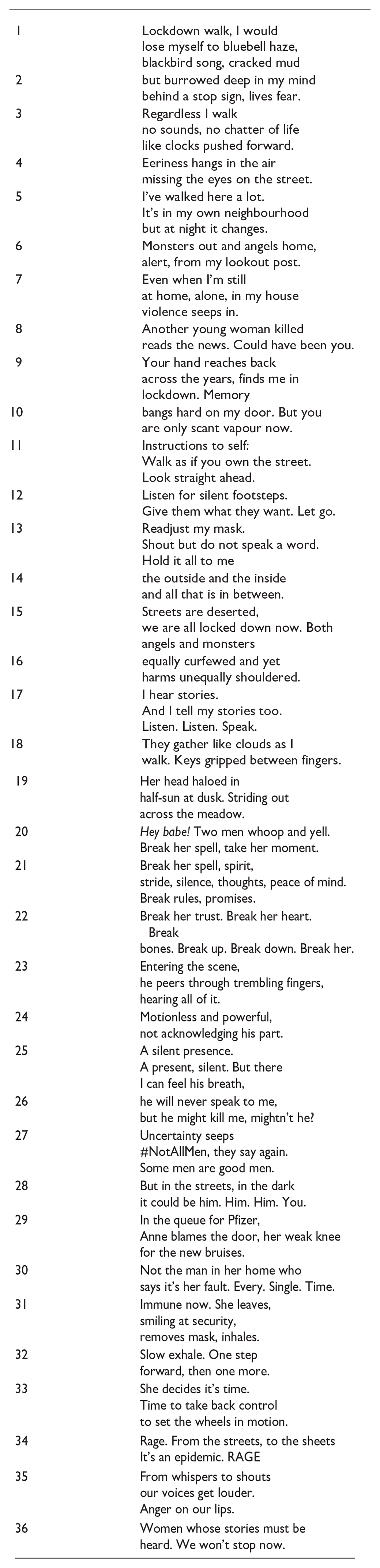
Creating a renga is traditionally an in-person event, but because of social distancing and lockdown restrictions, we could not meet to create our renga, so we took it in turns to write a tanka and email it to the next researcher on the list. Each tanka responded to a word, image, or theme from the previous tanka stanzas. We read through the growing number of stanzas before writing the next one and allowed the poem to unfold. As part of the process, we wrote short reflective pieces that became “a place of exploration just beyond the boundaries” (Bolton, 2014, p. 11), drawing on the researchers’ private selves as well as from culture. This fostered activities that were not tidy and safe, encouraging letting go of assumptions and certainties, to develop new ways of being and understanding and come up with “dynamic possibilities and startling solutions” (Bolton, 2014, p. 11). The researchers’ reflections are woven throughout this article (Geist-Martin et al., 2010; Lahman et al., 2018) while the renga poem appears in full at the end, to be read or spoken aloud in one sitting.
The “we” of the research team are five women social scientists, criminologists, and creative writers. As the “I” in the renga became “we,” we took on a collective voice examining and representing people (mostly women) who have experienced GBV during the Covid-19 pandemic. We drew on our own experiences of GBV, declared through writing stories (Richardson, 2001) and undeclared, choosing to keep some stories to ourselves (Helps, 2018; Moriarty & Ashmore, 2019). We used fiction to reinvent these stories for the renga poem, imagining (and in some cases re-experiencing) what it would have been like to experience this during the Covid-19 pandemic. We then formed our stanzas inspired by, in response to, and in dialogue with, what had gone before. We were at once writing on our own and with others. This fictional, poetic reinvention was given weight and context by the tidal wave of online stories of GBV that were part of the research and part of the pandemic backdrop. Using renga as a poetic form as part of our research into GBV during the Covid-19 pandemic is timely, collaborative across academic disciplines, and provides a space for resistant catharsis that can be widened out to non-academic, community-based groups rooted in the need for social change to challenge patriarchal and misogynistic discourses. In creating and reflecting on our renga, we suggest first that it is a timely poetic form, second that it encourages transdisciplinary collaboration, and third that it produces resistant catharsis.
A Timely Poetic Form
I miss the feeling in the room of connection, of the shared purpose, of being there to write, to let thoughts, feelings, stories unfold in the way they needed to. Some of the games from previous in-person workshops that I miss the most involved passing paper around the group, sometimes folding over to hide what we’d written and other times reading what went before and adding to those lines. Creating a renga poem was one of these processes, where each writer responded to the words already on the page. I remember the resistance from some to counting syllables (even when I told them it wasn’t strictly necessary) and then the joy when they completed the challenge, found just the word or phrase they were looking for and the pleasure when I read it out in full; their contribution fitting just right into a whole, creating something entirely new. I remembered this exercise when, almost a year later during the third U.K.-wide lockdown, I was working with a group of four researchers, three of whom I hadn’t met in person. I saw them on my computer screen and I knew the quality of their lighting in their individual rooms, but not how tall they were. I knew how they spoke and what they said, but not how they moved. I had not shared direct eye contact with them, whispered an aside, or shook their hand. After we had written and shared some stories of gendered-based violence from our lives, I suggested we create a renga by email. I was reluctant to add to the inboxes of academics (Tusting et al., 2019, p. 34) but I also had a feeling that this, more structured yet elliptical writing, would offer new perspectives and a safer way to express our emotionally charged, sensorial experiences and thoughts on the subject of gender-based violence during the pandemic.
For us, especially those among us who had facilitated collaborative writing in pre-pandemic times, when coming together and co-creating was not impossible, the renga provided a timely return to the possible. We learnt the process in tandem, starting with the origins of the form. Haiku is the smallest element: a three-line poem with the syllabic pattern of five-seven-five; add two seven syllable lines to that to make a tanka; tankas linked together by a group of poets is called a renga. It began with poet, Bashō, in the 17th century who would travel around Japan as a special guest at renga parties, held to write and share communal poetry. A renga can be up to 1,000 stanzas, but he popularized the kasen renga of 36 stanzas so that they could complete it in one night, then publish and move on to another town (Reichhold, 2013). The specific number was also in honor to the 36 immortal poets of Japan. The kasen renga suited the purposes of our research as not only is it a ready-made, ancient collaborative form, but it is also accessible to the non-poet by traditionally using everyday language. It also has a more recent history in tackling politically and emotionally charged subjects, such as the Gaza conflict (Hacker & Shehabi, 2014) and lockdown separation during the Covid-19 pandemic (Hacker & Naïr, 2021). In terms of our specific focus on GBV, its relevance was highlighted by poet, Ashraf, H (2020), who explores domestic violence against women using haiku in her book, Her Fading Henna Tattoo. This is the final poem: domestic violence— the dead ladybug in a nutshell
The short lines offer space around the words for contemplation and can also be seen as a representation not only of fragmented memory and trauma of GBV but also of the silence that surrounds and weaves through the experience.
During the Covid-19 pandemic, to prevent or manage the spread of coronavirus, we all changed the way we lived and worked. As our research team found new ways to work and connect online, other women were experiencing escalating abuse in their own homes, and places that were once safe to escape to during the day, such as work, were no longer an option (Ivandic et al., 2020). As a research team, we needed to understand that and other forms of GBV during the pandemic in a way that distracted us from the world outside. As one of us reflected, Once I started, it flowed easily. Unfamiliar with the requirements of renga, I had to keep checking back on the rules of the syllables. And expanding or restricting my ideas as I counted aloud on my fingers. Did it have the sufficient number? Could I use a similar word that had fewer or more? The maths of the renga preoccupied me as much as the creative content.
Both writing and reading poetry and subsequent reflection (Alfrey et al., 2021) can provide insights into experiences that people may not have experienced firsthand. As Sandra Faulkner demonstrates in her article, ‘Crank up the Feminism’, poetic inquiry is a feminist embodied theory which combines the personal and political as a catalyst for social change (Faulkner, 2018). With renga, creating this kind of personal yet political poetry in a group could still work across separation (Hacker & Naïr, 2021; Hacker & Shehabi, 2014).
Our renga project serves as feminist embodied (Faulkner, 2018) and performative (Prendergast, 2004) practice, as well as a compressed form and tool to present interweaving voices and data (Furman et al., 2007). As one of us reflected, Initially, the thing that felt strange or challenging to me about writing a renga was trying to squeeze an experience into a few words, in a very structured and concise way.
There was something about it that was similar to writing a tweet (Wade et al., 2020)—the limited use of letters, but in this case, syllables—having to be selective and creative about how to tell your story. It also conveyed an authentic personal voice to address difficult social issues (Pithouse-Morgan et al., 2017) and the collaborative nature of the project provided an inclusive space for beginners and more experienced poets to participate and work together (Mesch & Kaneko, 2017). It was important to bring these elements into our project, not only for the research on the immobilities of GBV, but also at this time, during the Covid-19 pandemic, as researchers isolated in our own homes, it was vital that we found a method for collaboration that overcame the challenges of working physically apart (Roy & Uekusa, 2020).
Transdisciplinary Collaboration
The aspect I found most interesting about the Renga was the collaborative element. The way what the previous person has written impacts what you write, what you share is dictated by what someone else has shared. Different memories and emotions being drawn to the surface. I found myself wondering, are we writing as individuals or as one? Will this be multiple stories, or one? Would someone reading it be able to tell who wrote what and which stanza belongs to who?
Polyvocal, collaborative poetry and research ensures that no one voice is privileged above another and that we do not fall into the danger of listening to and believing that there is a single story (Ngozi Adichie, 2009). Collaborative research, in particular, also mitigates against potential biases and encourages each other’s self-reflexivity (Furman et al., 2007). The nature of research collaboration and regular meetings online was an important connection (Gauntlett, 2011) during the pandemic, which caused people stress, depression, anxiety, anger, boredom, uncertainty, loneliness, and disconnection, including researchers. Roy and Uekusa put forward collaborative autoethnography as an alternative research approach during the pandemic, linking academic work with personal experiences of the difficulties. They also acknowledged the limitations in sharing wider stories of marginalized people who may not be willing to speak about their experiences (Roy & Uekusa, 2020). In our research project as a whole, we mitigated our privilege of being able to work from the safety of home, by including stories from participants in creative workshops and stories already existing online as well. The renga poem will be used not to standalone but as part of the wider project outputs that are used by policy makers as a prompt for discussion and debate, to ensure even more voices are heard in the final research outcomes of recommendations for change. In the case of the renga, we are the site of the research but the research still needs to connect back and help us and others, to learn about wider issues in relation to GBV.
Co-production has always had an important role to play in rethinking and remaking the world for the better (Daykin et al., 2017), and we (the project team) were interested in exploring and identifying suitable methods and methodologies for feminist work that were collaborative, valuing critical and creative storytelling as equal in any academic research we produced. Acker et al. (1991) suggest that feminist methodologies should be about women and can be used by women, not oppress women, and develop feminist perspectives that challenge dominant intellectual traditions.
The method of reading, writing, and sharing the renga aligns with collaborative autoethnography (Chang et al., 2014) that aspires to value collective, transdisciplinary storytelling and feminist work. In previous work (Moriarty & McInally, accepted/in press), a form of collaborative autoethnography was adopted, which we identified as nomadic storytelling (around the campfire; Deleuze & Guattari, 2014) and used a combined method of dialogues and creative practice to gather experiences with Covid-19. The process of co-creating the renga drew the project partners together (although not to a campfire!) to co-produce feminist work seeking to be part of societal and cultural change in relation to GBV. Here too, each tanka can be considered a continuation of the previous writer and a provocation to the next. It is this dialogue with others that underpins this type of collaborative poetry. It presents the opportunity to externalise in, what feels like, a more productive way than other forms.
By sharing stories—real and imagined—and using each other’s verses as a stimulus for our creative practice—the renga—we were able to offer personal and evocative insights into the project that, despite taking place online and through email, offered a way of deepening connection with (and understanding of) the people we were working with, reminding us of the power of stories to unite and transform. The form also forced reflection—we had to look at what has been written before to move forward. Sometimes, this placed us in conflict or made us unsure of what we were writing:
I felt a conflict between thinking that my renga contribution needed to be similar in tone with the others that went before, while also not wanting it to be similar in tone and wanting to feel free to write what I wanted to write without constraint. So I tried to achieve both—to keep my voice alive while trying not to “jump out” and lose the sense of the whole.
*
Writing my first stanza was scary. I felt anxious and, having never done it before, worried that I might get it “wrong.” It was also difficult, that first time, to get a sense of the direction of the poem as so little had been written of it.
But this sense of unease faded as we moved through the poem together:
By my second stanza, it felt easier as there was a theme, a “vibe.”
Stories, poems, and creative works of art are meant to be shared, and receiving one is like receiving a gift. As Lewis Hyde (1979/2012) explains in The Gift, it is a practice rooted in mythology. It is about “the power of art to take us beyond ourselves” (Sethi, 2015), the flow of energy, and how one gift begets another. It is an ever-expanding, ever-flowing form and continuation of forms, which suits the idea of the renga. The method of reading, writing, and sharing humanized the process of academic writing, making it more pleasurable and personal than conventional academic practice (Moriarty, 2019): Each time a new version of the poem arrived in my inbox, it was like receiving a gift, and this combined with the expectation of the next author in line, was motivating and exciting, rather than making me feel the unwanted pressure that academic deadlines sometimes induce.
Fonow and Cook (1991) argue that feminist work is often creative and spontaneous, and instinctively, our process was to read the previous writing and respond immediately and intuitively rather than overthinking a response. We were initially concerned that the fixed form of the renga would be too restrictive, evoking memories of being controlled by patriarchal and misogynist systems and events, and being denied autonomy, but instead, the structure encouraged us to take risks and experiment with language in a way that was playful and liberating: But then there is the joy of collaboration—sharing these experiences in a way that my co-writers could build on—that evoked a particular feeling or experience for them. Opening the renga each time it came round felt like opening a present.
I found myself writing the next part in my head, even though I had no control over what would be written. It reminded me of the childhood game, where one person whispers something and then it’s passed around the circle—the phrase or the story, its meaning morphs and evolves as it passes from person to person—inspired by what was said, but also open to misinterpretation, with the potential that it has changed entirely by the end.
However, this creative task competed with other demands in the inbox. This internal resistance, the worry about making time, about not being a good enough writer, questioning the importance of creativity in the first place, mirrors the resistance felt by people we were asking to contribute to the research and was an important reminder in how to break down the barriers to creativity: Being asked to write about my reflections on the process of writing the collaborative renga is very similar to the process of writing the renga itself. The request arrived in my inbox, like an uninvited guest that I didn’t know what to do with. I felt a bit resentful of the imposition, particularly on my time. I saw it only as another deadline amid a sea of existing deadlines, clamouring for my attention. And then, annoyed by the burden, I decided to deal with it quickly and absolutely. And so I start writing, and then things flow. And I wonder why I put it off, when the task was/is actually quite enjoyable.
Resistant Catharsis
The #MeToo campaign (Fileborn & Loney-Howes, 2019) and the murder of Sarah Everard (Rainbow, 2021) have led to more public consciousness of the cathartic sharing of stories and campaigning around GBV. By March 8, 2021, The Everyone’s Invited website has had more than 54,000 anonymous testimonies (Everyone’s Invited website) sharing stories of rape culture, which often began in teenage years. Everyday Sexism has had more than 100,000 testimonies since the project to provide a place for women to record stories of sexism experienced in ordinary places, began in 2012 (Feminist Book Society, 2021). There is now a public call to identify and support women to report domestic violence. “Critically, the role of identifying, monitoring and reporting is to collaboratively dismantle the patriarchal tools and reconstruct a post-Covid-19 society that is community-led” outlined Krishnadas and Taha in their exploration of the dismantling of the private and public spheres during the pandemic in the context of GBV (Krishnadas & Taha, 2020, p. 54). Making sense of experiences, breaking silences (Rich, 1995) and creating community (Gauntlett, 2011; Hyde, 1979/2012) are made possible through stories and poetry.
Experiences of GBV are traumatic and it is important to represent this on the page. Trauma is not remembered as an organized linear narrative (Atkinson, 2018), but unprocessed emotions appear to the person as sensory or visual fragments of experience (van der Kolk, 2002, as cited in Etherington, 2020). “These fragments cannot be voluntarily recalled when unprocessed but can be triggered involuntarily as a ‘flashback’ in circumstances that remind the person of the original trauma.” (Etherington, 2020 p. 69). The short, often fragmented lines in the renga poetry serve to reflect the traumatic experience, but the formal structure also contains it. In this way, writing as an act of resistance can be cathartic both for the writer and for the reader. And taking that further when writing the renga, we found an extra layer of connection with each other throughout the process.
So, for example, one of us reflected, I thought that it would be more difficult than it was, but actually the words just came. I wrote the first stanza in my head as I walked back from town at night. Reflecting on what I felt while I was doing it really helped me to navigate the empty streets and the feeling of foreboding that that brought. As soon as I got home, I wrote my bit and it was cathartic. So, I have found myself, since then, continuing to make sense of everyday challenges, by writing a stanza in my head. When I do this, it is meant as a conversation, as part of a collaboration.
*
I think that the constraints of renga help in focusing in on emotional and sensory responses to our current world. Like other people who have experienced gender-based violence, I am full of anger and sadness and afraid that if I started writing about it then it would all spill out of me and I wouldn’t be able to stop it. So writing like this—restricted by syllables, provides the space I need to express a particular response or feeling.
For healing to occur, traumatic memories need to be transformed into language (Etherington, 2020). Until a person is able to speak or narrate their story, fragmented words in the form of poetry with a recognized structure such as haiku may be useful. Bullock and Williams (2022) found when using haiku with veterans, both reading and writing it, it facilitated engagement. They said haiku differed from contemporary poetry in its nuanced employment of metaphor and other poetic tropes. It focuses much more frequently on the external world and is useful to the new writer as a simple means of exploring form and content, as well as the use of line and space. (Bullock & Williams, 2022, p.20)
Haiku is valuable for accessibility and depth.
*
The renga almost seemed to pick up pace as we wrote it—as it became alive with our stories fed into it. Each time as it came round I would read it back and feel a change, the emotion shifting and jumping from the stanzas. These shifts reminded me of a film too—a film that follows multiple characters, living different lives in different places, switching between them until their paths cross serendipitously.
*
Conclusion
I now hope to extend this practice into other feminist work and, when I do, I will cite the team of women who inspired, moved, and challenged me to produce writing that has helped me to feel differently about my own experiences. And that matters. It is work I want and need to do.
Our collective endeavor included a series of elements: writing fragmented stories from lived experiences of GBV inspired by a writing workshop, an unfolding collaborative renga poem adding stanzas in turn by email, and reflections on the process. It began with an intention of not asking research participants to do anything we wouldn’t do ourselves, underpinned with feminist methodology of combining the private with the public; remembered personal experiences with the wider picture of GBV during the changing landscape of lockdowns during the Covid-19 pandemic. The renga and reflections offered opportunities to resist and challenge dominant patriarchal narratives while giving space for catharsis too.
Particularly in this project, in which we have found it difficult to engage participants in writing about their experiences of GBV, this method was very successful in alluding to the underlying issues in recounting traumatic experiences. As aforementioned, it has demonstrated that GBV experiences are very difficult to recount if there is no guidance or constraints imposed on the process—if participants are not given enough direction on navigating the maze of emotions—knowing that they can take particular turns and leave others unexplored for now. For this reason, we would use renga again. Not only this, but even if the research context excludes the use of creative methods like this, we will carry the lessons learnt from this collaborative method—in terms of guidance and restraint—in devising methodological strategies in future: And reading it now, I feel proud. I love how optimistic the ending is, despite (or because of) its content. There’s a little bit in it that I really like (not written by me), and also a little bit that I don’t like (also not written by me). But I like that about it. It challenges me, and it reminds me that it represents all of us.
We have shared our collective experience of GBV in the context of lockdown, in a way that felt new and comfortable, and creative. And it feels like the sum of our collective endeavor is more than the individual parts. Renga is an ideal collaborative form for groups of writers and non-writers wishing to connect in uncertain times, offering structure to contain feelings and short lines to represent traumatic thought, leaving space for that which is unsaid. If every poem breaks a silence, renga has the potential to break multiple silences and contribute to meaningful societal change around GBV.
Silent Footsteps
Footnotes
Declaration of Conflicting Interests
The author(s) declared no potential conflicts of interest with respect to the research, authorship, and/or publication of this article.
Funding
The author(s) disclosed receipt of the following financial support for the research, authorship, and/or publication of this article: This research is funded by the Arts and Humanities Research Council (AHRC) as part of the U.K. Research and Innovation rapid response to Covid-19 (AH/V013122/1).
Ethical Approval
This research project gained ethical approval from the University of Brighton Arts & Humanities Cross-School Research Ethics Committee.
