




Abstract
This article proposes a new analytical framework to understand U.S. gun culture and its attendant cultural identifiers. It uses the Weberian concept of the state, in which the state’s monopoly on force is the basis of its legitimacy. Using this theory of the state, my key theoretical contribution is that gun culture is a contestation of the state’s monopoly on force. Relatedly, I argue that the system of cultural identifiers attached to gun culture competes with state power. In this way, gun culture asserts a devolved, local and patrimonial system of social power. I use this synthetic context of U.S. gun culture to understand theoretical issues of citizen–state relations and the role of identification in envisaging local power while offering narcissistic compensations to disenfranchised people. This descriptive theory argues that the state monopoly on force constitutes a central clause of the social contract between state and citizen, and the breach of this monopoly within gun culture challenges the contract itself. Identity and its conceptual markers, then, have a political end as a surrogate for social authority and personal-local power. This political function is hinted at but not adequately theorized in gun culture literature, certainly not using a Weberian, ‘monopoly on force’ framework. I propose that gun culture signals an antagonism within the social contract, in which citizens cede use of force to the state. This antagonism is activated in this case but theoretically latent in citizen–state relations. This article builds on the Hobbesian–Weberian premise to propose a model of Martial Culture Theory (MCT) to describe U.S. gun culture and those political movements that seek to reduce through force the state monopoly on power by diminishing its legitimacy and claiming theirs as a legitimate exercise of force.Through this process occurs a renegotiation of socio-political power distribution with the state. I submit this insight has valuable implications for state theory and citizen–state relations. In addition, it offers the most complete theory of how small government conservatism aligns with identity politics in U.S. gun culture, and how the prevailing mode of identitarian politics can manifest and be harnessed toward contestations of state power in Hobbesian-Weberian thought.
Keywords
“A well regulated Militia, being necessary to the security of a free State, the right of the people to keep and bear Arms, shall not be infringed.”
U.S. gun culture is a unique phenomenon, compelling in the versatility of cultural characteristics and political signifiers it contains. But how do these come together? More specifically, what analytic significance does gun culture have for state theory and citizen–state relations? What is the critical conceptualization of political power in U.S. gun culture? Relatedly, how and why does this conceptualization unite its enumerated signifiers of masculinity, self-sufficiency and so forth?
This article is an exploratory theoretical analysis which (a) proposes a framework for U.S. gun culture that provides analytic insights into the antagonism between state and citizen regarding the contractual ceding of force to the state (Weber, 2019) and (b) parenthetically elucidates the function of identification in this. I argue that gun culture is a martial culture, a term I coin to describe a situation in which firepower is equated with political and civic authority in a popular movement. The concept of a ‘militia’ is embedded in gun culture, the Second Amendment being predicated on the idea of a civilian military (see Waldman, 2015). As such, gun culture renegotiates the state monopoly on power. I argue this is a core constituent of U.S. gun culture and the political contestation around the state that is at the heart of small government discourses. I seek to refine and rehabilitate conventional notions of U.S. gun culture as ‘anti-state’ and instead propose that U.S. gun culture is an attempt to reset the state’s boundaries. U.S. gun culture—in its modern variant, as distinct from the hunting and fishing subculture of the pre-1970s (see Hofstadter, 1970 and Yamane et al., 2020 on Gun Culture 1.0 and 2.0)—competitively asserts alternative models of power, renegotiating the social contract in which citizens cede power to the state. Gun culture therefore embodies an antagonism in citizen–state relations.
This article offers a broad theory of citizen–state relations. It specifically theorizes the antagonism in the contractual trade-off in which citizens cede force for security, which originates in the Hobbesian conception of the social contract. Parenthetically, identity movements act as supplements to the narcissistic needs of its members. I employ a synthetic epistemology using the case of gun culture, the latter of which, this article argues, challenges the state monopoly on force, with significant analytic insights for state theory resulting. It yields a further theoretical contribution that popular challenges to the state monopoly of force provide aggrandizement through identification. This insight reconfigures how and to what end identification within gun culture functions, while primarily theorizing gun culture from the perspective of state theory and a Hobbesian–Weberian framework, which is presently lacking in the literature.
This article is a novel approach to the subject for state theory and gun politics alike. This level of analysis – that is, the use of state theory – is missing in the literature on U.S. gun culture. Relevant related work has been contributed by Celinska (2007) and Horwitz and Anderson (2009). While ‘big government’ is discussed (Melzer, 2009), the literature does not theorize gun culture in light of state theory, nor does it map theoretical conceptualizations of political power in gun culture. Ethnographic and social science literature has considered the protective, masculine honor and militant overtones of gun ownership (Barnes et al., 2012; Carlson, 2015b; Stroud, 2012; Felson & Pare, 2010; Flores, 2015; Gahman, 2015; Matson et al., 2018) (see O’Neill, 2007 for the concept of the “armed citizen”) as well as its individualist/collectivist paradigm (Celinska, 2007; Feldman & Stenner, 1997; Horwitz & Anderson, 2009). While the literature describes gun culture’s cultural signifiers, it lacks a theoretical framework that unites these. This article extends this literature by theorizing concepts addressed in the notion of the “armed citizen.” My concept of the ‘martial culture’ offers value in uniting an ambiguously-related triad of ideas: individual/citizen power, small government and militarism. Specifically, it interprets gun culture via the relation of citizen to state, a theorization absent from the literature. The critical insight of my theorization is that gun culture attempts to disrupt and siphon off the state monopoly on force: that is, gun ownership and pro-gun politics embody a politicized renegotiation of state power, which presupposes an equivalence between firepower (force) and social authority. I suggest this process of renegotiation inherently requires agents of gun culture to identify themselves as a proxy for state force and, in doing so, with the state itself. The complicating factor of pro-state military patriotism nuances the notion that gun culture is straightforwardly ‘anti-state.’ It also maps the identity constellation of gun culture onto a matrix of political power. These identity signifiers include masculine honor identities and notions of family, community and self-sufficiency. My model explains why gun culture’s identity categories offer a narcissistic payoff. Furthermore, this model may indicate that cultures of domestic militarism reflect an internalized ‘strong state’ ideology which gun culture’s practitioners attach to these identities. This is a new frontier in the study of U.S. gun politics. It may suggest that foreign policy does not exist solely at the level of government but is absorbed and reproduced within the national culture, gun culture being an endogenous offshoot of public imperialism.
While gun culture comprises an ecosystem of differing gun practices and subcultures, I suggest my model constitutes a theoretical underpinning of the culture as a whole. While positivistic studies may want to add granularity by studying how this is employed by different actors, this article offers an overarching model of gun culture at its grassroots ‘base’ as studied by ethnographers and sociologists including Burbick (2006), Melzer (2009) and Stroud (2012, 2016).
Methodologically, this article uses a synthetic approach to generate analytic insights by analyzing the ideas content of gun culture. It applies a neologistic critical model using the Weberian concept of the state, in which the state’s monopoly on force is the bedrock of its political legitimacy. An imperative to reorganize power distribution therefore lies at the heart of political thought within gun culture. This article is less focused on normative questions than it is on descriptive analysis of citizen–state relations.
In sum, the main submission of this article is that gun culture seeks to renegotiate state power by disrupting its monopoly on force. This constitutes, I argue, a martial culture, in which force is identified with socio-political authority (‘martial’ referring to a pseudo-military culture). I resituate the role of identification in this culture. I suggest the identification value that guns offer, including whiteness, patrimony, masculinity, rural dignity and individualism, are forms of narcissistic compensation. This may theoretically explain the overlap between gun ownership and economic privation in rural communities (Mencken & Froese, 2019). I also suggest this explains masculine honor cultures’ role as a substrate of gun culture. I contribute to the literature by theorizing gun culture’s political salience as reaching beyond its mere possession of identity signifiers (which I interpret as mediating factors in gun culture’s praxis of empowerment) to having a relationship to state power. I nuance my main argument, that gun culture disrupts the state through usurping its monopoly on legitimate force, by exploring its ambivalence about participating in the functions of the state. This adjusts the standard model of U.S. gun culture as ‘anti-state.’ I draw a distinction between anti-statism and renegotiation of the state’s bounds. In an exploratory discussion towards the end of this article, I suggest the role of nationhood and the aesthetics of American superpower in gun culture means we should consider its ideas around force as—in addition to a contestation of the state—a semantic register of an ‘imperial nation.’ This is relevant to the patriotic and neoconservative co-ordinates of GOP conservatism, which overlap with pro-gun attitudes and ownership historically and demographically (Melzer, 2009). In sum, gun culture is a system of political thought in which power is usurped from the state and invested in localized identifications such as patrimony and rural culture. This state-theory framework constitutes, in this sense, a unifying theory of the identification function and political resonance of gun culture in U.S. political thought as a public, grassroots praxis.
With a view to my structure: I first present background on and review existing analytical interpretations of U.S. gun culture, before outlining my model. Using Weber’s concept of state monopoly on force as the font of its political legitimacy, I then enumerate my theoretical contentions: in particular, that Weber’s theory of the state monopoly of force suggests force and authority are intimately tied together in gun culture, and that it is necessarily in contestation with the state. I then develop the role of identification in this substrate of ideas via my discussion of gun culture as a compensatory culture, in which self-aggrandizement and self-actualization are offered through identity categories that are privileged ahead of and usurp social authority from the state. This model resituates gun proponents’ ideas of the state away from rejection toward renegotiation. I provide preliminary thoughts on how this constitutes a civic militarism in the United States, an as-yet unaddressed connection between neoconservative ideas of military power, patriotic identification and domestic gun culture. Along the way, I provide illustrations and a discourse diagram to explain how Martial Culture Theory describes cultures with latent political drives to renegotiate state power and how this relates to its constituent ideas of male power, localism and individualism. I finally consider remaining questions about the production of political thought in this movement, specifically whether this model has a differential payoff for interest groups and elites compared to grassroots practitioners, before presenting concluding remarks.
Background and Existing Interpretations of U.S. Gun Culture
The literature on U.S. gun culture has identified its cultural and political characteristics, in particular its correlation with masculine cultures and small government conservatism (Melzer, 2009; Spitzer, 2008). Demography and cultural identification are among the literature’s core inquiries. Barnes et al. (2012) consider gun culture an explanatory response of masculine cultures to terrorism, which has a subtle militarism-related subtext. However, pro-gun attitudes (‘gun culture’) have not been considered a consequence of a martial or militaristic culture. Likewise, its implications for political thought (for example, the dialectic between state and citizen) are little-explored. The concept of the “honor” culture, explored by Felson and Pare (2010), is a compelling finding but whose political co-ordinates are under-theorized. There is a voluminous literature on how masculine honor correlates with pro-gun attitudes (Warner & Ratcliff, 2021; see also cultural studies of masculine gun culture including Arjet, 2007; Carlson, 2015a, 2015b; Cock, 1997, 2005; Cox, 2007; Gibson, 1994; King, 2007 on violence and manhood). Positivistic studies have correlated fear of crime with gun ownership (Buttrick, 2020; Warner & Ratcliff, 2021), as well as authoritarian views (Feldman & Stenner 1997; Flores, 2015). This frames guns as oriented around social alienation, fear and law. The ethnographic side of this literature indicates that guns mediate social signifiers and identity (Burbick, 2006; Lacombe, 2019; Melzer, 2009) (see Stets & Burke, 2000 for identity theory).
A synthesis of these two bodies of literature, of gun culture as civilian law-enforcement and as a vehicle to mediate identity, shows that guns exist in a social context. It is in this context, I propose, in which the monopoly on force becomes disrupted and redistributed among the group. Such redistribution is not a mere rejection of social authority, often framed as big government, but rather a usurpation of it. This relates to masculine norms, as it facilitates a perceptual regaining of social authority, resituated within families and communities through gun ownership. This embodies a system of patrimony, as an alternative socio-political model. Such systems are commonly found in traditional societies with weaker state structures. This insight articulates the latent political implications of the cultural studies literature on guns and masculinity. The symbolic capacity and versatility of gun politics has been explored (Cock, 1997, 2005; Johnson, 2017; King, 2007). Guns’ significance for neoliberal ideology among local communities has been explored by Gahman (2015), specifically with regard to masculinity and the paradigm of self-sufficiency. While Gahman considers economic imperatives, those of political thought have not been theoretically teased out with regard to gun culture. This article tangentially contributes to ‘honor’ and masculinity studies of gun culture, as a secondary point of contribution. It extends an embedded logical corollary of gun culture. Namely, gun culture is a martial culture; that is, a culture at once about social distribution of power among members of local society (gun culture being built around masculine cultures) and notions of white citizenship (see Mencken & Froese, 2019). I propose that this culture is therefore built around a competing model of social and political power.
The political ramifications of gun culture for state theory have been little addressed. Celinska (2007) comes closest when she discusses the individualism/collectivism dialectic entailed in gun culture. While she positivistically infers correlation with low-collectivist outlooks and gun ownership, she does not theorize a model. Gun culture’s inherent hostility to the state is implied by Horwitz and Anderson’s (2009) concept of insurrectionism but not elaborated as state theory. It is also framed as ‘anti-state’ as opposed to state-contesting (the latter of which is a renegotiation that conceptualizes an alternative power structure). Some contributions on the identity payoffs of gun culture, notably Carlson’s (2015a) concept of the “citizen protector”, offer rudimentary, related ideas to my driving insight in this article by, as Horwitz and Anderson do, logically implying gun culture’s rejection of the state. However, this is only indirectly related to my core concept and not theoretically articulated. My insight in this article is that gun culture, as an emergent phenomenon, functions to affect the social power distribution by redistributing force horizontally. In this way, gun culture is a phenomenon of political thought, with an embedded theory of state-citizen relations. Prior studies of identity such as the “citizen protector” do not frame this in terms of political theory epistemologically, nor do they fully realize its implications for or frame it in terms of state theory. Even the “armed citizen” concept (O’Neill, 2007) (a closer approximation for our purposes, which conveys its militaristic significance; the military being the organ of the state monopoly on power, hence the Second Amendment’s wording of “militia”) lacks an articulation of its theoretical corollaries for state-citizen relations, the connection between force and political power, and gun culture’s renegotiations of this.
This article also contributes to studies of identification by offering a theoretical locus for the cultural signifiers in which gun culture’s adherents traffic. I suggest that the masculine, local and individualistic value content derived from guns extends beyond the mere reputational benefit that may be conferred on its members. Rather, this self-actualizing function stems from systemic political thought about the state. My MCT model is complementary to historical observations of gun culture’s co-evolution with modern American conservatism. However, I maintain that, rather than having internalized small government ideas or functioning as an adjunct to a pro-small government movement, gun culture is encoded with its own systemic political logic.
Proposing Martial Culture Theory: Citizen–State Relations and Gun Culture
Here, I develop Martial Culture Theory (MCT) to describe a culture in which the exercise of legitimate force is a conduit for political power within a social network. It is theoretically built on the Weberian definition of the state as a “political institution that claims successfully the ‘monopoly of legitimate physical force’” (Anter, 2019, 2; Weber, 2019). A martial culture is pseudo-militaristic and signifies the self-organization of an autonomous individual or collectivity through (a claimed) legitimate use of force (a “militia” in the Second Amendment’s language). This is distinct from nonstate actors who may seek to break the state’s monopoly on force (see the example of paramilitaries below) but who do not seek social or institutional legitimacy. I use this concept of martial culture to evince two related observations: (1) the role of legitimate force (which commonly manifests as military forces acting for the state) is operationalized towards forming political authority and (2) this strategy seeks to disperse authority locally and horizontally. This model, I argue, situates masculine honor and identity-based critiques in a political contest about who should possess political power, which seeks to ‘replace’ the state. This is strongly linked to notions of personal and local power; in particular, political systems of patrimony and patrimonial ideas of social authority, martial culture consolidating a semiotic link between socio-political authority and force as a masculine activity often occurring in a family or local context. Blocher (2013) evinces this interpretation of traditional gun culture as a local, rural practice. I suggest this culture conceptualizes political-social power as available to be siphoned from the state through these practices. Modern gun cultures are not hunting/fishing subcultures but ones with an accompanying political framework of local, individual and patrimonial authority. Historical provenance of this contestation of state power — which is indicated as being to some extent latent in gun ownership as a long-term American cultural praxis, whose latent properties have been activated in recent decades by the conservative movement — can be found in Levin’s (2019) argument that the Second Amendment originated as a concession in federalist distributions of power in 1791. Such historicist arguments suggest local men conceived of themselves as sources of social authority. The MCT model, I propose, can affix the loosely-related strands of masculine honor, racial resentment and nationalism, which are social signifiers that demonstrably correlate with pro-gun attitudes and National Rifle Association (NRA) membership (Delmas & Bankston, 1993; Filindra et al., 2020; Filindra & Kaplan, 2016, 2017; Warner & Ratcliff, 2021).
This model of citizen groups competing against the state for political legitimacy via use of force has a distant theoretical relationship to the function of paramilitary forces as disruptive entities within weak state apparatuses, such as guerrillas in Latin America (see Acemoglu et al., 2013 on monopoly of violence in Colombia and Correa-Cabrera et al., 2015 on organized crime in Mexico). While the “armed citizen” concept offers an analogue to my model, Martial Culture Theory (MCT) proposes a state-centred theory using the Weberian premise which, I submit, by drawing an equivalence between military forces as a state apparatus and martial cultures (or “militia”) among citizens, inserts this analogue of state-citizen relations unlike the other term.
The MCT model also implies there is an alternative collectivist model underlying gun culture’s conceptual substrate of self-sufficiency individualism. While existing literature compellingly evinces the small government ideological discourse of gun culture since the NRA’s ascendency in the 1970s (Horwitz & Anderson, 2009), it omits the inverse insight: that gun culture contains a collectivism bound by nationalism and group identity (see Lacombe, 2019). A deeper theoretical insight is the role of ‘domestic warfare’ in competition between political actors: that is, the state and non-state actors.
Gun Culture as Contesting the State Monopoly on Violence
While existing literature explains predictors of pro-gun sentiment and features of group identity, it does not sufficiently theorize the analytical significance of this being mediated through force or, more accurately, martial-social practices. This, I propose, constitutes an important observation of political theory about the distribution of power via the symbolic currency of force within a social context. The Second Amendment’s concept of “militia” embeds this notion, ‘martial’ signifying the self-organization of legitimate force that lacks the organizational structures of a military, in the fashion of a civilian militia.
I develop this model with reference to two attendant features: (a) disruption of the state’s monopoly on force, as an essential characteristic of the state (Weber, 2009, 2019) (see also Anter, 2019; Grimm, 2003; Lottholz & Lemay-Hébert, 2016; Wimmer, 2003) and (b) the identity characteristics of gun culture which undergird, I argue, a competing form of sovereignty and socio-political authority. Weber’s descriptive theory of state legitimacy arising from its monopoly on force descends from Hobbes’ observation (see Hobbes and Missner, 2016) (the concept conceived in 1676) of the inter-reliance between state legitimacy and force via the social contract (see Whitman, 2003). The state’s legitimacy, which supports its capacity to function, proceeds from a contractual relationship with the sovereign’s subjects in which the sovereign’s monopolizing of force curbs the violence of anarchy (the use of force by all against all). Force and state legitimacy are therefore, within Hobbesian–Weberian thought, intertwined (Grechenig & Kolmar, 2014; Steidley, 2019, 929).
The theoretical significance of masculine honor cultures and pro-individual, family and community distributions of legitimate force is their negotiating and eroding this essential characteristic of the state. The concept of the monopoly on violence has not been considered in the gun politics literature to date. A relevant study in the field of criminology is by Steidley (2019) who applies the concept thinly to crime prevention. The conception of gun rights (“Standing Guard” being an NRA column in American Rifleman dedicated to protecting these rights) frames gun rights as part of an internecine ‘war’ (tacitly, a conflict over legitimate force) (Knox, 2009; LaPierre, 2009). This suggests the identity features of gun culture identified (Warner & Ratcliff, 2021), as well as being supplements to self-identification, function to usurp social and political authority. The notion of a latent anti-government potentiality in gun culture may be explanatory of the gun culture-conservative coalition’s emergence as political fellow-travellers, in answer to the literature’s question about how the nexus of anti-government, firepower and gun culture relate (Melzer, 2009). I propose the challenge to the state monopoly of power suggests these identity formations are competing forms of socio-political power. This explains the payoff to adherents of gun culture who may be invested in masculine norms, local self-rule and familial centrality over, for example, the abstraction of ‘small government,’ which is something of a ‘dead end’ for all but ideologically-motivated agents. I address narcissistic satisfactions of this state-contesting politics below.
Figure 1 illustrates the discursive chain of logic within gun culture, connecting individual-citizen power, small government and militarism. It illustrates the umbilical relation between social identity and its articulation in political thought. These co-implicated signifiers come together in the following way. The individualistic-family-oriented function of legitimate use of force (see Grechenig & Kolmar, 2014 on state force and protection of private property) suggests gun culture proselytizes redistribution of force among local communities. Given the overlaps with masculine honor cultures, I propose this is a patrimonial social model—the rule of local men—as a competing political order to the state. Gun proponents’ rhetoric of America’s frontier past (Slotkin, 1998) invokes a period of state absence, with self-defense and hunting as praxes of independence (force and sustenance). What may appear as aesthetic values contain, in this way, a political subtext about social orders beyond the reach of the state. Community and familial protection, as well as protection of property, are major political subtexts within gun culture. While one can argue their pragmatic value, a political argument about sovereignty (implicitly a contestation of the state) is necessarily implicated, one in which the family, particularly the father, supplants the state authority’s role to protect (which is a core Hobbesian–Weberian function of the state; the defining role of the state if we subscribe to this model). Patrimony is, then, a tacit system within the imaginary of gun culture. The self-sufficiency paradigm implicitly seeks to shift the locus of socio-political authority away from the state. Existing theory has discussed gun culture’s characteristics of individualism and ‘anti-statism’ but my insight signifies (a) a usurpation (as an alternative model in competition with the state, which is sometimes referred to as but is theoretically distinct from ‘government’) and (b) a more pro-social model than is generally discussed about gun culture, which is often considered a social movement favoring individualism and self-sufficiency. As mentioned, Levin’s (2019) game theoretic analysis shows a historical precedent of this contestation of state monopoly in which U.S. states bargained for the right to maintain localized militias, inevitably curtailing federal power (Figures 2 and 3). 1
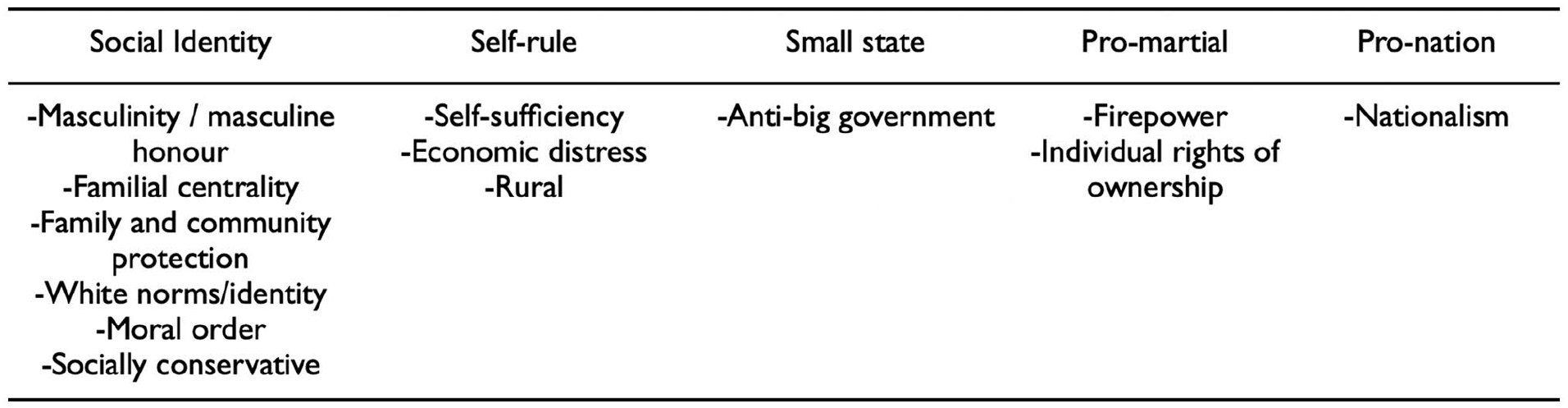
Discursive content of gun culture, nested into themed categories.
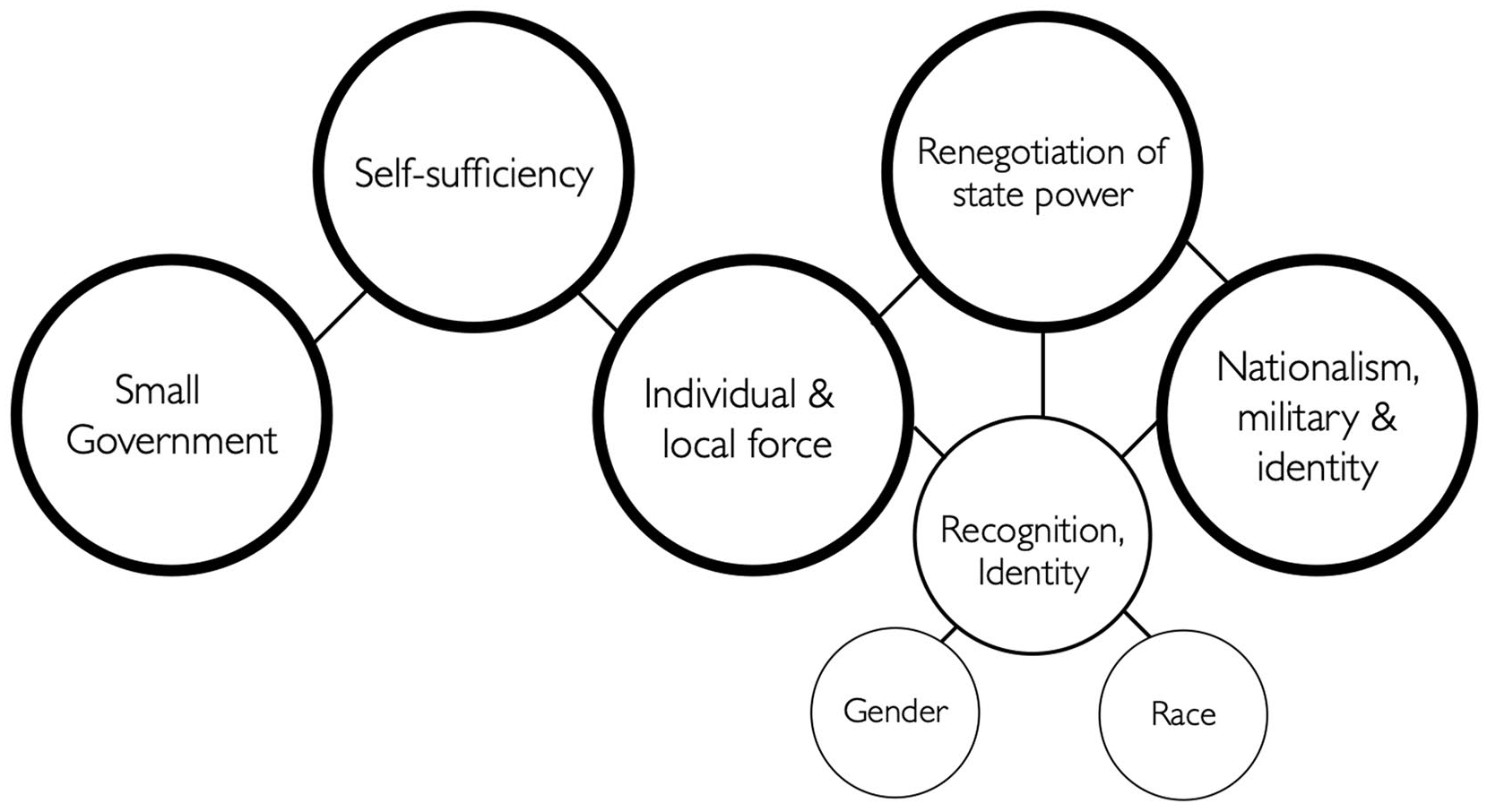
A conceptual map of gun culture.
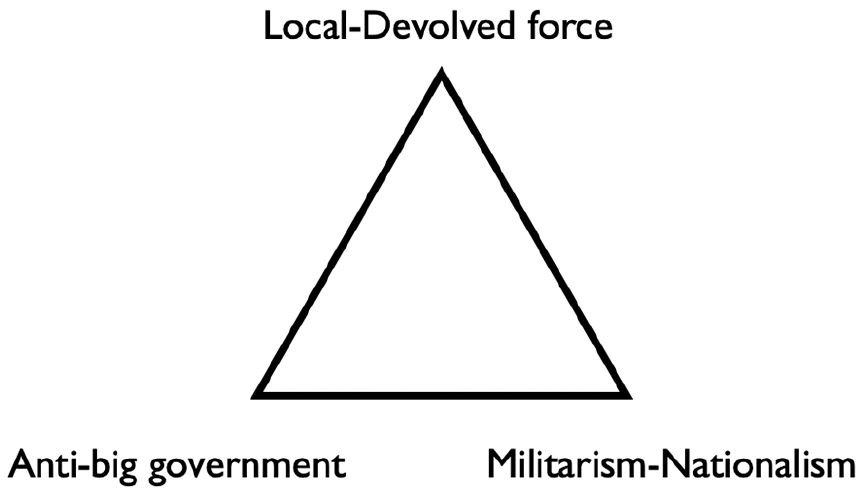
A inconsistent triad of gun culture: Contesting the state, participating in patriotism.
Herein, gun culture is a social practice imbued with moral and self-actualizing content. This explains an attendant feature explored in symbolic studies of gun culture: namely, its capacity to invoke a range of ideational concepts. In particular, it invokes a norm of masculinity (Anisin, 2017; Arjet, 2007; King, 2007; Mencken & Froese, 2019; O’Neill, 2007; Springwood, 2007; Sutton & Wogan, 2020). Mencken and Froese (2019) find that, “white men in economic distress find comfort in guns as a means to reestablish a sense of individual power and moral certitude” (3). Meta-analysis of similar studies shows that white participants are more likely to oppose gun control measures than non-white and “racial resentment is a significant predictor of gun policy preferences among whites” (Filindra & Kaplan, 2017, 414). While cultural and ethnographic studies focus, with great effect, on guns’ symbolic metonymy for manhood, I suggest its aggrandizing value comes from gun culture’s system of thought about the tacit distribution of socio-political power among males as members of a community imbued with social and moral authority. Guns are themselves imbued with moral value (see Dawson, 2019; Whitehead et al., 2018; Yamane, 2017). Their conceptual link with masculinity and pro-masculine self-ideation are indicated by positivistic studies, Mencken and Froese (2019) finding data suggesting female gun-owners are more likely to favor some types of bans on semi-automatic weapons (18). They also show that greater economic precarity is correlated with higher feelings of gun-empowerment among white gun-owners and an inverse relationship of this with non-white gun owners (Mencken and Froese, 2019, 18). Masculine honor is a strong indication that gun politics offers for many of its practitioners a political contestation of top-down power.
Compensatory Culture
This comes to a corollary I wish to extend: namely, that gun culture is a compensatory culture that offers ego-based compensations. This theoretical insight is in line with positivistic findings (Mencken & Froese, 2019, 3; Warner & Ratcliff, 2021). Freud (2012) observed that complex systems require (like the idiomatic carrot and stick) incentives, or compensations, to sweeten the costs of subordination to complex systems like societies, in the form of ego-based compensation: “One is a wretched plebeian, harassed by debts and military service; but, to make up for it, one is a Roman citizen, one has one’s share in the task of ruling other nations and dictating their laws.” Freud’s theory proposes that relationships with the state do not constitute a simple repudiation but rather a simultaneous power struggle and co-dependency, in which libidinal surplus is hoovered up by the state for purposes of production while auctioning back to the subject tools for self-identification and self-actualization. Identification doubles as a psychological need and a pacifying resource. Individuals may derive narcissistic satisfaction from identification with power and force; specifically, when mediated through a powerful state. While gun culture’s contestations of state power do not appear to fit neatly here, its overlap with economic distress, masculine ideals and racial identification suggests authority (socio-political, associated with legitimate force) is a compensation derived from participation in it (see Witkowski, 2020 on male compensation). The alternative community structures of participatory gun cultures, with congregations at gun shows and membership of organizations like the NRA, form a social structure with a moral value system, delineated ideological orientation and social identification as a member of the in-group. Localized cultures of legitimate force do likewise. The compensations of this politics of recognition (see Fraser, 2000, 2001; Fraser et al., 2003) theoretically tease out the full explanatory power of ‘identity’ as a framework through which to understand gun culture.
Disrupting the State, Participating in Nationalism: Complicating the Anti-Government Model
The nationalistic resonance of gun culture makes one pause when confronted with the standard text of it as simply anti-state. At one level, yes. Gun culture renegotiates state power; but this is not a straightforward, unmitigated repudiation of the state. Usurpation of and emancipation from state authority are certainly essential characteristics of gun culture but it contests the boundaries of the state, not its existence. Furthermore, gun culture’s engagement in national identity and Americanness implies it has a more nuanced relationship with state and national structures. Although ‘state’ and ‘nation’ are theoretically distinct, they are interrelated, not least because the military as a font of national force is venerated and implicated (via the militia-connection) within gun-owning cultures. Gun culture’s apparent repudiation of the state and embrace of nation signifies an internally-complex system of thought. The idea that it simply rejects state power is therefore an oversimplification. Specifically, the implications of MCT resituate the ‘freedom discourse’ away from anti-statism toward appropriating state power. Gun culture renegotiates state power and its distribution, participating in political boundary-setting. It certainly promulgates a challenge to and contestation of the state but the pro-nationhood position of gun culture makes this ambivalent and, arguably, not about the elision of the state as much as devolution of its authority. It possesses strong negative conceptions of the punitive state, which overlap with small government conservatism. However, it is more accurate to describe gun culture as oriented around social authority and legitimate use of force as a symbol of political inclusion within the power of the state; of enfranchisement. This necessarily erodes the state but it is also a negotiation of the franchise, which implies the creation of a new contract; of reconfiguration and reformation than a razing of the state. A distinct but related subculture is the insurrectionist potentiality (Horwitz & Anderson, 2009) which threatens to override state authority through force. While abstract, and while demographic research is needed to infer causation, this potentiality may have been part of the soup of causal determinants of the January 6, 2021, Capital Riots (United States Capital Attack) in Washington, D.C as a recent example of negotiating political legitimacy through force. Gun culture is, of course, distinct from this phenomenon. It is more accurate, however, to characterize the political thought of gun culture as concentrated on the family, locale and individuals and around males in particular (phallocracy?), as a competing model of power construction within society. This offers a potential explanatory frame for the ‘good guy with a gun’ trope as a supplement to law enforcement (Stroud, 2016; American Rifleman; see “The Armed Citizen” column in American Rifleman, for example, December 8, 1991; “Standing Guard” column by Wayne LaPierre, then-Executive Vice President of the NRA, December 7, 1991).
Superpower Patriotism, Public Imperialism?
This leaves a remaining question about gun culture’s militaristic subtext and its self-evident overlap with national identity. How far is it, in part, a domestic culture of U.S. militarism; an endogenous reflection of its superpower status? Is there a critical semantic relationship between guns as an identity signifier, and members’ identification with nationhood within a ‘great power?’ A radical exploratory addendum follows the main theoretical contribution of this article here, apropos gun culture under MCT. This is: gun culture may also, relatedly, offer citizens the compensatory value of nationalistic identification via its latent connection to U.S. military power as an embedded subtext. While this article is skeptical of ‘ideology’ as a truly-existing thing, I propose this identification with state national power in its externalized military form may derive from the self-actualization (psychological and egotistical) embedded in this. In this way, pragmatic self-interest and self-referentiality may be better explanatory mechanisms of this culture, ahead of the mere notion of ideology, which may well be a mediating variable, sustained by other motivations around identification as opposed to abstraction.
How does this inform the theory about a martial culture? The sense in which nationalism is an opiate (the plebeian is at the bottom of the social strata but a Roman) (Freud, 2012) may explain the fervor of gun culture. American Rifleman war memorial adverts and columns (e.g., December 5, 1991, 26-7) suggest a symbolic conflation of state military force as a locus of nationalism and domestic gun culture. That is, it is simultaneously a challenge to the state and an appropriation of the state function of the military as a source of patriotism and national identity. Gun culture may be, then, a narcissistic compensation via nationalism, a means of mediating national identity by participation in the state practice of force, as opposed to purely seeking to disrupt them. It is important to emphasize this duality within gun culture, nationalism being an important psychological resource in citizen–state relations, one which—it may be in this case—softens the single-mindedness of gun culture’s imperative to reduce the state’s circumference. Ambivalence, then, is a potent theoretical characterization of the egotistical dependency on some state activities—given that the state is the skeleton structure of nation, and the two, though distinct, are necessarily adjoined—with an egotistical desire to upend the contractual dependency on and concession of force (and with that, authority) to the state. This nuances the argument that gun culture is necessarily ‘anti-government.’ Rather, it is caught in a cognitive dissonance that renegotiates and seeks to reduce state power in favor of personal empowerment but simultaneously participates in a martial-nationalistic praxis, by supporting a pro-military, neoconservative politics. This may, in part, explain the reciprocity between the GOP and gun culture, assuming an ideological coherence at this level.
While the notion of “American imperialism” (Pease & Kaplan, 1993) is a vexed issue, having been harnessed by the American left to discredit U.S. foreign policy in the 1970s, the analytical tools of IR (“great power” politics, “US statecraft,” “US grand strategy,” “soft” and “hard” power) are technocratic euphemisms within the acceptable idiom of IR, ostensibly due to the American cultural taboo around ‘imperialism’ as a result of its historical provenance as a former British colony that fought a war of independence. I suggest this terminology should not put scholars off. It simply designates a system of economic, political and cultural dominance through a transactional and, at times, forcible interaction between ‘strong’ states and tributary states. This is entirely consistent with a realist view of international relations and the state of anarchy. Odd Arne Westad’s (2005) analysis of the Cold War reframes it as a continuation of the world wars; in a sense, it can be read as a relational struggle between competing ‘empires’ with proxy wars the localized sites of conflict. Critiques that are less squeamish about this term may arise in coming decades. Furthermore, that framework may be useful when considering – if not the actuality of the concept of ‘imperialism’ – the domestic cultural phenomena of pseudo-militarism, particularly during a period IR scholars have dubbed, rightly or wrongly, the “American Century” (Luce, 1999; Nye, 2015). This dimension, while equivocal, could be considered in analyses of the compensatory dimension of gun culture, particularly with regard to its emphasis on masculinity and its aspirations to a form of legitimate militarism. The aggressive neoconservatism of the Reagan period and “unipolar moment” (Krauthammer, 1990) of U.S. triumphalism are possible seeds of the more robust forms of nationalism perceptible in modern gun culture, the two co-evolving in the same period. 2 The U.S. government’s astronomical military spending and public emphasis on military buildup in the same period as gun culture’s ascendency may suggest a tentative hypothesis that gun culture may be a form of public imperialism. Whether there has been an actual administrative, transnational superstructure that one can describe as imperial (which is more a question for IR theorists) is a different and rather incidental question. The question is, instead, whether there has been a domestic ideological-cultural idea of America as a superpower, which informs gun culture’s semiotics of pseudomilitarism. Martial culture is a site of contestation around the state but also a participatory praxis of citizens in the state’s business of rule. The literature on British imperialism, as a domestic culture preoccupied with moral hegemony and participation in state rule (if not in so many words), is relevant here. This argument is essentially axiomatic in literature on Britain’s empire (see Hall & Rose, 2006). For example, the Boy Scouts are described as a culture of juvenile imperialism in Britain (MacDonald, 1993), to which the early pedagogical purpose of the NRA is arguably analogous (Mechling, 2014). While ‘power’ and ‘imperialism’ are indeterminate constructs, they have explanatory value as terms that intimate a phenomenological narrative in the minds of a culture’s participants; a chimera existing domestically, rather than necessarily in actuality. This remains, however, an exploratory suggestion to the literature; an addendum to the discussion of citizen–state dynamics in the main body of this article. Irrespective of the term one selects, U.S. gun culture appears to embody a cosplay of nationalism, in which the self-actualizing content of gun ownership (as a manifestation of legitimate force) functions as part of a nationhood at home, with force constituting a tool for social order at home and potentially imagined as one denoting order beyond the nation. This would suggest there is a state-participatory dimension to gun culture, in addition to a state-rejecting, conservative-oriented ‘emancipatory’ politics. This added dimension of martial gun culture as a state practice, simultaneous with its being an extra-state (or state-usurping) set of behaviors, suggests the ‘new’ gun culture from the 1970s was, in part, the rise of a particular brand of nationalism, or national ideal. Gun culture is, then, an emergent culture with ideas about state, force and power that have embedded incoherencies built into it.
This theoretically inflects back into our understanding of the state theory of gun culture. Freud’s insight suggests a complication to the notion that citizen–state relations in gun culture are purely antagonistic. There may also be a narcissistic dependency on national and state structures (the two having co-evolved and being historically intertwined) which makes the renegotiation of state boundaries messy and inconsistent. Ambivalence, then, characterizes gun culture’s attitude toward the state, the plebeian harboring resentment toward the social structure but requiring its continuance for narcissistic reasons, wanting to both weaken and strengthen it. This psychological dimension is an important nuance to the state theory discussed here.
Analytic Part: A Priori Significance for State and Citizen
U.S. gun culture’s broader theoretical resonance inflects back into state theory. It suggests the relationality between citizen and state is intrinsically vexed, one of contractual subordination in exchange for social goods and protection within the Hobbesian–Weberian frame. U.S. gun culture is an applied case in which one can see this contestation. While anomalous, its being at the sharp end of an antagonism between citizen and state with regard to the state monopoly on force brings implications for our understanding of how citizens conceptualize their relationship with the state. Specifically, it may suggest the traditional models of authority embedded as sub-strata within societies, such as those of the family, patrimony and gender-based social orders, contain a political analogue that seeks to renegotiate social (and political) power away from the state. There are potentially broad applications of the MCT model and the connection it makes between movements seeking to entrench local power and challenge state power via the (in part performative) use and displays of force. This may be particularly relevant to parts of the globe with a model of ‘traditional morality’ enforced by a loose network of (often male) local authority figures, in which the family is conceived of as an integration within the state apparatus, one that simultaneously devolves away state power and shores it up in the social regulation of behaviors, such as sexuality of women in particular. MCT in this study suggests there are different iterations and contestations of citizen–state relations as seen through the Hobbesian–Weberian social contract. State-citizen relations are not necessarily stable even in contexts like the United States with entrenched state apparatuses, and cultural movements can seek to disembed them. The MCT model gives particular insight into how renegotiations of monopoly on force also renegotiate state authority, for ends of self-aggrandizement, reascribing authority to models of identification among local people via masculinity, white norms and so on. This theoretically elucidates Felson and Pare’s (2010) concept of gun culture as an “honor culture.” My model, then, unites two levels of analysis, the political and social, which I submit are in a deep mutual embrace. This is an explanatory theory of how identification is not apolitical, existing in a purely phenomenological pursuit of identity for its own sake, but as a status structure with the capacity to compete for authority within or against the state’s boundaries. This is an important addendum to recent, wide-ranging discussions of ‘identity politics’ (the politics of recognition) among scholars like Nancy Fraser et al. (2003). In the case of conservatism, Martial Culture Theory offers, I suggest, the most complete theory of how small government conservatism aligns with identity politics in U.S. gun culture. Occurring in a large, industrialized, modern society, gun culture is a unique natural experiment for state theory in this regard. This article’s synthetic exploration of this phenomenon contributes, then, by elucidating how identification and social challenges to the monopoly on power can manifest via competing models of social power, an insight that may have explanatory power in social contexts with weak states or where the monopoly on power is weakly or not enforceable. Such phenomena reaffirm my underlying premise that militarization and use of force, endogenously and exogenously, are rudimentary functions of the state. Finally, this article contributes an ‘update’ to the Weberian–Hobbesian premise of state theory with an addendum that can speak to our times in which ‘identification’ and ‘identity’ have become a metonymy for modern politics (see Wulf, 2006, 2007 on the need for a changing conception of the monopoly of violence under modernity).
Production of Political Thought and Hierarchical Relations in Political Movements
The MCT model describes the political content in the praxis of gun culture and extends a theorization of a more developed version of the “armed citizen” concept using state theory, specifically the Weberian–Hobbesian notion of the state monopoly on force. This theory best describes and alludes to the grassroots in the synthetic context , as a stand-in for citizens at the lower strata. In other words, the social location of the practitioners of this culture are likely to be middle- and working-class, which sociological analyses support. The “armed citizen”, the local man, is, then, at the ‘receiving end’ of an organizational structure which administrates for and, to a significant degree, sustains this culture.
A remaining question is how far the martial substrate of gun culture is cultivated by stratified organizations like the NRA or whether it is produced horizontally; that is, is the NRA a primary causal agent or just a crucible for a wider movement? A Gramscian view in which the production of ideology is top-down (hegemony), which comes out of the Marxist (Engels’) notion of false consciousness, would argue the former. This is potentially affirmed by the ‘culture war’ (see Davison Hunter, 1991) dimension of the gun movement, which acts as a sop accruing self-actualizing payoffs (as per Freud) to the base but whose political utility to those administering or cultivating it is more instrumental. However, this linear model of ideological formation is likely to be highly flawed. An emergent explanation is more likely. Specifically, a salient question for us is, does martial culture arise as a consequence of interest group capture or does it have an emergent origin in American sunbelt conservatism of the 1970s (see McGirr, 2001)? Going further, does this politics function differently for those at the ‘top’ of organizational structures and those at the grassroots? As evinced above, the political thought of gun culture delivers the psychological-social payoff of aggrandizement and empowerment to the local individual. The apparent lack of trust in government suggests there is a dialectic within gun culture, in which membership of it substitutes for the absence of stability or status; that is, a perceived or actual breach of social contract by the state (see Wuthnow, 2019). Ostensibly, this same benefit does not accrue to organizational figures or those lobbying government. The question is, then, how far this martial culture comes out of political logics of groups like the NRA and whether its dissemination has a differential payoff to those at this level compared to supporters at the local level. This has theoretical relevance when thinking of how self-actualization via identity and state contestation may be produced within a political movement. How the ecosystem of gun culture produces its ‘ideology’ is still unclear. Speculating here, I assert this politics is likely to serve differing purposes for groups at higher socio-political locations, for example those who fund and lead the NRA, lobby government, work in the Republican Party to advocate for gun politics and advocate for gun manufacturers. This model is therefore not a totalizing vision of gun politics in the United States. More theoretically-relevant, it creates a question about whether the belief system structured around political and social self-actualization for local men with guns has political utility for others in the movement. Whether, in other words, gun culture – and its capacity to contest the state by renegotiating its boundaries – has a value to actors with more proximity to influence legislation, as distinct from grassroots practitioners. It might, for instance, serve to support a deregulatory argument, one contesting the state’s reach. Martial culture at the grassroots, then, may be a useful political movement with mutual benefits which are different to nonlocal agents. Since this article focuses on state-citizen relations, further research is merited to consider this question. Future studies may consider systems theory analyses, which may be useful here.
Concluding Remarks
In applying the Weberian concept of the state monopoly on force to U.S. gun culture, I propose it seeks to renegotiate the bounds of the state. In contesting state power, gun proponents assert a social model of civic as well as personal authority. Practitioners’ identification with gun culture’s constituent identities (masculinity, white norms, rural values) are situated in a political logic. The enumerated discursive ideas of gun culture identified in the literature, such as gender and small government, can be subsumed within a systemic set of ideas about socio-political authority. While this article acknowledges there are multiple interpretative-hermeneutic lenses applicable to gun culture, I contend that this overarching concept of who has power, and who commands its articulation through force, is a substrate of its core ideas. Political thought about state power distribution lies at the heart of gun culture. The basis for this, I have argued, is that political power is intrinsically a question of monopoly of force. Gun culture’s ambivalence requires us to rethink the standard model of it as a purely individualistic praxis but, rather, one interested in networks of power relations; a social movement whose social-narcissistic compensations make it, in specific and limited ways, collectivist, and, insofar as it is prone to nationalism, not entirely estranged from the state. This nuance aside, the essential analytical observation in this article is gun culture’s attempt to contest state power by disrupting its monopoly on force. The synthetic examination of this idea within gun culture provides us with an instance of citizen renegotiation of state boundaries in which socio-political authority is identified with force in the popular mind. The analytic insights of (1) identification as undergirding a competing form of social authority, particularly via patrimony, and (2) the compensatory role of usurping legitimate force are, I propose, useful to related fields of theory on state boundaries, weak states and citizen–state relations.
Footnotes
Declaration of Conflicting Interests
The author(s) declared no potential conflicts of interest with respect to the research, authorship, and/or publication of this article.
Funding
The author(s) received no financial support for the research, authorship, and/or publication of this article.

Notes
Author Biography
Josephine Harmon is a doctoral researcher in Political Science at University College London. She has taught at UCL, King’s College London, the University of Bath and the University of Exeter, and has lectured at The British Library. In 2018, she was a visiting research fellow at Yale University. She works broadly in theory-oriented empirical political science using qualitative and mixed methods, and also works in political theory, particularly on theories of the state, anti-democratic movements and the role of ideation in politics. Her doctoral thesis examines the ‘hot topic’ of gun politics among conservatives in American politics. Before her PhD, Josephine worked in public policy with a Member of Parliament and in research on Brexit and the European Union, including at the Remain campaign. She is currently membership secretary of the PSA’s American Politics Group. @Josephine_HAR