




Abstract
This article applies Schopenhauer’s stratagems to an examination of the professional, within a performative courtroom trial of critical analysis. The Defense submission seeks to sanctify the modern professional as a solidifying force in society. The prosecution employs Schopenhauer’s The Art of Being Right to bring a different definition and history to the concept of the professional. Through this application, the author hopes that you, the reader, might act as jury and so weigh the evidence to find your own guilt/innocence or truth/deceit in the operationalizations of professionalism within society.
Introduction
Teachers act with honesty and integrity . . . forge positive professional relationships; and work with parents in the best interests of their pupils. (Department for Education, 2013, p. 10) 35 year old white female professional seeks black male for bondage fantasies. Must be discrete. (Dictionary of Urban Slang)
Despite the operationalizations of professionalism offered above, the entomology of professional is rooted in the Latin and Greek languages. Historically, professionals were observed as people bestowed with gifts directly from God. However, as they began to prostitute such gifts for money, they became subject to condemnation by the church. In the modern world, professionals are deeply embedded in our society. For some, professionals are the “gold standard of occupational status” (Carr, 2014, p. 5) and are fundamental to preserving democratic accountability (Parsons cited in Evetts, 2014). For others (Illich, 1977), they are a force majeure which renders down the active citizen client into passive docile customers. Professionalism here becomes a market shelter as professionals, professionalized as agents of marketization and profitability, become no more than judges of jurisdictional disputes (Evetts, 2014). Professionalism, encompassed here, therefore provides revetment to empowerment and governmentality. As these certified charlatans serve their own aims, they employ a bureaucratic freezing of society becoming not the supporters of democracy but the exploiters of people (Rogers, 1989). In this form, professionalism is observed as disabling as professionals dominate, manipulate, and restrict democratic citizen participation (Illich, 1977).
This article applies Schopenhauer’s (n.d.) stratagems to examine the professional, in definition, history, word, and deed, within a performative courtroom trial of critical analysis. The prosecution’s case, through employment of Schopenhauer’s (n.d.) The Art of Being Right, seeks by right or wrong, fair or unfair means (per fas et nefas) to define, attack, and “perhaps” condemn the professional. Through this application, you acting as jury may find your own guilt/innocence or truth/deceit in the re/formulation of professionalism and the standards and charters which support them.
Don’t look up at the heavens. God is not going to help you with this case. Only the truth will set you free. (Judge Judy).
Opening arguments1,2
You are about to enter the courtroom of professionals and professionalism. The people are not real. The case is not real. The rulings are final. This is your courtroom.
Order, all rise.
The defense today is arguing that the professional is a force for democracy and social justice, that they have a rich history and their charters and standards should be respected. The prosecution seeks to show that professionals are undemocratic and in reality they disabled the individual.
Be seated! Your honor, this is case number 1998 on the calendar. Professionalism versus anti-professionalism. All parties have been sworn in Judge. People you may be seated . . .
All right, let’s get to business here. Defense open your case . . .
The case, members of the jury, I lay before you today is simple. That is to provide a justification for the continuance of the role and status of the professional. This case although simple also contains complexity. However, through examination of the foundational stones of definitions and history I will provide a specific and solid underpinning to the standards of professionalism employed today.
The contention I forward is that professionals build communities. While they do not lay the bricks of community, they provide the mortar that acts as a force of stability (Carr-Saunders & Wilson, 1931, cited in Evetts, 2014). This force, perhaps moral but certainly an ethical one, curbs individual egoism (Susskind & Susskind, 2015) balancing out individual motivation and market and state imperatives (Bradford, 1998; Weber, 1990) to provide a solidifying social glue to the fragile normative order (Parsons, 1939, 2017). Such stability invigorates individuals to feel a common sense of solidarity (Carr-Saunders & Wilson, 1931, cited in Evetts, 2014).
I will show, beyond a reasonable doubt, that professionals, strengthen “the whole length of the social fabric” (Durkheim, 1897/2002, p. 426) by drawing the threads of individuality together into a rich societal tapestry. Here, then, professionals plait together the fabric of society as the Many become the One and the One become the Many (Gasché, 1986). My case, then, in its distilled essence, is that professionals are citizens held in high esteem (McKnight, 1977). They are citizens who capture “hearts, minds and souls,” who do the right thing even when people are not looking (Crigger & Godfrey, 2010, p. 27). Citizens, who in Derrida’s (2002, p. 215) terms, “declare out loud, what one is, what one believes, what one wants,” who “profess through performance.” While I am sure the prosecution will argue that professionals follow their own standards and self-serving interests. 3 I put it to you that while professionals sometimes appear self-interested, this does not represent a selfishness of purpose, but rather a Platonic criterion of competency. Namely, “that the best way to serve general social goals may be to ignore them in the short term,” in the pursuit of higher and more laudable aims (Sanders, 1993, p. 85). It is through daily performative enactments (Fenwick, 2016) of these aims that the socio-material web, of which I spoke earlier, is enmeshed.
Prosecution, are you ready with your opening arguments . . .
Yes Judge . . .
. . . Ok, let’s hear it.
Now a brief word from our sponsor “Trumping Professional Carpet Cleaning Services.”
Hi there, we provide a professional but affordable service. We are a family run business you can depend on for the cleanest and freshest results—we excel at making problems disappear. Over 50 years of quality service—no job too big or small. You will be amazed with what we place on your carpets to provide a chemical wall a barrier to undesirable stains and insects. Trust me—trust Trumping Professional Carpet Cleaning Services—we aim to please no fake results here.
Now back to the courtroom; the case continues . . .
Ladies and gentlemen of the jury. My argument today, like that of defense counsel, is simple. It is this—professionalism is illusionary. I will argue professionals are a lowest common denominator phenomenon operating only as a recursive flatus vocis. They are a sympathetic residue of resonance that exists without a corresponding reality (Magee, 2004). While professionals claim an ancient right to profess, I will argue they also claim a “right to exclude” and manipulate (Abbott, 1988, p. 60). Their legitimacy may be illusionary, but I will show how they have a tighter hold over their victims than any mafia (Illich, 1977). I will demonstrate how professionals employ ideological subjection (Althusser, 2001) and illusionary “scientific orthodoxy” (Illich, 1977, p. ix) to reduce professionalism to an “algorithm of caring” (Dworkin, 2015, p. 591)—a residue not a resonance of caring.
I agree with Defense Counsel, professionals do win “hearts and minds,” but they do so through the ruthless employment of gadgets and objects as a performative act of power. Such power, warranted through supposed ethical ideals (Bradford, 1998), forecloses professionalism within market shelters. Shelters built with charters, oaths, knowledge, standards, and specialist training where power acts as revetment against social democracy. These social warrants, warrant professionals to describe their enactments of power as professionalism (Reiter & Williams, n.d.). As such, these “market shelters” maintain the pivot around which the capitalist machine turns (Illich, 1977). Such revetments and enactments, then, provide a cover to professionals gaining power over the common citizens. My question to you, members of the jury is this . . .
Ouis Cutodiet Ipsos Custodies? 4
Let me paint another picture for you—a picture where illusion diminishes and reality is revealed. Here the brush strokes reveal professionals as betrayers of the truth, as secretive, self-interested, and mindless (Morrell, 2004). Through enactments of professionalism, they lose their humanity (Fish, 1985). Their performance converts and perverts society—through “duelling aporias” 5 they reveal a Janus face, framing profession and confession within a flip-flopping discourse of service and the enunciation of hidden power. They do not enable, they disabled citizens through performative violence and professional dominance.
They say They mean
Confess profess
Normalization coercion
We promise we menace
Provide individuality provide homogeneity
Democracy undemocratic
Professionalism professional deformation
Counsel are you ready to begin your defense.
Yes Mam, I am.
Side bar your honor . . .
Ok, but be quick . . .
Your Honor, I need to introduce a legal argument here. Namely, I want to employ Schopenhauer’s “The Art of Being Right” as a basis of rebuttal of Counsel’s arguments.
Your honor, this is a nonsense. Using Schopenhauer is ridiculous. Schopenhauer was a,
misanthrope, misogynist, cynic, irrationalist, a friendless, godless philosopher of will, unloved, loveless, arrogant, mother despising, an academic failure, seamstress beater, Hegel-hating, hurler of ad hominine. (Cartwright, 2010, p. xi)
Yes, your Honor all that Defense Counsel has said is true. However, Schopenhauer was also the “most original figure” (Zimmern, 2017, p. vi), a “prominent European philosopher” (Vandenabeele, 2010, p. 567) and most widely read philosopher outside of academia (Cartwright, 2010). Schopenhauer warns that an opponent, such as Defense Counsel here, is likely to respond by hurling insults. Such insults, Schopenhauer, would remind us, and I would remind you your Honor, “have no place in rhetorical discussion” 6 (Phillips, 2015, p. 125).
You may continue for now, but let’s not stray too far with this.
Thank you your Honor. To continue, Schopenhauer addresses many traditional topics: aesthetics, epistemology, ethics, and logic as well as meta-physics. He has a “unique, virtuoso voice (Vandenabeele, 2010, p. 567) that influenced among others “Nietzsche, Freud, Borges and Wittgenstein” (Vandenabeele, 2010, p. 567). In my attacks, on Defense Counsel’s, my responses will employ stratagems that Schopenhauer references in his essay, The Art of Being Right. In this essay, Schopenhauer forwards a “gritty [and] perhaps ironic approach to philosophic discussion” through stratagems which are “acidulous and sarcastic” (Hample, 2000, p. 101). The purpose of these stratagems will be to “reveal the tricks, dodges and every kind of unfairness” that Defense Counsel will employ to protect the illusion of the professional (Schopenhauer, 1974, p. 25). Following Schopenhauer, therefore, I will seek to “alert dialections to the possible derangements an unscrupulous opponent may attempt to make” (Hample, 2000, p. 102). Thus, your Honor my employment of these stratagems will explore, test, and explain what Defense Counsel really means (Phillips, 2015). It will reveal the duelling aporias which are at play in professionalism.
Ok, you got my attention you may proceed. Defense Counsel forward your defense. I believe this will be around definitions and history.
Yes your Honor. These are the foundational stones of my submission.
My argument to maintain the status of professional will centre on historical and modern definitions of their role in society. I will reveal that they have an important history (Jaeger, 1986). Before I commence, I wish Judge, if I may, to make rebuttal to Counsel’s statement that the professional inhabits “market shelters.”
Ok, fine, but make sure you keep it short, I have other cases to hear today.
Prosecution Counsel has promoted the concept of “market shelters.” A shelter formed as an isolating, insulating and inward looking space protective of my clients and one that is to the detriment of society. You may be surprised to hear that I accept that professionals inhabit shelters. It is though with the function of such shelters where I take issue with Counsel’s language entrapments. The truth of these shelters is very different to that of the prosecutions. For the purposes of the defense, I want you to view such shelters formed in terms of Heidegger’s Enterbergen (Pinkus, 2011). Here, shelter is not a protective market space but an (un) harbor—not a point of securing but as a point of “in securing” as professionals “un harbour” themselves moving from “safety to risk” (Pinkus, 2011, p. 66). In this, the shelter becomes a space, which protects and reveals rather than conceals and deceives. They become shelters from which professionals “open out from” protective concealment—“harbouring forth” they enact professionalism as a “foundational act of community” (Crigger & Godfrey, 2010, p. 8). These shelters are then departure points where my clients venture forth in their journeys of societal support and advancement. Please keep this in mind as prosecution continues their submission.
I turn now to commence the defining of the professional. I accept though that this term is polysemic (Biow, 2000) and so my submission acknowledges “the squishiness of the conceptual terrain” (Sanders, 1993, p. 84). In defining professional, it is helpful to start with its traditions and history (Biow, 2000). History is helpful as this term is dynamic and it is therefore inevitable that definitions will shift over time (Illich, 1977) and so there will be difference in modern “notions and practices” to those of the past (Biow, 2002, p. ix). However, I argue, it is at the level of generality that we find evidence of the high esteem professionals have been, and are, held in. As others (see Evetts, 2014) have extensively “sketched [such] historical determinants” (Pellegrino, 2000) I wish here only to detail some of this long and important history as it relates to examples from the clergy and medical profession (Crigger & Godfrey, 2010; Zola, 1977).
Etymologically speaking, professional has a long history (Abbot, 1988) especially within onto theological traditions rooted in early Christian enactments of homologia. Homologia may be defined through a compact of two Greek words, those of homa and logos, which passing through the languages of Latin, Middle English, and French (Crigger & Godfrey, 2010) finds meaning as to “confess” and “profess” (Illich, 1977) and to proclaim ones faith out loud. Enactment of homologia became the bedrock of early Christian tradition especially in the Church’s contact with a none-believing world (Neufeld, 1963). Indeed, in the Medieval Age, in Italy, “professione” meant to be part of religious order (Biow, 2002). During the medieval age, then the Renaissance, and into the 18th century “where oaths and vows took on great meaning” (Crigger & Godfrey, 2010, p. 28), the conveyance and elaboration of the Christian message (Zola, 1977) meant that the clergy gained status as professionals. Enactment of homologia, therefore, brought a divide between professionals and lay people. Professional, therefore, at this time took meaning as those initiated into holy orders. I would like to put forward for the record that Zola (1977) accounts the “Christian ministry [is] the prototype of all professions” (p. 43).
Objection, your honor.
Go ahead Counsel.
Defense here is trying to mislead the jury, your honor. It is important to note the definition of homologia means that people are in agreement (Illich, 1977) and they have a dedication to an ideal (Sanders, 1993). It is in this “speaking with one voice” that Bernard Shaw said professionals are conspiracies against the laity (See Susskind & Susskind, 2015) and as such, have a much darker side than Defense Counsel is alluding to.
Defense Counsel has a point here and I am minded to accept this objection.
Rebuttal, your honor.
Let’s hear it.
I stated earlier that I would deal with historical tradition, as modern notions lead to misunderstandings such as those the Prosecution display here. Homologia does not require that everyone speak to the same conclusion—that would be “homologeo” or be of one mind—that would be “homologes” (Fuller & Godfrey, 2012) but only that they listen to everybody “homophonia” (Herd, 2014, p. 16). Ancient Greeks, for example, believed that homologia meant, “we don’t agree, but it sounds like we do” (Fuller & Godfrey, 2012, p. 13). Therefore, homologia is not the meeting of minds—far from it. While we are all “susceptible to enticement and entrapments by language” (Fuller & Godfrey, 2012, p. 33), it is important here Judge, to note that homologia is not about one mind and one voice as Prosecution would have us believe. Rather, as Castigilione (see Biow, 2002, p. 71) states, in its earliest form, professional finds enactment as “intellectual labour within a culturally defined discipline.” I put forward, from its earliest roots, enactments and traditions that professionals have conveyed a message through intellectual labour as they sought to “enmesh sociocultural webs in society” (Fenwick, 2016, p. 31).
Ok, I hear you—objection overruled. Strike Prosecution’s comments in relation to homolgia from the record. Jury members we move forward with a definition of homologia as defined by Defense Counsel. . . Counsel you may proceed.
To elaborate further, professionals were formed within craft guilds organizing structures of codes, ethics, and standards (Magee, 2004). Indeed, as early as the 5th century BCE, Plato adapted the word Demiourge, in the Timaeus, to represent doctors as public workers, and as divine craftsperson of deliberate intellect (Stanford Encyclopedia of Philosophy). It is also interesting that the first use of profession, in medicine, came in a book of prescriptions in AD47. This book written by Scribonius, at the court of the Emperor Claudius, defined a professional as one “who had a commitment to compassion or clemency in the relief of suffering” (Magee, 2004, p. 378). It would seem from its earliest conception that professional related to intellectuals who were people who had a real commitment to public service.
Objection again your honor–as to relevance.
Proceed.
This historical stuff is interesting but in reality, this tradition is being seen through rose tinted glasses. For example, during the 17th-century Moliere, the French playwright, wrote the spoof, the Imaginary Invalid (cited in Crigger & Godfrey, 2010, p. 28). This play suggests society had a more negative view of physicians during this time than Defense Counsel would have us believe.
Objection sustained. Defense move on from these narratives of the past—these retrospective identities and get onto the present and prospective professional identities (Berstein, 1996).
Yes, your honor.
There can be no doubt that the definitional characteristic of professionals have been subject to attack and change in the modern era. Indeed, Evetts (2014) details that there has been three phases in defining professionals. Within the first phase, Evetts suggests that professionals became a societal normative value. Later, in the second phase, professionals, on an ideological basis, were critiqued and dismissed. I put forward that the Prosecution Counsel is living in the past as his arguments so far relate only to these old-fashioned ideological critiques. From the 1980s, these ideology arguments have been observed as extreme and flawed (Evetts, 2014). In the third phase, I name as neo-professionalism, we are now experiencing a re-appraisal of the professional that enjoins normative value and ideological definitions. In what might be called the social consensus phase, professionals are defined as having a “special social warrant” (Reiter & Williams, n.d., p. 4) and are held in high esteem. Thus, through this social consensus paradigm, neo-professionals have been granted a special status in society. This status though is limited by “obligations and duties to society” (Crigger & Godfrey, 2010, p. 27). In this paradigm, we find the golden thread that ties modern definitions of professionals back to their historical past. From the 1980s forward, then, the neo-professional should be defined as one with a strong sense of duty as well as one who experiences occupational freedom (Crigger & Godfrey, 2010). This occupational status should evoke and provoke feelings of “dignity and self-worth” (Sanders, 1993, p. 82). Professionals, therefore, may be defined as those who have a sense “of a calling” (Abbot, 1988, p. 6) as “learned experts” in the service of others (Illich, 1977, p. 1).
At this juncture your Honor, I wish to enter two exhibits into the record. Such exhibits represent a systematic review of professionals and present a working definition of professional that the Defense wishes to employ in this case.
Bailiff—so enter the Exhibits 1 and 2 into the record.
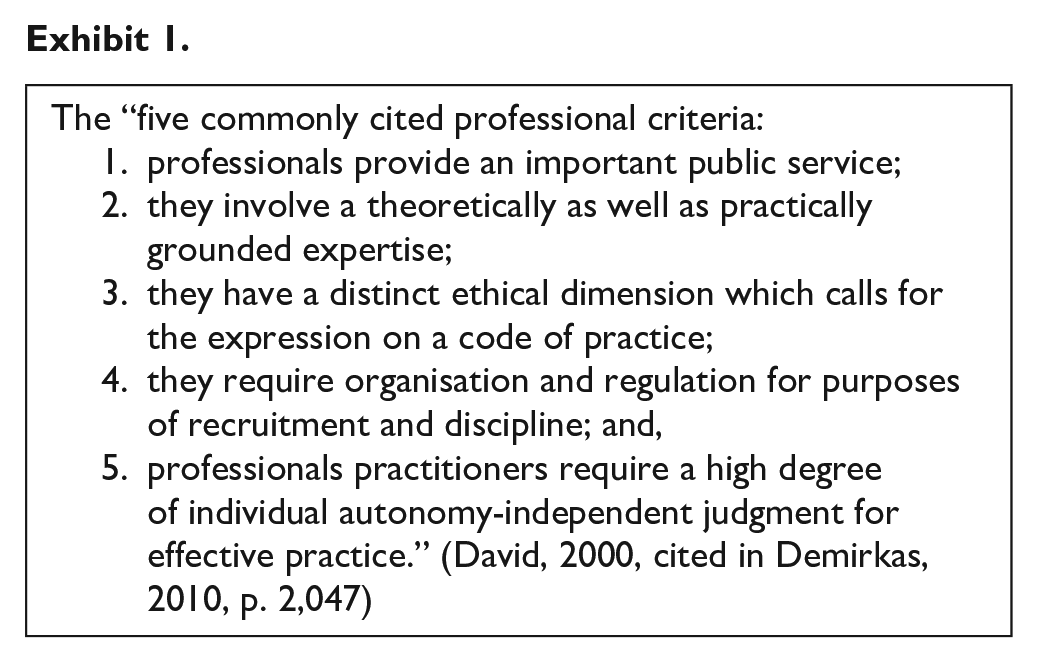
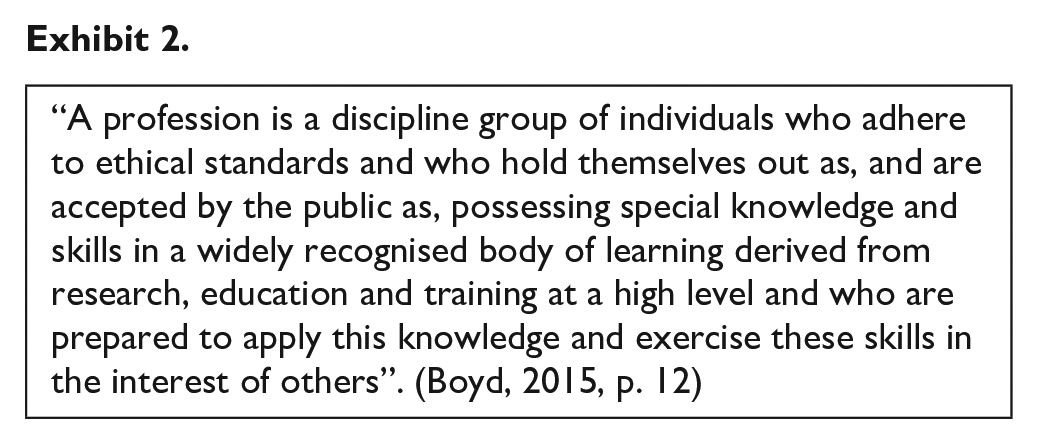
I would argue, though, that such definitional synthesises and precision might in this neo-professional age be redundant and actually should be observed as nothing more “than a time wasting diversion” (Evetts, 2014, p. 30). It is perhaps of more use to observe the professionals, as Illich did, as having some major roles that tie the threads of society together. That is, a sapient role through which they advise, instruct, and direct. Such authority to direct, though, is tempered through moral and charismatic authority. Thus, I forward that “a professional can be socially responsive and still be technocratic and democratic” (Illich, 1977, p. 83). This, I suggest, makes the professional role a useful one, as through the exercise of their knowledge, skills, and understanding, within defined ethical frameworks, professionals fulfill broad societal needs (Pellegrino, 2000). My argument, though, is also that it is the public, at large, not the professionals themselves, which ultimately declare the competency of professionals (Crigger & Godfrey, 2010). Through the social consensus paradigm, I detailed above, it is they—the public at large—that legitimate the continued existence of modern-day professionals.
Ok, prosecution do you want to provide your submission now.
Here and now your honor . . . yes (shuffling papers) . . . absolutely . . .
Here then Counsel will employ Schopenhauer’s stratagem XII. Within such, the art of extension is employed. As such, Prosecution will attempt to substitute, in the minds of the court, the word “power” for “professional.” It is through the employment and substitution of Defense Counsel’s use of professional for power that Schopenhauer would indicate an argument may be won.
Ladies and gentlemen of the jury, I want to start with one simple question. How . . . is it possible that craft persons of the medieval period have morphed into professional bodies that now control society? In evaluating this transformation, I am minded here by Socrates dictum (E. Baumgarten, 1982/2006, p. 282) “that no craft or profession should seek its own advantage but should benefit those who are subject to it.” How, then, in light of the craft guilds development “might we separate craft from crafty?” (Sanders, 1993, p. 76). I suggest that we might begin by analysis of the employment of professional and professionalism. The word professional is, I believe, employed as a mask to its true objectives and social purposes (Waisbord, 2012). Professional might be the word they use to gain an air of respectability but what they actually achieve is something completely different (Crigger & Godfrey, 2010). My argument, therefore, is that the employment of professional is different in different contexts; it has “semantic but substantive difference” (Crigger & Godfrey, 2010, p. 17). So, while we may have a common language of professional, this word, this concept is “understood only partially by outsiders” (Barrington, 2005, p. 136). Professional, I put forward should be defined as both a “promise and menace”—in reality it is nothing more than a promising menace. It is though not just a word but also a performance act, both “in and as language” (Waisbord, 2012, p. 46). It is through performative enactments of promises of care that craft guilds embedded themselves in socio-material webs. It seems that under the cover of time there has been a word/mission creep where “craft has [indeed] become crafty.” Crafts people, then, have gained control, such that they “control controls controlling control” (Sanders, 1993, p. 76) with enough dexterity to replicate themselves endlessly. While military mission creep often results in unplanned consequences, the word creep here always had intentionality. This intentionality was inextricable in its attempts to “secure and maintain control” over professionals working in the “economic, political, social and intellectual spheres” (Reiter & Williams, n.d., p. 3). This word creep, then, reflects power in the making (Waisbord, 2012) as a tyranny of experts (Susskind & Susskind, 2015) became an entrenched, supposedly caring, army of occupation. Woven within the illusionary promise of care, we have all been ensnared and enslaved by a modern priesthood, “armed with an aura of divine authority” (Illich, 1977, p. 22). Professionalism, then, is no more than a “powerful ritual” of power (Illich, 1977, p. 28). We have been enmeshed in a zero-sum game (Slotkin, 2010) where professionals have become a “solid entrenchment in the perceptual” Sanders, 1993, p. 86) as the citizen is disabled through the power of illusion and the illusion of power (Illich, 1977). My conclusion then is that professionals are nothing more than a disciplinary mechanism of power (Waisbord, 2012) that “captures status [as it] negotiates and regulates” (Evetts, 2014, p. 38). It is a foreclosure machine, run by a modern priesthood. A machine that seals and homogenizes as its mechanisms of replication provides machinations run on machined cogs oiled with pure power.
Professing themselves to be wise, they became fools. (Romans 1)
Let me exemplify how this power operates in practice . . . “for the great secret of modern power is that it is hidden in plain sight” (McKinlay & Pezet, 2012, p. 5). How did professionals take and hold power, how do they replicate themselves endlessly? Let me start by asking you to examine again Defense Counsel’s Exhibit 2, especially the phrase “possessing special knowledge.” A phrase that appears in most professional charters and standards. I want you now to ask yourself these questions—Why should it be the case that professionals control the acquisition and application of knowledge (Susskind & Susskind, 2015). In addition, why is it that “professions enjoy state sanctioned privileges which grant them monopoly of power” (Waisbord, 2012, p. 46). I suggest that it is at this boundary of professional integrity where professions manage the “hazy borderline between knowledge and non-knowledge” (Fuller & Godfrey, 2012, p. 3) [or not their knowledge] that we bear witness to a concerted program of deceit and systematic effort to mystify and deceive (Susskind & Susskind, 2015). Such policed boundaries, I argue, act like blinkers (Fuller & Godfrey, 2012) to obscure layers of deviation and blockages and the mask professions’ history of cultural engineering. It is within this “administrative monarchy” (Foucault, 1991, p. 102) that society is bent and shaped—not drawn together (McKinlay & Pezet, 2012). To me, professionals here have embedded themselves in society as a menacing omnipresent force (Foucault, 1974) and through the formulation of enunciative modalities they have carefully positioned subjects (B. Baumgarten & Ullrich, 2016). By enhancing the impression of expertise and care, they have created a self-replicating Cartesian heritage (Fuller & Godfrey, 2012). A heritage, which through “ruses of power” and the “effective manipulation of black boxes and grey zones” has produced a gray ontology, and epistemology that casts grey shadows of power (Fuller & Godfrey, 2012, p. 9). I suggest, this control of knowledge shades “off into the background . . . the troublesome materiality of things” (Fuller & Godfrey, 2012, p. 13). Within this materiality, “mechanisms of persuasions” (Biow, 2002, p. 11) created by knowledge control, create power and, in turn, power creates control. This is the mechanism of the self-replicating machine. Whose essential mechanism is built upon professions control of knowledge (Abbot, 1988). Through this machine’s re/production of regimes of truth “knowledge is not made to understanding, it is made for cutting” (Foucault, 1991, p. 580) the cloth of society to pre-designed patterns. We need, therefore, to take seriously that knowledge is the stuff of power (Foucault, 1991).
To conclude this section of my argument, it is important to note that language of professionalism is diffusional. That is, it has a double effect of promise and menace (Susskind & Susskind, 2015). From this point forward, I ask that when you hear the word professional, I want you, members of the jury, to substitute this word with power. It is only through such substitution that you will truly to be able to subvert the replicating machines actions and understand how professionals employ govern—mentality and how this technocratic elite of crafts people have perfected the mechanisms of social control (Waisbord, 2012). These guilds have exploited a technology of power and have become governmental through hundreds of years of gradually . . . slowly governmentalizing knowledge, making “knowledge powerful and power knowledgeable” (Foucault, 1991, p. 81).
—“just one bad apple”
At this point, the Prosecution is seeking to undermine the notion that a professional is of good character. Counsel will attempt this through the application of Schopenhauer’s (n.d.) XXV stratagem. Namely, that by consistently substituting contrary examples, as diversion, they will demonstrate that professionalism is about power and control not good character, morals, and ethics. Now, back to the courtroom.
Judge, I want, if I may, to refer directly back to the court transcript of this case.
Sure, that is your prerogative. Stenographer will you make the specific sections, of the transcript, available to the jury.
I am obliged your Honor.
Now, let me start members of the jury by asking you to refer to page* of the transcript. Here, Defense Counsel, in their wisdom, stated that professionals “build communities” and while they may be a “moral force” they are certainly an “ethical one.” The propositions of ethics was again emphasized in Exhibit 1—point three and within Exhibit 2. Later, please see page*, Defense Counsel details, and this is a most important point, that professionals “do the right thing even when people are not looking.” Furthermore, the transcript, on page*, reveals that “professionals offer societal support” “harbouring forth” from their market shelters. Finally, I would like you to examine page*. Here, Defense Counsel defines professionals as “learned experts” in the “service of others.” A point they again emphasized by introduction of Exhibit 2 into the Court Record.
From such evidence, Defense Counsel would have you believe the central element of the professional’s status is they are a “manifestation of a good person, of moral life and of being a person who will make moral choices based on good character” (Evetts, 2014, p. 33). My first question to you, ladies and gentlemen of the jury, is this—How do you measure such things as goodness or other aspects of professionalism like humility, compassion, being honorable or brave? (Crigger & Godfrey, 2010; Evetts, 2014). How do you teach such things? All of these characteristics are though central to the good character that Counsel denotes is fundamental to professionalism. But earlier I asked you to consider a most important question “Ouis cutodiet ipsos custodies.” I now offer you the answer to this question of who watches the watchmen. It is “their own deluded sense of duty, checks and balances” (Fuller & Godfrey, 2012, p. 76). If we accept Defense Counsel’s definition of the neo-professional as a social construct, then I argue that there is “no restraining force to keep the professional honest” (Crigger & Godfrey, 2010, p. 21). In reality, the professional claims legitimacy, over a “passive clientele” as a protector, interpreter, and supplier of care or service (see Illich, 1977). However, the professional must be worthy of such trust. But . . . I have argued that professionals are “inseparable from the logic of power” (Evetts, 2014, p. 35). Are we to believe, as Defense Counsel wants you to, that we only have ethics, morals, and a good character, things that I have suggested are hard to measure, to restrain “rampant individualism” (Evetts, 2014, p. 35)? Indeed, I believe it is epistemological ideals of cognitive autonomy and good character that leaves the professional ill-equipped to deal with modern society (Weber, 1990). I suggest to you, therefore, that at the heart of professionalism there is a lie—a lie that enfolds truth within a performative violence (Kronick, 2000, p. 1002) that hollows out the kernel of professionalism. I put it to you that one of the most visible changes in this so-called era of neo-professionals is the spread of malpractice cases (Weber, 1990) and something that is much, much worse . . . murder!
I now want to place a specific lens on those professionals who have successfully met the requisite standards, competences, moral, ethics and so must, the Defense argued, be of good character. I want to show, beyond reasonable doubt, the darker side of professionals and the pernicious power they have over us. Let us start by introducing “Dr. Death”—Harold Shipman—who murdered 218 of his patients. He is reputed to be the most prolific serial killer of all time (Manchester Evening News, 2018). Or, how about another professional of good character and morals—“The Angel of Death,” the Nazi Dr. Joseph Mengle. Then there was Dr. John Bodkin Adams who murdered 160 patients for money. Of particular interest here is Dr. H.H. Holmes—reputed to be America’s first serial killer. He built a torture castle to practice his art on his patients. Furthermore, there is the “Green Beret Killer” Dr. Morris Bolden who murdered 30 Italian migrants (Holmes & Holmes, 2009). It is not only doctors who kill but also the nurses. For example, Jane Toppin killed 31 patients with morphine. Her motive? She wanted to kill more people than anyone who had lived before. A particularly evil case was that of Nurse Beverly Allit, who injected children with insulin and air bubbles. She murdered four children in 39 days, attempted to kill three others, and injured another six (odee.com). I could go on but it is important to recognize that while Defense Counsel tells us that professionals have had a long respected history, there is also a long history of health care professionals killing patients (www.cbc.cal).
To move forward, let us take the profession that Defense Counsel argued was the architype for all professions that of the priesthood. A priesthood that has been involved repeatedly in child sex scandals. However, priests, reverends, and ministers also murder. To offer one example, there is Hans Smidt, a Catholic priest who claimed that God himself had told him to kill his housekeeper. This divine intervention came while our Hans was having a sexual encounter, with said housekeeper, on the high altar of his church. He subsequently slashed her throat, drank her blood, and then dismembered her body (Gado, 2006). What interests me about these professionals, of supposed good character, is that many people had suspicions as to the morals and ethics of these doctors, nurses, reverends, priests, and ministers. Indeed, Hans the blood-drinking murdering priest was noted for carrying the heads of dead geese around in his pockets. However, because of the professional autonomy and lack of oversight, many of their crimes went unnoticed for years (oddee.com, n.d). These professionals hid in plain sight. Often, they were respected members of the community. Here, then, we may observe how society has been subverted by the “unquestioned assumption of all-embracing professionals” (Illich, 1977, p. 22). I suggest that professionals are not “a common treasury for all” (Fuller & Godfrey, 2012, p. 2). They are not people who “provide their services altruistically” (Illich, 1977). They are in fact organized crafty people who by a ruthless control of knowledge have gained the power to subordinate people’s lives. As Stanley Fish (1985) notes, professionalism wears a different face “the face of manipulation and self-aggrandizement “(Susskind & Susskind, 2015, p. 26).
I would like to finish my submission by attacking Defense Counsel employment of “competency” Thereby, I finish with a quote by Sanders (1993, p. 88), “If the mark of a professional is competency at some difficult task then cannot every criminal . . . be understood as a professional?” Professional, then, is one of those “bullshit words”; it says everything but says nothing. Professionalism though is different, as it equals power. It is an algorithm formed within a zero-sum game which ensures that power plus knowledge, plus manipulation equals professionalism. This is the algorithm of professionalism; it is not one that has a factor of care.
Are you ready with your closing arguments.
Yes mam, I am . . .
At the conclusion of the trial, I ask you, the jury, something that no one here today will ask you to do. I simply ask that you maintain the status quo, make no changes, and by doing so protect and preserve the role of the professional. I ask you not to leave the professional role to the mercy and cynicism of the prosecution. Rather, I ask, no I plead with you to rescue, protect, and preserve the professional as a citizen who brings a force of stability and solidity to society. This rescuing and preserving of the professional’s role and status, ladies and gentlemen of the jury, must be your greatest rallying call. What you will be upholding today is not just professionalism itself, but the solidifying force of the modern professional in the protection of social justice and democracy.
Okay Prosecution; let us draw this to a close.
Throughout this trial, my central argument was that professional is a recursive definition (it is in itself—all of itself). Professionals are but actors on a stage of professionalism. They act in the performance of a “zero-sum game..” 7 A game where they hold the power as they always define the questions (Zola, 1977), knowledge base, the rituals, and the language. Professionals, then, are iatrogenesis, undemocratic capitalist modern priesthood elite who serve to disable the citizen. They have become a scientific orthodoxy, a crusading helper to normalizing judgments and an inspecting gaze. The craft guilds have found legitimacy through the performative violence of professionalism. These performatives “have produced a truth whose power has imposed itself” upon us, it has located a boundary between them and us, it has created a truth a “dominant and judicially incontestable public truth—professionals have made this truth real” (Derrida, 2002, p. 51).
In my closing argument, I pose these. Are professionals no more than instrumental actors on a stage of charters, standards, and oaths? Is this but a Janus performance of violence? I have revealed to you, through examination of their history, definition, and operation of standards, that professionals have a much darker side. In revealing this face to you, I unmasked professionals underwritten by power and as nothing more than “thieves and task monopolists [of] civic engagement, who overestimate [their] degree of impact” (Illich, 1977, p. 96). I put it to you that professionals’ epistemology and ontology is that of space “shrink-ers” in perverting citizens’ pursuits of democracy and social justice. Professionals through their “isms,” therefore, provides professionalism as [nothing but] oppressive and discriminatory attitudes and beliefs” (Merriam Webster, 2018).
“For too long our “isms” have pushed our young, our poor, and our minorities to the back of the social justice bus . . . . . . we all have got to come to grips with our isms.” (Joycelyn Elders)
8
Members of the Jury, you have heard the evidence. I now turn the case over to you . . .
Footnotes
Declaration of Conflicting Interests
The author(s) declared no potential conflicts of interest with respect to the research, authorship, and/or publication of this article.
Funding
The author(s) received no financial support for the research, authorship, and/or publication of this article.
