



Abstract
We call ourselves the Arctic terns after the birds that migrate between the northern and southern hemispheres. Three of us live in south-west Britain and three in south-east Australia. We tried to make sense of our lockdown lives and the ways we were imbricated in world events. We wrote and made art in response. We read our work to each other and showed each other our artworks. The material practices we developed helped make the pandemic endurable, and at times hilarious. Here we share some of our work and some of our thinking about why it matters.
Keywords
A previous version of this article was written/shown/performed at the online International Congress for Qualitative Inquiry 2021. This article documents our process of writing and art-making, followed by performing/showing our work to each other online and our subsequent online/written/made responses to each other: an improvised process of writing and art-making together apart (Barad, 2014). We have been engaged in this process on Zoom since March 2020. Here we have each presented extracts from what Massey (2007) would describe as our “simultaneity of stories, thus far” (p. 42). Our collaborative process has made a space in which to bear witness to these very strange times.
We met more frequently at our separate ends of the earth: the three from the United Kingdom (Davina Kirkpatrick, Carol Laidler and Jane Speedy) calling their work the Quarantine Conversations and the three from Australia (Bronwyn Davies, Susanne Gannon and Sheridan Linnell) calling theirs the Corona Diaries (names that belied slightly different ways of working), but we met together as a group of six women online across the continents every 6 weeks, or thereabouts. We had initially meandered somewhat haphazardly into this process and had simply agreed to document our lives as the pandemic unfolded. The practice that we eventually settled on together was one of meeting and chatting together about ongoing events (both personal and political) and then reading our work out loud to each other online, while sharing online the images we had made. 1 The following selections from our work over our first year of meeting were made and collated into this article. First each person shared their writing and images, and then, following in the same order (sometimes we reversed this order) we each made our responses, in each other’s presence online, into the space that we produced between us/across the planet. These material/relational/vibrational inter-weavings etched repetitions/iterations/vibrations across and between us in ever more complex networks. These were interconnections and intersections that we likened at various moments to Eva Hesse’s (1969) latex “rope” sculptures and Yayoi Kusama’s (2013, p. 21) infinity nets—perhaps these free-flowing, structured allusions also indirectly referencing Haraway’s (2016, pp. 9–58) string figures; multi-species muddles and tentacular thinking?
Here are the chosen extracts from our process, in the order we presented them at ICQI:
For 17 years I have lived in a place I thought was perfect. I loved the physical space and I loved the people, I loved swimming in the ocean pool. My friends visited me here for coffee, for lunch at Douce France or dinner in Llankelly Place. Now that’s all gone. Pools are closed. Theatres are closed. Coffee shops and restaurants are closed.
We are allowed out to buy necessary goods and to exercise. The fear of being confined to our homes for 2 weeks if we test positive gives rise to frantic hording behaviour and the supermarket shelves are often empty. The price of food goes up and the quality goes down. I start to grow food on my windowsills and experiment with eating geranium petals.
It is seriously hard work—everything has become dangerous and exhausting. Even the beautiful fresh fruit and vegetables look dangerous. I wash them in soapy water for 20 seconds.
Going out for my daily walk is a nightmare. The people in my neighbourhood are indifferent to social distancing. I got trapped in a narrow walkway down by the harbour, by a man swaggering with his partner toward me, leaving me no space at all to pass him safely. I climbed up backwards onto the sheer rockface and I lost it, calling him a selfish shite.
“Go fuck yourself you old hag” he replied.
My ambition for this week is to get clear in my mind (and my gut) that the virus is just one more threatening life-form, along with redback spiders and brown snakes and sharks and funnel web spiders. But I’ve discovered that if I relax and pay attention to the sunlight and the air and the sky when I go out for my walk, I forget to do social distancing. Being careful hasn’t become automatic yet; it still needs to be fuelled by fear/anxiety/hyper-vigilance. Given that 9 out of 10 people in my neighbourhood appear to have made no effort to learn it, or remember it, I have to remain vigilant all the time. It’s exhausting.
First day of winter and it is a glorious sunny day.
I went for a walk yesterday down to the Botanic Garden and lay down under the Holly Oak and felt the strength of the roots underneath. As I listened to the birds, I started to find my way back into my skin, responsive to the birds and the breeze and the dappled sun. The state of fright I have been in started to ease itself. On my way home I carried with me a piece of the Holly Oak that had fallen. I felt less threatened by runners coming up silently from behind while I was holding the stick a little out from my body. It didn’t feel dangerous, I didn’t imagine I would hit anyone with it, it felt, rather, like a small piece of the Holly Oak protecting me.
When I got home I sandpapered it and filled in the holes with beeswax and oiled it, then added the crown and the eyes and nostrils. It’s a nulla nulla, about 14 inches long and the end you can’t see is pointy and sharp. She is both funny and scary and somehow magical (Figure 1).
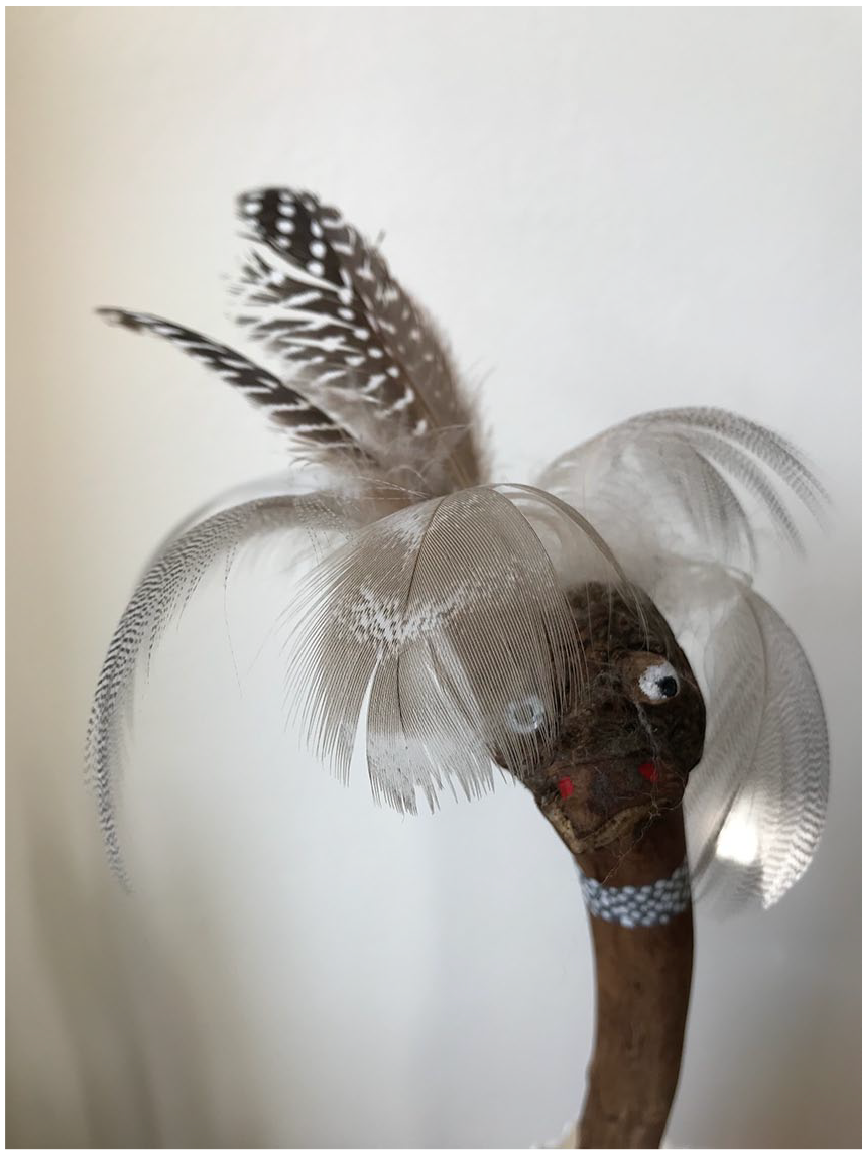
Nulla nulla. Holly Oak wood and found feathers, Sculpture and photo: Bronwyn Davies.
I have discovered that inside the paths around the harbour that I used to walk, there is a parkland where almost no-one goes. A space I can pause in, and wonder. I lie under an angophora costata that reminds me of a dragon (Figure 2).
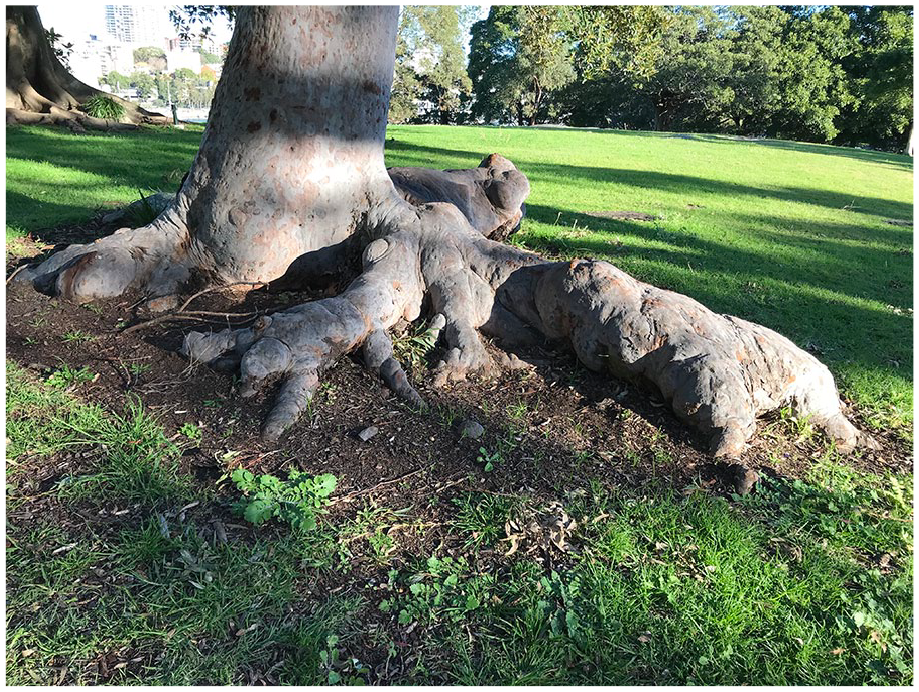
Dragon Angophora, Photo: Bronwyn Davies.
I visited her each day for weeks before it occurred to me to touch her. When I stand between her dragon paws and place my palm flat on the smooth bark, a surging energy runs up through the soles of my feet and hums in my genitals, then surges on up through my body. I hadn’t anticipated she would be so sensual.
Barad (2012) asks how particles sense each other—particles such as my body’s particles and the trees’ and birds’ particles, the arctic terns’ particles.
The force the tree exudes comes not just from the visible, and visibly beautiful trunk and branches, but from a vast underground network between and among the sister angophoras. Through tapping into that force, walking the root-line, the particles of my body are affected, and I am becoming-tree, my roots entangled.
How, I wonder, does the tree take up not just the particles of skin that I shed, but my living particles’ force and energy, such that it too is individuating, composing, metamorphosing, becoming-in-its-own-way-human.
Barad asks:
What if it is only in facing the inhuman—the indeterminate non/being non/becoming of mattering and not mattering—that an ethics committed to the rupture of indifference can arise? (Barad, 2012, pp. 217)
I am cocooned in this pandemic life, and isolated, yet fully alive in words and art and the gift of life’s interconnections–its spacetimematterings, its parklands and the gatherings of we six Arctic terns.
I re-turn to the parkland each day, breathing the cold air that blows off the ocean, shedding small particles of dry skin as I go, skin becoming the soil of the parkland, becoming the soil’s minute creatures, feeding the lives of the parkland’s trees and birds (Figure 3).
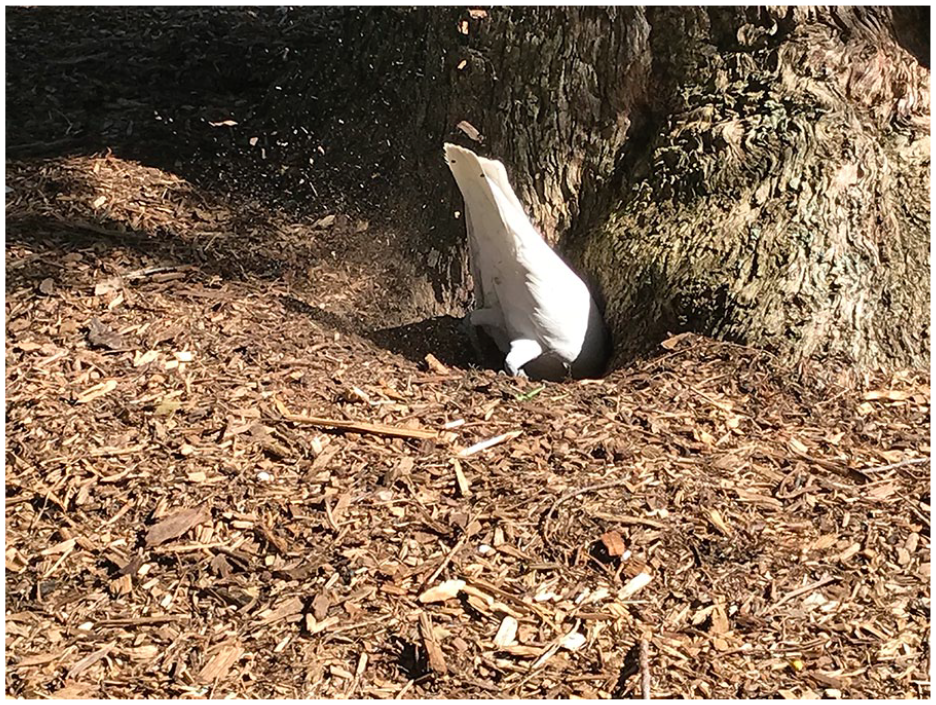
Cockatoo digging, Photo: Bronwyn Davies.
Today a cockatoo busily digs the earth, sifting particles of me deep into the soil. I am becoming-earth, becoming-bird, becoming-tree.
We share a “life that is able to transform itself depending on the forces it encounters, always increasing the power to live, always opening up new possibilities of life”(Smith, 2014, pp. 213).
Creating desire lines to follow; I create a mosaic of a giant cockerel on the side of my studio. I have wanted to do it for at least 15 years, it will serve as a good memorial to lockdown and means I can be in the garden in the sunshine. It also reconnects me to the enjoyment of the collective memorial mosaic making sessions in Cumbria pre-lockdown. The process exhausts me physically but also has the meditative quality that making holds for me; being both engaged in process and decision making yet my mind ranging freely thinking about Covid-19, the implications both personal, political and global.
Meanwhile indoors my dad writes his life story for his grandchildren.
I notice all the casual touching in the movies we watch each evening, the jostling crowds, the nearness, the proximity of bodies in space, and miss it. My dreams are technicolour productions—brim-full of festivals, jostling crowds, bodies pressed close to one another, alternative sensorial theatre, and sex in all its sticky, messy, odourful delight. All the forbidden pleasures of life in a pandemic. I crave sweetness upon waking and last thing at night, what is it a substitute for? This may contribute to my disturbed sleep and wild, confections of dreams.
Lack of touch due to social distancing has heightened my awareness of tactility, I take this yearning for touch into the studio (Figure 4, 5). Finding a way to re-formulate my focus and intensity. I work with some of the walk images from Gwithian Towans the day before lockdown, but also with what is absent now and for the foreseeable future—not going to the beach, missing the wide-openvistas of a littoral landscape, where Ulf, the red dog, can run free, breathing in the saline-infused air and hearing the repetitious rhythm of waves against land.
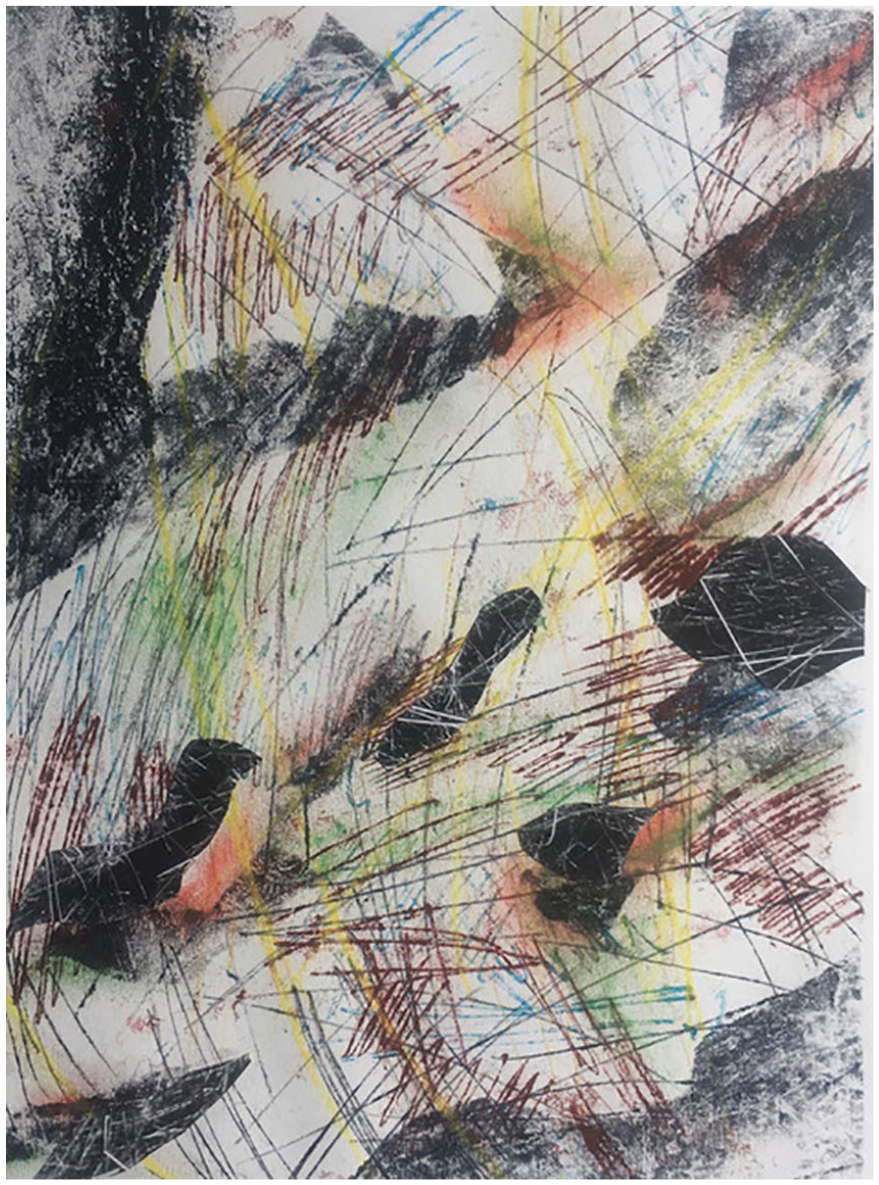
Sense memories I, Monoprint: Davina Kirkpatrick 2020.
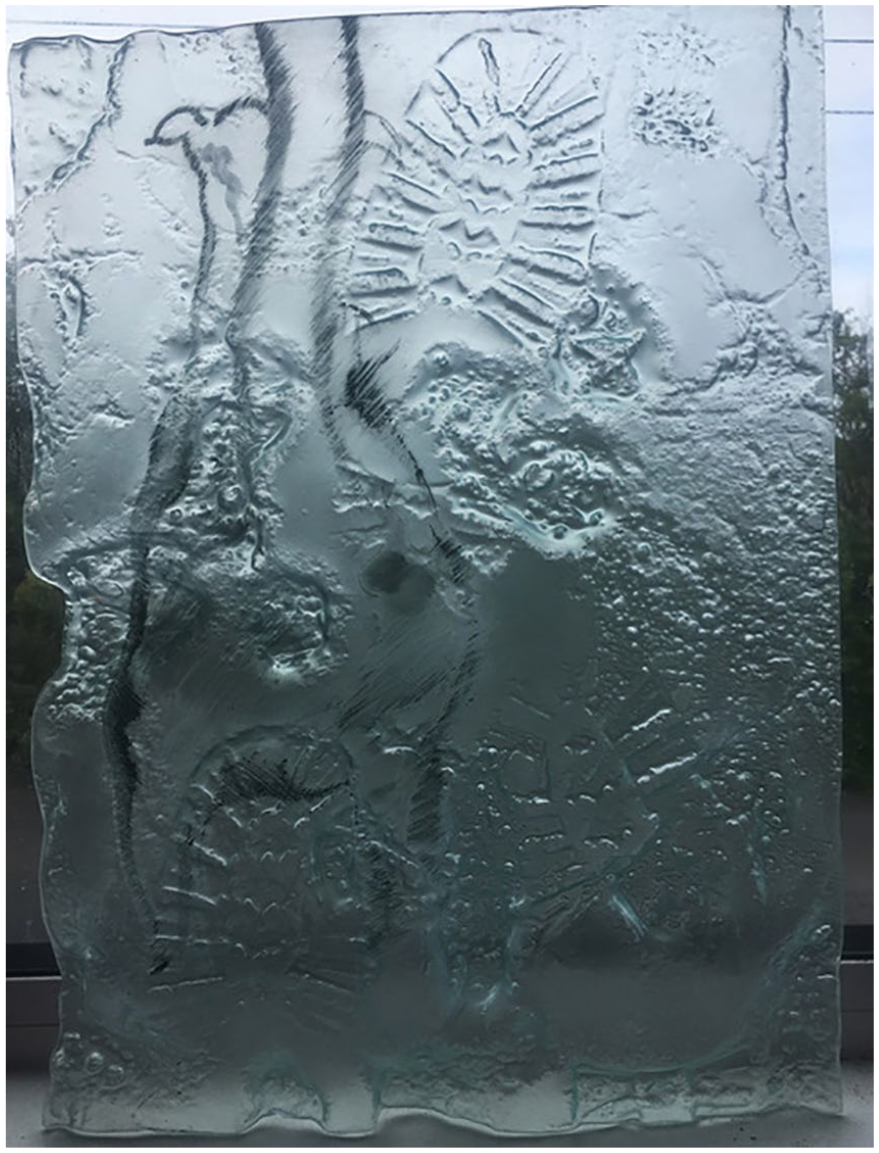
Sense memories II, cast glass: Davina Kirkpatrick 2020.
My favourite waking act is to nuzzle Ulf. I put my head on his chest whilst he is lying on his back and kiss him, inhale his ginger nut biscuit smell. He makes his happy dog noise in the back of his throat, as his paw rests on my shoulder.
I feel embraced and that all is right in my world. We often lie like this awhile, if he tires of the proximity first, he gently kicks me with his back leg, I raise my head and he sniffs my breath and licks the tip of my nose, it is an act of inter-species communion that has become vital this year. I love the simple, uncomplicated communication so different from the relational tussles between humans. Kindness is a key that unloosens the ever-tightening knots of reaction and response, remembering that can sometimes be challenging.
I have planted a tree named after the matriarchal Scandinavian tree spirit Hylde-Moer—Mother Elder. A powerful potent pagan symbol that, of course, had negative Christian symbolism. According to folklore I could burn the wood to see the devil, as the sap and open structure of the branches makes it spit and scream, but by planting one I ward him off.
I draw it once planted and decide to evoke second century magic by layering over the words—abracadabra (I will create as I speak) written in the form of a triangle (Figure 6). Maybe I’ll make an amulet to ward off disease even if Defoe scoffed at this symbolic practice applied to doors during the Great Plague of London. I’m trying to find ways to be playful with my fears of an ill-timed easing of the lockdown rules.
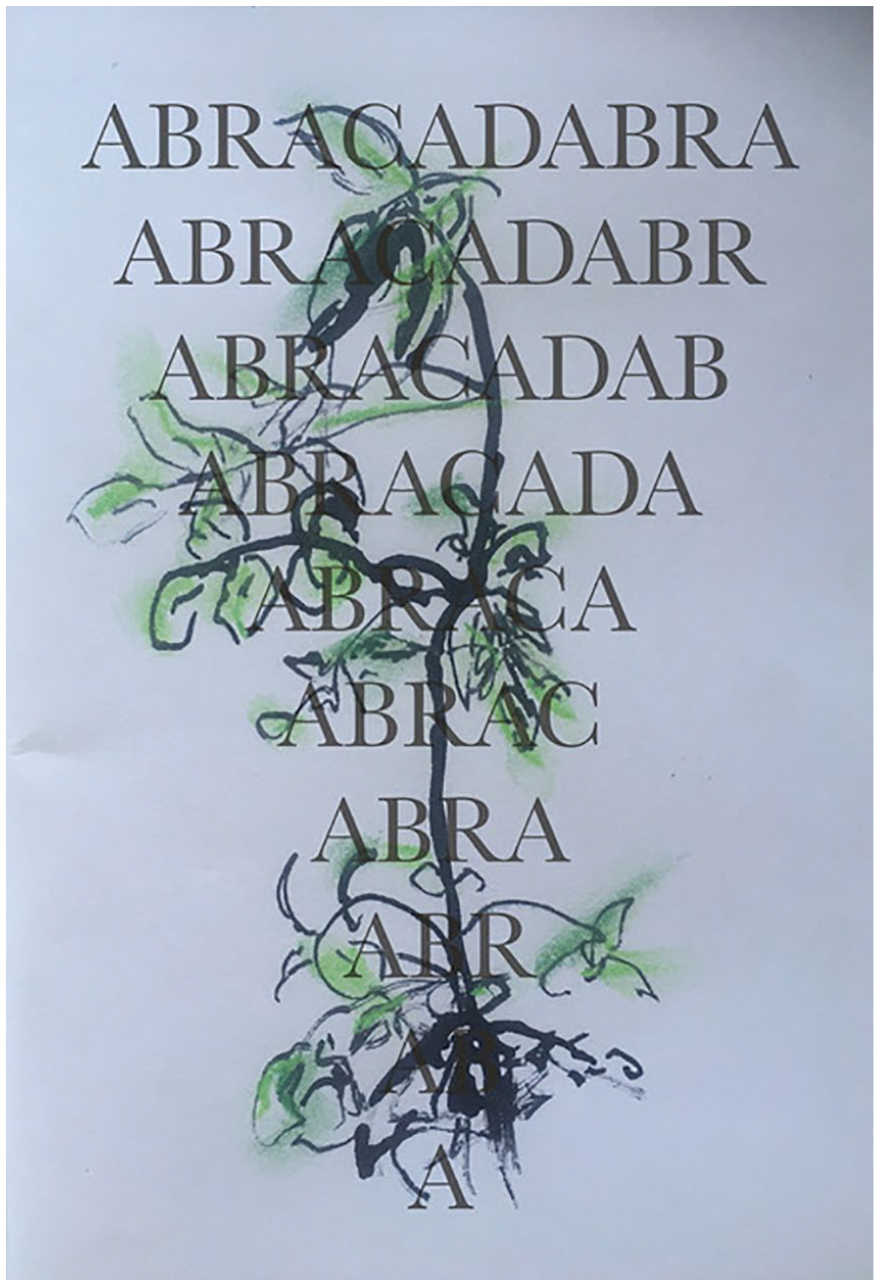
I will create as I speak, ink and pastel over giclee print: Davina Kirkpatrick 2020.
Creativity is vital to whatever utopian vision I have for the future; art enables us to look again, experience something differently, mend and make anew.
The swings are in motion, all the little pleasures break free. Black clad barristas trace hearts and flowers in a thick crema of excitement. Everything is free again and the account deferred for a fortnight. The sun is startlingly warm, everyday stars come out from behind their screens to join the cast. We are making the perfect family movie. I fail my audition for narrator and get a bit part as the grumpy old lady with bad hair walking round the edge of the playing field dodging and muttering at runners. And then there are the invisible extras defying social distancing rules—billions of them hanging around the set, waiting for their big break.
But it’s not so much Covid that’s the show stopper. It’s the sun, the breeze the clouds the cumulus of less and more, the tiny miraculous assemblages of cells and thoughts and moments the pulsing arterial roads and capillary byways, the call of currawongs this morning sheer amazement that we’re even here gone viral.
a low has moved in
malevolent vacuum
a hole in a thing that is not
too close, but apart from
I count on you all to create
thrownness (was it?) and wonder
the poem will be like you
that old shape of flashing wings
a riot cut in space
take out the scraps one after the other
snatch up big beakfuls of
every other bird’s song
Like black ice the virus is something you can’t see. You step gingerly out but suddenly your feet fly out from under you and you hit the ground hard. Except there is a delay in the stuttering old black and white film, a freeze for a fortnight before the fall. On a night of reports of deadly breaches on the Ruby Princess and in Melbourne quarantine hotels, an epidemiologist’s grave, crinkled face fills the screen. Asks with something on the edge of scientific and motherly concern, “Do they realise just how psychopathic this virus is?”
My granddaughter was living with us until one day I said her risk was also mine. She has been tender and pragmatic and clear about wanting to protect me and yet I still fear my words may have broken something. I keep retelling the story as though it could have a different ending, as though the narrative could turn out differently, as though we could sit around the dining table on a winter evening twirling pasta and stories of our days, until she retreats into her little room and streams trash on a small screen while my partner and I roll our eyes and stream B grade second wave scandi-noir through the TV in the living room. As though I am seeking some kind of absolution. . .
I thought that today I would write about the Chinese Australian man in the park. I thought I would write about how he rides a red bicycle and leans it against the trunk of a tall old tree. How he takes a shining sword with a long red tassel from his black rolled cloth, steps out to where the turf is close knit, thick and vivid green. How he turns with slow grace in the fading light of a late winter afternoon. How at sunset he leaps and is suspended for a moment in mid-air; a silhouette in black ink, a streak of metallic silver and a trail of bright red thread drawn across the darkening sky.
Spring…(Figure 7)
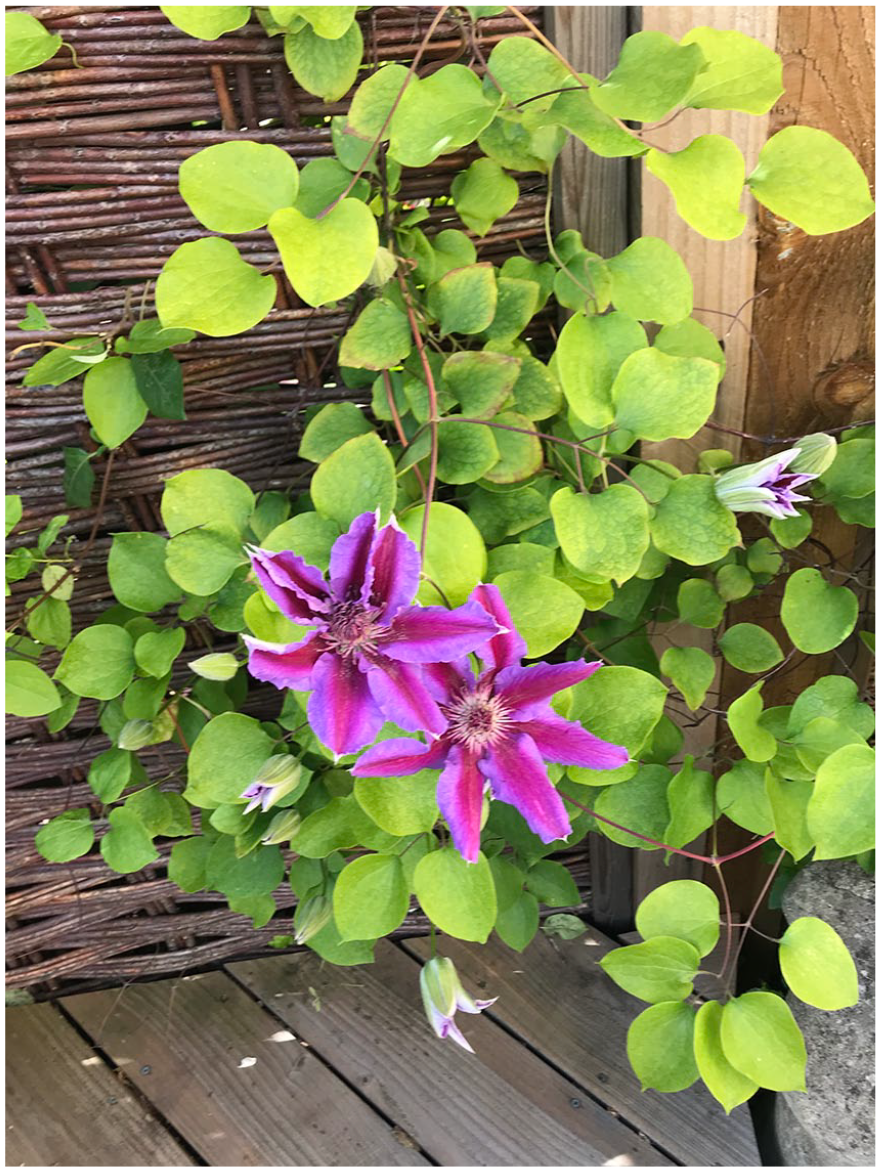
Spring clematis, photo: Jane Speedy, 2020.
Small life/small world/ Six weeks down this lane/ Bees in the rosemary /Deadheads in the lavender/
Tai chi in the lane/ twice a week/ Today the bin men interrupt/ Keeping a social distance/
buttercups surround the armless Statue/
and today the sun / beats down on the rain-soaked soil/
Small life/ small world/Six weeks in Denmark place/Bees in the rosemary/Deadheads in the lavender/
The rosebuds bursting through the fence/ popping up along the borders/Dunnocks building their nests/
The wisteria snowing white tendrils over the trellis and dropping poisonous seeds onto the deck/
Small life/small world /six weeks down this lane/ Bees in the rosemary/Deadheads in the lavender/
Just outside on the main road/passing sirens remind us of more lives /a larger world /
Small life/ small world/six weeks down this lane/
Bees in the rosemary/ deadheads in the lavender/
My son passed through/Just for the night/On his way back to London/
We all wore masks/And kept our distance
I made him Fish pie/And we actually had pudding/Apple charlotte/
But left in too long it was dry/ even soaked in custard/
our pudding and sorrows/ drowned in too much red wine
We all wore masks/And kept our distance
We gave our loving/and human touching /to his little dog (Figure 8)
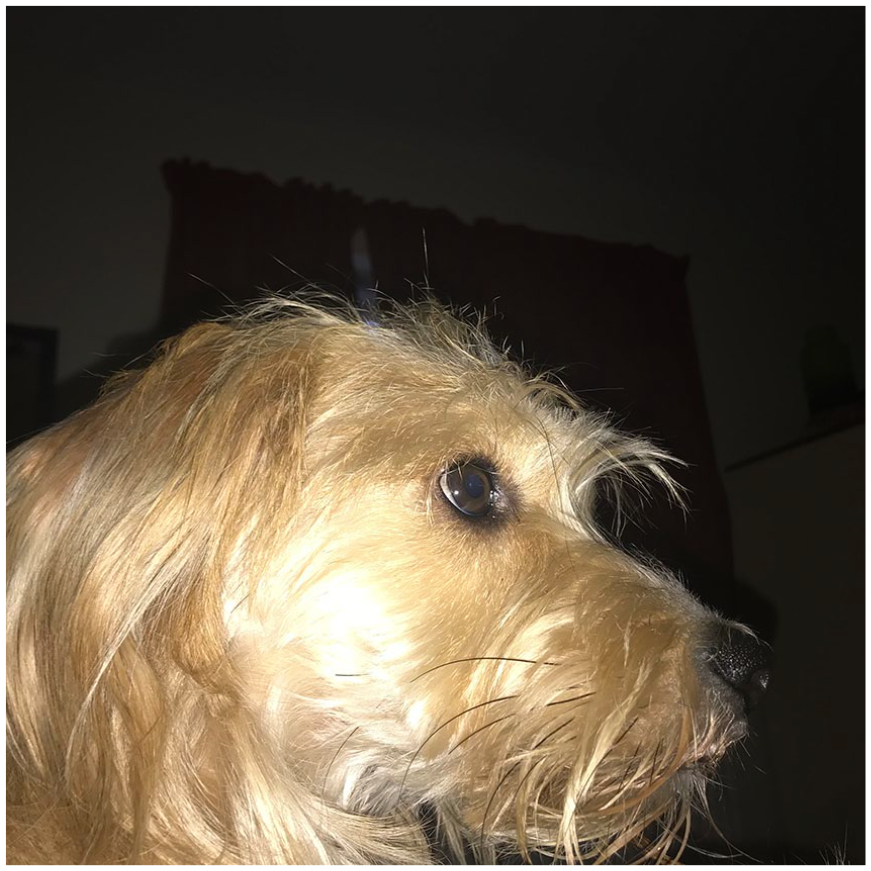
Little brown dog, photo: Carter Speedy, 2020.
Who comes rushing in/In the morning/
The way he used to . . .
Jumping on the bed/ running round in circles/
We all wore masks/And kept our distance
Then he waves goodbye/
Standing by the gate with his little dog/
And is gone/
a shadow of somebody important in life/
somebody fun and funny/
who makes me laugh and laugh/.
He was almost here
a familiar, untouchable stranger Just passed through/
We all wore masks/And kept our distance
The line etched out by this writing/
bumps up against other sinews (Figure 9)
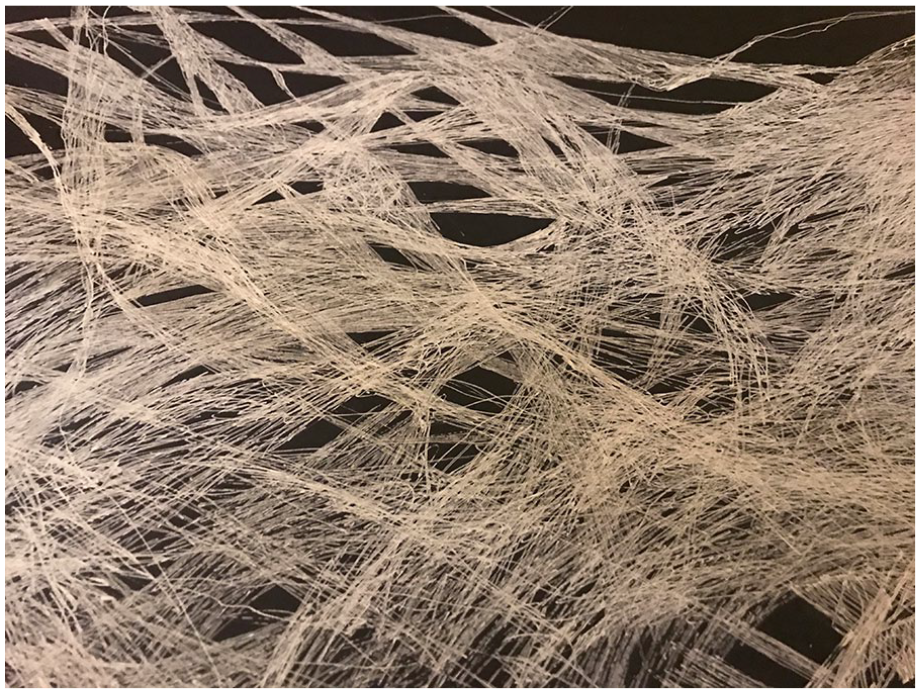
Sinews and nets, ink drawing on sugar paper: Jane Speedy, 2021.
/in the body of lines/
other stories/memories/histories/complexities/
ripping through with beauty/
skin peels away from this chaotic body of work/
estuaries overlaid with seaweed/white lines evoking fragility brought together/fraying and gaping edges/incomplete/unfinished/
ripped through . . .
What we are doing
Is not random
What we are doing is intentional
What we are doing is bruising
And quite often accidental
What we are doing is poignant and funny
And what we are doing is really quite beautiful/
I am thinking now with/ all five of you . . .
in your continuous presence/
Bronwyn’s dragon tree /its arms curving up and down across the ground/sitting in the botanic gardens/ leaning up against the tree/listening to the humming mycorrhizal messages the tree sends out into the ground beneath . . . /
Davina etching in her garden/ etching in glass with acid/The glass smoking/Smoke pouring out of the wound the acid makes/
Susanne walking along burnt-out blue mountain bush trails /surrounded by blackened plants/ discovering fragile growth
popping up through blackened earth/
Carol looking through old books of architectural photographs//cutting out black and white images/ sticking on small squares of colour/ typing with an ageing 1930s typewriter/
Sheridan zooming with students/ collaboratively graffitiing on a large screen/dancing around/the screen filling with ever-changing colours and patterns/
Sitting in my garden in December/ the sun shining and the Olive tree still producing fruit/ yet another sign of our climate changing/
here we are together:
Thinking/sitting/leaning/listening/curving/humming/sending/etching/holding/drawing/smoking/pouring/smiling/walkingdiscovering/popping/regenerating/hill-walking/hiding/looking/choosing/cutting/sticking/typing/ageing/sitting/scrutinising/zooming/graffitiing/dancing/filling/everchanging/laughing/writing/shining/producing/yellowing/changing/
I’m thinking about The Hundreds by Berlant and Stewart (2019). An experiment in ethnographic writing aimed to document “the new ordinary.” Exercises in “following out the impact of things (words, thoughts, people, objects, ideas, worlds) in hundred-word units or units of hundred multiples” (ix). Tiny texts to “get at a scene or process a hook” (x). Not a sequence or an argument but rather, intentional fragments, fractures, faultlines. Everyone, everywhere, is counting in decimals: tens, hundreds, thousands, tens and hundreds of thousands, millions.
Last night I dreamed I was touched. My shoulder squeezed, my arm stroked, my cheek brushed by lips. It doesn’t matter what the move was, or who, or where. What stayed was the sense of ease—her leaning into me, me to her. This was our normal. From a distance, her telephone voice can do some stroking—hold a smile, slip a laugh in alongside the words, a swallow holds a multitude of meanings, an exhalation holds the world. English is also a tonal language, of throat, tongue, air that flows and stops, vibrates and touches.
Writing back to back, writing back, writing black and blue. I find I need my blue felt slippers to write. We thought of braiding but what if each hank of hair doesn’t know the other, wends differently, amulet laden dreadlocks instead of tidy plaits. Remember that theatre workshop where we wrote characters having conversations that were misaligned, oblique. We expect a conversation that follows, each line answering another, call, then response, and so on (Figure 10). Dialogue. This is a sensical, sensible way of writing. But how to blow this up. What else happens. Blue flies through birds, slippers, bells, hair, hemispheres.
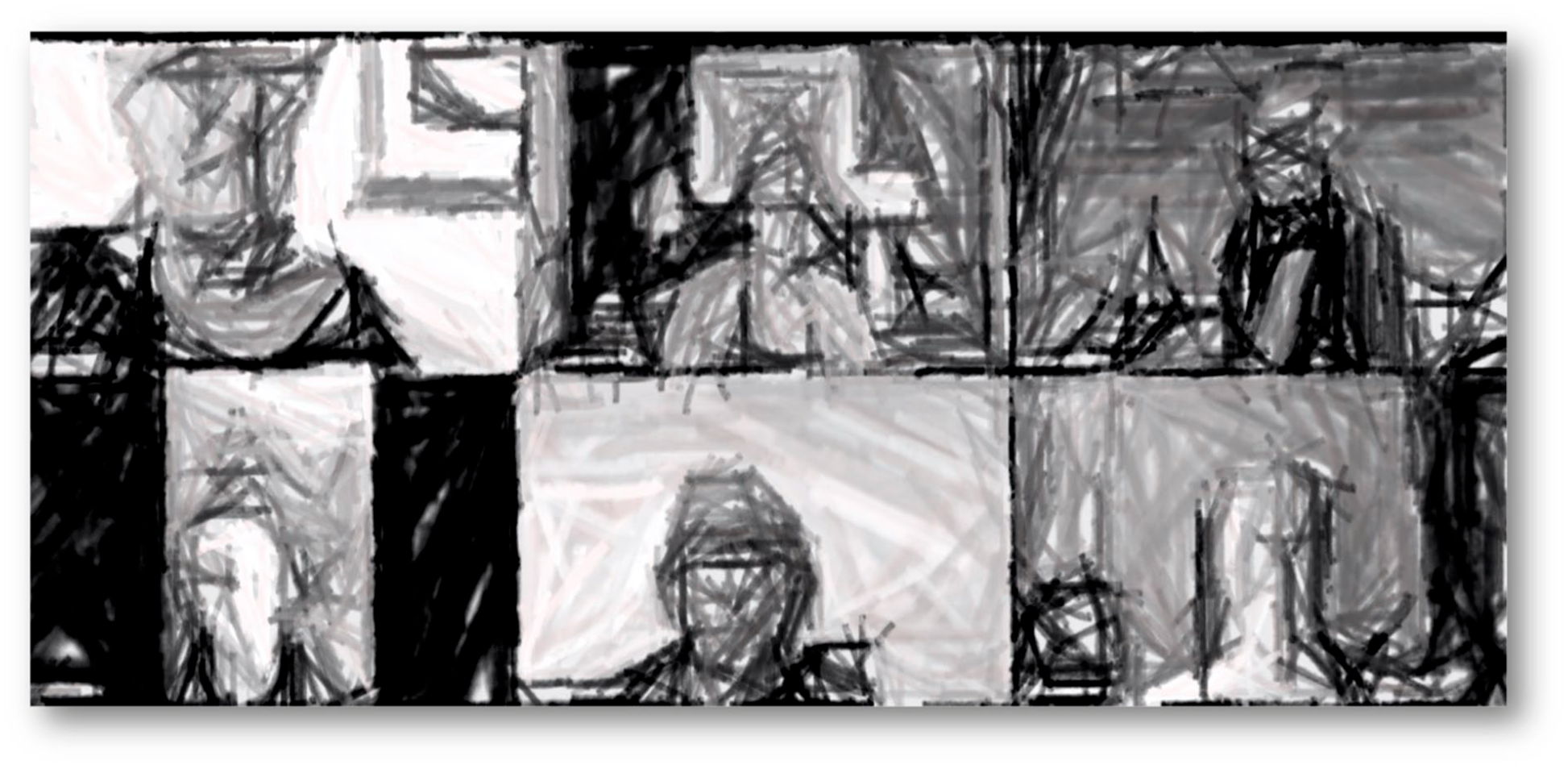
Screenshot/drawing: Susanne Gannon, 2020
Cicada spring breaks during the mandatory university shutdown. I squeeze in another Wednesday walk to Paradise Pool. We walk by a landscaper who can’t dig in soil so thick with carapaces. They crawl out from seven silent years underground, shake free of their former selves, drag their exoskeletal shells by tiny hooks on their feet, spread bright damp wings. Yellow Mondays. Their crusty memories stick all over the trees at my front fence, cling to the letter box (Figure 11). At dusk, their quivering love song drowns out the cockatoos. Green Grocers calling.
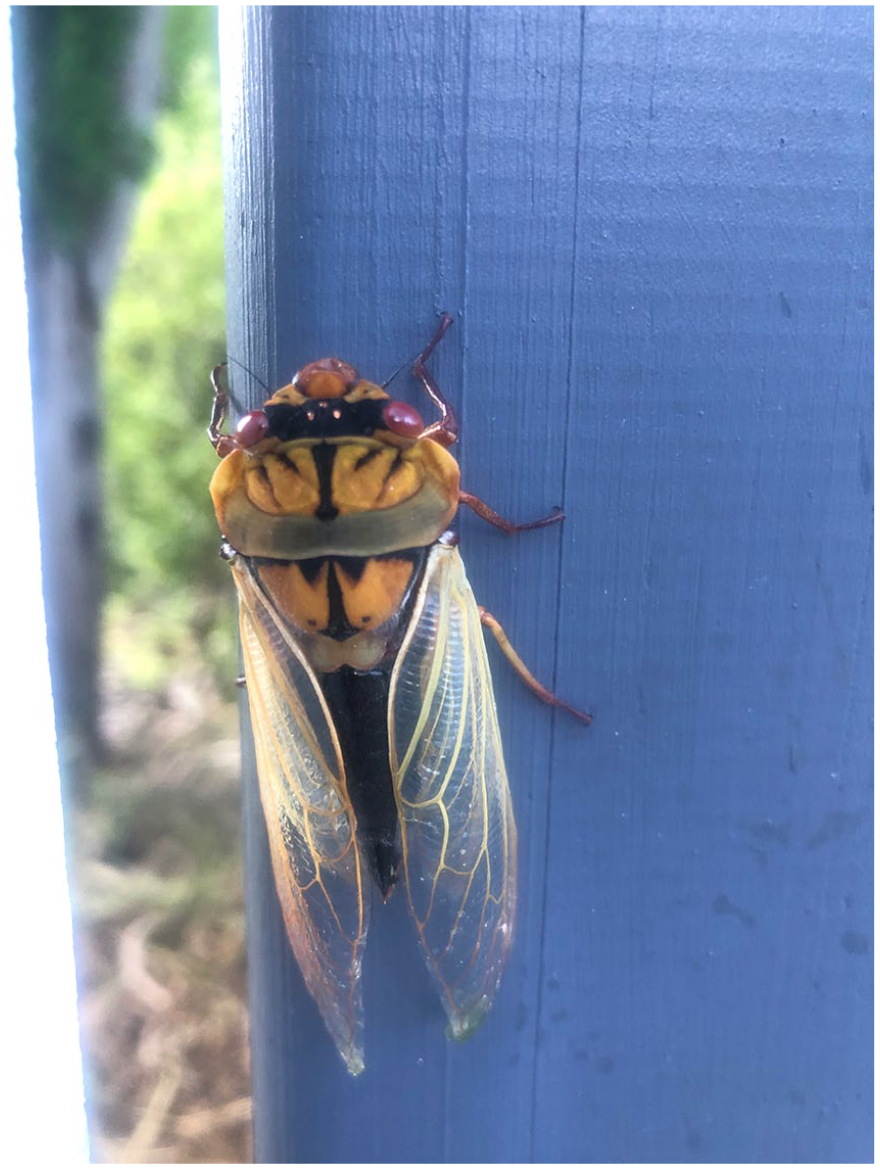
Cicada, photograph: Susanne Gannon, 2020.
covid-19 is a sort of white noise. There always. Undrownoutable. All the sounds we can hear, all at the same time, a mass of sound underpinning our every days. Almost indivisible, but for geographic variations that pulse across borders and become more or less shrill depending on other lines that we cannot see or did not know were there. Lines on graphs that won’t come down.
Lines of time, cross-hatched by prisoners on the walls of their containment. In Melbourne, the longest lockdown in the world falters, fails.
My Covid cat Annabel is a shadow, an absence, a blackness that swallows light (Figure 12). Every photo I take is a dark shape in a busy space. I remember Anish Kapoor in London. A room closing in. And this—the void. Negative space. This year. But we are not falling in, it seems. We resist the pull of negative space through netting, knotting, drawing lines, pulling together a loose strong carrier that might hold us, might help us through. Each time I write “us” I wince at the presumption.
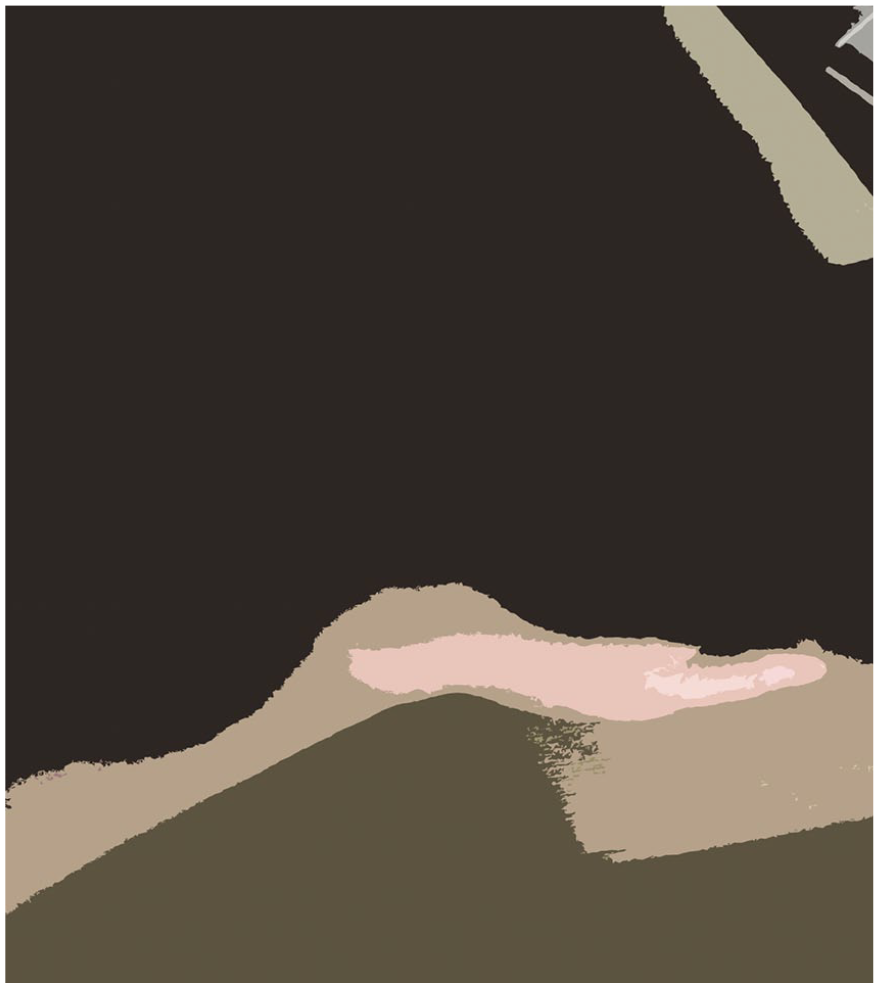
Black cat/void, digitally edited photograph: Susanne Gannon, 2021.
Official “freedom day”: I drive west over the mountains, the trip planned for Easter, midwinter, “as soon as the border opens I’m leaving.” Double donut numbers hold but borders are tenuous. On the lonely Hay plain, only odd trucks and utes and me under an endless sky, with sporadic Santas.
The road is a filtration system for drifting thoughts, news fragments, impressions (Figure 13). My mind is an accretion of non-hierarchical miscellania, a flattened ontology of sorts. A new atlas of the universe is mapped. Three million galaxies in 300 hours. And coronavirus remaps the atlas of this planet, its different tiny local universes. Three billion animals affected by last summer’s fires. The world heritage listing of the Great Barrier Reef is downgraded. We slash our only sustainability education course. Apart from birds and sheep, the only animals on the road for hundreds of miles are fake or dead.
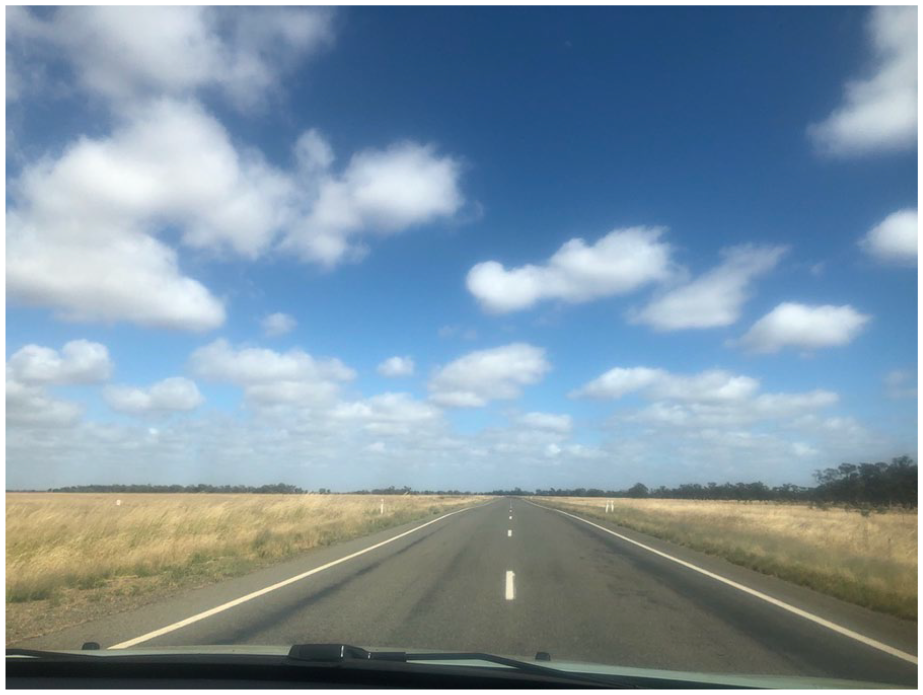
Highway, photograph: Susanne Gannon, 2021.
Standing still and looking up, the virus a vortex spinning around us, through us, turning through its infinite tiny altered worlds. In its continuous present and presence. What is the gerund for the virus? Muting / mutating/ enveloping/ cracking/ crazing / sapping/ stealing/ living and dying. Apparent facts continue to collapse, what we knew changes in an instant. The bridge is open. The genome mapped.
I open a letter, wash my hands, pick up my keys, wash my hands, wash the keys, rub my eye, wash my hands, wash my face.
“Outside living cells, a virus is not much more than a piece of information, a scrap of nucleic acid in an envelope of protein” (Meek, 2001).
Now, at this time, as we talk of “during” and “after-this-is-over”; we have no way of knowing what is “after-this-is-over” or when “after-this-is-over” will be.
My dreams are vivid, rich, tactile. Something was said on the radio about dreams but I missed it and it slid into the past. I meant to go back to find it, I meant to go back but I missed it and it slipped past. Someone said something, somewhere, the ping of something happening.
As you say the word chocolatier, I taste the chocolate melting in your mouth. I sense these words rather than hear them. I taste them, touch them, I am longing for touch. Is that what makes the time slip—imperceptible, immaterial, like thought before language? Air without touch is immeasurable, our bodies float (Figure 14).
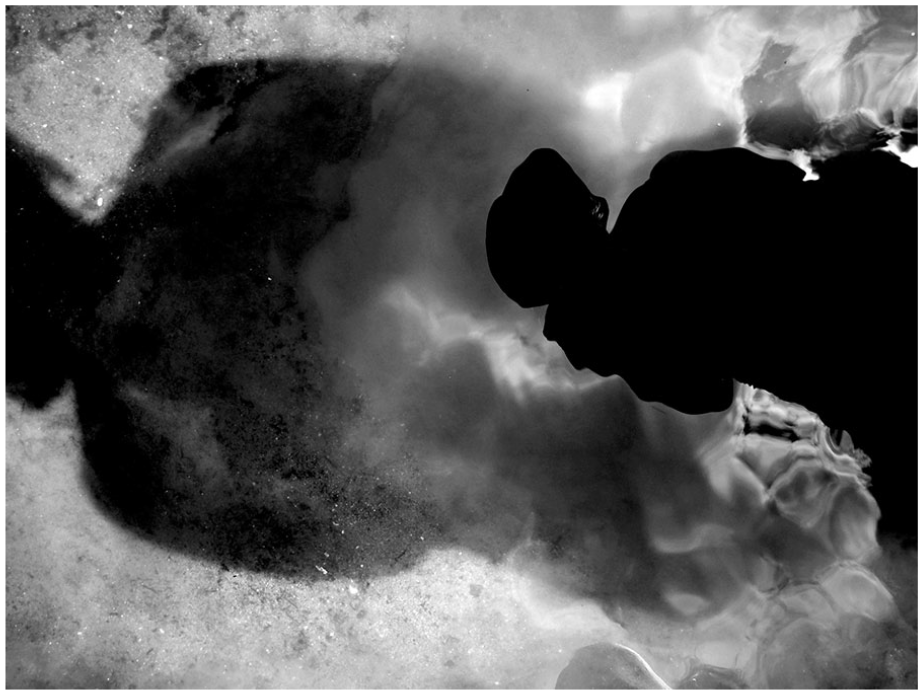
Watershadow, image: Carol Laidler, 2020.
Reaching across space to touch, a keep-safe, the taste of chocolate. One piece, then one more held in my mouth to sweetly melt.
Inside, a voice is whispering to me that what I am doing here now must be quickly over to allow the next thing to happen; a battle between my impulse to think quietly alone and my desire to join conversations. Each conversation merges into the next, a scattering of ideas gone in a breath.
A cut in space through the myriad of stories at any one moment (Massey, 2013).
As the light shifts the air becomes the object, an interior space cast in concrete, filling my lungs with darkness. The dark touches my skin. I exist as a silhouette swallowed by the blue (Figure 15). A shadow caused by occultation, an object between us, or is the word occluding?
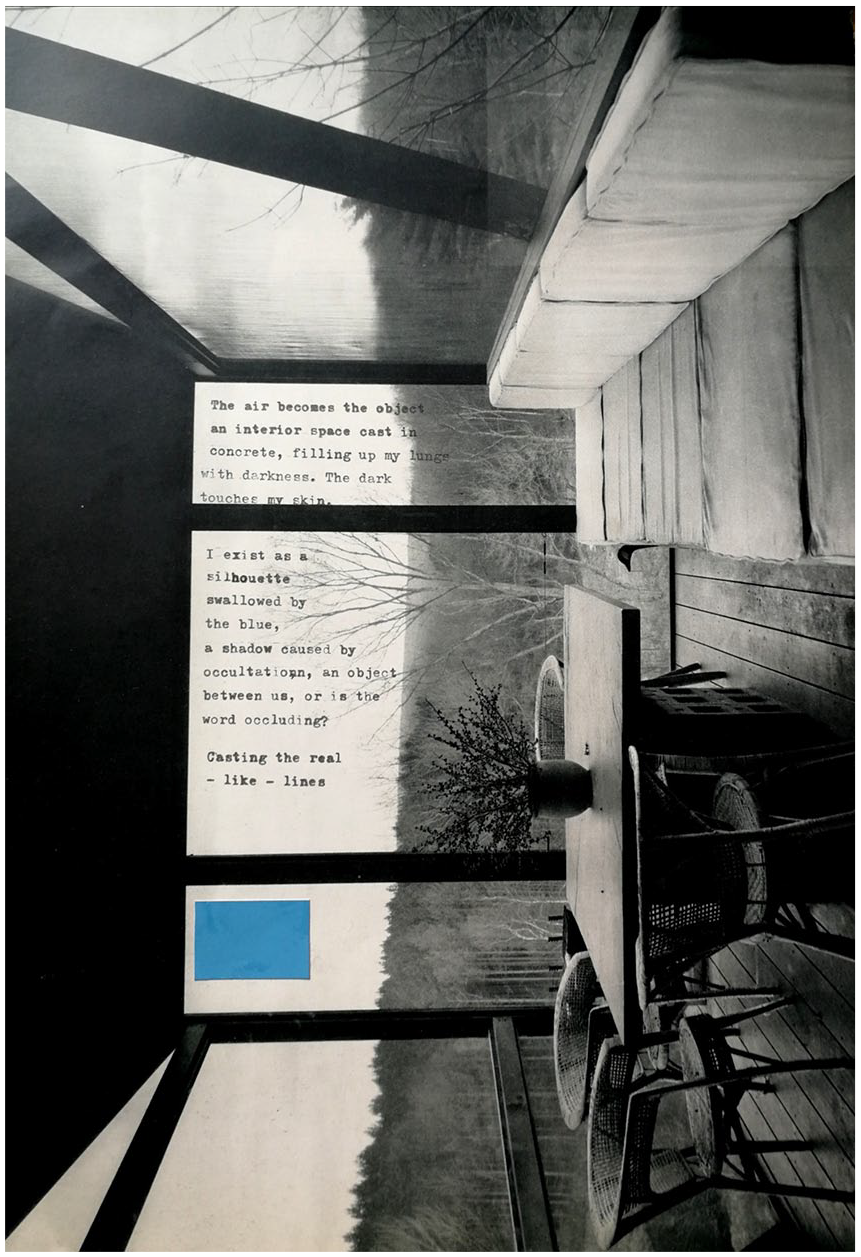
Real-like-lines, image: Carol Laidler, 2020.
Words casting the real—like—lines.
Sounds amplify, silence is in retreat. The air cuts through the myriad of noises, joining the fragments, “connecting us by an invisible, unspoken pact” (Tokarczuk, 2017).
The runners cut through the air, on a loop around the houses, sharing moist droplets in their puff.
Outside, the noise in the street picks up. I hear rubbish being collected, bottles rattle and shhhlank as they catapult into the truck, a radio slowly nears spitting words—isn’t that lovely /happiness /rises /Hollywood /what a start /your 7 day free trial begins today—The banging of bins, beeps of a lorry reversing, dog barking, men shouting.
I squeeze clay into fossils of touch, the imprint of my emotions (Figure 16). My hands look a hundred years old, washed till the skin tightens and pulls over the bones. I squeeze the clay. I feel the wet sticky drying, catch. I shape it into my palm, squeeze hard, squeeze harder. It takes all of my body weight.
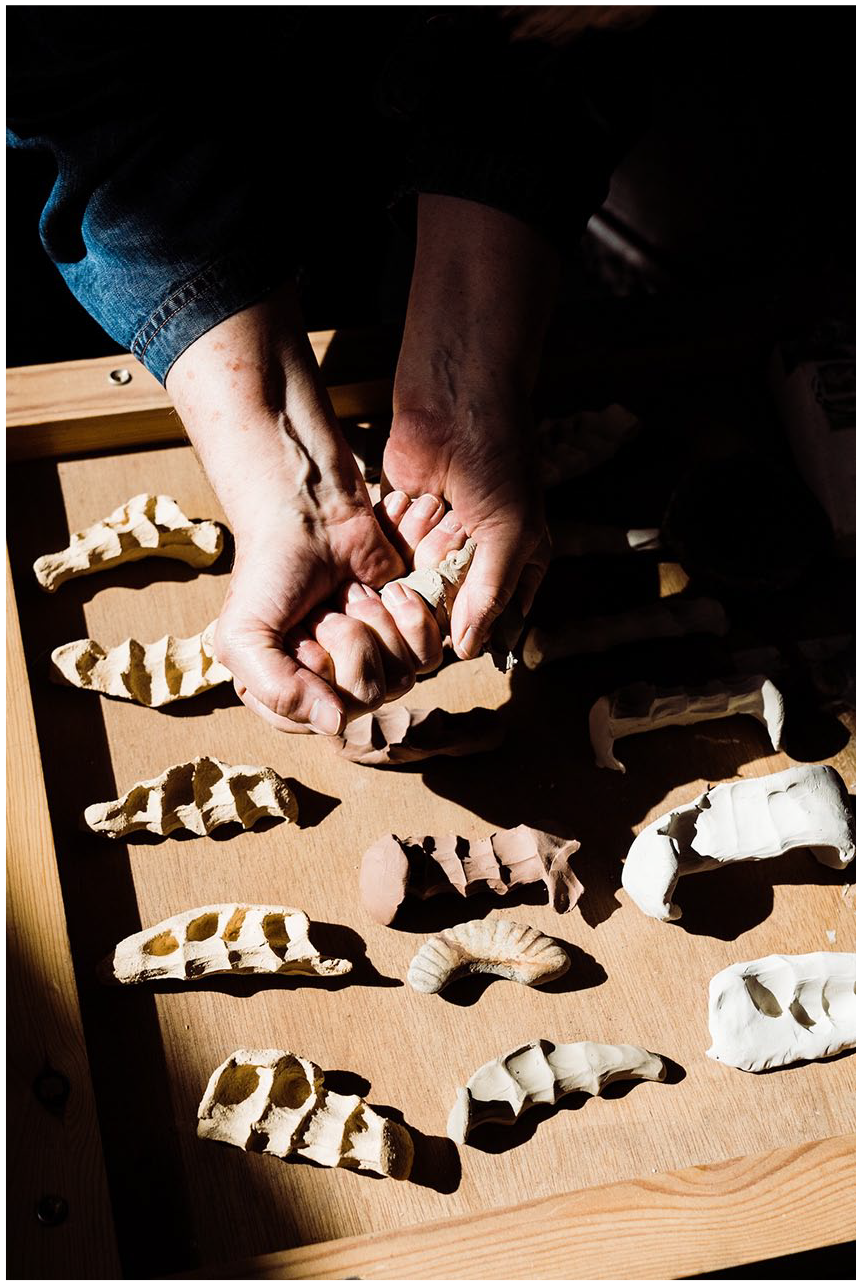
Squeeze, photograph of Carol Laidler in her studio: Rebecca Goldman, 2021.
It’s easy enough hiding in plain sight. No one has been in my house for weeks. All they see of me is what I choose to keep in the frame.
I push the words around the page, cross out, reverse, start again. This takes hours, spread across days, tense with the scrunched up-ness of it.
Do I enjoy my life I wonder? Who is telling me to do this? What makes me enact the same repetitions, eat and repeat. What makes me forget other things?
I borrow my neighbour’s blood pressure machine. It clamps on to my arm and expands hard till it hurts, then slowly releases. All my cells have changed, how many times since I was born?
Later at a talk about embodiment, I smile inwardly at the disembodied audience, most people hide behind their screens. For a moment I switch mine off to see what it feels like. I can hear and see you but you can’t see me.
I switch it back on.
I will drink tea, swig back wine, close my eyes and let my mind drift. And I will do it in full view!
I shake myself, or rather I shake one half of myself. The other half sits inert and thinks: If I put all the DNA in my body into one single fine strand it would reach beyond the solar system (Bryson, 2019).
The unexpected accident of it.
I get out the wind-up record player and the old wooden box of 78s that had belonged to my mother. I clean the appliance with nothing but water and a soft damp cloth and rub it dry with kitchen roll. I replace the rusting needle at the tip of the arm with a new one from the matchbox in the drawer of the player. And take the brittle record from its sleeve.
The violin’s exquisite notes shudder like a ballerina unfolding her petals, carefully till her skin is undone, till my skin is undone.
After we had gone round the group once and read our work aloud, we went round again and read each other the responses we had written/made to hearing from each other, starting once again with Bronwyn Davies:
While we pause and write in response to each other, in Australia at night and in the UK in the morning, the moon rises outside my window (Figure 17).
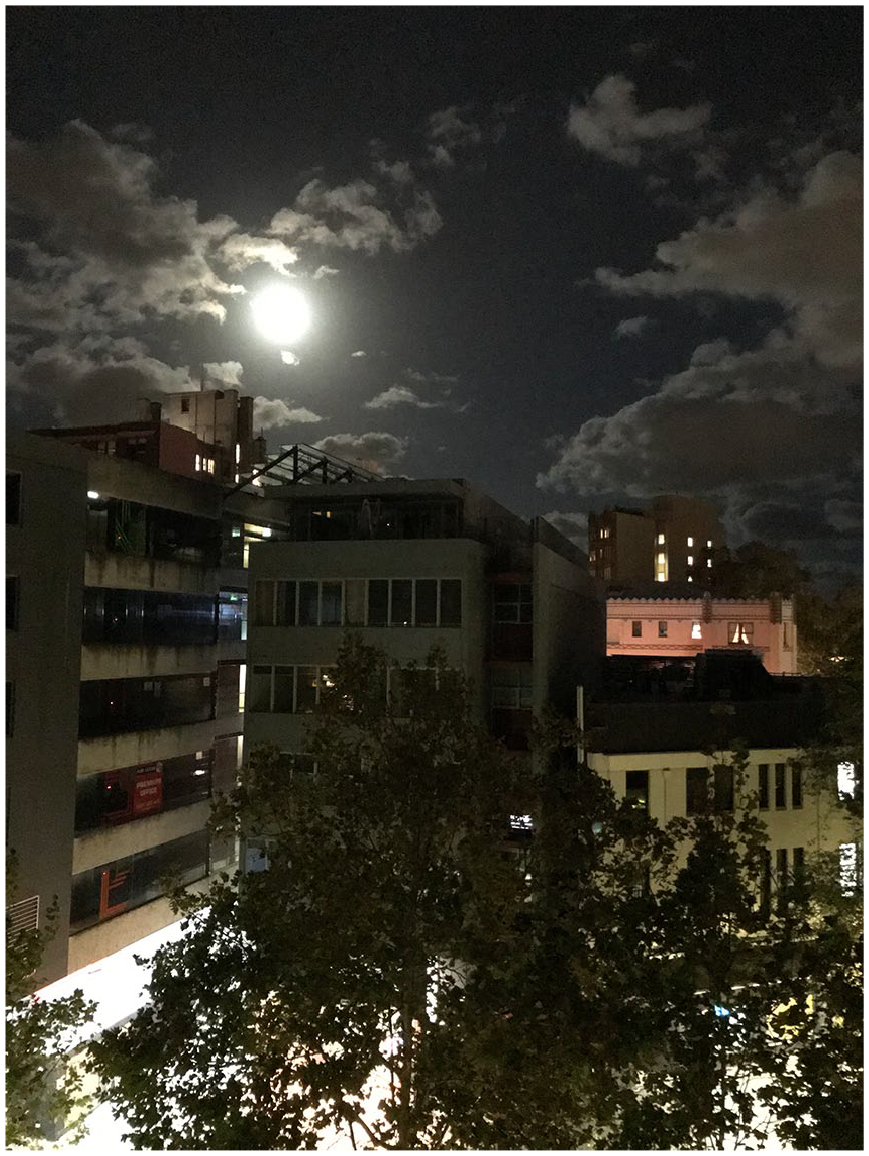
Moon rising, photograph: Bronwyn Davies (2021).
Davina’s dad writing his life story
Disturbed sleep and wild dreams
Touch and the longing for touch
The waves breaking against the land
And Ulf with his ginger-nut smell
And yet
The ever-tightening knots, but
She will speak, she will be playful
She will create life with her art
Sheridan’s pleasures break free
She plays the part of the grumpy
Old lady with wild hair
Dodging and muttering at runners
The cumulus of less and more
The call of currawongs
A hole in the thing that is not
she steps out gingerly
feet flying out from under her
And then
a streak of metallic silver
And a trail of red thread
Across the darkening sky
Jane’s buttercups and rain-soaked soil
White wisteria tendrils
And poison leaves
Fish pie and apple charlotte
And too much red wine
Her son visits and is almost there
With laughter and tenderness
And the love of a little dog;
Wearing masks and keeping distance;
The body of lines and
Skin peeling
Fragilities brought together
Ripped through, bruising
Poignant, funny and beautiful
Continuously present
Susanne’s greengrocer’s calling reminds me
When I was a kid Mr Moore the greengrocer came each Wednesday to our kitchen door with a cane basket filled with fresh fruit and veg. He would appear as a shadow through the screen door, the light blocked by the canopy of the trees. Greengrocer, he would call in his soft, deep gravelly voice, Greengrocer. The milkman brought milk in his horse-drawn cart and filled the empty jugs that we left in the cupboard before we went to bed. In the morning there were jugs of milk with thick cream on top, and a hot crusty loaf of sweet-smelling bread from Mr Fowler the baker.
Now, in the pandemic, we’ve re-turned to deliveries; no quiet horse drawn carts clip clopping through the town, but nameless young cyclists riding furiously through the city, losing their lives in the hurtling traffic.
Carol’s endless hand washing reminds me how
On Sunday I got clumsy
gouging two deep holes
in one of my knuckles
blood everywhere,
nearly fainting
hadn’t realised
I was getting a migraine
language scrambled
body unco-ordinated
quite tricky putting
one bandaid over
two bleeding holes
twelve times over
every day; every handwash
a new bandaid.
And so many terrible dreams
I dreamt a man had died
and someone
removed his kidneys
a panic realisation
he is not dead—
what to do . . .
I’m driving
searching for a place
I once knew
We talk and its ok
the urgency of the man
without kidneys fades
I’m driving again
this time I
don’t know where I’m going
can’t escape the state
of not knowing
where I’m going
can’t escape
not knowing
how to find the way
I squint at the clock
it’s 5.55 am.
I get up in the dark
Like a boy caught in an
inevitable video-game-death
pulling out the plug
so the screen goes dead,
escaping death, triumphant,
just so, I escape my dream.
I read yesterday how peoples’ relationships are straining and splitting because of differences with the ethics of response to Covid, social distancing, vaccination. Trying to find perspective, how to find a way to say this is me, I hear you, when you say/do that, I feel/do this.
We are evoking older magic—holly oak protection, Nulla Nulla, object relations, shapeshifting into the old shape of flashing wings, dragon trees, bluebells, dead heads in the lavender, holding at bay for this moment in our continuous present the white noise of Covid. Remapping our universe, teetering on the edge or falling forward into the void; playfully holding the live wires of no touch, eat and repeat, hiding in plain sight, do I enjoy my life?
(Figures 18, 19, 20)one hundred year
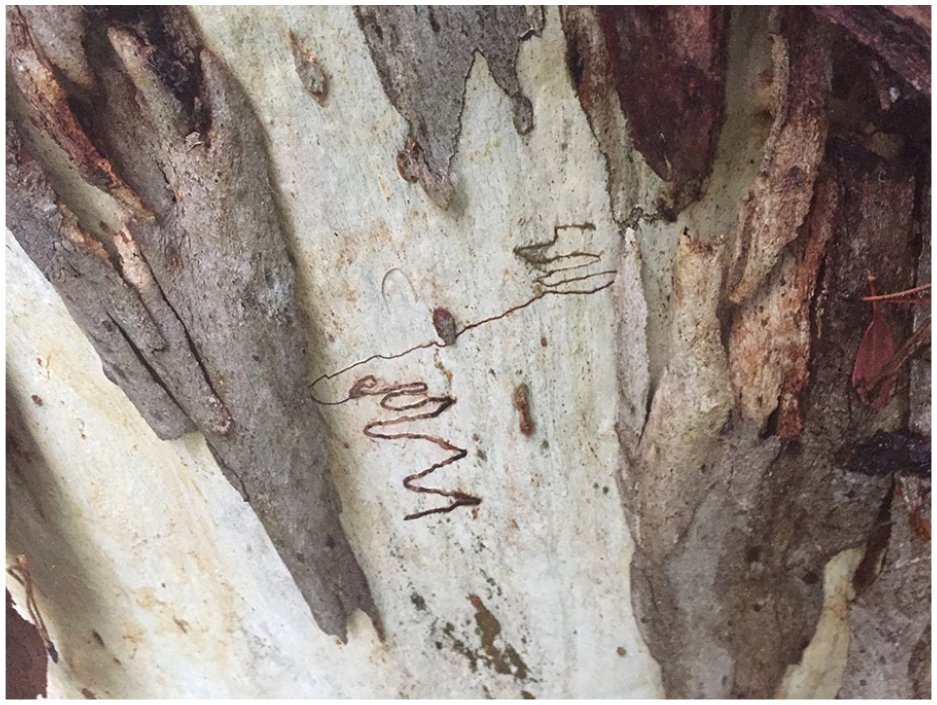
Becoming tree, Photograph: Sheridan Linnell, 2021.
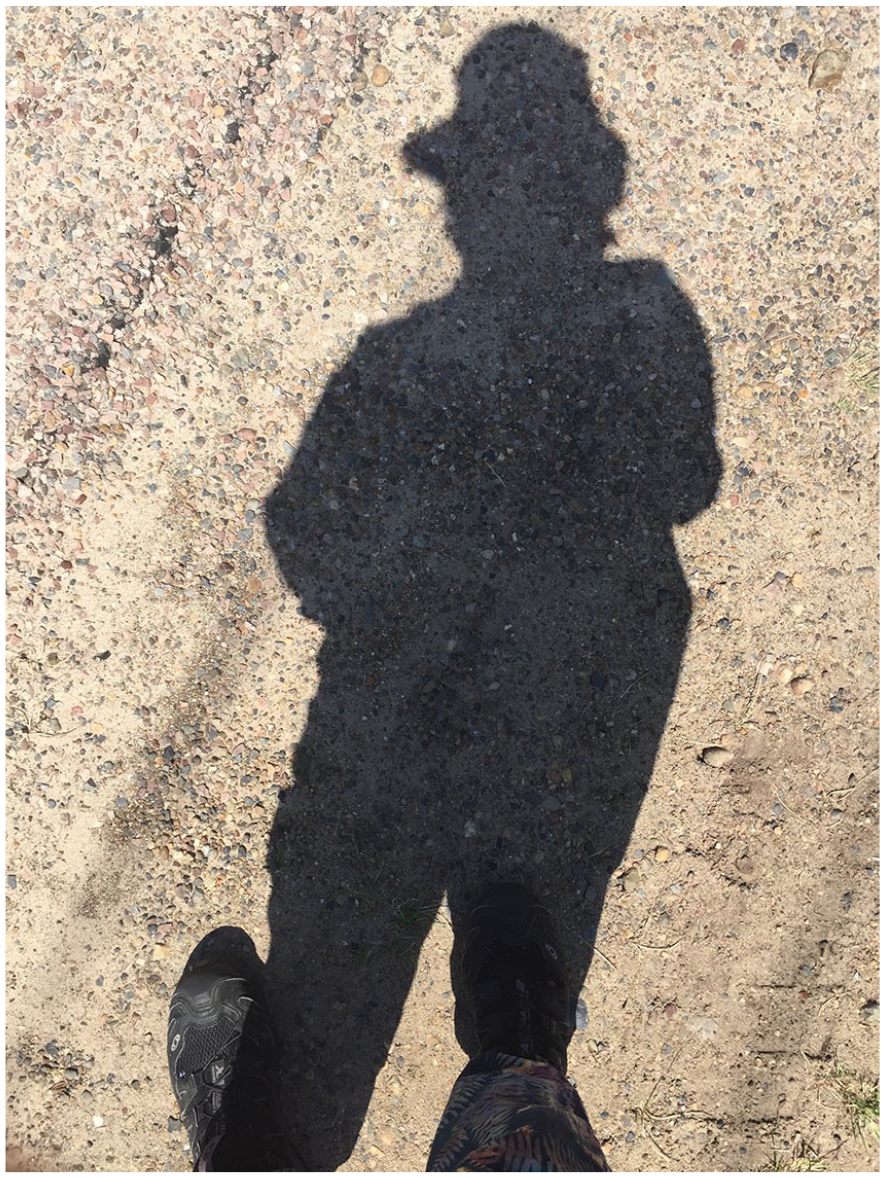
Becoming shadow, Photograph: Sheridan Linnell, 2020.
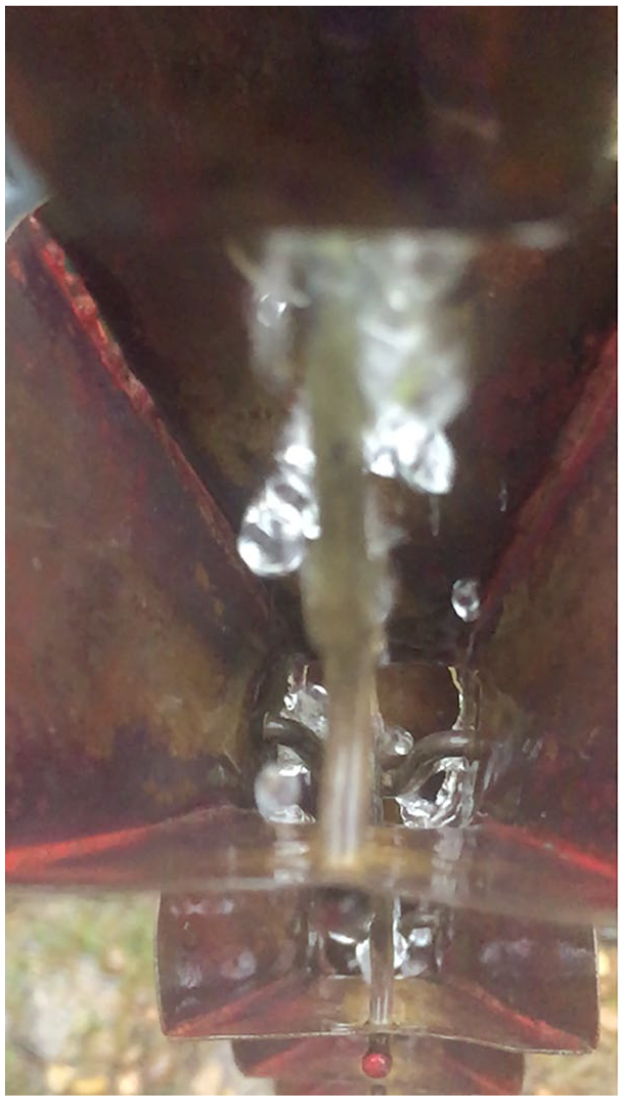
Kusari doi (Rain chain), Still from Video: Sheridan Linnell, 2020.
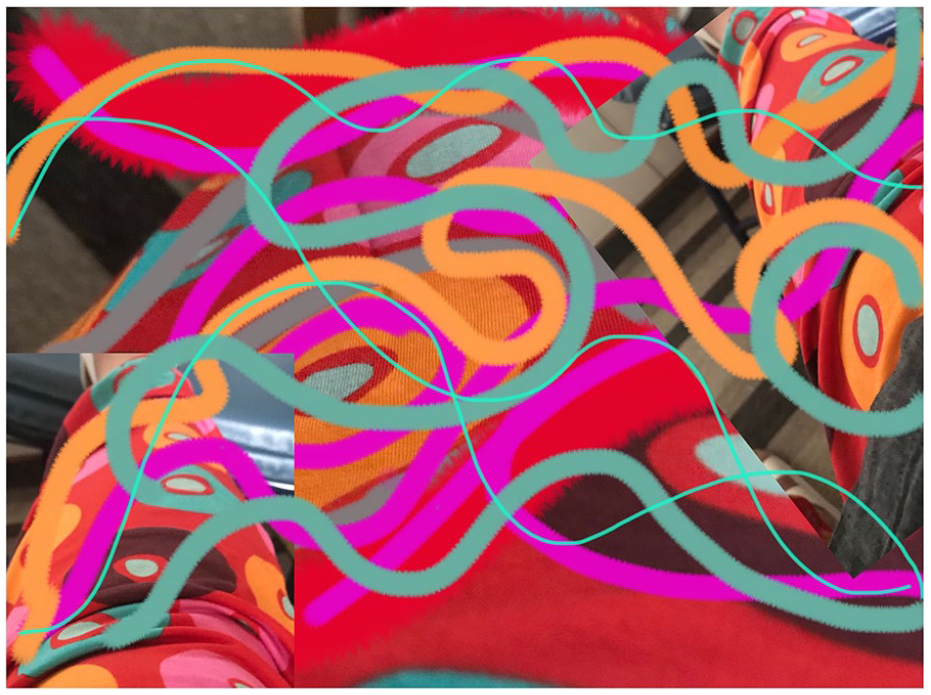
Psychedelic networks, iPad painting: Jane Speedy, 2021.
rain event
fire, pandemic, flood
public and private horrors
saturation point
every thing
slows
becoming
continuously present
Last time we did this we all disappeared at this juncture in my writing, this time I am fighting against disappearance. If I was still in the academy, I would write something esoteric and multisyllabic now, quoting Lauren Berlant on “affect” and cruel optimism, but I retired 10 years ago and have lost that edge, living now in lockdown on a diet of Netflix romcoms and neighbourhood chat groups, so all I want to say now is that I have just fallen in love with you all, all over again. Through this process of intense listening and looking I have fallen down that dark, Anish Kapoor-shaped negative/positive hole that is filled with love. Love. I am in love with the woman who flies up the wall behind Susanne on zoom calls, and Davina, who took the call to a “pyjama party” so literally and is here in her cuddly hoody. I look forward, every time we meet, to how much longer Sheridan’s hair will have grown, in comparison with Bronwyn’s haircuts, which get shorter and shorter . . . I still worry about that Chinese man on the red bicycle, I dreamt about him the other night. Annabel the cat came on our call this morning, and I wanted to cry out “Hello Annabel!” (I feel I know her, you see.) There is a kind of knowing to our ways of being in each other’s lives, which frames these conversations, just as the stark black in between slides, frames the monochrome images that float past us, as Carol’s familiar voice floats past us. Her images are as monochrome as mine are technicolour. But you did not see mine today, with the little dog, Rashi, who I saw on zoom this weekend with my family. I want to include you in my weekend, in this festival weekend. I want to say Chag Sameach: happy passover. This weekend is a celebration of an escape from slavery, oppression and disease; a celebration of an escape from Egypt, the waters of the Red Sea parting and making way for us . . .
In these science-worshipping times we live in, there are all manner of kosher, tsunami-informed explanations for that parting of the seas, but I prefer the old stories, just as I preferred the old story of us all disappearing at the end of this writing/art-making process, and all that was left was a slubby piece of paper, stuck in an old 1930s typewriter, saying “hysteria/women/Freud . . .”
A ping somewhere, a gurgle, the tappity tap of keys. Today—six weeks ago—the first plane landed here loaded with vaccines. I wanted then to ask about yours, if you’d had it, if you were alright. Despite all our arts and all the threads of words that bring us close, this seemed too intimate, brash, ill—mannered. If we’d met in person—imagine, say, that little garden in front of the Chicago art museum, or outside the Illini Building in the weak spring sun by the dogwoods—would we hug each other, wear our masks?
So much seemed new in what you read, that single strand of DNA that embraces the earth. The blue tilt to everything. Your sadness—for son, daughters, dad, grandchildren? My little world was keeling back into balance, I ran off to the mountains and sang to the endless sky.
Today I printed my permit to cross the border south for Easter, but to the north, another border closed. And PNG is in crisis, to our north, vaccines are diverted there and the Torres Strait but we have neglected them too long. Rumours of vaccines circulate. Ghost booking sites appear online. Who knows when anything will happen. I have nightmares about walking out a door into a void, stopping this writing, being forced to catch a plane somewhere, and missing you.
I feel strangely brittle.
swaggering, jostling, muttering, touching, bruising, leaning into, ripping through,
faultlines,
forbidden pleasures,
I drift on the words and take a childish in-breath
looking back across the distance between us,
call and response.
“Poetry is for everyone.”
Not long after the great flu pandemic in 1919, Tristan Tzara, 2 the man from nowhere, created a poem on the spot, so the story goes, by pulling words out of a hat. This was enough in those days to cause a riot.
“Cuts ups are for everyone,” said William Burroughs 3 40 years later.
“A thing is a hole in a thing it is not”—said Carl Andre, 4 referring to the idea of the object as a “cut in space.”
Doreen Massey (2013) posited space as “a cut through the myriad stories in which we are all living at any one moment.”
How do any of us join up?
Here—sharing our small lives, small worlds long days/ long months.
My companions
in your rough, tender hands
similar and different.
You are my amulet to ward off this disease.
Everyday stars, writing our crusty memories.
We shed small particles of dry skin
feeding the soil’s minute creatures.
Hoping it will have a different ending
and hearing
every other bird’s song.
Footnotes
Declaration of Conflicting Interests
The author(s) declared no potential conflicts of interest with respect to the research, authorship, and/or publication of this article.
Funding
The author(s) received no financial support for the research, authorship, and/or publication of this article.
Notes
Author Biographies
 ) She lives and works in St Davids (West Wales) and Bristol South West England), and has a studio practice as a painter. Her latest book is Collaborative artful inquiry: Writing and making qualitative research, 2021, Routledge, London.