



Abstract
The term blackfishing, which takes a twist on the concept of catfishing, that is, tricking people online into thinking you are someone else, refers to the practice of (mostly) White women pretending to be Black by using makeup, hairstyles, and fashion that originate in Black Culture to gain financial benefits. This article aims to contextualize the concept of blackfishing through a critical literary review that will cover the following elements: cultural appropriation, the commodification of Black culture, the representation of Black women in North America, and the operationalization of blackfishing.
When it was revealed in 2015 that Rachel Dolezal, who at the time was president of the National Association for the Advancement of Colored People’s (NAACP) Spokane chapter, was a White woman pretending to be Black, it became news all around the world. Dolezal herself says that she is not White because she “identifies” as a transracial Black woman and argues that she has done a lot of good for the community through her works as an activist and educator (Brownson et al., 2018). However, it is important to recognize that she received benefits, in the form of employment and financial compensation, based on her blackness, thus taking these opportunities away from actual Black women. This is not the first-time people have appropriated cultures and identities for personal gain. In 2015, it was revealed that Vijay Chokalingam, brother to actress and producer Mindy Kalling, pretended to be Black in his medical school applications to benefit from affirmative actions intended to support Black, Hispanic, and Indigenous students (Pearson, 2015). In 2020, American professor of African and Latin studies Jessica Krug admitted to faking her Black and Latin heritage (Asmelash, 2020). In these cases, the racial appropriation achieved by physically changing one’s appearance led to the co-opting of resources, positions, and profits meant for Black people. In recent years, this phenomenon has developed to the extent that it gained its own name: Blackfishing (Thompson, 2018). This term, which takes a twist on the concept of catfishing, that is, tricking people online into thinking you are someone else, refers to the practice of (mostly) White women pretending to be Black by using makeup, hairstyles, and fashion that originate in Black Culture to gain financial benefits. This article aims contextualize the concept of blackfishing through a critical literary review that will cover the following elements: cultural appropriation, the commodification of Black culture, the representation of Black women in North America, and the operationalization of blackfishing.
Cultural Appropriation
The Cambridge Dictionary (n.d.) defines cultural appropriation as “the act of taking or using things from a culture that is not your own, especially without showing that you understand or respect this culture.” There are three main elements that need to be highlighted here. First, this definition implies that the “appropriator” is not part of the group to which the cultural element itself belongs. Second, this concept implies the act of “taking or using” cultural elements, meaning that whoever is engaging in this process can engage with the culture on their own term, thus indicating that power dynamics are at play. Third, and perhaps most important, the cultural element is taken out of its context in a way that either does not credit its origins or is disrespectful to its meaning.
A good example to illustrate this definition is the wearing of “native headdresses” by nonindigenous folks at events like Coachella. In North America, indigenous people have been made subalterns through settler colonialism and white supremacy (Mann, 2000; Razack, 2002). As a result, there exists at both the macro- and micro-social level a power dynamic between indigenous people and non-indigenous people who live on these lands. In State of Race: Critical Race Feminism for the 21st Century, Razack et al. (2010) describe those power differentials in the Canadian context as follows: The racial and gendered politics of the state were organized through a complex triangulation of relations, with Indigenous peoples marked for physical and cultural extinction, European settlers for integration, and people of colour for perpetual outsider status as “immigrants” and “newcomers.” (pp. 4–5)
Here, we see that indigenous peoples’ positioning is different to that of nonindigenous peoples, and is specifically subservient to that of Europeans, in a way that threatens their culture and continued existence. As a result, there is an inherent power differential that is enacted when someone who is not indigenous decides to take headdresses out of their context to wear them as fashion accessories. In addition, the significance of headdresses in indigenous communities, while varied, is generally associated with status and achievements. By wearing one without having the necessary qualifications, a nonindigenous person is removing it from its original context in a way that disrespects the traditions of the community.
Young and Brunk (2009) identify two main ways in which cultural appropriation can create harm. First, cultural appropriation could imply infringement of legal property rights. For example, both Khloe Kardashian and her sister Kylie Jenner were accused of stealing designs made by Black creator Destiny Bleu and Black-owned brand Plugged NYC (Lawrence, 2017). In these cases, the Kardashian–Jenner sisters took cultural items that were both inspired African American fashion from the 1990s and created by Black designers. In doing so, and without crediting the creators of the clothes nor paying them to use the designs, their appropriation of elements of Black culture simultaneously infringed on intellectual property rights owned by Destiny Bleu and Plugged NYC.
The other potential harm identified by Young and Brunk (2009) is “an attack on the viability or identity of cultures or their members” (p. 5) The authors go on to write: Appropriation that undermines a culture in these ways would certainly cause devastating and clearly wrongful harm to members of the culture. If appropriation threatens a culture with assimilation, the same moral issues are raised. Other acts of appropriation potentially leave members of a culture exposed to discrimination, poverty, and lack of opportunity. (p. 5)
They in essence present the argument that the symbolic harm caused by appropriation as an enactment of power dynamics causes concrete consequences for the culture of origin and its people. Their legitimacy in society and the meanings they ascribe to their own symbol are negated in favor of those who are appropriating. In addition, cultural appropriation leads to benefits for those doing the taking, whether financial or social, and prevents the original peoples from accessing those same gains. When Kylie and Khloe launched products based on stolen designs, they not only financially benefited from the sales, but also prevented less known Black designers from earning profits on their creation. The mechanics of cultural appropriation thus maintain racial and ethnic hierarchies that effectively disempower communities that are already marginalized.
Commodification of Black Culture
This leads us to a discussion on how the appropriation and commodification of Black culture have served to enact white supremacy, capitalism, and patriarchy as interlocking systems of oppression. In the introduction of The Black Culture Industry, Ellis Cashmore (1997) writes the following: Any residual menace still lurking in African American practices and pursuits has been domesticated, leaving a black culture capable of being adapted, refined, mass-produced, and marketed. Whites not only appreciate black culture: they buy it. A great many blacks have become rich on the back of it. An even greater number of whites have prospered. (p. 1)
The integration of Black culture in contemporary capitalist frameworks has served to “domesticate” the stereotype of the dangerous African American, but only insofar as it can be consumed. This consumption, Cashmore is pointing out, is not universal. Black culture is intentionally being made palatable to a White audience, with the goal of making a profit. This is neither an accidental development nor the natural progression of anti-racist activism. It was a planned transformation orchestrated by capitalists who saw an economic opportunity.
In the text, Cashmore emphasizes the dangers of forgetting this fact, as he states, . . . inflating the significance of black culture may work against tangible enhancements to the lives of African Americans. The most significant value of black culture may be in providing whites with proof of the end of racism while keeping the racial hierarchy essentially intact. (Cashmore, 1997, p. 2)
Rather than being a successful integration of Black people into the public sphere, the commodification of Black culture is a superficial show of tokenized representation that serves to obscure the ways in which this process has not only failed to create deep social changes but has effectively enacted existing power dynamics.
This becomes particularly evident once questions of intellectual property and ownership are brought into play. A recent example is the difference in popular discourses regarding Taylor Swift’s decision to remove her content from streaming services versus that of Jay-Z to do the same and launch his own streaming platform named Tidal. In 2015, Swift, supported by her label, announced the decision to remove her works from Apple Music following the company’s decision not to pay royalties to artists during new users’ 3-month free trial (Tiffany, 2017). The singer argued it would detrimentally affect less known artists (Tiffany, 2017). Her published statement received an outpouring of support from artists, labels, and fans, and media outlets framed this as her standing up against big corporations on behalf of small creators (BBC Staff, 2015). That same year, Jay-Z launched the streaming platform Tidal with 15 fellow Artist Shareholders 1 with the goal of ensuring that artist be paid fairly for their work (Flanagan & Hampp, 2015). From its announcement onward, both business experts and the general public predicted that it would fail, and Jay-Z was mocked incessantly (Kosoff, 2017; Willens, 2015). Both Taylor Swift and Jay-Z were making the same argument: Companies that made enormous profits should respect artist’s work and pay them properly. Yet, while Taylor Swift, a White woman, was praised, Jay-Z, a Black man, was ridiculed. In the end, while Apple Music agreed to change their policy regarding free trials in response to Swift’s critique (BBC Staff, 2015), Jay-Z sold Tidal to telecommunication company Sprint (Rys, 2017). The discrepancy in support that was provided to Taylor Swift and Jay-Z reflects Cashmore’s argument because it reveals how racial dynamics affect the ability of Black artists to defend their intellectual property the way White artists can.
This inequality is also demonstrated through the consumption of Black culture by White audiences. In “Not My Sister’s Keeper,” Natasha Howard (2014) states that the increasing popularity of hip-hop and rap music among White youths is a form of voyeurism that allows them to peek at the lived reality of the racial other. This voyeuristic engagement with blackness through the consumption of its commercialized culture is rooted in historical and ongoing processes of racialization (Cashmore, 1997; Howard, 2014; Railton & Watson, 2011) and is particularly evident in the way Black womanhood is represented and consumed (Holmes, 2016; Hooks, 1992; Railton & Watson, 2011).
Representations of Black Women
In “Coming Apart,” Alice Walker (1981) describes how the Black male character in the story realizes the difference between the representation of Black and White women in pornography: What he has refused to see—because to see it would reveal yet another area in which he is unable to protect or defend Black women—is that where white women are depicted in pornography as “objects,” Black women are depicted as animals. (p. 103)
This dehumanization and animalization of Black womanhood, especially as it relates to sexuality, is rooted in colonialism and slavery. Before abolition, Black women were legally constructed as cattle: Their bodies and progeny were owned by White masters the same way they owned any animal (Hooks, 1981). Following emancipation, this association between animals and Black women served to frame their sexuality as one of constant need, thus depicting them as un-rape-able and justifying the assaults committed against them, especially by White men (Holmes, 2016; Hooks, 1981).
The penultimate example of this embodied animalistic sexuality lies in the representation of Saartje Baartman as Venus Hottentot. Paraded and exposed around the world as though an animal in a zoo, Saartje Baartman’s entire being was reduced to her body, which was essentialized as Black womanhood (Hooks, 1992; Railton & Watson, 2011). The obsession of White audiences with the shape of her genital, butt, lips, breasts extended beyond her life, and the body that had been dissected by their gaze while she lived was eventually dismembered and studied after her death (Hooks, 1992; Railton & Watson, 2011). She was made to be less than the sum of her parts, and her entire being was confined to its potential for consumption by White audiences.
The obsession with Black womanhood as individualized body parts rather than whole beings remains. In Black Looks: Race and Representation, Bell Hooks (1992) writes, Although contemporary thinking about black female bodies does not attempt to read the body as a sign of “natural” racial inferiority, the fascination with black “butts” continues. In the sexual iconography of the traditional black pornographic imagination, the protruding butt is seen as an indication of a heightened sexuality. Contemporary popular music is one of the primary cultural locations for discussions of black sexuality. In song lyrics, “the butt” is talked about in ways that attempt to challenge racist assumptions that suggest it is an ugly sign of inferiority, even as it remains a sexualized sign. (p. 63)
This isolation of butts in contemporary music through lyrics and visuals, including that created by Black women, maintains its status as an embodiment of blackness and Black womanhood in a way that emphasizes the sexuality of Black female bodies. Often, it is also associated with imagery that reproduces the association between Black women and animals. In 2014, Nicki Minaj released the music video for her song “Anaconda”—a response to Sir Mix-A-Lot’s 1992 song “Baby Got Back”—in which she and backup dancers twerked and whined in a jungle-like setting, with the camera repeatedly zooming in and focusing on their butts. In “Pussy Talk” by City Girls (2020) and Doja Cat, the three female artists are shown wearing cat costumes while lying down in a forest, and during dance segments, the camera repeatedly focuses on their genitals, butts, and breasts. The massively popular Video for “WAP” by Cardi and Megan Thee Stallion, which debuted at no. 1 on Billboard, included visuals of the artists in a sandpit surrounded by snakes, repeated close-ups of their butts and those of guest actors Kylie Jenner and Normani, and a scene where Cardi B (2020) is dressed in a leopard print corset and thong that completely exposes her breasts. In all these examples, the association between the emphasized body parts, the references to animals and wild spaces, and the revealing outfits serves to reinscribe on the artists’ bodies the essentialization of their Black Womanhood. They are sexualized, animalized, and objectified. Referring back to Cashmore, their blackness is being “domesticated” and commodified to be consumed by the White gaze. 2
While the aforementioned examples consider how Black female artist themselves are engaging with existing stereotypes, the expansion of Black culture into the mainstream has led to non-Black women also partaking in the production of consumable medias that implicates blackness and Black womanhood. Railton and Watson examine the implications of this development by using Christina Aguilera’s (2003) music video for “Can’t Hold Us Down” featuring Lil’ Kim. The authors write, on the one hand the lyrics refer to a universal female experience (the consistent appeal to “all my girls around the world”), while on the other hand blackness and whiteness are clearly inscribed on and through the bodies of Aguilera and Kim. Indeed, it is the precise nature of that inscription, a process in which Aguilera simultaneously performs whiteness and non-whiteness while Kim is seen to embody “essential blackness.” (Railton & Watson, 2011, p. 89)
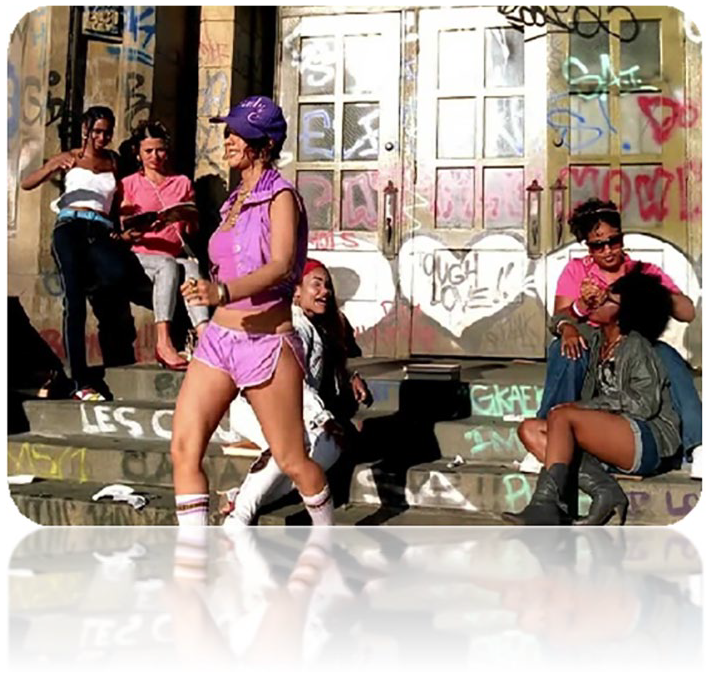
What is of particular interest here is that, unlike Lil’ Kim who can only ever embody blackness, Christina Aguilera is able to take on both whiteness and nonwhiteness. The video features the White singer in a Black neighborhood, next to Black women doing their hair, and dressed in a style that associates her with hip-hop and Black culture. The visuals and aesthetics reproduce Black culture as it has come to be commodified in North American popular culture, thus allowing Aguilera to put on these elements and superficially represent this palatable version of nonwhiteness. As an artist, this allows her to capitalize on existing desires from White audiences to consume Black culture. She, however, is still a White woman and thus also retains the privileges that come with her race. At the end of the day, she can choose to take off the hoop earrings, remove her fake tan, and go back to her life away from the “ghetto” without facing any of the challenges a Black woman would. This brings us back to the concept of cultural appropriation and blackfishing.
Christina Aguilera in “Can’t Hold Us Down.”
Blackfishing in Action
In an article for Paper Magazine, Wanna Thompson (2018), who is credited for popularizing the term blackfishing, made the following critique: white women have been able to steal looks and styles from Black women . . . these women have the luxury of selecting which aspects they want to emulate without fully dealing with the consequences of Blackness . . . With extensive lip fillers, dark tans and attempts to manipulate their hair texture, white women wear Black women’s features like a costume. These are the same features that, once derided by mainstream white culture, are now coveted and dictate current beauty and fashion on social media, with Black women’s contributions being erased all the while.
This excerpt not only highlights the characteristics of cultural appropriation described earlier—namely, the power relations and de-contextualizing inherent to the process—it also points out how blackfishing is a more insidious form of the practice. White women are appropriating Black women’s features to appropriate blackness itself. As was discussed, Black womanhood has been essentialized into the Black female body in a way that is curated to be consumed by White audiences. Insofar as the white gaze is concerned, the Black female body and its parts—lips, hair, butts, skin—are blackness at its core. Thus, by donning on these features, White women are taking this blackness onto themselves with the goal of profiting financially from it. Just like Christina Aguilera, they can choose to remove this blackness from their person in a context where whiteness would be more beneficial.
An example of how blackfishing operates as appropriation in mainstream popular culture is the music video for Ariana Grande’s (2019) “7 Rings.” Grande, who began her career on Broadway and gained popularity through her role on the Nickelodeon show “VICTORiOUS,” is a White woman of Italian background.
Ariana Grande (center) in “7 Rings.”
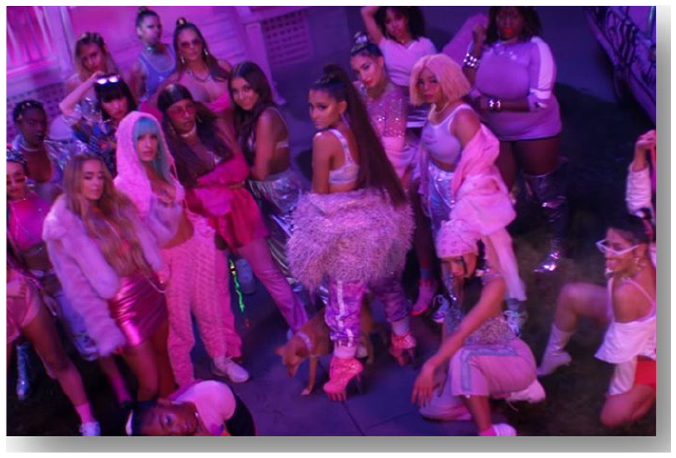
In the early years of her careers, she was marketed as a typical young White female star, with her singing and music firmly anchored in the pop genre. As she grew older, both her music and appearance changed as she engaged more and more with hip-hop and R&B (Motley, 2020). The video for “7 Rings” features the singer sporting a dark tan, as well as clothing and accessories popularized by Black fashion creators. Just like Christina Aguilera, Grande uses these visual markers to connotate herself as non-White. The setting emulates the visuals and aesthetics of hip-hop music videos, with a racially diverse cast of similarly dressed women standing and dancing outside and inside a house. Grande herself appears throughout the song in various rooms where she sits on top of a kitchen table, drinks champagne, and dances with her “squad.” Once again, this allows the singer to position herself within Black culture in a way that allows her to capitalize from it.
The lyrics for the song also serve to code her as “non-White” as they borrow many terms from African American Vernacular English (AAVE). In addition, multiple lines refer to body parts in ways that reflect the previously described embodied essence of blackness. A line from the chorus states, “You like my hair? Gee, thanks. Just Bought it,” a clear reference to the popular use of wigs and hair extension among Black women. Grande also sings: “When you see them racks, they stacked up like my ass, yuh.” Here, the butt is centered through the lyrics, but what is interesting is the visuals that go along with it. Rather than showing Grande during this line, the video shows the back view of a Black woman “twerking” as the camera focuses on her rear end. The juxtaposition of the lyrics with the visual of a Black female body represents the essence of blackfishing: a White woman taking on black features, art, music, culture as a “look.” It is not her butt that is being shown, but the lyrics make it hers. The visuals support the song’s claim regarding Grande’s body and connotates it as non-White even though her actual body is not what appears on the screen, just as her fake tan makes her appear non-White although she is not. Her presentation is the result of a series of conscious choices to commodify and domesticate blackness by curating it through her own body and self, which she can only do because as a White person she has the privilege to select which parts of the Black experience she wishes to engage with. The parts she chooses are the one that can make her money.
In conclusion, this essay attempted to locate the recently developed concept of blackfishing within the broader literature by examining how it relates to writings on cultural appropriation, the commodification of Black culture, and the representation of Black women, as well as the way blackfishing itself is operationalization in contemporary mainstream media. Blackfishing can be understood as the latest development in the consumption of blackness through the appropriation of the Black female body as its essence. By “wearing” Black womanhood, White women can extract from its position in the North American cultural imagination the marketable and palatable parts of Black identity, without having to endure the systemic oppression that shapes it. In short, they benefit from blackness without ever having to give up the privilege of being White. As most other forms of appropriation, this causes harm to both individual Black creators, as their own work and craft is co-opted, and Black people as a collective, through the reproduction of racial hierarchies and power dynamics. Going forward, there needs to be a conscious effort from both academic and activist circles to address the violence inherent to blackfishing. It is also important for non-Black people such as myself to reflect and critically engage with our own consumption of Black culture. Am I perpetuating harm and enacting violence through the way I consume Black content and bodies, or the appropriation of blackness on White bodies? This question is particularly relevant to the way we engage with social medias as a setting in which we negotiate and consume identity. Further research on the use of blackfishing by social media influencers would provide an additional framework through which the concept and its enactment could be explored.
Footnotes
Declaration of Conflicting Interests
The author(s) declared no potential conflicts of interest with respect to the research, authorship, and/or publication of this article.
Funding
The author(s) received no financial support for the research, authorship, and/or publication of this article.
