



Abstract
This article establishes the relevance of surveillance and secrecy as methodological tools, and it substantiates the argument that surveillance and secrecy are not oppositional in character, but overlap. It does so by drawing attention to obvious, but scholarly neglected performers of secrecy and surveillance: children. It discusses what it means to “work with” surveillance and secrecy as it develops their relevance in case studies involving children. As a contribution to cultural studies, the article shows how surveillance and secrecy “get to work” by tracing their constitutive character and by providing new angles for understanding points of contact between the two.
Introduction
“One secret was really not easy to keep. It almost burst out of me, but then it didn’t burst out anyway.”
“How did you manage to keep the secret?”
“I just tried not to move my mouth.”
Øydis has barely started school. She talks about the secret as if it has its own agency. It almost sounds like the two are fighting with each other. In this article, I take children’s experiences with secrecy as a vantage point to analyze new facets of the relationship between surveillance and secrecy.
Choosing to learn from children expresses a critical position. Most research on surveillance and secrecy addresses phenomena at the level of governance and tends to neglect that surveillance and secrecy are already relevant practices in the life of a child. Surveillance as control (Foucault, 1977), care (Foucault, 1979) or both begins pre-birth. Different types of watching are organizing principles of childhood and society at large, which is why simply opting out of surveillance is not possible. Thus, a general question becomes how this culture of surveillance is engaged with, and in particular, what role secrecy plays here. There is a growing body of research about secrecy as a response to surveillance (e.g., Birchall, 2011; Gilliom, 2005; Krasmann, 2019). Especially attempts of rendering oneself invisible to data- and algorithmic veillance have become prevalent here (e.g., Brunton & Nissenbaum, 2011; Raley, 2013; Kaufmann, 2020). Being aware about these literatures, I deliberately focus on points of contact between surveillance and secrecy to move further away from their characterization as oppositional. In addition, I focus on offline environments and children to better understand the many relationships between surveillance and secrecy. Norman Denzin (2010) shows us that the inquiry into “how society is possible” (Simmel, 1950) needs to take account of the social experiences of children. He suggests that “(a)ny account of the socialization process must probe the hidden, secret, and private worlds of the child and caretaker” (Denzin, 2010, pp. 1–2). Children allow for an empirically rich study of secrecy as the concept is much more prominent in their lives than, for example, privacy. While children have mainly been discussed as those subjected to surveillance (e.g., Steeves & Jones, 2010), I argue that children use practices of secrecy to answer, engage with and perform surveillance. Children’s relationships to cultures of surveillance and secrecy tell us something fundamental about the relevance of the secret in society. They show us that the secret is performative and that it constitutes much more than a simple escape from surveillance.
In this article, I develop the cultural sociology of surveillance and secrecy further. To situate my contribution, I first give an overview of existing arguments about the relationships between children, surveillance, and secrecy. In the subsequent section “Do we have a secret?” I add to the scholarly discussions about critical methodologies that involve children and sensitive topics (e.g., de Goede et al., 2020; Görzig, 2012; Nespor, 1998). I discuss surveillance and secrecy as methodological tools, how they are both present in research-interactions with children and shape studies that involve minors and sensitive information. After showing what it could mean to “work with” secrecy and surveillance (cf. Birchall, 2016), I turn from critical methodology to cultural studies. I show how surveillance and secrecy “get to work” in children’s lives, how they overlap and influence each other conceptually, suggesting several new functions that secrecy takes. I bring these observations to a more general level by showing their relevance for the sociocultural study of surveillance and secrecy at large.
Surveillance and Secrecy—What Do We Know?
“In a sense, to be a child is to be under surveillance”—this is what Valerie Steeves and Owain Jones (2010, p. 187) observe in their correspondent special issue. The authors trace how a culture of surveillance “structures and constraints” (Steeves & Jones, 2010, p. 189) childhood, care, pedagogy, and children’s mobility. In fact, many contributions to this field study how children are subjected to surveillance. They are watched for health or behavioral purposes (Marx & Steeves, 2010), marketing (Chung & Grimes, 2005), pedagogy (Sparrman & Lindgren, 2010), or for keeping track of them (Porter et al., 2011). Children are also subject of surveillance when other children watch them or when they watch themselves. Scholars acknowledge the relevance of surveillance in children’s lives, but also problematize that perceptions of children as either victim or threat are misused to expand surveillance practices (Wrennall, 2010). Probably because children are associated with a higher need for oversight and care, most authors single out the social, ethical, and developmental effects that surveillance has on children.
The relationship between surveillance and children is, however, messier than that. What Norman Denzin (2010) formulates with regard to the role of children in socialization processes is also true for their relationship to surveillance and secrecy. They tend to be studied as objects, though they are meaning-seeking individuals and “active participants in this process” (Denzin, 2010, p. 4), often in very unique ways. The surveillant assemblage (Haggerty & Ericson, 2000) is here a model that allows us to identify the many aspects that characterize children and surveillance. More specifically, we can think of children and surveillance through “assemblages of in/visibility” (Kaufmann, 2020): any veillance practice only ever sees parts, which means that other aspects of a child’s life are not watched, not seen or even actively rendered invisible by both caretakers and children. With the help of the assemblage, we can acknowledge the many different dynamics of un/watching and attempts of engaging with gazes. There are many aspects of surveillance in children’s lives, which classically involve parents and other family members, pedagogues, care officials, but also private actors and companies who un/watch children both offline (Monahan & Torres, 2009) and increasingly online (Steeves, 2007). At the same time, we also find sousveillance (Mann & Ferenbok, 2013) and peer-to-peer or lateral veillance (Andrejevic, 2004), for example, when children are observed by their younger siblings who imitate them, or when classmates compare themselves with each other. In some social situations, often during play, we even find varieties of vigilantism between children. Many children also self-surveil, which happens in disciplinary situations at home or in relation to schoolwork (Foucault, 1977, 1979), but also in more playful activities of writing diaries, taking selfies, or playing games, which became apparent in this study. Any of these veillances can be an instance of control (Fotel & Thomsen, 2002; James, 2000), but also of care and pastoral power (Foucault, 1979) in the sense of watching over someone or watching out for someone (Walsh, 2010). Situations of veillance, then, can easily combine affect and affection with duty.
Children are not aware of all these situations. And yet, children’s relationship to surveillance structures their lives from the beginning as is the case, for example, in genetic screenings. Veillance actively co-creates their social relations (e.g., Rooney, 2010). At school, a classic surveillance setting, we find that surveillance is “discontinuous rather than total, and therefore open to resistance and evasion” (Gallagher, 2010, p. 262). Thus, some situations of veillance are very much accessible to children. And when that happens, it is natural for children to explore this relationship: they thrive on veillance—especially when expressed as care and friendship. Children answer surveillance by actively challenging it or by seeking privacy (Raynes-Goldie & Allen, 2014). Children resist surveillance, they negotiate it (Barron, 2014), they perform with it, they test it, and question it.
The secret as a critical response to, an engagement with, or a performance of veillance is here one aspect that needs more focus. Children deploy secrecy as a tactic or method to interact with veillance. The terminology of secrecy is closer to children than the terminology of privacy and data protection that surveillance theories usually invoke in response to veillance. It seems obvious that secrecy means different things to children than it means to teenagers and adults as the semiotics of secrecy and the relationship between veillance and secrecy change with age. But rather than focusing on such differences, I suggest that many aspects of secrecy this article analyzes have relevance across different ages.
In fact, Georg Simmel argued already in 1906 that the interplay of knowing and not knowing is what fundamentally shapes social relations. Not only “knowledge of each other” (Simmel, 1906, p. 444) is a socializing force, but secrecy, concealment, and ignorance disrupt and ultimately vitalize socializing forces (Simmel, 1906, p. 448). Or as Susanne Krasmann (2019, p. 690) puts it, “In an imagined world without secrets, there would be no curiosity or confidentiality, no sincerity or trust, and no political possibility of thinking otherwise.” The cultures and social practices of secrecy and surveillance meet. Not only making known and knowing, but also secrecy regulates veillance, information flows, and actively shapes interaction. Here, secrecy has a tendency to be discussed as a power-tool for domination and exclusion (e.g., Blakely, 2012; Fenster, 1999). Carol Warren and Barbara Laslett (1977) try to dissociate the secret from elitist tools, but they still analyze secrecy as the morally questionable refuge for those without access to privacy: “Privacy is consensual where secrecy is not” (Warren & Laslett, 1977, p. 43). Not only could one object, suggesting that the shared secret (cf. Smart, 2011) very much includes a dimension of consensus, but Simmel (1906, p. 463) also warned that we should not “be deceived by the manifold ethical negativeness of secrecy.”
Clare Birchall gives up both a negative and a dyadic view of open knowledge vs. secrecy as she points to their convergence and the ongoing tensions between them. She invites us to “problematize any easy opposition between secrecy and transparency” (Birchall, 2014, p. 21). Jack Bratich (2006, p. 48) observes that meeting secrecy with surveillance, publicity, and exposition—even when it is done for activist reasons—denies the fact that this opposition plays “into a larger logic of concealment and revelation that is ultimately disempowering” (cf. Debord, 1998). Transparency, knowing, and watching may challenge the secret, but in this article, I adopt the view that they are not counterpoints to the secret. Knowing, watching, as well as secrecy can be tools of power. Secrets, as well as their exposure, have political force (Bratich, 2006). Rather than being counterpoints, I argue, transparency, knowledge, and veillance are points of contact with secrecy. The secret is “always a moving target” (Birchall, 2014, p. 46; cf. Deleuze & Guattari, 1987). Remaining a moving target and managing secrecy, then, is also a project of challenging the “conditions of visuality,” veillance, and watching (Birchall, 2016, p. 159f). Indeed, the secret guides our attention and manages visuality (Krasmann, 2019). Secrecy can thus question veillance and watching, but it may also be based on exactly those practices. While many projects study engagements with visibility and veillance as expressed in activism or art (cf. Birchall, 2014, 2016; Bratich, 2006; Blas, 2016), I draw our attention to activities that happen in everyday settings (De Certeau 1986).
With this article, I want to broaden our perspective on the relationship between secrecy and veillance and point to children as obvious performers of surveillance and secrecy. They are very good at managing visuality, but they do so for a whole range of reasons. This article is an invitation to learn about points of contact between secrecy and surveillance from the youngest. Secrecy is not only a critical method or tactic deployed by children in the context of veillance, but when studying secrecy and surveillance, they both become methodological tools, too. The contribution of this article is thus not only to argue about the critical relevance of surveillance and secrecy in children’s sociocultural settings, but also to discuss them as critical methodological tools, which I will turn to now.
“Do We Have a Secret?”—A Methodology of “Working With” Surveillance and Secrecy
The main aim of my project was to learn from children about how they experience, combine, and engage with surveillance and secrecy. Choosing to speak to children about a theme that is otherwise associated with adult life, with policing, and intelligence was in and of itself a conscious methodological decision. It expresses a critical position in two respects. First, it engages with the trend that more and more literature explores digital and dataveillance instead of offline contexts. In addition, children do not hold a central position on the conceptual map of research done about surveillance and secrecy, even though we can very well learn from them about these topics. Second, the choice expresses the critical vantage point of the project, namely that in the context of surveillance secrecy does more than just concealing information. The everyday social situations of children can help illustrating that.
To gain insight I visited school classes and conducted 30 in-depth interviews with children between the age of 6 and 12 at a primary school. Due to the limited attention span of children, these interviews lasted between 30 minutes and an hour. Twenty children were between 6 and 7 years of age, eight children were between 8 and 10 years old, and two children were 11 years old. Two thirds of my sample were girls, while one third were boys. Classroom dynamics influenced my sample, meaning that in some school classes children signed up in bulks or not at all. Not surprisingly, being allowed to interview children about surveillance and secrecy requires long-term preparation. A review process from the National Center for Research Data provided guidance for securing the children and their data. I contacted the collaborating school, presented my project idea and won the principal’s support. I informed the children’s parents, explained the idea to all school classes, and secured the parents’ written consent as well as the children’s oral consent, which they could withdraw at any point during the study. And yet, a methodology of “working with” surveillance and secrecy goes beyond sample preparation, recruitment, and data protection.
During the interviews, one child asked me whether we would have a secret—now that we had begun to speak about secrecy. The child’s question invokes and summarizes some fundamental considerations about methodology. Thus, I use the question “Do we have a secret?” (Fieldnotes) as a vantage point to reflect about methodology and methodically rich encounters. Clare Birchall (2016, p. 153) invites us to “work with secrecy—seek inspiration from it as a methodological tool and techno-political tactic.” As the child’s question symbolizes, I embraced and consolidated this methodology of working with surveillance and secrecy. Secrecy is a critical tool not only because it enables critique to be formulated in an intimate situation, but also because secrecy is of critical importance. Secrecy holds this potential, because it has many meeting points with surveillance. We will see that the concepts sometimes challenge each other, but that they also overlap. Sometimes, secrecy is veillance.
When using secrecy as a methodological “tactic” (Birchall, 2016), it cannot be forced, but has to develop in the interview situation. Speaking about secrecy often turned into sharing a secret with the interviewees, which is also a moment of watching (out for) each other. That way, I could learn from children about the many facets of secrecy in cultures of veillance on two levels: they reflected with me about situations involving veillance and secrecy, at the same time as both of us were participating in a situation of secrecy and surveillance.
Participating in a situation of secrecy and surveillance—especially when speaking to minors about sensitive topics—also caused methodical challenges. Working with secrecy requires careful consideration of risk and responsibility (Mitchell, 1993). Ethnography and interviews are well-established methods within sociocultural studies. Conveying research ethics and creating a safe atmosphere of sharing are standard elements of conducting interviews. And yet, doing so on a level that appeals to 6- to 12-year-olds can create its own dynamics. Children are seldom in situations in which they reflect and speak about private topics with strangers. This is why I interviewed the children at school, a setting they know. Yet, speaking to one kid at a time was not always helpful. Some children were intimidated speaking to a researcher by themselves. The situation of being interviewed is exciting for children, which sometimes created a positive flow, and sometimes blockages in the conversation. In case of the latter, I interviewed some children together with their trusted schoolmates so that they would feel safer.
The sample included children who would speak my mother tongue to allow for immersive interviews. And yet, I still experienced the challenge of needing to speak a common language on a different level. There was a need to inspire children to think about the types of veillance and secrecy they experience—without them necessarily being aware of the concept of veillance yet. In addition, I did not always grasp what they said, either because they had a unique way of expressing themselves or they had an urge to share a lot of information in a very short time. Children’s answers varied from silence to monosyllabic answers or stories without a straightforward narrative, which required imagination from my side. I had to remind myself to use simple expressions—not least because children also needed to be able to correct my understanding of their narrative. This nurtured, however, a very positive culture of asking again or prompting examples and explanations, of rendering implicit assumptions explicit together, which I am now also adopting for interviewing adults.
Throughout all interviews, I emphasized that children would not have to share actual secrets with me. I asked questions in a way that allowed them to talk about surveillance and secrets more generally. And yet, the interviews were also shaped by a dynamic of surveillance and secrecy. For example, what if I would learn something secret from a child that would relate to deeper-seated problems? I, who was now in the know, could not expect a debrief. In instances where children shared sensitive information, I kept this information to myself. There was no mentioning of physical violence in my interviews, but some children spoke about social difficulties. Although being the one who was now in the know, it was not my role to start conversations with parents or teachers about these difficulties. Confidentiality was my main guideline, and I was also not in the position to judge whether the children would want me to address this further. There were also moments in which children wanted to keep something secret from me. Here, I did not ask further questions.
These ethically difficult encounters also required critical reflections about my own role as a surveiller. After all, I did not only “work with” secrecy, I was also in a situation of veillance. Indeed, as a researcher I performed a lot of roles: Some children related to me as an authority, which means they may have felt watched from above. Others treated me as a confederate or friend, showing signs of affection, so they may have experienced my form of watching as care. Some children wanted to be understood, some wanted to please me. Most children mixed my roles. I could not always filter all role ascriptions during the interview situation, but they required my analysis in preparation for a new interview.
To have a meaningful interview situation, I needed to create an atmosphere of trust. Richard Mitchell formulated guiding questions for developing trust that also became relevant in my study: (a) Is the researcher scientifically capable? (b) Will she or he use those capabilities for subjects’ benefits? (c) Will the researcher go about his or her work without disruptions to the subjects’ existential order, their taken-for-granted realities? (Mitchell, 1993, n.p.)
And much in the spirit of these questions about competence, I was surveilled by the children:
1 : “I will write about secrets in a way that no one understands whom I actually spoke to.”
“But the machine records everything we say.”
“I will write that down and give you a different name—so that no one knows which person I spoke to.”
“You are typing a different name then!”
This illustrates that I, too, was watched and tested before the children would allow themselves to speak to me. Building that trust also included not to verbalize my moral judgments about some of the children’s actions at the same time as not trying to become their ally. Once the children started opening up, it was refreshing to experience that they kept surprising me. On the one hand, children spoke very honest with me. On the other hand, children also fabulated or performed a spontaneous brainstorm:
“Sometimes when Georgia comes for a visit, I trick her together with my sister.”
(looks surprised at Fiona)
“Well, I never did that! Sometimes. Not so often.”
“I never noticed.”
Especially children’s sense of quantity and time is different from that of adults.
“We were on the Internet and saw that there were thousands of signs and then we drew them and hid them in the cupboard with the secret language. ( . . . ). And in two years, we want to release the secret language. We can’t really write yet ( . . . ) So in the secret alphabet we made it to, like, H. We started the whole project three years ago.”
“How old are you again?”
“Seven.”
Some children told me something they thought I wanted to hear, which is why it was hard to know what part of the answer was fabulation. Some remembered the introduction to the project I held in class, which guided their answers. This goes to show that throughout the whole interview situation various forms of veillance and secrecy shaped the type of information shared.
In my role as the researcher—who watches and watches out—there were several options to work with these surprising encounters in a productive way. For example, with time it became easier to detect variations of the same story, because I listened to an account of the same situation by different children. Oftentimes, children only repeated or expanded on the last example I mentioned in my question. Then questions had to be asked many times with different wording. Even if it was difficult to tell whether children referred to an actual experience or whether they created a story, the aim of this study was not to claim that children successfully decode the surveillance of everyday life and develop functioning secret practices in response. I did not watch to create simplistic forms of evidence about surveillance and secrecy in children’s lives. Instead, I watched and chose to learn from most narratives presented to me—not least because the interview situation became imbued with mutual watching, sharing, and secrecy, where I could experience how children acted and reacted in relation to veillance.
In sum, what at times occurred as a concrete practical issue during an interview situation often ended up turning into a methodically rich encounter. Although the above are encounters from my specific project, they also contribute an understanding of secrecy and veillance as critical methodological tools.
Surveillance and Secrecy Get to Work
While the methodological section described instances of working with surveillance and secrecy, this section describes how surveillance and secrecy get to work in children’s lives. Children take active roles in their relationship to caretakers, to other children and themselves: “in fact they produce their own languages and conversations of gestures that may be unique to them” (Denzin, 2010, p. 4).
The analysis below will not distinguish between age groups, but I observed that children at the age of 6 and 7 invoke secrecy as one way of answering the veillance of others, whether that of other children or caretakers. At times, secrecy would be a spontaneous way of marking distance to some children and closeness to others, which also meant that their practices of secrecy included peer-veillance and shared knowledge. As they just started learning how to write and conceptualize language, they would often be eager to experiment with secret codes without necessarily planning ahead what they would use them for. As opposed to the youngest ones, children at the age of 11 had already developed concrete practices of veillance and secrecy for specific purposes. I observed that they would, for example, develop ways of watching the teacher and using secret codes for communicating during class. Or they developed secret languages as a way of demarcating which knowledge they shared with friends and not with other classmates or parents. They would also perform self-surveillance in secret diaries. Altogether, their approaches to veillance and secrecy would be more strategic. The interviews with children between the age of 8 and 10 were abundant with interesting examples because they generally combined the playfulness and immediacy of the young with the analytic mindset of the older interviewees.
Often, secrecy is a quite stereotypical response to surveillance: “We use secret language during exams. Sometimes, we also use it when we, well . . . when we have an opinion about a person.” What Paula describes here is almost a cliché. Another, even more stereotypical instance is that children try to avoid parental surveillance when it comes to sweets. In independent interviews, Morten and his brother Oliver mention involved stories about snatching sweets, putting them back if they were discovered, but also about hiding them. While describing the hiding scenario, Oliver reveals that secrecy actually makes use of surveillance: I have secret treasure maps ( . . . ) (pointing on a map) This here is my library and on this particular map only I know the correct cross mark (the hiding place of the sweets). And when you pick the wrong crossmark, there is just lego in the box. So let’s say you (stole my treasure map) and you’d start looking for my sweets in the lego box in the middle of night, I would wake up and say: “Hey! You’re looking for my secret sweets!” And they can’t know that I tricked them with the (deceptive) crossmark on the treasure map.
Children think of secret prey and the secret itself in terms of protection. They also use it as a form of taking control, both of which incorporate aspects of surveillance. We will see that the relationship between surveillance and secrecy also entails a range of expressive and creative processes. In the following, I substantiate the critical argument that the secret includes more than rationalities of hiding, concealing, and exposure. To illustrate this argument, I will present my empirical material in terms of the many roles, performances, and performativities of the secret, showing where and how surveillance and secrecy meet. The emphasis lies here not on rigid classifications, but in line with Denzin’s (1975) work on play, it lies on emerging facets of secrecy and surveillance that have so far been paid little attention to. These facets have been illustrated by Magnhild Winsnes (Oslo Literary Agency, n.d.). They were created as part of the aspiration to give back to the researched community. The aim of collaborating with a children’s book illustrator was to communicate research findings in a way that is relevant to children via a small booklet.
The Secret as a Tool to Take Control
Morten mentions that it is smart to have a secret language as it would allow you to speak about secrets in situations where one is not allowed to whisper. As innocent as Morten’s comment is, it leads us to the idea of using the secret to guide situations—with the intention of answering surveillance. One of the first forms of surveillance that comes to mind is parental surveillance. Quanda, for example, hides when she expects that her Dad will ask her to do a certain task. Fiona has a secret code with a friend to communicate about things her parents should not know about. The teacher fills another stereotypical role of the surveiller who is sometimes not allowed to watch or know, for example, during class:
“We are not allowed to talk. So we show each other signs (wags her hand)”
“And that means?”
“The teacher is very, very strict.”
“Or . . . well, I don’t really wanna say the word, but that the teacher is (tips her forehead)”
“That the teacher is a bit crazy.”
( . . . )
“And your teacher never noticed that you make signs?”
“Nah, and when she looks at us, we do this: (puts on a well-behaved expression and plays with her hair)”
Children do not just steer situations by answering the surveillance of classic authorities. They also use secrets to control the surveillance of their peers. Two rivaling secret detective clubs have resorted to quite official means to limit each others’ surveillance. Jenny explains, Of course we don’t want the other club to know what we talk about. We actually just made a paper together (a contract-like document with the other group) in order to keep peace with each other.
A few days later when I interview a member of the rivaling club, the story about their deal takes a surprising turn:
“First, we had a contract with the others to ensure that we don’t spy on each other. But today, they tore the contract and said it’s no longer valid. That’s why we also have a secret written code so that when the other group sees our documents, they won’t be able to understand them.”
“They ripped the contract in two?”
“Yes. We had that contract to make sure we don’t spy on each other, because they were our enemies and stole our documents. ( . . . ) But, actually, we forged the contract. So that’s why the other group continued spying on us and tore the contract.”
This example shows that the secret is also a means of power among peers. For Zeynep, for example, secrecy is tied to creating her own rules when she shares secrets with specific friends only: “I wanted her (the excluded) to realize how it is when one is rejected.” In some cases, the secret is a form of resistance. Alinea and her friend, for example, felt ridiculed by children who used a secret language to mock them. In response, they developed their own secret language: We demonstrated: we are capable of this, too. They were two years older and we were very upset that they mocked us—us, who are much younger than them ( . . . ). That’s why we made our point.
These last examples show well how secrecy also includes peer-surveillance. That practices of surveillance and secrecy tend to interlock also becomes visible in moments where the secret is less a form of signaling power and control, but where it protects.
The Secret Protects
Alinea has gifts and finds that she cares about. They mean so much to her that she does not want others to touch or know about them. They elicit memories. She keeps these items in a secret hiding place to protect them. She locks them in a box. This box is, again, object of her own surveillance: “the keys I put somewhere else. I have different boxes and for this one, I hid the key in my doll house!” The exclusive access to the secret is a moment of protection. It also serves preventing others from seeing and copying their ideas. Children not necessarily share unique ideas loudly and proudly, but they also protect some of them. Ulla and Veronika, for example, keep their schoolyard game secret, escaping the surveillance of their peers. Veronika explains: “I don’t want that almost anyone plays my game. That is why I keep it secret. No one should copy it.” Lars assesses the risk of having one’s ideas seen and copied: “Maybe you have design drawings that you don’t want anyone to steal, because that person could say ‘This is my invention and now I want money for it.’” Hilde is part of a secret detective club, which she even avoids mentioning at home, because her little brother could spread this knowledge. When I ask “Why are you afraid someone is copying you?” Hilde answers, “There are only few things one can investigate at school. If there are, like, three groups, then it’s very limited what you can even investigate.” She also fears that new group members could destabilize the group: “I was worried that the group would break up.” In a similar vein, Ronja keeps a whole friendship secret to protect it. She fears that with the veillance and knowledge of peers, she could lose her friend, as other friends could become “angry.”
Children also use secrets to protect other people. Paula has a secret with her sister: “We argued a lot whether we should keep the secret or not. In the end, we kept it secret, because we found good arguments as to what may happen to her if we don’t keep the secret.” Alinea sees that others could feel “hurt” or “excluded” if one would not keep some knowledge secret.
However, keeping secrets not only protects others, it is also a moment of protecting oneself. Karlo has a secret hiding place to which he retreats when he is angry or sad. He says that in these moments he wants to escape watching altogether: “I don’t need anyone (around).” The interviewed children also protect themselves when they fear negative consequences. Quanda and her friend have a secret hiding spot where they go to when they accidentally hurt themselves. With parental surveillance, they know, they will get a type of attention they don’t want: “We don’t want to tell the grown-ups, because they always say we need band-aids. And I hate taking off band-aids (see Figure 1).”
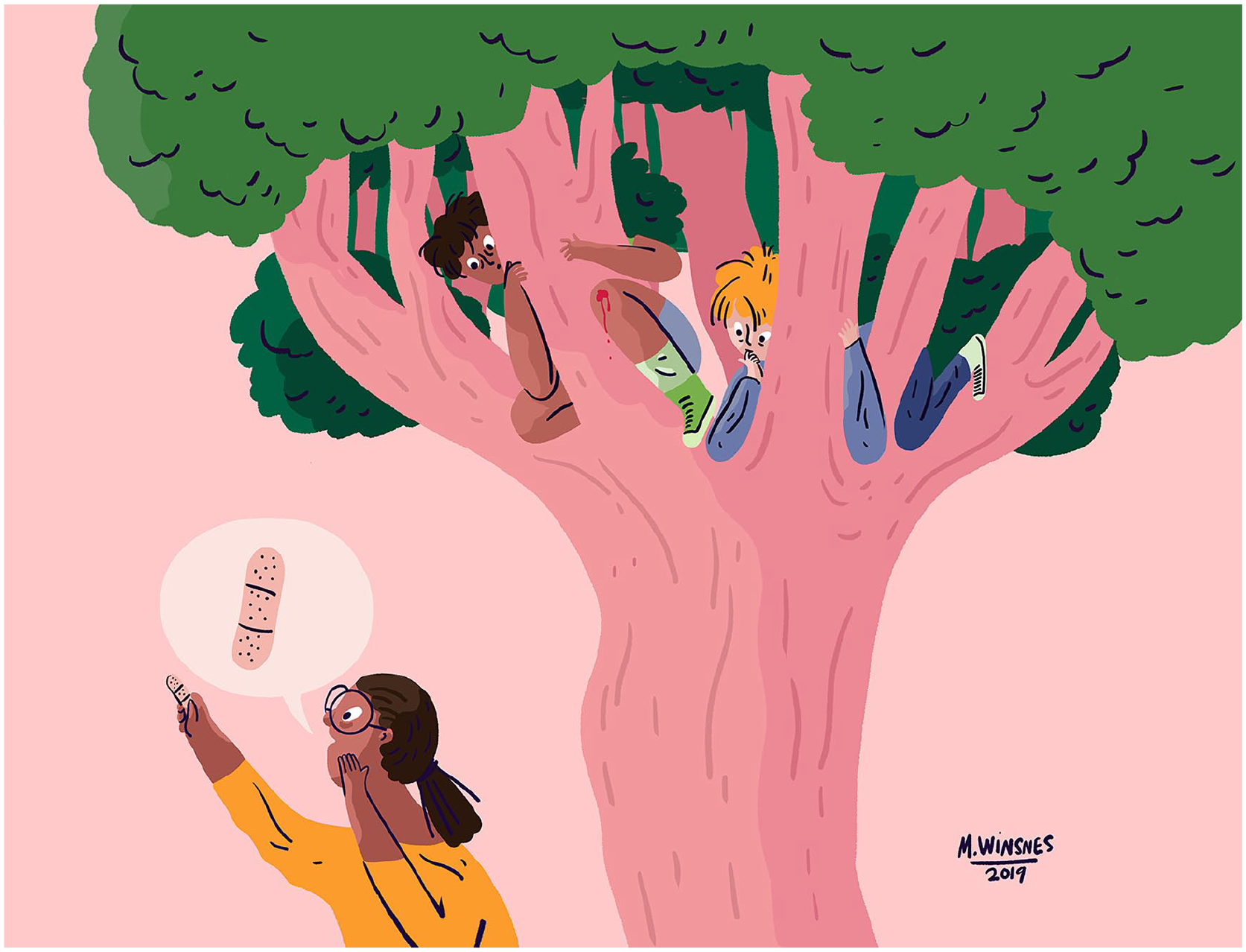
Protection. © Magnhild Winsnes.
Older children describe these uncomfortable moments in relation to privacy. Dora and her friends use a secret code: “Sometimes you want to write a letter (during class) ( . . .) and maybe what we write is private and we don’t want anyone to see that.” Fiona, who is still very young, explains that secrecy protects them from surveillance in intimate moments.
“And why are you going to the toilet in the dark?”
“So that no one notices it. My sister’s room is very close to the bathroom. She can tear the door open and see me.”
Jenny writes letters in secret code to protect what she and her friends tell each other about their feelings. Zeynep has a secret box where she keeps notes about whom she fancies to protect the actual feeling.
A different protective function of secrecy is when children prepare a surprise. Georgia explains, “If we want to plan a birthday surprise and the birthday child hears us speaking about it, the kid would understand everything.” Timo says that he enjoys anything that has to do with secrets, because “it makes other people happy, too!” In these examples, the secret is not just about answering veillance, but secrecy involves intimate moments of mutual veillance and shared knowledge. These practices of surveillance and secrecy establish privacy, social relations, and emotions. Some of these moments are about creating or eliciting specific feelings—sometimes willfully, sometimes playfully, sometimes unintentionally.
Affects and Affectivity of the Secret
When I ask one of my younger interviewees why she engages with anything secret, Ulla answers, “It is a lot of fun—not just a little bit, but really a lot of fun!” She especially enjoys secret games. Secret games, again, are often a combination of secrecy and surveillance, of not knowing and making known. Jenny, for example, thinks it is fun receiving, de- and encrypting secret messages. For Ingo, it is entertaining and exciting to be part of a team exploring secretive things, and Sina enjoys cracking secrets, as well as coming up with riddles and having others crack them. Some children are outspoken about the fact that excitement and thrill are the most important aspect of secrecy. And it shows in Emily’s behavior: “In the beginning it was so much fun when we tried being secret detectives. We jumped around when took on our different roles.” Bo explains his experience with a secret treasure hunt: “The more difficult the secret hideaway was, the more precious was what we found and the more exciting it was!”
Yet, excitement, thrill and fun are not the only feelings elicited by secrecy and surveillance. Several children mentioned how the secret is also meant to remain secret, because it is associated with shame or fear. Fiona admits that she kept something secret because “what we painted was actually really disgusting. So I put it in my drawer.” Secrecy also ties in with self-surveillance. Here, it may be associated with shame, but also with comfort, for example, when Alinea “shares” secrets with her diary. Zeynep finds that having a secret can be relaxing. She uses a secret box or a diary “because this is a little bit as if I told it to someone. Then I write it into my secret diary and then it is a little bit shared (see Figure 2).”
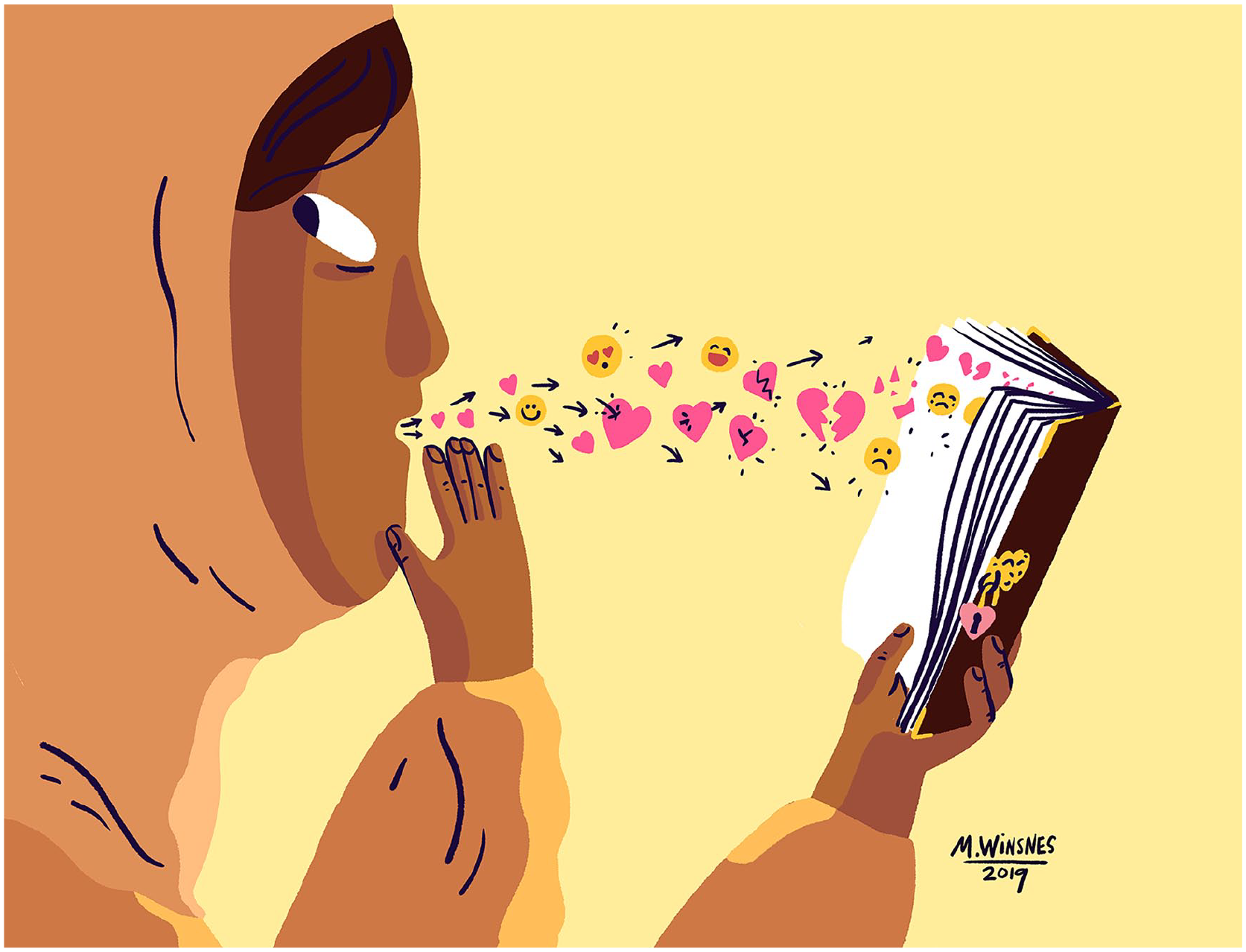
Affect and affectivity. © Magnhild Winsnes.
Especially when shared with those who watch out for each other, the secret is something that not just expresses, but actively creates closer relationships. Christa and her friend developed a secret game to mark their friendship. Similarly, Emily explains how a secret meeting spot at school helped creating a new friendship: She came to me and asked: “Shouldn’t we do something together—just the two of us without all the others?” And I said: “Yes, of course!” And that is how the whole thing started—with a secret room where we would meet.
Morten, who was among my youngest interviewees, finds that sharing secrets with his brother is important in their experience of being brothers. When I ask “Why exactly did you share your secret with your brother?,” Morten answers, “Because we always play together and we are best friends.” Similarly, Alinea tells a story about a secret code that signaled how close she felt to her kindergarten teacher: On a rainy day I did not want to go out and I was cold and I felt sick. So I stayed inside and got a hot tea. Then I got bored. So the kindergarten teacher said: “We could develop a secret written code.”
Precisely because the secret signals intimacy, watching and watching out for each other, some children explain how they had to choose carefully whom they would share a secret with.
“How did it feel having a secret?”
“Actually, it felt really good. Because . . . say you had a secret with a teacher, well, then (giggles) that would be weird, because you don’t know teachers as well as you know your friends. Say I would share a private secret with my teachers, they would probably go like: ‘Okeeey?’ (uses a worried, confused tone) whereas my friends would say: ‘Ok!’ (using an understanding tone). So they understand that.”
The affective world of secrecy illustrates how the secret is not just an emotional escape from specific types of surveillances, but how it also involves self-surveillance and mutual veillance. This combination of secrecy and veillance constitutes states of beings, it communicates proximity and distance, excitement and relief—all of which is also part of forming identity.
The Secret Expresses and Shapes Identities
The secret, whether shared or not, whether it actually exists or not, constitutes self-hood and identities. That is true for individuals and groups. The children reflected about how the secret becomes an active ingredient in their relationship to others and to themselves. Æsa, one of the oldest interviewees, describes how a secret made her literally see herself from a new angle. She explains how she made secret imprints of her fingers and feet, at which point she saw something about herself that she did not see before. She believes that many secrets can tell the owner something about themselves, which marks a very specific form of self-surveillance.
That the secret communicates something special to its owner also means that not everyone relates to secrecy and surveillance in the same way. Zeynep, for example, wishes her Mom would show more interest in Zeynep’s secret diary. She analyses: “For her, my secrets are just air; they are only decorated paper. She knows that these are my secrets, but she does not find them interesting.” The fact that they are not public knowledge, but knowledge that Zeynep would like her mother to see, is actively shaping the relationship to herself and her mother. That these secrets seem invisible to her mother—that they do not seem relevant to her—means for Zeynep that her mother does not see or “care for” her. Here, the secret shapes the relationship to herself as neglected and unsurveilled.
The secret also shapes group identities. Especially secret clubs were important here: the fact that “no one else is part of it” (Lars) creates the groups’ own identity dynamics. Hilde describes how the secret club is mainly about “being together”; their self-made membership passports and (unpassable) secret test procedures for potential new members give these groups a status of exclusiveness without which the internal dynamics would not be the same (see Figure 3). Other examples are the dedicated secret roles that each member fills in the club, the club’s name, their secret languages, their cases, membership cards, group signs, or inauguration procedures. Secret groups, but also secret meeting places or games, are rich examples of secrecy as identity-shaping that involve different types of veillances—inclusive and exclusive—combining watching out for each other with watching others.
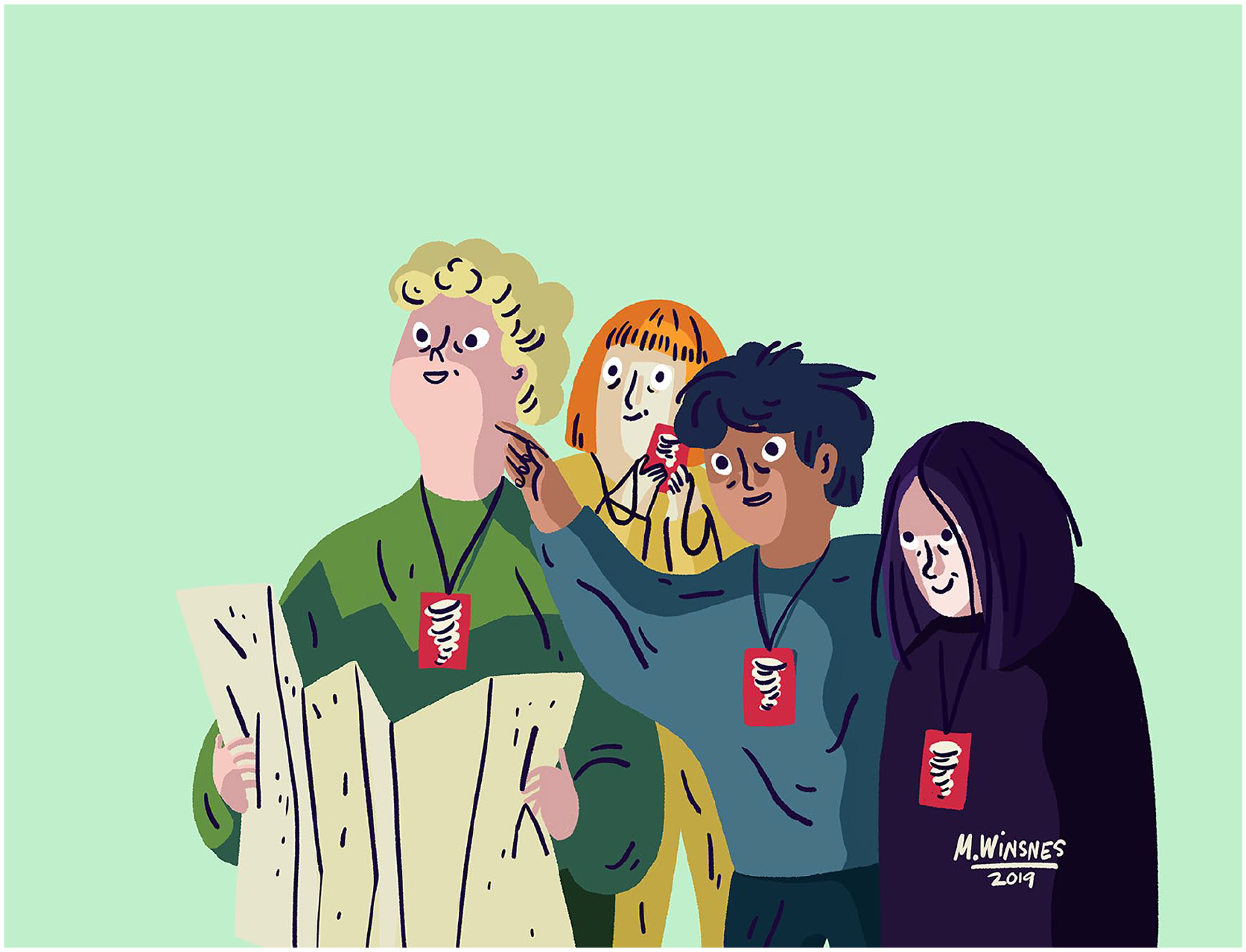
Identity. © Magnhild Winsnes.
The Secret as an Aesthetic and Creative Expression
In many cases, creativity is an important part of engaging with surveillance or keeping a secret. Sometimes, however, creativity is the secret’s primary function. Often, these are also moments in which aesthetics and beauty become central to the secret. Bo literally uses the word “beautiful” in his mother tongue when he describes his secret box where he keeps things that he found (see Figure 4). He extrapolates this sentiment of aesthetics to the secret in general: “I find it beautiful having these secrets. And keeping these secrets.”
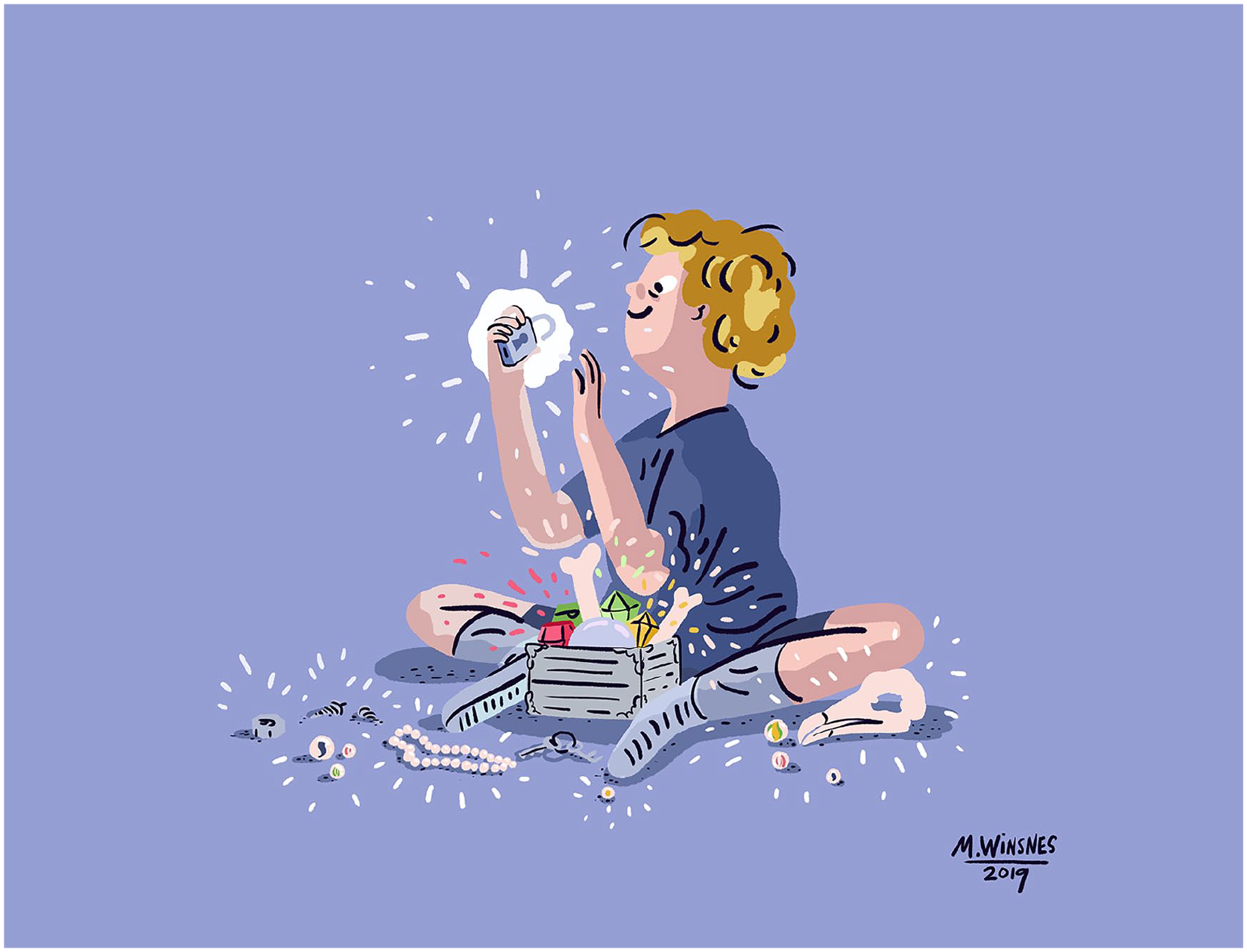
Aesthetics. © Magnhild Winsnes.
In a similar vein, Hilde discusses her secret group’s sign with me: “We use a tornado, because we find tornados cool. Everyone has it on their membership card.” Sina’s example is even more distinct. She developed a secret written code in which she combined different favorite things of hers: a pretty picture, a beautiful letter and her favorite letter. She says, “Sometimes I use this secret writing only because it is supposed to be beautiful.” Here, the secret causes a state of being, an aesthetic experience of self-surveillance, rather than being a solution to a problem. Sometimes, children use secrets as an occasion to be creative or develop a new idea. Dora and her friends, for example, developed a written code that does not use the alphabet. Alinea explains that she finds secret languages helpful to say something that is hard to capture with existing vocabulary: I have a secret language with my friend. We have not really found many proper words, but more like names: “house” means “Friday” and “lantern” means to “sleepover” and then we have the word “lenka.” That means when you really want to move a lot, like swimming, running—so not things that you play everyday.
Here, the secret articulates something which is hard to express. Secrecy, then, is a state of engaging creatively with surveillance and of experiencing self-surveillance. It provides new ideas to their owners, but it is also an impetus to be creative without any further purpose.
Points of Contact Between Surveillance and Secrecy—Methodological and Conceptual Contributions
The aim of this article was twofold: to discuss surveillance and secrecy as methodological tools as well as to reconceptualize their relationship in sociocultural studies. The study acknowledged the many forms of veillance in children’s lives and used the concept of secrecy to trace the complicated dynamics between knowing, not knowing, making and being known that already take place during childhood.
As methodological tools secrecy and surveillance meet and define the empirical situation: not only did I surveil the children in the context of the study, but they also watched me in return. This dynamic much determined the interview situations. At the same time, secrecy was not only a topic spoken about, but due to the sensitivity of the theme, the research situation itself was imbued with secrecy, with sharing, knowing, and also keeping secrets from each other. By sharing methodologically challenging, but rich encounters and explaining the roles that secrecy and surveillance can take here, I consolidated the discussions about the methodological relevance of secrecy (cf. Birchall, 2016; Mitchell, 1993) and surveillance.
Beyond showing what it means to work with secrecy and surveillance, I described what happens at a conceptual level when secrecy and surveillance get to work. Instead of discussing secrecy against surveillance, the critical contribution of this article is to further move beyond simple dichotomies and acknowledge the points of contact between the two. The focus on children’s engagements with surveillance and secrecy gives us insights into the ways in which surveillance and secrecy meet, question, constitute, and overlap with each other. Secrecy is not just a pragmatic strategy of avoiding surveillance, but surveillance and secrecy are embodied and performative (cf. Reale, 2017) in many ways. Surveillance and secrecy work on, with, and through us. Sometimes, they work against us.
Secrecy is thus more than information concealed, waiting to be revealed. Of course, skillful revelation is often part of the secret (Taussig, 2003, p. 297). In some of the children’s accounts, we have seen that secrecy exists exclusively to make something seen, known, or acknowledged—whether that concerns a child’s competence, feelings, or sense of aesthetic. To remain a “moving target” (Birchall, 2014, p. 46), secrecy also involves new ways of re-instantiating the secret after it has been revealed. Thus, keeping and revealing secrets not only condition each other, but they also develop each other further. Xenia and Yvonne explain this back-and-forth dynamic.
“When someone copies our secret written code, I have a different one. ( . . . ) for example, a mixture of both codes.” ( . . . )
“And if someone copies that, too, we would again and again come up with new codes.”
“But what if we end up having nothing?”
“Then we start drawing a code!”
This mutual reinforcement is typically observable in other societal settings where secrecy and its decryption drive each other forward.
Yet, the productive relationship between surveillance and secrecy is more than dialogical. The children’s accounts illustrate the ways in which secrecy and surveillance incorporate each other and how they are productive. We see this, for example, in the many types of protection: secrecy does not only protect something or someone, but it establishes a protected room for keeping things from being known. To do so, however, secrecy also muddles with surveillance. Children watch themselves, each other, authority figures and secret spaces to ensure that there is room for keeping things secret. The secret, thus, embraces logics of surveillance for protection, care, and self-care.
Children’s experiences also show how secrecy brings complexity to a culture where surveilling and rendering known is a prevalent form of governance. In fact, children have demonstrated clearly that the secret, too, can become a form of governance and control. Children explained how they experience secrecy as empowering—especially when they know they are being watched. The secret is productive in the sense that it gives the children the feeling of being in control—at the same time as the children in this study could only assure themselves of owning that control when they watched their surveillers.
Jacques Derrida (1992, p. 201) pushes the discussion on the relationship between surveillance and secrecy further when he describes the secret as “an experience that does not make itself available to information.” And yet, even when it is unknowable, the secret remains productive. The article gives concrete examples of this by highlighting the secret’s affective, aesthetic and creative registers. Sometimes, the secret is marked by an aesthetic that can only be known by experience. At other times and in the form of code, secrets are not just an attempt to answer surveillance, but they can give meaning to something that cannot be said otherwise. It can express the unexpressable, that is to make something known that is not intended to make itself available to information. Sharing a secret and its inherent surveillance not only expresses but actively builds relationships of care between children and things, between a child and an authority, or among a group of children. More than that, the secret, whether shared or not, whether it exists or not, constitutes identities. By having a secret and by self-surveilling, children learn something about themselves. The secret expresses what children are concerned with, whom they trust, what type of veillance they would like to avoid, and what type of veillance they would actually want in their lives.
Conclusion
In this article, I worked with surveillance and secrecy. I offered reflections about the ways in which ethnography with minors about surveillance and secrecy also includes instances of both, and how that creates specific productive challenges in interview settings. In addition, I analyzed how surveillance and secrecy get to work in children’s lives. My analysis contributes to a thicker understanding of the relationship between surveillance and secrecy as it traces how they interact and incorporate elements of each other. This helps us to move away from simplistic dichotomies of secrecy vs. surveillance, dichotomies of negative vs. positive morality of secrecy or veillance, as well as of containment vs. secretion. Surveillance and secrecy are integrated—and they can be both, pretty and ugly, mean and affectionate, planned and coincidental, protective and exclusive. Secrecy is secured with contracts and codes or meant to be discovered. This complex interplay between surveillance and secrecy is already present at childhood, and children are relevant societal actors to learn from.
I argued and documented that in their integrated fashion, secrecy and surveillance are productive. They bring situations, relationships, dynamics, feelings, aesthetics, new types of information and knowledge as well as their encryption into being. Here, my empirical study expanded existing insights on the secret as moments of governance and protection, where secrecy is a form of managing visibility and knowability. This does involve the intent to (make) disappear, to become opaque and inaccessible (Birchall, 2016; Glissant, 1997; Spivak, 2013; Kaufmann, 2020). At the same time, however, these attempts to manage visibility and knowability always involve elements of surveillance and being seen. Secrecy also includes intentions of showing and knowing something, making it visible, of showing off, of signaling power as well as intimacy. This interplay of knowing, not knowing, or making known sparks creativity and shapes identities of groups and individuals. Even when the secret remains unwatched and unknowable—when it relates to embodied experiences of affect, affectivity and beauty—it is still productive as it expresses that which cannot be made available to information or language.
My documentation, analysis, and theorization of children’s engagement with surveillance and the performativity of secrecy invites scholars to take a closer look at the interplays of veillance and secrecy and the changing conditions of visibility and knowability. In line with the position that critical methodologies and cultural studies influence each other, I encourage an analytic that considers surveillance and secrecy together—when working with them and when studying how they get to work. It is a position that neither interprets technological advances as an all-embracing force of veillance and transparency, nor does it focus on the exclusive politics of secrecy alone. It is a position that sees the complicated relationships between concealment and exposure and foregrounds how they take shape in society.
Footnotes
Acknowledgements
I thank all children, their teachers and parents who made this study possible. A big thanks goes to Magnhild Winsnes, who owns the copyright for all figures featured in this article. She kindly agreed to publish them here. The figures were created as part of a booklet developed to give back and convey research findings to those children who participated in the study.
Declaration of Conflicting Interests
The author(s) declared no potential conflicts of interest with respect to the research, authorship, and/or publication of this article.
Funding
The author(s) received no financial support for the research, authorship, and/or publication of this article.
