




Abstract
This article attempts to reconfigure hegemonic framings of “the academic conference” and thereby offer a means to (re-)encounter the spatial, temporal, and affective forces that conferences generate, differently. We are a geographically dispersed but multiply entangled group of academic researchers united by theoretical fault lines within our work that seek to ask what if and what else. This “what if” and “what else” thinking has manifested in experimental and subversive doings otherwise at a series of academic conferences. The storying practices presented in this article were made possible by the vital materialism of a shared google.doc. It was within this virtual environment that we attempted to weave diffractive accounts of what conferencing otherwise produces. This writing experiment offers a series of speculative provocations and counter-provocations to ask what else does conferencing make possible. This article is an invitation to the reader to plunge in and wallow within the speculative accounts which ensue and to contemplate the possibilities of breaking free from sedimented ways of neoliberal conferencing.
Introduction
We are a collective of academics committed to pushing against the normative parameters and expectations of the neoliberal conference. The twelve of us have, on various occasions and in different permutations, facilitated workshops, given performances, organized events, and hosted conferences that have sought to disrupt and offer a means to “conference otherwise.” We do this because conferences are difficult spaces in which academics are required to undertake considerable emotional, physical, and academic labor in attempts to “fit in” and perform the unspoken rules of the conferencing game which tends to privilege the White, Western, middle-class unencumbered male academic. Together, our work has been shaped by a range of philosophers and theorists including Haraway, Barad, Bennett and Deleuze and Guattari, among others. We recognize that drawing upon concepts and practices that are broadly defined as posthumanist or new materialist presents tensions and incongruences; however, our aim is to work with the potential that theoretical pluralism can bring to our shared project of “conferencing otherwise.” Collectively, we are committed to a new materialism that is feminist (Osgood, 2019; Taylor & Hughes, 2016), and our project is a political one that seeks to expose, problematize, and challenge injustices, inequalities, and prejudices that are embedded within and routinely play out in conferencing.
Specifically, then, the aim of this article is to generate knowledge differently so as to reconfigure hegemonic framings of “the academic conference” and thereby offer a means to (re)encounter the spatial, temporal, and affective forces that conferences generate, differently. This article instantiates feminist new materialist theory in its organization, structure, pace, and tempo. In this, it is attuned to the spirit of Haraway’s SF philosophy and engages in practices of speculative fabulation. Haraway (2016) proposes SF as a theoretical and methodological signifier: string figures, science fact, science fiction, speculative feminism, speculative fabulation, so far. In pulling these practices and ways of knowing together it becomes possible to engage in producing knowledge differently, to push thinking in other and novel directions, and to contemplate how speculating on our actively entangled place in the world prompts ethico-onto-epistemological (Barad, 2007) response-abilities (Haraway, 2008) to engage in more affirmative world-making practices. It attends to the real, virtual, and imagined through SF storytelling practices.
To enable us to tell these speculative stories based on fact and fiction, we draw upon the work of a number of feminist scholars in addition to Haraway that includes Karen Barad, Jane Bennett, Rosi Braidotti, Doreen Massey, and Kathleen Stewart. By putting to work a range of concepts offered by these feminist scholars, we are enabled to pursue conferencing (otherwise) as a political project that celebrates the importance of the mundane, the everyday, and the seemingly unremarkable. By turning our attention to affective, material, sensory, and embodied conferencing encounters, through processes of decentering the human subject, this article aims to generate a sense of dis-ease, recognition, and hope; hope that working on the margins can produce knowledge differently and pose a challenge to the normative and normalizing AcademicConferenceMachine (Benozzo et al., 2019). The crafting of this article was made possible by more than just our human intentionality; it was the vital materialism (Bennett, 2010) of a shared google.doc that intervened and unsettled the emergent narratives. This recognition of the agency of the more-than-human (i.e., the Google online space) imposed its own interventions and provocations (assigning otherworldly pseudonyms, denying access, and refusing to format images). It was within this virtual environment that diffractive accounts of what conferencing otherwise produces were woven together and also, in places, frayed apart. What follows, then, is an SF narrative enactment, which takes its (own) shape as a messy, emergent collaborative writing experiment in which a series of speculative provocations and counter-provocations are presented which together pose the question: What else does conferencing make possible? The article is an invitation to the reader to plunge in and wallow (Taylor, 2016) within the speculative accounts which ensue and to contemplate the possibilities of breaking free from sedimented ways of neoliberal conferencing.
It will be clear from this that we see our conference thinking and doings as an ethico-onto-epistemological challenge to mainstream thinking and doing in conferences. But this challenge has to have material effects—it has to be instantiated in the disruptions and provocations we enact as minor gestures (Manning, 2016) in neoliberal conference spaces. Such minor gestures are important in acting—in materializing—our shared political commitment to conferencing otherwise. These commitments work via tactics and strategies which release (as well as reveal) possibilities to actively rupture the ways in which conferences are organized, made accessible. Doing conferences otherwise can, then, be shaped as playfully serious resistance, and this article contains a number of instances of this. Our hope is that through playful practices of reconfiguring we expose other, minor ways in which to upturn conferences and invite others to join us in reshaping what conferences might become.
An Initial Provocation
/ˈkɒnf(ə)r(ə)ns/
noun
1. a formal meeting of people with a shared interest, typically one that takes place over several days.
“an international conference on the environment”
synonyms: congress, meeting, convention, seminar, colloquium, symposium, forum, convocation, summit, synod, conclave, consultation, awayday “an international conference on the environment”
o a formal meeting for discussion.
“he gathered all the men around the baize table for a conference”
synonyms: discussion, consultation, exchange of views, debate, talk, conversation, dialogue, chat, tête-à-tête; More
o a linking of several telephones or computers, so that each user may communicate with the others simultaneously.
“a conference call”
2. a commercial association for the regulation of an area of activity or the exchange of information.
“an international authority or, if that was not possible, a regional operators’ conference”
o an association of sports teams which play each other.
“Colchester regained the lead of the GM Vauxhall Conference”
o the governing body of some Christian Churches, especially Methodist Churches.
verb
1. take part in a conference or conference call.
“video conferencing”
(Source: Google, 2019)
A Counter Provocation
Provocazióne. s. f. [dal lat. provocatio -onis (der. di provocare: v. provocare), che significava, oltre che «invito alla lotta, sfida al combattimento o a un duello», anche «appello a un giudice superiore»]. –
A Response . . .
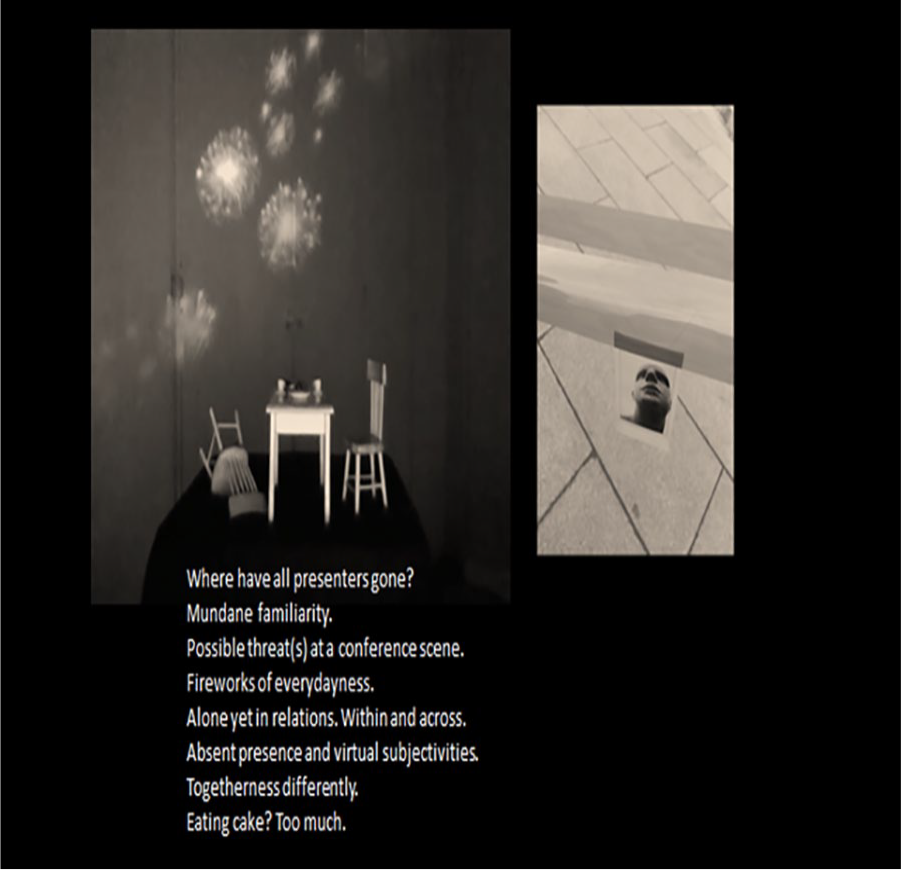
Provocation 2 . . .
Conference (n.)
1550s, “act of consulting together,” from Middle French confrence (15c.), from Medieval Latin conferentia, from Latin conferens, present participle of conferre “to bring together; deliberate, talk over,” literally “to bring together,” from assimilated form of com “together” (see
A Walkabout to Make “Conferencing Otherwise” (More) Possible
A chilly February morning. A pre-conference “Organising Committee” walkabout with “Estates Management” and “Room Bookings” to assess what will (mostly) be (im)possible at a conference that aspires to stretch the boundaries of conferencing:
“Why do you need a dance studio at an education conference?” “Stand-up comedy!? Well we don’t have a stage available at that time” “Why are you making it so complicated?” “There’s good reason for three 20 minute papers per 90 minute session; tried and tested . . . don’t mess with what works is my advice” “A troop of dancers from Mumbai?! Not sure you could have them all out here, in the public area, especially at lunchtime. . .” “Teachers just dropping in for one session? Not registered? Could be a security breach, I’ll have to check and come back to you on that” “I’ll see what I can do but I’m not making any promises” “Health and Safety won’t allow for that you see!”
L.php (PhEMaterialism, 2018).
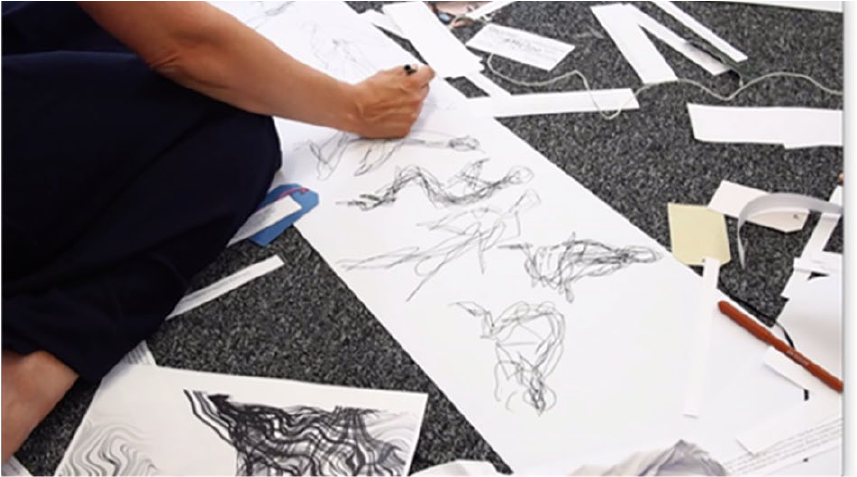
Walking-with theory (Taylor, 2018) at ECQI in Leuven, Belgium was an immanent event where walker bodies were put in motion and in relation-with the pavements and buildings of Leuven. The walk in question was not about going “anywhere” or doing “anything” in particular. Rather, it was a mode of sensing the affective resonances of the city and the materialities that were enacted therein.
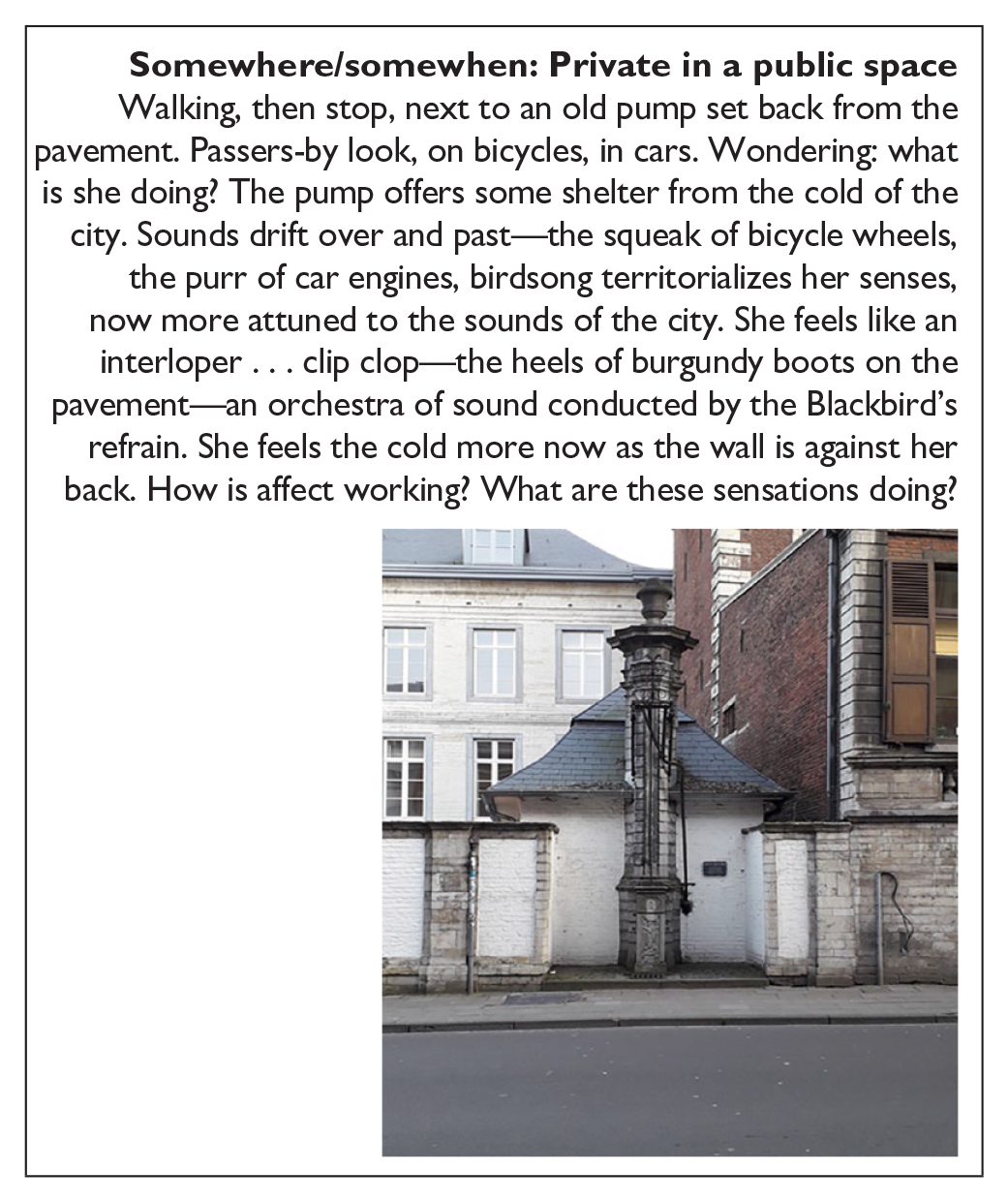
The potentiality of the affective resonances of the city becomes embodied as a range of transfers and relays when walking-with. The sensuous and affective encounters become “visceral and immanent encounters of walking in urban spaces” (Springgay & Truman, 2018, p. 35). Walking-with affective conference bodies denotes the ordinary affects of space and place where these moments attend to how bodies have the capacity to affect and to be affected to reveal “contact zones where . . . flows of power take place” (Stewart, 2007, p. 3).
“Somewhere/somewhen: Private in a public space” shifts the conference gaze from individually bodied academics presenting their paper in a seminar room to an audience with the materiality of the city. Sounds, senses, feelings, atmosphere, streets, people assemble in a mundane and happenstance way, prompting and exploration of the “nature” of ordinary life. Affect is sensing-feeling-knowing and works as an intensity that sits outside the discourses of linguistic representation of emotions, psychologistically understood. Affects have been conceptualized as intersubjective and pre-personal and have the capacity to change bodies (Massumi, 2002). Affects tune into sensory experiences in ways which make it possible to disrupt the over-reliance on sight and the dominance of occularcentrism, so common to Western modes of knowledge-making and, indeed, those associated with the privileges of the masculine flaneur. Walking-with-theory disrupts any notion that the senses are neutral recorders of experience and can potentially lead, instead to “racialized, gendered and classed understanding of place” (Springgay & Truman, 2018, p. 38). In Leuven, Belgium, our researcher/researched/conference bodies became entangled with enduring historical privileges marked in the materialities of stone, pavement, and building.
This, then, becomes an opportunity for a momentary tactics of contestation in which movement—and the movement of thought—seeks to rupture the business-as-usual machinations of the neoliberal AcademicConferenceMachine (Benozzo et al., 2019). This machine, by scheduling workshops, papers, and panels “inside” (in the interiority of rooms), continually reworks normative space and place boundaries which separate off conference bodies from the “outside” air, atmospheres, and materialities. This separation reflects nature/culture binaries which valorize certain “erudite” knowledge-making practices. A conferencing walking-with is an affirmative practice which disrupts these valorized practices; it produces an ethics and politics of noticing in which conferencing bodies materialize in relation with those other-than-human bodies whose vital and sustaining work is usually ignored.
Talking Heads: Conferences Are Where the Mind/Body Dualism Comes Undone . . .
Tete-a-tete-a-tete-a-tete-a-tete. One of those phrases absorbed from the French that makes you want to say it over and over again until the words lose their meanings and become just interesting phonemes and movements of the tongue against the roof of the mouth. Head to head to head to head to head. All our heads facing forwards and listening to this head that talks. It talks and points and gestures. It walks across the stage and raises its hand to the screen. It asserts and demurs and proves and disproves. It draws on the work of others and refutes/confirms/challenges the findings of others. It illustrates, dedicates, operates, separates, oscillates between script and off-script. It looks out at us but doesn’t see us. And afterwards we get together in small enclaves and confer. What a clever talk that Head A gave. I enjoyed Head A’s presentation. Head A really nailed that! Head A’s talk—what d’you think? Head A—getting a bit long in the tooth for this maybe. Head A—only here cos Head AA couldn’t make it you know—at another conference. International. Big! Head A, who the hell is Head A? What was all that about? There are conferences within conferences. Sometimes very wise people get together and share their wisdom with newer folk who haven’t been on the circuit as long. Sometimes newer folk get together and after spending far too long saying how cowed they feel and how little they know they might have quite a useful conversation where they share their thoughts and learn something. Sometimes people who have worked for years to make their ideas known are heard properly for the first time, really heard, and the hearer is borne or carried elsewhere. And it makes a difference. This is a good thing. Conferences can be good things. Sometimes the food is good too. Too good and you eat too much and then the afternoon is just a battle with your gurgling digesting stomach and your desire to sleep off your lunch. Sometimes the food is abysmal and you can’t stand the hobnobbing and tete a tete-ing so you nip out to the local sandwich shop, sit on a bench and wish you still smoked to pass the time. Sometimes conferences can be lonely as hell. You spend the whole day listening and don’t say a word. Sometimes you feel so out of your depth you are almost drowning in it. Sometimes the travel there takes so long that by the time you arrive you’ve lost the will to live and keep fretting you’ll miss the train home. Once I went to a conference and spent an hour and a half walking around the city centre looking for the venue. I was so lost I actually cried in the street. A grown woman. Leaning against a wall and crying. When I looked up to see the name of the street I was on I noticed a sign above my head. Lily’s massage parlour. This is a true story. Some people have shit lives servicing others and never get to go to a conference.
How Else Can Conferences Be? Spaces made Anew . . .
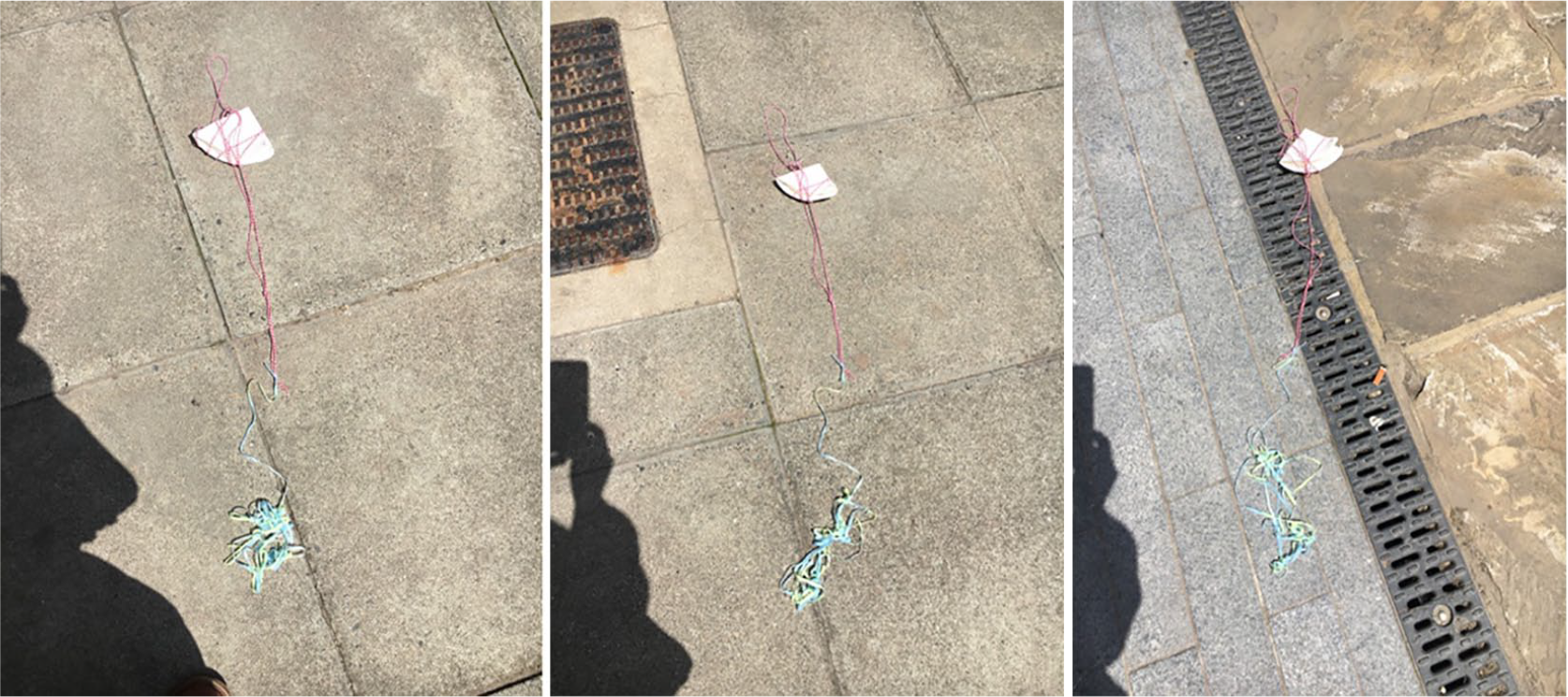
Spaces made anew. An academic conference is a place for humorous diffractions in which little objects like a used paper plate and a string can change the path from repetitive and already-known conferencing into exploring the space and encountering the spaces for learning differently. By making the space “leak,” diffraction gives way for non-human materialities, but also creates the human diffractively, intra-actively and open to encounter (Barad, 2014). Haraway (1997, p. 16) suggests that “we need . . . to make a difference in material-semiotic apparatuses, to diffract the rays of technoscience so that we get more promising interference patterns on the recording films of our lives and bodies.” Diffracting conference spaces with humor and non-human materialities could therefore problematize the humanist-oriented and self-reflective space by bringing “worldly objects” to the humanist epistemological “eye” enabling us instead to follow the eyes of objects, their temporalities, and ways of creating spaces and human-non-human knowledges on and on.
What Else Does a Conference Do? In Anticipation . . .
Variation 1
Paul (Kings College London) received an email from the conference organizers of the ICSTS accepting his abstract. He forwarded it to the Head of Department. She supported his participation—next May in Milan. That email made his day. Paul felt immediately happy and thoughts turned to Milan. It was clear that the two most interesting and urgent things were shopping and eating.
Paul knew in advance that the congress would be dull. He did not know the keynote speakers and had only submitted an abstract because a few days in Milan was a very tempting prospect. In particular, he was excited by the idea of doing some clothes shopping. His wardrobe needed to be renewed. One of his colleagues (a rival!) earned points from the Head of Department by his sharp look. Paul couldn’t be less than him. The time for new jackets, shoes, shirts, trousers . . . perhaps also socks had come! And what about eating? Somebody had told him that in the last few years Milan had seen an explosion of new cafes and restaurants—spoiled for choice. And what about drinking . . . ?
Variation 2
Susan (University of Boston) received an email from the conference organizers of the ICSTS accepting her abstract. She forwarded it to the Head of Department. He supported her participation—next May in Milan. The email made Susan’s day. She felt immediately happy. She did not hesitate for a moment but turned off the PC, left the office, and went home. Her mother-in-law was there looking after her eight-year-old twin sons. It was the middle of October and chilly; winter was arriving but Susan did not feel the cold. She was warmed by the thought of going to Milan where, three years before, she had met Pasquale.
She remembered not being interested in the conference sessions and wandered around the city, her feet taking her dreamily to Duomo, Castello Sforzesco, and finally the Bar Magenta, where she had stopped to have a beer. It was there she saw Pasquale, they looked at each other, they were both alone and free that night. She still has his phone number.
Variation 3
Matt (University of Toulouse) received an email from the conference organizers of the ICSTS accepting his abstract. He forwarded it to the Head of Department. He supported his participation—next May in Milan.
That email made Matt’s day. He immediately called Alan, his husband, to propose they had a holiday in Italy. Alan was so enthusiastic that, on his way home, Matt bought a Milan Travel Guide at Waterstones. In the evening they started to plan their travel.
I’ve never been with you while you are attending a Conference. I suppose that you have to go to all the sessions?
Well, I am not obliged to. I will present my paper, and attend some sessions if I spot something interesting in the program but, I can be with you otherwise . . .
I think I will be on my own a lot, mmm, that is ok, I can be a tourist . . .
Don’t worry, we will spend a lot of time together and perhaps . . . well, but . . . work is paying, and I will have to spend time at the conference . . . oh, I feel guilty both ways . . .
I understand, it will be fine, let’s plan where we want to go . . . OK, Milan, and then? Venice, Florence and Rome or somewhere unusual, less known? Oh Italy, the art we can see!
Variation 4
Astrid (Stockholm University) received an email from the conference organizers of ICSTS accepting her abstract. She had forwarded the email to the Head of Department. He supported her participation—next May in Milan. That email made Astrid’s day. She felt immediately happy. She was going to Milan with her friend Nuala from the University of Cardiff! For many years their friendship has continued through their meetings at conferences. They knew that the abstract did not fit the call that well but, hey, they had succeeded. They would share a room at the Conference and talk and drink and drink and talk and talk and drink.
Astrid opened a folder on her desktop called “Bureaucracy.” She opened “List_for_Milan.doc.” After all these years, she had got conference luggage down to a fine art:
One small bag:
- Documents (passport and flight tickets)
- Computer
- Umbrella
- Drugs (aspirin, laxative, nicotine patches, disinfectant napkins)
- 2 pens and 2 pencils
- Bloc-notes
- Wallet
- Two small plastic bags (just in case)
- Diary
- Scarf
- Small sewing kit with three buttons
- Milan map
- Plastic knife, fork and spoon (just in case)
One big bag
- 5 sets of underwear
- 5 pairs of tights
- 2 pairs of socks
- One nightgown
- 2 dresses (one day, one evening)
- 2 skirts
- 2 pair of trousers
- 3 shirts
- 3 t-shirts
- a cardigan
- a sweater (you never know about the weather)
- her best formal suit
- A comb
- 1 raining pair of shoes
- 1 walking pair of shoes
- 1 pair of slippers
- Make-up case
- And what else?
Recently Astrid came across a paper in which a group of researchers had started to pay attention to bags as mundane, everyday objects to “illustrate the interrelatedness, connectivity, and potential embedded in ‘thing power’ (Bennett, 2010) and matter that . . . [they] (as scholars) generally bypass and potentially deem meaningless or lifeless” (Taylor et al., 2019, p. 17). It seems an innovative article. It also resonated with her neurotic need to control her bags and her frustration with Nuala . . . However, many times she gave her list to Nuala she had always refused to use it, yet at every conference Nuala always had to borrow something from her. She laughed and said (in Nuala’s voice) words: “Damn, I’ve forgotten to pack X, you don’t by any chance have one with you, do you?”
What Else Might a Conference Become?
Six of us planned a workshop over many months (Osgood et al., 2017); we experience the pleasure and chaos of collaboration again (Nordstrom et al., 2018). These events are entangled and transversal (Osgood et al, 2018). They are curious nomadic research movements in the Anthropocene borne of worry and care about the ocean. Endless unanswerable questions are provoked. How to be an early childhood researcher when worrying and caring about the ocean? How to research and conference and still be on the move? Moving. Being moved. And still care and worry about the ocean? How do we perform worrying and caring about the ocean? How is the ocean connected to the aeroplanes that have brought us together?
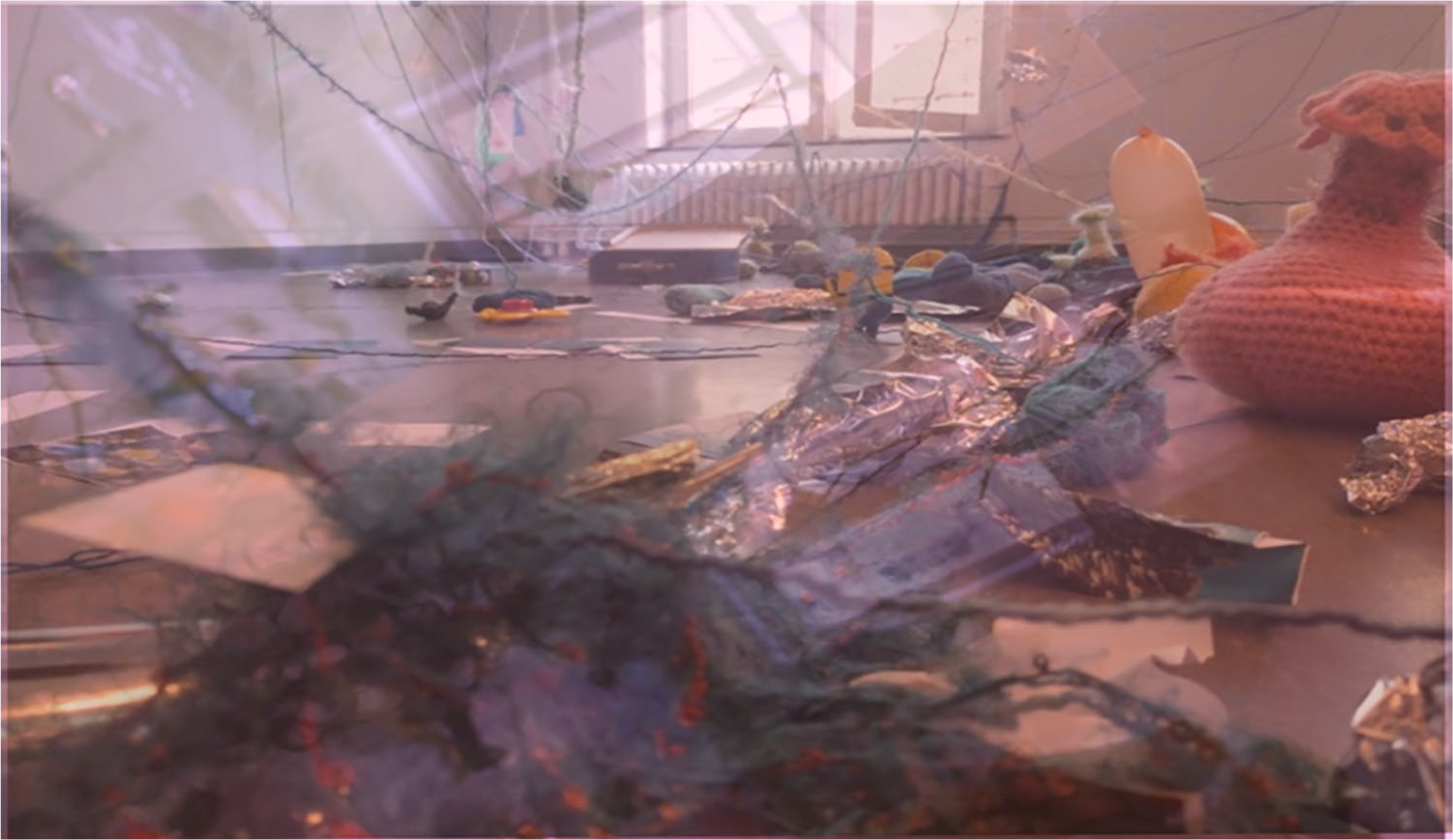
We read Alice Through the Looking Glass, in preparation. Perhaps it can help us to “move on, beyond the empire of the sign, toward a neoliteral relationship to animals, anomalies, and unorganic others” (Braidotti, 2013, p. 84). To a different relationship with the ocean. To the conference. The room we are offered must be transformed: yarn; old plastic toys, stuff that children amass through their daily lives, soon to become litter, clogging the oceans. We work to alter this dreary teaching room. Beautifully designed anemones of yarn. Foil. Balloons. Quotes from philosophers and thinkers. Printed images from oceans. We invite people who have come to use the materials and the space in whatever way they want. Little is said. We cut through now and then with difficult gifts. A video has been recorded by one of us and is shown during the workshop. She reads Jabberwocky from the Alice-book. Someone starts to knit.
Presenters and participants become the same shoal. Performing collective mess. We care. Almost silently we care perhaps for “what humans—most of us—have learned collectively to neglect” (de la Bellacasa, 2017, p. 162). We also perhaps “cultivate joy” when doing and feeling care is shared (de la Bellacasa, 2017, p. 163). Conferencing creates individuations, collectivities, worlds.
“We have now discussed the issue within the organizing committee . . . we are still unsure if we are able to accept workshops that do not fit into our time slot categories . . . We are also considering other options”
The AcademicConferenceMachine: Processing Academic Bodies
AERA Registration Hall, Metro Convention Centre, Toronto, April 5, 2019
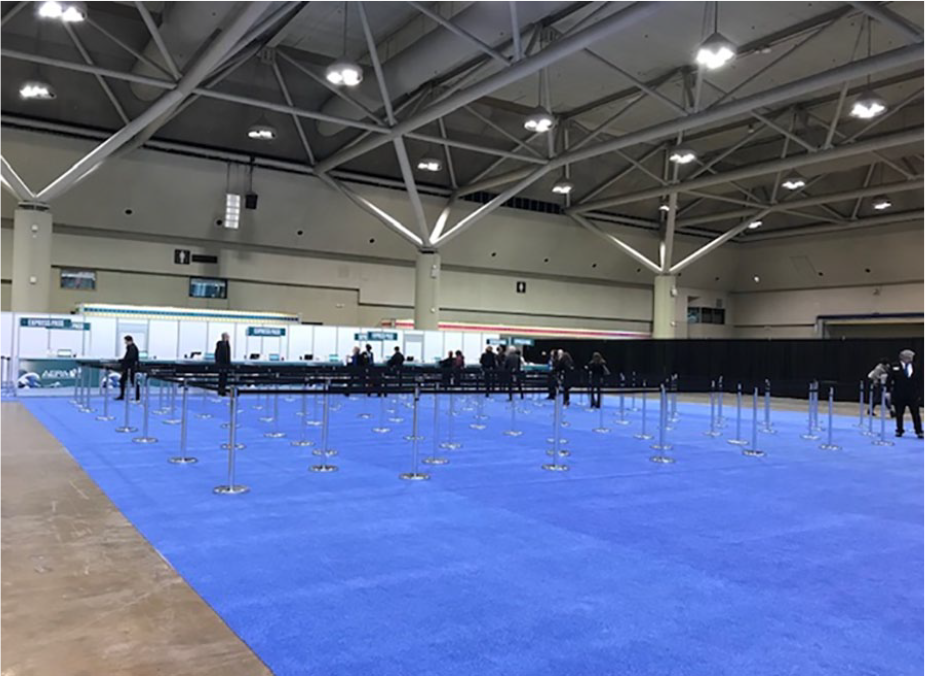
Enter the line Get in line Pass along the line Wait for your turn in the line Bag. Check Programme. Check Badge. Check Thank you. You’re welcome Oh, to be welcome(d) To pass as welcome To be passed as welcome A welcome(d) body A worthy body A warm and well-fed body Sometimes a dis/abled body Sometimes a black, brown or othered body Sometimes a body with a baby Sometimes a body with an animal companion But more often than not, not In conferences spaces, that sort of body is usually not In this space a body who passes is A legitimate body A body with the correct credentials A recognised body A body possessing papers A body who has paid the money A body with the right to be here in the here-and-now Enter the academic conference space This is not airport passport control This is not an immigration entry centre This is not a meat processing plant Is it?
To enter the huge and space-hungry halls of international conference convention centers requires kudos and confidence. Kudos because you are a body who/which materializes the achievement of having arrived: your name is on the “accepted” list; you have a badge awaiting you with your name and institution on it; your presentations are in the printed and online programs, sometimes multiple times! Confidence because you are a body who/which can segue into the conference space and no one will query your right to be there: you can occupy and claim the space—your space within the vaster space. Of course, your imposter syndrome may cause you to worry that you don’t “feel” quite right here, that you don’t quite “fit,” that you look wrong, or act out of place, or are not wearing the right kind of clothes, that your questions are too naïve or critical or off the wall (if you are able to get around the tongue-ties that prevent you asking any questions at all that is). Despite all of this, once through the registration hall, you have been “registered,” in other words, you have been processed as a body whom—as matter which—has been recognized as “officially” belonging here. Your particular body has been invisibly stamped and formally incorporated. You have been processed into, accepted as, a member of the AcademicConferenceMachine, that neoliberal assemblage of global knowledge production which organizes-produces scholarship and intellectual activity in accordance with the routines, rituals, and regularities required by the corporate university and its concomitant privatization of academic capitalism (Taylor et al., 2019). Once processed, all you have to do now, it seems, is work out how to enact an embodied tact of belonging, as if it were natural, so that you forget when it felt un/natural.
Processing academic bodies with/in the AcademicConferenceMachine enfolds cultural privilege into space-time-matterings over, under, and through which patternings of power pulse, widen, and diffuse. These patterns are elusive but felt: some bodies always matter more—come to matter more—than others. The quick glance at you, off you and away, the smooth-insincere smile, the carefully polite note of interest. You hold down that flash of anger in your gut as you are looked-over and overlooked. What can you do? You remind yourself again and again that your conference doings can be oriented to care and kindness—to making kin—with those other bodies who are looked-over and overlooked. Together we are legion.
Processed initially at registration, your body continues to be processed, minutely and mutely, again and again, as you process through the spatial assemblage of the conference: the White gaze; the male gaze; the normative gaze from nowhere. Barad (2007) notes that “bodies in the making are never separate from their apparatuses of bodily production” (p. 159). In the spatial assemblage of the conference, entangled intra-active forces do powerful work to cut bodies together-apart in ways which ensure that in/visible re/marks are continually made to re/materialize the striations of race, gender, class, sexuality, able-bodiedness.
Such entangled boundary-making practices prevent any pretense of equality and demonstrate the inaugural conference moment—the act of registration through which bodies are processed equally—as a smooth neoliberal fiction. A posthuman/new materialist feminist orientation to the processing of bodies within the AcademicConferenceMachine pays attention to the complex spatialities, uneven bodily topographies, and material dynamics of encounter which produce bodies which/that matter more (or less) than others in conference spaces. Conference spaces are, of course, not one but many. They are multiple and heterogeneous, enfolding dominant, peripheral, marginal, and informal spaces together (Massey, 2005). Their human–nonhuman agencies act in confederation to produce “practice[s] of mattering through which intelligibility and materiality are constituted” (Barad, 2007, p. 170). Such practices of mattering are vital matters for those whose bodies are subject to processing in/by/through the powerfully performative vagaries of the contemporary neoliberal AcademicConferenceMachine. The multiplicity of space releases potentialities for multiple tactics and strategies for making othered bodies welcome. Why not try clearing the space, move the chairs, shift the bags and obstacles to the side, move away from the lectern. Make your talk a smile; make your presentation a welcome. This sometimes happens. It can happen more often.
Every conference paper counts. Reference to conference papers in endless applications. Quantified: 41 to date. Cited in an application for promotion. This year I will be 47 years-old. First conference paper at 30 years-old. An average of four per year. This amounts to a lot of time spent applying for money to attend, preparing, booking flights, accommodation, travelling (documenting it all in the system afterwards to be reimbursed). Always sitting in an air-conditioned room alone as the conference unfolds, madly finishing, finessing, always harder that it is in English. Only myself to blame! I could have chosen not to spend time with my kids in the run up, but I will be away for days. I should have started earlier, but I did not. I will next time. This cycle has become my normal when it comes to conferencing. I cannot say I do not like it.
Academic conferences are creative spaces for thinking and writing, collective possibilities, for connections and re-connections, for being troubled. Of worlds. They sometimes create movement within the field: “I was there when SHE presented THAT paper. We did not have a clue what she was doing at that time.” The joy of being inspired. Of learning.
The usual one and one and one and one and one and one and one format of presenting at conferences is so easy to fall into; to obey. It functions as the way of conferring, albeit the verbal language privileges some. Not me. The enjoyable stream of words lull us into being good academics. I share with colleagues how to do conferencing, experienced, how to be a good academic. I do not follow my own advice. I seldom resist the usual conference format, even though it is problematic. The enormous amount of work that it would take to do it differently is almost too much.
Rupturing the AcademicConferenceMachine: conferencing otherwise . . .
Sometimes it is possible to make space for different modes within the “striated” (Deleuze & Guattari, 1980/1987) spaces of conferences. Different democratic openings. Haraway said that “democracy requires people to be substantively involved and know themselves to be involved and are empowered to be accountable and collectively responsible to each other” (Goodeve, 2000, p. 157). Could conferences be creative of democracy?
It took me some time to enjoy conferencing otherwise. To break free from the normative expectations that were sometimes produced within me. To take up space differently, Leaning into new smooth ways of conferencing, sensing the intensity of collective doings provoked in thoughtful ways Conferencing otherwise is like sharing gifts. To confer, to give, is not one thing. What and how we give matters.
The voice sounds uncannily familiar. It might be their own if it weren’t so fully bereft of all the doubts that attend their worldings and everyday becomings. Are they looking at themselves in a mirror? They move toward the image, its reflection is at once them, and yet is not. The mirror offers a fractured and fracturing independence of their mirrored reflections that belies its/their sameness.
They start to tell a “how,” though even that is difficult to conjure in some summarized and pithy way. They make various re-turns—this conference, that conference, no that conference, or was it?—re-membering stations abuzz with bodies doing bodies; tables provoking disturbances; chairs entangled with things, strings, bits, bobs, stuff, matter—and they rest dreamily in the uneasinesses those multiply-refracted spatio-temporal actualities that slip and slide into and with other imaginings that are neither wholly recollected nor representational. The question (why conference differently?) moves them to think: we are not a lepidopterologist, we want to (are trying to) live in/with the vagaries of the coincidental, the happenstance, uncertain, so that we may ponder the comings-together and embodied doings in the here-and-now. Who are you to ask us to pin down, to fix, to know “things” through memory rather than in the complexities of their material-discursive-relational being? We appreciate that our doings unsettle participants, times, spaces, conference scripts and usual ways of knowing. We are seeking to refuse the expected and acceptable to produce something “new” (whatever that might be).
It’s quite a sweaty squeeze here at the top of the stairs on the landing. Not so much a corporeal sweat or squeeze. More a virtual glow, a glistening in the unpredictability of what might happen here. Like their co-participants at the workshops who intra-act with a head on an iPad hanging in a bag, doll bodies, glue, scissors, pens, hair, dirt, cheese, Lego, detritus, there is no way to know in advance how these “talks” might go, in what direction they might lead. These un/conferencing “workshops” are speculative possibilities that ooze with the virtual scent of not-happening; they stammer and seed into fertile furrows that go who knows where and how. Of course, there is a worry about whether and how this counts as conferencing. A not so subtle whiff of doubt is, at first, blended and then transformed into something else, something humous, that has the scent of a darker dirt, a performance composed and nurtured in the decomposition of what is acceptable and expected. Squeezed together, they sense their mirror un-likeness bristling with another objection. Here comes another “but” they think.
But, conferences are spaces where experts come together to share their views, views resulting from the exercise of reason and logic, on the basis of research that is rigorous and finalized. Surely, mirror-voice says (with what might be the intimation of a condescending tone) one should arrive at a conference well-prepared, well-practiced, presentations should be honed, potential questions or challenges guessed at in advance.
There, on the landing, their mirror likeness steady momentarily, then fractures, they are becoming-multiple across a range of times, places and activities. They are on Skype, on emails, on virtual online spaces set up for synchronous and asynchronous writing and musings. They are in rented rooms, in hotel bedrooms, in conference hallways, in the bar or walking from venue to venue. They are perusing conference venue spaces, laid out in standard and conventional formats to be (re)imagined as housing activity stations. There are tables and chairs to reorganize and place, needles to be threaded, walls and ceilings to be surveyed for their suitability for hanging and sticking and touching. There are fabrics for hemming or fraying; there are materials gathered, made, transported to and into the venue and arranged. There is technology to be sussed so that virtual co-participants can partake. This is the joyful labor of doing conferences differently. It does not involve the mirror reflection of practicing my 20-minute talk to perfection. Conference preparation otherwise nurtures the fecundity of stammer in the bounce of ideas in the aim to push at the limits of the unrecognized. There are considerations of what participants might do, of the ethics of what they might experience; of what the material arrangements might do, of what and how they might have affect. This abundance of bouncing and doing is generative of collaboration, of confidence and confidences shared. It bounces with the queered surprise of meeting the familiar and the foreign, the shared and the strange. These are preparations of an architecture of performance. The conference script is relatively blank: it is speculated and speculative, it is anticipated, but . . . It aligns with the unexpectations of the and-yet, wheezed in the exhale of the perturbations to come. They laugh as the temptation to pun on “congress” bubbles up—congress—a fitting refrain on the intimate, collaborative labors of the AcademicConferenceMachine with its academic and gendered performances, its restraints demanded by discipline and convention.
All these potential points of divergence exemplify the serious play that teases and prises open the fissures in normative modes of academic knowledge production at conferences. Why ask why? What the improvisations do speak to is the “why” of conferencing differently. They no longer hear the whisper of their mirror reflection, although they sense clamor in its silence. They realize that, although it fascinates and appalls, the “why” is such a brutal question, demanding as it does some smooth finality; a mapping that is marked with closure, with pre-formed understanding. There is a glow, a surge among them, a smile and joy. They stand on the landing as on a ledge of indeterminacy, one that affords a rest from the norm, the proper. There is generativity in each relational encounter as, marked and supported by their vulnerabilities, “they” transmogrifies into a “we” that continues to collaborate, to contaminate, to dream.
(In)Conclusion: What Else Does “Conferencing Otherwise” Make Possible
This article has endeavored to disrupt the conventions of both academic writing and conferencing through Haraway-inspired practices of speculative fabulation. The stories that have been told are intentionally provocative and troubling. They provoke dis-ease and are designed to challenge. We suspect that they will reverberate and resonate as well as agitate and possibly inspire. We cannot be certain what engaging with our project of conferencing otherwise will provoke in the reader but for us, as authors, attending to the material, affective and embodied nature of conferencing encounters has enabled other stories to find expression, and through a deep excavation of the discursive-material-semiotic framings of “the academic conference,” we have been able to consider what they make im/possible and for whom. The multiple, interwoven and, at times, incongruous stories offered in this article insist that conferencing, when considered through a feminist new materialist framing, must be understood as inherently political and deeply ethical. Pursuing other ways to do conferencing, ways that can make a difference in the world, is core to feminist new materialist work (Strom et al., 2020). The challenge is how to do this in each and every space and place where we conference. This is not an abstract consideration. It is a question of doing—of attending to the mundane materialities of how conferences are done—so that in everything we do we insist upon questioning, challenging, and pushing back against the demands of the neoliberal academy and thereby creating space for knowledge to be produced differently. Materialized practices designed to rupture the academic-conference-machine have to, we suggest, be oriented as feminist, decolonial, anti-racist, non-ableist practices to enable the political potential of our collaborative project to come to life. Enacting such practices opens opportunities to put “what if” questions (Haraway, 2016) to work so that we might—in this space here and now—bring the “what else” (Manning, 2016) into becoming. We think that it is in unfolding what else might be possible that we create space to allow conferencing otherwise to find expression. Small interventions matter. The mattering of conferencing, and the possibilities to conference otherwise, matters.
Footnotes
Authors’ Note
Nikki Fairchild is currently affiliated with University of Portsmouth.
Declaration of Conflicting Interests
The author(s) declared no potential conflicts of interest with respect to the research, authorship, and/or publication of this article.
Funding
The author(s) received no financial support for the research, authorship, and/or publication of this article.
