



Abstract
This article is about movement, documenting a researcher’s reading, seeing, and feeling with the flaring movements of a young child’s clenched fists as he punches the air in an early years’ classroom. Drawing on postqualitative inquiry and feminist new materialisms, the article aims to engage with a series of images to think otherwise about the fists, aiming to nudge the researcher’s gaze to attend to the unfolding affective forces of movement’s encounters and compositions that touch the structure of subjectivity. The first part of the article addresses the importance of returning to early years’ events to slow them down and open up spaces for not knowing so quickly what seems to unfold in/to the classroom. As an ongoing provocation of thought, I am interested in resisting the accelerated temporality of education by re-turning these images over and over, hovering over the surfaces of histories and politics to interrupt associative chains of thinking–feeling. The article then moves into the problems posed by the fists, stirring the sediments and deposits that are rapidly set in motion as the fists flare. Recognizing the affects of congealed language that genders and racializes my sense-making apparatus, the article mixes in stock notions of the child, reducing him to a body in pugilistic rebellion. The article finally turns to consider movement as another way of becoming oriented within one’s environment. The moving fist-assemblage becomes a potent thread that gathers and disperses meaning and bodies, politics and history, form and movement, and being natural and ideological, material and semiotic.
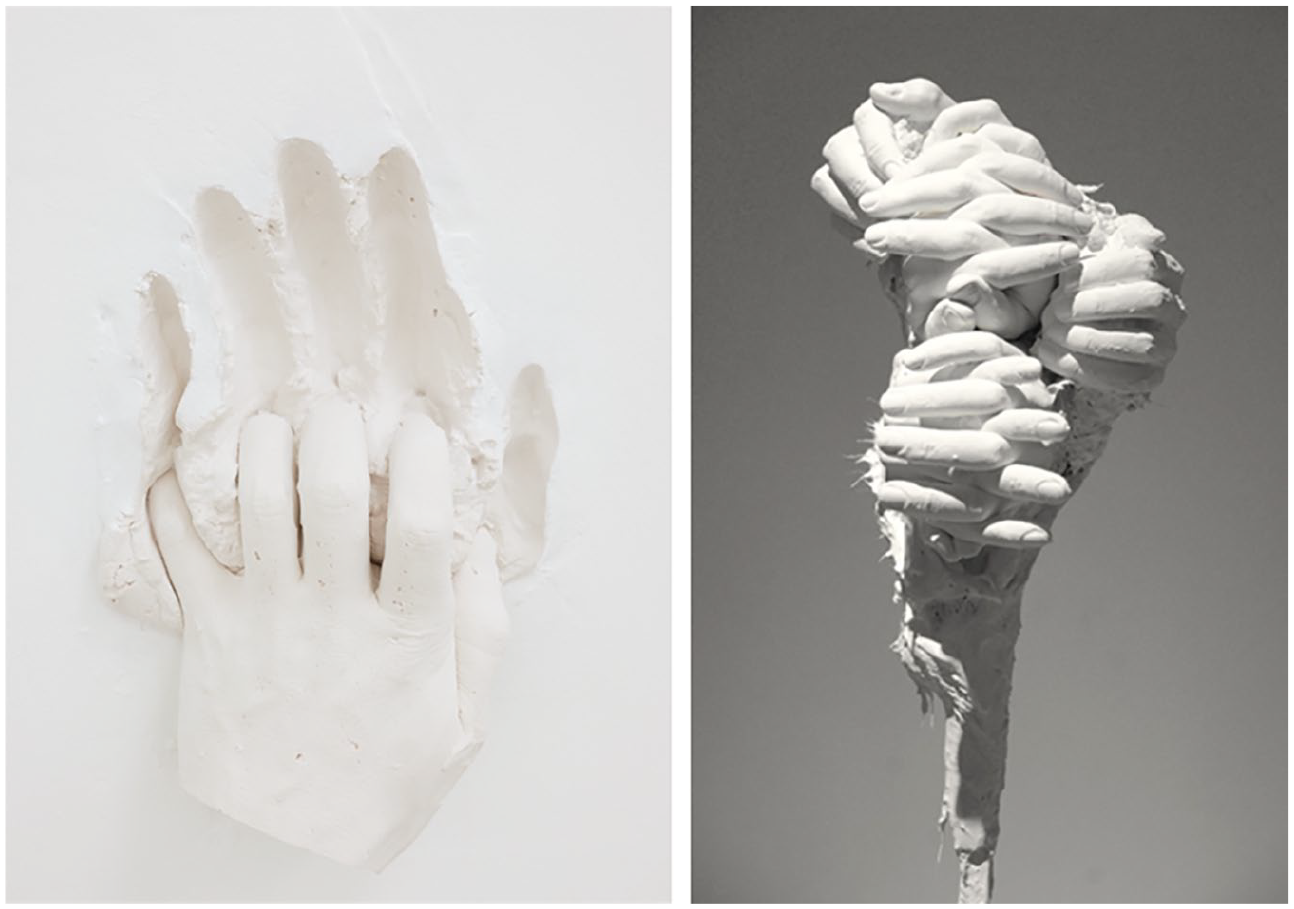
Thought 2 1 Untitled 1 Work Tables
2019 2011
Edition of 3
Aqua-resin and fiberglass
8 × 11 1/2 in. (20.3 × 29.2 cm) David Altmejd. Image © White Cube (Kitmin Lee)
Introduction
This article is about movement. It documents a researcher’s reading, seeing, and feeling with the flaring movements of a young child’s clenched fists as he punches the air in an early years’ classroom. It was a moment that was caught on video during an ethnographic study that focused on young children’s behavior. 2 While this study occurred 11 years ago, I nevertheless find the close-ups still living with me: in my body, my mind, and in my rethinking when writing this inquiry. By engaging with the images, the aim is to think otherwise about the fists, so as to attend to the unfolding affective forces of movement’s encounters and compositions that touch the structure of subjectivity (Braidotti, 2016). By eschewing a focus that centers only on a subject, I am more able to appreciate how things come to matter (Barad, 2003), hovering around movements that are palpable but often overdetermined. Throughout, there is a will to resist a gaze that has been trained to focus on the subject where human exceptionalism is always assumed.
The first part of the article addresses why it is important to slow down events that have occurred in an early years’ classroom. It also addresses the importance of “not knowing,” which, as I go on to argue, serves as an antidote to habitual responses that serve to overdetermine not only what has occurred but also why it has occurred. I consider the speed with which I summon crude labels that somehow uncomfortably congeal into almost imperceptible, yet overt assumptions about the boy’s behavior and its relationship with his gender and race.
The article then turns to consider movement as another way of becoming oriented within one’s environment. The moving fist-assemblage becomes a potent thread that gathers and disperses meaning and bodies, politics and history, and form and movement.
This article is significant as it draws on postqualitative inquiry and feminist new materialisms so as to offer a different approach to studying movement in the field of early childhood. Undertaking a long and slow analysis forces a radical reconsideration of established educational and methodological habits and ready-made territories, “ . . . by traversing the dualisms that form the backbone of modernist thought” (Dolphijn & van der Tuin, 2011, p. 383). This article documents my being as well as my reading, seeing, and feeling with the movements of the fists, so as to produce a thinking otherwise or, put a little differently, a “topographical analysis”—one that “ . . . uses bits and pieces of theory to listen to the dynamics attuned to ‘figural densities’ of texts set alongside one another” (Lather, 2016, p. 127).
We Are All in This Together
www.bristol-street-art.co.uk https://pompeiibodies.weebly.com
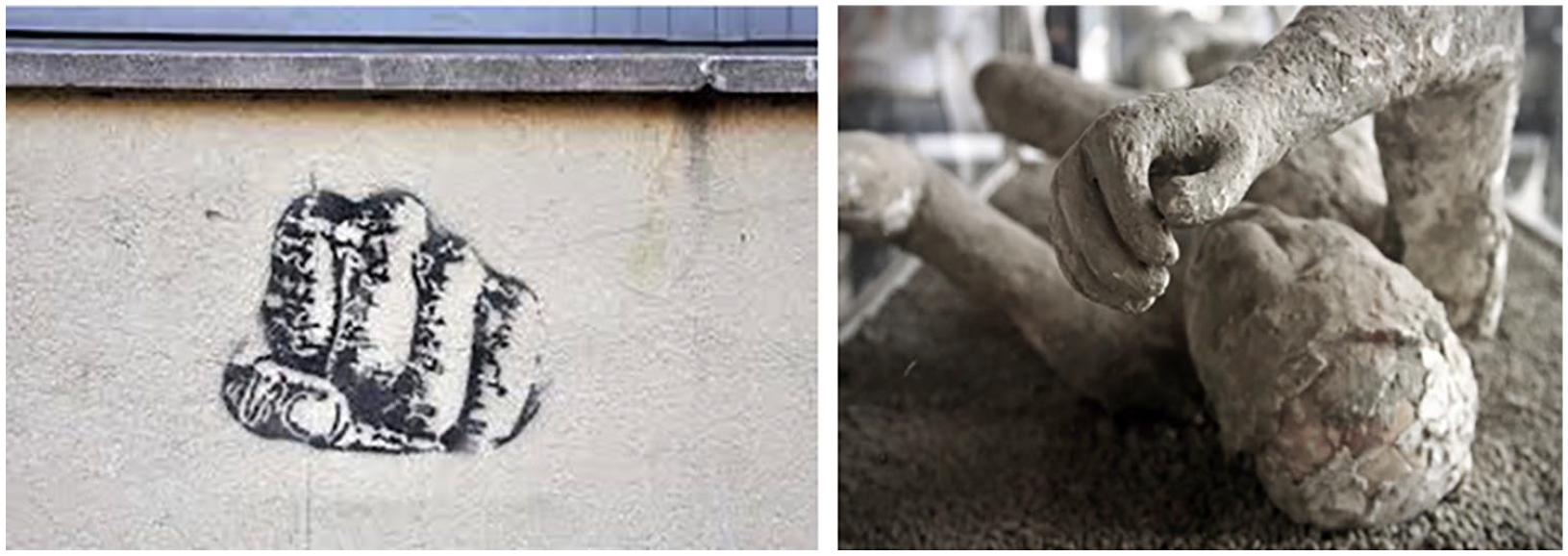
Clenched fists, whether erupting into the classroom milieu, stenciled on a wall, flaring in the boxing ring, a salute or petrified as a plaster cast body, always provoke and raise questions. They also pose problems. They are far from indifferent or passive objects, but invested with threat, resistance, antagonism, struggle, strength, and unity. They are deeply complex riddled with highly charged desires producing a multiplicity of sensations that together creates a problematic field. Rather than setting the problems to one side or just simply ignoring them, I want to stay with them. As noted previously, I also resist focusing exclusively on one child as, in all likelihood, this could only prompt habitual questions including, for example, What has caused this behavior? How can the fists be explained? Such questions necessitate a separation between the observer and the phenomena being observed. They gesture at a rational, disconnected researcher who is able to stand outside so as to survey the enclosed field that includes the boy and his fists; one who is able to assume a God’s eye view of the classroom, conferring meaning and significance upon it through the exercise of human capacities of consciousness, intentionality, reason, and moral judgment. Such practices encourage illusions of “interpretative dominion over an enclosed field” (MacLure, 2013a, p. 167). This article argues that rather than standing above or outside the world of the classroom, individuals (including, for example, researchers, children and teachers) are deeply entangled, embedded, and embodied. In other words, we are all, as Braidotti (2006) points out, in this together:
What this refers to is a cartography where clusters of interconnected problems touches the structure of subjectivity . . . “an embodied and embedded entity, which exists in the interaction with a number of external forces and others, not all of them human, social or historical others” (www.rhizomes.net).
To curtail my eagerness to see everything from nowhere (Haraway, 1988), this article acknowledges the importance of dislodging dualisms by engaging with Braidotti’s sense of interconnected problems. In education generally but perhaps more especially in the early years’ classroom, language is increasingly used to represent reality, make meanings that shape and define human matter and articulate words to describe things; processes of separation that hold apart mind/body and subject/object and, in so doing, bolster human(ist) exceptionalism. Such processes necessitate dumbing down the vibrancy of matter, and as a consequence, the entangled significance of human and nonhuman bodies is neglected.
Moves to destabilize dualisms and work more adequately with assemblages, events, entanglements, milieus, multispecies, intra-actions, and ad hoc groupings in the early years are interrogated by scholars such as Rautio (2013), MacRae (2019), Hackett and Somerville (2017), Osgood and Robinson (2019), Murris (2019), Hohti and Tammi (2019), Jones et al. (2012), Trafí-Prats (2019), Cutter-Mackenzie-Knowles et al. (2019), MacLure (2013a), and Pacini-Ketchabaw and Taylor (2015). These scholars resist preoccupations with the privileged human who can know, represent, and act on the world. Such a move allows for experimentation and speculation in issues including those of sustainability (Cutter-Mackenzie-Knowles, Malone and Barratt-Hacking), interspecies learning and autotelic material practices (Rautio), relations of care (Hohti & Tammi), and more-than-human literacies (Hackett & Somerville, MacLure). Their commitment to dismantling separations and bounded fields between entities opens different thoughts about “fixing problems” in the early years’ classroom and it is toward these methodological practices that I now turn.
Not Knowing
Colebrook (2017) notes how it is interesting to think about education, not as a discipline with a terrain of “know-how” or “expertise,” but as a process of not knowing. It is refreshing indeed to insist on growing a culture of not knowing, especially in the United Kingdom, where prescribed pedagogy and tick-box exercises are steered heavily toward a “what works” agenda driven by the need for quick fixes (Lewis & Hogan, 2018). This is a process of what Wallin (2014, p. 18) describes as, the “closed and self-referential educational territory of standardization” that renders the child/pupil, teachers, and parents already surrendered to forces that have led them to where they are (Deligny, 2015), “school [or any form of institutional education] not only anticipates the kind of people it will produce, but enjoins such production to an a priori image of life to which students are interminably submitted” (Wallin, 2014, p. 117). Within such a discourse, children are struggling to cope (Young Minds, 2018); teachers describe themselves as feeling like failures (Vedder-Weiss et al., 2018) and budgets compromise inclusive practices (Ainscow et al., 2016). Given such a fast-paced, metric-oriented context, it is critical to establish spaces so as to suspend the rush to fix. In such a space, the “multiplicity of a thing” can be studied, without “seeking to locate or construct universal principles or explanations” (Southerton, 2012, p. 125, cited in Coleman & Ringrose, 2013, p. 10).
In my own efforts to open such a space, I begin by confronting my initial responses to the boy’s fists. As the researcher, “I” was meant to able to stand back from, take in, and comprehend the unfolding scene. Having tried to absorb something of the classroom milieu, this boy’s reputation as disruptive, unpredictable, firey, had already begun to frame my readings of his behavior. As an interpreter, I duly made sense of the event, labeled the fists, tried to offer some semblance of analysis that might satisfy the teacher as well as support more “appropriate” interventions that would relieve the boy of his seemingly noncompliant tendencies. Steeped in sociological readings of childhood (James & Prout, 1997), I summoned notions of “voice,” where the fists were aligned against personal expression and agency.
The fists and my reading of them stirred well-trodden ground. But could the event of the fists ever dare to be unknowable, or would I forever be, “trapped in associative chains that lead the mind to look for always-already enacted contents” (Svirsky, 2015, p. 60)? Could I “break the habit of rushing to pre-existing research methodologies”? Could I follow “the provocations that come from everywhere in the inquiry that is living and writing” (St. Pierre, 2017, p. 1). In what follows I return again to the stills so as to intensify my gaze. By lingering over the fists, I want to pick up different scents and follow diverse connections that have been triggered whether that’s my own childhood experiences, artwork, or whatever.
Touching the Structure of Subjectivity
Reorienting the analysis toward Deleuze and Guattari’s (1987) concerns, not with what this child’s fists mean, but what the movement of the fist does (p. 257), I want to examine the fists as continuous folds of “floating times” (Deleuze and Parnet, 1997/2007, p. 92), where the social, physical, political, and historical fold and pleat into each other. This process, as Stenner and Taylor (2008) suggest, draws on data’s potential to be turned over and over in “ . . . the space between, across and beyond existing disciplines” (p. 430). Following Barad (2014), the data need to be aerated so as to allow “oxygen in” and breathe “new life into it” (p. 168). In returning to the fists, I consider those spaces between thoughts and memories, feelings and sensations. I want to examine the limitations of particular ways of knowing and being, recognize and take seriously “that which escapes disciplinary knowledge” (Motzkau, 2009, p. 173). I want to se(ns)e a world of education that folds something different (in)to itself, multiplying not in quantity but in quality
Russel Cameron 3 https://pompeiibodies.weebly.com/artefacts.html
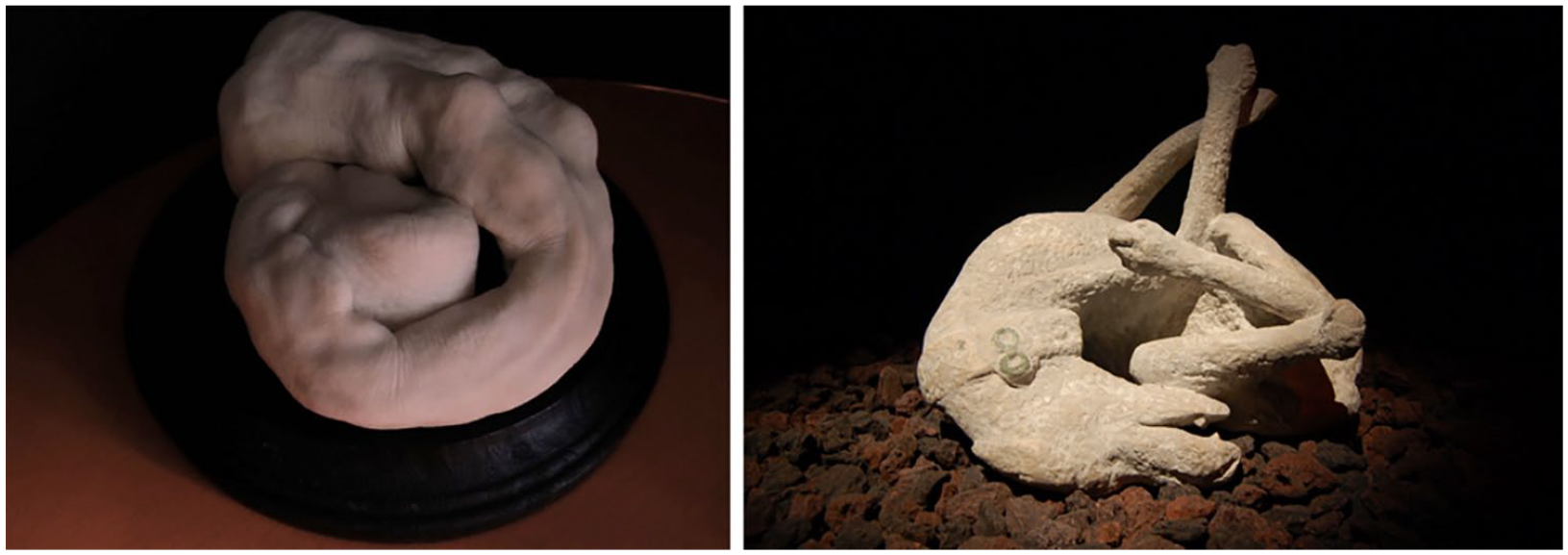
In the data images, the fists are expressed as finite phenomena—a unity of curled flesh and skin covering bones, pulsating with blood. But the affectivity of the fists takes me to a time when I was threatened as a child. In that moment, they are instantly given to an infinite process of difference and becoming—suddenly dispersed through a Deleuzian paroxysm, where the fists seem to escape their unified outline form to “take on a kind of momentary independence” (Deleuze, 1986, pp. 88–89). Lather (2012) when researching the Penn State University sex scandal describes having to “feel” her way “into a different analytic space that was not particularly comfortable.” She details having to resist her own interpretations—a process that created “ . . . a fraught space where I became a fragile thinker” (Lather, 2012, p. 126). As a “fragile thinker,” she had to take the risks imposed by “a new relationality” (Lather, 2012, p. 126). As I try to account for the fists, I too find myself mut(at)ed, pulled and contorted as I enter into new intrarelations with the data. St. Pierre offers me further considerations. She notes that her own ethnographic study—that was undertaken in an area where she had grown-up—while “officially” beginning in her forties “unofficially” “began before it began, and I had always been in the middle of it” (St. Pierre, 2017, p. 689). Similarly, I have been in and around schools for the past 48 years as a pupil, researcher, teacher, parent, and school governor. Similar to St. Pierre, I find myself still in the middle of an ethnography that began to un/fold when I began school. Ethnographic inquiry has traditionally been characterized by delineated disciplinary research procedures and processes, time frames, and specific methods of “data collection” that are focused on the promise of knowable su/o/bjects. But, perhaps as Manning (2016) writes, ethnography is nothing more than “ . . . an apparatus of capture . . . [which] stops potential on its way” (p. 31). She asks, How might experimentation meddle with/in the middle, “ . . . in the mess of relations not yet organized into terms such as ‘subject’ and ‘object’”? (Manning, 2016, p. 29) I am left, therefore, wondering whether artifacts such as affect, bodily changes, sensation, traces of memory, and habit that pass in and out of, as well as between, the boy’s fists, the classroom, my own, and other bodies could dislodge me from the dualisms which insist on ontological and epistemological separations?
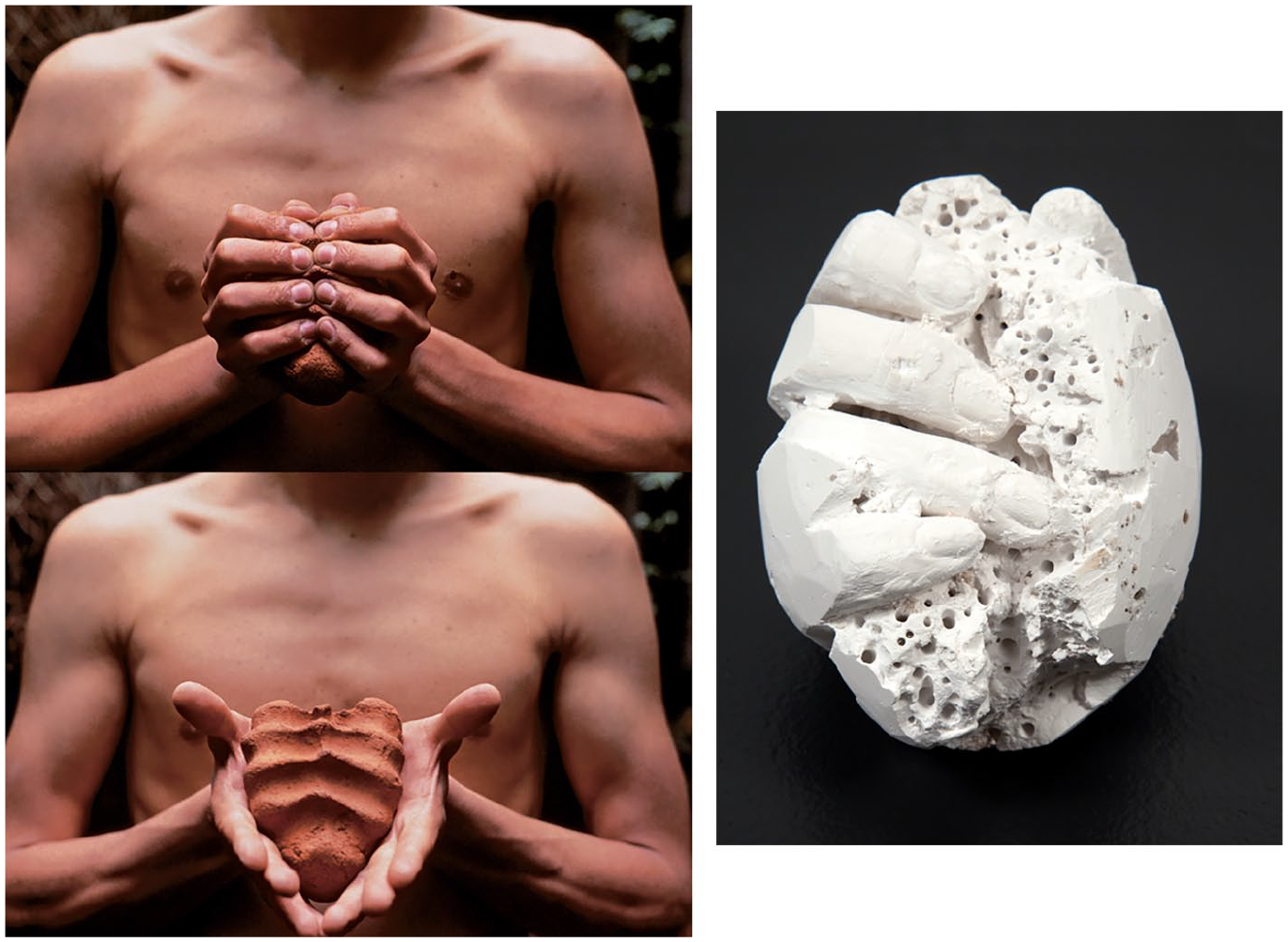
Gabriel Orozco 5 David Altmejd 4
My Hands Are My Heart (Mis manos son mi corazon), 1991 Untitled (Eggs)
Silver dye bleach print in two parts plaster and burlap
Each image: 9 1/8 × 12 1/2 in. / 23.18 × 31.75 cm 9.5 × 12 cm (3 3/4 × 4 3/4 in.)
Courtesy of the artist and Marian Goodman Gallery Executed in 2010
Copyright: Gabriel Orozco
Fist-data 6
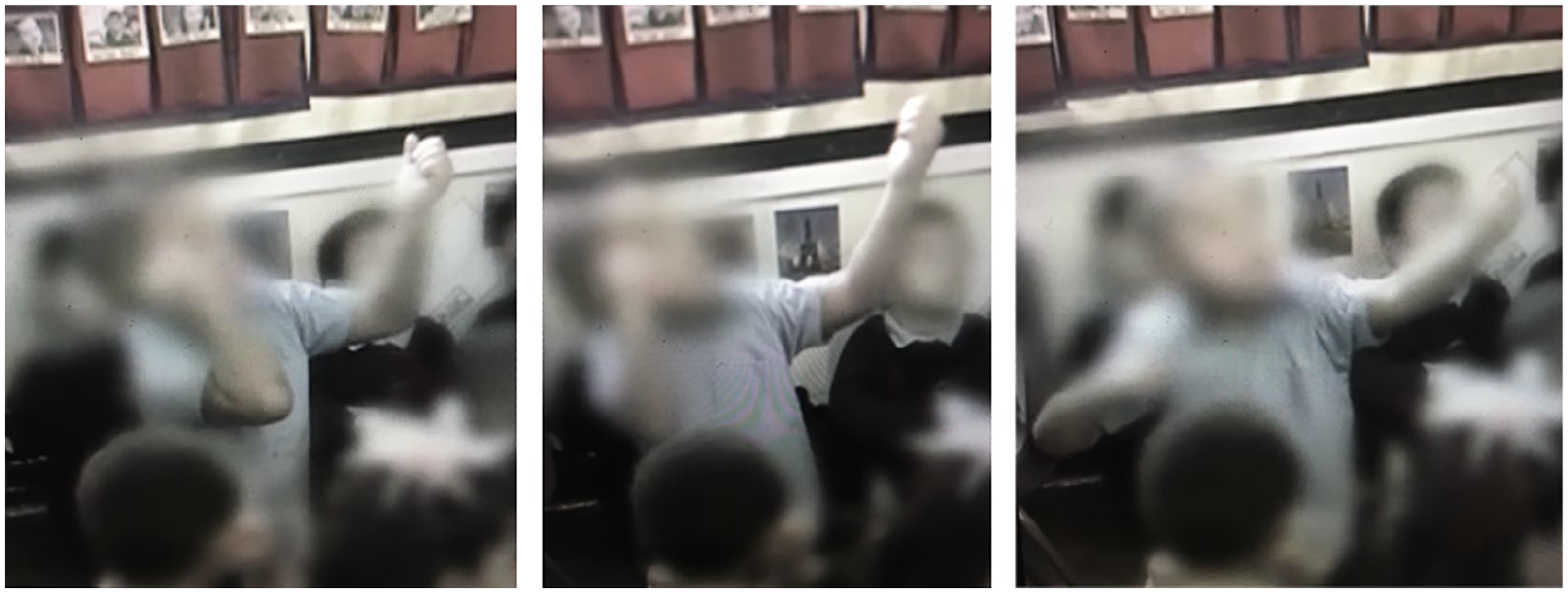
My interest lies then, in what emerges as “artefacts” of research when boundaries of time, disciplines, locations, human, and nonhuman collapse. Or, at least are less distinct. Where things and words are porous. Where subject/object distinctions are called into question. Where the broader notion of “body,” becomes more about folds, pleats, and flows, as “ . . . the ‘past’ and the ‘future’ are iteratively reconfigured and enfolded through one another” (Barad, 2007, p. 383). In this sense, “artefact” refers to what is produced in the folds, in the intra-actions of empirical and associated materials that insist, resist, rebel, provoke, seduce, irritate, intrigue, and confuse over time and place. How can the thousands of strange, curious, and irrational tiny folds of data and art, art and politics, politics and affect, affect, matter and materials, creative practices, memory, habit, sensation, processes and systems of human bodies that pass in and out of engagements with the fist be accounted for? By engaging with the aesthetic dimensions of experience, attention is paid to affects and sensations that conventional research methods fail to capture or even notice (Hickey-Moody, 2013; MacLure, 2016).
Problems Posed by Fists
Ko Muroboshi, Butoh Dancer 7
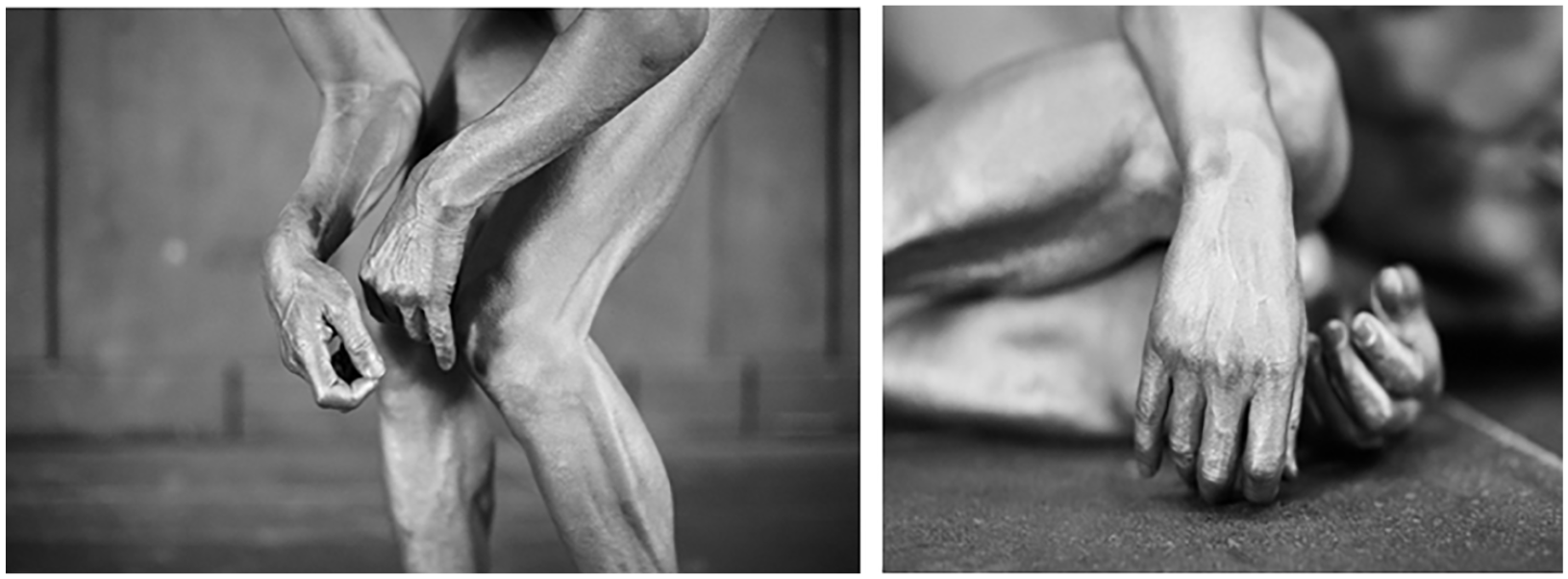
Life in all its modes—human and nonhuman—proceeds by way of the posing of problems. Such problems are resolved not by grasping, representing, or assimilating information that lies in wait for the knower. Problems are forces of composition, ongoing events of dynamic learning. (Colebrook, 2017, p. 653)
Contextual details are integral to the evolving composition. Here the stills, besides capturing the fists also reflect what is known in U.K. early years’ education as “carpet time.” This is when all the children are gathered together, and in this instance, the register of attendance was being taken. Once completed, the teacher then went on to tell the children what activities were on offer over the course of the morning. It is during this account that the boy knelt up with his fists raised. Despite encouragement from the teacher to sit down, he refused.
As MacLure et al. (2012) point out U.K. early years’ classroom consistently use forms of body discipline that are aimed at ensuring very young children “sit erect and immobile—i.e., ‘properly’—on the floor for substantial amounts of time” (p. 467). The child’s body is expected to be under control to enable a readiness for his cognitive learning. The young body has to be rendered docile. The adoption of an appropriate sitting posture gestures toward supposed attentiveness.
Over decades and from the child’s earliest years, considerable investment has been made in the U.K. education system where the goal is to ensure the development of the rational individual (Department for Education [DfE], 2019). More specifically, the U.K. Government’s agenda for early years’ education focuses on getting children “school ready” (DfE, 2014, p. 5). Here, “school-ready” implies the inculcation of correct “pro-social behaviour” as well as correct “emotional self-regulation.” Such foundations insist on the eradication of all that is considered as irrational. This process is seen as the necessary precursor for the successful flourishing of development and learning (Melhuish et al., 2017). Waddell describes such persistent Cartesian educational practices as a kind of, “ . . . cultural fossilization,” while Deleuze (1988) refers to it as sedimentation, where historically conditioned forms become rigidified and the inevitable conclusion is petrification. In education, despite many attempts to unsettle the mind–body dualism, the power of the mind still underpins most European intellectual views of human exceptionalism, ensuring an increasing emphasis on “mind” at the expense of the body. This child’s body is expected to be under control which—so the theory goes—will enable a readiness for his cognitive learning.
The child’s fists take me to the pugilist pose that was adopted by fist-fighters in the 18th and 19th centuries which in turn raises the question of whether the raised fists are a deliberate provocation? Adopting complicit behavior on the carpet enables survival in terms of how he would be “read” psychologically; docility becomes a default way to behave. Such a pugilistic gesture both defines and defies a meaning that resides not in the object of the fist(s) itself, but outside of it. Marback (2008), when reflecting on the Fist Monument to Joe Louis, notes that it is “a perceivable object that comes to matter less than the interpretations it occasions” (p. 51). But in this particular instance, there is less space for interpreting because carpet time is a practice aimed at docility. Given this, it is not too surprising that certain questions sprang more readily to my mind than others. For example, “why is this child not able to regulate his emotions?” “Why can’t he sit quietly on the carpet?” It is this sort of thinking that feeds into stock notions when interpreting the images. This line of inquiry refuses to make sufficiently visible the complex workings of striated bodily organization in relation to “codes of un/acceptable behaviour.” As Kennedy et al. (2013) suggest, societies of control, including the institution of the school, “modulate bodies not only as effects of representation but also in their affective capacities” (p. 49). As a boy with mixed race heritage, his pose is only too easily associated with disaffection, confrontation, and fighting, his psyche politicized within the school’s environment; as Cervenak (2014) suggests, “black movement is, more often than not, read as disruptive physicality” (p. 5). Fanon (1952/1986) also talks of being read from the outside, “I am overdetermined from without. I am the slave not of the ‘idea’ that others have of me but of my own appearance” (p. 116). As Haraway (1997, p. 213) clearly articulates, “race is the kind of category about which no one is neutral” and it is among nonneutral assumptions that the boy’s pose is shrouded. It is a pose that is saturated with discursive histories. For example, it is associated with bad behavior (Williams & Graham, 2016), race and aggression (Andrews & Palmer, 2016), young black boys and school failure (Wright et al., 2016), and normativity and child development (Laws & Davies, 2000).
As data, the fists are troublesome and perplexing, and as such, they set in motion “disconcertion, bafflement, bother” (MacLure, 2006, p. 226). The child raises his fists, and the movement is assumed to belong to him, prompted by some sort of inner impulse including, for example, frustration. But, by learning to think in movement with them, I want to suggest that “something” else becomes possible. Manning (2014) suggests that movement makes “apparent that nothing is quite what it seems” (p. 165). And if nothing is quite what it seems, there is nevertheless something. A something where fists, movements of thoughts, experiences, feelings, fantasies, and perceptions are folded into each other so as to produce ways of reimagining this classroom “scene.” As Seppi (2016) foregrounds, the idea of the fold demolishes the common practice of a well-defined line of investigation (p. 55). The fold or folds, afford “a different concept of thinking and an equally altered concept of the world as such; a world affected, compressed and curved by the interplay of forces and matter” (Deleuze, 1993, p. 45).
A Fistful of Problems
Tarde (in de Freitas, 2016) suggests that certain phenomena including, in this instance, the raised fists produce a swarm of assumptions that congeal as a striated biological body type exhibiting specific behaviors. In brief, the fists produced by/in gendered and racialized discourses hold this “boy” in place. This boy could be read as deviating from the normal path, yet also predictably “doing boy” (Renold, 2004, p. 248), offering resistance, leveling aggression, and expressing distaste. Given my long, slow immersion in schooling, it is almost impossible to read these images outside of particular discursive frames including that of race and gender, and it is these that lead to premature responses that are driven by an impoverished form of sense-making. However, along with Hinton et al. (2015), I am concerned how we might address issues of gender and race without at the same time reinstalling an essentialist, universal or a generic body at the heart of our inquiry (p. 3).
In turning to other disciplines, there are opportunities for aerating the data. This is especially necessary when race (gender, disability, etc.) is implicated in the assemblage. Saldanha (2006) points out that race is “a configuration made viscous by a whole host of processes” and that for race to be understood, it needs other disciplines including genetics and ethnography as well as economics and literary theory (p. 22). The literary critic Katherine Rowe (1999) offers some fresh air when she notes that,
what the brain and hand do especially well together, because of the hand’s remarkable range of motor function is to develop novel behaviours and adaptive strategies . . . to meet unpredictable demands presented by the particular environment encountered by each individual. (p. xiv)
She further notes that because hands have a neuromechanical structure, it allows them to perform all kinds of skills and tasks. Not least they are implicated in “processes of modeling of thought into instruments of material action” (Rowe, 1999, p. 187). Hands are heroes of communication where on occasion “hand gestures go beyond words” (Goldin-Meadow, 2003, p. 262). The sociologist Wacquant (1992, 2004) offers another crack. Via his studies that focus on a boxing gym, he challenges the assumption of the Cartesian split by showing how the mind–body, subject–object divide is eroded. As the boxer becomes more proficient, there is a greater reliance on embodied knowledge and ability. The boxer acquires knowledge “through direct embodiment” (Wacquant, 1992, p. 221). Moreover, it is an embodiment that necessitates an intra-active mixture of space, movement, matter, forces, and flows that together challenge what Nelson (1993) refers to as “unreal dichotomies” (p. 127).
These reflections prompted by wonderings into other disciplines allow me to perceive the classroom data images as emergent and not as a reflection of a set of assumptions. In cutting through the dichotomy of mind/body, an emphasis is placed on “relationality” where body, hand, and brain are integral to the process of thinking and moving. These writers also serve to remind me of the child’s body before the classroom took over and how difficult it must be to assume the guise of the “proper” school child for lengthy periods of time. And while playtimes might offer some respite what Rowe and Wacquant do allow me to glimpse is a boy who is thinking with movement (Manning & Massumi, 2014). One who might well be executing an “opening”. Following Manning and Massumi (2014), an opening is a “field effect” where “everything in the field, moving and still, integrally relates at that instant” (p. 9). Perceiving the boy’s body, his raised arms, and his fists as a component of a field has consequences. It strips him of his assumed agency as an individual. However, as Manning and Massumi (2014) point out, if you focus “on one body over another, you see one body then another—and not the opening in the field of movement they share” (p. 10). Fixing too closely on just one boy and his fists encloses perception as I find myself hopelessly trapped in anthropocentric associative loops and chains, blocking potentialities for the experience to be sensed as alive and vital. Interpreted as boy, fighter, resistant, and aggressive ignites processes that order the fists into perceptions of matter that condemn the movements to being an articulated body expressing something organized and legible. Matter’s movements are rendered knowable, devaluing alternative ways of being moved by, with and through the classroom. Living out perceptions of the fists as produced by/in gendered and racialized discourses affirm black, male intersectional identities, simultaneously explaining and critiquing the body politic. However, as Grosz (1994) reminds me,
Bodies are always irreducibly sexually specific, necessarily interlocked with racial, cultural, and class particularities. This interlocking, though, cannot occur by way of intersection (the gridlike model presumed by structural analysis, in which the axes of class, race, and sex are conceived as autonomous structures which then require external connections with the other structures) but by way of mutual constitution. (p. 20)
The complexity of this “mutual constitution,” this body’s emergence along with its connections and networks, requires closer scrutiny. Saldanha (2010) expresses this as the “manyhood of bodies in emergent togetherness” (p. 2419). The particularities and manyhood of this boy’s body features as being in coactivity with the other children’s bodies, the classroom architecture that somehow demands a way of trying to describe the spatial experience of the classroom to the fullest (Wheeler, 2016), the carpet, the teacher, the atmospheric intensities that are swirling around, where moments become teeming with differentiated “movement-textures, complexly patterned, full of change and transition” (Manning & Massumi, 2014, p. 10). An atmosphere is a “ . . . certain quality which words cannot translate but which communicates itself in arousing a feeling” (Dufrenne, 1975, p. 178). It is an experience that Böhme (2014) believes is, shared with others but cannot be described independently of them. It is by paying persistent attention to what the fists do among the flows of complex and highly charged atmospheric energies that I can begin to refuse intersectional and taxonomic ordering. The materiality of all bodies offers an opening in the density of the classroom where the relations and movements between humans, things, and their ever-changing environment can be studied.
Breaking Open
So, what are the relations encountered by these fists? Rushton (2002) captures the process:
one begins by clenching the fist, then as one continues clenching the fist the muscular effort moves up the arm, to the chest, down to the legs and through the entire body; what began in a small, localized spot of the body (the hand) “intensified” so as to cover a vast area. The action of clenching the fist will result in an instantaneous scrunching up of the face as well—a tightening of the lips, a clamping of the teeth, a contraction of the eyes, until eventually the whole face will become heated, bloated, and red with the compound intensity at hand. Bergson . . . compares the state of increasing intensity . . . with “a symphony, in which an increasing number of instruments make themselves heard” (23). (p. 230)
Recognizing this sense of accumulative intensities and a thickening of textures that add space to space, sound to sound, movement to movement, the entire body becomes electrified with energies when forces and matter come together and intensities circulate through the opening field to/with all other bodies, including my own. Fleshing out the materiality of bodies in the classroom that coproduce, witness, engage with, and are in mutual constitution with the fists, returns me to Manning and Massumi’s field of movement. The fists are no longer a ready-made harmony of parts that must work in certain ways. Instead, they are “a congealing of agency” (Barad, 2003, p. 822), an aggregate whose connections, relations in movement, and assemblages forever alter their elements (Deleuze & Guattari, 1987). Drawing on her dance work, Manning (2014) proposes that a body never preexists its movement, yet movement congeals or aggregates as “incipient form-taking.” It is interesting then to consider the fists as “a brief instantiation of what movement has become” (p. 165).
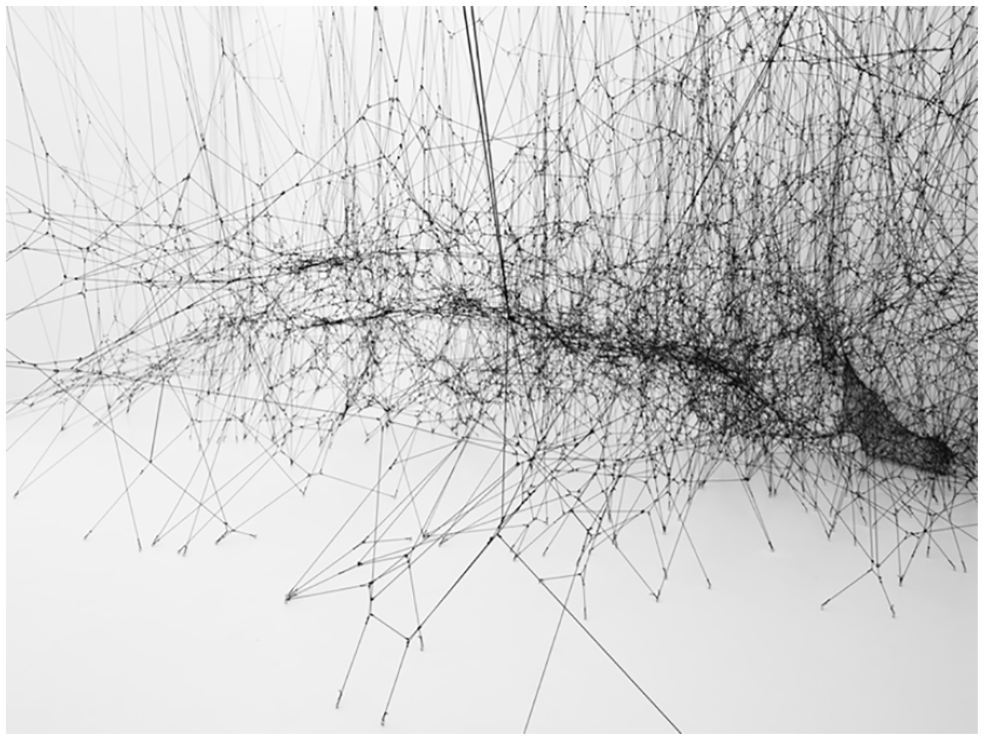
Tomás Saraceno
14 billions (working title), 2010 8
Installation view at Bonniers Konsthall, Stockholm.
Courtesy of the artist; Andersen’s, Copenhagen: Ruth Benzacar, Buenos Aires; Tanya Bonakdar Gallery, New York/Los Angeles; Pinksummer contemporary art, Genoa; Esther Schipper, Berlin. © Photography by Studio Tomás Saraceno, 2010
Experienced as an opening, the classroom relations of movements and stillness are always in improvised processes of change. Hornblow (2006), when describing the Japanese dance Butoh suggests the body’s movements are able to radically scrutinize its “expressive capacity through an interrogation of its materiality” (p. 1). In the classroom, the materiality of the fists becomes affectively congealed as they flow into movement and gestures evoking dynamism that is “unpredictable, undisciplined, anti-disciplinary, and non-static” (Mazzei & Jackson, 2012, p. 505). The fists neither preexist, nor can be understood sufficiently as mere sociohistorical constructions or discursive effects, as the cultural, narrative, and biological dimensions of them are inherently dynamic.
By paying attention differently to the energies of this classroom data, with a less focused gaze and more peripheral vision, I am consumed by some thing of every thing in the same way. A burst of concentrated energies opens up the heavy timbre that settles over the quiet carpet area where bodily matters are institutionalized in the entire ecology of the U.K. system of education and process of schooling. These energies suggest clandestine disorder in the uniformed and coded crowd (Lingis, 2000)—no thing is exempt from this disorder. Every thing is participating fully, in its entirety, at every level and in every way. Every thing is complex and related as differentiating bodies intra-act: in/animate (children, carpet, researcher, classroom rules and regulations, teacher); present yet absent (pedagogies and practices, discursive narratives of race, gender, class, dis/ability, processes of schooling); past yet present (traditional linear theories of child development, ongoing ethnographies, recollections and memories); distant yet immediate (European imperialistic production of knowledge, educational ideologies); visible yet contentious (g/phenotypology, affective sensitivities); imperceptible yet palpable (curriculum, behavior policies, teacher training, reputation, ethos/atmosphere). In a system of education that seeks to clear the ground for equality of opportunity, such “bodies” are assumed to be neutral, docile, or transcended (Gilroy, 2000) by way of ongoing critique in an inclusive school, yet here seem riddled with the restlessness of their insistent vitality. The children, their teacher, and the researcher are inextricably in coconstitution with the web of energies that the fists in an instant gather together. It is such intensities that trigger the world’s “worlding”; points of “expressivity” or “legibility” when the forms, rhythms, and refrains of the world come into being (Stewart, 2010). Through this process, the particular world (and carpet time scenario) emerges. The fist data propose that bodies (human and bodies of things) belie an essence of stillness, as together in worlding movements they coproduce an eruption into paroxysm—a pugilistic jolt—that forces a stream of air into the stifling atmosphere of the classroom. Although a bold gesture, its clandestine disorderliness seeps into the room and is registered via exchanges of glances, piercing stares, a frisson of sensing that this transgression disrupts the solidity of perception and opinion. The gesture, like a menacing lubricant, rapidly seeps into and saturates the field’s composition. The fists are an expression of how every thing, whether moving or still, relates in that moment; it is as if the gesture features jointly as coactivity, opening up the field as it gathers energies and agency. The fists are “the thread which links the seen set to other unseen sets . . . the adding of space to space” (Deleuze,1986, p. 17). They enact a fusing of bodies and space (Umino Bin, in Waguri and Kohzensha, 1998). They are an experimental interplay of matter and movements. They are, in Manning’s (2014) terms, pure movement. And it is movement that “is in the process of recalibrating an ‘I’ that will eventually emerge, unmoored” (p. 167). So, what does it mean to think about movement recalibrating an ‘I’?
Ontological difference, according to Grosz (2004), is about a “perpetual, unpredictable and open-ended becoming,” the dynamic forces of self-differentiation that potentially un/grounds everything, both nature and culture (p. 49). Thiele (2011) argues that such infinite differentiation affects everything on every level, unsettles our confidence and surety about how things will unfold. Reassuringly, Thiele (2011, p. 18) acknowledges that ontological difference necessarily has all the disruptive and transformative potential, and importantly the necessity that nothing can or will remain the same. Given this more fragile thinking, yet vital line of inquiry, Hinton, Mehrabi, and Barla ask what would it mean to understand matter in this way, as agentive, radically open, and dynamic (Barad, 2007), particularly when thinking about gender and race and associated politics?
Saldanha (2006) proposes that race, for example, “must be conceived as a chain of contingency, in which the connections between its constituent components are not fixed or given, but are made viscous through local attractions” (p. 18). What this implies is that there is no essence of a “good pupil,” of a “fighter,” of “doing boy,” or of “being white” that is independent from the complex web of relational energies in which bodies contingently find themselves emerging. In this classroom instant, there are multiple chains of contingency produced in, and proliferating through bodies’ DNA, phenotype, blood cells, diastolic forces, muscular tissue, finger nails, flesh and bone, epidermal schemas (Fanon, 1952/1986), school behavioral policies, regimes of truth, Ofsted inspections, school curricula, the political context, prevent agendas, foreign policy, forms of knowledge production, reputations, familial histories, income and benefits, property, privilege, and so on. Together, each is operating and intra-acting with and through one another in mutual coconstitution. As Engelman (2017) suggests of Tomás Saraceno’s hybrid spiders’ webs, “there is never only one web” (p. 162), instead the, “ . . . collaborative experiments are always already about the relations between webbed forms . . . more precisely about the meshing, layering and attracting of webbed forms to each other” (p. 162).
Saraceno’s spider patterns and suspension work re-turns me to the fists and the complex web of relational energies of the classroom, where as Saldanha (2006) proposes, a relative fixity inheres in all the “local pulls” and sticking points of many elements. In the swirling classroom cacophony of tautly woven and suspended tensions, movements and rest between these and many other elements, a subtle differentiation emerges where affective energies are drawn into a moment when something that becomes overly legible erupts and takes form—the fist gesture.
Akiko Ikeuchi, Knotted Thread-red-h120cm, 2008–2009 Ronit Baranga, Mimosa Pudica 9
©︎ Akiko Ikeuchi Courtesy of gallery21yo-j 10
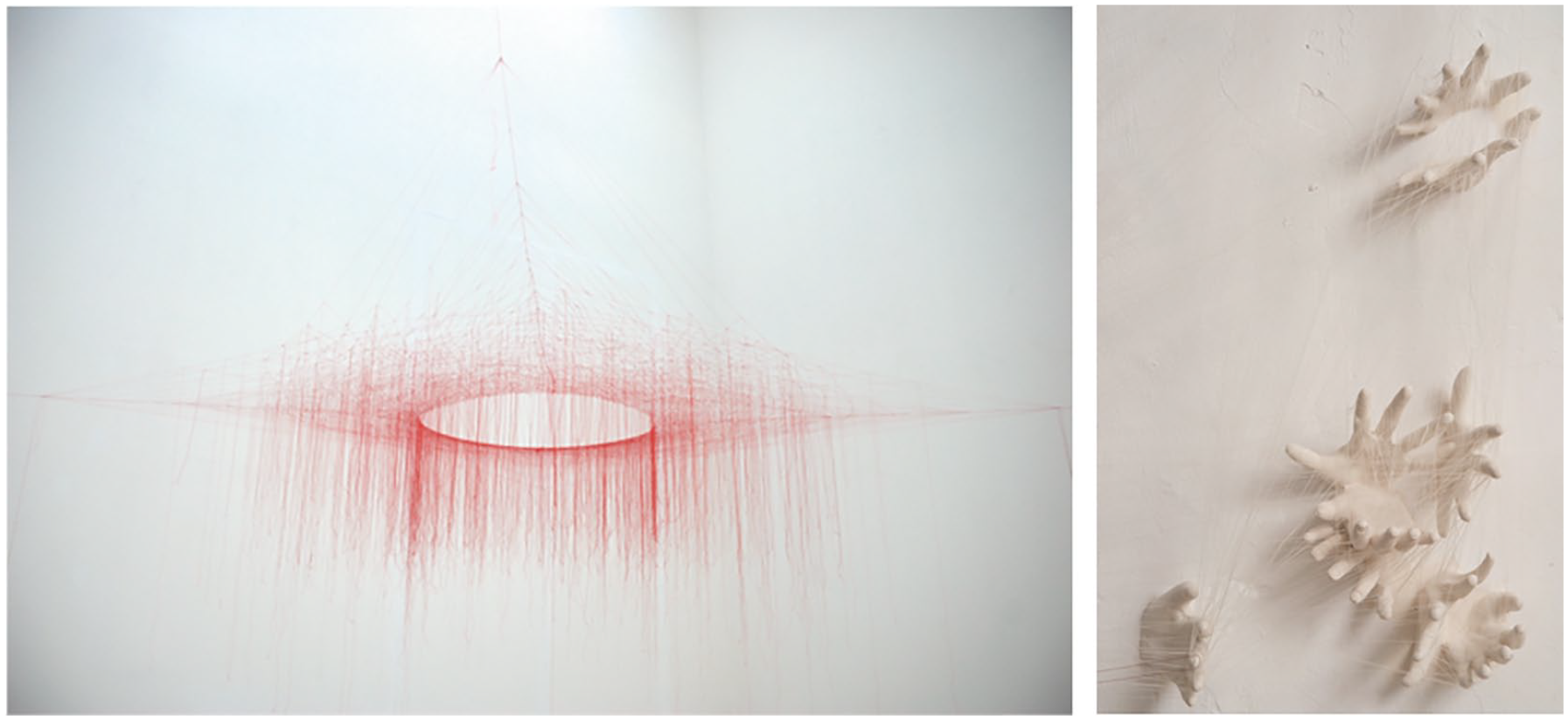
“ . . . this kind of spidery web-weaving accentuates ‘collective production,’ as well as ‘incomplete lines that are contingent,’ immanent and emergent” (Sauvagnargues, 2016, p. 164).
I find myself threading and holding together fragile structures, while simultaneously being de-/reformed and suspended by multiple, connected threads, full of severs and knots as I move from word to idea, literature to philosophy, fantasy to daydream, laboratory to gallery, feeling to sensation, and thought to gut. I stumble as I attempt to conjure the language to communicate this deeply fragile thinking. Elements assemble, compose, disperse, and decompose to produce sensations of paroxysm.
Rearrangements: No Closure
The fists pose an epistemological problem in terms of how they come to be known and understood, how sense is made of them, and how they are represented in/through language. The fists also pose an ontological problem in relation to how they come to be produced by movement, settling on particular predeterminations of bodies and events. As Gray van Heerden (2017) proposes, “the arachnoid network . . . favours the rhythmic impermanence of minor movements over molar modes of social organisation, and fixed notions and representations of personhood” (p. 13). Yet by becoming a fragile thinker, I have attempted to immerse, follow, and become entwined in lines of different intensities, speeds, forces, and flows. I have tried to rid myself of the idea of fixing the data, or indeed fixing the child. Following Saldanha (2006), the fists have momentarily allowed me to glimpse the openness of bodies, “the way organisms connect to their environment and establish uneven relationships amongst each other” (p. 22). Tomás Saraceno’s hybrid webs, for example, helped me think about the affordances of being caught in the middle of things, as Engelman (2017) writes,
The aesthetic and affective force of these hybrid webs . . . lies in the middle, in the discernible interweaving of both webs, and in the sense that their structures are in suspension, in a “holding pattern” . . . In this fragile suspension, each web refracts its difference from the other. (p. 167)
Being caught up in the middle of fragile, suspended bodily webs enabled me to trace and sense potential vibrations and movements. In turning to other disciplines, I have been able to play with bodies in general and fists more specifically so as to glimpse extensive and dynamic connections with other bodies and materials. Taking up a stance of “not knowing” has obliged me to be inventive and experimental which in turn has served as an antidote to habitual responses and habitual assumptions. As Barad (2007) infers everything does something and nothing can be separate, or isolated from everything else.
I have come to understand this “does something” as akin to Deleuze’s concept of becoming. So, while 11 years ago I found myself inclined to make links between the boy, the posture, and the fists as enacting an association or correspondence between relations (posture and race; posture and gender; posture and regression from normal behavior), I now perceive it as “becoming.” Becoming is not an identification. The boy is not becoming a boxer. He is not imitating a fighter. He is simply becoming where “becoming produces nothing other than itself” (Deleuze & Guattari, 1987, p. 262). To continue,
We fall into a false alternative if we say that you either imitate or you are. What is real is the becoming itself, the block of becoming, not the supposedly fixed terms through which that which becomes passes . . . Becoming is a verb with a consistency all its own; it does not reduce to, or lead back to, “appearing,” “being,” “equalling” or “producing.” (p. 268)
So, no closure only rearranging where bodies are not predetermined or aligned against preset paths aligned against fixed and identifiable points. It is by rearranging (my own) ideas, (my own) developed concepts, and (my own) practices that spaces have been opened where I can think, see, feel, and write differently.
Footnotes
Acknowledgements
I am grateful to Liz Jones for some wonderful conversations concerning this article.
Declaration of Conflicting Interests
The author(s) declared no potential conflicts of interest with respect to the research, authorship, and/or publication of this article.
Funding
The author(s) received no financial support for the research, authorship, and/or publication of this article.
