




Abstract
The June 24, 2022 Supreme Court decision in Dobbs v. Jackson Women’s Health Organization represented a seismic shift in abortion policy in the United States. Since then, state courts have begun playing an integral role in expanding or restricting abortion access in their jurisdictions. What do these cases look like and how does the public respond to court decisions that are pro- or anti-abortion? We collect original data on state court abortion cases post-Dobbs and field two survey experiments pre- and post-Dobbs to investigate these questions. We find state courts have expanded their scope in abortion policy and that pro-abortion court decisions are consistently popular. Anti-abortion court decisions, however, are increasingly unpopular. Our paper suggests that state courts are a new vital venue for abortion policymaking and that the public is growing frustrated with the countermajoritarian tendencies of courts.
On June 24, 2022, the US Supreme Court ruled that, “the authority to regulate abortion is returned to the people and their elected representatives.” 1 The seismic change in abortion regulation promulgated in Dobbs v. Jackson Women’s Health Organization has had widespread (negative) impacts to women’s health and equality in the US: closings of dozens of clinics and growing numbers of contraception deserts across the country (Kimport & Kreitzer, 2023). This is especially concerning as growing numbers of scholars and the public alike consider the Supreme Court a countermajoritarian institution (Clark et al., 2023; Mishler & Sheehan, 1993) that is much more conservative than the public (Jessee et al., 2022). A majority of American voters support abortion and believe it is morally acceptable, with 61% of respondents in one survey indicating that overturning Roe v. Wade was a “bad thing.” 2 Dobbs had a durable (and negative) impact on institutional legitimacy of the Court (Gibson, 2024). This mismatch between public opinion and federal policy on abortion makes states the new battlegrounds in abortion policy. Yet, we do not know the scope of these policies in the states or the consequences of those decisions for public opinion. We address this essential gap.
States have expanded and restricted access to reproductive healthcare in response to Dobbs (Ghorashi & Baumle, 2023). Most of the recent scholarly work is devoted to questions about abortion legislation (Kreitzer, 2015; Matthews et al., 2020; Roth & Lee, 2023). We provide context to state abortion policymaking through the lens of another essential political institution: state courts (Brace et al., 2001). State courts are especially important in this context for two reasons. First, given the declaration written by Justice Samuel Alito in Dobbs, the Supreme Court has led to state courts making broad decisions about abortion policy. A person’s state of residence now determines their level of abortion access, resulting in inequalities across geographies. Second, state courts possess a remarkable degree of discretion in the implementation of Supreme Court decisions. There is substantial variation in how state courts view and interpret Supreme Court precedent (Hoekstra, 2005, Kassow et al., 2012). Given that most state court judges are elected, we argue that public opinion plays an important mediating role in both the kinds of decisions state court judges make and how they believe the public will interpret them (Caldarone et al., 2009; Romano & Curry, 2019).
What is more, a seismic decision like Dobbs likely altered the jurisprudence regime of abortion policy in the courts: given that the precedent has been completely upended, “we expect case factors to matter to the justices in a manner distinct from their influence in cases decided prior to the establishment of the regime” (Richards & Kritzer, 2002, p. 305). Here, rather than looking at how Supreme Court decisions affect future decisions of that Court, we examine how a change in the jurisprudence regime alters both how state court judges make decisions and how those judges anticipate public reaction to those decisions.
Our findings indicate that the scope of abortion policy considered by state courts has expanded — consistent with a change in jurisprudence regime. Most state court decisions post-Dobbs concerned trigger bans or new legislation seeking to protect or restrict abortion access, rather than more specific and limited decisions. How does the public respond to the growing scope of court cases concerning abortion? Our original survey experiments indicate that support for pro-abortion court cases stays remarkably consistent pre- and post-Dobbs. The same is not true for anti-abortion court cases, however. Decisions that reinforce abortion rights remain popular, whereas anti-abortion cases are even more unpopular now than they were before Dobbs. Taken together, this paper illustrates the expansion of state court decisionmaking on abortion and how anti-abortion decisions are increasingly unpopular. We argue that this is indicative of public opinion playing a key role both in how states courts make decisions and how the public perceives those decisions. Judges likely now anticipate that the public will react negatively to an anti-abortion decision that does not mirror public opinion and take that into consideration accordingly when making decisions.
Courts & Abortion Policy Post-Dobbs
How did abortion policy change in state courts post-Dobbs? To explore the question, we use Nexis-Uni to collect information on all state court cases that were decided on abortion policy post-Dobbs from June 24, 2022 to the end of 2023. Though more than 200 cases matched this criteria, we limit the cases to those that were substantively about abortion regulation, resulting in 51 such cases in supreme courts, intermediate appellate courts, or trial courts. 3 These cases occurred in twenty-one states: Arizona (1), California (1), Delaware (1), Florida (2), Georgia (2), Idaho (3), Indiana (2), Iowa (2), Kentucky (3), Louisiana (2), Michigan (4), Minnesota (1), Montana (3), North Dakota (1), Ohio (6), Oklahoma (3), Pennsylvania (1), South Carolina (4), Texas (7), Virginia (1), and Washington (1).
State Court Cases Post-dobbs by Regulation Type.
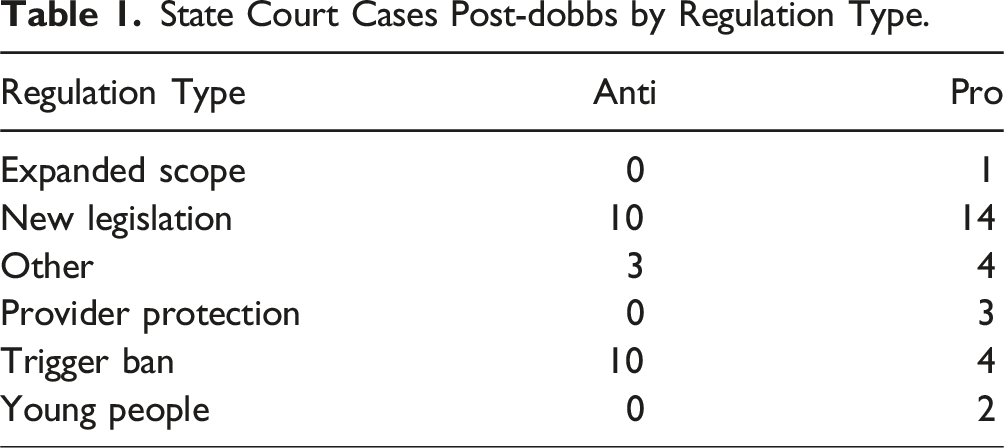
Many of the cases considered by state courts in the post-Dobbs era are cases considering new laws designed to limit access to abortion or trigger bans, laws within state constitutions that would have immediately repealed abortion access after the Supreme Court rescinded Roe and Planned Parenthood v. Casey. Pre-Dobbs, state court decisions were often more narrow in scope as states sought to chip away at abortion access rather than to outright ban abortion (Kim et al., 2023). These topics are in contrast to a previous study that analyzed state court decisions pre-Dobbs and found that state courts altered abortion restrictions concerning a variety of categories (Kim et al., 2023). More court cases regarding new legislation were pro- rather than anti-abortion, at 14 and 10, respectively.
We expect that most post-Dobbs cases deal with new legislation or trigger bans because of the constraints of Roe and Casey; because abortion could not be completely banned and states could not place an undue burden on people seeking abortions, state courts were limited in the scope of their anti-abortion court rulings. Post-Dobbs, this new jurisprudence regime represents a different legal landscape for abortion policy (Richards & Kritzer, 2002). This narrowing of court decisions suggests that the state courts are an important actor in the fight to expand or restrict abortion access. This is also indicative of litigant strategy of bringing abortion-related cases to state courts changing; people are using state courts to secure broad protections for abortion access. State courts may be the last hope for abortion rights proponents to slow the outright banning of abortion in various states across the country.
The expanded scope of abortion litigation across the country is not happening in a vacuum. Often, voters and the public alike are acutely aware of court decisions and the importance of individual judges in determining policy outcomes, especially clear since Dobbs. Janet Protasiewicz’s victory in the Wisconsin Supreme Court race in 2023 illustrates this point: she made protecting abortion a centerpiece of her campaign, a message that resonated with voters. 4 A similar story unfolded in Pennsylvania in November 2023. Daniel McCaffery, a Democrat, won a decisive victory against his opponent partially driven, as pundits suggest, by his vocal support for protecting abortion rights. 5 It is likely these contentious elections are harbingers of broader fights to come across the country. Voters recognize the power of individual justices in crafting important policy, illustrating the clear link between public opinion, judicial decisions, and abortion policy.
Abortion Opinion Pre- & Post-Dobbs
Changes in public opinion in response to court decisions can occur through multiple pathways including media coverage (Hitt & Searles, 2018) and reactions by politicians (Casillas et al., 2011). It is also likely that the relationship between public opinion and court decisions is reciprocal and reinforcing, making it difficult to pinpoint the influence of court decisions from pre-existing changing attitudes. Nevertheless, we expect that salient decisions will attract attention from most Americans, particularly those who pay attention to the news or who are ideologically polarized. We expect the seismic Dobbs decision (Gibson, 2024) to crystallize both support for pro-abortion court rulings and opposition to anti-abortion court rulings, particularly since the decision garnered significant media attention: one poll identified 97% of respondents as hearing about it (Norrander & Wilcox, 2023).
We therefore make two predictions:
Respondents will be less supportive of anti-abortion court rulings post-Dobbs than pre-Dobbs.
Respondents will be more supportive of pro-abortion court rulings post-Dobbs than pre-Dobbs.
Experimental Study Design
We field two separate survey experiments of Americans recruited from Lucid in March 2021 (N = 263) and Prolific in September 2023 (N = 370). We conducted our first study before the Dobbs decision and our second study just over one year after the Dobbs decision. 6 This allows us to examine shifts in how the public perceives court decisions in light of the (a) seismic shift in abortion policy and (b) the heightened role of state courts in determining abortion policies. Though these studies used two different samples, they are similar on a range of demographic characteristics like gender, race, partisanship, and others (see the appendix). 7
We rely on experiments to track public opinion toward state court decisions on abortion because this method allows us to directly manipulate whether the court decision supported or did not support abortion access. Fine-grained public opinion data on state court decisions is virtually nonexistent, and collecting public opinion data immediately after a court decision in multiple states is not practical (Morton & Williams, 2011).
We structured our two experiments similarly. Each respondent read a short vignette that consisted of a news briefing describing a recent state court decision on abortion, where we varied the outcome of the decision (pro- or anti-abortion). To provide an ideological cue, the vignette stated that liberal women’s groups supported the pro-choice decision and opposed the anti-abortion decision, while conservative groups held the opposite position. The key difference between our pre- and post-Dobbs study is that we directly primed consideration of the Supreme Court’s decision in our post-Dobbs study intentionally to connect state court decisions to Dobbs. Our treatment text is in the appendix.
We asked two outcome questions in our two studies. First, we asked “How much do you agree with this statement? The decision issued by the courts was the right decision for women.” The response options ranged from strongly disagree to strongly agree. Our second outcome asked respondents, “How well do you think the decision issued by the courts represents women’s interests?” The response options ranged from not well at all to extremely well. We coded both outcomes to range from 0 to 1, and higher values indicate a more positive response to the decision.
Experimental Results
We analyze the results of our pre-Dobbs and post-Dobbs studies together so that we can compare how the public’s responses to court decisions shifted after the Supreme Court decision.
8
We begin with our first outcome, agreement that the decision issued by the courts was the right decision for women. We display our means in Figure 1 for both experiments based on whether respondents were in the pro-abortion or anti-abortion court decision condition (see appendix for full results). In the pre-Dobbs study, respondents in the anti-abortion condition had a mean rating of 0.4274 (sd = 0.3658) while respondents in the pro-abortion condition had a mean rating of 0.5783 (sd = 0.3467), p < .0007. Post-Dobbs, respondents in the anti-abortion condition had a mean rating of 0.2648 (sd = 0.3561) and respondents in the pro-abortion condition had a mean rating of 0.5993 (sd = 0.3501), p < .0001. The difference in responses across the anti-abortion condition pre- and post-Dobbs is quite large as respondent support for the court decision drops from 0.4274 (sd = 0.3658) to just 0.2648 (sd = 0.3561), and comparing across the two conditions shows this is a significant decline in support, p < .0001. We also see a 0.084 increase in people’s support for the pro-abortion court decision across our two time periods, which is statistically significant (p < .0001). This indicates growing unhappiness with anti-abortion court decisions after Dobbs (consistent with Hypothesis 1), but not much change on those decisions that are pro-abortion (not consistent with Hypothesis 2). Agreement with “the decision issued by the courts was the right decision for women.”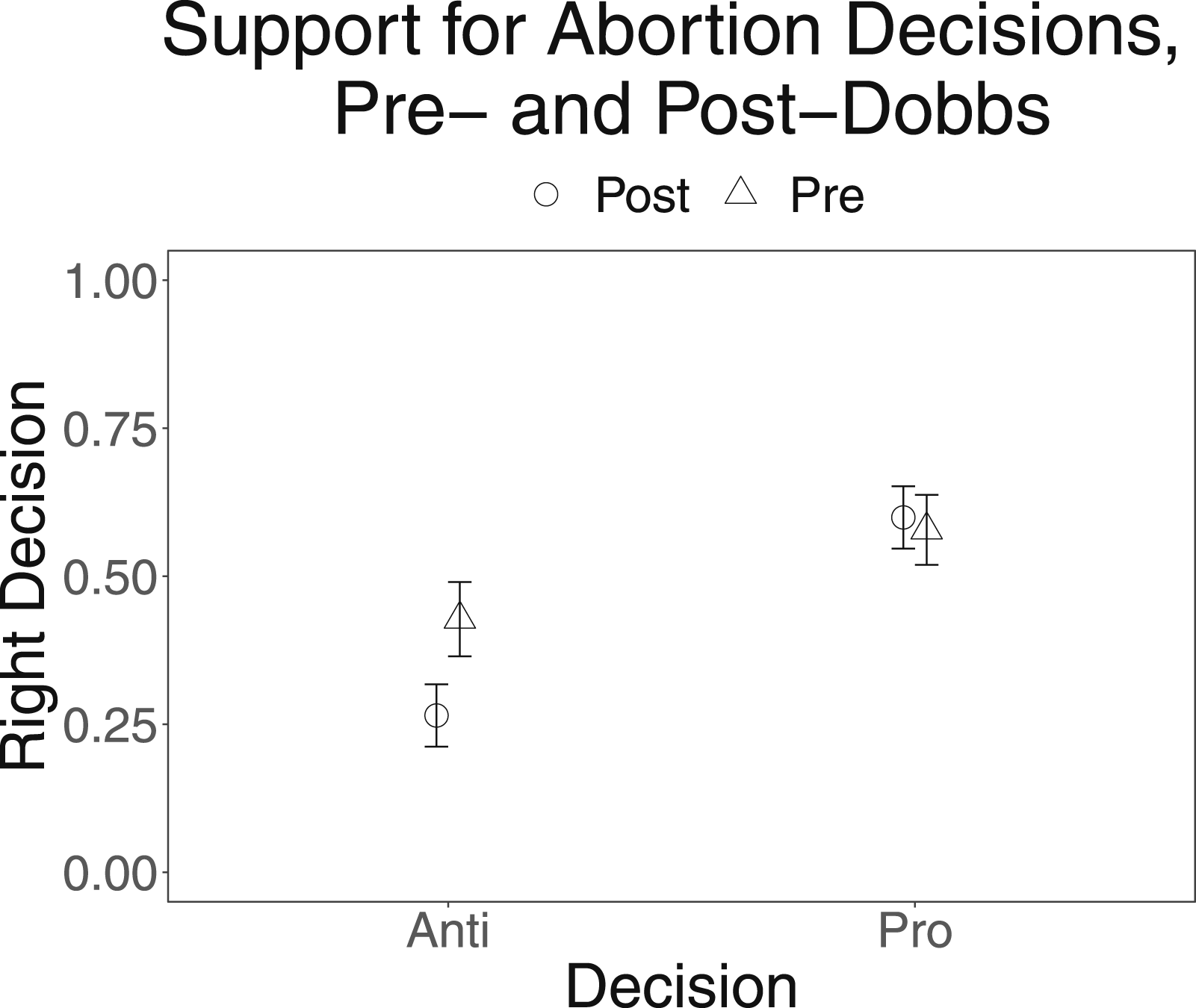
Figure 2 displays the results for our second question about whether the court decision represented women’s interests. We find that pre-Dobbs, the mean rating for respondents in the anti-abortion condition was 0.369 (sd = 0.3750) and the mean rating in the pro-abortion condition was 0.5152 (sd = 0.3715), p = .0017. The mean rating for respondents in the anti-abortion condition post-Dobbs was 0.2220 (sd = 0.3258) and the mean rating for respondents in the pro-abortion court decision condition was 0.5362 (sd = 0.3532), p < .0001. Across both conditions, significantly more respondents thought the pro-abortion court decision best represented women’s interests. We find that across the pre- and post-Dobbs period, respondents responded more negatively to the anti-abortion court decision (similar to Figure 1). Post-Dobbs, the support for the decision was lower than pre-Dobbs by 0.1474 points, and comparing responses across these two conditions indicates that this decline is statistically significant, p < .0001. People’s responses in the pro-abortion conditions across the two studies are fairly consistent with one another, not expected from Hypothesis 2. Agreement with “How well do you think the decision issued by the courts represents women’s interests?”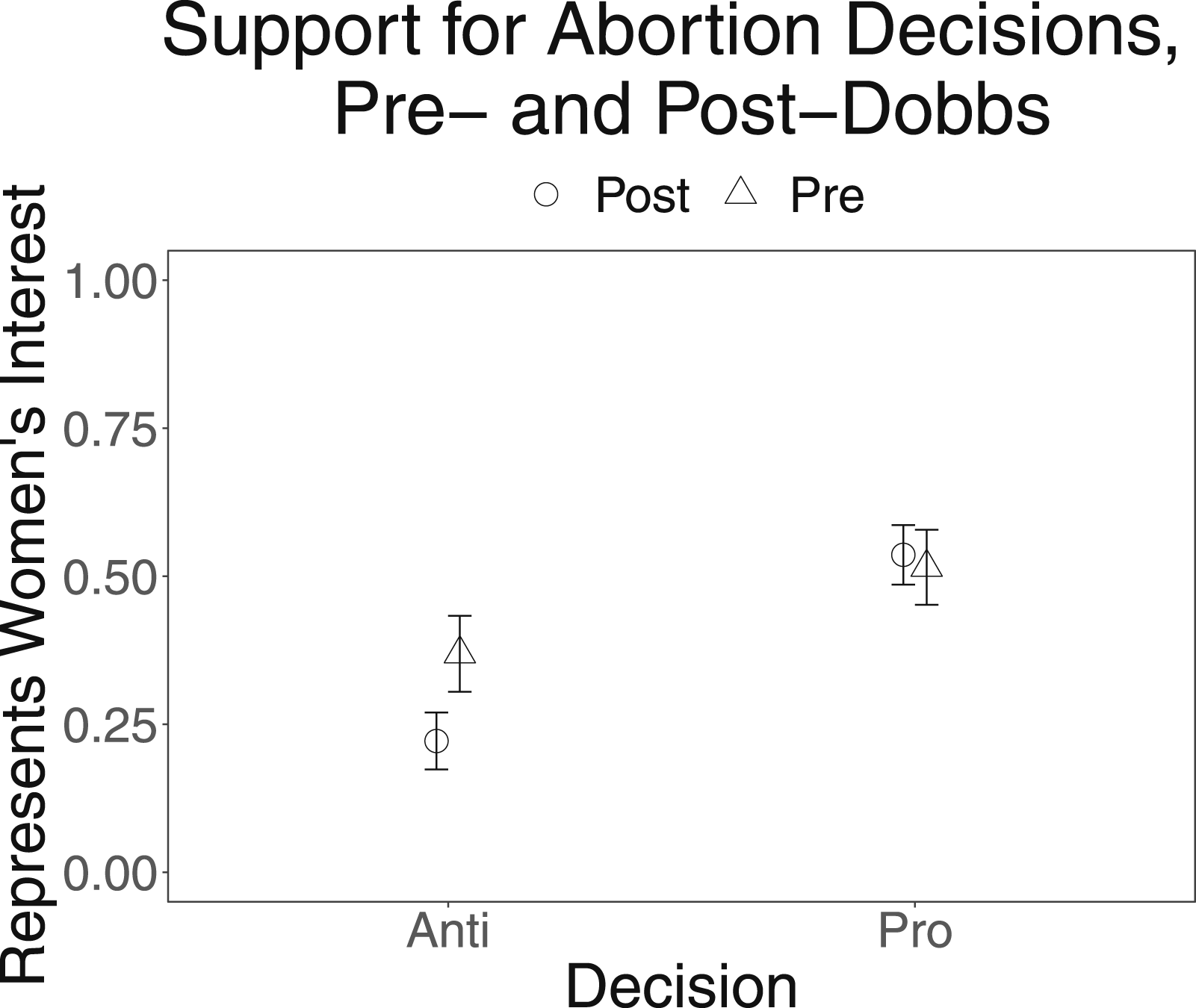
We compare the difference in the pro-abortion and anti-abortion decisions in the pre-Dobbs decision to the difference in the two conditions post-Dobbs. We expect to find a wider gap in the pro- and anti-abortion conditions across the two studies on our two response questions. The differences across our conditions pre-Dobbs on the representing women outcome was 0.1508 (sd = 0.0440) and this difference widened to 0.3345 (sd = 0.0371) post-Dobbs, p < .0001. We find a similarly sized gap on the right for women outcome that is also statistically significant, p < .0001. These findings suggest that the Dobbs decision may have shifted some people’s opinions to be more firmly in support of courts protecting the right to seek an abortion.
We conducted robustness checks based on participant partisanship and gender — though, note our smaller sample sizes here make these exploratory analyses. First, abortion and reproductive rights more generally are issues with fairly clear partisan distinctions (Carsey & Layman, 2006). The appendix includes this test and we find that Democrats respond more negatively to our questions about whether the court decision represents women and is the right decision for women in the anti-abortion condition compared to Republicans. Not only did we analyze differences across party, but also within party. Republican respondents react similarly to the decisions regardless of outcome in both waves. However, Democrats are consistently less supportive of any decision (whether it be pro- or anti-abortion) post-Dobbs, potentially indicating growing frustration with the current state of abortion policy.
We also investigated differences across participant gender. Abortion is thought of as a woman’s issue (Matthews et al., 2020; Reingold et al., 2021, Rolfes-Haase & Swers, 2022), however, public opinion polls and electoral referenda often show that women and men have similar opinions about their support for abortion access (Kim, 2022). We find few differences in how women and men evaluated the court’s decision across the two conditions in our pre-Dobbs study, and no differences in our post-Dobbs study.
Discussion and Conclusion
Our results indicate that the nature of litigation around abortion has changed with the Dobbs decision. Original data collection on all abortion cases heard by the state courts after Dobbs show that these cases are more expansive than those heard prior, consistent with a change in jurisprudence regime (Richards & Kritzer, 2002). How is the public reacting to those decisions? We investigate this question using two experiments pre- and post-Dobbs that vary a state court’s position on abortion policy. We see a significant percentage of people lowering their support for anti-abortion court rulings, but opinion on pro-abortion cases stays relatively constant between the two studies. Our paper provides an important contribution on two fronts. First and foremost, we are the first, to our knowledge, to catalog the legal landscape of abortion decisions in the state courts post-Dobbs. Given that Dobbs expressly put the responsibility for abortion decisions in state courts, this means, then, that we provide a description of current abortion policy. Second, we demonstrate public opinion on state courts in an environment where respondents may not have considered this context previously. Given that respondents may be hearing about state court decisions on abortion for the first time, we believe we are uncovering important results in how public support about abortion has changed in the aftermath of Dobbs.
These findings hold several implications. First, given the key role of elections in state judicial systems, our results suggest that people might be more likely to vote for pro-choice judges when states make restrictive abortion policy — as was in the case, anecdotally, in Wisconsin. Though we did not expressly test these dynamics, future research ought to untangle these dynamics further. Second, and more importantly, our results highlight that public opinion likely plays a key role in how state courts make decisions. Given that the jurisprudential regime around abortion decisions has changed (Richards & Kritzer, 2002) — with broader rulings — and that anti-abortion decisions are increasingly unpopular post-Dobbs, we argue that public opinion in this context is understudied. How might citizens view state court abortion rulings? And, will they perhaps use those evaluations when they get to the ballot box? Similarly, judges likely anticipate frosty reactions to unpopular anti-abortion policies and take that into consideration when deciding cases. Though we do not uncover the scope of these dynamics here, our results point to important implications for both the public and the judiciary. And finally, we point to the states as the new battlegrounds for abortion policy. Without federal guarantees to abortion access, it is likely that the fight over this policy will occur in multiple venues, from legislation to subsequent litigation. State courts can act as a bulwark against organized, anti-abortion activists that seek to limit abortion access, access that continues to be overwhelmingly popular among Americans.
Supplemental Material
Supplemental Material - State Courts, Public Opinion, and the Changing Abortion Landscape after Dobbs
Supplemental Material for State Courts, Public Opinion, and the Changing Abortion Landscape after Dobbs by Anna Gunderson, Chesani Askew, Jeong Kim, and Nichole Bauer in American Politics Research.
Footnotes
Declaration of Conflicting Interests
The author(s) declared no potential conflicts of interest with respect to the research, authorship, and/or publication of this article.
Funding
The author(s) disclosed receipt of the following financial support for the research, authorship, and/or publication of this article: This work was supported by Louisiana Board of Regents; Research Competitiveness Subprogram Grant Number A.
Ethical Statement

Supplemental Material
Supplemental material for this article is available online.
Notes
References
Supplementary Material
Please find the following supplemental material available below.
For Open Access articles published under a Creative Commons License, all supplemental material carries the same license as the article it is associated with.
For non-Open Access articles published, all supplemental material carries a non-exclusive license, and permission requests for re-use of supplemental material or any part of supplemental material shall be sent directly to the copyright owner as specified in the copyright notice associated with the article.
