



Abstract
For decades, a focus on the gender gap in political attitudes has been a traditional way of understanding public opinion in the United States. However, as American political life becomes more polarized and partisans more divided, this frame fails to consider whether the increased importance of partisanship might work to disrupt expected patterns of gender difference. Examining an issue of significant prominence and salience in American political life – guns and gun policy – we move beyond a simple gender gap frame to examine gender gaps within each of the parties and the partisan differences among women and among men on these important issues. Drawing on data from the 2022 Cooperative Election Study, we consider whether gender and partisanship work together to shape attitudes toward guns and gun policies. We find that gender and party both work to shape attitudes on guns, but some respondents, Republican women and Democratic men, experience cross-pressures from their gender and party identities. This results in important complexity among gender and party groups, which we miss when we fail to account for the impact of multiple identities on the preferences of individuals.
Americans have a complicated relationship with guns. The culture and history of the United States is one that mythologies guns as a central right and a part of our traditions and heritage. The U.S. is one of only three countries in the world that enshrines a constitutional right to individual ownership of guns and about one-third of American adults say that they own at least one gun. There are more civilian guns in the U.S. than there are people (Fox et al., 2023; Schaeffer, 2024). At the same time, our nation experiences horrific and regular gun violence that is unlike anything found in other countries around the world. The United States has the highest level of gun violence among developed nations, with a gun homicide rate that is 26 times that of peer nations (Jordan, 2022). Americans have experienced mass shootings in elementary schools, high schools, on college campuses, in movie theaters and malls and grocery stores, in places of worship and in workplaces all over the country. In the contemporary period, the United States is a country in which gun rights and gun violence go hand in hand in ways that are unique to our country and our political culture.
Public opinion on gun rights and gun reform is just as complex, reflecting the political polarization that is an important aspect of current debate and policy proposals. In the wake of a mass shooting, most Americans demand government action on guns, often calling for significant gun reform legislation. A mass shooting leads to an approximately 15 percent increase in the introduction of firearms bills in an affected state’s legislature in the year after the shooting, but not necessarily to the passage of that legislation (Luca et al., 2019). Then, attention wanes and guns recede from the public mind until the next mass shooting (Hassell et al., 2020). The June 2022 passage and signing of the federal Bipartisan Safer Communities Act was a relatively rare and immediate response to a series of mass shootings – the deaths of 19 children and two adults at Robb Elementary School in Uvalde, Texas and the deaths of 10 Black shoppers in a Buffalo, New York grocery store within 10 days of each other in May of that year.
Scholars of public opinion have devoted significant attention to understanding where Americans stand on gun issues and what influences shape these opinions. While there are numerous personal and political characteristics that can influence opinion on guns, among the most prominent are gender and partisanship. There is a longstanding and significant gender gap in the U.S. on guns and gun policy issues, with women expressing higher levels of support for gun control legislation and men being more likely to favor looser gun restrictions. As partisan polarization has increased, Democrats and Republicans have demonstrated wider and wider gaps in their support for gun control, with Democrats being in favor and Republicans opposed. Yet, there is relatively little work that examines the intersection of the influence of gender and party and examines whether there are simply gender gaps and party gaps or whether there are also party AND gender gaps. Previous work on public opinion supports the idea that focusing on a gender gap obscures the differences among women and those among men and ignores the influence of other important social identities (Barnes & Cassese, 2017; Cassese, 2020). The same is true for political party, where there are often gender gaps in public opinion within Democrats and within Republicans (Hansen & Dolan, 2020; Hansen et al., 2022). Here we explore whether party and gender work together to shape opinion on gun policies by examining data from the 2022 Cooperative Election Study (CES). These CES data cover an unusually large number of policy proposals related to guns and clearly support our hypotheses about the interactions of these two key influences. While expected party and gender gaps exist, we also find gender gaps within each party and partisan differences among women and among men, suggesting that these influential identities can sometimes work as cross-pressures on individual attitudes. Our findings demonstrate the importance of considering how multiple influences on opinion work to shape attitudes on this important contemporary issue.
Attitudes About Gun Policies in the United States
Scholars of public opinion have traced several explanations for attitudes on gun policies in the contemporary period. Donald J. Campbell argues that the heart of attitudes about guns in the United States revolves around a cultural divide between what he calls “Bedrock America” and “Cosmopolitan America” (2019). Bedrock America values the historical role guns played in the American story and espouses the values of self-reliance, individualism, and freedom, while Cosmopolitan America sees the nation’s gun culture as an anachronism, championing a more complex, interdependent, and inclusive society that trusts government to solve social problems. Campbell argues that these two cultural perspectives have had an uneasy co-existence since the early 1900s, one that is likely more pronounced today as polarization grips American political life. These cultural perspectives will sound familiar to scholars of public opinion, as they closely mirror the cultural and ideological divides between conservatives and liberals and, increasingly, Republicans and Democrats. A robust literature on the determinants of attitudes toward gun policies points to these sources of division.
While our focus is on the relationship of gender and partisanship to attitudes about guns, we acknowledge that there are a myriad of influences at play. Emotions like fear, anxiety, and trust can have an impact, as perceptions of crime, distrust of others, and anxiety about victimization can drive gun ownership (Cao et al., 1997; Kelley & Ellison, 2021; Warner & Steidley, 2022; Warner & Thrash, 2020). Episodic incidents can also move gun attitudes, whether by stimulating racial resentment or fears of personal harm, which is in line with demonstrated spikes in gun sales after Barack Obama’s election in 2008 and during the COVID-19 pandemic (Allyn, 2020; Bohn, 2008; Collins and Yaffe-Bellany 2020; Ratcliff, 2022). Beliefs about the government’s, particularly law enforcement agencies, ability to protect people versus individuals having to protect themselves can also shape views on gun control and gun rights (Carlson, 2012; Hansen & Seppälä, 2024; Kelsay et al., 2018; Ryan et al., 2022).
Another body of research emphasizes the importance of individual-level demographic and political characteristics and lived experiences on attitudes toward guns and gun reform. Given the increasing number of mass shootings in schools and on college and university campuses in the United States, it is hardly surprising that young Americans are more supportive of gun control laws and less likely to own firearms than older Americans (Adams, 2017; Schaeffer, 2024; Vegter & Middlewood, 2022). Other work has identified the important role of race in these attitudes, finding that racial prejudice reduces support for gun control among white Americans and that white respondents are less likely to support firearms availability when a hypothetical gun owner is black than white (Filindra & Kaplan, 2016; Hayes et al. (2021). Indeed, a consistent theme in the literature on race and gun attitudes is the influence of racial prejudice as a differentiator of white attitudes (Dowd-Arrow, 2020; Filindra & Kaplan, 2016; O’Brien et al., 2013).
Gender and Partisanship and Guns
Gender
Scholars of public opinion have given significant attention to the impact of gender on attitudes toward guns. The gender gap, the difference between women and men on political issues, is a common frame for examining support for public policies (Barnes & Cassese, 2017; Huddy, Cassese, & Lizotte, 2012; Shapiro & Mahajan, 1986). Indeed, there is consistent evidence that women are generally more supportive of gun control policies and less supportive of policies that expand the presence of guns in public life (Barnes & Cassese, 2017; Carlson, 2014; Filindra & Kaplan, 2016; Goss, 2017; Haider-Markel & Joslyn, 2001; Howell & Day, 2000; Lizotte, 2020). This relationship is also robust to the consideration of multiple other influences on policy opinion (Celinska, 2007; Haider-Markel & Joslyn, 2001; Lehmann & Pickett, 2017). Recent polling data demonstrates a 13-percentage point gap (64 percent to 51 percent) in women’s and men’s affirmative response on the question of whether gun laws in the U.S. should be stricter than they currently are, which is just the most recent data point in a longstanding pattern on this issue (Goss, 2017; Schaeffer, 2024). These consistent gender differences are explained by several theoretical assumptions about the differences between women and men. Chief among these are the beliefs that 1) the values of motherhood and care for the vulnerable among women lead them to be less supportive of use of force in general than are men, and 2) that women’s lived experiences cause them to have a different relationship to guns and its associated violence than men do, which is supported by significant body of work that finds women less likely to own guns, more likely to fear them, and more likely to want government control of firearms (Carlson, 2014; Eichenberg, Lizotte, and Stoll, 2022; Goss & Heaney, 2010; Hansen et al., 2022; Huddy et al., 2008).
Partisanship
As is the case on most policies issues, partisanship is a significant shaper of attitudes about guns, both with regard to gun control policies and toward the role of guns in American life. Recent opinion polls demonstrate that 88 percent of Democrats want gun laws to be stricter than they are now, compared to 26 percent of Republicans. Democrats are also more likely than Republicans to favor a ban on handguns, say it is too easy to buy a gun, and believe gun violence is a major problem in the country. They are less likely than Republicans to believe owning a gun makes a home safer and are less likely to personally own guns (Jones, 2023; Schaeffer, 2024). Although party polarization is present on most gun issues, there are some proposals on which there is more general agreement, where significant majorities of the members of both parties take a similar position. These include widespread support for proposals that would limit access to guns for people with mental illness, increase the age for buying guns to 21, and support for universal background checks (Best et al., 2022; Schaeffer, 2024).
There is fairly consistent evidence that Democrats and Republicans take different positions on gun reform issues. But, perhaps more important than the fact that the parties are polarized on gun issues is the way in which being a gun advocate or gun foe has become a significant part of the political identity of many Americans. Lacombe (2019) outlines the successful efforts of the National Rifle Association (NRA) over many decades to cultivate a shared social identity among gun owners around hunting, shooting, and firearms activities. For many Americans, gun ownership has become associated with distinct cultural, social, and political values and is driven by contact with the NRA (Joslyn et al., 2017; Lacombe et al., 2019). Since about 1980 and the presidency of Ronald Reagan, this social identity around guns has also become deeply politicized and increasingly intertwined with Republican party politics, also as a result of the activities of the NRA as it becomes an increasingly successful lobbying organization that spent millions on campaign donations. As Republicans pursued and became more identified with gun rights legislation throughout the presidencies of Reagan and George H.W. Bush, Democratic presidents Clinton and Obama take increasingly public positions in favor of gun control, with a key moment becoming the passage of legislation banning assault weapons in 1994. Lacombe (2019) suggests that this is the period during which public attitudes on guns start to become polarized by political party. Miller (2019) also points to the 1994 “Republican Revolution” as a time period in which gun attitudes became more polarization and identifies Barack Obama’s election in 2008 as a second period of acceleration of that polarization. Since then, partisan polarization on guns has only spread, leaving us in a contemporary time when the leadership of the two parties have staked out reliably distinct positions on issues, with the Republican party’s embrace of the Second Amendment and gun rights as a key part of their ideological and policy agendas. As a result of party signals and reactions to a constant stream of high-profile mass shootings in the U.S., members of the general public have also retreated to their different sides.
The Cross Pressures of Gender and Partisanship
Due to the centrality of gender as a lens through which people experience and evaluate the political world, a focus on the gender gap has been a mainstay in the study of public opinion for decades (Conover & Sapiro, 1993; Lizotte, 2020; Mazza & Scipioni, 2023; Shapiro & Mahajan, 1986; Woo et al., 2023). However, one limitation of this approach has been the evolution of a conventional wisdom that assumes women and men take opposing positions on most issues, which results in a masking of what can be significant diversity among women and among men (Barnes & Cassese, 2017; Hansen et al., 2022; Huddy et al., 2008). This problem is also evidenced by the incorrect assumption that the gender gap is driven by women and that the vast majority of women are Democrats (Box-Steffensmeier et al., 2004; Kaufmann & Petrocik, 1999; Ondercin, 2017). Coverage of the number of Republican women who voted for Donald Trump has shifted the conversation (Barnes et al., 2021; Cassese & Barnes, 2019; Sides et al., 2020), but a default to examining the political world through the lens of the gender gap is common.
Recent work has begun to situate gender in the context of other important political influences, including religion, race, parental status, and partisanship (Barnes & Cassese, 2017; Cassese, 2020; Cassese & Barnes, 2019; Deckman & Cassese, 2021; Hansen & Dolan, 2020, 2023; Klar, 2018). Indeed, the potential for identities to work to cross-pressure individuals on political issues is heightened in the current era of partisan polarization. Although partisanship has traditionally been an important influence on attitudes and behaviors, its influence has strengthened dramatically in the last 20 years (Bartels, 2000; Carsey & Layman, 2006; Iyengar & Krupenkin, 2018; Layman & Carsey, 2002; Mason & Wronski, 2018). At the same time, partisanship has become more closely intertwined with social identity, creating a culture in which parties and their supporters become opposing “teams” of partisans (Mason, 2015; Miller & Conover, 2015; West & Iyengar, 2022). Thus, we likely need to update our understanding to examine how party sorting is shaping positions on issues, which may be driving differences between women and men, as well as differences among women and among men (Barnes & Cassese, 2017; Deckman, 2016; Hansen et al., 2022; Hansen & Navarro, 2023).
The Impact of Cross-Pressures
According to past research, it is not without merit to expect that women might be closely aligned in their support for gun reform and gun control issues. Indeed, this work points to women’s status as the most likely victims of domestic and gender-based violence, their general opposition to use of force, and the assumption that they have a more nurturing and protective nature as the key factors shaping their attitudes (Lizotte, 2020). At the same time, there is a body of research that reveals the degree to which gun rights organizations and movements have made a gendered argument about the importance of gun rights. Key here is the framing of guns as a way a woman can protect herself, a mother can protect her family, and keep an ever-encroaching, paternalistic government at bay. From Sarah Palin’s calls to “Mama Grizzlies” to the NRA’s “Refuse to Be a Victim” program, conservative gun rights organizations have made specific appeals to women to increase their embrace of and support for guns and gun rights (Deckman, 2016; Dolan, 2005). These efforts to frame guns as a positive force for protection to conservative women hews to a framing more consistent with the Republican party’s position on guns. As Deckman (2016) finds, Tea Party activists, particularly women, argue that access to guns is crucial as an “equalizer” for women, who may have less physical strength than men. Much of this outreach has an appeal to women as mothers protecting their children and homes, which is the traditional conservative vision of women’s primary area of focus.
These attempts to appeal to (some) women can be successful since there is fairly clear evidence that gender is a less relevant influence for creating a sense of group identity than race or religion, as American women are much less likely to possess a sense of gender consciousness than, say, African Americans are to have a shared sense of racial identity. As Klar (2018) frames this, women in the U.S. lack a shared understanding of what it means to be a woman. This lack of a common understanding, she suggests, is what makes it more challenging for women to put their identities as women first against the potential influence of any of their other social identities. Her argument echoes earlier work on women’s interests and women’s identities as women, such as arguments over the meaning of “feminism” in women’s lives or what position on abortion is truly the “women’s perspective” (Deckman, 2016; Klatch, 1987; Schreiber, 2008; Swers & Larson, 2005).
The potential for partisanship to divide women or men on gun issues is strengthened because the two parties take polarized positions on guns, as a series of court decisions and a continual string of mass shootings have reinforced Democratic support for gun control measures and Republican opposition (Barney & Schaffner, 2019). Cross-pressures, then, can appear when an individual’s social and political identities might pull in opposing directions on some issue. Here, in thinking about the potential cross-pressures of gender and partisanship, Democratic women and Republican men are more likely to experience consistent influences from their gender and party. These influences could be at cross-purposes for Republican women and Democratic men, making it more challenging for these individuals to develop clear issue positions as they wrestle with different expectations and influences, particularly on an issue like guns, which is highly salient to both gender and partisan groups.
Among members of the public, the impact of cross pressures could take the form of identifiable gender gaps within each party and partisan differences among women and among men. Recent scholarship suggests that these patterns are emerging on a set of issues. In examining attitudes toward the use of force, Hansen et al. (2022) find that gender and party cross-pressures clearly affect Republican women and Democratic men across a range of issues involving the use of force. On a series of domestic issues, Barnes and Cassese (2017) find Republican women holding more moderate positions than their male colleagues because of gender differences in attitudes about the role of government and gender-based inequality. These patterns of cross-pressures for Republican women and Democratic men also appear on attitudes about sexual harassment, suggesting that partisanship can be a strong influence even on highly salient gendered issues (Hansen & Dolan, 2020, 2023).
In thinking about how gender, party, and cross-pressure influences shape attitudes toward guns and gun reform proposals, we need to consider the party interests and gender interests of women and men. As such, we can identify the crosscutting influences of party and gender on individual evaluations of the movement. Party interests identify the expected partisan position on gun reform issues. For Democrats, this takes the form of advocating for expansive gun control laws and measures to ensure public safety. For Republicans, party interests involve an emphasis on individual rights, more gun rights policies, and acceptance of guns in public spaces. In terms of gender interests on guns, the assumption is that women, who are much more likely to experience domestic violence than are men and have a stronger aversion to violence in general, will be supportive of efforts aimed at controlling guns. For men, a greater focus on the link between guns, masculinity, and individual rights leads them to be less likely to favor gun control policies. Based on the consistent influence of their party and gender interests, Democratic women and Republican men should be the most and least supportive of gun control efforts. Republican women and Democratic men, however, could potentially experience the cross-pressures of party and gender interests.
Hypotheses
In examining attitudes toward gun reform, we have several goals. First, we want to examine whether the expected gender gap in these attitudes is present in our data. To do this, we compare reactions of women and men to a series of proposed gun reforms, both pro-control and pro-rights. Since we also seek to assess the impact of partisanship on the gender gap in these attitudes, we examine the gender gap within the Democratic and Republican parties as well as the party gap among women and among men. In doing so, we will be able to see whether some respondents, namely, Republican women and Democratic men, demonstrate evidence of being cross-pressured by their gender and partisanship. We test three hypotheses. First, we examine the gender gap between women and men and the party gap between Democrats and Republicans. Second, we test whether gender gaps exist within each party. Third, we observe partisan differences among women and among men. Finally, we note that the surveys we employ offer an unusually large and varied number of items about gun control and gun rights, which allows us to more fully test a series of hypotheses that examine both the gun control and gun rights positions.
H1: In general, women will have more positive attitudes toward gun control proposals and more negative feelings toward gun rights proposals than will men and Democrats will have more positive/negative attitudes than will Republicans.
H2: Women in each party will be more likely than their co-partisan men to exhibit positive attitudes toward gun control proposals and more negative feelings toward gun rights proposals. Because of the traditionally strong gender influence on gun issues, the potential cross-pressures on Republican women should lead to a larger gender gap among Republicans than among Democrats. H3: Democratic women will have more positive feelings toward gun control proposals and more negative feelings toward gun rights proposals than Republican women and Democratic men will have more positive feelings toward gun control proposals and more negative feels toward gun rights proposals than Republican men. Due to potential cross-pressures on Democratic men, we expect the party gap among men to be larger than the party gap among women.
Data and Methodology
The data for this project come from the 2022 Cooperative Election Study (CES). The 2022 CES is a survey administered to a national stratified sample of 50,000 respondents, carried out in two waves before and after the U.S. midterm congressional elections. Respondents were surveyed on a range of political topics, including political ideology, partisan identification, vote intention, public issues, and issues pertaining to the 2022 midterms. An important strength of these survey data is the large number of items that asked respondents for their reactions to gun reform issues and that these items included both gun control and gun rights positions.
Dependent Variables
The dependent variables employed represent attitudes toward both gun control and gun rights expansion. In the CES pre-election survey, respondents were asked, “On the issue of gun regulation, do you support or oppose each of the following proposals?” Three of the proposals represented the expansion of gun rights: 1) Prohibit state and local governments from publishing the names and addresses of all gun owners, 2) Make it easier for people to obtain concealed-carry permit, and 3) Allow teachers and school officials to carry guns in public schools. Three proposals assessed support for gun control: 1) Ban assault rifles, 2) Provide federal funding to encourage states to take guns away from people who already own them but might pose a threat to themselves or others, and 3) Improve background checks to give authorities time to check the juvenile and mental health records of any prospective gun buyer under the age of 21.
The gun reform questions are similar to other longstanding measures represented in large-scale national election studies, such as the CES since 2014 and several American National Election Studies (ANES). The measures were intended to explore a baseline understanding of public sentiment for national-level gun reform. It is important to note that these measures do not account for local variation in current gun laws and the reforms vary in terms of how well they would reduce gun violence, as well as varying in their prospects for implementation. For our purposes, the intended use of these measures is to understand general support for a range of reforms.
Independent Variables
Because of our focus on the potential for cross-pressures on respondents based on their gender and party identification, these are our two main predictors of interest. Gender is coded as woman = 1, man = 0. For party identification, we use a three-category variable, folding leaners into the relevant partisan categories. To test for cross-pressures between gender and partisanship on support for gun reforms, we include interactive terms in the regression models with the two independent variables. Beyond these, we include important demographic and attitudinal influences on attitudes toward gun policy: age, gender, race, education, income, and ideology in our models (Patten, Thomas, and Wade 2013; Vegter & Middlewood, 2022). Variable coding and descriptive statistics for all variables are included in Appendixes A and B. In the empirical analysis, regression models are estimated utilizing the “common weight” post-stratification survey weight to reduce sampling error and potential non-response bias. 1 We estimate logistic regression models with survey weights incorporated due to the binary measurement of the dependent variables.
Analysis
Support for Gun Policy Reform Full Sample and by Partisan Identification and Gender (2022 CES).
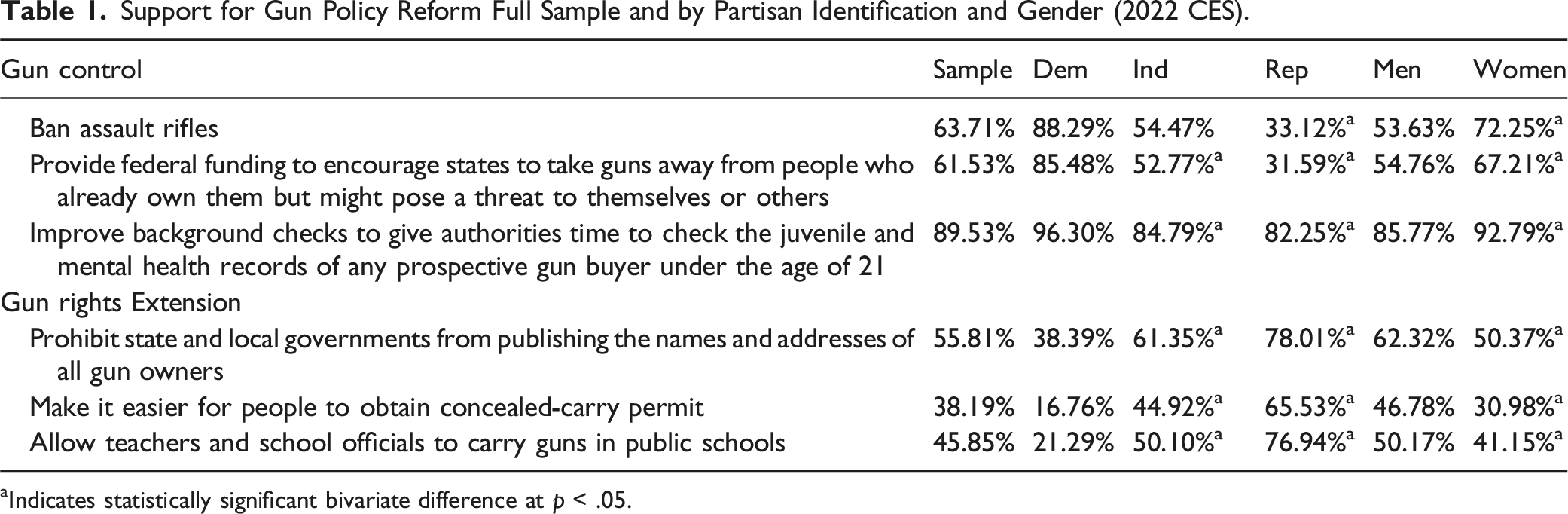
aIndicates statistically significant bivariate difference at p < .05.
Models Predicting Support for Gun Reform Proposals.
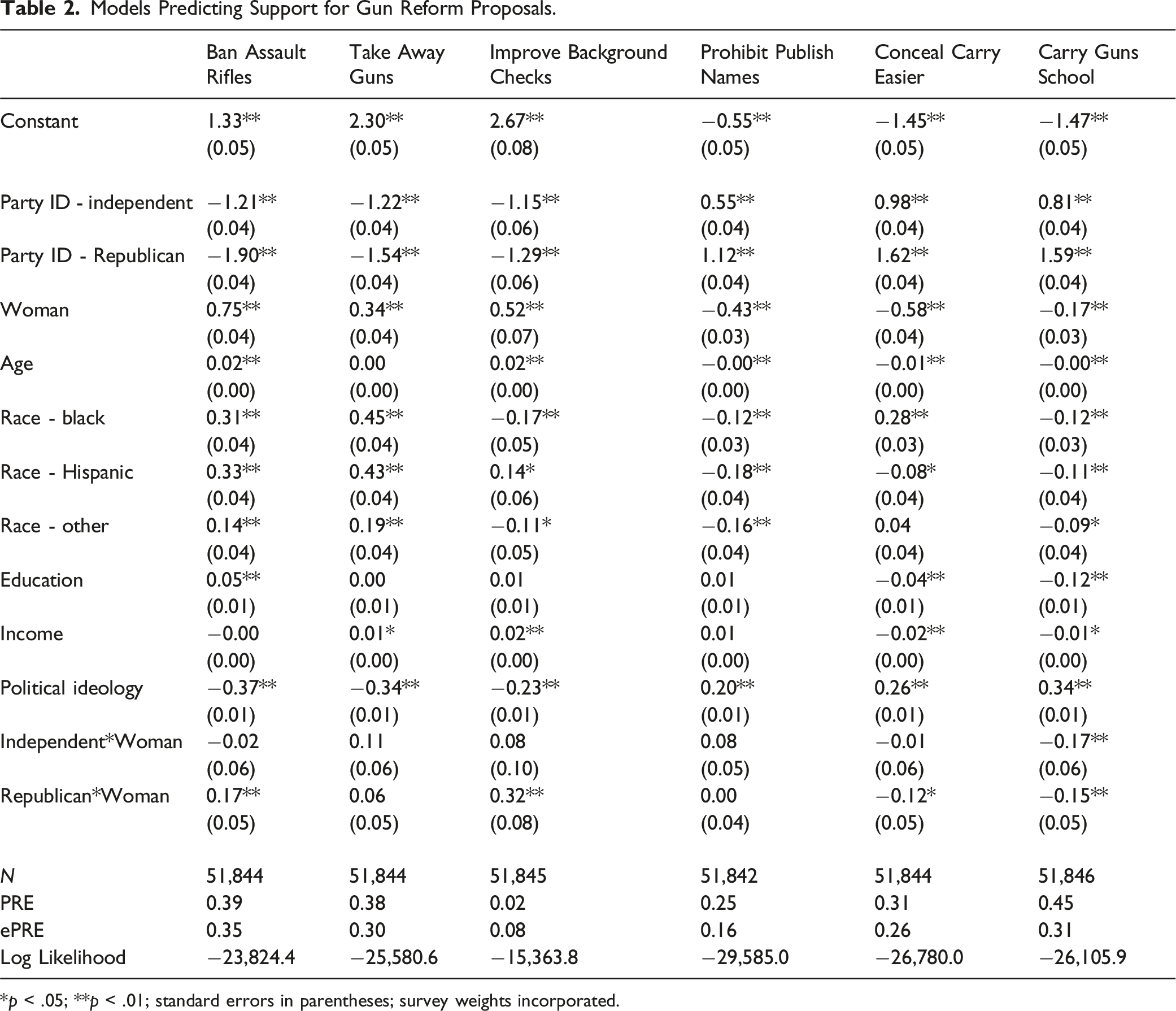
*p < .05; **p < .01; standard errors in parentheses; survey weights incorporated.
Because our subsequent hypotheses examine gender differences in party effects and party differences in gender effects, we also include an interaction term that captures gender and party. Here we see that the interaction term accounting for Republican women performs differently across the six items. For two gun control items, banning assault weapons and strengthening background checks, the significant interaction suggests that gender has a larger effect on support for these items than it does for Democrats. The same is true for the significant and negative relationship for two of the gun rights items – allowing conceal carry and arming teachers and staff in schools.
Gender Gaps within Parties
To this point, our analysis confirms the expected gender and party gaps in attitudes on gun control and gun rights issues. Given that our hypotheses about the potential for gender and partisanship to cross-pressure individuals, our next step is to examine more fully the gender gaps among Democrats and among Republicans. Given the long-standings patterns of the gender gap on gun issues, we hypothesize that women in each party will be more likely to have higher levels of support for the gun control items and lower levels of support for the gun rights items than their co-partisan men. Given the potential cross-pressures of gender and party here on Republican women, we expect a larger gender gap among Republicans than among Democrats, as indicated by the interaction result that showed a greater impact for gender among Republicans than Democrats. To examine these gender gaps within the two parties, we calculate predicted probabilities from the estimated models with the samples split by partisanship while holding other independent variables at their survey-weighted means (See tables in Appendix D).
Figure 1 demonstrates the gender gap within the two parties on each of the gun policy items. Beginning with Democrats (top panel) we see that, while the expected patterns of women’s and men’s support for gun control and gun rights are maintained, the gaps between their positions on the various items are small, suggesting that Democratic women and men are more similar in their positions on guns than more divided. On the gun control items, both women and men articulate high levels of support, with more than 85 percent of each in support of all three items and women exhibiting higher support than men. To the degree there is a gender gap on these items, it is quite small, ranging from almost complete agreement on improving background checks, with a one percentage point difference, to a three-percentage point gap on taking guns from those who pose a threat, to a relatively small gap of six percentage points on whether government should ban assault weapons. Effect of Gender – Samples split by Partisanship. 95% confidence bounds displayed; independent variables held at their survey-weighted means.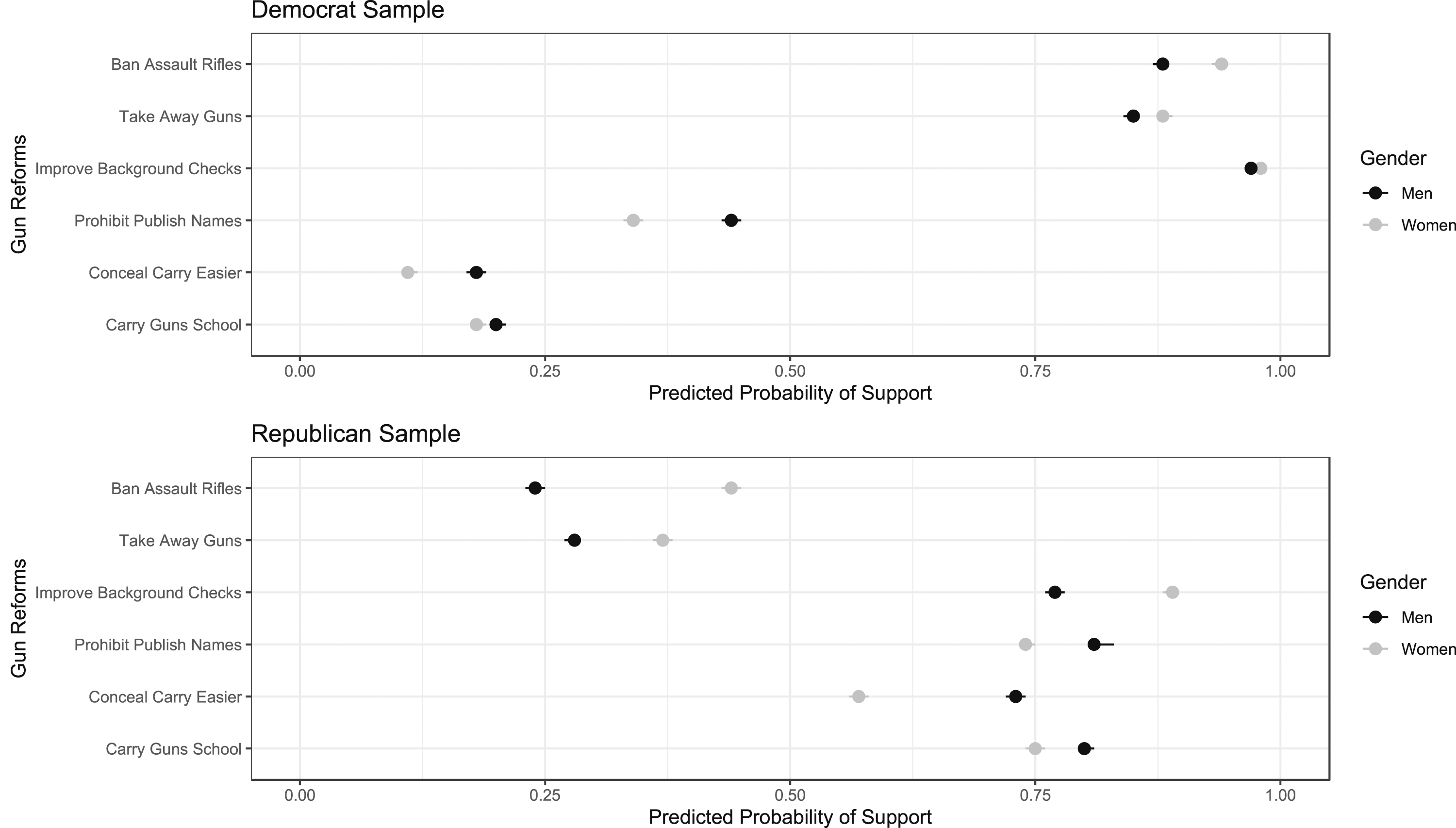
The expected pattern of lower levels of support for gun rights policies is also present among women and men Democrats, with no item getting the support of a majority of women or men and women voicing lower support on each item than men. Again, the gaps are small, but a bit larger than those on the gun control items. Women and men demonstrate the smallest gap on whether to arm teachers and staff in schools (two percentage points), a seven-percentage point gap on easing conceal carry laws, and the most diversity on whether government should prohibit publishing the names of gun owners (10 percentage points). Taking all of the items into account, the average gender gap on gun reform among Democrats in our sample is 4.8 percentage points.
The attitudes of Republican women and men are also in the expected directions on each issue (bottom panel), with women having higher support than men on each of the gun control issues and lower levels of support for the gun rights issues. However, here we see that the size of the gender gaps among Republicans are considerably larger than among Democrats. On the gun control items, the only item on which Republican women and men exhibit majority support is on improving background checks, with a 12-percentage point gap among them. The smallest gender gap is on whether government should take guns from those who pose a danger, at nine percentage points, and the largest is the 20-percentage point gap on whether to ban assault weapons. Although support for this idea is below a majority for each group, 44 percent of Republican women are in favor, compared to only 24 percent of Republican men. This is the largest gender gap among Republicans on any of the six items.
On gun rights issues, majorities of both Republican women and men support these proposals, but, again, there are bigger gaps than we see among Democratic women and men. The smallest gender gaps among Republicans are on arming teachers and staff in schools at five-percentage points, and on prohibiting the publication of information about gun owners, at eight percentage points. There is a much larger gender gap among Republicans on the issue of making conceal carry easier, with only 57 percent of Republican women in favor and 75 percent of Republican men. Taking all issues together, the average gender gap among Republicans is 12 percentage points, a substantially larger gap than the 4.8 percentage points among Democrats and in line with our hypothesis about the cross-pressures on Republican women. 3 While these Republican women are clearly anti-gun control and pro-gun rights, they are much less so than their men co-partisans. The results would suggest that gender is a stronger influence among Republicans than among Democrats, with the resulting cross-pressures on Republican women pulling them farther away from their men co-partisans. This finding for Republican women is also consistent with earlier work that found gun control to have the largest gender gap across 10 policies issues examined and to be the issue least likely explained by related attitudes such as conservatism or attitudes on the scope of government, pointing to a likely role for women’s rejection of violence and greater fear of crime (Barnes & Cassese, 2017; Huddy et al., 2008). In total, the analysis of gender gaps within parties confirms our second hypothesis.
Partisan Differences Among Women and Among Men
We have demonstrated that there are gender gaps in attitudes on guns within each party and that Republican women experience cross-pressures from these two identities. At the same time, it is important to acknowledge one of the primary limitations of consistently examining public opinion through the gender gap frame. This focus can lead to a misunderstanding of the dynamics of women’s and men’s attitudes and easily disguises the diversity of opinion among women and among men (Hansen et al., 2022). To contribute to a broader focus on opinion on guns and to examine the impact of partisanship on gender groups, we examine differences among women and among men. Figure 2 presents the predicted probabilities for the models with the samples split by the gender of the respondent, holding other variables at their survey weighted means. Among women (top panel), we see considerable differences of opinion on guns based on partisanship. On the gun control issues, Democratic women are more supportive than Republican women and the reverse is the case on the gun rights items. Two interesting patterns emerge here. First, on each of the three gun control items, a majority of women of both parties support these policies. The difference is the size of the gap among them. For example, 59 percent of Republican women support banning assault weapons, which is a somewhat surprising result. We can compare that to the 90 percent of Democratic women who support this proposal, which results in a 31-percentage point gap among women in the sample. The gap clearly suggests the importance of examining difference among women, particularly on partisanship. Theories about gender would suggest that women are more opposed to guns and violence in general, but the findings here remind us of the importance of partisanship in a polarized era. On whether the government should take guns from people who pose a threat, 54 percent of Republican women and 84 percent of Democratic women are in favor, a 30-percentage point gap. The smallest gap is on improving background checks, a gap of six points, with more than 90 percent of women of each party voicing support. Effect of Partisanship – Samples split by Gender. 95% confidence bounds displayed; independent variables held at their survey-weighted means.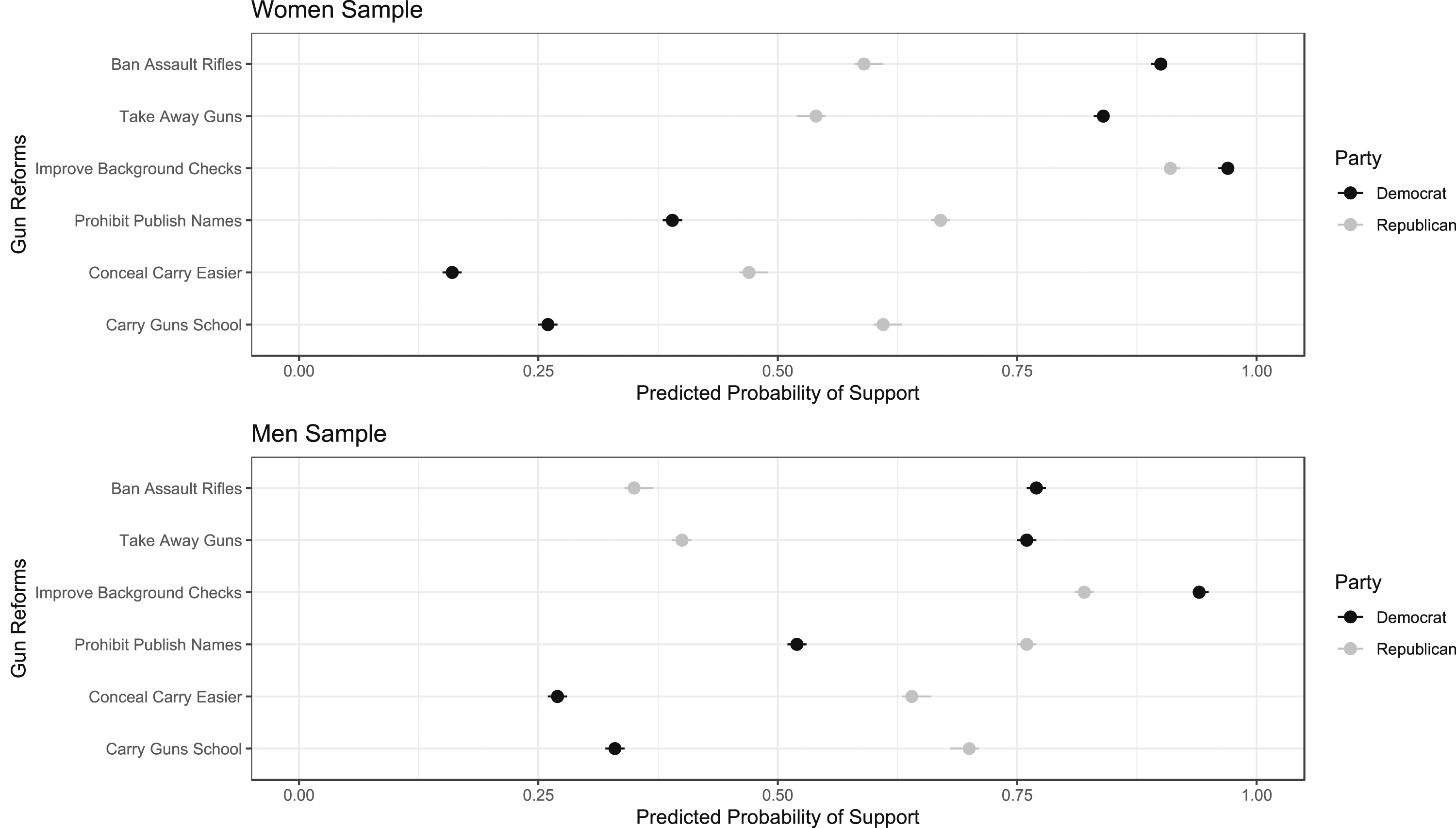
Large gaps in attitudes among women partisans is also the pattern on gun rights policies. On government publishing names of gun owners, 67 percent of Republican women are opposed, compared to 39 percent of Democratic women (28 percentage point gap). There is a 31-percentage point gap among women on making conceal carry easier, with 47 percent of Republican women, fewer than a majority, and 16 percent of Democratic women supporting. Finally, the largest gap among women is on the question of arming teachers and staff in schools, with 61 percent of Republican women and 26 percent of Democratic women favoring this approach. Among women, we see large gaps in opinion when we examine their partisan affiliation, even when we see Republican women evidence higher levels of support for some gun control positions and lower levels of support for some gun rights positions than their partisanship might have caused us to expect. In total, the party gap among women on the six items is 26.8 percentage points.
Among men (bottom panel), we see that the overall gaps between Democratic men and Republican men are generally larger than the gaps among women partisans. As expected, Democratic men have higher levels of support for the gun control items and Republican men higher support for the gun rights items. However, while we saw majorities of Republican women support the three gun control items (above), here we only see Republican men provide a majority of support for improving background checks. In fact, the smallest gap among men on any of the six items is on improving background checks, where 82 percent of Republican men and 94 percent of Democratic men are in favor (12 percentage point gap). Other than on this item, the gaps among men are quite large. While 77 percent of Democratic men support banning assault weapons, only 35 percent of Republican men do, resulting in a 42-percentage point gap. There is a 36-percentage point gap between Democratic and Republican men (76 percent to 40 percent) on whether government should take guns from people who pose a threat.
On gun rights issues, partisan differences among men remain large. The gap among Democratic and Republican men on prohibiting the publication of gun owners’ names is 24 percentage points, on making conceal carry easier, the gap is 37 percentage points, and on arming teachers and staff in schools, the gap is 37 percentage points. In total, the gap on gun attitudes among men is 31.3 percentage points, higher than the overall gap in opinions among women. As with Republican women, these findings suggest that Democratic men, who receive cross-pressured messages from their gender and party alignments, experience a push and pull on gun issues in a way that Republican men do not.
Discussion
Guns and public opinion on the appropriate policies to control or allow their use are an important contemporary political issue in American life. The prominence and salience of gun policies is driven by the near-daily occurrence of mass shootings and other incidents of gun violence in the U.S. and by the deepening partisan polarization that has taken place among elites and members of the mass public. As such, we must be aware of the ways in which people’s attitudes toward this important topic are influenced by multiple personal influences. We examine the impact of gender and partisanship, both as solo influences and as potentially interactive effects. Personal experiences and political expectations can send signals to individuals regarding the “appropriate” opinion on any given issue for members of their group. Since people hold multiple identities, these influences can lead to multiple signals, which can be consistent or inconsistent. People whose identity groups send consistent messages likely have their opinions reinforced, resulting in stronger attitudes on political issues. Others whose identities send mixed or inconsistent messages on issues can experience cross-pressures from these competing messages. This is what we see when we examine contemporary gun attitudes among Americans.
As expected, our results confirm the presence of both a gender gap and a partisan gap on both gun control and gun reform proposals. Women and Democrats are more likely to support gun control policies and less likely to support gun rights proposals than are men and Republicans. And when we examine the gender gap within parties and the partisan gap within gender groups, we see the impact of cross-pressured identities. The typical gender gap in attitudes on both gun control and rights issues is present among both Democrats and Republicans. However, the gender gap among Democrats is quite small, with women and men in the party clearly having more consistent attitudes. The gap is considerably larger among Republicans, with Republican women having more pro-gun control and anti-gun rights positions than their male co-partisans. The gender gap among Republicans is more than twice the gender gap among Democrats, highlighting the cross-pressures of gender and party messages on guns for Republican women.
In an effort to move beyond an exclusive focus on the differences between women and men, we also examine whether there are partisan differences among women and among men. Among women, we see that majorities of both Democratic and Republican women are in favor of the three gun control items. The difference is in the size of the gaps in these attitudes. For women, larger differences emerge on the gun rights items. For men, we see evidence of a cross-pressure of gender and party on Democratic men, as we find larger gaps in positions on both gun control and gun rights issues among men than among women based on party. The result suggests that Democratic men experience tension from the somewhat inconsistent messages sent by their gender and partisan identities. These findings support other recent work that examines the diversity among women (Barnes et al., 2021; Barnes & Cassese, 2017), which we argue is important for bringing greater understanding to the diversity among women and among men, whether on policy issues or other political topics like vote choice.
These findings are in line with others that suggest that Americans, while polarized on guns, are not nearly as polarized as political leaders (Cook & Goss, 2020). This understanding may be useful for advocacy groups or political leaders as they navigate policy demands and proposals. There are some consensus items on which compromise is likely possible, similar to what we saw in the Bipartisan Safer Communities Act of 2022. Gun control organizations have clear allies among Democratic women and men on many potential reforms and can likely make special appeals to women on issues like banning assault weapons and limiting conceal carry laws. And, while less supportive than Democratic women, majorities of Republican women support several gun control proposals.
In the end, this analysis of attitudes on a highly salient public issue demonstrates the need to take a fuller look at the determinants of public opinion. While a focus on the gender gap is a standard approach in opinion research, our findings demonstrate that there is more diversity among women and among men than we generally acknowledge. Individuals are clearly influenced by multiple identities and it important to consider whether the signals sent by different identities result in consistent or inconsistent messages, since clear messages are more helpful to citizens and voters as they develop their attitudes and vote choice behaviors (Levendusky, 2010). Future work on the influence of multiple identities and cross-pressures should focus on a range of issues and a range of identities, since different identities may pressure individuals differently across issues (Barnes & Cassese, 2017; Hansen et al., 2022). Since polarization and social sorting show no signs of slowing in U.S. political life, continuing a focus on the complexity of public opinion will remain an important goal.
Supplemental Material
Supplemental Material - Cross-Cutting Identities in American Politics: Gender, Party, and Attitudes on Gun Reform
Supplemental Material for Cross-Cutting Identities in American Politics: Gender, Party, and Attitudes on Gun Reform by Michael A. Hansen and Kathleen Dolan in American Politics Research
Footnotes
Declaration of Conflicting Interests
The author(s) declared no potential conflicts of interest with respect to the research, authorship, and/or publication of this article.
Funding
The author(s) received no financial support for the research, authorship, and/or publication of this article.

Supplemental Material
Supplemental material for this article is available online.
Notes
References
Supplementary Material
Please find the following supplemental material available below.
For Open Access articles published under a Creative Commons License, all supplemental material carries the same license as the article it is associated with.
For non-Open Access articles published, all supplemental material carries a non-exclusive license, and permission requests for re-use of supplemental material or any part of supplemental material shall be sent directly to the copyright owner as specified in the copyright notice associated with the article.
