




Abstract
Research in political science suggests campaigns have a minimal effect on voters’ attitudes and vote choice. We evaluate the effectiveness of the 2016 Trump and Clinton campaigns at informing voters by giving respondents an opportunity to name policy positions of candidates that they felt would make them better off. The relatively high rates of respondents’ ability to name a Trump policy that would make them better off suggests that the success of his campaign can be partly attributed to its ability to communicate memorable information. Our evidence also suggests that cable television informed voters: respondents exposed to higher levels of liberal news were more likely to be able to name Clinton policies, and voters exposed to higher levels of conservative news were more likely to name Trump policies; these effects hold even conditioning on respondents’ ideology and exposure to mainstream media. Our results demonstrate the advantages of using novel survey questions and provide additional insights into the 2016 campaign that challenge one part of the conventional narrative about the presumed non-importance of operational ideology.
Introduction
“I have some more thoughts on Clinton’s remarks I will be sharing momentarily, but first I want to tell you what I am going to do to make your life better. We’ve outlined a detailed plan on trade, on immigration, on rebuilding the military, on changing our foreign policy.” – Donald Trump at a rally in Asheville, North Carolina (three days after Clinton’s description of (half of) Trump supporters as a “basket of deplorables”)
Do campaigns produce a partially informed electorate which is aware of at least some policy proposals? Taking a broad view of what campaigns do — including the tactical decisions to attract unpaid press coverage — we are interested in whether or not voters learn anything about the candidates’ policy positions after a long, well-funded, high-salience political campaign. We measure this with a novel strategy which would normally be employed at a smaller scale: we ask respondents directly. Respondents on a nationally representative survey were asked if they could name a policy for each candidate that would make them better off. This is quite different than asking respondents if they know a candidate’s position on a particular policy. Here we are asking voters if, after candidates have spent many months and hundreds of millions of dollars trying to convince voters that they offer a brighter future than their opponent, they can name a single policy of each candidate that would make their lives better.
By using a novel and simple survey instrument, we show that at the end of the 2016 election campaign respondents were much more likely to be able to provide a Donald Trump policy that they believed would make them better off than they were to provide a Hillary Clinton policy that they believed would make them better off. Further, we show that respondents with characteristics typically associated with higher levels of political knowledge were more likely to be able to name policies for Clinton, but that this relationship was quite weak for the ability to name policies for Trump. By considering respondents’ media diets and their ability to name a policy for each candidate, we show that even conditioning on respondents’ ideology and other characteristics, media seemed to provide policy-relevant information to voters. In addition, we examine the issues people list and show that the candidates did register with the voters on different policy dimensions.
Among the consequences of Donald Trump’s victory in 2016 was a disorientation among political observers and a lack of agreement on an instructive narrative (Masket, 2020). To analyze whether views of candidates’ platforms are electorally meaningful, we relate respondents’ ability to name a policy for each candidate to respondents’ vote choice. Our results suggest that Clinton’s failure to inform voters of policies that could make them better off was costly to her among Democratic voters. A central finding is that a significant proportion of Democrats (38%) could not name a single Clinton policy which would make their life better, and that respondents who were unable to name a desirable Clinton policy were significantly less likely to vote for her. Even among Democrats who liked nothing about Donald Trump, those who were uninformed about policy reasons to vote for Clinton were 17 percentage points less likely to vote for her than Democrats who could name a favorable policy proposal of Clinton’s.
Republicans were substantially more likely than Democrats to be able to articulate a policy-related reason to support their party’s nominee. We find that only 21% of Trump’s co-partisans were unable to name a policy-related reason to support him. It thus appears that the GOP nominee pursued a more effective campaign strategy as measured by whether the campaign provided voters policy-based reasons or justifications to support the candidate. Moreover, while immigration-related promises were the most frequent category of the policies known and approved of by Republicans, many respondents also remembered Trump’s promises to lower taxes, bring back jobs, and renegotiate trade deals.
Most existing scholarly work on electoral persuasion relies on close-ended survey questions to measure voters’ knowledge about politics, or their preferences and beliefs (Druckman, 2022), whereas open-ended questions appear to be still underused; we argue that open-ended questions are a well-suited approach for studying what sticks in voters’ minds. 1 The respondents’ answers provide two things. First, can they name anything? We have prompted them for a policy, so if they are Trump supporters because they like his ‘style’ or because they prefer a man to a woman, they may be giving us a policy that is not the primary reason they are voting for him. But that is not what we are trying to measure. We want to measure if respondents are simply capable of providing a policy they like from either of the candidates. We find this particularly informative when measuring whether or not they can do it for their preferred candidate. 2 If a Clinton supporter could not name a single Trump policy they like, it would not necessarily surprise us. And, of course, a Clinton supporter might simply be refusing to admit that they like some Trump policy. But if a respondent cannot name a Clinton policy that would make them better off, and they vote for Clinton, we would be confident in ruling out that they were engaging in issue-voting. Thus, we provide a test for the view that many respondents voting for Trump (or Clinton) were doing so based on identity considerations independent of any policy belief. Again, we note a limitation of the test: respondents could simply engage in motivated reasoning to produce a policy they claim to like. But to do so they would be required to at least know a policy of the candidate.
We test several hypotheses of which individual characteristics are related to the ability to name an issue, including the respondents’ levels of education. We also examine the association between the respondents’ individual media environments and their ability to name an issue. Finally, while we are not in a position to make causal claims about the association between being able to name a policy of a candidate that would make them better off and voting for that candidate, we do find the results suggestive. The literature suggests persuasive effects of campaign messages tend to be small (Broockman & Kalla, 2022; Coppock et al., 2020) and short-lived (Gerber et al., 2011), but new research also suggests that persuasiveness of new information may have been previously understated (Coppock, 2022). But beyond persuasion via paid media or outreach, free media coverage can also inform voters about candidates’ policy proposals and issue positions, and this consideration is especially relevant in the context of the 2016 U.S. presidential campaign.
Background: The 2016 U.S. Presidential Campaign
Is there evidence that “malpractice cost Clinton the election [including] her ambivalence on big issues” (Greenberg, 2017)? Despite suggestions that the Democratic campaign failed to inform voters about issue-related reasons to vote for Hillary Clinton, political scientists usually find that campaigns only have short-term effects (Hill et al., 2013), and that national fundamentals matter a great deal for how candidates perform (Campbell et al., 2017). Notwithstanding skepticism of campaign effects, public opinion research suggests that events such as conventions and debates can change citizens’ evaluations of candidates (Holbrook, 1996). An additional argument that campaigns may matter can be found in exit polls; for example, in 2016, 13% of voters said they decided for whom to vote for in the presidential election in November (just before the election), and an additional 12% said they made their choice in October.
What information did late deciding voters have when they made their voting decisions? Some researchers have blamed the press for giving disproportionate coverage to Trump (Patterson, 2016; Sides, 2015). Clinton herself devoted more messages to portrayals of candidates’ personalities (60% of her ads) than to policy issues (Fowler et al., 2017). Fowler et al. also showed that, perhaps surprisingly, most Trump campaign ads between June 8, 2016 and the election day focused on policy. Echoing these results, Tedesco and Dunn (2019) find that “it was Clinton who waged more ad hominem attacks in her advertisements, mostly focused on labeling Trump as unfit for office.” While we are not proving a causal connection between Clinton’s campaign choices and what voters knew at the end of the campaign, we do show that there may have been downstream effects of the Clinton campaign’s decision to de-emphasize issues in her ads.
Although Clinton’s website contained 39 policy proposals (30 more than Donald Trump’s campaign website, based on reporting by Bacon Jr., 2016), journalists prioritized stories related to Clinton’s emails. Searles and Banda (2019) suggest that journalists’ incentives favored scandal stories over policy stories. Accordingly, no memory of Hillary Clinton was stronger and longer-lasting than her use of emails, as shown by measurements of Americans’ verbal associations with Clinton and Trump (Bode et al., 2020). 3 At the same time, Donald Trump’s accessible language (Kayam, 2018) 4 and his strategic use of intuitive imagery (Lamont et al., 2017) may have proven advantageous to him, especially if voters are inattentive and boundedly rational (Lodge et al., 1995). 5
The key players in the information space—both mainstream media and campaigns—put substantial emphasis on the question of character. News channels devoted about three times more time to Clinton’s emails than to all policy issues combined, 6 notwithstanding the fact that 66% of potential voters told pollsters that positions (rather than “character”) were more important to them when choosing a presidential candidate. 7
Given this information environment, did voters encounter messages related to policy? To be sure, measuring citizens’ attention to politics is difficult because behavioral data on media consumption is rare and expensive. Accordingly, we bypass directly measuring exposure to information about policies, and instead we use a novel survey instrument fielded during the 2016 election campaign to determine whether voters remembered policy-related reasons to support Clinton or Trump. Our results suggest that simple, memorable policy proposals advanced by Donald Trump were remembered more widely than were policy proposals made by Hillary Clinton.
Research Questions and Expectations
We are interested in determining in as unbiased a way as possible whether respondents were aware of policy positions of each of the presidential candidates that could benefit them. Asking respondents to place candidates on issues, as is commonly done on the ANES and many other surveys, does not tell us if the respondents are aware of policy proposals of the candidates. More importantly, it does not tell us if the respondent is aware of a policy position of the candidate on an issue that matters to the voter. We also note the context of the 2016 presidential campaign, in which the Trump campaign was accused of making racist and sexist appeals. Independent of evaluating the effectiveness of that aspect of the campaign, we wanted to know if voters were also aware of Donald Trump’s substantive policy proposals that could improve their lives. And of course we wanted to know the same of voters with respect to Clinton; beyond knowing that she was a Democrat and was not Donald Trump, could they name a policy proposal or a policy goal that would improve their lives? Finally, we ask whether partisan defection rates are related to awareness of (desirable) issue promises.
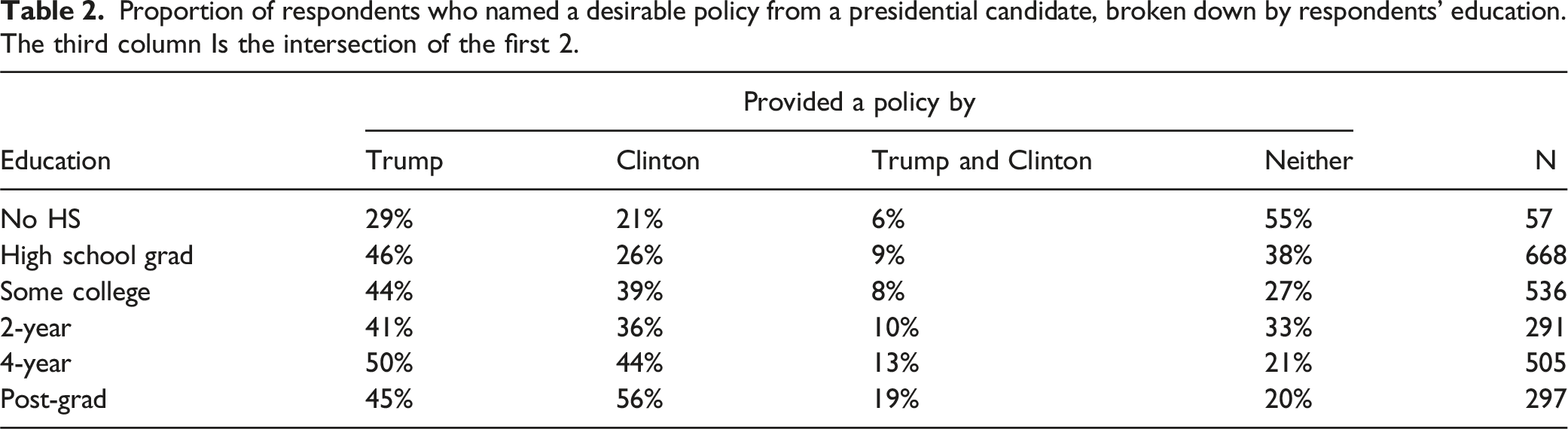
After examining which candidate voters were more aware of policy based reasons to vote for at the end of the campaign, we test a number of hypotheses related to the factors that make respondents more likely to be informed and able to name a (desirable) policy. First, we expect that co-partisans will be significantly more likely to name desirable policies by a candidate nominated by their own party (H1). Second, in light of the existing research suggesting that more educated people are better informed (Carpini & Keeter, 1996; Mondak, 1999; Pew Research Center, 2009), we hypothesize that voters with a college degree will be more likely to name a policy proposed by either Trump or Clinton (H2). 8
Next, we will test whether media consumption and voter characteristics contribute to voters’ awareness of candidates’ policies. We hypothesize that exposure to news (via print or television) will increase the probability that a respondent can name a policy (H3A). In addition, we hypothesize that a more conservative news diet will be associated with a higher probability of naming a Trump policy (H3B), and with a lower probability of naming a Clinton policy (H3C). Conversely, we hypothesize that a more liberal news diet will be associated with a higher probability of naming a Clinton policy (H3D) and with a lower probability of naming a Trump policy (H3E).
We also document which policy areas Americans were most likely to name. We show that awareness of (appealing) policies is linked to vote choice, though our research design does not allow us to make causal claims relating knowledge and behavior at the ballot box. We note that according to the online model Lodge et al. (1995) voters need not be able to name a policy proposal for it to influence their vote. In this model voters keep a running scorecard, and they may just update their view of a candidate when the candidate proposes something they like (or dislike), but not remember the specific proposal.
Data and Method
To assess what respondents remember, we let them use their own words to convey what policy—if any—was remembered and deemed desirable at the final stages of the 2016 U.S. presidential election campaign. We asked respondents on a nationally representative online survey conducted at the end of the 2016 U.S. presidential election two open-ended questions. First, “Name a policy that Donald Trump supports that would make your life better if it is enacted.” Second, “Name a policy that Hillary Clinton supports that would make your life better if it is enacted.”
The survey was written by the authors and fielded by YouGov between October 25 and November 7, 2016 (analytic N = 2,354). When we report proportions of respondents who remembered a beneficial policy, we weight the data to be representative of the voting-age population by gender, age, race, education, party identification, ideology, and political interest. 9 In addition to standard demographic questions, we asked respondents a battery of media consumption questions. We note that a small number of political scientists have asked Trump supporters directly in their communities (Cramer, 2016) and at campaign rallies (Dickinson, 2018) what motivated them, but the use of unstructured answers to open-ended questions on surveys continues to be relatively uncommon.
Results
Proportion of respondents who named a policy “that would make (them) better off” from a presidential candidate, broken down by respondents’ party ID and vote choice.
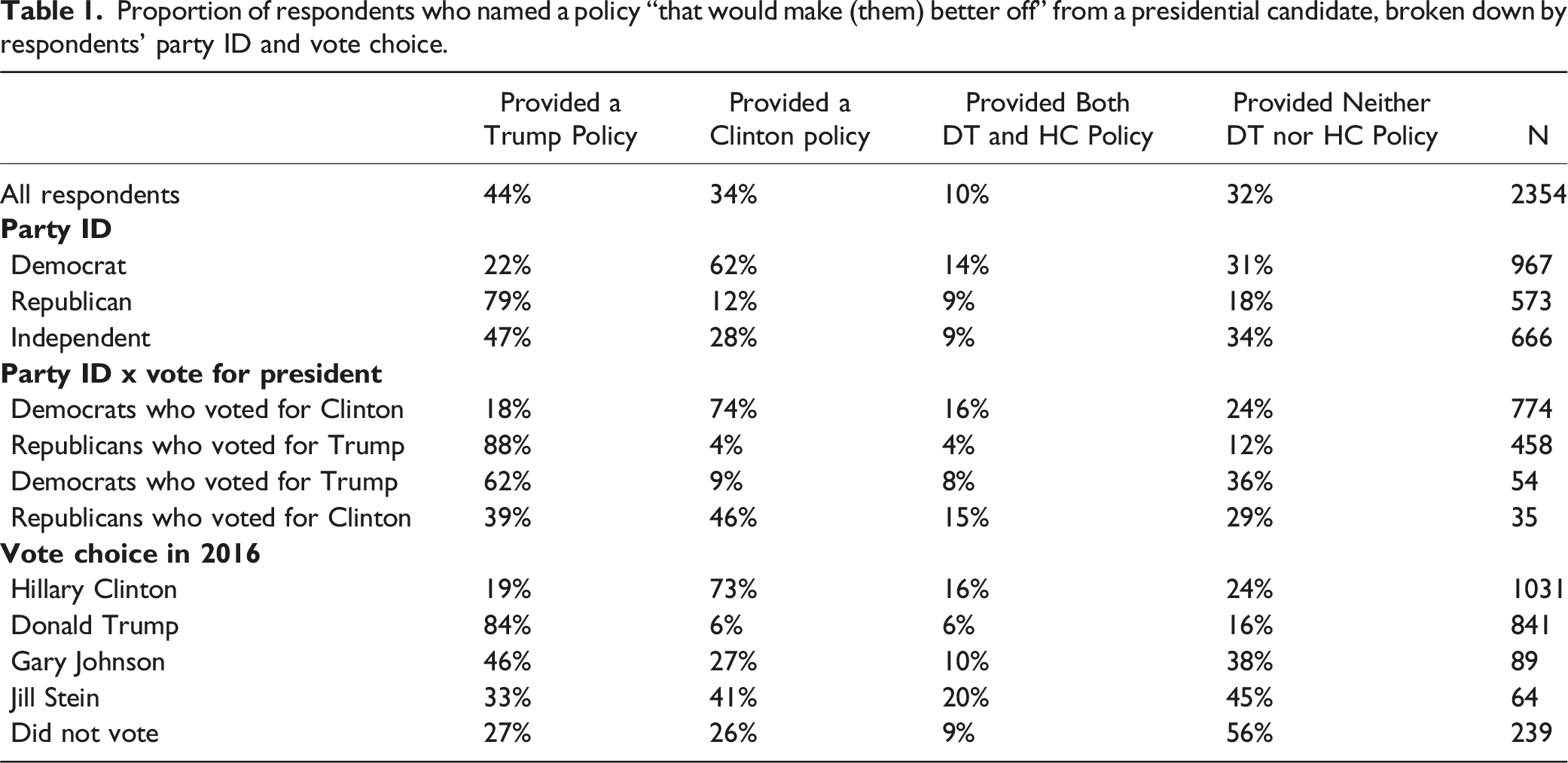
Recall rates among Democrats and Republicans displayed in Table 1 confirm our first hypothesis; respondents are more likely to be able to name a policy they prefer of their co-partisan candidate. And they reveal an additional pattern worth noting: while only 12% (CI: 9.1%–14.4%) of Republicans stated there was a Clinton policy they approved of, 22% of Democrats (CI: 19.0%–24.1%) were able to recall a favorably-evaluated Trump policy. 12
Proportion of respondents who named a desirable policy from a presidential candidate, broken down by respondents’ education. The third column Is the intersection of the first 2.
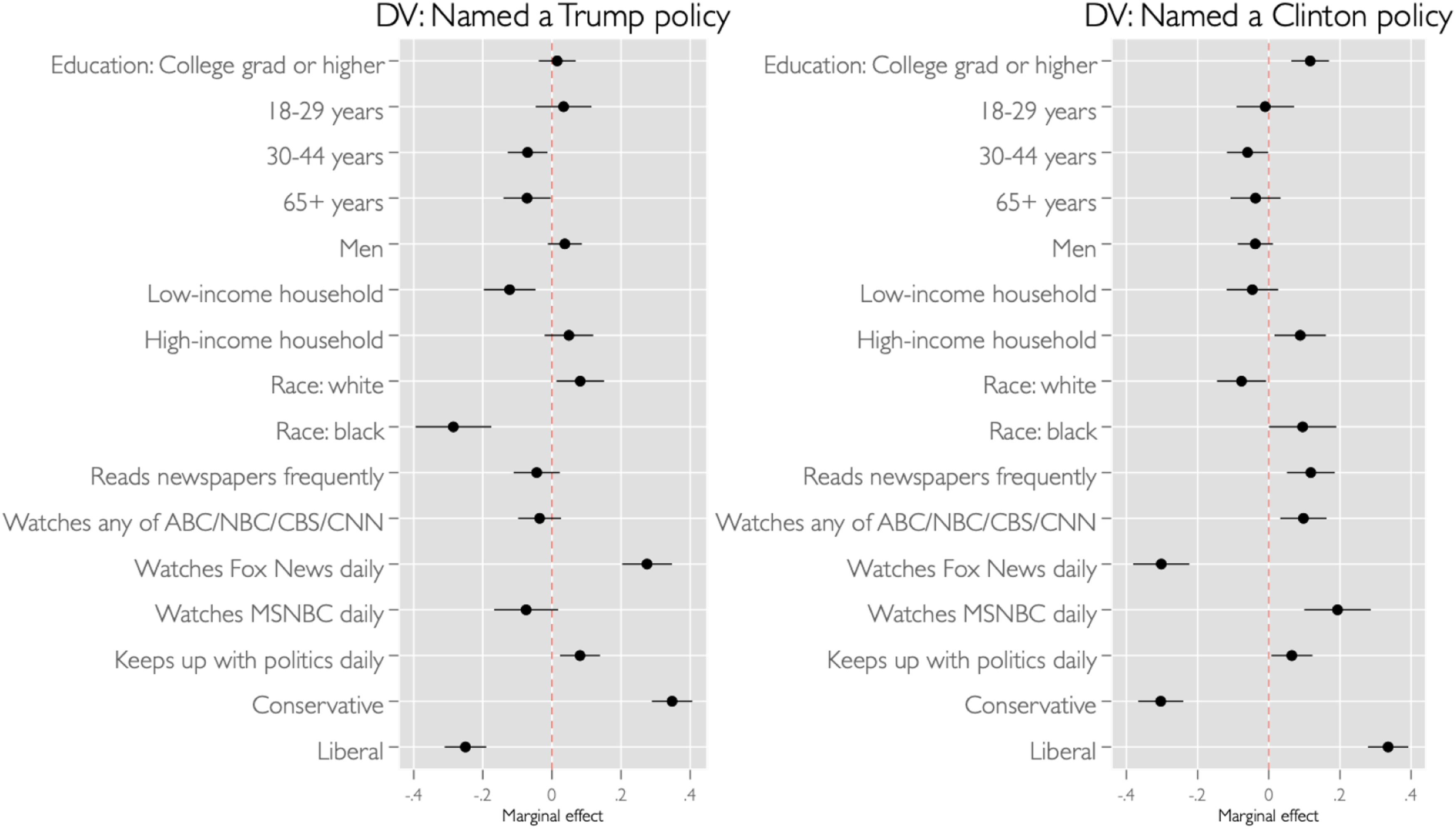
Marginal effects from two logistic regressions estimating associations between observables and respondents’ ability to name either a Trump policy (left panel) or a Clinton policy (right panel). Horizontal lines denote 95% confidence intervals.
To examine whether or not media consumption was associated with the ability to name either a desirable Clinton or Trump policy, we estimate a set of logistic regressions where the dependent variables are: A) naming a Trump policy the respondent viewed as beneficial, or b) naming a Clinton policy that a respondent perceived as beneficial. The independent variables include education, age, gender, income, race, self-reported ideology, and several measures of media consumption. We condition on respondents’ self-reported frequency of reading newspapers, whether they watch any of a set of mainstream news shows (ABC, NBC, CBS, and CNN), and separately, whether or not they report watching Fox News daily, and watch MSNBC daily. We also include a measure of their level of political interest (their response to whether they “keep up with politics daily”). We report results in Figure 1. The displayed coefficients in this and subsequent figures are marginal effects derived from logistic regression coefficients. Specifically, the displayed coefficients are the estimated changes in probability of naming a policy for a respondent who possess a given trait, relative to lacking a given trait, while the remaining covariates are held at their mean values.
In Figure 1 we see that respondents who report consumption of mainstream news media (television and newspapers) are significantly more likely to be able to recall a Clinton policy they approve of compared to respondents who do not consume such media. Thus the data is consistent with Hypothesis 3A for Clinton’s policies. But we do not observe a positive relationship between mainstream media consumption and respondents’ naming a Trump policy they approve of, the estimated coefficient is negative (though not statistically significant). We find clear support for Hypotheses 3B and 3C: frequent consumption of conservative partisan news (i.e., Fox) is associated with a higher probability of naming a Trump policy, and with a lower probability of naming a Clinton policy; the relationships are significant, and each model conditions on respondents’ ideology and other characteristics. Moreover, frequent consumption of liberal news (i.e., MSNBC) is associated with a higher probability of naming a Clinton policy, as predicted by Hypothesis 3D. However, while the coefficient for consumption of more liberal media was negative in the left panel, suggesting it lowers the probability of naming a Trump policy, the coefficient was not statistically significant at traditional levels. 13
To consider whether the relationship between media consumption and ability to recall a desirable policy proposal from either candidate differs between Democrats and Republicans, we first disaggregate respondents by partisanship and estimate separate models for being able to name a Clinton policy for Democrats and Republican respondents. We present the results in Figure 2 where we show marginal effects on the probability of naming a Clinton policy derived from models that were estimated separately for Democratic and Republican respondents. Again, we model the probability of naming (and approving) a candidate’s policy as a function of demographics, ideology, a proxy for political interest (keeping up with politics), news-reading and news-watching habits, and exposure to partisan cable TV (Fox News and MSNBC respectively). We see empirical support for Hypothesis 3A (that exposure to news increases the probability that a respondent can name a policy) only among Democrats, and for Hypothesis 3C especially among Democrats. Exposure to mainstream news was associated with a higher likelihood of naming a Hillary Clinton policy only for Democrats (confirming Hypothesis 3A); and the relationship between exposure to Fox news and being able to name a Clinton policy was especially strong for Democrats (supporting Hypothesis 3C - that exposure to conservative news would lower the probability of being able to name a Clinton policy). As for the link between a liberal news diet and a higher probability of naming a Clinton policy (Hypothesis 3D), in the fourth row from the bottom of the left panel we observe that Democrats who watch MSNBC daily are 11 percentage points more likely to name a Clinton policy than Democrats who do not. In the right panel, we see that among Republicans, the estimated effect is only 4 percentage points (and is not statistically significant). Average marginal effects from logistic regressions estimating the association between the row variables and the probability of naming a Clinton policy, estimated separately for Democratic and Republican respondents. Horizontal lines denote 95% confidence intervals.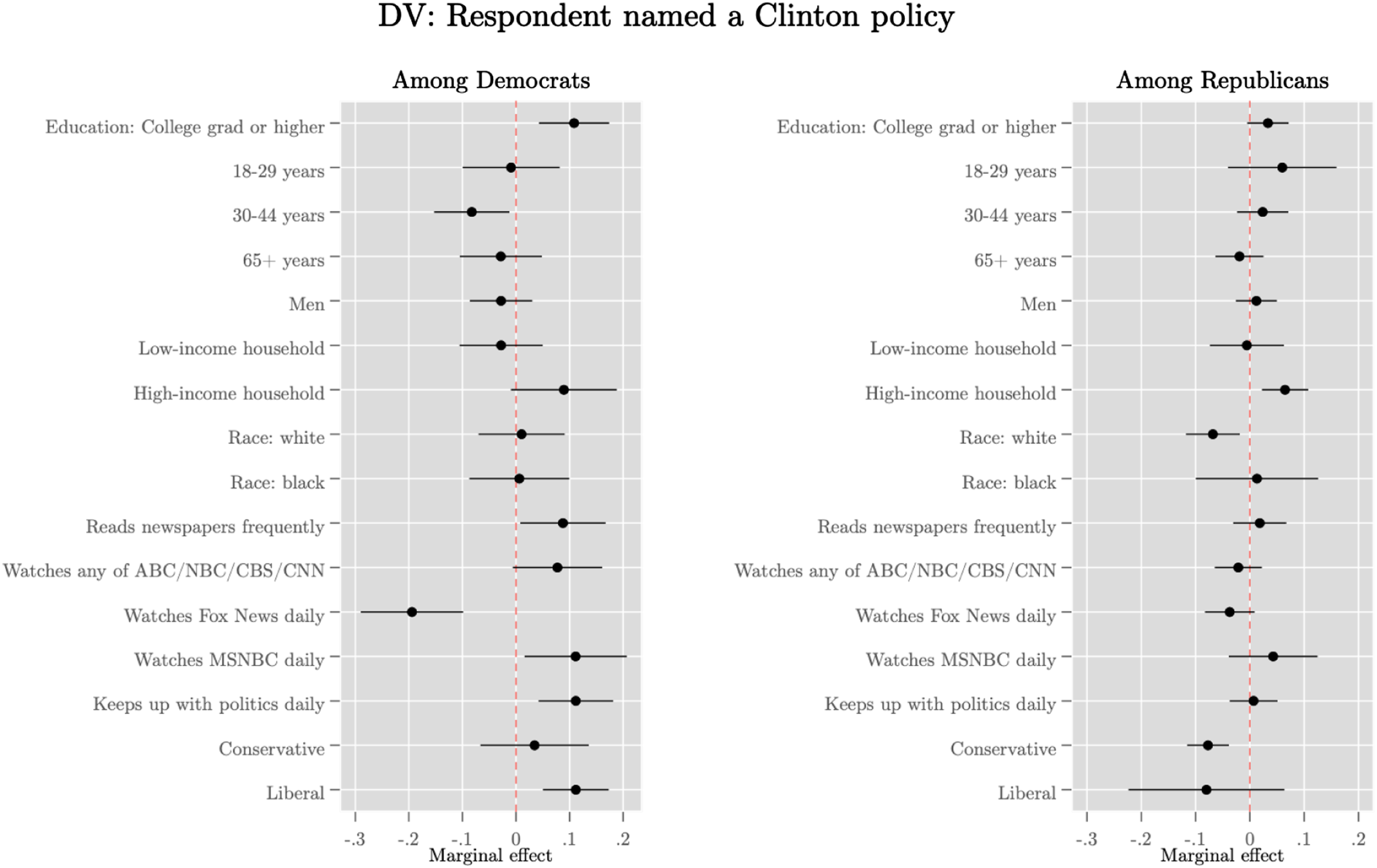
Figure 3 shows marginal effects of the same set of variables on the probability of naming a desirable Trump policy, estimated separately for Democratic and Republican respondents. What is most notable here is the strong relationship between media consumption and remembering a Trump policy among Republicans, compared to the lack of an observable relationship in the data between media consumption and remembering a Trump policy among Democrats. In the fifth row from the bottom of the right panel we observe that Republicans who watch Fox News daily are 14 percentage points more likely to remember and name a Trump policy relative to Republicans with lower (or no) exposure to Fox News. The negative association between MSNBC is also significant and large (−17 percentage points).
14
Average marginal effects from logistic regressions estimating the association between the row variables and the probability of naming a Trump policy, estimated separately for Democratic and Republican respondents. Horizontal lines denote 95% confidence intervals.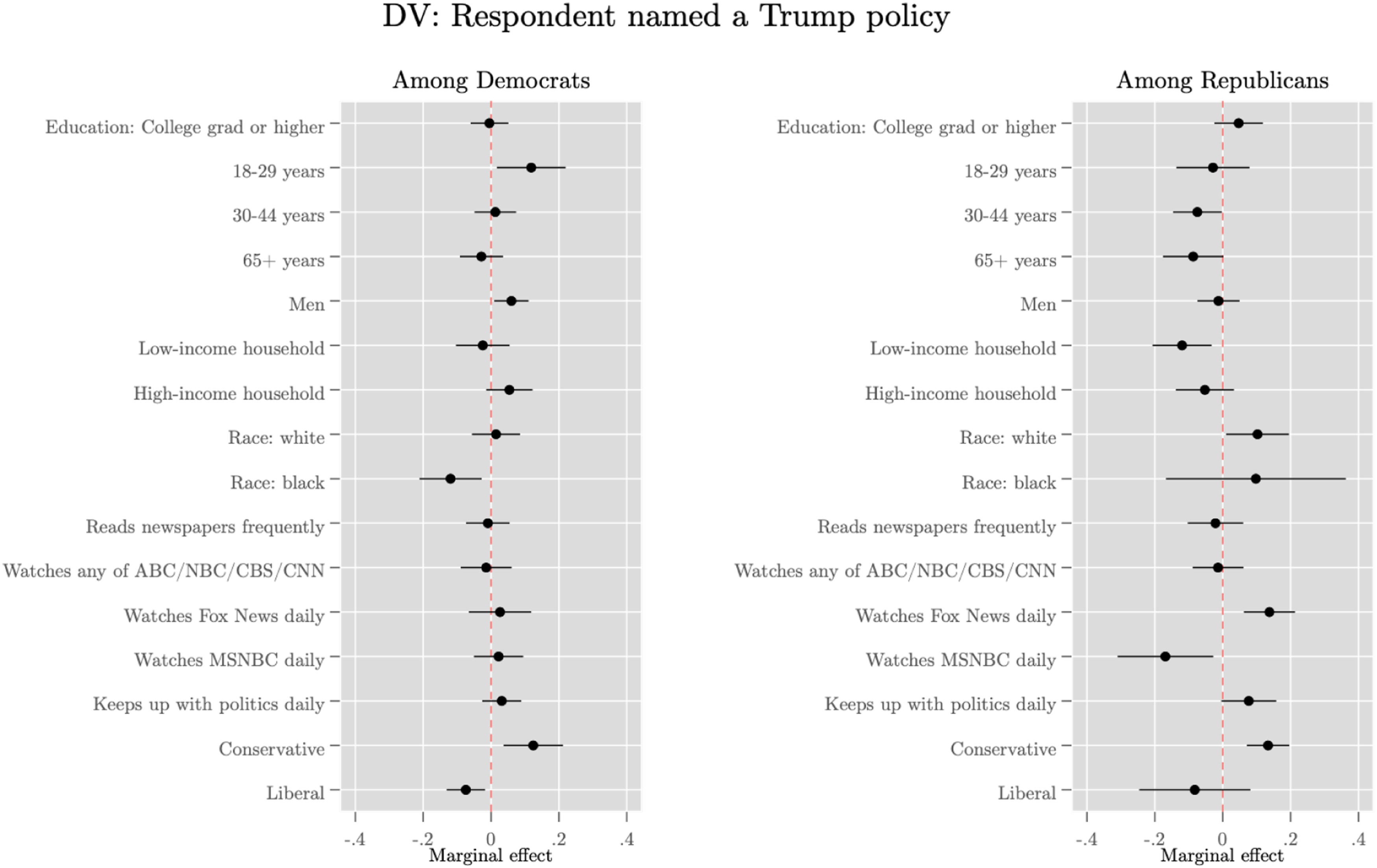
Issues Mentioned
Distribution of responses to the Trump and Clinton policy questions by issue category (Shown: Only respondents who could name a policy).
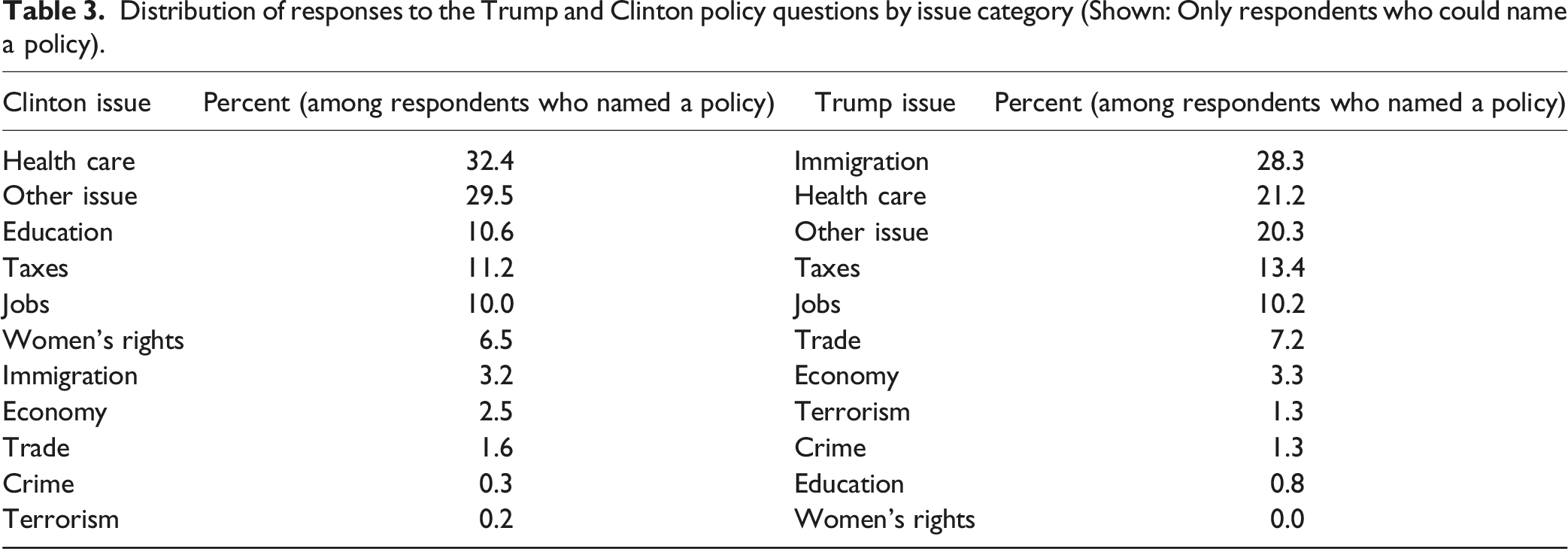
The most frequently mentioned Clinton issue was health care: specifically, 32% of respondents who recalled a Clinton-related positive issue mentioned health care. It thus appears that Clinton benefited from a perception that she would protect the Affordable Care Act. Among respondents who thought that Clinton would enact a policy that would make them better off, only about 25% could think of an economic issue. Very few respondents (fewer than 2% among those who approved of something in Clinton’s platform) mentioned her trade policy.
Vote choice
While we have no strict test of causal inference, we show that Democratic voters unable to name a policy of Clinton’s that would make them better off were much less likely to vote for her than were Democratic respondents who could name such a policy (Figure 4). Thus, again admitting we cannot prove causality, this is consistent with the theory that the Clinton campaign’s decision to emphasize Trump’s negative character attributes—rather than informing voters about her own policy policy solutions—may have cost her votes.
15
Vote choice among Democratic respondents who voted in the 2016 election (points denote average vote shares for Clinton (left panel) or Trump (right panel) among the row group and shaded areas represent 95% CIs). Parenthetical values under the row labels give the column percentages of Democratic-identifying voters in that row (i.e., 59.8% of Democrats who reported a vote choice could not name a Trump policy but did name a Clinton policy).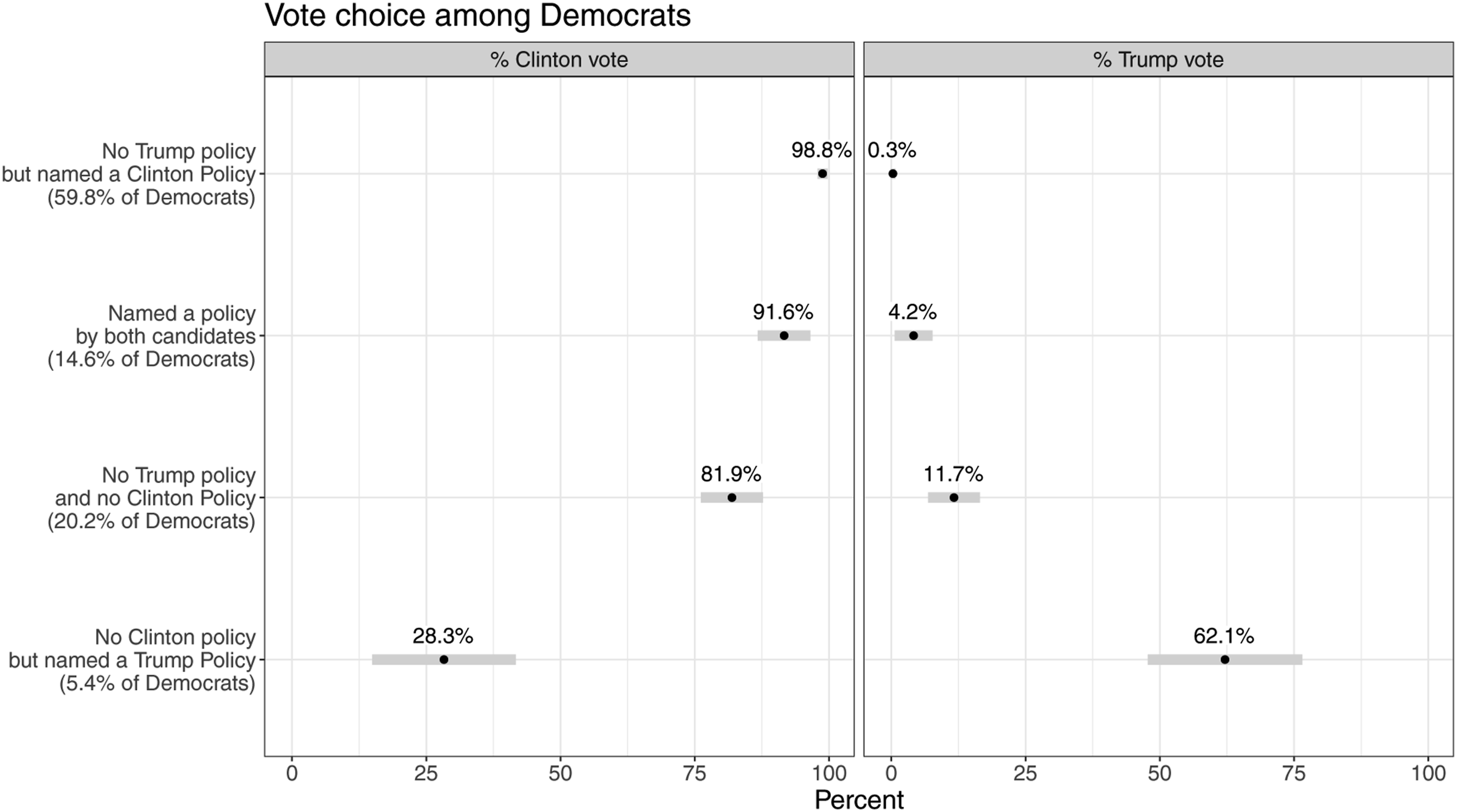
Figure 4 shows Clinton won fully 98.8% of Democrats who could not name a Trump policy, but could name a Clinton policy (row 1); while she won only 81.9% of Democrats who could not name a Trump policy, and could not name a Clinton policy (row 3). We note (from Table 1) that 78% of Democrats could not name a Trump policy; and thus Clinton was potentially suffering a 16.9 percentage point reduction in vote-share among 20.2% of Democratic voters, or a reduction in overall vote-share among Democrats of approximately 3.4 percentage points. We note that these respondents in row 3 were Democrats who did not volunteer a Trump policy they liked, suggesting that they were available to the Democratic candidate. Things were even worse for Clinton among the 20% of Democratic voters who could name a Trump policy they liked (row 2 plus row 4). 16 Here we see that Clinton won 91.6% among those voters who could name a Clinton policy they liked, but only 28.3% among those voters who could not name a Clinton policy they liked, a difference of 63.3 percentage points. We note that by similar calculations to the above, Clinton may have increased her vote share by another 3.4 percentage points had she given these voters a policy reason to vote for her (though the confidence interval around the estimate is substantially larger).
It is of course possible that voters who disliked Clinton for non-policy reasons also refused to acknowledge that they liked any of her policies. But we note that the figure only shows behavior among Democrats: thus these are the voters predisposed to favor Clinton, predisposed to be willing to support Democratic policies and the worldview of the Democratic Party, and likely to come across positive information about the Democratic presidential candidate.
Conclusion
While Clinton’s proposed policies were readily available on her website throughout 2016, we infer from our results that her campaign failed to ensure that Clinton’s policy proposals would travel widely in the information ecosystem and enter potential voters’ minds in a memorable way. 17 To be sure, we are not suggesting the Clinton campaign operated in a vacuum; it is well documented that the media was focusing more on Clinton’s emails than her policy proposals (Bode et al., 2020). But the proportion of respondents who could name an attractive Clinton policy was 10 percentage points lower than the proportion of respondents who could name a Trump policy they liked, and these gaps may have been electorally meaningful. Indeed, there is evidence that Clinton’s primary opponent, Bernie Sanders, benefited from taking a clear stance in support of workers’ rights (Lyon, 2019). While adopting a Sanders platform was not necessary or realistic, our results suggest that Clinton would have been better positioned for the general election if more voters could have articulated one policy-related reason to vote for her. Thus, perhaps a central question for the 2016 Clinton election campaign is not “why did Clinton not go to Wisconsin”, but “what would she have said when she got there?”. 18
In contrast to Clinton, Trump appears to have been more successful at implanting memorable policy themes, even if they were often vague or lacked detailed implementation plans. This suggests that while the Clinton campaign has been criticized for strategic missteps such as neglecting certain swing states, a more fundamental weakness may have been the lack of a clear, compelling policy message. Instead of making a positive case for herself, Clinton focused heavily on Trump’s weaknesses, a strategy that appears, in retrospect, to have been ill-advised. Indeed, recent research by Broockman and Kalla (2022) shows that pro-Biden messages were more effective at generating support for the Democratic nominee than anti-Trump messages, underscoring the importance of affirmative messaging. 19
To be sure, we cannot rule out the possibility that Trump voters were motivated by factors beyond the policies they named. It is conceivable that some respondents who were drawn to Trump because of appeals that many would consider racist might have worked harder cognitively to come up with a policy justification for their support. 20 Nonetheless, even if non-policy considerations played a role, the fact remains that these voters were able to articulate a Trump policy that they believed would improve their lives, suggesting that his campaign succeeded in communicating a memorable policy vision to a significant segment of the electorate. Of course as we noted above, the media’s focus on Clinton’s email practices did not help voters learn about Clinton (or Trump’s) policy positions. Thus there may be much blame to go around for voters’ inability to name Clinton policy positions they liked.
The relatively high salience of immigration-related reasons for supporting Trump notwithstanding, our findings suggest that his Electoral College victory should not be dismissed as merely the result of populist appeals devoid of policy content. Across a range of demographic groups, a significant proportion of voters could point to specific Trump proposals that they believed would benefit them personally. In contrast, Clinton struggled to articulate a compelling policy rationale for her candidacy that would resonate with key segments of the electorate, including some that had previously supported Obama (Fraga et al., 2017). Clinton’s underperformance relative to Obama among most demographic groups—including Black voters, White voters, and liberal voters (Weinschenk, 2019)—also suggests that explanations of the 2016 election outcome that ignore policy concerns to focus only on racial identity or political polarization are incomplete. 21
While our study cannot definitively prove that these policy messaging gaps cost Clinton the election, the results underscore the importance of candidates conveying a memorable policy vision – not only for purposes of persuasion but also for mobilization (Leighley & Nagler, 2014). Contrary to the view that campaigns should focus primarily on turning out their base, our findings suggest that even voters who are predisposed to support a candidate may be less likely to do so if they cannot identify specific policies that the candidate champions that they believe would improve their lives.
Supplemental Material
Supplemental Material - The Trump Advantage in Policy Recall Among Voters
Supplemental Material for The Trump Advantage in Policy Recall Among Voters by Jan Zilinsky, Joshua A. Tucker, and Jonathan Nagler in American Politics Research
Footnotes
Author Contribution
All authors designed the research. JZ and JN wrote the first draft of the paper. All authors contributed to editing the paper.
Declaration of Conflicting Interests
The author(s) declared no potential conflicts of interest with respect to the research, authorship, and/or publication of this article.
Funding
The author(s) disclosed receipt of the following financial support for the research, authorship, and/or publication of this article: This work was supported by the INSPIRE program of the National Science Foundation (Award SES-1248077).

Supplemental Material
Supplemental material for this article is available online.
Notes
References
Supplementary Material
Please find the following supplemental material available below.
For Open Access articles published under a Creative Commons License, all supplemental material carries the same license as the article it is associated with.
For non-Open Access articles published, all supplemental material carries a non-exclusive license, and permission requests for re-use of supplemental material or any part of supplemental material shall be sent directly to the copyright owner as specified in the copyright notice associated with the article.
