



Abstract
“Cross-aisle” interpersonal relationships on the Supreme Court receive significant attention from the justices and the media that covers them. When speaking to the public, justices frequently deflect questions about legal differences with each other by pointing to their ability to get along off the bench, suggesting everyone is just doing their job and there are no hard feelings when opinions go the other way. We theorize these tales of off-bench collegiality create a non-judicial avenue for public evaluation of the Court and its justices. But we also suspect that case outcomes limit these stories’ influence. To test this theory, we conducted a survey experiment that exposed individuals to several stories about judicial friendships. We find that discussing friendships influences attitudes toward the Court most when such stories include a clear cue about the friendly justices’ opposing ideologies. When accounting for ex ante policy preferences, however, that influence is entirely attenuated. Our results indicate these stories impact evaluations of the Court, but outcome-based evaluations prove more critical, suggesting the menu of options for the Court to bolster public support is limited in the context of case outcomes.
Some things are more important than votes. Justice Scalia on his friendship with Justice Ginsburg They say that friends are friends to the bitter end. Tenacious D, “Friendship”
A 2022 poll by the Bipartisan Policy Center found that 62% of registered voters prefer candidates willing to compromise and find common ground. 1 In fact, the American people regularly voice strong preferences for political actors that behave in cooperative and bipartisan manners (Harbridge et al., 2014), and they voice a similarly strong distaste for political strife (Klar & Krupnikov, 2016). At the same time, however, research shows Americans at the mass and elite level are increasingly polarized (Iyengar et al., 2019), struggle to sympathize with partisan opponents (Connors Forthcoming; Mason & Wronski, 2018), and reward politicians who prioritize ideologically-favorable outcomes over bipartisan ones (Bauer et al., 2017). Despite these contradictory findings, some legislators still go out of their ways to broadcast their collegiality, appearing on television with their ideological opposites and writing about their unlikely friendships in books. 2 Such shows of bipartisan collegiality are practical, as knowledge of political actors that is not directly tied to policy outcomes – such as women’s presence in institutions (Clayton et al., 2019; Stauffer, 2021), or perceptions of productivity (Grimmer, 2013; Mayhew, 1974) – still influences people’s approval of the institutions in which those actors work.
Perhaps no political institution showcases its collegiality more than the United States Supreme Court. Despite a notorious reticence to discuss the Court’s decisions while in public settings (Zilis, 2015), Supreme Court justices love using popular forums to discuss their warm relationships with each other. Justices Antonin Scalia (a staunch conservative) and Ruth Bader Ginsburg (a strong liberal) were famously “best buddies” whose relationship spanned back to the 1980s, 3 and similar stories about the other justices abound: Scalia formed a warm friendship with Justice Elena Kagan after taking her hunting; 4 Justice Sonia Sotomayor mentions her admiration for Justice Clarence Thomas; 5 Kagan introduced her “great, good friend John Roberts” when he won a prestigious award; 6 and the justices regularly rhapsodize about the importance of their weekly lunches for keeping the Court cohesive and collegial. 7 While learning about the justices in off-the-bench contexts broadly humanizes them and increases support for the Court (Glennon & Strother, 2019; Krewson, 2019; Urbatsch, 2022), such tales of judicial friendships should be particularly impactful; in showing they take their work so seriously that no one holds off-bench grudges about its results, the justices offer a subtle reminder about their dedication to principled decision making, which should increase support for the Court. We want to know if friendship stories do that.
We believe the mass public will react to stories about positive relationships among the justices in one of two ways. First, given off-bench friendships highlight civility and productive dialogue, conversations about those friendships should emphasize the positive aspects of the judicial decision-making process. Because the mass public evaluates the Court using a process-based framework when it lacks outcome-based cues (e.g., Baird, 2001; Gibson & Nelson, 2015), exposure to stories that simply reinforce positive processes should increase support for the institution and the justices who serve on it. But we also believe that, as with the elected branches, collegiality’s positive effect on legitimacy has a limit. Because individuals use an outcome-based framework to evaluate the Court when one is available, we argue the influence of friendship stories attenuates when individuals are reminded about judicial disagreement on salient issues such as affirmative action or abortion. We suggest this is because collegiality provides little solace for policy losses on big political issues, and reminding people of the stakes of the Court’s work reduces their more general support for judicial friendship (though see Salamone, 2014).
To test these propositions, we deployed a unique survey experiment of a thousand participants that uses multiple treatments to identify the effect friendship stories have on the public’s views of the Supreme Court. Some treatments identify the justices’ ideologies and others refer to disagreements on specific policies. In all, we find that exposure to friendship stories impacts myriad views of the Court, including their willingness to modify the Court’s structure (Badas, 2019), and their belief in its perceived politicization (Bartels & Johnston, 2012). Our results are nuanced, however. The strength of the ideological cue in the story matters; results are most consistent when the story is accompanied by a strong cue that the friendship under discussion is a cross-ideological one. We also find that exposure to a tale of judicial friendship causes increases in both positive and negative evaluations of the justices (which is consistent with existing scholarship).
By examining how judicial friendships affect popular support for the Court, we add to a growing literature about how off-bench, extra-legal judicial activities alter people’s perceptions of the judiciary. Supreme Court justices have long responded to popular criticism of their work with a variety of activities that emphasize the Court’s legalistic roots. 8 Research suggests that some of these off-bench behaviors, such as giving talks at law schools that garner media coverage, can increase support for the Court (e.g., Krewson, 2019), but not all off-bench behavior can do so all the time (e.g., Armaly & Enders, 2021). Even the justices are occasionally unsure which actions will improve their standing or when to deploy them (Ramsey, 2021). Given the justices’ focus on maintaining the judiciary’s integrity and standing in the eyes of the public (Kaplan, 2018), it may be prudent for the judiciary to highlight off-bench behavior that aids, rather than harms, the Court in the public eye. In this paper, we analyze one type of off-bench behavior the justices clearly believe helps them do that, and our results suggest it may not be as effective as the justices want it to be.
Off-Bench Behavior and Court Support
The scholarly literature on support for American courts largely focuses on either process-based or outcome-based assessments of the institution. Process-based theories suggest individuals support institutions that deliver policy losses as long as they perceive the process underlying those decisions as fair. That is, policy winners are always happy, but policy losers will accept the loss as long as they believe it stemmed from a fair day in court (Baird, 2001; Tyler, 2006; Tyler & Mitchell, 1994). Research shows the justices’ official actions enhance popular belief in the institution and its procedural fairness, from wearing robes that remind people of the Court’s non-political objective (Gibson et al., 2014), to releasing their opinions without elaboration or grandstanding (Zilis, 2015), to strategically assigning opinions to certain justices (King & Schoenherr, 2024). Alternatively, a large—and growing—body of evidence suggests people also rely on outcome-based assessments of the Court, and they perhaps care more about policies than processes. Such work shows that individuals are more supportive of the Court when it reaches decisions they like (Bartels & Johnston, 2013), alter their perceptions of it based on individual case outcomes (Christenson & Glick, 2015), pay close attention to the groups the Court seems to favor and adjust their (dis)favor accordingly (Zilis, 2021), and accept policy gains even if the Court did not reach them fairly (Armaly, 2021).
Both the process-based and outcome-based assessments of judicial support derive from the justices’ official duties and processes, but scholars have more recently considered a third source of influence on support for the Court: the justices’ off-bench activities. Armaly and Enders (2021), for example, find that Chief Justice Roberts’ behavior at President Trump’s first impeachment hearing—during which he was described as having “avoided any hint of partiality”—impacted popular views of the judiciary. While Roberts was not acting as an agent of the Supreme Court when he presided over the proceedings, this work shows that exposure to statements he made during them nevertheless led to some decreased willingness to accept Court outcomes as well as decreases in diffuse support. Similarly, Supreme Court nominees’ performances at their Senate confirmation hearings can affect the way people feel about the Court (Carrington & French, 2021; Krewson, 2023; Krewson & Schroedel, 2020). Even seeing the justices at speaking engagements can affect legitimacy; Krewson (2019), for example, shows that law students attending a lecture by Justice Sotomayor expressed more favorable views of the justices and stronger belief in the law’s importance to judicial decision making after watching her speak. Thus, individual justices’ off-bench behavior can factor into perceptions of the institution as a whole, too.
Importantly, the justices appear to recognize that off-bench appearances offer opportunities to reinforce the Court’s legitimacy. The justices regularly give speeches at law schools and before legal organizations (Black et al., 2016), and occasionally appeal to more popular audiences at college graduations and on broadcast television, too. 9 These appearances (and the media coverage they generate) expose the mass public to the justices and the Court in a manner divorced from the cases or controversies that typically color peoples’ perceptions of it (Hitt & Searles, 2018; Zilis, 2015). While giving these speeches, the justices emphasize the legal nature of their jobs and their dedication to procedural fairness by explaining the Court’s role in society, their duties as a part of that institution, and their approaches to interpreting the law (Glennon & Strother, 2019). The justices also discuss the collegial nature of the Court itself, including their off-bench friendships with each other. Stories abound of closeness that exists often in spite of ideological differences, from Scalia’s relationship with Ginsburg (de Hart, 2018), to Justices John Paul Stevens and David Souter’s genuine love for each other (Stevens, 2019), to Justice Sandra Day O’Connor’s lifelong friendship with Chief Justice William Rehnquist (Thomas, 2019). 10 Each justice ties these stories back to a simple message: policy disagreements do not affect relationships, because the disagreements are principled and the relationships based on respect for the craft. 11
While friendship is not directly related to principled decision making, it cues collegiality, or a willingness to listen to and collaborate with other decision makers (Hazelton et al., 2023). Logistically, collegiality is crucial for effective judging. At a minimum, judges have to collaborate to form majorities and enact policy change (Black et al., 2012; Maltzman et al., 2000); collegial breakdowns lead to legal chaos and a breakdown of the rule of law, and the justices avoid such situations as much as possible (Hitt, 2019). Additionally, the long time horizons over which the justices work together drives this process to be civil and principled, which research suggests can lead to better outcomes (Landa & Lax, 2009; Urofsky, 1988). Popularly, showing the collegial nature of the justices’ process can reinforce perceptions of the judicial decision-making process as being fair and principled, which is crucial for the judiciary’s legitimacy (Bartels & Johnston, 2013). Put simply, while collegiality is broadly important for the judiciary’s functionality, reminding people of its role can specifically affect people’s respect for the institution itself.
With that said, not all collegial cues work as well as others. For a multitude of reasons (see, e.g., Carrington & Strother, 2023; Zilis, 2015), the justices are hesitant to let the public see their collaborative process and distance themselves from suggestions they bargain their way toward decisions (Toobin, 2008; Woodward & Armstrong, 1979). But judges willingly lean into the characterization that their process is civil and thoughtful, as former chief judge of the D.C. Circuit, Harry T. Edwards, pointed out when he claimed judicial decision making is a “principled enterprise that is greatly facilitated by collegiality among judges” (Edwards, 1998). Public appearances humanize the justices, and humanizing them reduces people’s belief the Court is a partisan institution and increases belief it is a legal one (Glennon & Strother, 2019; Krewson, 2019). Beyond that, seeing off-bench friendships—especially those that cross ideological lines—can also signal the disagreements on the Court—an institution people increasingly view as politically driven (Bartels & Johnston, 2020)—are civil and principled, not disrespectful and political. This should especially be true when the justices showcase cross-ideological friendships, because such examples emphasize that the justices’ policy disagreements are based on legal, and not personal or political, differences (Gibson & Caldeira, 2009a), which the public actually likes to see (Salamone, 2014). To be sure, civility does not necessarily translate to collaborative success, but it does suggest to the mass public that the decision-making process itself is collegial and open to all views, which is valuable in itself.
We believe that process-based, outcome-based, and off-bench assessments of the institution coalesce when it comes to stories about friendships between the justices. That is, we expect popular exposure to stories about judicial friendships will increase positive views of the Court by making it appear less political and more devoted to a fair process. Still, because process and personality appear to take a backseat to outcomes when they are considered in tandem (Bauer et al., 2017; Harbridge et al., 2014), particularly when one cares a great deal about an outcome at the Court (e.g., Armaly, 2021), we expect this effect to be attenuated, or even entirely subsumed, when friendship gets mentioned alongside a (dis)pleasing case outcome.
Data and Experiment
We collected a sample of just over a thousand U.S. adults via Amazon’s Mechanical Turk (MTurk) in January 2023. While MTurk does not offer nationally representative samples, it is useful for experimental designs (Horton et al., 2011) and is widely used in research on public opinion regarding the judiciary (e.g., Armaly, 2018; Christenson & Glick, 2015). 12 Nevertheless, there are some concerns with using platforms like MTurk, and we consequently take multiple steps to ensure the quality of our data. First, we include several survey screeners, including two stand alone questions and two in matrices with other survey items. Following best practices for dealing with inattentive participants, we removed participants who failed the first screening question from the survey altogether, but kept people who failed the subsequent attention checks in our analysis (Aronow et al., 2020). 13
Participants began the survey by answering standard questions about their political predispositions, support for different policy positions, and knowledge of the Supreme Court. We then randomly placed each participant into either the control group or one of the five treatment groups. Participants in the control group read the following prompt: “In 1972, Chief Justice Warren Burger changed the shape of the U.S. Supreme Court’s bench from a straight bench to a U-shaped bench. The Court still uses this U-shaped bench today.” While many survey experiments avoid any mention of the target of investigation, we refer to the Court in our control vignette for two reasons. First, if mere mention of the Supreme Court evokes some reaction, we think this makes for a more relevant baseline from which to compare our treatment effects than a decoy story would. Second, we already mentioned the Supreme Court prior to the treatments, so providing participants with a statement about the Court ensures all participants read about the Court twice before answering the items associated with our outcomes of interest.
Summary of Treatments.
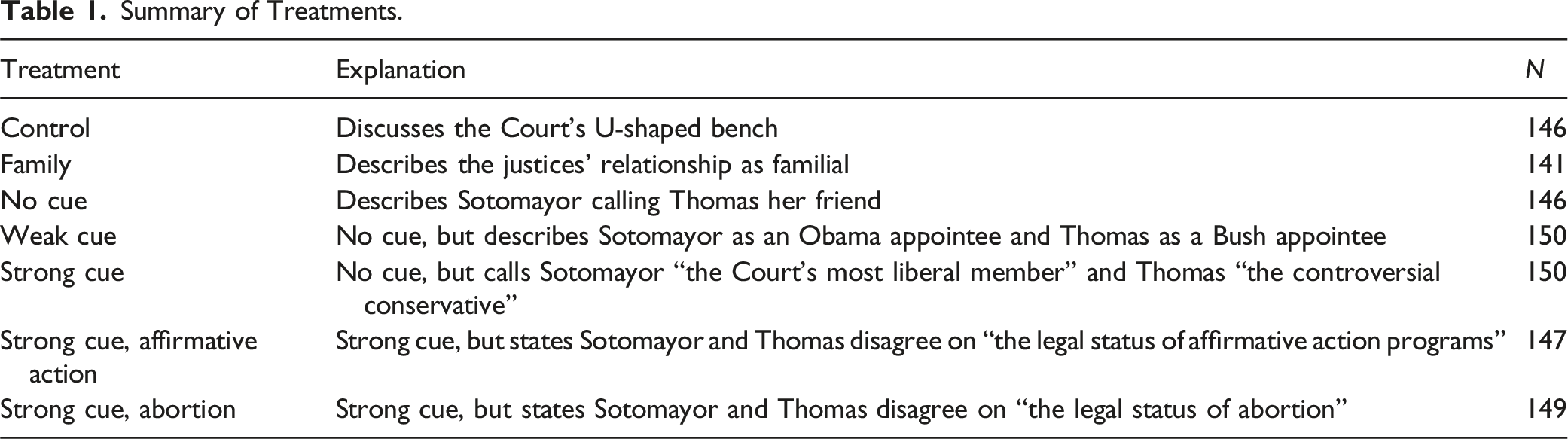
After reading the treatment vignettes, participants answered questions from five different batteries, each of which measure their feelings toward the Supreme Court. In any instance that an individual hears about the actions of the Supreme Court, there are (at least) four dimensions they might consider: (1) the case outcome, (2) the Court, (3) the law, and (4) the justices. Given that some of our treatments do not consider case outcomes, we focus our analysis on the other three. As such, we utilized five different sets of questions that speak to these dimensions: regarding the Court, we ask (1) the Court-curbing questions used in the Applied Legitimacy Index (Badas, 2019) and (2) questions about the politicization of the Supreme Court (Bartels & Johnston, 2020); regarding the law, we ask (3) questions about the role that laws play in a functioning government (Tyler, 2006); and regarding the justices, we ask word-association questions on how well (4) “good” words like “trustworthy” and (5) “bad” words like “partisan” apply to Supreme Court justices. 14 These final two are common in studies inquiring about support for judicial nominees (e.g., Kaslovsky et al., 2019), though apply equally to confirmed justices. 15
Summary of Dependent Variables.
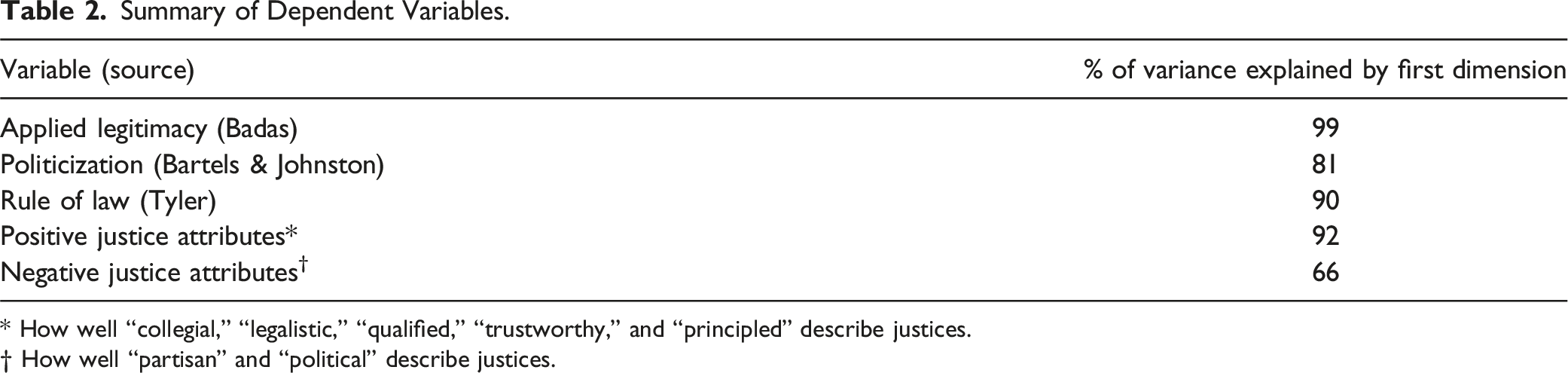
* How well “collegial,” “legalistic,” “qualified,” “trustworthy,” and “principled” describe justices.
† How well “partisan” and “political” describe justices.
Empirical Results
We present our results in three parts. First, we examine how a basic collegiality cue—reading about a justice referring to the Court as a “family”—affects people’s feelings toward the Supreme Court. We then discuss how knowledge of cross-aisle relationships modifies those feelings, focusing on the role that political cues play in response to these stories. As we outlined previously, we expect that learning about judicial collegiality separate from policy outcomes will increase positive feelings toward the Court. We end by examining cross-aisle friendship treatments in the context of disagreements between the friendly justices regarding abortion and affirmative action. Here, we expect to find that people care less about collegiality when presented with real policy outcomes.
Basic Collegiality Cue
We first consider a treatment that discusses broad collegiality across the Supreme Court justices.
18
Participants read the following excerpt: Recently, one of the justices on the U.S. Supreme Court was asked how members of the Court deal with disagreement and contentious political issues. The justice stated the following: “When you’re charged with working together for most of the reminder of your life, you have to create a relationship. The nine of us are now a family, and we’re a family with each of us our own burdens and our own obligations to others, our own families. But this is our work family, and it’s just as important as our personal family.”
Figure 1 shows the treatment effect, relative to that of the control group, for each of the five dependent variables listed across the y-axis.
19
Horizontal lines are 95% confidence intervals; where confidence intervals cross the dashed vertical line, the average treatment effect is not significant. For two of our five dependent variables, positive justice attributes and applied legitimacy, the treatment effect is statistically significant. At first blush, this might indicate that stories about collegiality only weakly influence views of the institution. But we also note there are null effects for negative justice attributes and perceived politicization, indicating that basic stories about judicial collegiality seem to boost positive evaluations of the Court and the justices, but do not appear to exacerbate negative perceptions of the justices or the institution they serve. This may be good news for the Court, as it suggests off-bench behavior can aid the Court’s image in the eyes of the mass public, at least when that information reaches the public in the most benign manner possible. Effect of the “family” treatment, relative to control, on dependent variables listed along vertical axis. Horizontal lines represent 95% confidence intervals.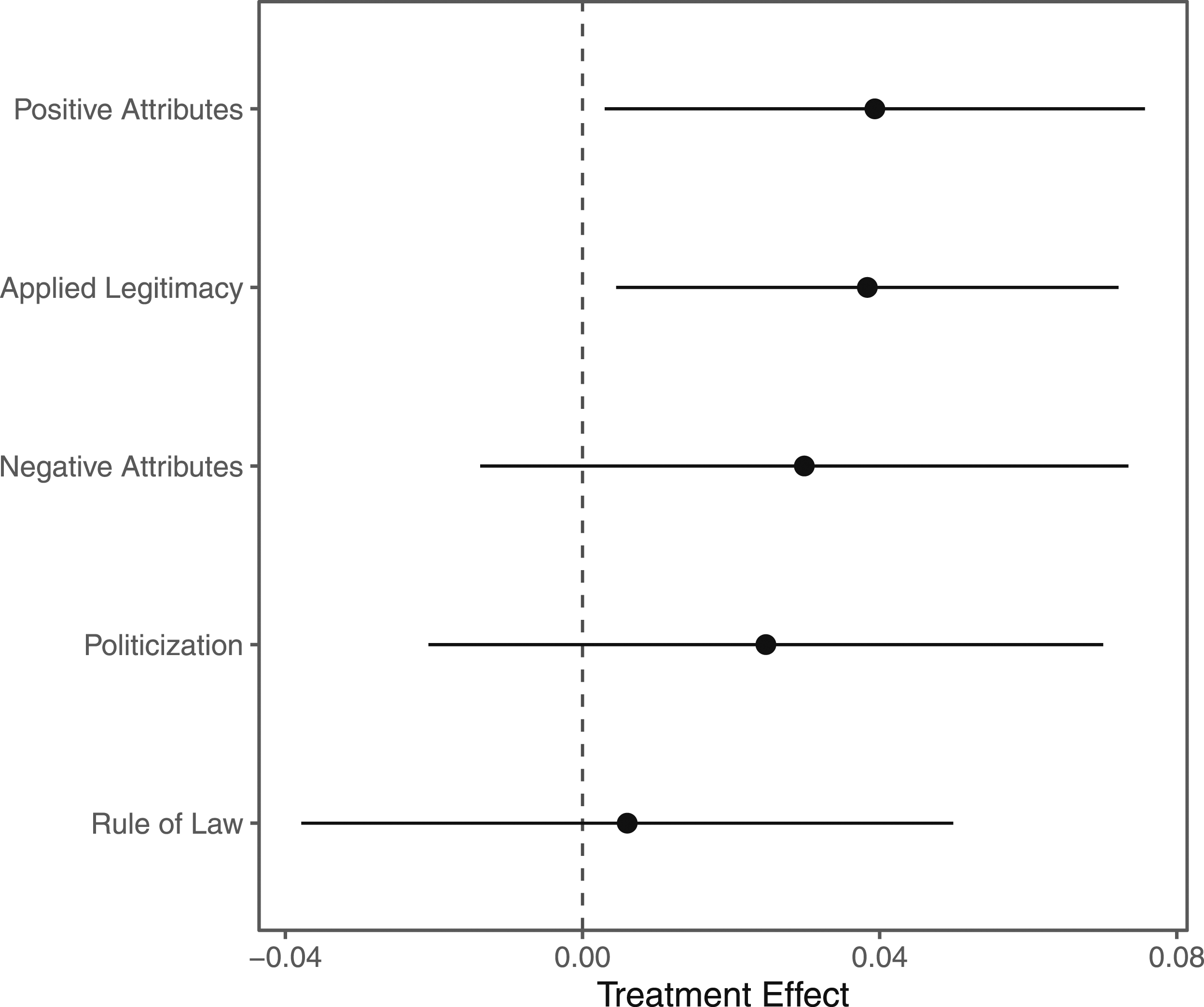
Friendship and Political Cues
While results from our analysis of the familial treatment suggests stories about collegiality can affect peoples attitudes toward the Court, part of our theory relates to “cross-aisle” friendships. Thus, in this next section, we incorporate explicit cues about the ideologies of the friendly justices. We consider three treatments that build upon the same basic story. Once again, participants read about a real quote from Justice Sotomayor (Deese, 2022): Recently, Supreme Court Justice Sonia Sotomayor gave a speech at Roosevelt University in Chicago. She was asked to discuss how she maintains relationships with justices with whom she disagrees on legal and political matters. During her response, she spoke fondly of Justice Clarence Thomas, stating: “I have disagreed more with him than any other justices…And yet I can tell you that I spend time with him, understanding that he is one of the few justices who knows practically everybody in our building. He cares about people.”
Figure 2 displays treatment effects for each dependent variable listed across the y-axis.
22
There are no statistically significant differences in feelings toward the Court between the control group and those in the no ideological cue (circles) and weak cue (triangles) groups. But participants who received the strong ideological cue (squares) expressed more positive views of the Court than did participants in the control group. The treatments effects are not universally positive, however. The cue appears to prompt participants to think of the justices as collegial, legalistic, and qualified while simultaneously reminding them the justices are partisan and political. This result is not entirely surprising, given Krewson’s (2023) finding that public appearances can increase positive and negative feelings about the Court. While we cannot state with certainty with these data, we suspect members of the mass public do not view collegiality and politicization as mutually exclusive; justices can be the best of friends and still engage in clear political decision making. Treatment effect, relative to control, on dependent variables listed along vertical axis. Horizontal lines represent 95% confidence intervals.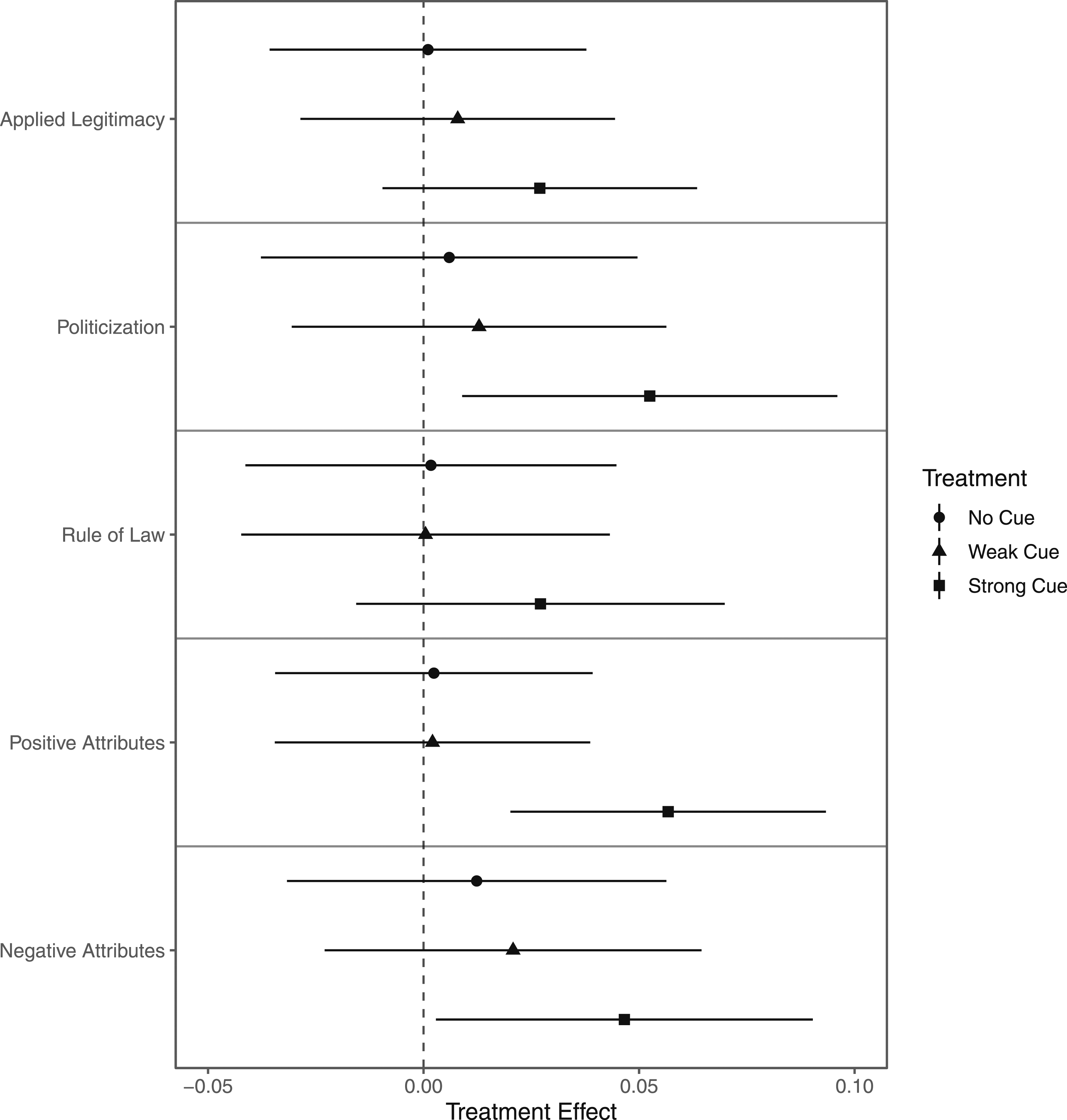
These results, combined with the findings presented in Figure 1, are a mixed bag. On the one hand, they indicate that not all stories about friendships on the bench influence attitudes toward the Court, particularly when the stories are about individual justices but provide little context about their political views. Notably, we find that while reading the Court is a family off the bench increases participants’ feelings of applied legitimacy, reading about individual justices’ friendships fails to do the same, which could suggest that divorcing individual justices from the broader Court affects the effectiveness of collegial cue (see also Boston et al., 2023). But, importantly, we should note such stories are rarely—if ever—presented without names and ideological context. And, importantly, news media tend to use frames that show divisions on the Court rather than similarities (Hitt & Searles, 2018). Consider, for example, that the media is mostly mum about conservative Justices Roberts and Kavanaugh spending time together at their country club, 23 but Scalia and Ginsburg’s “strange bedfellows” relationship, or even Scalia and Kagan’s hunting trips, received wide coverage. Members of the media seem to prefer the cross-aisle story angle, and our results suggest these types of stories actually do influence attitudes toward the Court.
Collegiality versus Policy
Having found that stories about judicial friendship—particularly those that obviously point to a cross-aisle relationship—can influence public attitudes about the Court, we finally consider the role case outcomes play in these otherwise-lighthearted stories. We wondered, do these stories still affect feelings toward the Court when the stories also remind readers about the policy outcomes at stake? We expect that any effect—positive or negative—of these stories will be largely attenuated by information about a case outcome, because preferences regarding outcomes outweigh other influences.
To address this question, we modified the strong cue treatment so that Justice Sotomayor explicitly mentions one of two policy areas where she and Justice Thomas disagree: abortion or affirmative action. The vignette now reads: Recently, Supreme Court Justice Sonia Sotomayor gave a speech at Roosevelt University in Chicago. She was asked to discuss how she maintains relationships with justices with whom she disagrees on legal and political matters. During her response, she spoke fondly of Justice Clarence Thomas, stating: “I have disagreed more with him than any other justices,
Figure 3 displays the treatment effect when controlling for ex ante policy support (the coefficient magnitudes for which are omitted in the figure). The left panel refers to participants who received the abortion treatment, and the right panel refers to participants who received the affirmative action treatment. Horizontal bars are 95% confidence intervals; where they cross the dashed vertical line, the coefficient estimate is not statistically significant. Treatment effects, controlling for ex ante policy support. Horizontal lines represent 95% confidence intervals.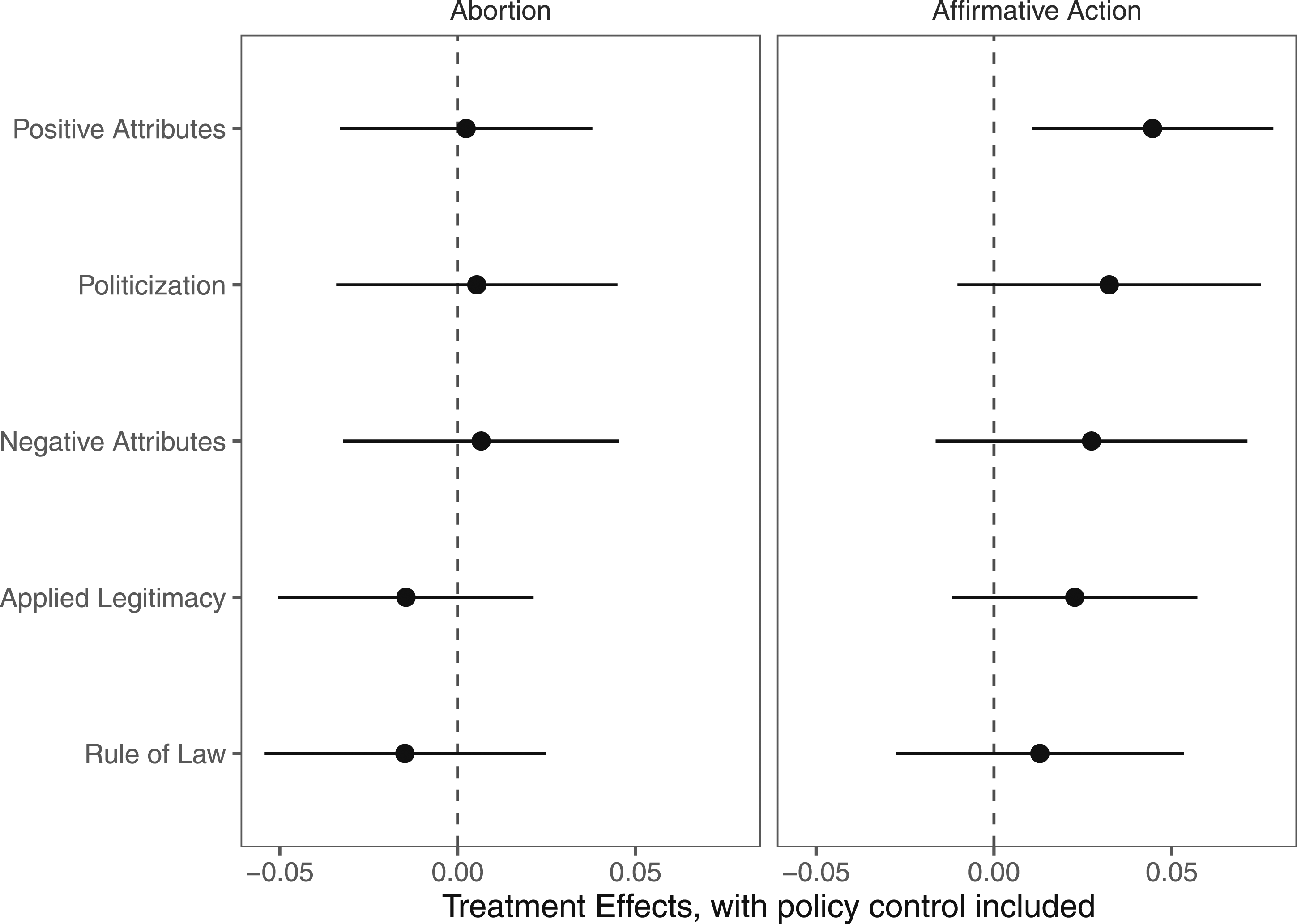
Save for a single average treatment effect estimate (for positive attributes in the affirmative action context), we find no statistically significant treatment effects when accounting for ex ante policy support. But all policy support estimates are significant. Put simply: when reminded of the issues over which these collegial justices disagree, stories of judicial friendship do not significantly increase feelings toward the Supreme Court. Recall that, as we showed in Figure 2, the strong cue—that is, the one that most clearly spelled out the friendly justices’ ideological differences—was associated with a significant treatment effect for several of our dependent variables, namely politicization and positive and negative attributes. But, as we show in Figure 3, those effects mostly disappear when we combined that strong cue with a reminder about the policies on which the justices disagree. As such, we believe this is fairly clear evidence that introducing the policy context minimizes any positive impact collegiality stories may have.
These results, like those above, are somewhat mixed. On the one hand, they fit with our expectations regarding the limited utility of collegiality stories, suggesting individuals prefer collegial politics, but not at the expense of policy (Harbridge et al., 2014). But, on the other hand, this treatment may not generalize to the types of stories individuals are exposed to. The stories about judicial friendship—which can typically be classified in the “fluff journalism” category—usually do not include decision content. Still, we believe it is worth probing both the utility and the limits of these stories.
Discussion
In this paper, we asked if public discussion of off-bench Supreme Court friendships, particularly between justices who disagree on legal and political issues, play any role in public evaluations of the judiciary. The justices enjoy talking about their interpersonal relationships when they appear in public (Glennon & Strother, 2019), and the media enjoy discussing their friendships, especially those that “cross the aisle.” These speeches, and their subsequent coverage, provide the justices with the opportunity to engage with the public and broadcast a message of collegiality in spite of their ideological differences, which can affect how people view the Court itself. Our research suggests such stories actually do influence public views of the institution, with strong cues of the cross-aisle collegiality making the biggest mark. But we also find these increases are only true when presented as part of “fluff” pieces; when the article also mentions the issues on which these collegial justices disagree, support in the face of collegiality drops off.
The Supreme Court has long enjoyed a shroud of secrecy, and by purpose and tradition has avoided putting forward robust public relations efforts (Zilis, 2015). To many members of the mass public, these secretive figures—whom the public can scarcely identify 25 —rule on the most important issues of the day from on high and then slink back to obscurity. On the rare occasion the media covers the Court’s work, they focus on the most controversial cases of the year (Collins & Cooper, 2012), and they typically present that information in the most divisive manner possible (Hitt & Searles, 2018). Because the Court often looks divided, it makes sense that information contrasting that view increases institutional positivity. After all, while disagreements born of animus may rub the public the wrong way, disagreements born from reasoned deliberation and collegial processes appear good and principled (Gibson & Caldeira, 2009a). While researchers have considered how the justices can use the language of the law off the bench to improve views of the Court (Glennon & Strother, 2019; Krewson, 2019), we consider if extra-legal off-bench behavior can do the same.
Our investigation is not without limitations. First, we use an opt-in, online convenience sample, which resulted in a sample that deviated from the general population in a multitude of ways. Importantly, our randomization was effective and there are no mean differences across demographic groups, which suggests our treatment groups looked similar. 26 Given the experimental nature of our study, such a sample works for our purposes because we are not particularly interested in estimating public opinion; for example, we do not examine the percentage of Americans that support the friendships under consideration here. Because such samples tend to share political characteristics with larger, more representative samples (Huff & Tingley, 2015) and typically uncover treatment effects well (Horton et al., 2011), we are comfortable with MTurk for this study. Nevertheless, we encourage replication using different treatments, samples, and even variables of interest.
We also recognize there are some scope limitations here. First, even though media accounts of these friendships are widespread, they may only reach those who are politically active and self-select into outlets that publish such stories. Thus, the effects of these stories in the real world may be limited to those already prone to support the Court, specifically the knowledgeable (Gibson & Caldeira, 2009b), those supportive of the rule of law (Tyler, 2006), and those able to make sense of the place of the judiciary in the broader political world (Armaly, 2020). Additionally, it is unclear how long these effects might last. If, as some argue, attitudes regarding the Supreme Court are a function of a running tally and one need not recall precisely why they (dis)like the institution (see, e.g., Armaly, 2018; Baird, 2001), we would expect these stories to matter in the long run. Any effect may recede quickly, however, especially if the Court reaches a disliked decision shortly after a friendship story is published.
Building on these limitations could offer a fruitful venue for new research in this area, and we encourage scholars to expand on our work and examine friendship and collegiality in many different ways. For example, when we consider the influence of policy context we only consider policies that are salient to many Americans. It is possible—likely, even—that less salient issues, like tax law, might not attenuate the effect of collegiality cues as readily as abortion and affirmative action do. We encourage further work to consider whether preference crystallization and salience matter. Additionally, we find treatment effects from exposure to only a single story; those who see multiple such stories over time—even incidentally—may exhibit stronger effects. Finally, scholars could investigate how shows of collegiality and friendship differ across other political institutions, as those institutions garner more media attention and play into the spotlight far more.
Supplemental Material
Supplemental Material - Friendship is Rare: The Influence of Off-Bench Friendships on Support for the U.S. Supreme Court
Supplemental Material for Friendship is Rare: The Influence of Off-Bench Friendships on Support for the U.S. Supreme Court by Miles T. Armaly and Jessica A. Schoenherr in American Politics Research
Footnotes
Declaration of Conflicting Interests
The author(s) declared no potential conflicts of interest with respect to the research, authorship, and/or publication of this article.
Funding
The author(s) received no financial support for the research, authorship, and/or publication of this article.

Supplemental Material
Supplemental material for this article is available online.
Notes
Author Biographies
References
Supplementary Material
Please find the following supplemental material available below.
For Open Access articles published under a Creative Commons License, all supplemental material carries the same license as the article it is associated with.
For non-Open Access articles published, all supplemental material carries a non-exclusive license, and permission requests for re-use of supplemental material or any part of supplemental material shall be sent directly to the copyright owner as specified in the copyright notice associated with the article.
