




Abstract
Research shows that Americans have a generally poor understanding of welfare programs. Providing information about such programs has the potential to shape public preferences, but we argue that such effects may differ based on the content of the information and its correspondence with existing ideological beliefs. Using original survey experiments embedded in the Cooperative Congressional Election Study and through Amazon’s Mechanical Turk, we analyze how the relationship of ideology with welfare programs varies in response to different types of negative information about the program, and different descriptions of policy design. We find that information about inadequate benefits has a larger negative impact on welfare support for liberals than for conservatives but that both liberals and conservatives may be equally concerned about fraud and inefficiency. Other information about policy design has the expected conditional effect: state (as opposed to federal) funding and short time limits for benefits are more appealing to conservatives than liberals.
It is well-established that few Americans have a detailed understanding of public policies. Scholars have particularly noted citizens’ poor understanding of the American welfare state (Kuklinski & Quirk, 2000; Soss & Schram, 2007), including “hidden” or “submerged” welfare programs that provide aid in a complex or indirect manner (Howard, 1997; Mettler, 2011). In the absence of detailed information about such programs, many people form judgments about them based on partisan cues (Cohen, 2003; Mettler et al., 2023) and symbolic considerations, such as the perceived “deservingness” of those who benefit (Gilens, 1999; Mårtensson et al., 2023; Petersen, 2012; Schneider & Ingram, 1993; Soss et al., 2011) or assumptions about their race and ethnicity (Garand et al., 2017; Gilens, 1999; Lieberman, 2011). This naturally leads to the question of whether providing Americans with factual information about these programs can shift their beliefs (Callaghan & Jacobs, 2017; Guardino & Mettler, 2020; Kuklinski & Quirk, 2000). We argue that while information can shift beliefs about social welfare policy, the effect of information depends on the individual’s underlying beliefs. The same set of facts is likely to hold a different meaning for a liberal egalitarian than it would for a conservative individualist, for example.
In this study, we present the results of paired survey experiments from a high-quality nationally representative survey, as well as a conjoint experiment using a convenience sample, testing the effect of two types of negative information about social welfare programs: information about fraud and abuse (a particular concern of conservatives) and information about the inadequacy of the program to lift people out of poverty (which should be especially disconcerting to liberals). On balance, the results of these experiments support the expectation that liberals are more responsive than conservatives to information about the inadequacy of social welfare programs, but not that conservatives are more responsive to information about fraud and inefficiency. Indeed, liberals appear to be at least as concerned as conservatives about the latter issues. Conservatives did behave as expected in response to information about program design, however – describing a program as being funded solely by state government or having a short time limit for the receipt of benefits boosted conservatives’ support more than that of liberals.
Our findings have important implications for the research on public opinion toward welfare programs. First, previous studies in this field often neglect the effects of vulnerabilities of welfare programs on citizens’ welfare attitudes, despite the considerable problems of the American welfare state (Andrade et al., 2019; Headworth, 2021; Kim & Maroulis, 2018). In this study, we conceptualize these problems as falling into two categories: fraud and inefficiency on the one hand, and inadequacy on the other. Our experimental results demonstrate that information about these problems can indeed move public opinion, but in different ways for people with different sets of beliefs. These findings also buttress the argument that vulnerabilities of welfare programs, such as welfare fraud and abuse, are instrumental in undermining political support for key social welfare programs (Kohler-Hausmann, 2015). Our study also contributes to the growing literature on the effects of policy design (e.g., policy delivery mechanisms and work requirements) on public attitudes toward welfare policies (Ashok & Huber, 2020; Haselswerdt, 2022). This research helps to promote more comprehensive thinking and exploration of the effects of policy problems and design elements on the politics of the welfare state.
Public Opinion and Social Welfare: The Roles of Ideology and Information
In our theoretical framework, political ideology plays a fundamental role in the formation of initial opinions when citizens consider a welfare program. In other words, when citizens learn of the function and basic goal of a welfare policy, ideology helps them make their first judgment on the policy. This is supported by extensive research finding that ideologies or values are central to public opinion toward such programs (Blekesaune & Quadagno, 2003; Feldman & Steenbergen, 2001). In general, the political values or ideologies relevant to social welfare can be divided into liberalism and conservatism. Liberals or those with “left-wing” ideology hold egalitarian and humanitarian values and usually support welfare programs, while conservatives or those with “right-wing” ideology hold individualistic values and tend to oppose welfare policies (Andreß & Heien, 2001; Blekesaune & Quadagno, 2003; Feldman & Steenbergen, 2001; Feldman & Zaller, 1992; Gilens, 1999).
While ideology shapes initial judgments, providing additional information about policies may also affect people’s opinions toward these policies (Campbell, 2011), since most citizens lack a detailed understanding of how social welfare policies work. Soss and Schram (2007, p. 123) find that public perceptions of welfare have only the “loosest relation” to the programs’ actual features, and many citizens do not have “a firm cognitive grip on the material nature of welfare programs.” Public understanding is thought to be even weaker with respect to the “hidden welfare state” (Howard, 1997) or “submerged state” (Mettler, 2011), which includes policies like tax expenditures that provide government aid indirectly. The subtlety and complexity of these policies obscure their operational logics and social effects, making them especially difficult for general audiences to grasp (Guardino & Mettler, 2020).
This lack of understanding suggests that providing citizens with relevant policy information can help them form judgments about social welfare policies. New information can supplement their general political knowledge, facilitate issue comprehension, shape cognition, and influence opinion (Barabas & Jerit, 2009; Feldman et al., 2015; Jerit et al., 2006; Price & Zaller, 1993). Previous research shows that specific information about racial and ethnic identities of welfare recipients (Callaghan & Olson, 2017; Peffley et al., 1997) and policy design elements, such as policy delivery mechanisms (Ashok & Huber, 2020; Ellis & Faricy, 2020; Faricy & Ellis, 2014; Haselswerdt & Bartels, 2015), work requirements (Haselswerdt, 2022), inclusiveness or universalism (Jordan, 2013), and distributional outcomes or benefits (Cook et al., 2010; Faricy & Ellis, 2014; Guardino & Mettler, 2020) can affect citizens’ attitudes toward welfare policies. Other research shows that unfavorable or negative information has a greater impact on citizens’ impressions and political perception than does favorable or positive information, across a wide variety of situations (Ronis & Lipinski, 1985; Soroka, 2006), suggesting that information on a policy’s vulnerabilities is likely to have a bigger impact than information on its strengths.
In light of this, it is surprising that existing work on social welfare attitudes has given relatively little attention to policy flaws, especially since the American welfare state suffers from considerable problems. Briefly, these problems can be roughly classified into two categories: inefficiency and fraud on the one hand, and inadequacy on the other. According to the White House Office of Management and Budget (OMB 1 ), in 2021, improper welfare payments, including welfare fraud and abuse, were estimated to be 15.2% (more than $160 billion) of all federal welfare payments. This rate varies widely for specific programs, from 9.3% for Temporary Assistance for Needy Families (TANF) in 2008 to 15.6% for Medicaid and 31.6% for the Earned Income Tax Credit (EITC) in 2022 (Headworth, 2021; Kim & Maroulis, 2018; Office of Management and Budget, 2023). Notably, the latter estimate does not subtract overpayments recovered by the Internal Revenue Service (IRS), a recent and controversial measurement decision by OMB (Greenstein et al., 2019). Prior to this change, improper payment estimates for EITC hovered around 25%, still considerably higher than traditional social welfare programs like TANF.
In addition, due to stingy benefits, administrative burdens, social stigma, low benefit take-up, and perverse incentives to keep earnings and savings low (income and asset limits), key welfare programs like TANF have not been effective in helping impoverished families and reducing income inequality (including the racial wealth gap) in recent years (Andrade et al., 2019; Hamad et al., 2022; Herd & Moynihan, 2018; Michelmore & Lopoo, 2021; Wagmiller et al., 2020). Indeed, the very stringency and strictness that contributes to TANF’s lower-than-average improper payment rate limits the reach of the policy (e.g., Wang, 2021). Notably, the EITC performs better on some of these dimensions: the administrative burden and stigma of the program (operated through the tax code rather than a social welfare bureaucracy) are relatively low, and a gradual benefit phase-out mitigates disincentives to increase earnings. As a result, the credit succeeds in lifting millions of low-income families out of poverty (Marr et al., 2015). On the other hand, the EITC does not help poor families with no earned income, and waiting to receive benefits until tax time, particularly since a 2015 policy change slowed the processing of EITC claims, negatively impacts beneficiaries’ well-being (Kondratjeva et al., 2022).
Taken together, the problems of fraud and inadequacy result in a welfare state that distributes resources both too generously and not generously enough. Information about these issues has the potential to affect the way Americans think about these programs.
Crucially, however, we should not expect the effect of any piece of policy information to be the same for everyone. A person’s ideology shapes not only their initial judgments of welfare programs but their receptivity to additional information (Zaller, 1992). For example, information about the inadequacy of a program for helping people in need is more likely to depress support among liberals than conservatives, since it speaks more directly to the policy concerns of the former group. Conversely, information about fraud and abuse in a social welfare program should have the largest negative impact for conservatives, while liberals are more likely to dismiss such concerns as conservative talking points.
Political ideology may also affect the formation of divergent public opinion toward welfare programs when citizens receive information about the design of welfare programs. Provisions like time limits or work requirements likely appeal to conservatives, who usually prefer welfare programs intended to get people working again and oppose open-ended benefits. Conservatives are also wary of the federal government, and thus likely to be more favorable toward state-funded social welfare programs, whereas liberals are more comfortable with federal programs (Feldman & Zaller, 1992; Grafton & Permaloff, 2005; Weaver et al., 1995).
Research Design and Data
Our study uses two survey experiments 2 that test the effects of negative information or criticisms of social welfare programs on respondent support. Both studies randomize the presentation of information about flaws or vulnerabilities in social welfare policies and gauge the impact of this information on policy support among ideological subgroups. Since our focus in the present study is on negative information per se, these experiments do not test the impact of information about positive aspects of policy, or provide context that might mitigate negativity. They resemble fact-based political attacks on these programs from opposing political actors rather than balanced and complete assessments of the programs. As such, these experiments can be viewed as “most likely cases” for the impact of negative information on welfare attitudes.
The first experiment was embedded in a module on the 2020 Cooperative Congressional Election Study (CCES) (conducted September 29 – November 2, 2020), a nationally representative survey run by the survey firm YouGov. The full CCES includes 61,000 respondents, all of whom answer a “Common Content” battery of demographic and political questions that make up half of the survey. The other half is made up of questions written by university-based teams that are presented to randomly selected modules of 1000 respondents each. Both the Common Content and module questions are distributed between pre-election and post-election surveys fielded to the same respondents. The questions for the present study were fielded in the pre-election survey.
Experimental Design: Two Treatment Groups with Different Descriptions of Each Type of Problems of the Two Policies.
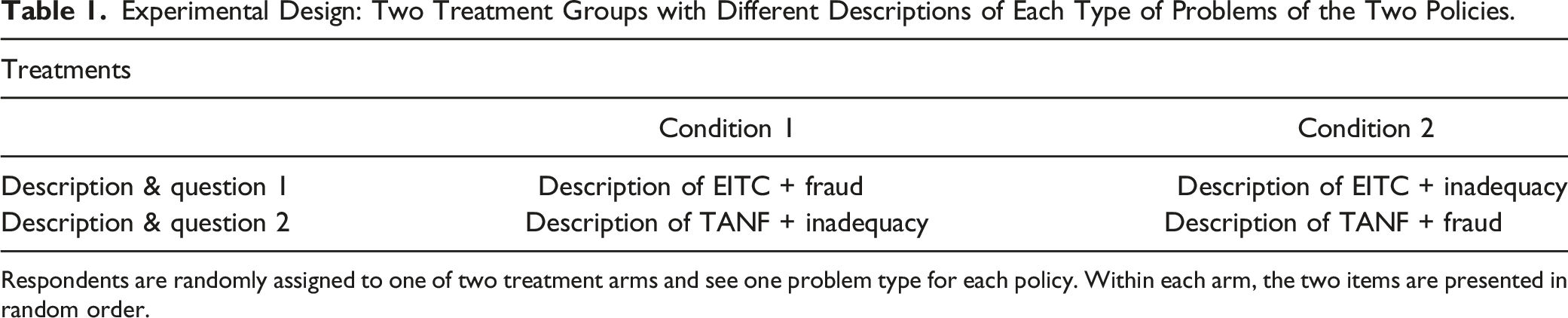
Respondents are randomly assigned to one of two treatment arms and see one problem type for each policy. Within each arm, the two items are presented in random order.
After each description, subjects were asked to give their opinions of the policy using a five-point scale ranging from “oppose strongly” to “support strongly,” with “neither support nor oppose” as the midpoint. Responses to these questions form the dependent variables for our analyses, most of which use ordered logit models.
Other variables for this study are drawn from the Common Content questionnaire. These include ideological self-placement (five-point scale), political knowledge (an index constructed from eight factual knowledge questions about the partisanship of elected officials and federal and state government institutions), party identification (seven-point scale), age, sex, education, race, and annual household income. All of these covariates were measured prior to the experiment on the pre-election survey.
While the CCES provides a high-quality nationally representative sample, the limited space and sample size limit the leverage we have to test our hypotheses. To explore the effects of more types and combinations of information, we also conducted a conjoint survey experiment on Mturk with 2177 Amazon Mechanical Turk workers from September 6 to October 12, 2021. The conjoint experiment is a survey-experimental technique that allows researchers to obtain reliable measures of multidimensional preferences and estimate the causal effects of multiple attributes on hypothetical choices or evaluations. When making choices among multiple options, citizens normally will not only rely on their preferences on one or two dimensions, but also make trade-offs across dimensions (Bansak et al., 2021). This method allows us to analyze how attitudes toward welfare policies vary based on multiple dimensions such as policy problems, program cost, and program participant population, and if so, which dimensions are substantively and statistically significant.
An Example Conjoint Table.
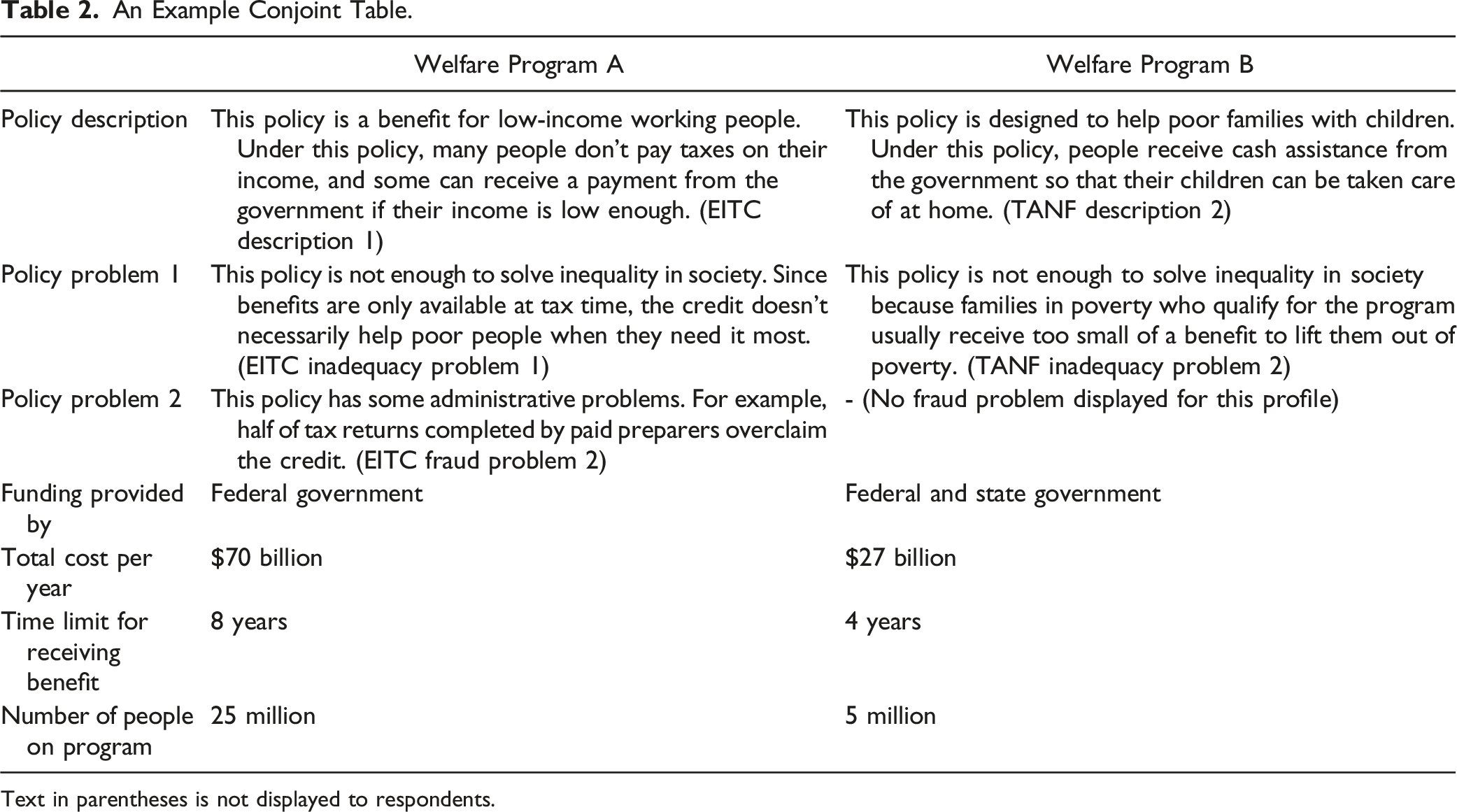
Text in parentheses is not displayed to respondents.
The levels of each attribute are randomly varied, with randomization occurring independently across all respondents, tables, and attributes, aside from a constraint that the EITC policy problems are not displayed for TANF and vice versa. Each subject was presented with eight randomly generated comparison tables on different screens, for a total of sixteen hypothetical programs. We use clustered standard errors at the participant level to correct for within-respondent correlation across observations. To provide respondents with a smooth experience, we fix the order in which attributes are presented across all tables for each respondent, although we randomize the order across respondents.
After showing each comparison table, we ask participants two questions to measure their attitudes about the programs presented: a seven-point Likert scale of program support and a forced choice between the two profiles. We randomize the order of these two questions at the respondent level.
Our conjoint design has several advantages. First, unlike the CCES experiment, it includes a true control condition with no policy vulnerabilities. Second, we are able to test multiple policy problem treatments in each category for each policy type, reducing the chances that observed effects are idiosyncratic to the wording of a particular treatment. We are also able to incorporate tests of our hypotheses on funding source and benefit time limits. Lastly, randomly varying other program characteristics (like program cost and the size of the beneficiary population) improves the generalizability of these results to welfare programs beyond TANF and EITC.
The conjoint experiment seeks to determine, first, what types of attributes increase or decrease a welfare program’s support on average when the other welfare program attributes included in the research design vary independently, and second, whether the effects of these attributes depend on respondents’ political ideologies. These questions can be answered by estimating conditional average marginal component effects (AMCEs), which are the average effects of the attributes conditional on survey participants’ measured characteristics (political ideology in this case) (Bansak et al., 2022).
Since attentiveness is an issue with MTurk respondents, we include the battery of screener questions recommended by Berinsky et al. (2021) as pre-treatment attention checks to identify inattentive respondents. Per our pre-analysis plan, the results we present and discuss in the main text include all respondents, though we present results that exclude the respondents that failed to answer at least two attention check questions correctly in Tables G.2 and G.4 in the appendix. The findings are generally similar, though as expected the experimental effects are somewhat stronger for the more attentive subset of respondents.
Hypotheses
From the above theoretical arguments and framework, we put forward a series of testable hypotheses on the effects of information, ideology, and policy design on individuals’ attitudes towards social welfare programs. These hypotheses were preregistered in the Open Science Framework Registry prior to the receipt of the data. 4
Information about inadequate benefits will have a larger negative impact on liberals’ support than on conservatives’ support.
Information about inefficiencies and fraud will have a larger negative impact on conservatives’ support than on liberals’ support. These hypotheses are consistent with our argument that political ideologies matter not just to initial judgments about policy but to receptivity to new policy information. As the deep foundation of public opinion formation, ideology serves as a lens through which individuals perceive information about policy. For the CCES study, which lacks a control condition of no information, we cannot test H1 and H2 in isolation, so we test a modified version of both:
Information about inadequate benefits will have a larger negative impact on liberals’ support than conservatives’ support relative to information about inefficiencies and fraud.
5
The “ideological lens” pattern should also apply to other policy characteristics, such as their funding sources and limitations on benefits. Since conservatives are usually uncomfortable with a large federal government and with open-ended public assistance, whereas liberals are more comfortable with both, we expect that:
Describing a program as being funded by state (as opposed to federal) government will have a larger positive impact on conservatives’ support than on liberals’ support.
Describing a program as having a time limit for receiving benefits (especially a shorter time limit) will have a larger positive impact on conservatives’ support than on liberals’ support. The CCES experiment provides tests of Hypotheses 1 and 2, while the conjoint experiment tests all four hypotheses.
Results
CCES Experiment
Mean Support for Social Welfare Policies Across Treatment Conditions.
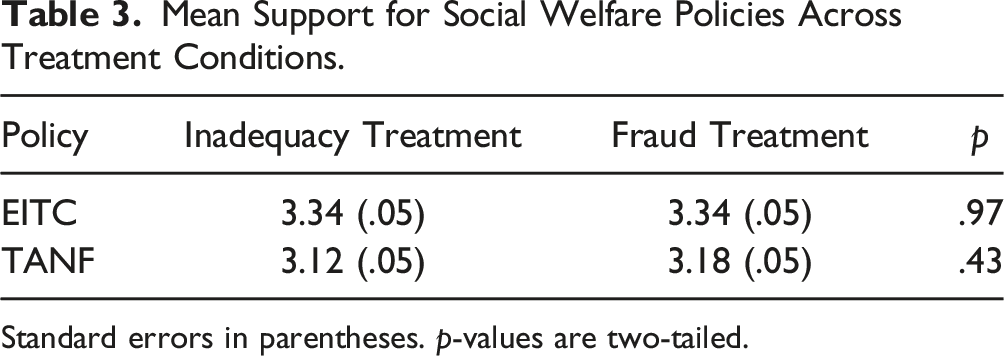
Standard errors in parentheses.
Our expectation is that this surface similarity across the treatment groups masks ideological differences in response to different types of information. We explore this possibility with ordered logit models of policy support, with treatment indicators and their interactions with respondent ideology as the main explanatory variables. Figure 1 presents the results of these analyses graphically, per the advice of Brambor et al. (2006).
6
For the EITC experiment, we see the pattern predicted by the combined version of H1 and H2: the fraud treatment had a larger negative impact among conservatives relative to the inadequacy treatment than among liberals. Conversely, the inadequacy treatment had a considerable dampening effect on liberals’ support relative to the fraud treatment. The interaction term is statistically significant both with and without control variables ( Predicted probabilities of strong policy support across treatment groups and respondent ideology. Predictions and 95% confidence intervals generated from ordered logit models with control variables.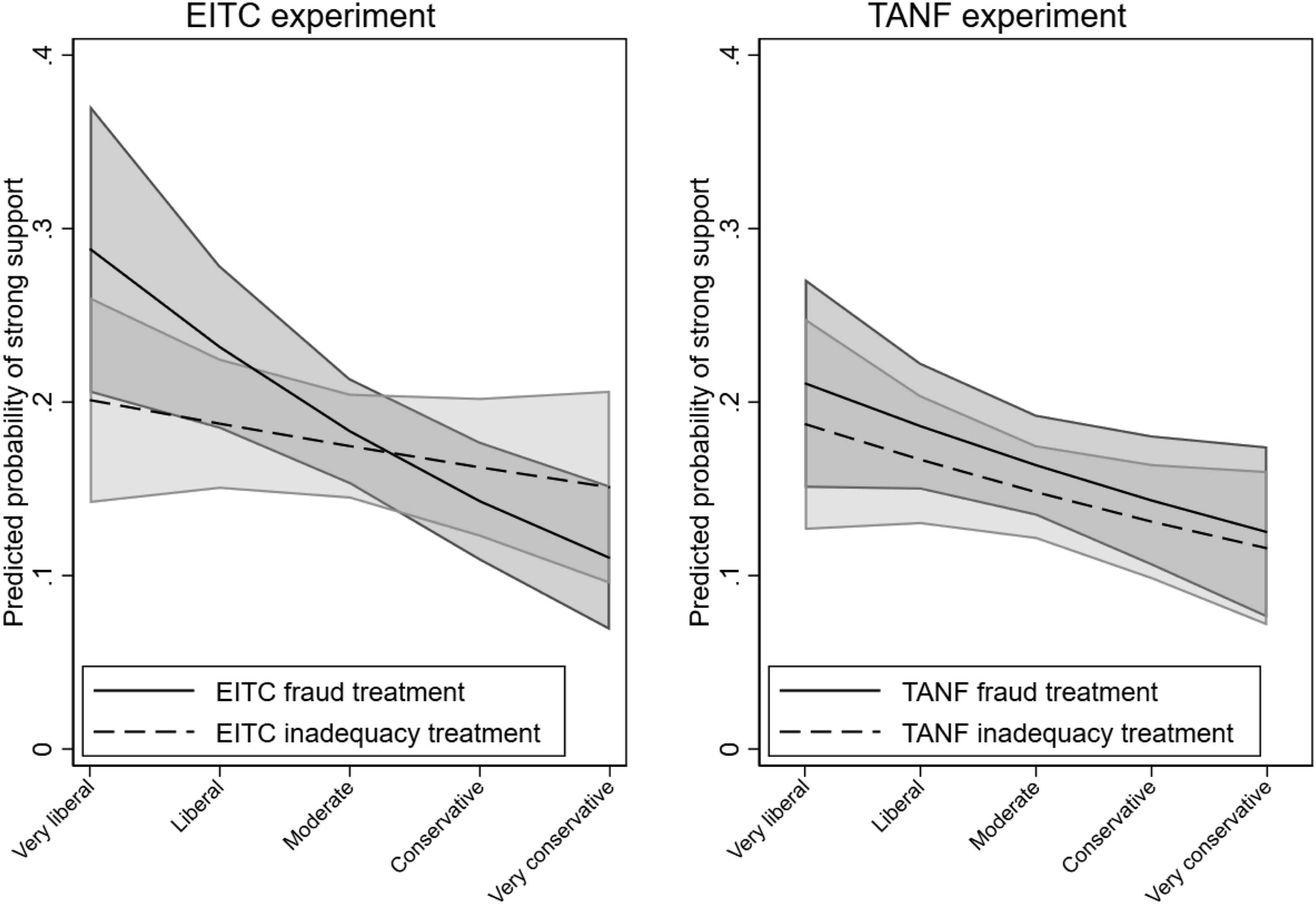
MTurk Conjoint Experiment
We now turn to our conjoint experiment, which allows us to test a greater variety of informational treatments, and to test our hypotheses about policy design. The results are summarized in Figure 2, which displays the AMCEs with 90% confidence intervals for all levels and attributes for liberal and conservative respondents,
8
using forced program choice as the dependent variable. The results support Hypothesis 1: information about the inadequacy of both types of social welfare policies had a more pronounced negative effect on liberals’ support than that of conservatives, though it is notable that these treatments also negatively affected conservatives’ support. To formally test this hypothesis, we follow the procedure recommended by Leeper et al. (2020), running regressions of forced program choice and program support on the four inadequacy problem treatment indicators, a dummy variable identifying conservatives, and interactions of this dummy with each of the treatments (or attribute levels), with ideologically moderate respondents excluded. We then conducted omnibus F-tests on the interaction terms. The interaction terms were jointly significant in each regression ( Conjoint experiment forced choice results by ideological group (with all respondents and 90% confidence intervals).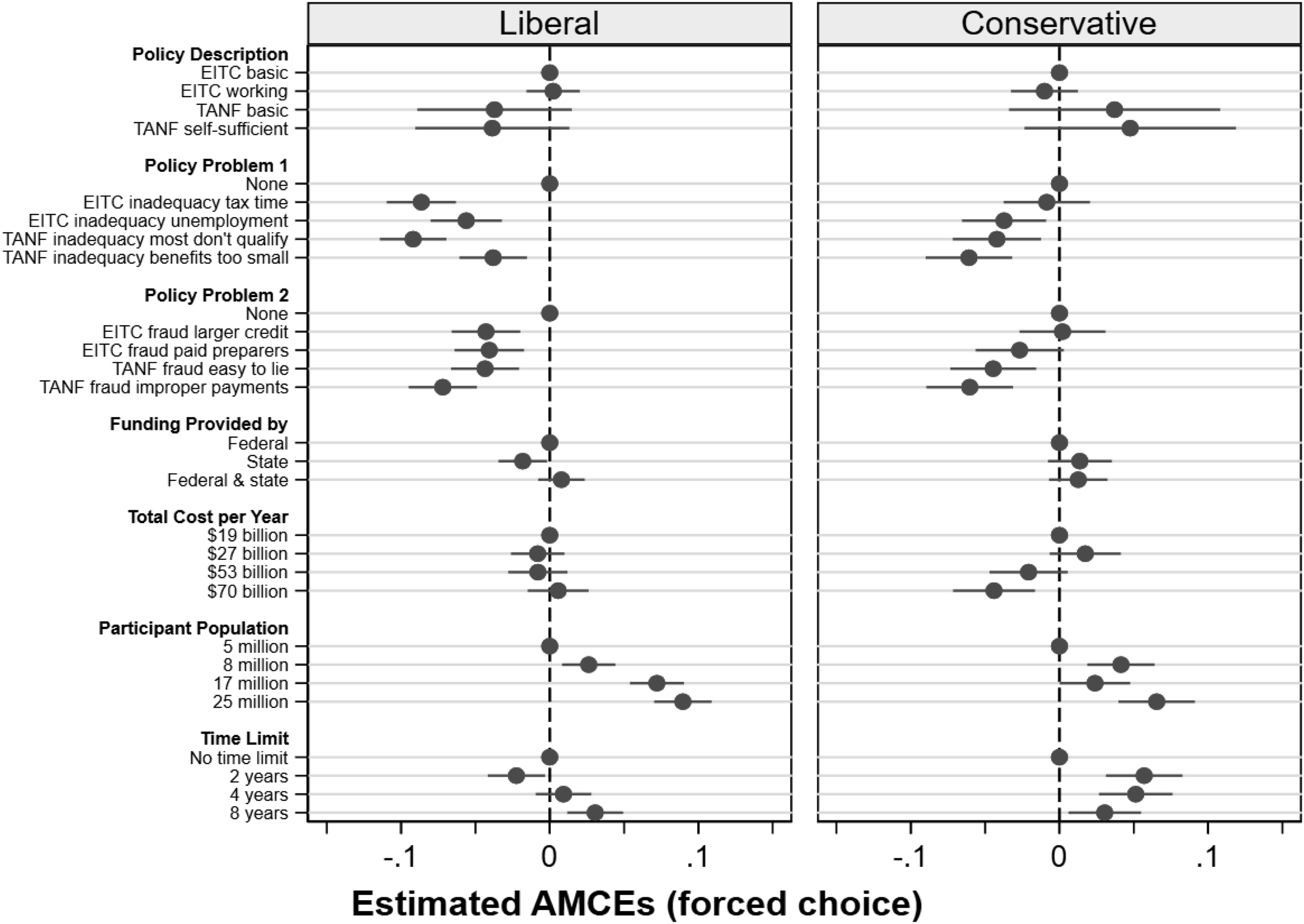
For Hypothesis 2, though, the findings suggest that the fraud treatments had pronounced negative effects on policy support for liberals as well as conservatives, with little evidence of differences in effects between the two groups. Recall that while the CCES experiment included no true control group, meaning that we could only compare support in the fraud condition to support in the inadequacy condition, here the baseline of “none” for each policy problem attribute allows for a non-zero-sum comparison. In this design, liberals show a surprising level of concern about fraud and abuse in both types of welfare programs. In fact, while the EITC “larger credit” treatment had no effect for conservatives, it had a significant negative effect for liberals. In the omnibus F-tests for this hypothesis, the interaction terms are jointly statistically significant in the wrong direction for both dependent variables (
The results support Hypotheses 3 and 4, however: both state funding and time limits (especially a short time limit of two years) are more appealing to conservatives than liberals. To test H3, we ran regressions of the dependent variables on an indicator of the state funding level (setting “federal” and “federal and state” as the excluded category), an indicator for conservative respondents (dropping moderates so liberals are the excluded category), and an interaction of the two. The interaction term is statistically significant in both regressions (
Adjustments for Multiple Hypothesis Tests
Since each study tests multiple hypotheses across two dependent variables, there is the potential that some statistically significant findings may emerge purely by chance. To account for this, we use the Benjamini-Hochberg procedure (Benjamini & Hochberg, 1995) for adjusting for multiple hypothesis tests with a false discovery rate of 10% for each study, as specified in our preregistration.
9
Details on the hypothesis tests and adjustments can be found in Appendix H. Adjustments do not change our conclusions about any of the hypothesis tests for the CCES study (the combined version of H1 and H2 is supported in the EITC experiment, while other results remain insignificant, see Table H.3). For the MTurk study (Table H.4), the significant findings for H1 (on inadequacy) and H3 (on state funding) are robust to adjustment for both dependent variables, as is the result for H4 (on time limits) with the forced choice dependent variable. The initially significant
Conclusion
This study provides experimental evidence that citizens’ ideologies shape their response to information about social welfare policies. Specifically, we found that information about the inadequacy of social welfare programs to solve problems of poverty and inequality was more likely to depress support for the program among liberals than conservatives. This hypothesis received partial support in the traditional CCES experiment and strong support in the MTurk conjoint experiment. We also expected to find that information about fraud and abuse would be more salient to conservatives than liberals, but found no support for this hypothesis. In fact, the findings of the conjoint study suggest that liberals are surprisingly similar to conservatives in their concern about fraud and abuse in social welfare programs, a pattern that scholars of social welfare should explore in future studies. We also found that conservatives are less comfortable with federally funded programs and with open-ended public assistance than liberals, as we expected, though support for the latter is mixed across the two dependent variables.
Our findings of heterogeneous ideological effects help to reconcile two findings from the literature that seem to be in tension: Americans know little about social welfare programs (Mettler, 2011; Soss & Schram, 2007), yet their beliefs about them are nonetheless difficult to change (Kuklinski & Quirk, 2000). Our results suggest that these beliefs may be malleable in response to new information, but in a limited sense: the new information must speak to concerns relevant to a person’s existing beliefs. Still, our many null or unexpected findings (including for additional hypotheses discussed only in Appendix H) indicate that these patterns are not necessarily predictable. Some results, particularly the aforementioned finding that fraud is a major concern for liberals, suggest that it may be a mistake to take for granted that a self-reported ideological position corresponds to a particular policy preference. This lends credence to the distinction between “operational” and “symbolic” ideology that scholars in the ideology literature have identified (Claassen et al., 2015; Ellis & Stimson, 2012; Grossmann & Hopkins, 2016, pp. 14, 19). It is also an important reminder that the relationship of ideology with specific policy opinions should be tested rather than assumed.
Our findings point to several directions for future research. In general, they suggest that scholars should incorporate the concept of policy vulnerability into their research designs, but do so in a way that takes into account how people of different ideological predispositions might view those vulnerabilities. More specifically, future work should explore the types of information or considerations that dampen support for social welfare programs among liberals, the core constituency for such programs, but one that is rarely the central focus of research on the politics of welfare. Our findings suggest that liberals are less supportive of programs that do a poor job of helping people, but also that they are surprisingly concerned about beneficiaries cheating the system, much like conservatives. These future studies should also seek to move beyond our admittedly narrow focus on negative information, allowing for the possibility that positive or contextual information may dampen or eliminate the negative effects we document here. For example, information about the administrative efficiency of a program like the EITC may serve to mitigate the negative effect of information about the program’s drawbacks. Additionally, in considering the politics of policy vulnerabilities, future work should consider the role of information sources. While we show divergent effects for different ideological subgroups when messages are presented out of context, citizens in the real world are likely to encounter such information in communications from political elites or organizations or in reporting from media outlets. In these cases, an individual’s level of trust in the source is likely to play an important role in determining if and how they incorporate the information into their beliefs. Lastly, while we explore the impacts of several different forms of information and policy design elements in the present study, there are obviously many other avenues for future research in this vein, including administrative burden (Keiser & Miller, 2020), targeting versus universalism (Gugushvili & Van Oorschot, 2020), in-kind versus cash benefits (Liscow & Pershing, 2022), and more.
Supplemental Material
Supplemental Material - Ideology, Information, and Social Welfare Preferences
Supplemental Material for Ideology, Information, and Social Welfare Preferences by Hang Qi, and Jake Haselswerdt in American Politics Research.
Footnotes
Acknowledgements
The authors would like to thank Katherine McCabe, seminar participants at the 2021 Midwest Political Science Association annual conference, the editor, and anonymous reviewers for constructive comments and advice.
Declaration of Conflicting Interests
The author(s) declared no potential conflicts of interest with respect to the research, authorship, and/or publication of this article.
Funding
The author(s) disclosed receipt of the following financial support for the research, authorship, and/or publication of this article: This work was supported by Kinder Institute on Constitutional Democracy at University of Missouri, Columbia, and Harry S Truman School of Government and Public Affairs at University of Missouri, Columbia.

Supplemental Material
Supplemental material for this article is available online.
Notes
References
Supplementary Material
Please find the following supplemental material available below.
For Open Access articles published under a Creative Commons License, all supplemental material carries the same license as the article it is associated with.
For non-Open Access articles published, all supplemental material carries a non-exclusive license, and permission requests for re-use of supplemental material or any part of supplemental material shall be sent directly to the copyright owner as specified in the copyright notice associated with the article.
