




Abstract
Party realignment is occurring along the lines of education in the United States. As college-educated voters increasingly align with the Democratic Party, it is necessary to revisit the partisan effect of turnout. We predict that, since 2016, the Democratic Party no longer benefits from higher turnout. Using validated voter turnout from the Cooperative Election Study (CES), we simulate election results across turnout rates for the 2010, 2012, 2014, 2016, 2018, and 2020 elections. Our findings show that increases in turnout greatly benefit the Democratic Party in the pre-Trump era. However, this pattern has drastically changed. In 2016, 2018, and 2020, the Democratic Party sees a much smaller gain in vote share as simulated turnout increases, but also a large vote share advantage when voter turnout is extremely low. These results indicate that continued party realignment along the lines of education could lead to a persistent reversal in the expected partisan effect of turnout—where Democrats perform better in low-turnout local or primary elections and Republicans perform better in high-turnout general elections.
Consolidated democracies witnessed partisan realignments along the lines of socioeconomic status over the last decades (Dalton, 2018). In the US, Donald Trump has accelerated the transition of low-socioeconomic status voters from the Democratic Party to the Republican Party (Kitschelt & Rehm, 2019). Specifically, less-educated whites are leading the abandonment of partisan cleavages established in the New Deal era. During the 2016 election, many spectators and analysts noted that Trump’s surge was strongest among less-educated Americans. 1 Based on a study of validated voters from the Pew Research Center, Trump earned more than 60% of the white, non-college votes in the 2016 and 2020 general elections. 2
Concomitantly, support among college-educated voters for the Democratic Party has increased. As Figure 1 depicts, the Republican Party was composed of more college educated identifiers than the Democratic Party from 1980 to 2012.
3
In 2016, both parties had approximately the same share of identifiers with a college degree, and, by 2020, the Democratic Party had an eight-point advantage. The Republican Party has witnessed a decline in the percent of college-educated identifiers despite a continual increase in college graduates among the electorate. These trends suggest that education plays a crucial role in the recent realignment observed in American politics. Education is also a strong predictor of political participation: college graduates are more likely to participate than citizens who do not have a college degree (Mayer, 2011). Yet, how this new cleavage affects the relationship between turnout and partisan vote share remains unexplored. In this paper, we fill this gap. Percent of partisans with a college degree, 1980–2020. Source: American National election Studies (ANES).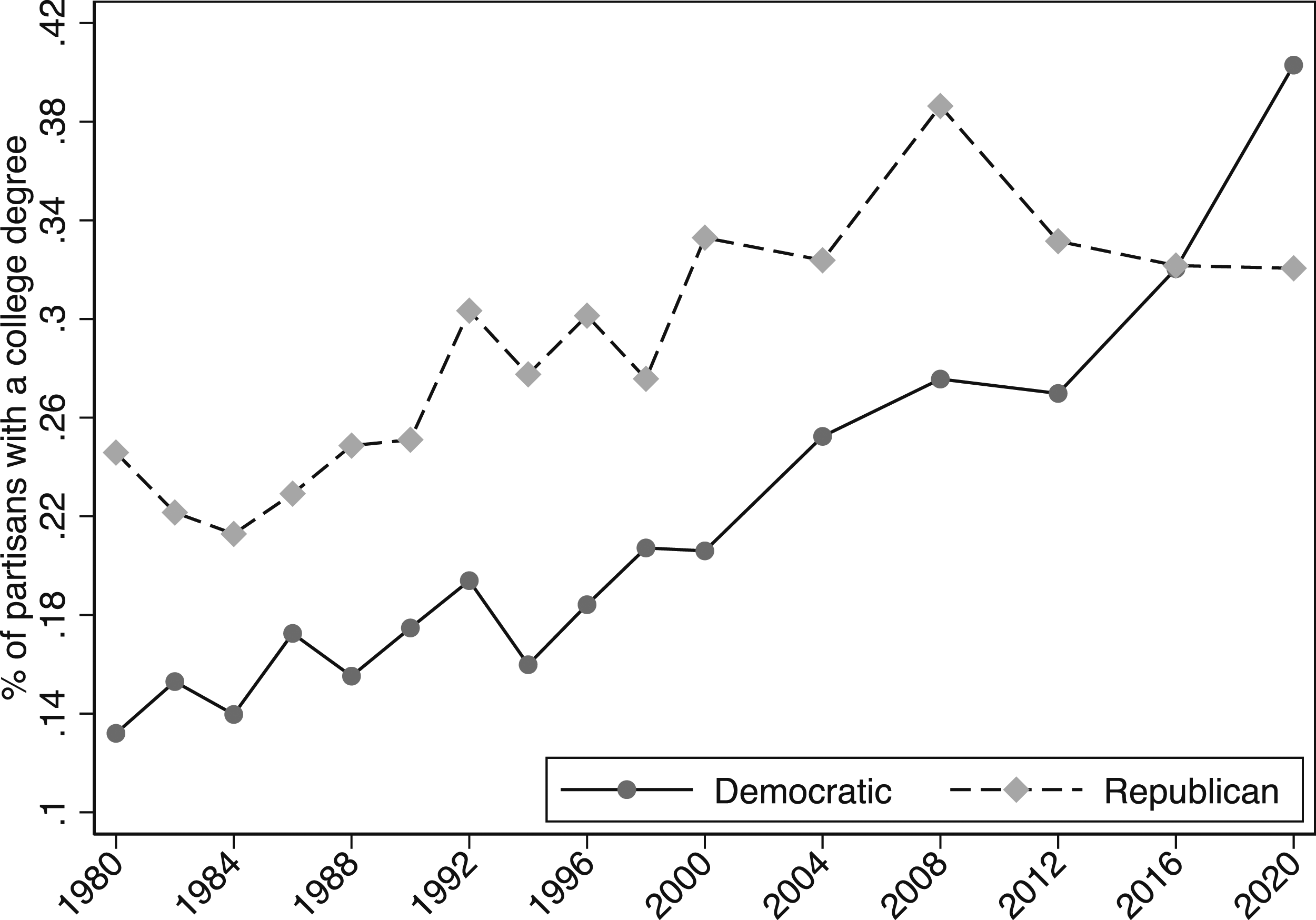
Following the strategy proposed by Martinez and Gill (2005), we simulate Democratic vote share across hypothetical turnout rates in the last six federal elections. Since 2016, voter turnout should no longer increase the Democratic vote share as white, less-educated voters are aligning with the Republican Party. Our findings support these expectations. We conclude by discussing (i) if our findings will be persistent, (ii) if these cleavages could cross ethnic lines in the future, and (iii) our findings’ implications for reforms that can reduce voter turnout.
Turnout Advantage and Education
A vast literature looks at the partisan effects of voter turnout. Most findings are suggestive that, on average, Democratic candidates benefit from higher turnout (Hansford et al., 2010; Martinez & Hill, 2007; Franklin & Grier, 1997). Although this Democratic turnout advantage may not be large enough to change the outcomes of most presidential or Senate elections (Brunell et al., 2004; Citrin et al., 2003), changes in turnout rate can be consequential. Fraga (2018) argues, for instance, that full turnout in 2016 would have delivered Hillary Clinton the Electoral College victory over Donald Trump. Other scholars, however, outright reject the presence of a partisan turnout advantage (Shaw & Petrocik, 2020) or posit it is conditional on which party has the majority of “core voters” within an electorate (DeNardo, 1980; Tucker et al., 1986) or which party has the incumbent candidate (Grofman et al., 1999).
These mixed findings reflect, in part, two different research questions (Grofman et al., 1999). (i) Does the Democratic Party benefit in elections with higher turnout? (ii) Would the Democratic Party benefit if turnout were higher in a given election? Martinez and Gill (2005) answer the latter question by simulating turnout rates using survey data. They find that there was a Democratic turnout advantage in the 1960s and 1970s that disappeared over time. After the New Deal, the working class sorted into the Democratic Party and the middle and upper class into the Republican Party. As the class-based cleavage weakened, so too did the Democratic turnout advantage. Yet, a new cleavage has recently emerged along the lines of socioeconomic status. Specifically, white non-college voters—who, according to the 2020 Census, comprise more than 40% of the total electorate—are more likely to vote for Republican candidates. Meanwhile, the Democratic Party has, for the first time, a larger share of identifiers with a college degree than the Republican Party (per Figure 1).
In this paper, we investigate the partisan turnout advantage in light of this change in the composition of the two parties. Why would an emerging cleavage along educational lines change the partisan turnout advantage? Scholars may disagree on whether there is a turnout advantage, but it is beyond question that education is a strong predictor of voter turnout (Sondheimer & Green, 2010), voter registration (Timpone, 1998), and a variety of other political activities (Mayer, 2011). The more educated citizens are, the more likely they will participate in politics. There is an ongoing debate over the causal relationship between education and participation (Berinsky et al., 2011; Tenn, 2007). But, it is unquestionable that education is highly correlated with participation (Persson, 2015). If educated people participate more, then a migration of the educated into one party should alter the turnout advantage assumptions of the past.
Therefore, we expect to find that higher turnout in the 2016, 2018, and 2020 elections no longer benefits the Democratic Party. As low-propensity voters sort into the Republican Party, higher turnout should not lead to an increase in Democratic vote share. Although the education realignment may reflect a long-term process of changing voting behavior, Trump’s political emergence has certainly accelerated it (Kitschelt & Rehm, 2019). In 2010, 2012, and 2014, the Democratic Party did not have a clear advantage among college graduates. Moreover, Obama’s candidacy propelled the participation of minorities who are historically less likely to turn out. For these reasons, higher turnout should benefit the Democratic Party in these three elections. These expectations lead to our two hypotheses about turnout advantage in recent presidential elections:
Higher (lower) voter turnout in the 2010, 2012, and 2014 elections causes an increase (decrease) in Democratic vote share.
Higher (lower) voter turnout in the 2016, 2018, and 2020 elections does not cause an increase (decrease) in Democratic vote share.
Research Design
We extend Martinez and Gill’s (2005) analysis and simulate vote share across levels of voter turnout. We estimate multinomial logistic models that predict vote choice (including abstention), then record the predicted probabilities for each respondent. With the predicted probabilities of abstaining, the levels of voter turnout are simulated. For example, to simulate vote share when turnout is 5% lower than observed, the 5% of respondents that voted with the highest probability of abstaining are changed to abstainers. To simulate 5% higher turnout, the 5% of abstainers with the lowest probability of abstaining are counted as voters. These new voters “cast votes” for the party they are more likely to have supported according to the predicted probabilities.
We simulate vote share across levels of voter turnout in the last six federal elections: 2010, 2012, 2014, 2016, 2018, and 2020. However, we use CES data instead of ANES. The CES offers two major advantages. First, it includes validated voter turnout for all elections—eliminating respondent misreports of voter turnout. Second, the CES has many more respondents per election, which increases the accuracy and power of our estimates.
Our dependent variable is constructed using both self-reports and validated voter turnout. We use self-reports to record whether a respondent voted for the Democratic or Republican Party, but these reports are only counted if the individual’s vote is validated. All validated nonvoters and self-reported nonvoters are recorded as abstainers. 4 We exclude the remaining respondents that could not be matched to the voter files. Our models include a long list of independent variables: party identification, ideology, gender, race, marital status, age, family income, employment status, children, religion, economic evaluations, news interest, education, presidential approval, and vote intention.
Our study replicates analyses conducted nearly two decades ago, and, in the intervening years, political campaigns have drastically changed. Beginning in 2003, states were required to provide databases on registered voters. This change, along with the rise of “big data,” has resulted in a shift to microtargeting voters, where campaigns attempt to turn out specific groups of voters that are more likely to support their party (Ridout et al., 2012). However, we have reasons to believe that the shift to microtargeting has made voter turnout efforts more similar to our simulations. Campaigns now extensively rely on propensity scores to target most likely voters (Endres & Kelly, 2018; Stuckelberger & Koedam, 2022). By doing so, they activate those who we call marginal abstainers, people “on the fence” to turn out. As the political attachment of marginal abstainers changes, so does the partisan effect of turnout.
Findings
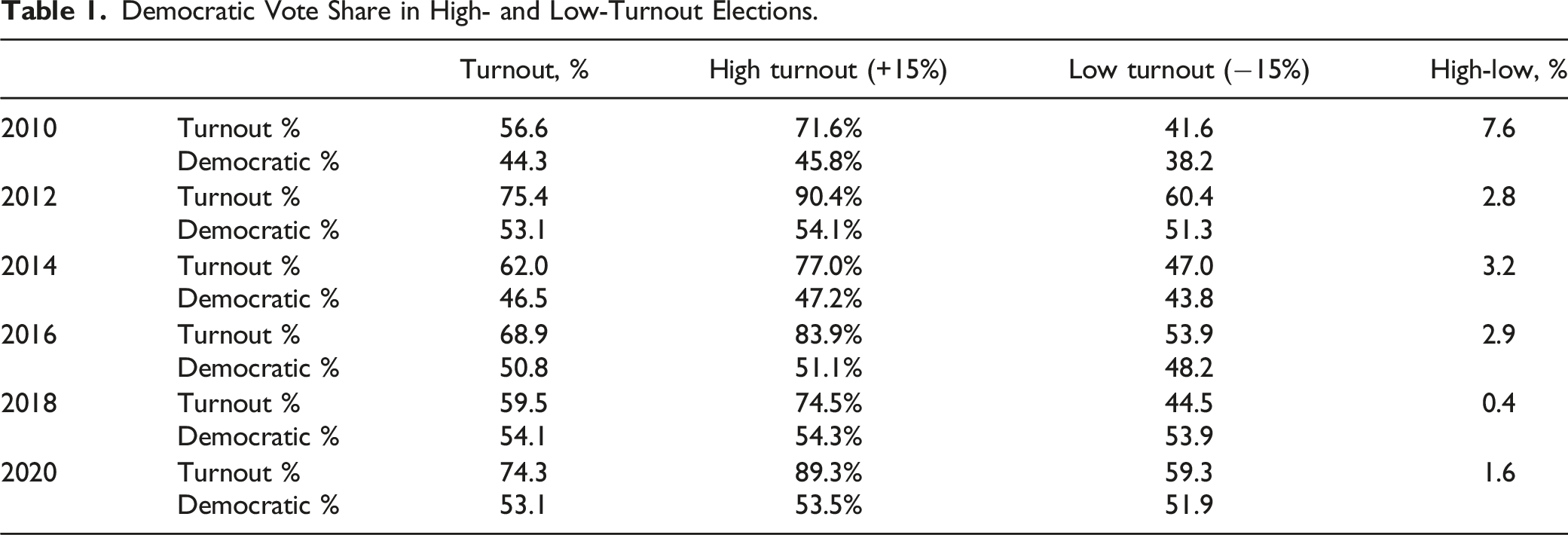
Figures 2(a) and 2(b) show the predicted Democratic vote share across levels of simulated turnout in the 2010-2020 elections. The range of participation in the horizontal axes varies from 5% to 95%. Vote share is estimated using the predicted probabilities from multinomial logistic regressions. These regression results are included in Tables SM1-SM6 of the Supplementary Material. In the 2010, 2012, and 2014 elections, we see a notable increase in Democratic vote share when turnout increases above the observed turnout rate, and a sharp decrease in Democratic vote share when turnout decreases. These findings support Hypothesis 1, showing that the Democratic vote share would be hurt by low turnout when Obama was the leader of the party. According to Figure 2(b), a reversal in the relationship between turnout and Democratic vote share begins to appear in 2016 and continues in 2018 and 2020. In stark contrast with the 2010-2014 elections, the Democratic Party would benefit from extremely low turnout. The Democratic Party would obtain larger advantages in 2018 and 2020 at very low rates of simulated participation—between 5% and 35%. (a): Democratic vote share by simulated turnout rate, 2010–2014. (b): Democratic vote share by simulated turnout rate, 2016–2020.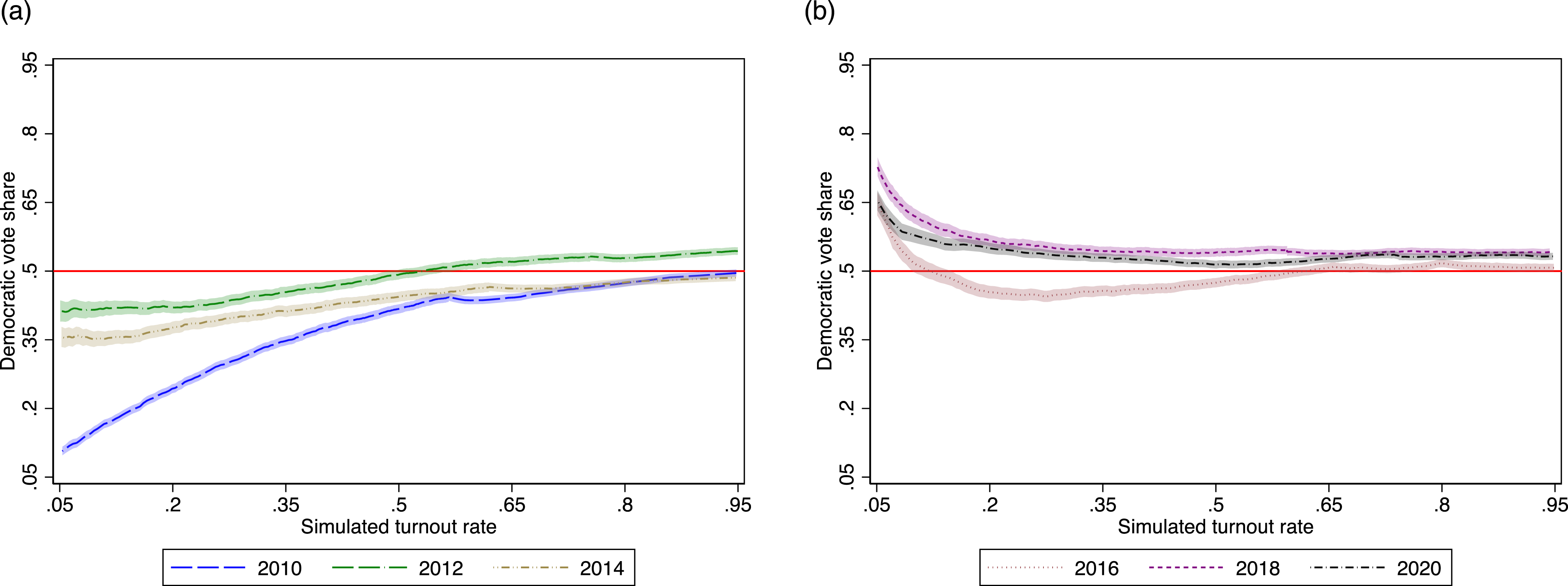
Democratic Vote Share in High- and Low-Turnout Elections.
Who is turning out in our simulations of higher turnout? To further understand this process, we investigate whether the marginal abstainers—those abstainers who were most “on the fence” about voting—are increasingly Republican. We define marginal abstainers as the 15% of respondents that did not vote, but were most likely to vote according to our models. The partisanship and educational attainment of marginal abstainers is shown in Figures 3(a) and 3(b) respectively. As expected, marginal abstainers are consistently less educated than the general population of voters. But the partisanship of marginal abstainers has changed. (a): Partisanship of marginal abstainers. (b): College education of marginal abstainers.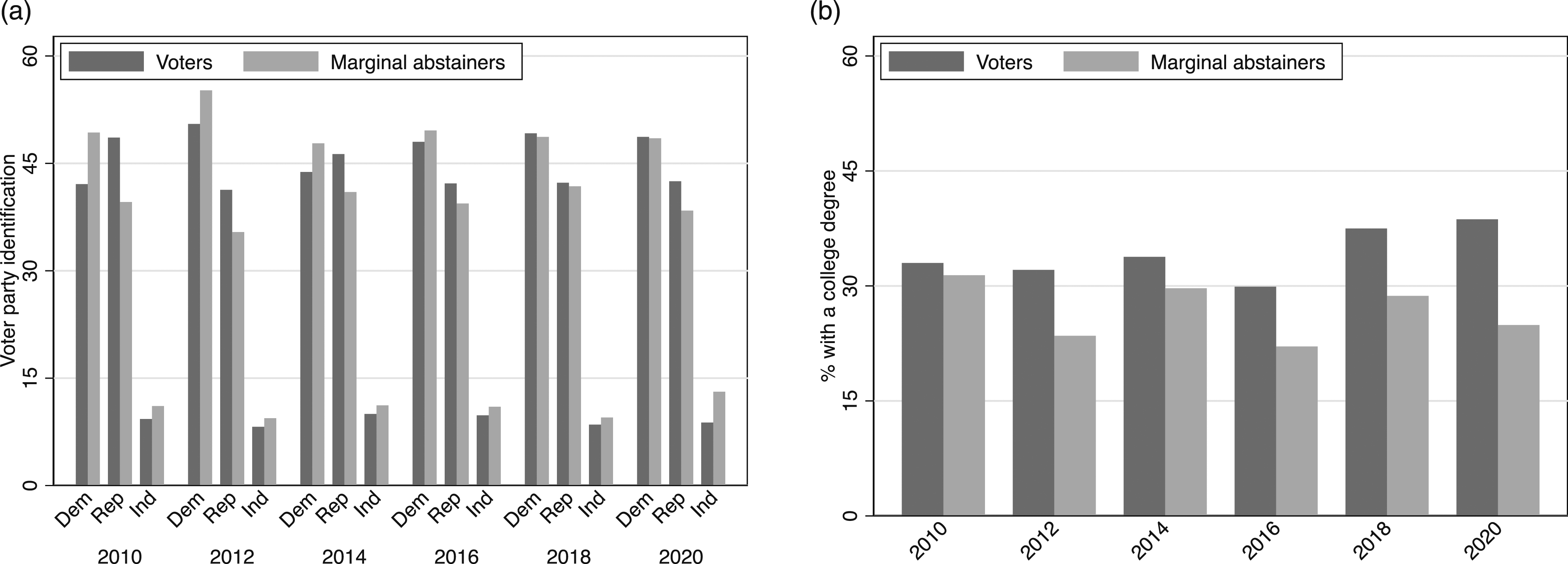
In 2010, marginal abstainers are substantially more Democratic than voters—7.2%. The gap in Democratic identification between voters and marginal abstainers shrinks until 2018 when the relationship reverses. In 2018 and 2020, the voters are .5 and .2% more Democratic than the marginal abstainers. At the same time, the share of college graduates has increased in the electorate; yet, marginal abstainers have remained consistently less college educated. Consistent with the theory of educational realignment, Figures 3(a) and 3(b) show that while the educational attainment of marginal abstainers stays constant, their partisan attachment has moved toward the Republican Party.
The simulations provide evidence that party realignment has changed the partisan turnout advantage, but they do not show that education is driving this realignment. To further look into this realignment, we plot the average marginal effect of a college education on vote choice across elections in Figure 4. These average marginal effects are taken from a simple multinomial logistic model with vote choice as the dependent variable and an interaction between a college education dummy variable and the year of the survey.
6
Abstention is the baseline category in this model. The results are presented in Table SM7 of the Supplementary Material.
7
Effect of a college education on party choice.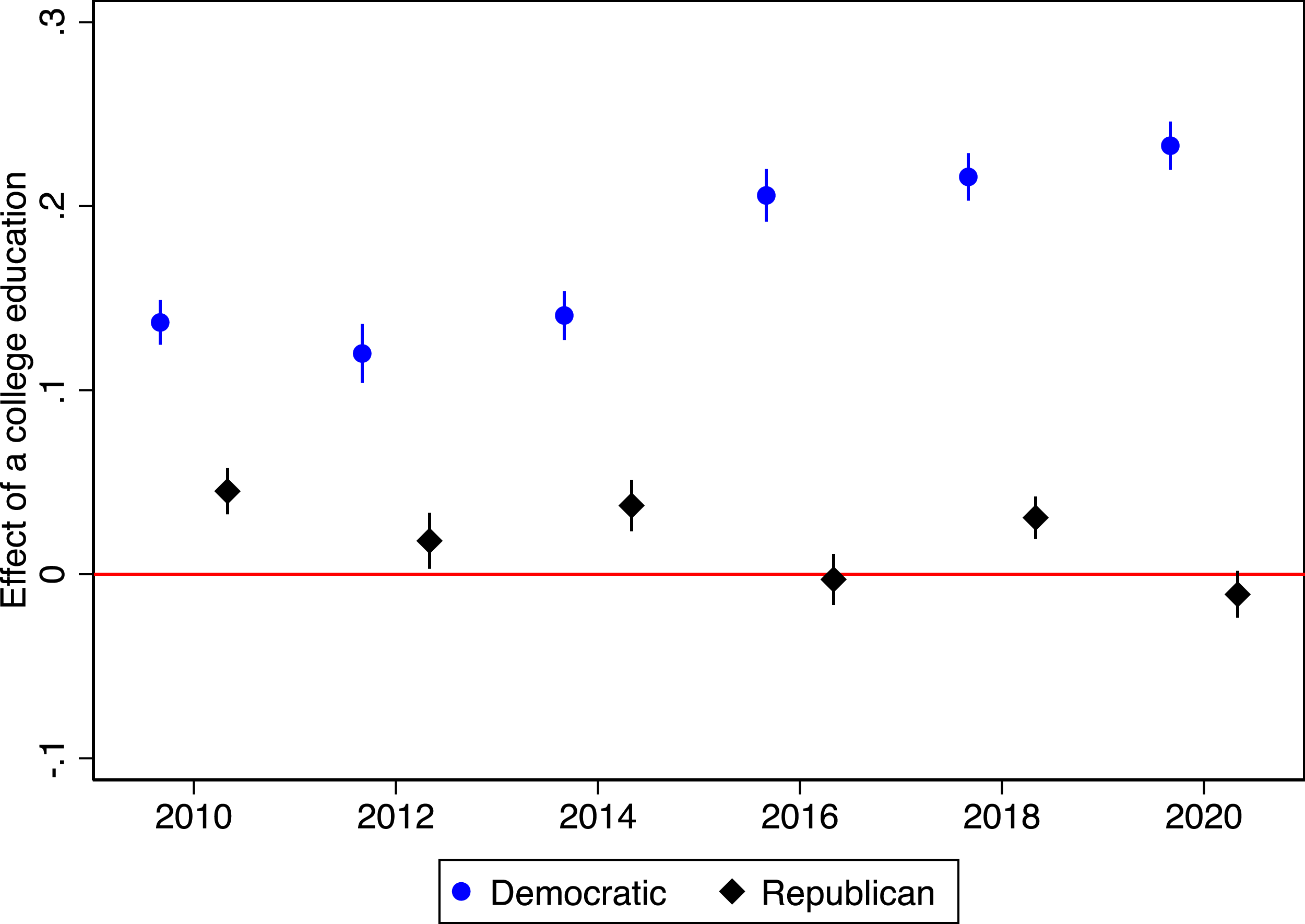
Having a bachelor’s degree has a stronger effect on the probability of voting Democratic in all 6 elections; however, in 2010, 2012, and 2014, the gap is small and there remains a significant positive effect on the probability of voting Republican. The gap in effect size is much larger in the latter three elections. Plus, the average marginal effect on voting Republican is null in 2016 and 2020. Although they are not evidence of a causal relationship, these results show that educated Americans, precisely those more likely to turn out to vote, are increasingly supporting the Democratic Party.
Discussion
Given the signs of an education-based party realignment in American politics, we extend Martinez and Gill’s (2005) approach to investigate the partisan effect of turnout in recent presidential elections. We predict that higher turnout increases the Democratic vote share in 2010, 2012 and 2014, as Obama mobilized minorities. However, because Trump accelerated the realignment along educational lines, higher turnout no longer clearly advantages the Democratic Party in 2016, 2018, and 2020. Our findings confirm these hypotheses and show that the ongoing realignment could drastically change previous assumptions about the effects of voter turnout.
Education is not a novel cleavage, but the new partisan attachment across levels of education could redefine the relevance of this cleavage in American politics. For this reason, future research should consider what the arising relevance of the education cleavage means for U.S. politics. Is this a persistent party realignment or just a transitory Trump effect? Only time can answer this question, but trends observed by Kitschelt and Rehm (2019) suggest that the realignment is a long-term process hastened by Trump. Hence, our findings may represent a new and enduring relationship between voter turnout and election results.
Another interesting question concerns whether this realignment can travel across ethnic and racial lines. Would it be limited to white voters? Or can it also influence voting behavior in other groups? The education gap among Hispanic voters in 2020 indicates that it can: Hispanic vote share for Trump jumps from 30% among college graduates to 41% among those without a college degree. 8 Finally, our results also suggest that electoral reforms to reduce voter turnout can trigger unexpected consequences. By making participation more difficult for less-educated voters, reforms such as voter ID legislation may benefit Democratic candidates rather than their Republican sponsors. As such, future research should investigate the implications of education inequality both within and across minority groups and the effects these inequalities may have on the future of U.S. politics.
Supplemental Material
Supplemental Material - Party Realignment, Education, and the Turnout Advantage: Revisiting the Partisan Effect of Turnout
Supplemental Material for Party Realignment, Education, and the Turnout Advantage: Revisiting the Partisan Effect of Turnout by Spencer Goide, Thiago M. Q. Moreira, Brenna Armstrong in American Politics Research.
Footnotes
Declaration of Conflicting Interests
The author(s) declared no potential conflicts of interest with respect to the research, authorship, and/or publication of this article.
Funding
The author(s) received no financial support for the research, authorship, and/or publication of this article.

Supplemental Material
Supplemental material for this article is available online.
Notes
References
Supplementary Material
Please find the following supplemental material available below.
For Open Access articles published under a Creative Commons License, all supplemental material carries the same license as the article it is associated with.
For non-Open Access articles published, all supplemental material carries a non-exclusive license, and permission requests for re-use of supplemental material or any part of supplemental material shall be sent directly to the copyright owner as specified in the copyright notice associated with the article.
