




Abstract
Party factions are central to our understanding of American politics, but what role do party factions play within the electorate? With an August 2022 survey of the American South, we investigate factions within the modern GOP. We find evidence that faction identities overlap, as most Republicans hold some degree of identification with multiple factions. We also employ multivariate analyses to show that, despite evidence of overlap, Make America Great Again (MAGA) identifiers hold distinguishable opinions on President Trump and a variety of election issues. This research demonstrates the importance of factions within the southern Republican electorate and argues that factions can be an identity, representing a new way to conceive of intraparty factions in American politics.
“By a faction, I understand a number of citizens, whether amounting to a majority or a minority of the whole, who are united and actuated by some common impulse of passion, or of interest, adverse to the rights of other citizens, or to the permanent and aggregate interests of the community.” (Federalist No. 10, [22 November], 1787)
In a September 2022 speech, President Joe Biden took aim at MAGA (Make America Great Again) Republicans. He proclaimed that MAGA Republicans, and not their traditional Republican counterparts, represented a threat to democracy by promulgating the “Big Lie” that Donald Trump had won the 2020 presidential election, placing a person (Donald Trump) above their country, and for stoking the flames of violence and intolerance (Biden, 2022). And, more recently, President Biden “sharply criticized ‘MAGA’ Republicans for their refusal to vote in a higher federal debt ceiling” (Reuters, 2023). 3
Rhetorical bouts with the opposition party have a long history in American politics, but Biden’s attack on a specific faction within the opposition party was unusual. In addition to the practical political implications, Biden’s attacks on MAGA Republicans raise theoretical and empirical questions about the nature and purposes of intraparty factionalism in modern American politics. This paper focuses on three primary questions about intraparty factionalism in the American South: (1) What proportion of southern Republicans identify as MAGA Republicans? (2) Are MAGA Republicans a distinct faction in the southern electorate? and (3) Do these MAGA Republicans have distinct views on American democracy?
To address these questions, we analyze data from an original August 2022 survey of the American South. The South is an appropriate region to conduct this study because it has become the base of Republican strength in the United States (Black & Black, 2007; Hood et al., 2012; Maxwell & Shields, 2019). Additionally, the South has a long history of intraparty factional conflicts (Caughey, 2018), perhaps most pronounced when Key (1949) elucidated the region’s heightened one-party Democratic factionalism near the end of the 1940s. In the present day, we find that MAGA Republicans are a sizable portion of the southern Republican electorate, but not the dominant one. Also, MAGA Republicans are less likely than “Traditional Republicans” to believe that former President Trump should be prosecuted for the events of January 6, 2021, and less likely to believe that the 2020 elections were free and fair. We contribute to the literature on intraparty factionalism, arguing for a new way to conceive of intraparty factions in mass politics—factions as identity (Kalin & Sambanis, 2018).
Intraparty Factions in American Politics
Intraparty factions have played important roles in American politics since the founding of the Republic. In addition to being “sown in the nature of man,” the U.S. political system provides a breeding ground for insurgent groups to challenge the traditional party structure (“The Federalist Number 10, [22 November], 1787”). As Duverger (1964) noted, single member districts and winner-take-all electoral rules foster two major political parties vying for power. When just two parties exist in a large and diverse country like the United States, it is only natural for intraparty factions to emerge. Intraparty factions give voice to the differing coalitions that make up the “big tents” of the modern-day Republican and Democratic Parties.
But despite their importance in American politics, intraparty factions can sometimes be hard to identify. There is typically no formal membership card or official roster. In a recent book, Blum (2020, pp. 101–02) offers a helpful definition: “A party faction is an intraparty group, distinguished from other groups in its coalition by its demands for a renegotiation of its party’s consensus.” Blum (2020, p. 102) further distinguishes between “insurgent factions” that use combative strategies to drive partywide change and “consociational factions” that employ more cooperative strategies to change the party structure. According to Blum (2020), the Tea Party is a classic example of an insurgent faction while the Christian Right represents an instance of a consociational faction. Similarly, the States’ Rights Democratic Party (Dixiecrats) led by its presidential nominee Strom Thurmond is a salient historical example of an insurgent faction within the southern wing of the Democratic Party. Its emergence was triggered by the national (northern) Democratic Party’s overtures and embrace of Black civil rights, as President Truman sought to prolong his tenure in the 1948 election (Frederickson, 2001; Key, 1949).
In U.S. politics, intraparty factions often push the two major parties to political extremes. As the Madison quotes above explain, factions can be detrimental to democracy by uniting citizens around an interest “adverse to the rights of other citizens, or to the permanent and aggregate interests of the community” (“The Federalist Number 10, [22 November], 1787”). In addition to the Tea Party, the House Freedom Caucus, founded in 2014, has wielded considerable power by putting pressure on Republican Party leadership (Green, 2019). While the Tea Party and House Freedom Caucus have driven the Republican Party in a more conservative direction, Democrats face similar pressures from progressive party factions pulling their party in the opposite direction. For example, groups associated with Senator Bernie Sanders pressure elected Democrats to move left on economic issues. Similarly, there is “The Squad,” consisting of four minority Democratic congresswomen: Alexandria Ocasio-Cortez (NY-14), Ilhan Omar (MN-5), Ayanna Pressley (MA-7), and Rashida Tlaib (MI-13), who have driven elements of the Democratic Party leftward on policies addressing environmental protection and criminal justice reform (DiSalvo, 2022). As DiSalvo (2022) has argued, “the trouble with recent factions is that they have abetted polarization, increased affective partisanship, and made governing arduous for members.”
Of course, not all intraparty factions push political parties to the extremes. According to DiSalvo (2022), some factions move political parties to the center or toward the median voter. For example, the Democratic Leadership Council (DLC) was founded in response to the leftward shift of the Democratic Party during the 1960s and 1970s. Former President Bill Clinton claims that the DLC paved the way for his 1992 election and other Democratic Party successes after his presidency (Isenstadt, 2009). Likewise, the so-called Blue Dog Coalition of congressional Democrats are intentionally centrist, but their numbers have dwindled via member replacement, as more and more polarized Democratic colleagues enter the national legislature (Fleisher & Bond, 2004). Ironically, this moderate faction of the Democratic Party is now close to extinction because of a dispute among its members over whether to retain or change the group’s name (Mutnick & Ferris, 2023).
While the Tea Party faction ended somewhere between 2016 and 2018 because it “had more or less succeeded in eliciting its desired concessions” (Blum, 2020, p. 103), the movement continues to influence the GOP. The Tea Party undoubtedly increased political polarization in American politics. In particular, this Republican faction emboldened far-right candidates, culminating in Trump’s 2016 election to the presidency (Gervais & Morris, 2018). As Blum states (2020, p. 105), “the acceptability of Trump’s reactionary rhetoric is perhaps one part of the Tea Party’s legacy.”
In the post-Tea Party world, there is a battle over the new Republican Party. While traditional Republicans hold down one side, insurgent Republicans, sometimes called “MAGA Republicans,” and sometimes called “America First Republicans,” are trying to wrest control of the party. MAGA Republicans appear distinct in a number of ways, most of which may be deemed as anti-democratic and opposed to multiracial participatory democracy. For example, leveraging a panel study of MAGA adherents, Blum and Parker (2023) find that MAGA supporters are overwhelmingly white, Christian, and male, and they tend to hold beliefs that are more likely to be racist, misogynist, and anti-immigrant. In related work, Graham et al. (2021), find that people who express more support for white nationalist movements are more willing to don a MAGA hat.
While there is little doubt that MAGA Republicans are positioned counter to Traditional Republicans, there is perhaps more murkiness concerning the agenda of so-called “America First” Republicans in the contemporary GOP. For example, recently ousted freshman member of Congress Madison Cawthorn identified as an “America First” Republican. His fellow North Carolina congressional colleague Dan Bishop also favored the “America First” label (CBC Editorial, 2022), and Marjorie Taylor Greene launched an “America First” Caucus, rather than one identifying as MAGA (Diaz et al., 2021). Whereas MAGA is associated primarily with Donald Trump, America First has a looser and perhaps more complicated connection to the one-term President. In brief, we know that Traditional Republicans and MAGA Republicans find themselves at loggerheads, but no empirical study has attempted to grapple with the question of exactly where America First Republicans fit in and whether they are simply MAGA Republicans by another name, or if they constitute their own faction within the modern GOP.
Partisan attachments can form an important part of a person’s social identity (Green et al., 2002; Mason, 2018). According to social identity theory, group membership creates an “us” versus “them” dynamic and involves three stages: categorization, social identification, and social comparison (Tajfel & Turner, 1979). Further, there is even evidence that attachment to political parties is stronger than identities to race and ethnicity, and that partisans discriminate against the political opposition to a greater degree than against members of a variety of other out-groups (Iyengar et al., 2019; Westwood et al., 2018).
A social identity approach to studying intraparty factionalism is particularly important in the contemporary American South, a region with a long history of intraparty factionalism (Canon, 1978; Glaser, 2006). In Southern Politics in State and Nation, Key (1949, p. 11) argued that without two viable political parties, “the political battle has to be carried on by transient and amorphous political factions within the Democratic party, which are ill-designed to meet the necessities of self-government.” Following this one-party Democratic Solid South era, the region entered a period of two-party competition (Lamis, 1988), which led to a Republican advantage, if not a time of electoral dominance (Hayes & McKee, 2008). Currently, due to racially diverse high population growth (Bullock et al., 2019) in a region on the move (Morris, 2021, 2022), and with many Democratic-leaning in-migrants (McKee & Teigen, 2016), parts of the South are shifting back towards two party competition.
Throughout the South’s modern partisan permutations, the scholarly focus has tended to be on parties as the organizing political unit, but what about the role of intraparty factions? As mentioned, scholars have examined recent national intraparty factions like the Tea Party (Blum, 2020; Gervais & Morris, 2018; Parker & Barreto, 2013; Skocpol & Williamson, 2012) and the House Freedom Caucus (Green, 2019). Others have focused specifically on intraparty factionalism in the late 19th and early 20th century American South (Caughey, 2018; Heersink & Jenkins, 2020; Mickey, 2015), and the rise of the Tea Party in the region (Hood et al., 2015). However, there is very little examination of intraparty factionalism in the American South during the post-Tea Party era. This is a particularly notable oversight given the recent characterization and framing of Donald Trump and his presidency, as uniquely “southern” (Cox, 2021; Maxwell, 2020). 1 To address this oversight, we posit three questions examining intraparty factionalism in the contemporary southern Republican electorate.
To address the first two questions, we describe the proportion of the southern GOP electorate that identifies as Traditional Republicans, MAGA Republicans, and America First Republicans. We then consider whether these three groups constitute separate factions in the Republican Party, or whether there is too much overlap to consider them truly distinct. After exploring the first two questions, we examine four primary hypotheses aimed at answering a third overarching question: Do these MAGA Republicans hold distinguishable views of former President Trump and with respect to some features of modern American democracy?
Republicans who identify strongly with the MAGA label are less likely to believe the 2020 elections were free and fair.
Republicans who identify strongly with the MAGA label are less likely to believe that former President Trump should be prosecuted.
Republicans who identify strongly with the MAGA label are more likely to believe elections are not secure enough.
Republicans who identify strongly with the MAGA label are more likely to approve of former President Trump.
Data and Methods
To answer our three primary research questions and test our hypotheses, we rely on an original survey of 2275 (weighted) respondents in the American South, who took part in the 2022 Southern Focus Survey administered by Winthrop University. Although there are a multitude of potential definitions for the South (Cooper & Knotts, 2017; Springer, 2019), we limit the region to the 11 former Confederate states: Alabama, Arkansas, Florida, Georgia, Louisiana, Mississippi, North Carolina, South Carolina, Tennessee, Texas, and Virginia. Respondents were drawn from a curated panel purchased from Marketing Systems Group and the sample was weighted by race, gender, and age from each state surveyed (e.g., not the country as a whole) based on data from the U.S. Census Bureau. The Southern Focus Survey utilizes professionally trained callers and a Computer Aided Telephone Interviewing (CATI) system. The survey employs Random Digit Dialing (RDD) and wireless telephone number sampling. Weighted data have a margin of error of +/−2.8% at the 95% confidence level. 2
To measure factionalism within the Republican Party, we employ three questions asking respondents to “tell us how well the following terms describe you, where 1 = not at all and 10 = completely describes me.” There are separate indicators for “MAGA Republican,” “America First Republican,” and “Traditional Republican,” three intraparty factions that are frequently mentioned in congressional communication and elsewhere. These questions were only asked of respondents who indicated they identify with or lean towards the Republican Party (e.g., it includes independents who lean towards the Republican Party). Rather than treating intraparty factions as mutually exclusive, this measurement strategy allows for the possibility that respondents identify with multiple intraparty factions. We expect that intraparty factions, and specifically MAGA Republicans, hold distinguishable positions on several salient issues regarding American democracy and former President Trump.
Once the data were collected, we employed multiple ways to operationalize the intraparty factionalism concept. First, we use the raw 1–10 scale for the survey, an operationalization we term Scaled factionalism. In the second measure, which we term Committed factionalism, we code respondents with a “1” if they answered a “10” on the scale; all other respondents were coded 0. This allows us to consider only the respondents most committed to the faction. In the third operationalization (Leaning factionalism), we coded respondents a “1” if they answered a 6, 7, 8, 9, or 10 on the question. Respondents who indicated a 1, 2, 3, 4, or 5 were coded “0.” Finally, to create an operationalization where people are placed into discreet categories, we created an indicator variable where each respondent was placed based on the highest identification(s) (Dominant factionalism). Each of these operationalizations has strengths and weaknesses, but together they provide us with empirical robustness by employing multiple ways to assess the concept of intraparty factionalism. These measures also provide for the possibility that people may hold multiple identities, a reality recognized in previous work on regions (Cooper & Knotts, 2010). It is important to note that only the Dominant factionalism operationalization eliminates the possibility that respondents will be coded as identifying with multiple factions. As such, models that include the other operationalizations will not employ an excluded or base category.
For our dependent variables, we use four questions that address various parts of the MAGA Republican brand President Biden called out in his September 2022 speech. The first question asks respondents “Do you believe that the results of the 2020 Presidential election were fair and accurate?”; with response options for yes, no, and not sure. The second question asks, “Do you believe Donald Trump should be charged with a crime for his involvement in the events that happened at the U.S. Capitol on January 6, 2021?”, with response options for yes, no, and not sure. Third, we evaluate a question that asked respondents how serious of a problem they believe “elections are not secure enough” is; on a scale of 1–10 where 1 = not a problem and 10 = a very serious problem. Finally, we analyze responses to a question that asks, “Would you say that your view of Donald Trump is…?”, with response options for very favorable, somewhat favorable, neither favorable nor unfavorable, somewhat unfavorable, and very unfavorable.
Results I: Describing Factionalism in the Modern Southern Republican Party
In this section we summarize the distribution of our sample across our key variables of interest: identification with MAGA, America First, and Traditional Republicanism. As stated above, we employ four measures assessing the extent of factionalism: Committed, Leaning, Scaled, and Dominant. Results for the first operationalization are presented in Figure 1, the second and third operationalization in Table 1, and the fourth operationalization in Figure 2. Percent of southern Republican respondents who describe themselves as. Committed Factions, Faction Identifiers, and Faction Overlap. Dominant factions among southern Republican identifiers.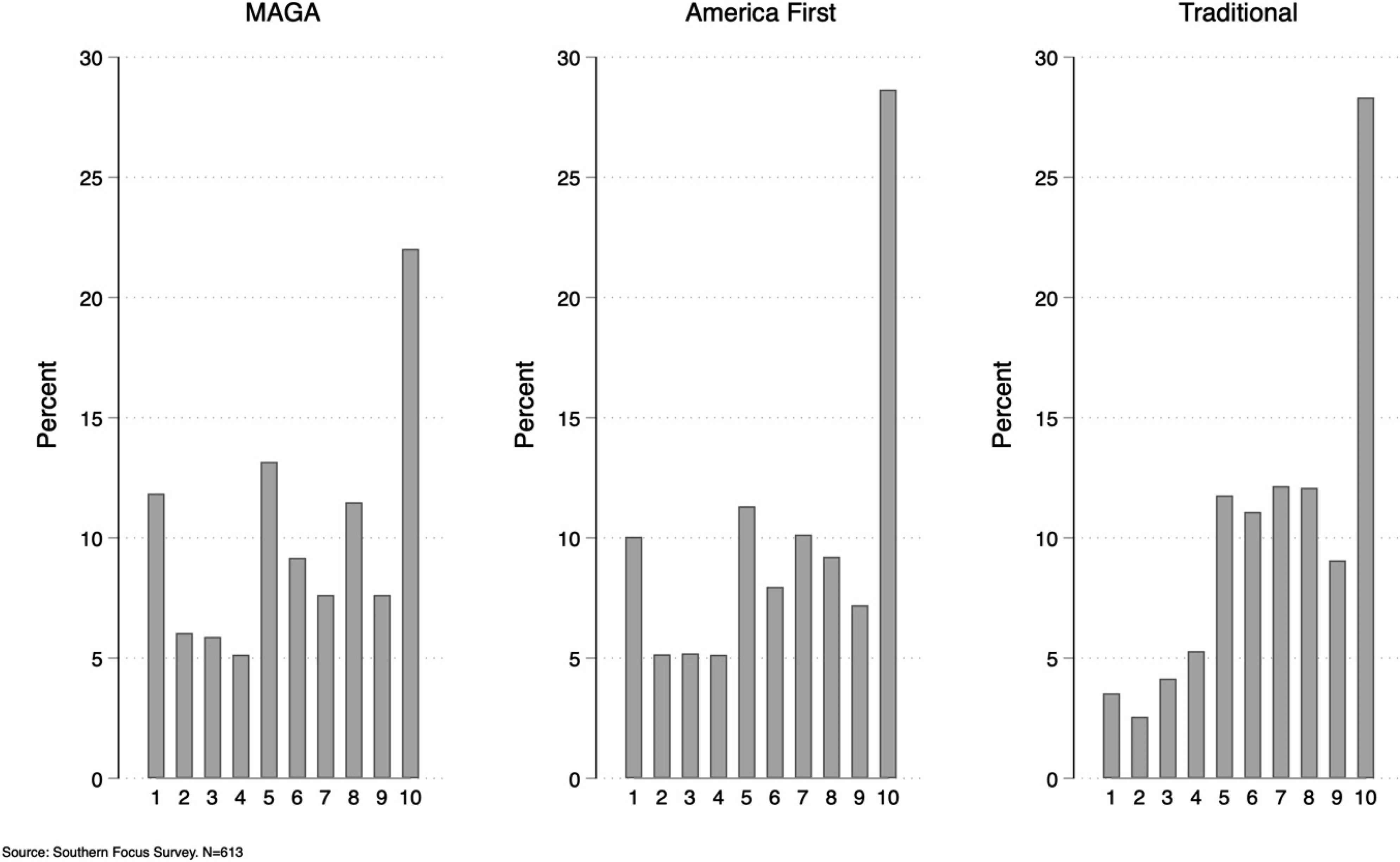
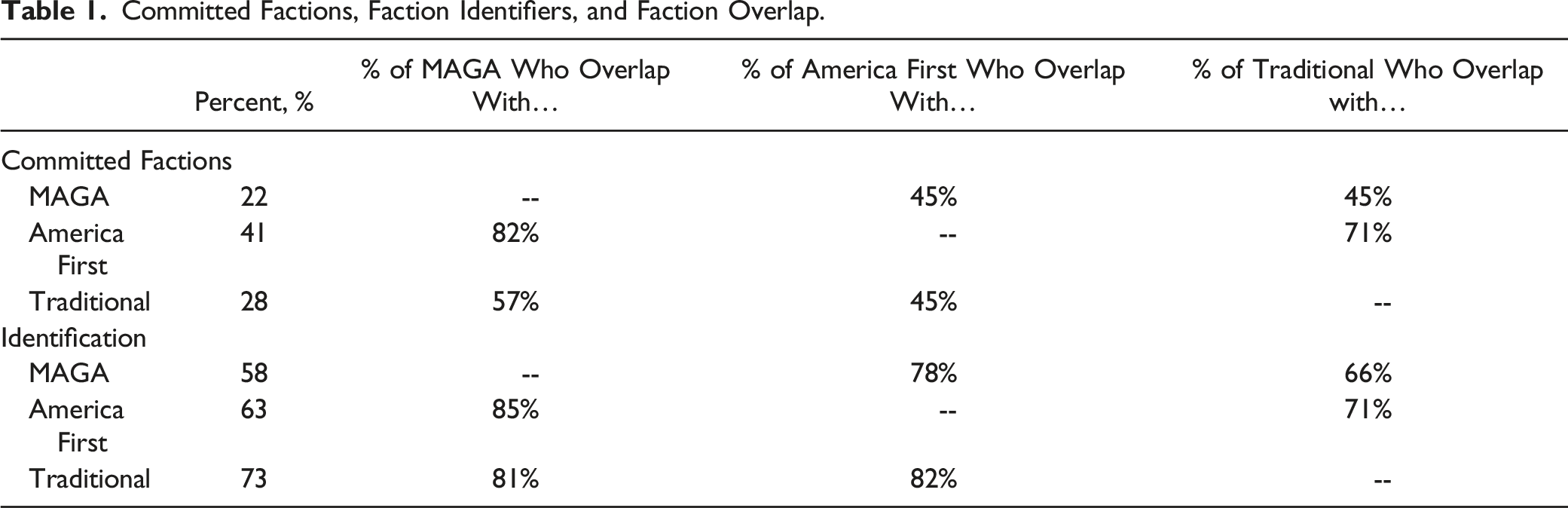
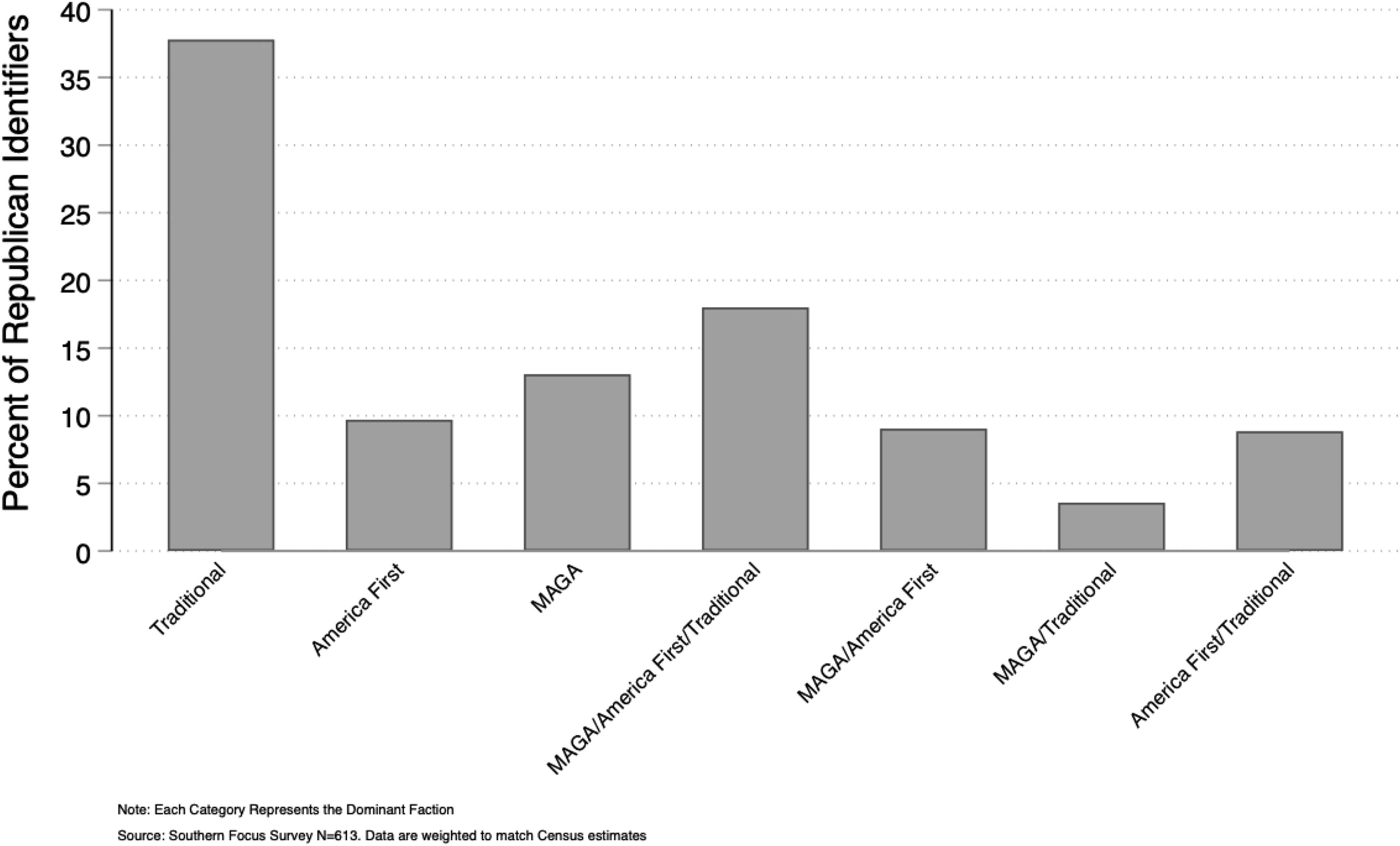
Figure 1 presents perhaps the most straightforward way to understand these data—a display of the percentage of respondents who gave each answer 1–10 for MAGA, America First, and Traditional Republican. Using this metric indicates that MAGA identification is the lowest of the three groups, with an average score of 6.12. America First is the next most frequent factional identity, with an average score of 6.45 and Traditional Republican is most prevalent, with an average score of 7.02. Additionally, notice the high degree of overlap in factional identity; identification with one faction is not exclusive of identification with one or the other two intraparty factions, particularly between MAGA and America First Republicans.
Next, we present the distribution of committed factions in the top half of Table 1. Approximately 41% of respondents indicated the strongest possible identification (a 10 on a 1–10 scale) with the America First label, 28% with the Traditional label and 22% gave the strongest possible identification with MAGA. Committed MAGA respondents indicated the least overlap with the other factions. Nevertheless, many respondents identify strongly with two or three factions. About 11% of respondents indicated a 10 for all three factions and 20% indicated a 10 for two of the three. Most MAGA members are likely to affiliate with the other factions, as 82% of people committed to the MAGA faction also identify as America First and 57% identify as Traditional Republicans.
Our findings on Faction Identifiers can be seen in the bottom half of Table 1, and these findings yield slightly different results. Around 73% of respondents indicate a 6 or higher for Traditional Republicanism, about 63% for America First, and 58% for MAGA. In terms of overlap, we once again see that MAGA identifiers are very likely to identify with America First (85%) or Traditional (81%) Republican factions. The greatest overlap is between America First and Traditional Republicans (82% of America First identifiers also identify as Traditional), followed by America First and MAGA Republicans (78% of America First Republicans consider themselves MAGA) with the least overlap between MAGA and Traditional Republicans (66% of Traditional identifiers also identify as MAGA).
While each of the three measures allow people to fall into multiple categories, a fourth and final way we operationalize intraparty factionalism is to place respondents into a bin based on the highest score they offered. When multiple factions are tied, they are listed as such. Figure 2 suggests that Traditional Republican is once again the most popular choice and the melding of MAGA and Traditional Republican is the least popular pairing.
Altogether, this descriptive analysis of intraparty Republican factionalism in the American South suggests there is overlapping intraparty factionalism. This overlap is particularly prevalent between the America First and Traditional Republicans as well as between the America First and MAGA categories. Future studies should continue to monitor these groupings and the names associated with them. When Donald Trump fades from the political scene, will GOP insurgents continue to express their identity with the MAGA name, or will they favor “America First” as their preferred moniker? Particularly with the presidential candidacy of Florida Governor Ron DeSantis in mind, these differences may become more prominent in the future. The commonly known disdain that former President Trump holds for DeSantis might make the MAGA label increasingly less appealing for this politically ambitious Florida governor.
Results II: Intraparty Factionalism and Opinions on Former President Trump and Democracy
Given what we discovered above, this section assesses whether MAGA Republicans have distinguishable opinions on former President Trump and democracy, as compared to their Traditional Republican and America First counterparts. Specifically, we expect identification/affiliation with the MAGA GOP faction means greater support for former President Trump and less support for American democracy. We run 16 multivariate models—the four primary operationalizations of factionalism (Committed, Leaning, Scaled, and Dominant) likely to influence the four dependent variables discussed in the data and methods section.
In addition to the primary independent variables measuring factionalism, we include six other control variables that may influence the outcome. These additional variables are gender (male = 1; all other = 0), age (in years), race (white = 1, all other = 0), strength of Republican identification (1–3), education (0 = less than High School, 1 = High school/GED, 2 = some college, 3 = Two-year technical or community college graduate, 4 = four-year college graduate, 5 = post-graduate), and whether the respondent is a born-again Christian (1 = yes, 0 = no). Recall that given the factional overlap identified in the previous section, only the Dominant faction models need to exclude a base term.
The 2020 Elections were Free and Fair.
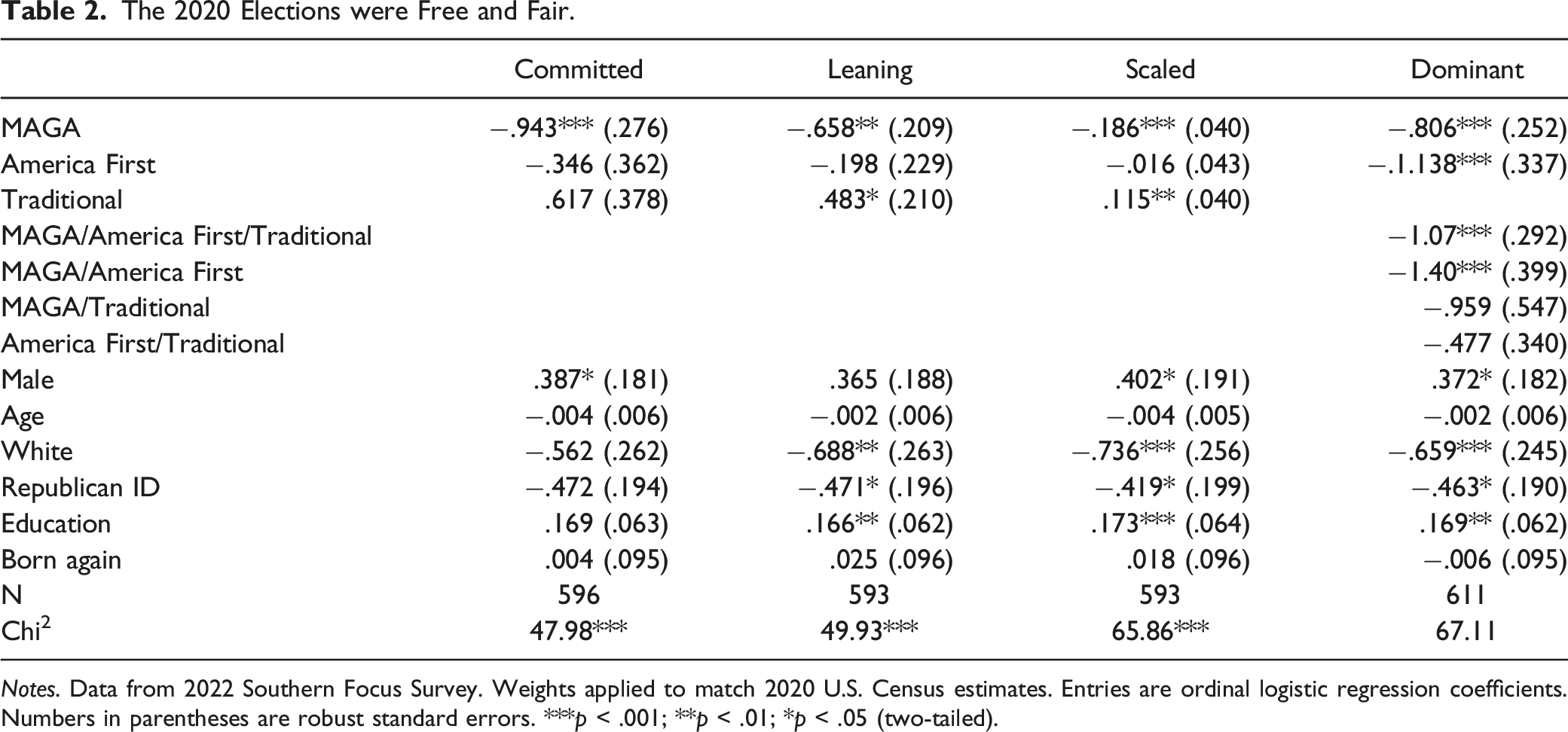
Notes. Data from 2022 Southern Focus Survey. Weights applied to match 2020 U.S. Census estimates. Entries are ordinal logistic regression coefficients. Numbers in parentheses are robust standard errors. ***p < .001; **p < .01; *p < .05 (two-tailed).
Regardless of how factionalism is operationalized, people expressing greater identification with the MAGA wing of the Republican Party are less likely to believe that the 2020 election was “free and fair.” Further, this relationship is significant across all four models. These results are substantively as well as statistically significant. For example, for the Committed operationalization of factionalism, respondents who score a 0 on the MAGA faction variable have a .34 probability of believing the election was free and fair versus .20 for those who score a 1 on the MAGA faction variable.
Prosecute Trump for Events of January 6, 2021.
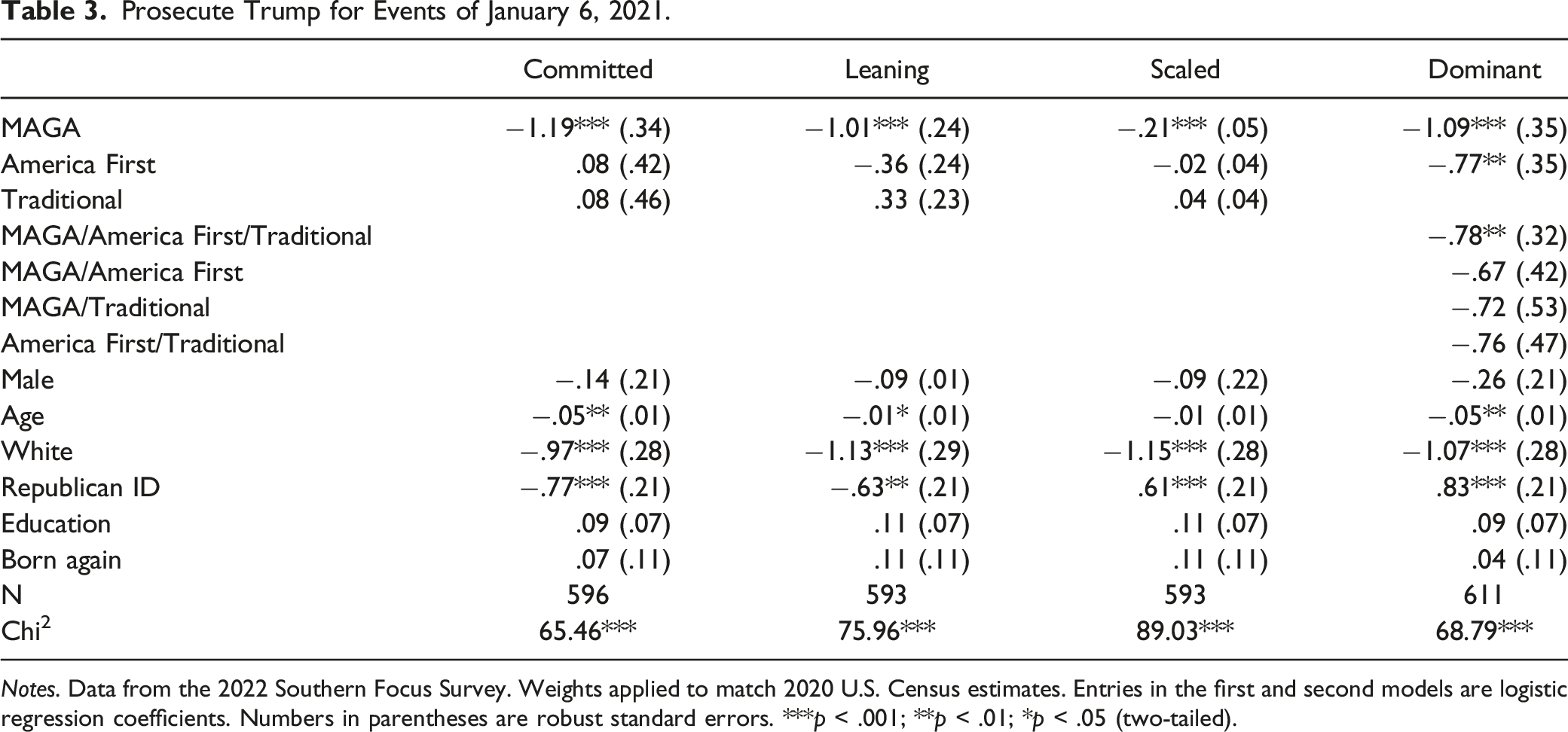
Notes. Data from the 2022 Southern Focus Survey. Weights applied to match 2020 U.S. Census estimates. Entries in the first and second models are logistic regression coefficients. Numbers in parentheses are robust standard errors. ***p < .001; **p < .01; *p < .05 (two-tailed).
American Elections Are Not Secure Enough.
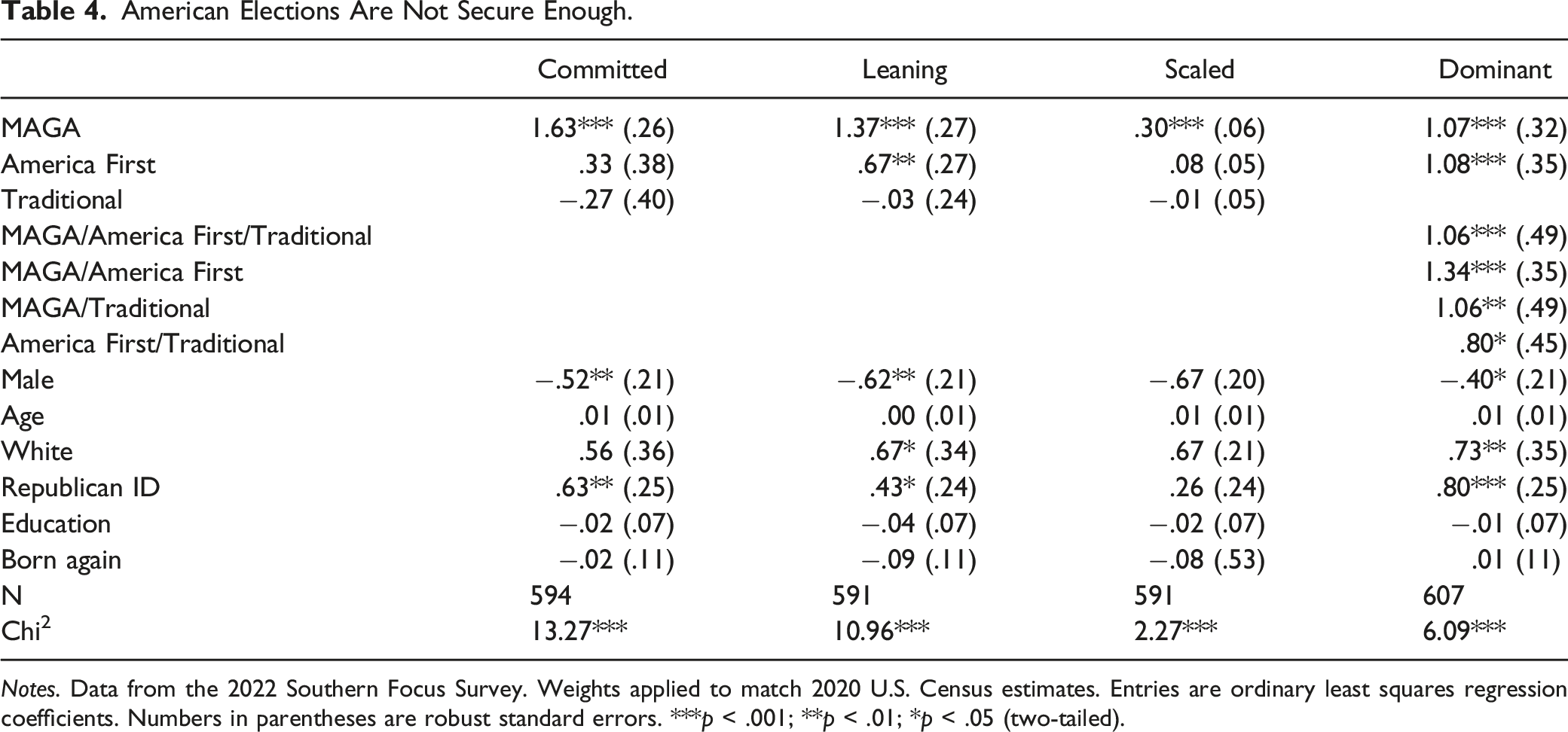
Notes. Data from the 2022 Southern Focus Survey. Weights applied to match 2020 U.S. Census estimates. Entries are ordinary least squares regression coefficients. Numbers in parentheses are robust standard errors. ***p < .001; **p < .01; *p < .05 (two-tailed).
Approval of Former President Trump.
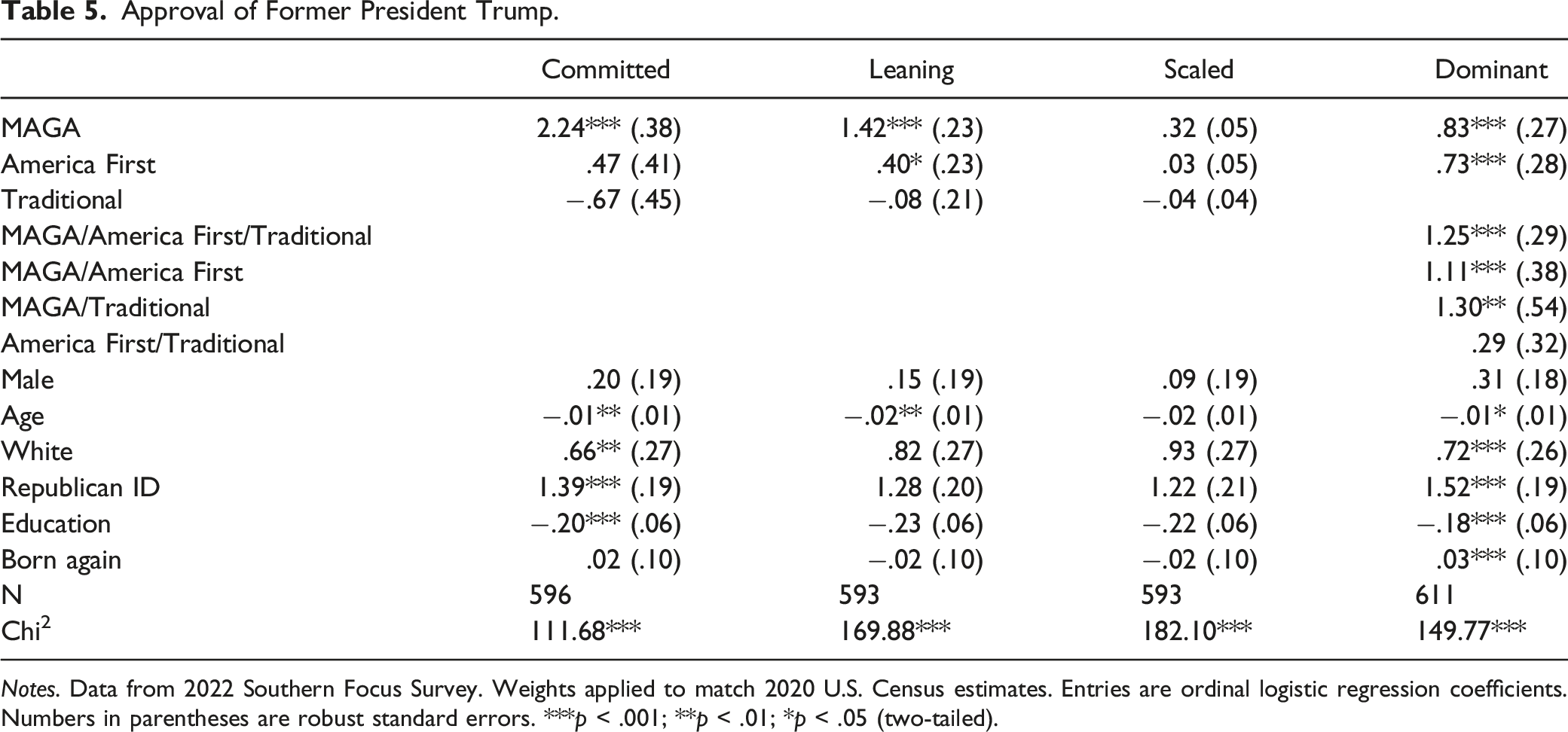
Notes. Data from 2022 Southern Focus Survey. Weights applied to match 2020 U.S. Census estimates. Entries are ordinal logistic regression coefficients. Numbers in parentheses are robust standard errors. ***p < .001; **p < .01; *p < .05 (two-tailed).
Conclusion
This study examined the presence and political significance of Republican Party factions in the contemporary American South. Overall, we find a high level of support for MAGA Republicans within the southern electorate. Further, there are varying degrees of overlap between MAGA identification and identification with other factions (America First and Traditional Republicanism). We also find that, despite the overlap, MAGA identifiers have different opinions on several important political issues related to President Trump and American democracy. Our findings highlight the vital role identity plays in modern American party politics (Kalin & Sambanis, 2018), and specifically in the case of southern Republicans. Lastly, our work reinforces the view that scholars of southern political parties and parties more generally should acknowledge that intraparty factionalism is not simply an elite dynamic, but instead has important consequences for the ways in which rank-and-file Americans understand politics and government.
Previous work has demonstrated that many elite intraparty factions have limited staying power and are often replaced by similar factions with different names. For example, among congressional Republicans, the Tea Party gave rise to the Freedom Caucus. Likewise, scholars who examine intraparty factionalism in the electorate should continue to probe the reach and limits of the current iteration of intraparty factionalism in the Republican Party. While the MAGA label will likely fade, the forces that gave it life will probably persist, albeit under a different name. President Biden has stressed repeatedly that his main dispute is not with the Republican opposition per se, but rather the MAGA faction within the GOP. As our findings indicate, many rank-and-file MAGA affiliates belong to other Republican factions like America First and Traditional Republicans. Hence, disparaging MAGA Republicans as a distinct component of the GOP is not empirically accurate. However, the evidence strongly suggests MAGA Republicans indeed stand out for harboring anti-democratic opinions and beliefs most aligned with this faction’s undisputed and unquestioned leader, former President Trump.
Footnotes
Declaration of Conflicting Interests
The authors declared no potential conflicts of interest with respect to the research, authorship, and/or publication of this article.
Funding
The authors received no financial support for the research, authorship, and/or publication of this article.
