



Abstract
Since the 9/11 terrorist attacks, research on attitudes towards the use of torture on suspected terrorists has become common. However, despite acknowledging the identity-rooted relationship between threat and out-group hostility, the possible relationship between identity attachment and attitudes towards torture has been under-explored. Using data from the 2016 American National Election Study, the results of the present study further the understanding of the relationship between identity and support for torture. Two main findings are supported: 1) greater attachment to American Identity increases support for the torture of suspected terrorists, and 2) the perceived threat of terrorism partially mediates the relationship between attachment to the American Identity and attitudes towards torture. Ultimately, the study demonstrates, high attachment to American Identity and the 9/11-generated discursive construction of terrorists as threatening this identity is associated with individuals’ attitudes towards torture.
Introduction
The 1949 Universal Declaration of Human Rights and the 1984 United Nations Convention against Torture prohibit the use of torture (Office of the united nations high commissioner for human rights (OHCHR) 1984). Yet, in 2014, the Select Committee of the United States Senate published a report documenting the CIA’s six-year-long “enhanced interrogation program” (BBC 2014). Initiated in the aftermath of the 9/11 terrorist attacks, the program involved the harsh interrogation of suspected terrorists at black sites around the world through methods such as: sleep deprivation, prolonged stress positions, wall standing, box confinement, sexual threats, sexual humiliation, mock executions, and waterboarding (ibid). The release of the report provoked outrage across the world, but in the United States, torture had already become a subject of public discussion a mere 2 months after the September 2001 terrorist attacks (Rutenberg 2001).
Since then, countless national polls have explored Americans’ attitudes towards torture, illustrating a diverging set of opinions (Gronke et al., 2010). Given the importance of public opinion on policies and the grave violation of human rights that torture implies, the main question has always been: What drives support for the use of torture on suspected terrorists? Broadly speaking, research has mainly focused on four sets of factors. First, individual profiles and their relations with attitudes; in this direction, the scholarship has highlighted the role of ideology, partisanship, gender, age, and authoritarian predispositions in determining attitudes towards torture (Gronke et al., 2010; Haider-Markel and Vieux 2008; Huddy et al., 2005; Lizotte 2017; Mayer and Armor 2012; Piazza 2020). Second, the influence of exposure to political information, most notably the political discourse surrounding the war on terrorism, in determining foreign policy attitudes after 9/11 (Blauwkamp et al., 2018; Haider-Markel et al., 2006). Third, the role of situational perceptions, such as the link between the perceived threat of terrorism and opinions on torture (Huddy and Feldman 2011; Huddy et al. 2005, 2007; Nacos et al., 2007).
Next to these three broad sets of factors, there is, fourthly, dynamics of social and political identity have also been shown to play a central role in explaining individuals’ attitudes towards torture. Specifically, the ethnic background of suspected terrorists, whether they are of Arab descent and/or Muslim, has been shown to be related to Americans’ support for torture (Conrad et al., 2018; Huddy et al., 2005; Piazza 2015). However, although the scholarship has emphasized the importance of identity politics, the relationship between identity and attitudes towards torture has so far been under-explored. Therefore, the present study aims to tackle this scholarly gap and to explore the following research questions: How does identity impact the support for the torture of suspected terrorists in the United States? And to what extent is the role of identity contingent on the perceived threat of terrorism?
Academically, the exploration of this topic is relevant to understanding both the influence of identity attachment on intergroup behavior and the effect that threatening events have on individuals’ attitudes. Moreover, since policy decisions can often be determined by public opinion and that torture represents a grave violation of human rights, it is quintessential to grasp the drivers of support for such policy preferences.
Specifically, the current study focuses on the potential role of perceived threat in linking identity and support for torture. Social Identity Theory (Tajfel and Turner 1979, 1986; Tajfel et al., 1971) is theoretically extended by applying Brewer’s (2001) assumption that out-group hostility is expressed in an aggressive fashion only in the presence of a perceived threat to the values of the in-group. In other words, it is theorized that perceived threat mediates the relationship between group identity and attitudes towards torture. To test this assumption, data from the 2016 American National Election Study (ANES) are utilized. The analyses support two main findings. Firstly, American identity is indeed shown to have a positive relationship with support for the torture of suspected terrorists. Secondly, the relationship between American identity and attitudes towards torture is shown to be partially mediated by the perceived threat of terrorism. These findings underscore the importance of identity and perceived threat in determining individual’s attitudes towards torture.
Attitudes towards torture
Immediately after the 9/11 attacks, torture had seemingly become a topic of conversation among ordinary Americans (Rutenberg 2001). The 9/11 attacks also sparked an interest in understanding support for torture among Americans. Gronke and colleagues (2010) identified 32 polls conducted during the presidency of George W. Bush that showed that a majority of Americans stood in opposition to torture. Nevertheless, the public’s tolerance for torture has actually increased since 2009; the first majority support being identified during the first days of the Obama presidency (Gronke et al., 2010; Mayer and Armor 2012; Tyson 2017). Moreover, during one of his first television interviews as president, Donald Trump declared that he believed that torture “absolutely” works and that if Americans felt strongly about it, he would reinstate the enhanced interrogation program (BBC 2017). Since changes in public opinion can influence a state’s policy orientations (Baum 2004; Holsti 2004; Powlick 1995; Zaller 1992; 1994), researchers have paid a fair amount of attention on the factors that can drive support for the torture of suspected terrorists.
Several studies have demonstrated that people believe certain exceptional circumstances justify the use of torture (Homant and Witkowski 2011; Homant et al., 2008; Houck and Conway 2013). Accordingly, how the issue of torture is framed in questionnaires can have an influence on attitudes (Homant and Witkowski 2011; Homant et al., 2008; Houck and Conway 2013; Haider-Markel et al., 2006). For instance, Blauwkamp and colleagues (2018) found that around half of Americans support torture when made to think about its effectiveness, but a great majority oppose it when asked about the specific interrogation methods. Looking at individual differences, ideology has been shown to greatly influence attitudes towards torture; with those leaning to the right being more likely to support the torture of suspected terrorists, and similarly Republicans tending to have more favorable attitudes towards torture than Democrats (Conrad et al., 2018; Eichenberg 2010; Huddy et al., 2005; Mayer and Armor 2012; Miller et al., 2014; Piazza 2020).
Indeed, recent literature has shown that in certain contexts, partisan cues can have a larger influence on political preferences than certain psychological predispositions. For instance, Connors (2020) shows that social cues can influence political values as people do what they perceive to be socially desirable. Citizens might even adopt personality attributes that they perceive as politically congruent (Bakker et al., 2021). Partisan cues would therefore activate previously latent biases held by citizens (Cohen 2003; Goren et al., 2009). Partisan cues can significantly influence even very specific moral foundations (Ciuk 2018; Hatemi et al., 2019). The influence of partisanship suggests that political values are not internal predispositions, but rather could be socially induced. With regards to attitudes towards torture, these findings hint at individuals potentially following political elites’ and others’ opinions when it comes to their support for it (Guisinger and Saunders 2017).
Religiosity has also been shown to increase support for torture when this relationship is mediated through increased levels of conservatism (Malka and Soto 2011). Additionally, older people and those more educated tend to be less supportive of torture (Lizotte, 2017; Tyson, 2017; Mayer and Armor 2012). Authoritarian predispositions are also recurrently associated with intolerance, prejudice, hostility, and favorable attitudes towards torture (Huddy et al., 2005; Linden et al., 2018; Ramos and Nincic 2011). As for gender, men tend to be more supportive of torture than women (Lizotte, 2017; Wemlinger 2014). However, this gender gap has been mainly associated to the diverging ways in which men and women perceive threat.
In fact, the perceived threat of terrorism has been shown to be one of the most important predictors of support for torture. In general, research on terrorism has demonstrated that the support for aggressive policy responses and hostility towards terrorist suspects are associated with increased threat perceptions after the 9/11 terrorist attacks (Huddy et al. 2005; 2007; Mayer and Armor 2012; Nacos et al., 2007). Importantly, research exploring terrorist suspects’ ethnic background has demonstrated that Americans express increased support for torture when it is directed at suspects of Arab descent, of Middle Eastern origin, or of Muslim faith (Conrad et al., 2018; Huddy et al., 2005; Piazza 2015). In line with Social Identity Theory, these ‘threatening individuals’ can be conceived as an out-group (Tajfel and Turner 1979; 1986).
While identity might seem a worthwhile line of research in order to better comprehend individuals’ support towards torture, the scholarship has so far not focused heavily on this relationship. Therefore, the aim of this study is to further the understanding of attitudes towards torture by exploring the following question: How does identity impact the support for torture of suspected terrorists in the United States?
The Road(s) from Identity to Torture
George W. Bush is often quoted for having said, “There is no American race. There’s only an American creed” (Margulies 2013). This creed broadly refers to an attachment to values such as liberty, universal equality, the rule of law, and the integrity and dignity of the individual (ibid). Commitment to the creed is at the basis of the American identity. When asked about their attachment to this identity, Americans with pride refer to “the American Way of Life”, meaning to convey the American exceptionalism (ibid). Interestingly, research has shown that both partisan and racial divisions can be overcome by making a superordinate American identity salient (Huddy et al., 2007; Transue 2007).
An individual’s identity can have an important influence on their attitudes towards others. Social identification has been recognized as being a key element in intergroup behavior (Tajfel et al., 1971; Tajfel & Turner 1979). According to Social Identity Theory, at the heart of social identity is the process of social categorization, which distinguishes individuals into groups with differing meanings and values (Tajfel 1981; Tajfel & Turner 1979; Tajfel et al., 1971). A belief that one belongs to a group determines the delineation of the in-group and individuals who differ from the in-group are considered the out-group. Once individuals internalize their group membership as part of their self, the intergroup categorization and affective processes lead to in-group favoritism and hostility towards out-groups (Brewer 2001; Stephan & Stephan 2000; Tajfel & Turner 1979; 1986; Tajfel 1981) - with clear attitudinal consequences, including the development of political tribalism and affective polarization (Iyengar et al., 2019).
Consequently, the strength of one’s attachment to their American identity should impact their out-group behavior; specifically, it should lead to more hostile attitudes towards those demonized out-group members. Within this framework, it is easy to conceptualize terrorists as a particularly salient out-group, symbolizing the anti-thesis of the “American way” - and as such antagonism towards them, and support for actions that harm them directly or indirectly, should be a direct function of positive sentiments for the in-group. Because of the fundamental role of social identity dynamics, this relationship should exist above and beyond the ideological and sociodemographic profile of respondents. This reasoning leads to a first hypothesis:
Stronger attachment to the American Identity increases support for the torture of suspected terrorists.
While the relationship between American identity and hostility towards terrorists might seem rather evident, their relationship might not be a simple, direct one. Threat perceptions have been highlighted as a variable that mediates the relationship between identity and out-group animosity. Huddy and colleagues (2007) find that under conditions of perceived threat, hostility towards the threatening out-group is mostly identified among those highly attached to the American identity. Accordingly, strong attachment to the in-group and an increased perceived threat from an out-group would lead to strengthening the discrimination and feelings of hostility towards the out-group. Brewer (2001) argues, that the move from hostility to aggression is determined by heightened perceptions of threat directed at the very existence of the in-group. In this sense, perceptions of a threatening out-group can play a determining role in individuals’ attitudes on foreign policy in general and on torture in particular (Huddy et al., 2005).
Importantly, since the 9/11 terrorist attacks, the story of the American creed has been discursively used in such a way to portray the attacks and the terrorists as a great threat to the nation itself (Margulies 2013; Blauwkamp et al., 2018). Public opinion on foreign policy is often determined by the way the issue is framed within elite political discourse (Blauwkamp et al., 2018; Gadarian 2010; Iyengar and Simon 1993; Zaller 1992; 1994). Importantly, Americans take policy cues from their leaders, but the effects of framing depend on the pre-existing values and beliefs of the individual (Blauwkamp et al., 2018; Lightcap and Pfiffner 2014). The main affective responses provoked by 9/11 reshaped public estimations of risk and created a long-lasting increase in the public perception of a terrorist threat (Gadarian 2010; Woods 2011). This phenomenon has also observed in other countries, for instance in France after the November 2015 Paris terror attacks (Vasilopoulos et al., 2019). This perceived threat seemingly led to both emotional reactions, such as concern and fear, and cognitive reactions, such as hostility directed at those seen as threatening (Woods 2011). Following the 9/11 terrorist attacks, the political discourse presented in the media appeared to effectively influence the public’s opinions on counter-terrorism measures (Gadarian 2010; Huddy & Feldman 2011).
Significant for the present study is the manner in which the terrorist threat has been portrayed in the public discourse - most notably in light of the known effects of exposure to information framed along (negative) emotional cues (Albertson and Gadarian 2015; Brader 2005). Immediately after 9/11, authorities publicly warned about “monsters” threatening the very American way of life (Margulies 2013). Bush argued “These terrorists kill not merely to end lives, but to disrupt and end a way of life” (Bush 2001). He consistently repeated in public that the Islamic terrorists wanted to destroy what stood at the very basis of the American Creed, thus constructing the 9/11 attacks as an assault on the American identity (Margulies 2013). This discourse was made to resonate with existing beliefs about the exceptional, innocent, heroic, and good American self (Jackson 2005; 2006; Steele 2008). These in-group characteristics were contrasted to the opposed barbarism of the threatening out-group, the actions of the terrorists being deemed evil, cruel, vicious, and an act of war (Bartolucci 2014; Hatem 2004; Jackson 2005; 2006). This framing set the path for the War on Terror, a crusade to protect the values Americans most cherished in the everlasting “age of terror” (ibid).
Hence, the discourse of the war on terror appealed to and reinforced pre-existing meanings associated to the American identity. Sharp lines were drawn between the in-group and the out-group based on the construction of a powerful enemy threatening the values that formed the American identity. The perceived threat of terrorism was further strengthened by the media to such an extent that high levels of threat have persisted years after the 9/11 attacks (Haner et al., 2019). Once the enemy was defined, the justification was set for the use of extraordinary measures against those threatening the American way of life. By portraying the enemies as alien, foreign, evil, cruel, vicious, and barbaric, they were demonized and dehumanized (Jackson 2005). Accordingly, the discourse might have helped to create both a prolonged perceived threat of terrorism and the wider tolerance and legitimacy for the use of torture, some coming to see torture as both necessary and moral.
Ultimately, considering Brewer’s (2001) emphasis on perceived threat, it becomes clearer that the heightened perception of an out-group threatening the American identity can generate fear and hatred; thus, starkly dividing the world into an innocent “us” and an evil “other” (Margulies 2013). This logic leads to the presentation of a second hypothesis:
The perceived threat of terrorism mediates the relationship between attachment to the American Identity and support for the torture of suspected terrorists.
Data and Methods
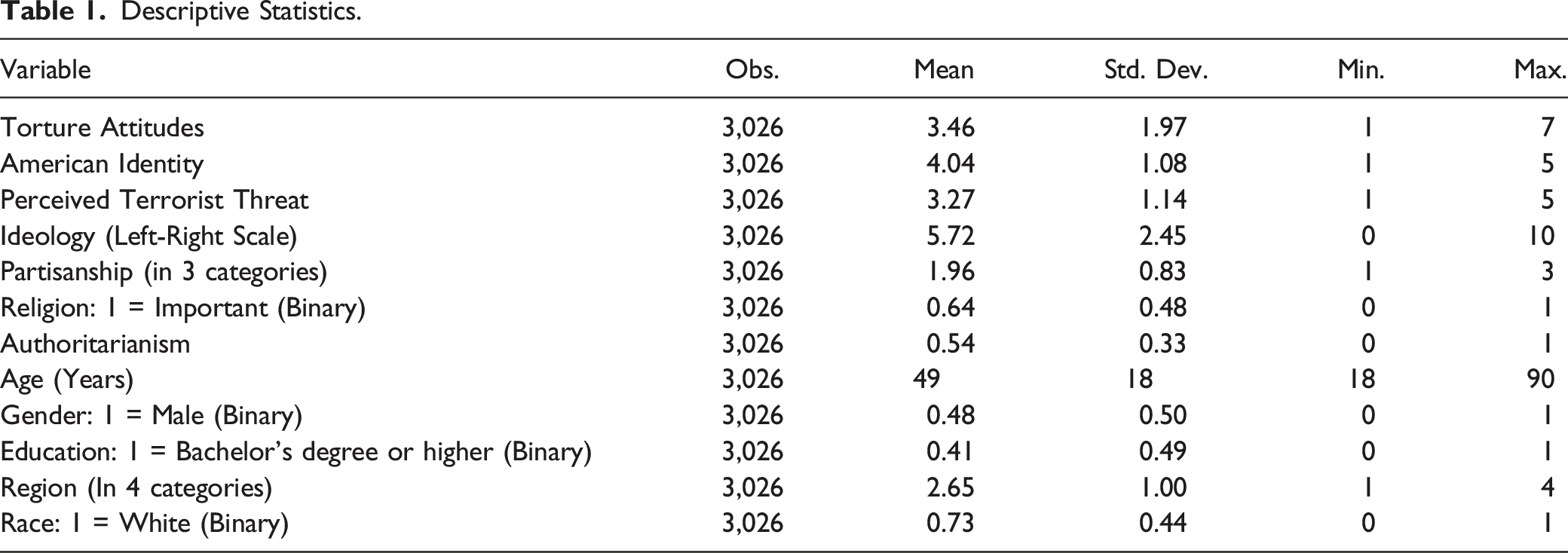
To test these hypotheses, data from the 2016 Time Series American National Election Study (ANES) are used. This large-scale, nationally representative study features a dual-mode design of two independently drawn probability samples from face-to-face interviewing (n = 1180) and internet-conducted surveys (n = 3090), data being collected between September 2016 and January 2017 (ANES 2016). With a sample frame based on lists from randomly selected residential areas and a target population of 18 years and older, the total sample size of the survey is 4270 respondents. The analyses were performed with weighted data and “Do not know,” “Refuses,” or “Left Blank'' answer choices were coded as missing. To facilitate the interpretation of the results, all variables were recoded, if need be, to run from negative to positive. Finally, missing observations were excluded from the analyses through listwise deletion; leading to a final sample of 3026 respondents.
Descriptive Statistics.
Results and Analysis
American Identity and Attitudes Towards Torture
Effect of Attachment to the American Identity on Torture Attitudes.
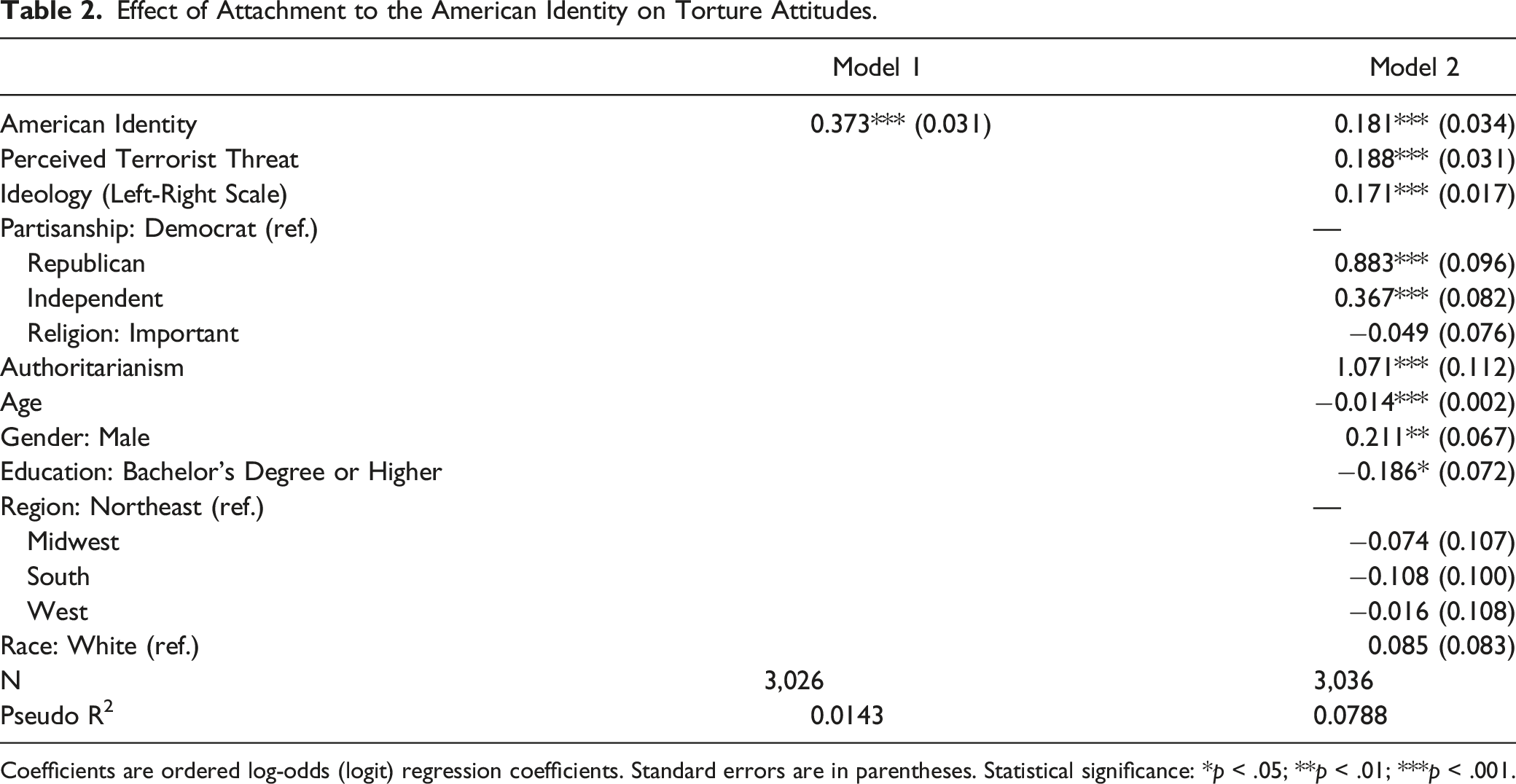
Coefficients are ordered log-odds (logit) regression coefficients. Standard errors are in parentheses. Statistical significance: *p < .05; **p < .01; ***p < .001.
In the first, baseline model, only attachment to American identity is included as a predictor of attitudes towards torture of suspected terrorists. In the second model, the perceived threat of terrorism is added in addition to American identity, along with the control variables. In line with the first hypothesis (H1), the baseline model shows attachment to American identity as being positively and significantly (at p < .001) related to attitudes towards torture. In the full model, American Identity remains positively and significantly (at p < .001) associated with attitudes towards torture, even after the addition of perceived terrorist threat and the control variables. These results support the notion that the more attached to American identity an individual is, the more likely they are to support the use of torture on suspected terrorists.
The results also show that the perceived threat of terrorism is positively and statistically significant (at p < .001) related to attitudes towards torture. This finding is in line with previous literature and highlights that the more one perceives terrorism to be a threat, the likelier they are to support aggressive counter-terrorism policies in general (Huddy et al., 2005) and the use of torture in particular (Conrad et al., 2018). As for the control variables, ideology, partisanship, authoritarianism, age, education and gender are shown to be significantly associated with attitudes towards torture. Specifically, the more one leans to the right on the ideological spectrum, the more likely they are to support torture. Similarly, Republicans and Independents are significantly (both at p < .001) more likely to support torture when compared to Democrats. Moreover, those scoring higher on the authoritarianism scale are also more likely to support torture. As for age and education, the variables have a negative and significant relationship with attitudes towards torture. The older and more educated an individual is, the less likely they are to support torture. Also, men tend to support torture (at p < .01) more than women. Finally, religion, region, and race do not show a significant association with support for torture.
The Mediating Role of the Perceived Terrorist Threat
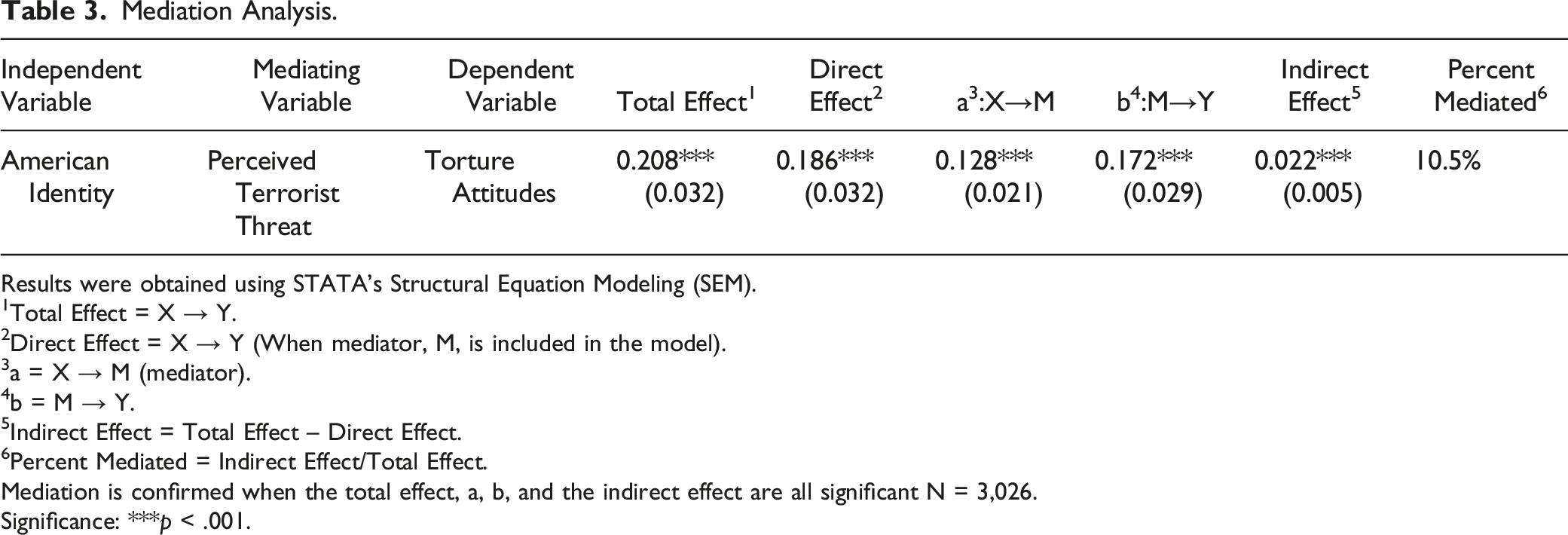
Mediation Analysis.
Results were obtained using STATA’s Structural Equation Modeling (SEM).
1Total Effect = X → Y.
2Direct Effect = X → Y (When mediator, M, is included in the model).
3a = X → M (mediator).
4b = M → Y.
5Indirect Effect = Total Effect – Direct Effect.
6Percent Mediated = Indirect Effect/Total Effect.
Mediation is confirmed when the total effect, a, b, and the indirect effect are all significant N = 3,026.
Significance: ***p < .001.
The results show that the American identity has a significant (at p < .001) positive relationship with attitudes towards torture. The mediating variable, perceived terrorist threat, also significantly (at p < .001) and positively leads to greater support for the torture of suspected terrorists. In addition, the results indicate that the direct effect on attitudes towards torture of American identity remains significant (at p < .001) when controlling for the mediator, suggesting partial mediation.
The significance of the indirect effect mediated through the perceived terrorist threat was also tested using the bootstrapping method. Results of the mediation analyses support an indirect effect by confirming the mediating role of the perceived terrorist threat in the relation between being attached to the American identity and support for torture. Around 10% of the impact of attachment to the American identity on the support for the torture of suspected terrorists is mediated through perceptions of terrorism as a threat to the United States.
Overall, the results of the different analyses support both hypotheses H1 and H2. The first series of analyses, the ordered logistic regressions, demonstrated that greater attachment to the American identity increases support for the torture of suspected terrorists. This finding was also present in the subsequent analyses. Therefore, there is strong support indicating that American identity has a positive relationship with attitudes towards torture (H1). Finally, the results of the mediation analyses showed that this relationship is mediated by the perceived threat of terrorism; in accordance with the second hypothesis that was proposed (H2).
Discussion and Conclusion
The 9/11 terrorist attacks undoubtedly shook the United States to its core. The emotional reactions that the attacks sparked arguably often sought revenge. Besides searching the globe for those responsible for these attacks, with the consequences that are today in hindsight known, Americans’ sense of vengeance also manifested itself in the rehabilitation of torturous actions towards suspected terrorists. So prominent was torture in the post-9/11 era, that it was able to impregnate itself into most facets of American culture (Adams, 2016).
The surge in debates over the use of torture subsequently led researchers to investigate the drivers that lead individuals to support a policy that is legally, ethically and morally questionable. Yet, although acknowledging the relationship between threat and out-group hostility, the scholarship under-explored the possible influence of attachment to the in-group identity and attitudes on torture. The discourse surrounding the 9/11 attacks was arguably shaped around notions of social identity, in-group preference and out-group hostility specifically. The attackers were portrayed as a threatening out-group, being evil, cruel, and barbaric and the attacks as an assault on the American way of life, and subsequently on the American identity. As such, in line with Social Identity Theory (Tajfel 1981; Tajfel & Turner 1979, 1986; Tajfel et al., 1971), attachment to the American identity should lead to increasingly hostile attitudes towards the threatening out-group; thus, explaining to a certain extent the favorable attitudes on torture.
The present study expanded on this notion and outlined a theory of mediation to explain how attachment to American identity impacts attitudes towards torture. Using data from the 2016 ANES, the results highlight two main findings. Firstly, American identity is consistently shown to be positively associated with attitudes towards torture. The stronger the attachment of Americans to their national identity, the stronger their support for the torture of suspected terrorists. This finding aligns with previous scholarship that has found that identity is an important driver in out-group hostility (Iyengar et al., 2019). By extending the out-group concept to suspected terrorists, our results demonstrate that suspected terrorists not only threaten the physical security of the United States, but they also seem to pose a threat to the symbolic notions that constitute the American nation.
Threat is the focus of the second main finding as the results also show that the relationship between American identity and support for torture is partially mediated by the perceived threat of terrorism. This finding provides support for the extension of Brewer’s argument (2001) that perceived threat to the values of the in-group is key to understanding hostility towards the members of an out-group. After internalizing group membership as part of their self, under conditions of threat individuals respond with heightened hostility towards out-groups (ibid). This is in line with the previous scholarship linking perceived threat and attitudes towards anti-terrorism policies restraining civil liberties of those seen as threatening (Huddy et al. 2005; 2007).
However, we should not dismiss the literature suggesting that the mass public is inclined to shape their political preferences and attitudes according to partisan cues (Bakker et al., 2021; Ciuk 2018; Connors 2020; Goren et al., 2009; Hatemi et al., 2019). This theoretical approach posits that social cues have an effect on people’s political values. Indeed, if political preferences are adopted based on social influences, the mediating role of the perceived threat of terrorism might be weakened. Nevertheless, as explained by previous scholarship, we have taken into account that the public opinion on foreign policy is oftentimes determined by politicians’ framing of issues (Blauwkamp et al., 2018; Gadarian, 2010; Zaller 1992; 1994). In our case, the anti-terrorism discourse in the aftermath of the 9/11 attacks helped construct a battle between the alien and barbaric enemies and the innocent Americans (Jackson 2005; 2006). This discourse which strongly resonated with values associated to the American identity heightened the perceived threat of terrorism, thus setting the conditions needed to tolerate and support the use of torture.
Ultimately, the results of the present study provide evidence to the interplay of identity, fear, and politics. Specifically, the findings underscore that the recurrent construction of terrorists in the news by politicians as threatening the very nature of the American identity has likely led to higher hostility towards threatening out-groups, including increased support for punitive actions such as torture.
While these findings make an important contribution to understanding the drivers of support for torture, there still remains many blind spots that future research needs to tackle. Firstly, would the ethnic background of the terrorist suspects make a difference? While past research has shown that the ethnic background of suspected terrorists, specifically whether they were Arab and/or Muslim, to influence Americans’ support for torture (Conrad et al., 2018; Huddy et al., 2005; Piazza 2015), it is not known whether the mediating effect of perceived threat would act in the same manner. Unfortunately, the data used in the current study did not allow to test this assumption. Further studies should explore whether and the extent to which social influence determines such attitudes on torture. Linked to this, it would also be important to better understand the influence of political discourse in this relationship. What exact role does the media play in setting the influence of threat? Also, it would be important to establish if these relationships hold true outside the United States. Debates on the treatments of prisoners/enemies that go against established norms in international law are not exclusive to the United States (United Nations 2021). Seeing the United States exceptional political system, international influence, and media environment, it is difficult to speculate on the exact international applicability of this study’s findings.
Nevertheless, the present study allows to better understand support for torture. It especially contributes to teasing out the impact of identity and threat on this policy support. If anything, this paper showcased not only the importance of a strong attachment to a social identity, but also the influence of a powerful political discourse on threat perceptions in the aftermath of a shocking event. For citizens, it raises important questions on how they interpret elite discourse. For politicians, it rings an alarm to the way their words can decrease tolerance in societies already suffering from polarization.
Footnotes
Declaration of Conflicting Interests
The author(s) declared no potential conflicts of interest with respect to the research, authorship, and/or publication of this article.
Funding
The author(s) received no financial support for the research, authorship, and/or publication of this article.
