




Abstract
We test how perceptions of feeling like a loser in American politics may condition support for changes to how elections are conducted. We report a survey experiment that sheds some light on why people may feel like an electoral loser, then use this measure of losing to predict support for a range of proposals to change elections. The experiment prompted people to consider if they were satisfied with how democracy works and to think about the design and structure of American government. Respondents were then asked if they felt like they were on the winning or losing ‘side’ of politics. The prompt was associated with higher rates of respondents reporting they felt like they were on the losing side. Non-experimental estimates of support for a range of proposed changes to elections find a substantial relationship between this form of feeling like a loser, and supporting changing how elections are conducted. This relationship holds with controls for partisanship and other factors. One implication of this is that the more that some Americans are prompted to think about their government and democracy, the more likely they support changing how it works.
Changes in election rules are relatively rare events at the national level in established democracies (Lijphart, 1991), given the incentives incumbent policymakers have for maintaining status quo rules (Benoit, 2004; Cox, 1997). In the United States, first-past-the-post rules (FPTP) structure national elections albeit with some variation at the local level (Bowler and Donovan 2008). Many election rules changes can be seen as elite driven, such as diffusion of the direct primary in the US (e.g. Ware, 2002; Reynolds, 2006), the brief adoption of the Alternative Vote (AV) in British Columbia (Cairns, 1968), and adoption of AV in Australia (Farrell and McAllister 2005). Changes in electoral arrangements may also be conditional on public opinion favoring change. Examples include adoption of legislative term limits in the US (e.g. Karp, 1995), adoption of MMP in New Zealand (Banducci and Karp 1999), and single-winner ranked choice voting (RCV/AV) in some US cities and states (Santucci, 2018). This paper examines factors associated with public attitudes about changing how American elections are conducted.
Our understanding of how and when election rules may change is enhanced by better understanding factors affecting public attitudes associated with support for rules changes. A number of existing studies examine mass opinions about election rules in terms voter self-interest, with an emphasis on understanding opinions in terms of how a change in an electoral rule may be viewed in terms of how the change advantages a person’s preferred political party (e.g. Karp, 1995; Bowler and Donovan 2007; Biggers and Bowler 2022). Additional studies examine how ideology and values such as fairness may affect evaluations of electoral rules (e.g. Banducci and Karp 1999; Bowler et al., 2006), how an electoral system may affect how people perceive democracy (Gutierrez et al., 2022), and in terms of how dissatisfaction with democracy corresponds with support for adopting new rules (McCarthy and Santucci 2021). This paper follows this latter path.
Our interest here is with what, other than supporting a candidate who lost a recent election, may make people perceive themselves as losing in electoral politics and how this perception may affect support for changing how elections are conducted. Much of the research on the ‘winner – loser’ gap in politics has focused on electoral losers rather narrowly defined; that is, people who reported they supported a party or candidate who lost a recent election (Anderson et al., 2005). From this approach, self-reported vote is assumed to reflect the respondent’s status as ‘losing.’ Electoral losers thus defined may be less satisfied with democracy (Curini et al., 2012; Blais and Gélineau 2007; Han and Chang 2016), less trusting of government (Anderson and LoTempio 2002), have less positive attitudes toward the government (Anderson and Tverdova 2001), be more supportive of their political system (Esaiasson, 2011) and be more likely to discredit the integrity of elections (Cantú and García-Ponce 2015).
However, self-reported vote may be an indirect measure of a respondent’s actual perception of feeling like they are a winner or loser in politics. For example, some voters might cast a relatively indifferent vote or a protest vote for a party or candidate that won, while having little enthusiasm about the result. Conversely, one might enthusiastically support a party or candidate that wins, while nonetheless feeling aggrieved or frustrated while their party is in government. Defining political losers by a vote cast is particularly fraught in the United States, where separation of powers at multiple levels in a federal system may make it difficult for survey researchers and respondents to identify which vote or votes represent being a winner or loser politically.
We propose a conception of losers in politics grounded in terms of an individual’s own perceptions of winning or losing, rather than their reported vote after one election. We employ a question previously used on a Pew survey that asked respondents to “think about the way things have been going in politics over the last few years on the issues that matter to you…would you say your side has been” winning more often than losing. Prior to asking this, some respondents are prompted to consider how satisfied they are with how democracy is working and to consider if the design of America government needs fundamental change. We expect this prompt will cause some to recall when the political system failed to have met their expectations, and thus cause them to feel they are on the losing side of things. We find that respondents prompted with such considerations in a survey experiment are not simply more likely to report feeling like losers, they are also slightly more likely to support adopting proportional representation for Congress. This sense of feeling like being on the ‘losing side,’ further, is a robust predictor of support for changing a range of election rules in non-experimental estimates of opinions, much more so than a person’s reported level of satisfaction with democracy.
Attitudes about Electoral Rules
Democratic politics are contested under a range of electoral rules that, in part, may affect who wins or loses, or who perceives themselves as winning or losing in politics. We expect that status quo rules are viewed more favorably by those who feel they are winning than those who feel they are losing in politics. We assume that many people are generally risk averse when presented with proposals to change status quo election rules. Risk aversion and lack of familiarity with a proposed alternative may lead people to accept status quo election rules. At the same time, people dissatisfied with the status quo – those who feel they are losing in the political arena - may be more inclined to support changes in electoral arrangements; potentially a wide range of changes. But what causes dissatisfaction with the status quo that might translate into greater acceptance of proposals to change election rules?
We do not expect that the average person spends very much time reflecting on various proposals to change electoral rules (e.g. proportional representation, non-partisan redistricting, changes to primary elections, ranked choice voting, and so on). Nor do we expect the average person to be very familiar with the nuances of how such alternative arrangements might function if adopted and implemented. Nonetheless, survey respondents do offer up their opinions on such matters when asked. Although they may not have a full understanding of various aspects of democratic institutions (Hibbing and Theiss-Morse 1995; Delli Carpini and Keeter 1996), we do expect they have general opinions about how well or poorly democracy and government are working for them, with some being less sanguine about this than others.
We should note that discontent with the design and structure of American government is rather widespread. A Pew survey (Pew Research Center, 2018) found that 61% of respondents – majorities of Democrats and Republicans - agreed that significant changes were needed in the fundamental design and structure of American government. Discontent was higher among Democrats than Republicans, but this was more of a consensus attitude than might be observed where there are deep partisan divisions, such as approval of the president, Congress, or views of rival political party. As such, we expect that when people are prompted to briefly consider fundamental aspects of American government and democracy that this may prime a sense of discontent among some, making them more likely to feel like they are losers in politics. Discontent with how democracy is working and with the structure of American political institutions is seen here as a determinant of whether one feels to be on the losing side of things in politics.
Although we cannot randomly assign people varying levels of discontent with the status quo political system in an experimental setting, we can randomly prompt respondents to reflect on the workings of American government and democracy. We expect that when people are prompted to reflect the current state of American democracy and government, some will become more likely to perceive the system does not work in their favor. This is based on the assumption that many people in the US were unhappy with their political system (broadly defined) 1 and when prompted to consider it, we expect they will be more likely to feel it does not work in favor of their interests.
Hypotheses
(H1) We expect that prompts to consider fundamental aspects of the political system will cause respondents to be more likely to feel that they are on the losing ‘side’ of politics. (H2) We Expect this perception of ‘losing’ will correlate with greater support for changing electoral arrangements.
Data and Methods
We placed a question order experiment and a number of questions about proposals to change election rules on the 2020 Cooperative Election Study (CES), a cross-sectional sample designed to be representative of all national adults in the United States. The CES is a 50,000 person national stratified sample platform administered by YouGov. The CES is an opt-in internet sample. Many CES respondents are YouGov panelists who are are periodically recruited to take surveys; other respondents are recruited from online advertisement. Some respondents who complete the CES are pruned from the eventual sample in order to make the sample representative. Weighting is also used to make the sample representative. 2 Our CES module used for this study had 1000 respondents on the 2020 pre-election wave, with interviews conducted between 29 September through 2 November.
The experimental design and hypothesis tested here (both experimentally and with statistical models) were described in a conference paper proposal for an earlier paper after the survey questions were submitted to YouGov in July 2020, but prior to our receiving the data from the CES team. Although not formal pre-registration, we highlight this to point out the design is not post hoc. The question order experiment is designed to test the hypothesis (H1) about how prompts to consider the workings of American government and democracy affect whether or not people viewed themselves as losers in politics. Immediately after the experiment, respondents were asked if they supported adopting proportional representation (PR) for elections in the US. This allows us one preliminary test of H2 by allowing us to compare support for PR among those who were asked to define themselves as winners or loser after considering democracy and government (the treatment group) to support among those in the control group. In a subsequent section of this paper, we examine how ‘feeling on the losing side’ predicts support for a range of additional changes to electoral rules.
Figure 1 illustrates the design of our question order experiment that asked all respondents the question, “thinking about the way things have been going in politics over the last few years on the issues that matter to you, would you say your side has been winning more often than losing, or losing more often than winning.” This question wording was taken directly from an item used previously by Pew Research. Our experiment manipulated what respondents viewed immediately prior to being asked this question. One half of respondents received this question after being being randomly assigned two items in sequence that constitute our treatment. The first prompted them to consider their satisfaction with how democracy was working in the US, and the second asked them to consider if changes were needed in the “fundamental design and structure” of American government. The satisfaction item is the standard question wording used on the Comparative Study of Electoral Systems surveys. The ‘design and structure’ item was taken from another question previously used by Pew (Pew Research Center, 2018). The control group was asked the ‘losing side’ question prior to being asked the satisfaction with democracy and structure of government questions. It is important to stress that these are pre-election survey data (most interviews were conducted in mid-to-late October), measured at a point when the 2020 presidential election result was unknown but polls and forecasts showed a clear presidential popular vote advantage for Democrats. This ‘losing side’ measure is then at least partly insulated from short-term vote choice as measured in post-election studies. Question order experiment testing how considerations of democracy and government affect perceptions of feeling like a loser.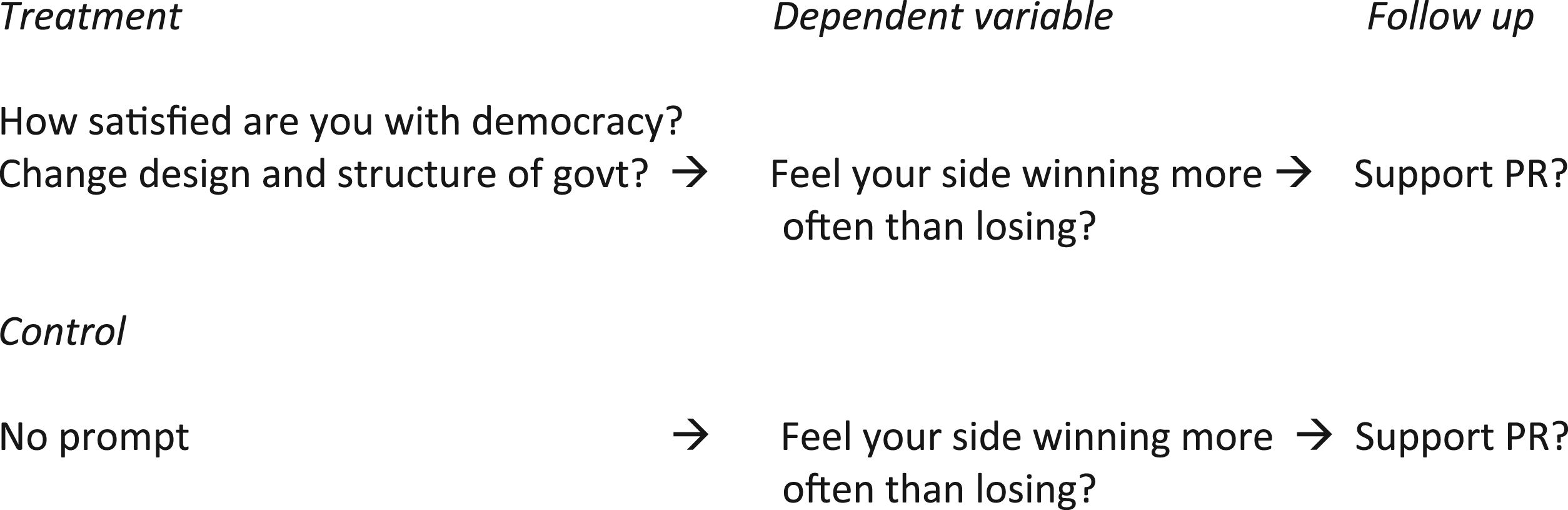
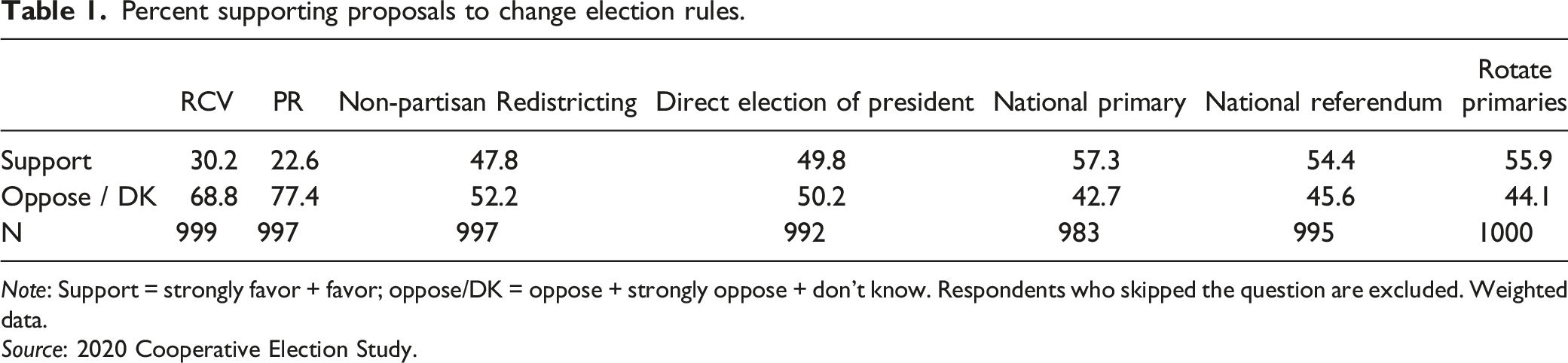
We test H2 two ways. As noted above all respondents received a question about adopting proportional representation immediately after the question order experiment. Our primary tests of H2 are conducted by estimating models of respondents' support for change to assess how sentiments of being on the losing side predict support for seven changes in electoral arrangements: 1) adopting proportional representation for Congress, 2) adopting single-winner ranked choice voting, 3) non-partisan redistricting, 4) direct election of the president by popular vote, 5) having a national presidential primary, 6) having national referendums, and 7) rotating which state’s presidential primaries are scheduled earliest. This range of ‘change’ options spans options that may be expected to be perceived by some as potentially advantaging one of the major parties over the other (e.g. direct election of the president could advantage Democrats) to others that may otherwise be neutral in terms of which party would benefit or be harmed (e.g. national presidential primaries, rotating states holding early presidential primaries).
Percent supporting proposals to change election rules.
Note: Support = strongly favor + favor; oppose/DK = oppose + strongly oppose + don’t know. Respondents who skipped the question are excluded. Weighted data.
Source: 2020 Cooperative Election Study.
Results
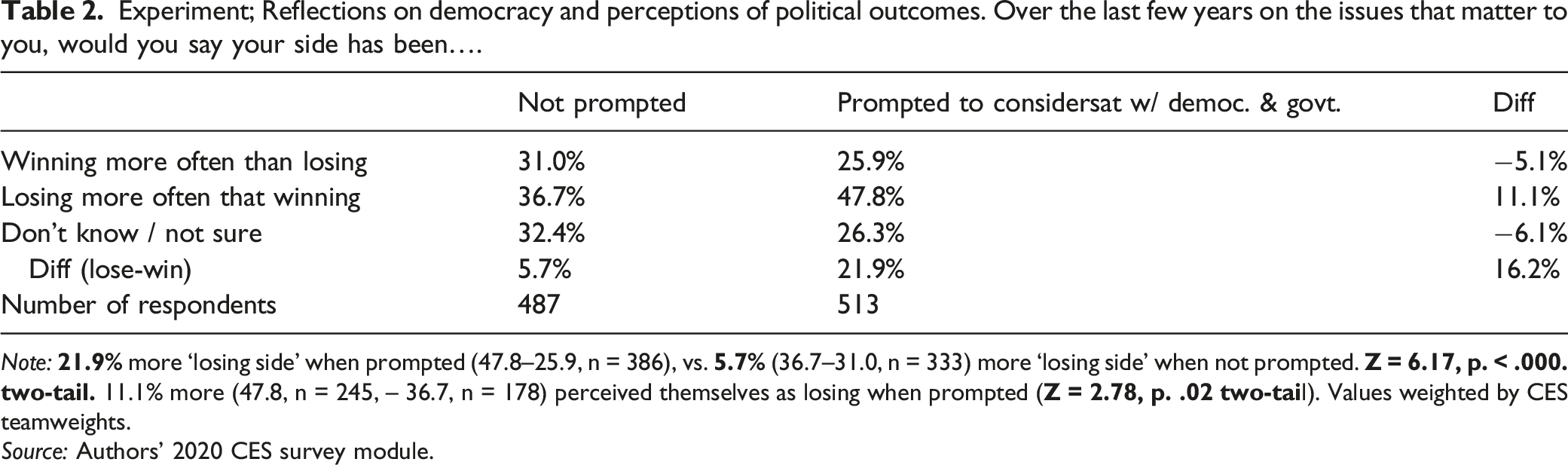
Experiment; Reflections on democracy and perceptions of political outcomes. Over the last few years on the issues that matter to you, would you say your side has been….
Note:
Source: Authors' 2020 CES survey module.
The experimental results suggest that self-perception of being on the losing side in politics is associated with considerations of how much one is satisfied with democracy and/or considerations of the need to change the design of American government. Unfortunately, these two elements of the treatment were effectively fused together, with everyone in the treatment group receiving the same two-part treatment. We cannot tell which part of the treatment – satisfaction with democracy or the need to change the design of government – is driving the result, or if both parts have equal weight, or if these effects are dependent on the two-part treatment (although we can parse this out a bit in multi-variable estimates that follow). All of this said, these experimental results suggest that perceptions of political outcomes working in ones' favor over time may be somewhat malleable and affected by considerations of broader aspects of the political system (in this case, considerations of satisfaction with how democracy was working and of the fundamental design and structure of government). Put differently, although dissatisfaction with democracy is known to predict support for new election rules (e.g. McCarthy and Santucci 2021), our experimental results suggests considerations of this dissatisfaction may cause people to be more likely to feel they are losers in politics. This suggests more depth to dissatisfaction effects and electoral ‘loser’ effects found associated with support changing rules (e.g. Karp and Tolbert 2010; Bowler and Donovan 2007) than previously understood.
Elections, and the manner by which elections are conducted, are a fundamental aspect of democracy and government. The results in Table 2 are thus relevant to our understanding of factors affecting support for changing electoral rules because these perceptions of feeling about being on the winning or losing side – independent of the party one identifies with and votes for at a particular election - may predict support for changes in election rules generally. In additional to the experimental results presented in Table 2, we also find that people in the treatment group were slightly more likely to support adopting proportional representation when asked so immediately after the experiment. Our survey included a battery of items asking about support for changing election rules at a different location on the instrument, located prior to the experiment displayed in Table 2. One item asking about PR was placed intentionally immediately after that experiment. This allows us to differentiate support for PR in the treatment and control groups described above. A logit estimate generating odds ratios with support for proportional representation as the dependent variable and a marker for being in the treatment versus control group as an independent variable found that self-reported losers in the control group were 1.53 times more likely to support PR than control group winners (p. =.12). Losers in the treatment group were 1.89 times more likely to support PR treatment group winners (p. < .02). This suggests that these consideration of satisfaction (or dissatisfaction) with democracy and government not only increased the sense of someone feeling they are losing out politically, it may also make them more likely to support changing how elections are conducted.
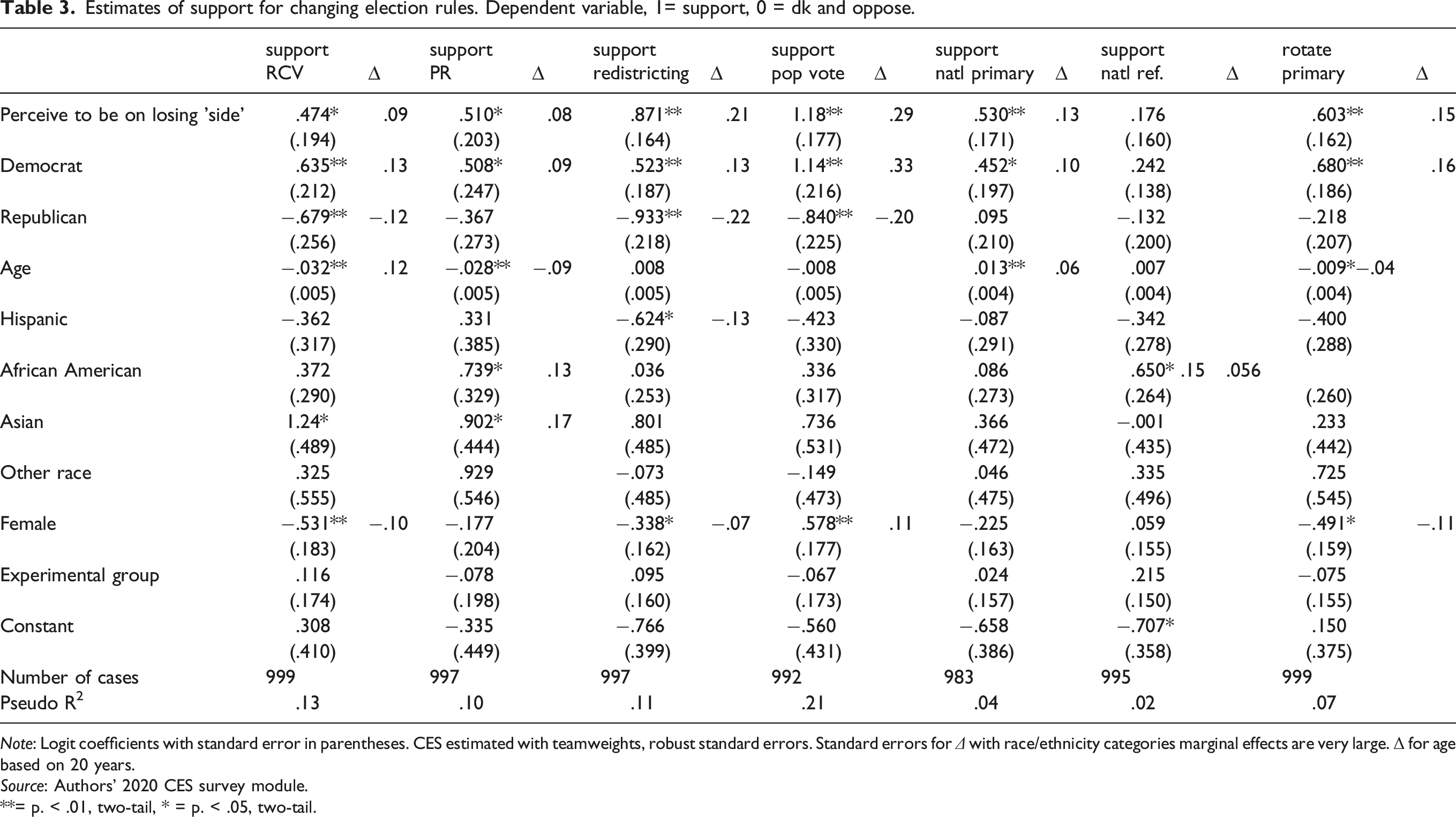
Estimates of support for changing election rules. Dependent variable, 1= support, 0 = dk and oppose.
Note: Logit coefficients with standard error in parentheses. CES estimated with teamweights, robust standard errors. Standard errors for Δ with race/ethnicity categories marginal effects are very large. Δ for age based on 20 years.
Source: Authors' 2020 CES survey module.
= p. < .01, two-tail, * = p. < .05, two-tail.
Post-estimation predictions (represented with Δ for variables in Table 3 where an estimate is significant) illustrate the substantive magnitude that a change in a variable is estimated to have on the probability of favoring proposal for a new electoral arrangement. The predictions for the losing sentiment are also presented graphically in Figure 2 in order to document the confidence intervals associated with the predictions. Figure 2 illustrates that those who perceive to be on the losing side of things are predicted to have an even probability or greater of supporting these proposals for change, apart from RCV and PR. Probability of support for changing election rules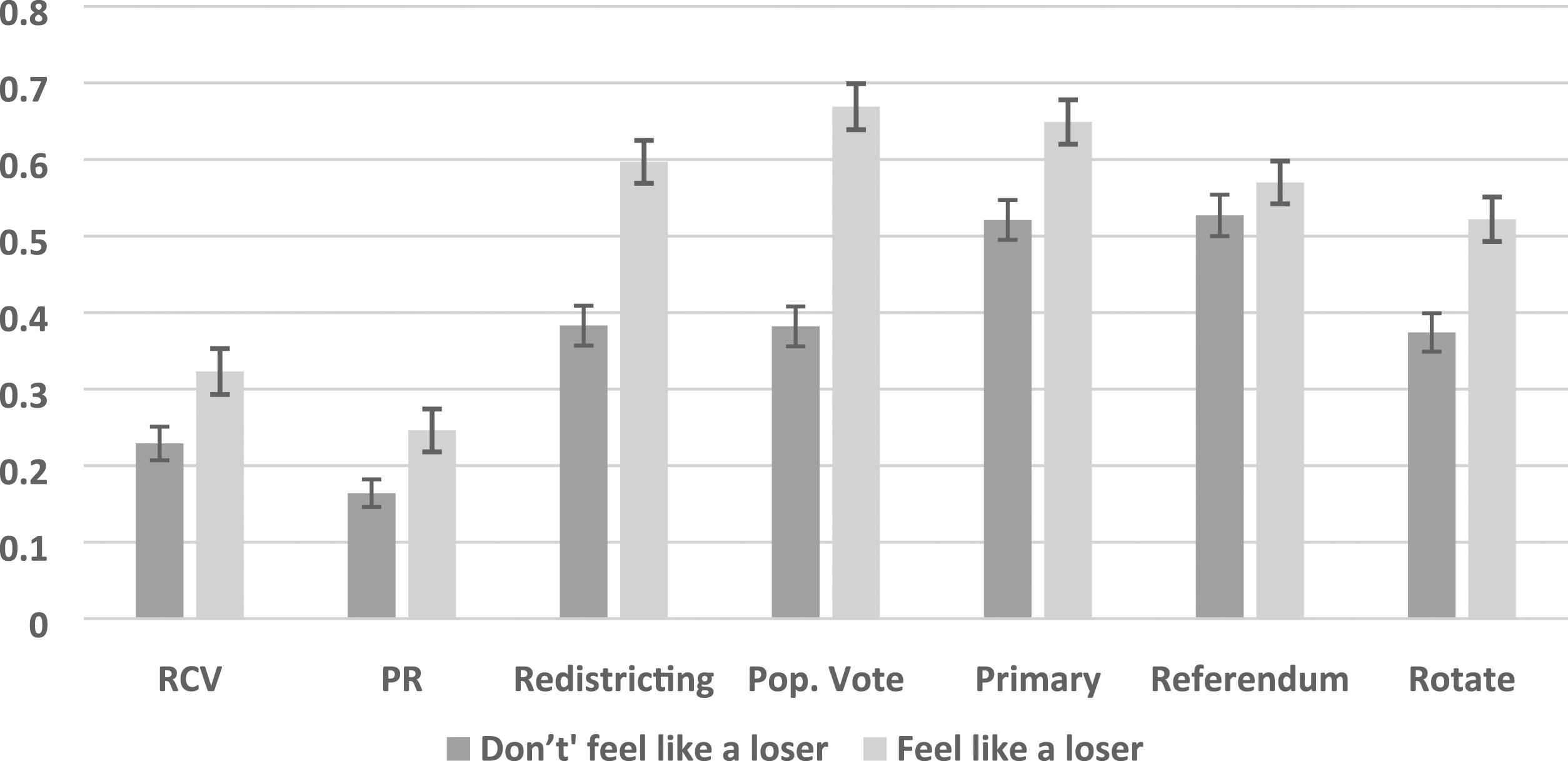
Other things held constant, including partisanship, the probability of respondents who perceived themselves on the losing ‘side’ supporting a proposed change ranged from a .08 increase probability of supporting PR, to a .29 increased probability of supporting direct election of the president. Table 3 illustrates these increased probabilities of supporting change associated with feeling on the losing side are substantively similar to (and occasionally larger than) the estimated magnitude of the relationship between partisanship and support or opposition to changing election rules. These estimates in Table 3 illustrate that the independent effect of feeling like being on the losing side of politics is as consistent a predictor of support for changing electoral rules as partisanship, with other factors held constant. The relationship between this sense of losing and support for changing elections are largely robust when the models are estimated with controls for ideology rather than partisanship (as show in Appendix Table 1A) and when estimated with party is replaced with a control for having voted for Clinton in 2016 (as shown in Appendix Table 1B).
Studies of electoral losers, as defined by reported vote, have identified an inverse relationship between being an electoral loser, and satisfaction with democracy (e.g. Blais and Gélineau 2007; Singh et al., 2012; McCarthy and Santucci 2021). As noted above, our experiment suggests that some component of a person feeling on the losing side may be associated with considerations of how satisfied they are with how democracy is working. This begs the question of whether results in Table 3 and Figure 2 associated with our measure of losing reflect some unspecified relationship between (dis)satisfaction with how democracy is working, and support for changing how elections are conducted. We test for this by replicating models in Table 3 with an alternative set of estimates in Appendix Table 1C, where our ‘feelings of losing variable’ is replaced by the standard ‘satisfaction with democracy’ question (high scores here reflect greater dissatisfaction).
When our ‘feeling like a loser’ variable is replaced with the measure of (dis)satisfaction with democracy, model fit is slightly reduced in six of seven estimates, with satisfaction with democracy being a significant predictor of support for change for just two of the seven proposals (redistricting, and direct election of the president). The feeling of losing specified in our models in Table 3 is a more consistent predictor of support for changing electoral rules than respondents' reported level of satisfaction with democracy. This suggests that perceptions of feeling on the losing side of things over time, while perhaps accentuated by considerations of how satisfied one is with democracy and how government is working, has an association with support for changing election rules above and beyond dissatisfaction with democracy per se. Feeling like a loser in the sense we have measured here is also a much more consistent predictor of support for various proposals to change election rules than is a measure of the perceived efficacy of voting. 3
Discussion
We demonstrated experimentally that perceptions of feeling as being on the losing ‘side’ in politics are increased when people are prompted to reflect on fundamental aspects of the American political system. In turn, we demonstrated that those perceptions of being on the losing side in politics are a rather consistent predictor of support for adopting a wide range of non status quo election rules. The sum of this is that support for changing electoral rules may not simply be affected by partisan interests, but also by a sense of losing that is associated with reflections on fundamental aspects of how the political system is see to be working. This improves our understanding of forces affecting public opinion that might precipitate (or potentially facilitate) some changes in election rules. One implication of our findings is that the more that some people may think about the state of American government and democracy, the more they may feel as if they are losers, and the more likely they are to support changing a wide range of rules about how elections are conducted. This does raise the question of whether actual changes in election rules could ever mitigate the feelings of losing shown here to be associated with support for changing rules. That is, if very brief reflections on America’s political system lead some people to feel they are losing out, and that is associated with support for changing electoral rules, would adopting new rules actually reduce disaffection? This is difficult to test in any manner that accounts for causality, and is beyond the scope of this research.
We expect this perception of losing associated with considerations of basic aspects of American democracy and government is different that how losing is typically measured in research on views of politics and democracy. That is, these may not simply be people who voted for a candidate who lost in a very recent election, as the ‘losing’ effect is generally measured. Clearly, losing in terms of voting, and losing in terms of the sentiments we model may likely be related, but losing as measured here does appear to be associated with broad reflections on the political system. Further, at least in terms of predictive validity, this sentiment of being on the ‘losing side’ in politics is something distinct from the ‘satisfaction with the way democracy is working’ item often used in this line of research, it is different than feeling that one’s vote may not give one a say, and it is a robust predictor of support for change when we control for supporting a candidate who lost the most recent presidential election (see Appendix Table 1B). This ‘losing’ sentiment we identify here appears to be a broader attitude or perception associated with considering how American democracy and the “fundamental design and structure of American government political system” is working (or not working). There may always be a sense among those feeling they are political losers that a change in almost anything may make them better off. Thus, what we are measuring may not be direct reflections about of what these electoral arrangements might actually produce. That, too, is beyond the scope of this work.
Some caveats are in order here. These survey data were collected online in Fall of 2020, during the COVID pandemic when more subjects than usual may have been inattentive, limiting the potential for treatment effects. Peyton et al. (2022) found that online experiments conducted in 2020 may have had smaller estimated treatment effects compared to similar experiments conducted prior to the pandemic, but they largely replicated pre-pandemic effects and concluded that online samples collected during the pandemic do not threaten the generalizability of results. Further, our logit estimates, despite controls for partisanship, could be still be capturing an additional aspect of partisanship. Some of the proposals we model support for – particularly direct election of the president and non-partisan redistricting, are disproportionately favored by Democrats in our sample. However, we also see the association between ‘feeling like a loser’ and support for a proposal supported by majorities of both Republicans and Democrats where there was much less partisan division in opinions (a national primary). We also find the relationship between feeling on the losing side of things and support for a proposal that had little support from either group of partisans in our sample (proportional representation). This suggests our findings reveal something above and beyond the standard conception of being a partisan electoral loser that may affect why some people say they would accept proposals to change status quo election rules.
This has relevance to how we have previously identified 'losers' in studies of assessments of electoral rules and political institutions. The extant literature generally accounts for electoral losers in terms of their self-reported vote in an election conducted at or near the time of a survey, or their reported vote from a single election held most immediately prior to the survey. This is not to say that people who feel they are on the losing side ‘over the last few years' would not also be those who supported a losing candidate in a recent major election. Our data are pre-election and do not allow us to estimate the potential consequences of a respondent supporting winning or losing candidates immediately after an election. However, our experimental result demonstrates that the sentiment of being ‘losing side’ identified here perhaps reflects considerations about how fundamental aspects of democracy and the political system are working (or failing).
All of this raises questions about what it actually means when we can gently prod respondents to consider the fundamental workings of their political system, and then observe that this produces a sense among some of them that the system doesn’t work for them. That sense of losing predicts support for change, with other factors held constant statistically. If just thinking about how American politics works make some folks more acceptant of changing the rules of elections, are we measuring something different than a survey respondent having any actual interest in how districts are drawn, how primaries are conducted or how presidents are elected? There may be a ‘change for the sake of change’ element here beyond interest in these election rules.
Supplemental Material
Supplemental Material - Considerations of American Democracy, Feeling Like a Loser, and Support for Changing the Rules
Supplemental Material for Considerations of American Democracy, Feeling Like a Loser, and Support for Changing the Rules by Todd Donovan, Caroline Tolbert, Samuel Harper in American Politics Research
Footnotes
Declaration of Conflicting Interests
The author(s) declared no potential conflicts of interest with respect to the research, authorship, and/or publication of this article.
Funding
The author(s) disclosed receipt of the following financial support for the research, authorship, and/or publication of this article: Common Cause Education Fund

Supplemental Material
Supplemental material for this article is available online.
Notes
Author biographies
References
Supplementary Material
Please find the following supplemental material available below.
For Open Access articles published under a Creative Commons License, all supplemental material carries the same license as the article it is associated with.
For non-Open Access articles published, all supplemental material carries a non-exclusive license, and permission requests for re-use of supplemental material or any part of supplemental material shall be sent directly to the copyright owner as specified in the copyright notice associated with the article.
