




Abstract
Voters often rely on informational shortcuts, such as the background traits of politicians, to decide which candidates to support at the ballot box. One such background trait is family composition, particularly parental status. Research, however, has mostly overlooked whether the value-laden choices that politicians make regarding their families—like what neighborhoods they live in, where they worship, and what schools they send their children to—affect how constituents view them. We conduct a survey experiment in the U.S. that presents respondents with hypothetical biographies of politicians that randomly vary one of the most important decisions that politicians make regarding their families: whether to send them to public or private school. We find that: (1) voters are more inclined to vote for politicians with children in public school; and (2) this preference may be due to voters perceiving these politicians as both warmer and more committed to public services.
Voters often turn to background traits of politicians—such as a candidate’s race, sex, education, or social status—as a heuristic to inform ballot box decisions. 1 Research examines whether family composition, and especially parental status, matters to voters (Bell & Kaufmann, 2015; Campbell & Cowley, 2018; Deason et al., 2015; Elder & Greene, 2012; Stalsburg, 2010; Teele et al., 2018; Thomas & Bittner, 2017). Yet despite the visible role that families play in campaigns, studies largely overlook how the decisions that candidates make regarding their families affect their electability. Anecdotal evidence, however, suggests that family decisions can shape voter perception of politicians. In the extreme, for example, tawdry revelations of a secret side family derailed once-rising Democratic star John Edwards. Yet even more mundane choices—such as where politicians live or how they spend time with their family—may sway voters. The fact that Joe Biden, for instance, rode the train home to Delaware nightly to be with his family during his more than three decades in the Senate rather than live in Washington was the subject of media interest, earning Biden the nickname “Amtrak Joe” (Bosman, 2008).
In this piece, we probe one of the most important family choices that many politicians make: whether to send their children to public or private school. The issue can be seen as tied to broader values. 2 As far back as the 1970s, for example, Jimmy Carter made headlines for sending his daughter to a D.C. public school, as he railed against “‘exclusive private schools’ that allow the children of the ‘political and economic elite’ to avoid public schools that are considered dangerous or inferior” (NYT, 1976). More recently, however, Barack Obama made a different choice, enrolling his daughters in tony Sidwell Friends, despite once insisting that private schools fuel “an anti-government ideology” (Schwartz, 2015). The choice, however, is not merely symbolic. Many politicians seem to think that selecting public schools can be a boon in elections. For example, while running for president, Bill Clinton reportedly subjected voters to “yards of rhetoric about Chelsea’s schooling in Little Rock, Ark”—and was “quick to point out that it was a public school in which white kids were in the minority” (Daley, 1993). As one Wall Street Journal article notes, schooling decisions are where “[t]he personal becomes political” (Kaminski, 2008).
Questions about where politicians send their children to school are not just confined to presidential races and other high-level contests. In Florida, for example, one Broward County School Board member’s decision to enroll her son in prep school caused a former member to declare that “[n]o school board member should send her child to a private school for any reason” (Baron, 2013). In Wisconsin, a state school superintendent candidate was denounced for “mountain-sized hypocrisy” as a result of sending her own children to Catholic school while positioning herself as anti-school choice (Bice, 2021). In Michigan, a trustee of a local board of education declared that a school board member who does not send his or her children to local public schools is akin “to the CEO of General Motors driving a Toyota or Detroit Tigers’ Manager Jim Leyland rooting for the Chicago White Sox” (Hatter, 2006). Even outside the U.S., the issue has made headlines. In the U.K., for instance, a Labor Party cabinet minister’s decision to enroll his child in a “private boarding school for pupils with special needs” led him to be lambasted by an MP within his own party for engaging in a “betrayal of the party’s principles” (Hunt, 2007).
Are voters more likely to cast their ballot for politicians who send their children to public over private school? To answer this question, we fielded an original survey experiment conducted on a diverse national sample in the U.S. that presented respondents with biographies of hypothetical politicians running for office. A survey experiment has at least two advantages over observational studies. It isolates how the schooling choices of politicians affect voter evaluations apart from other traits that might both correlate with schooling choices and ballot box success. Additionally, it permits us to tease out the mechanisms that could explain why voters assess politicians differently based on where they send their children to school. We randomly varied whether two hypothetical candidates running for state office are parents—and, if so, whether they send their children to public or private school. We then asked about the likelihood of respondents supporting each profile of politician at the ballot box as well as respondent perceptions of the politicians. Results are consistent with expectations: Voters are significantly more inclined to vote for candidates who send their children to public instead of private school.
We explore two possible explanations for this finding. First, we theorize that voters may perceive politicians with public school children as “warmer.” In the U.S., both public and private schools carry distinct connotations that speak to social class, mores, and other traits. Whereas private schools are typically the province of the elite, public schools serve the masses (Howard & Gaztambide-Fernandez, 2010; Kober, 2007). 3 As such, voters may perceive candidates with public school children as more likeable and friendly to the extent that the choice reflects being grounded and modest. Voters may also see such politicians as caring more about their community because they are invested in one of its main public institutions. They may even view such candidates as more conscientious, since they have aligned an important lifestyle choice with that of most constituents. We find evidence that respondents do view politicians with public school children as being more likeable, friendly, caring, and conscientious—traits that we use to create a measure of warmth. These judgments are most positive for respondents who presumably have the most in common with these politicians: public school parents themselves.
Second, we theorize that voters may also prefer politicians who send their children to public school because they view them as more dedicated to public services generally. Survey data reveal that overwhelming majorities of Americans favor increasing or preserving spending on public services. 4 This suggests that politicians who will follow through with maintaining or increasing government expenditures are likely to have electoral advantages. Politicians who send their children to public school may be more likely to signal a “credible commitment” (Elster, 1979; Holmes, 1988) to public spending because they have “skin in the game” insofar as they have tied the well-being of their family to a public institution. When candidates choose public goods themselves, voters may be more apt to believe that these politicians also value government funding because they have a personal incentive to maintain high-quality state provisions. We find evidence that respondents do view politicians with public school children as stronger advocates of public spending across a range of policy areas. This effect, however, is largest for the policy area with the most direct relevance to schooling choices: public education.
Our results add to a sizable literature on candidate experiments (Campbell & Cowley, 2014; Carnes & Sadin, 2015; Gift & Lastra-Anadón, 2018; Kahn, 1994; Sigelman et al., 1995) by examining how an important background trait—specifically, whether politicians send their children to public or private school—affects ballot box appeal. While prior research has analyzed the effect of family composition—including whether politicians have children—on electability, we find that decisions regarding families can condition how voters perceive politicians. We show that voters prefer politicians who send their children to public over private school, and that this preference may be attributable to both their perceived warmth and commitment to public services. Practically, our analysis sheds light on how politicians use their families in elections to shape their reputations (Lane, 2015; McElvoy, 2014). In the media and on the campaign trail, politicians are often seen with their families, which many seem to believe helps to cultivate their public images. We demonstrate that not only does having children matter to voters, but so do their parental choices.
The Experiment
We conducted a survey experiment in the U.S. that randomly varied whether two hypothetical candidates running for governor had children and, if so, whether the children attended public or private school. By randomly varying details about children, while holding all else constant, we can reasonably attribute any differences in candidate assessments to that information.
Sample
We conducted the survey online through the Harvard Digital Lab for the Social Sciences (DLABSS) from April to August 2019. A well-established survey platform, the DLABSS panel is comprised of volunteers who sign up to complete questionnaires relevant to the social sciences (Strange et al., 2019). The sample is diverse with respect to standard demographic traits (age, race, gender, region, etc.) and is similar to samples fielded from other commonly-used online survey platforms like MTurk (see Appendix Table A1 for summary statistics). Considerable research has relied on DLABSS data (see http://dlabss.harvard.edu/results), and the panel has been externally validated on a number of well-known surveys, including ones using nationally-representative samples, such as the General Social Survey. 5 We analyze only respondents who self-report as U.S. residents. Our final sample size is 946 respondents.
Survey Instrument
Respondents each read vignettes of two hypothetical male candidates whose order of presentation was randomized (see Appendix). After reading details about a candidate, respondents answered questions about that candidate, then repeated this step for the next candidate. Respondents were randomly assigned to one of three groups: (1) a Control, where children were not mentioned; (2) a Public School treatment, where the politician had two children (a boy and a girl) who both attended public school; and (3) a Private School treatment, where the politician had two children (also a boy and a girl) who both attended private school. In addition, the vignettes provided other generic details about the candidates (age, work history, volunteerism/charitable work, government experience, and marital status). They also included a generic quote from the politicians explaining why voters should support them. To emphasize in the Control condition that the candidate did not have any children, we noted that the candidate and his wife lived with their dog, to imply that they did not live with anyone else. For consistency, in both the Public School and Private School conditions, we also said that the candidate and his wife lived with their dog, as well as their children. 6
We attempted to create a reasonable balance with respect to the content of the vignettes—one that provided sufficient detail such that the schooling treatment was not the obvious main focus, while also ensuring that the biographies were sufficiently parsimonious to reduce cognitive burdens and to make the politicians generic enough to ensure generalizability. The vignettes do lack extensive content—such as multi-faceted policy positions — that might be salient to voters in real campaigns. This could make the treatments stand out more and bias the results toward finding an effect of schooling choices. This challenge reflects ongoing debates in the literature about how detailed or (minimalist) politician depictions should be in candidate experiments. We aimed to make the level of detail in the biographies broadly consistent with related research (e.g., Campbell & Cowley, 2018; Gift & Lastra-Anadón, 2018, Iyengar & Westwood, 2015). In context of other information, it is not clear that schooling choices should be an overly blunt treatment. Nonetheless, by only manipulating parenthood and schooling choices, the vignettes do limit our ability to test, for example, whether our results are conditioned by various omitted variables (such as the candidate’s partisanship, gender, etc.) that have been shown to matter in prior research, and to explicitly compare effect sizes to these variables.
Dependent Variable
Our dependent variables were the candidate’s ballot box appeal, warmth, and commitment to public services. We measured ballot box appeal by asking how likely the respondent would be to vote for the candidate. Answer choices were coded on a 1 to 5 scale, where 1 denoted that respondents would be “Extremely unlikely” to vote for the candidate and 5 “Extremely likely.” We measured perceived warmth on a 1 to 5 scale by creating an average index incorporating likeability, conscientiousness, friendliness, and caringness. 7 Respondents answered how well or poorly each of the words “likeable,” “conscientious,” “friendly,” and “caring” describe the candidate. 8 We measured perceived commitment to public spending on a 1 to 5 scale averaged across multiple policy areas. For each policy area, we asked, “If this candidate were elected governor, how likely do you think he would be to advocate for more funding for public [schools/anti-poverty programs/transportation/health initiatives]?” 9
Empirics
We estimate the effect of where politicians send their children to school using the following model:
Main Results
Figure 1 displays our main results (See Appendix Table A3 for the results as a table). For each dependent variable—ballot box appeal, perceived warmth, and perceived commitment to public spending—we find that respondents give public school candidates the highest ratings. The greatest differences in evaluations are between the public and private school candidates, and in all cases, these differences are statistically significant. For ballot box appeal, respondents rate candidates who send their children to public school 3.26, meaning that they are slightly more than “neither likely nor unlikely” to vote for them. That rating drops to 2.94 when politicians send their children to private school (slightly less than “neither likely nor unlikely”). 14 The rating of non-parent candidates lies in the middle, at 3.1. We theorize that politicians who send their children to public schools have greater ballot box appeal because they are viewed as warmer and more committed to public services. For perceived warmth, the rating for public school candidates is 3.55, compared to 3.42 for private school candidates. 15 For perceived support for public spending, those ratings are 3.52 and 3.09, respectively. 16
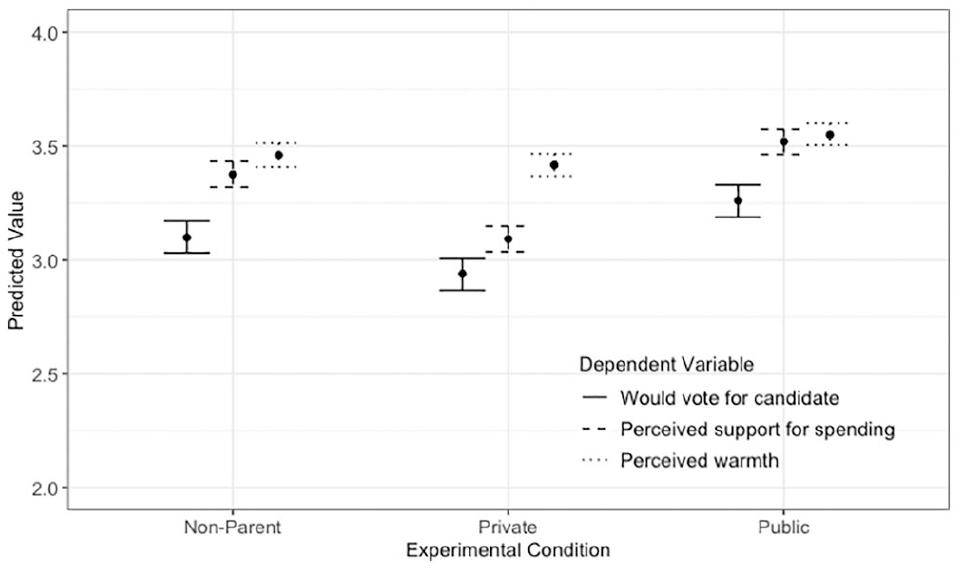
Predicted values of ballot box appeal, perceived warmth, and perceived support for public spending.
Conditional Effects
We also probe whether our mechanisms have a stronger effect under certain conditions. In Figure 2, we analyze whether respondents who send their children to public schools view politicians with public school children as particularly warm. Restricting the data to only respondents with children, we find that public school respondents rate public school candidates as 3.58 on the warmth scale, compared to 3.4 for private school candidates. Appendix Table A9 confirms that the interaction between the public school treatment and the respondent being a public school parent is positive and statistically significant. In Figure 3, we analyze whether voters perceive politicians with public school children as more likely to invest in public schools than any other policy area. We find that, for public school politicians, perceived support for public schools is 3.87 on the spending scale, compared to 3.49 for public health, 3.3 for public transportation, and 3.43 for anti-poverty programs. Tests for the equality of coefficients across the underlying models for each spending area confirm that the effect of the public school treatment is largest when the outcome is perceived support for public school spending. 17
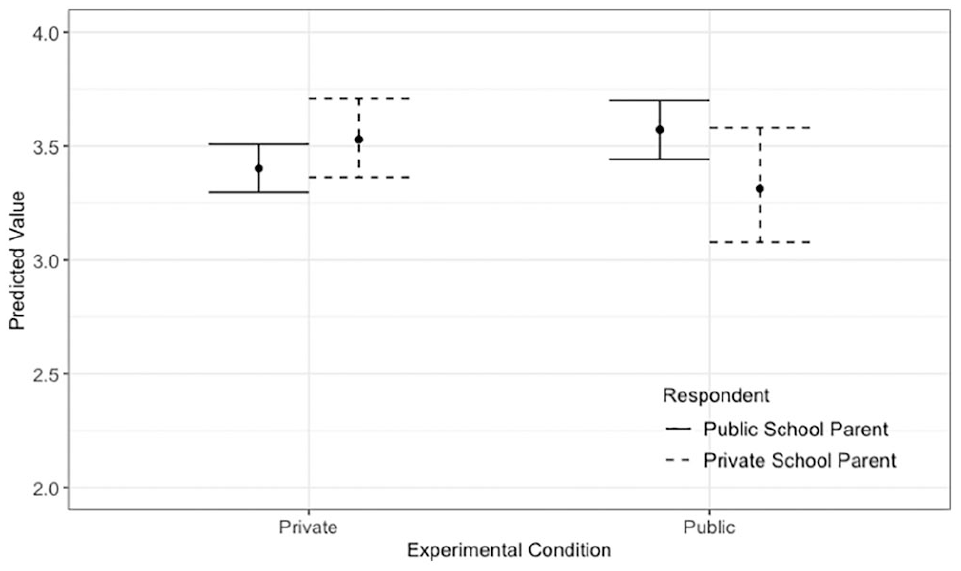
Predicted values of perceived warmth, by whether the respondent is a public or private school parent.
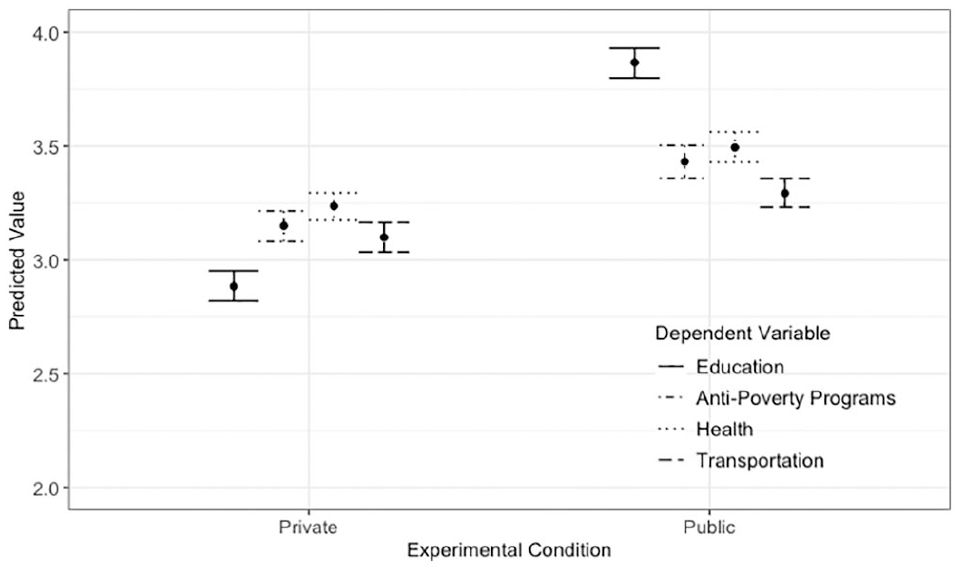
Predicted values of perceived support for public spending, by policy area.
Separating Partisanship and Schooling Choices
One potential confounder is that voters use politician schooling decisions as a heuristic for other background traits that are excluded from our biographies—mostly notably, partisanship, since this is often linked to educational policy agendas. The Democratic Party, for example, is aligned more with teachers unions and against school choice, so voters may assume that politicians who send their children to public school are more likely to be Democrats and cast their ballot accordingly. Although we do not manipulate candidate partisanship due to concerns that it would overwhelm the evaluations, 18 we reestimate the main ballot box appeal model but include controls for whether the respondent perceives the candidate to be a Democrat, the respondent’s own partisanship, and an interaction of the two. As anticipated, Appendix Table A10 shows that, although the magnitude of the public school parent coefficient decreases, it remains positive and statistically significant. This improves confidence in our results. Even if some respondents infer the partisanship of candidates based on their schooling choices and then evaluate them according to whether this partisanship matches their own, this does not fully explain why politicians with public school children have more ballot box appeal.
Conclusion
It is widely believed that the decisions politicians make regarding their families can influence how voters perceive them. We analyzed how one of the most visible and important such decisions—whether politicians send their children to public or private school—can shape their ballot box appeal. To do so, we fielded an original survey experiment among a nationwide sample in the U.S. that presented biographies of hypothetical politicians, and then randomly varied whether they had children and enrolled them in public or private school. We found that voters were more likely to support politicians who send their children to public over private school. Additionally, respondents perceived politicians with public school children as warmer and more committed to public services, which may explain their greater ballot box appeal. Results also point to notable conditional effects. Respondents with public school children find politicians who also send their children to public school especially warm. Moreover, respondents perceive politicians who send their children to public school as particularly committed to spending on public education relative to other policy areas.
These findings may have implications for understanding how politicians use family members strategically in campaigns. They also contribute to a growing literature on candidate experiments. We are, to our knowledge, the first to analyze how the actual decisions that politicians make regarding their families shape voter evaluations. This is a promising avenue for inquiry, as there is much we do not know about how other family choices—such as whether politicians live in wealthy suburban enclaves or working-class neighborhoods, whether families are active in local place of worship, and so on—shape voter assessments. Future research could test our main predictions using observational data. Scholars could also analyze whether other background traits of politicians—such as their partisanship, gender, or race—interact with parental status and schooling decisions to affect whether voters view them favorably. Another extension could be to see whether results our replicate in national-level campaigns (e.g., for president) and district- or local-level campaigns (e.g., for U.S. or state representatives or school boards). Our study suggests that the decisions politicians make regarding their families can affect how voters assess them.
Footnotes
Appendix
Author’s Note
Leslie K. Finger is now affiliated University of North Texas.
Declaration of Conflicting Interests
The author(s) declared no potential conflicts of interest with respect to the research, authorship, and/or publication of this article.
Funding
The author(s) received no financial support for the research, authorship, and/or publication of this article.
