




Abstract
Citizens need to trust in the integrity of news reporting for the free press to fulfill its role as a democratic institution that enables citizens to hold representatives accountable. Growing research has shown that increased use of social media erodes trust in legacy news. However, trust-reducing social media messages are not contained to social media platforms; they are widely recirculated by the mainstream media. We argue that mainstream media corporations select social media messages to recirculate precisely because of their trust-reducing features in order to respond to short-term competitive market incentives. We turn to Donald Trump’s Twitter posts as examples of trust-reducing messages and show that the media cites more trust-reducing messages more quickly and more frequently than less trust-reducing messages. These findings implicate mainstream media corporations alongside social media platforms in the systematic and ongoing degradation of trust in legacy news reporting.
Introduction
In order for democratic institutions to function, people need to trust in them (Gamson, 1968; Hetherington, 2005; Hetherington & Husser, 2012; Levi, 1998; Kampen et al., 2006; Misztal, 2001; Sabel, 1993). The news media is one democratic institution that enables citizens to learn about their officials’ behavior in office and later hold them accountable for that behavior in the ballot box (Liebes & Ribak, 1991; Tsfati & Cohen, 2005). As such, trust in the news media as a free, independent, and reliable source of political information is critical for protecting democracy (Blöbaum, 2014; Müller, 2013; Paisana et al., 2020). However, Americans are increasingly turning away from legacy news media outlets toward social media as a primary source for political news (Mitchell et al., 2020; Oeldorf-Hirsch et al., 2020; Oliphant, 2020), a development that threatens to erode trust in legacy news media, increase partisan polarization, and decrease engagement in the democratic process.
As users turn to social media for their news, they encounter more ideologically polarized and less factual messages, partially as a result of their own seeking behaviors and partially due to the non-content-neutral sorting and searching algorithms that select the content users see (Cardenal, Aguilar-Paredes, et al., 2019). When viewers encounter ideologically-confirmatory information, they are less likely to validate it (Edgerly et al., 2020; Edgerly & Vraga, 2020), and when they encounter ideologically-disconfirmatory information, they are more likely to respond by doubling down on ideologically polarized beliefs and doubting the credibility of the message’s source (Anderson & Auxier, 2020; Feldman et al., 2020; Levendusky, 2013; Slothuus & de Vreese, 2010; Taber & Lodge, 2006). Furthermore, social media platforms can be infiltrated by many groups with antidemocratic goals, including authoritarians who harass and censor information (Tucker et al., 2017), foreign states who use troll farms and fake accounts to foment discontent (Jayamaha & Matisek, 2019), and domestic users who spread antimedia rhetoric that calls into question the validity of traditional news reporting (Strömbäck et al., 2020). Social media corporations contribute by exacerbating these hostile behaviors with demonstrably inconsistent applications of community standards (Smith, 2020) and counterproductive content warning labels (Oeldorf-Hirsch et al., 2020; Vogels et al., 2020). All of these forces jointly contribute to decreased trust in legacy news reporting among social media users.
Investigations into the effects of social media messaging on trust in democratic institutions tend to focus on the circulation of social media messages within social media platforms (Cardenal, Aguilar-Paredes, et al., 2019; Edgerly et al., 2020; Edgerly & Vraga, 2020; Nekmat, 2020; Steppat et al., 2020). However, social media messages, including messages which erode trust in traditional news reporting, are also widely dispersed throughout the legacy media. Why do mainstream media producers recirculate social media messages which threaten to push viewers away from their platforms, and how do they select which messages to recirculate from the millions posted every day?
We argue that legacy news producers select and redistribute trust-reducing social media messages not despite their trust-reducing features but because of those features. Drawing upon Iyengar and Hahn’s (2009) influential account of how competitive market forces influence news media content, we trace damaging social media messages originating from Donald Trump’s now-suspended @realDonaldTrump Twitter handle throughout traditional media broadcasts. Trump’s trust-reducing messages were widely distributed throughout broadcast news in the United States, and in an effort to attract viewers in the short run, broadcasters cited the most trust-reducing messages more quickly and more frequently than less trust-reducing messages. These findings implicate the mainstream media in a causal explanation for growing distrust in legacy news reporting and contribute to our knowledge about how social media messaging may threaten democratic norms.
@realDonaldTrump
Breaking with a long tradition of presidential communication aimed at focusing public support on a unified policy agenda (Corrigan, 2000; Kernell, 1997; Kingdon, 1995; Schattschneider, 1975), Trump eschewed official White House correspondence channels in favor of his personal Twitter account, which he claimed enabled him to bypass news and other media producers who would dilute or corrupt his message to the American public (Trump, 6/6/17, 06:58). Before his Twitter account was suspended in January, 2021, Trump tweeted with extreme frequency, and his tweets were (in)famous for being anything but official-looking correspondence from the office of the President of the United States. They routinely contained misspellings, ad hominem, inflammatory and politically extremizing language, grossly misleading statistical or empirical data, and, above all, photos of himself. Instead of using the bully pulpit to push a unified policy agenda, Figure 1 provides examples of how Trump turned to social media to opine about topics that interested him personally, like the relative ratings of various television programs or what he perceived to be personal slights against him when others failed to express sufficient gratitude for favors (Trump, 11/19/2017, 11:42; 3/5/20, 10:10; 1/2/18, 18:49; 6/6/17, 6:58).
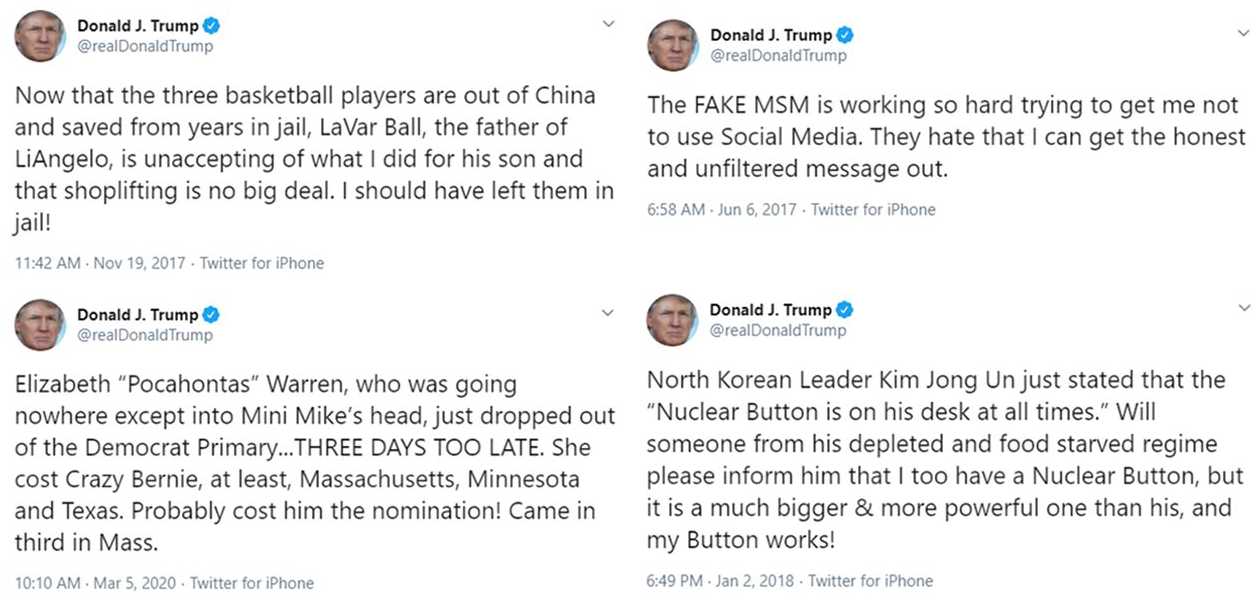
Examples of Trump tweets.
Much of Trump’s notably un-presidential social media antics explicitly or implicitly encouraged distrust in legacy news reporting. Among right-wing media users who already disproportionately receive their political news on social media (Bruns & Highfield, 2013), those who received their news directly from Trump’s social media accounts were the most likely to distrust the mainstream media (Gottfried et al., 2020a, 2020b; Kalogeropoulos et al., 2019; Klein & Robison, 2020; Mitchell et al., 2020; Schranz et al., 2018; Steppat et al., 2020; Stier et al., 2020), express positive suspicion of journalistic malintent and carelessness (Gottfried et al., 2020a, 2020b; Vogels et al., 2020), and show lower political knowledge (Cardenal, Galais, et al., 2019; De Zúñiga et al., 2017; Oeldorf-Hirsch, 2017; Schulze, 2020) and political engagement (Song et al., 2020). Among social media users, these various trust-reducing and ideologically polarizing forces combine to form a cyclically reinforcing process wherein decreased trust in traditional news reporting leads to decreased exposure to legacy news (De Zúñiga et al., 2017; Nekmat, 2020; Schulze, 2020) and increased exposure to ideologically confirmatory news (Cardenal, Aguilar-Paredes, et al., 2019). Consumers subsequently perceive this ideologically confirmatory information as more credible than legacy reporting (Edgerly et al., 2020; Edgerly & Vraga, 2020), thereby further eroding trust in traditional reporting and beginning the cycle anew (Tsfati, 2020; Tsfati & Cappella, 2003). Most worryingly, this cyclical degradation of trust in the media is non-linear: negative experiences reduce trust more than individual positive experiences rebuild it (Gottfried et al., 2020b; Kampen et al., 2006), indicating that once this cycle has begun, it is difficult to stop.
Trump’s high salience in the news and his messages’ promise to degrade trust in democratic institutions make his Twitter messages uniquely valuable for understanding how mainstream media corporations redistribute trust-reducing messages. Of course, part of the interest in Trump is no doubt driven by his office’s high latent newsworthiness, but that explanation fails to account for why media companies seem more drawn to Trump’s most inflammatory comments than to more policy-oriented messages which typify traditional presidential public communication. Media companies are businesses: in order to survive, they must earn profits, and they maximize profits by producing, at the lowest possible cost, media content that viewers want to watch. Viewers in the United States seek news that confirms their prior ideological preferences (Iyengar & Hahn, 2009; Iyengar et al., 2008; Taber & Lodge, 2006) with simple narratives, emotional stakes, and conflict (Prior, 2007; Sobieraj & Berry, 2011; Trussler & Soroka, 2014). Contentious commentary is far less expensive to supply than curated content, provides a façade of balance, and satisfies audience preferences for exhilarating conflict and incivility (Forgette & Morris, 2006; Morris, 2004; Mutz & Reeves, 2005). This makes Trump’s tweets uniquely attractive content for media corporations to report, even more so than presidential communication already is (Kingdon, 1995; McGregor & Lawrence, 2018). Media corporations themselves have confirmed this: CNN President Jeff Zucker justified the contentious policy of airing Trump rallies in their entirety by appealing to their positive effect on viewership (Bowden, 2018).
In light of competitive market pressures to reproduce contentious content, we hypothesize that tweets with more trust-reducing features will be cited more quickly and more frequently by the mainstream media than tweets with fewer such features. To test this claim, we trace social media messages from their origin at @realDonaldTrump through broadcast transcripts of all major news networks in the United States during Trump’s first year in office, using cosine similarity scores to identify broadcast transcripts which contain direct citations of Trump’s tweets.
Operationalizing Trust-Reduction
In order to identify trust-reducing features of messages in the absence of observations about their effect on real recipients’ trust, we rely upon theories of authoritarian media use. Authoritarians employ well-known rhetorical devices to undermine trust in adversarial democratic institutions like the free press (Gandhi & Okar, 2009; Márquez, 2016, 2018; Schatz, 2009), and scholars have already noted compatibility between these authoritarian tactics and use of social media (Tucker et al., 2017). By turning to accounts of authoritarianism, we are able to trace broader trends in the recirculation of trust-reducing messages than would be impossible if we were limited to observations of trust responses among individual social media message recipients.
We hasten to clarify that this decision is not driven by any claim that Trump is an authoritarian ruler out to undermine American democratic institutions and seize personalist power. First, we couldn’t demonstrate such a claim based only upon Trump’s tweets without committing the fallacy of assuming the consequent. Second, and more importantly, we don’t think it particularly matters (at least not within the context of democratic trust) whether Trump sees himself as an authoritarian or even whether he has any plans for a political career following his failure to win reelection. The reason we don’t think these things matter is because it’s possible that social media messages like Trump’s tweets are eroding trust in American democratic institutions even if Trump in fact didn’t mean them to be damaging. If you eat something toxic, it makes you sick regardless of whether you knew the thing was toxic or meant to poison yourself. We rely only upon the weak phenomenological claim that Trump’s tweets have similarities to authoritarian messaging which makes them useful units of observation when considering how social media messages recirculated by traditional news outlets may undermine trust in critical democratic institutions.
Soft Authoritarianism
Trump’s consistent hostility and violent reactivity to criticism on Twitter mimicked the media outreach strategies of so-called “soft” authoritarian leaders seeking to undermine democratic norms and institutions in order to consolidate power in themselves. “Soft” authoritarianism differs from the more brutal “hard” authoritarianism associated with tyrannical regimes such as Nazi Germany and Stalin’s USSR. While infamous authoritarians, such as Stalin or Pol Pot, could compliment their cult of personality with the unfettered coercive power of the state, soft authoritarians are forced to grapple with adversarial democratic institutions that split and balance authority (Gandhi & Okar, 2009; Márquez, 2016, 2018; Schatz, 2009). In order to consolidate power, soft authoritarians must play a long game where they start by undermining these adversarial institutions until the institutions are too weak to resist the authoritarian’s bid for power (Cheibub et al., 2010; Gandhi & Okar, 2009; Márquez, 2016, 2018).
The media is one adversarial institution that soft authoritarians must either degrade or coopt in order to consolidate power in themselves. As Schatz (2009) notes, through “discursive preemption,” the soft authoritarian seeks to “maintain the upper hand in guiding the media to project images that strengthen his position” in a way that “may flirt with outright propaganda” but which maintains a veneer of transparency and legitimacy (207). For example, in 2005, Kazahki President Nazarbaev preempted charges of electoral fraud in his reelection with what appeared to be leaked documents showing that the opposition planned to allege fraud against the regime regardless, which in turn blunted the impact of the scandal (Schatz, 2011). By diluting public discourse with misinformation and false labels of inaccuracy, citizens lose faith in journalistic credibility (Freeze et al., 2020) and “no one can criticize power, because there is no basis upon which to do so” (Snyder, 2017, p. 65, 71). Authoritarians then capitalize on growing distrust in institutions by promulgating their own salvation narrative, usually in defense of the “common man” (Schatz, 2009). Effective salvation narratives require the social amplification of a crisis, followed by blaming the “other” for the crisis and other problems that can stick (Waring, 2013; Waring & Glendon, 1998; Waring & Paxton, 2018). By controlling the media, authoritarians can deny wrongdoing, delegitimize their opponents and oppositional institutions (including traditional media outlets themselves), and spin a narrative that the state is sick. The only cure for this sickness, the authoritarian claims, is to trust in the leader and grant them the authority to set things straight (Svilicic & Maldini, 2014).
We conceive of two facets of this approach to soft authoritarian messaging. The first facet captures specifically authoritarian rhetoric which (1) delegitimizes opponents and opposing institutions; (2) denies or deflects blame or wrongdoing, often by utilizing red herrings or simple reversals; or (3) dramatizes the news by announcing particular events as especially newsworthy or taking interpretive stances upon the meaning of recent events. The second facet, outrage, is adapted from Sobieraj and Berry (2011) and includes several dimensions of tone and content, including a message’s use of emotive or politically extremizing language, ad hominem, threats, and personal brand-building. Here, we briefly describe the authoritarian and outrage facets, which are later used to construct our measures of trust-reduction.
Authoritarian: Delegitimize
To delegitimize the opposition, authoritarian leaders present those who previously held power and influence as inept and/or corrupt and responsible for the nation’s ills. Right-wing authoritarians in particular tend to delegitimize incumbent office holders, journalists, academics, bureaucrats, immigrants, and racial/ethnic minorities as those who are “takers”: parasites who prey on the hard work of the common man (Svilicic & Maldini, 2014; Waring & Paxton, 2018). After demonstrating that the opposition does not have the interests of the common people in mind, authoritarians reveal that the only solution is to grant the leader the power to override the corrupt and ineffectual national institutions the opposition has coopted for their own insidious ends. By delegitimizing opposing media outlets in particular, authoritarian leaders exacerbate tendencies among their followers to selectively expose themselves to political information, thereby strengthening the leaders’ ability to propagandize and distribute partial, misleading, or outright false information (Arendt, 1968; Stanley, 2018). At the same time, authoritarians offer the opportunity for prior members of the establishment to demonstrate their loyalty by repeating and defending some of the leader’s more extreme claims, which can bind these loyalists to the new order and head-off potential internal dissension (Márquez, 2018).
A substantial portion of Trump’s messages on Twitter contained delegitimizing messaging. For example, Trump’s morning tweet on July 25th, 2017, accused opposition leadership of corruption and suggested that institutions which limit direct presidential involvement with Justice Department investigations actively obstruct the execution of justice: “Attorney General Jeff Sessions has taken a VERY weak position on Hillary Clinton crimes (where are E-mails &; DNC server) & Intel leakers!” (Trump, 7/25/17, 5:12). More broadly, A New York Times categorization of Trump’s tweets found that as many tweets sought to delegitimize President Obama (15) as addressed semi-specific policy issues (16), while a much larger proportion were dedicated to attacking the media (41) (Parlapiano & Buchanan, 2017). Finally, in terms of offering positions of power to coopted establishment loyalists, Senator Lindsey Graham (R-SC) provides a prime example. Originally a staunch opponent of Trump, he is now one of the former President’s most ardent defenders, seen by Senate colleagues as no longer able to retreat from his loyalty to Trump (Leibovich, 2019).
Authoritarian: Deny and Deflect
Denial and deflection often employs red herring or tu quoque fallacies to rebut direct critique. Authoritarian leaders use this tactic to cast uncertainty over the leader’s behavior and appeal to their base by reconfirming supporters’ ideological commitments about what “feels true” (Paxton, 2018; Schatz, 2009; Waring & Paxton, 2018). Party loyalists are already primed to believe their own representatives over opposition leaders, an effect which is further magnified by delegitimizing messaging. Often, all it takes for authoritarian leaders to exploit this high propensity for motivated reasoning and unify their base is a simple denial or reversal of incoming blame (Butler, 2013; Shaffer & Duckitt, 2013; Stanley, 2018).
Trump frequently communicated denying and deflecting tweets with respect to the Muller investigation into Russian interference. Take for example Trump’s tweet on July 23rd, 2017: “As the phony Russian Witch Hunt continues, two groups are laughing at this excuse for a lost election taking hold, Democrats and Russians!” (Trump, 7/23/17, 15:09). In this message, Trump not only denied any truth behind the Russian interference investigations; he also claimed that the real scandal was that Democrats were working with Russians in order to delegitimize his presidency. Trump’s partisan base interpreted these messages as powerful rebuttals against Democratic allegations (Paxton, 2018), and they caused opposition voters to disregard allegations as mere partisan bickering, enabling Trump to escape more serious scrutiny (Bennett, 1990).
Authoritarian: Dramatization
Authoritarians use dramatization to positively preempt the public discourse with their own agenda in order to prevent the opposition from influencing the narrative. Dramatization is often more positive, melodramatic, and suspenseful than delegitimization or denial and may be as simple as announcing an interview or a new alleged crisis that must be addressed post-haste (Schatz, 2009). By dramatizing the news, authoritarians unify their base around a common set of salient (but often fictitious or relatively unimportant) topics and draw attention away from potentially unpopular or embarrassing developments within the legislature.
Thanks to his background in entertainment, Trump is intimately familiar with dramatization, and he drew upon this experience to craft messages that commanded public attention. Figure 2 offers an example of how Trump seized the nation with a three-part tweet on July 26th, 2017, which announced the banning of transgender individuals from serving in the military (Trump, 7/26/17, 7:55; 7/26/17, 8:04). By leaving a 9-minute gap between two of his announcements, Trump led many in the media and Department of Defense to worry that he was about to declare military action against North Korea (Buncombe, 2017).

Dramatizing announcements by issuing messages across multiple tweets.
In another act of dramatization apparently aimed at drawing attention away from unpopular policymaking, Trump reversed critiques raised by Senators Lindsey Graham and John McCain over his travel ban by tweeting that the “Senators should focus their energies on ISIS, illegal immigration and border security instead of always looking to start World War III” (Trump, 1/29/17, 15:49). Both of these messages bear the mark of a well-tested authoritarian tactic of dramatically blaming already marginalized segments of the population for public crises (crises which themselves are dramatized and often largely fictitious), as a way of controlling the public narrative, simultaneously unifying the authoritarian’s base around fear of the “other” and dragging opposition commentators into dead-end arguments over red herrings and false dichotomies.
Outrage
Our second facet of soft authoritarianism is outrage. Authoritarians augment their efforts to delegitimize, deny and deflect, and dramatize in the media by deploying outrageous statements to capture the attention of a media hungry for spectacle (Niewart, 2017; Waring, 2018). Sobieraj and Berry (2011) define outrage as “political discourse involving efforts to provoke visceral responses (e.g., anger, righteousness, fear, moral indignation) from the audience through the use of overgeneralizations, sensationalism, misleading or patently inaccurate information, ad hominem attack” and other logical fallacies (20). Such outrageous statements appeal to emotion and vilify their targets, which reduces trust in government and institutions (Forgette & Morris, 2006). We conceive of outrage as a second approach to trust-reduction employed by authoritarians which may be utilized alongside or independently from authoritarian tactics.
The outrageous spectacle of Trump’s tweets commanded much public interest in his Twitter handle. Trump routinely referred to Democratic representatives with derisive nicknames (“Fake Tears Chuck Schumer,” 1/31/17, 5:21), used vaguely threatening language (“If Chicago doesn’t fix the horrible carnage going on. . . I will send in the Feds!” 1/24/17, 20:25), posted patently false numerical data (“at least 3,000,000 votes were illegal,” 1/27/17, 7:12), and mocked media outlets that published news and op-eds critical of Trump and his administration (“FAKE NEWS @CNN,” 1/24/17, 20:16). In many cases, the outrageousness of Trump’s tweets reinforced their effectiveness at delegitimizing, denying or deflecting, or dramatizing by making them more memorable, emotionally triggering, or polarizing. Perhaps the best illustration of how outrage and authoritarianism work together can be seen in the extreme uptake of the term “fake news,” which gained popularity as a common Twitter Trumpism but is now a widely adopted term employed by representatives, reporters, and scholars.
Coding the Tweets
In order to test whether the media is more responsive to the most trust-reducing tweets, we downloaded all 2,546 tweets from Trump’s first year in office directly from the Twitter API using the twitteR package for R. Because our interest lies in Trump’s messages in particular, we omitted 304 “retweets” from the dataset, which are instances where Trump used his own Twitter account to simply echo a tweet originating from a different account. Additionally, the extreme length limitation of Twitter messages occasionally led Trump to issue a single message as a rapid series of multiple individual tweets, usually indicated by an ellipsis at the beginning of tweets containing ongoing content. Each set of such messages was treated as a single observation for the purposes of the study. Combining messages in this way further reduced the dataset by 138 observations, leaving 2,104 messages for analysis.
When viewed on Twitter.com, Trump’s tweets often included supplemental photos, videos, links, or hashtags. The links to these multimedia appear in the plain text downloaded from Twitter, and we opened each link to determine what was being included with the tweet text. If the multimedia content was brief (a photograph, slideshow, or short message from another source, such as Trump’s Facebook page), its content was also included in the content coding. 1
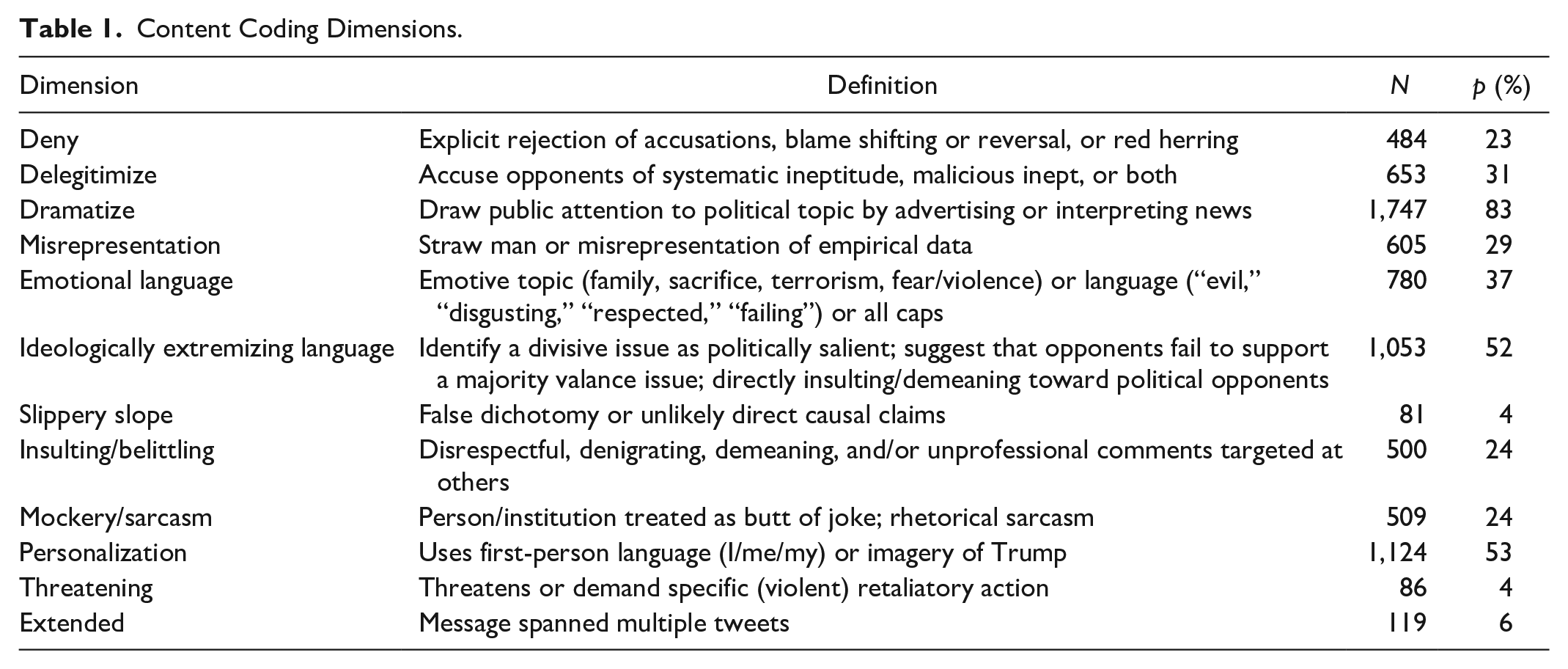
Tweet content was coded dichotomously along 12 dimensions: 3 dimensions captured authoritarianism (deny, delegitimize, and dramatize), 6 dimensions captured elements of outrage (misleading, emotional language, insulting/belittling, ideologically extremizing, slippery slope, and mockery/sarcasm), and 3 dimensions captured additional features of Trump’s tweeting behavior (personalizing, threatening, and extended). Official White House correspondence and Trump’s campaign slogan (“Make America Great Again!” or “#MAGA”) were included in the dataset but were treated as non-informational. Table 1 briefly describes each of these coding dimensions and reports descriptive statistics on the prevalence of each. We offer a more detailed discussion of content coding, along with example tweets to demonstrate coding decisions, in the Online Supplemental Appendix.
Content Coding Dimensions.
Finding Trust-Reducing Tweets in the Media
We employ a three-part modeling strategy to test the hypothesis that mainstream media companies recirculate more trust-reducing tweets more quickly and more fully. Our first model analyzes the duration until a news program cites one of Trump’s tweets. The second model is a two-stage analysis of how much coverage is dedicated to the tweet, given that the news has cited it. These models are estimated on an original dataset of 46,066 full-text transcripts from all six major US news broadcasting companies (ABC, CBS, CNN, Fox News, MSNBC, and NBC) and the news-like infotainment program Fox & Friends that aired during Trump’s first year in office, beginning at 12:01 AM on January 20, 2017 and ending at 11:59 PM on January 20, 2018. Legacy news media broadcast transcripts were obtained from LexisNexis Academic’s broadcast news database (now Nexis Uni). The dataset includes transcript coverage from at least one news broadcaster for every 30-minute interval in the study period. Because Fox & Friends is not news, it was not stored in the LexisNexis broadcast news database, making it impossible to obtain full-coverage transcripts for Fox & Friends programming. However, we were able to construct a partial coverage dataset of 150 episode transcripts from YouTube user uploads. Some of these video uploads included automatically-generated closed-captioning transcripts which are directly downloadable from YouTube. To obtain transcripts for videos lacking closed-captioning, we downloaded the video’s audio file and used VoiceBase, a voice-to-text processing service similar to those which provide voicemail transcripts to many smartphone users, to transform audio files into text-searchable transcripts.
We model the data such that each transcript may cite one (or more) of Trump’s tweets independently of all other transcripts. This leads to dyadic data, where dyads are comprised of all possible transcript-tweet pairs—a total of 117 million dyads. To restrict our attention to media transcripts which are responding to Trump’s tweets quickly, we imposed a constraint to limit dyadic constructions to only those news transcripts which were broadcast within 36 hours of a tweet’s publication. This approach reduced the total number of eligible dyads to 368,270 and results in conservative estimates, as any tweets cited by news outside this window are censored.
We determine whether a news organization cites one of Trump’s tweets through text similarity analysis. As manually reading each transcript and comparing it to tweets would have been impossible, we determine similarity using cosine similarity scores, which employs a bag-of-words approach. The method compares vectors of word frequencies across our corpora of interest and produces a 0 to 1 score, where 0 is no similarity and 1 is complete similarity, such that

Whether a cosine score implies an oblique reference or a direct citation varies depending on the type of corpora analyzed. When comparing tweets and news transcripts, there are serious discrepancies in text length, as a tweet is limited to 140 characters (280 characters after November 7, 2017), while even a short news transcript is at least hundreds of words long. This discrepancy means it would be impossible to determine whether a tweet cited a news program, but it does not prevent identification of transcripts that cite tweets, as long as the proper cosine similarity score can be identified as a cutpoint (similarities above this score are considered successes; similarities below this score are considered failures). By reviewing dyads with known direct quotations of tweets in news transcripts, we found that a cosine score of 0.4 reliably indicates direct tweet citations, while lower cosine scores do not.
Figure 3 presents the distribution of cosine scores. Note that by employing a cutoff of 0.4, we impose a strict limit where only 10% of the data are considered successful events: a cited tweet. Ethan Zuckerman from the MIT Media lab found Trump to be the subject of discussion 22% of the time in all media transcripts (Brown, 2019). Our threshold of 0.4 assumes that the media directly cited Trump’s tweets around half of the time that they talked about him.
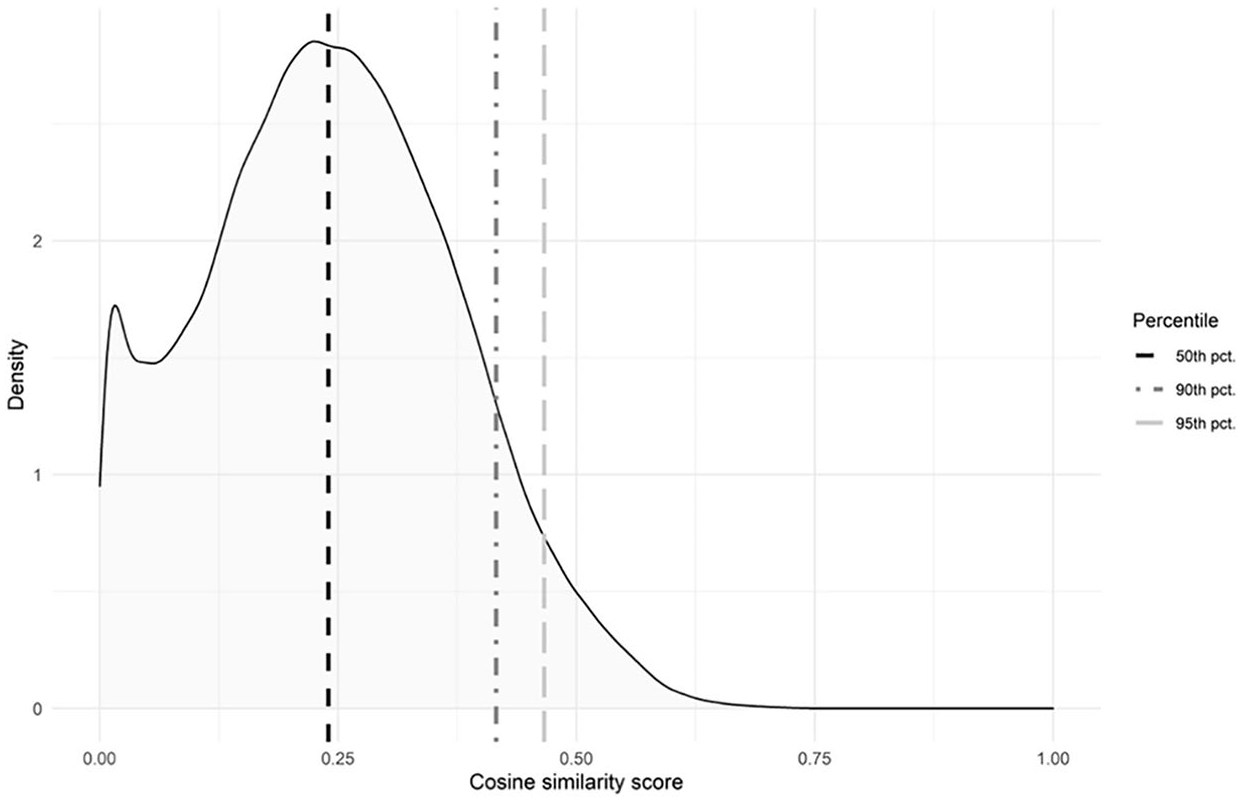
Distribution of cosine similarity scores (n = 368,270).
Our first analysis tests the duration until a news program cites a tweet as defined by a cosine score 0.4 or greater. Risk begins when the show in a tweet-transcript dyad begins for a given day, and time is measured in hours. We adopt breaks as determined by LexisNexis, where the median break between news show segment transcripts is 30 minutes. We employ a log-logistic parametric accelerated failure time (AFT) model where the dependent variable is logged time until an event occurs, a negative scale parameter indicates initially increasing then decreasing hazard, and a positive scale parameter indicates monotonically decreasing hazard. On this scheme, negative scale parameter coefficients would provide support for our hypothesis, indicating less time until citation for more authoritarian and outrageous tweets.
For our second analysis, we employ a two stage model, where the first stage is a logistic regression of whether a news program cites a tweet. The first stage of the model essentially replicates the duration analysis, except the residuals are the likelihood that a tweet is cited for a given time period as opposed to the duration until citation. The predicted residuals from the first model are then included as a regressor in a negative binomial count model of the extent to which Trump is mentioned personally. We include this second stage in an attempt to distinguish between latent discussion of Trump and explicit quotations or attributions of his tweets, which will help track the redistribution of his social media messages qua posts from his personal social media accounts.
Our explanatory variables of interest in all three models are the authoritarian index and outrage index, each of which is a simple additive index of the number of authoritarian or outrageous features a tweet contained, respectively. We include broadcaster fixed effects in both analyses and program fixed effects in the AFT model. Program fixed effects were dropped from the two-stage model to allow convergence. We also control for the time difference in minutes between the time a show begins and the time the dyadic tweet was posted, capturing the expectation that long time differences between a tweet being posted and a news program starting should result in fewer tweet citations. Although this may at first seem counterintuitive, as more time between a tweet post and the airing of a news program allows additional time for the news to react to the tweet, the pace with which Trump tweeted means that long durations between tweet-posting and the beginning of the program increase the probability that another tweet (or several) had been posted in the interim, thereby increasing competing risks for all earlier tweets. Finally, we include controls to account for the extent to which Trump talked about himself in the tweet and messages which were conveyed over multiple tweets.
The results of all three estimations are reported in Table 2. Model 1 is the log-logistic model of duration in log-hours until the citation of a tweet. Model 2 is the first stage logit model of whether a tweet is cited, and Model 3 is the second stage negative binomial model of mentions of Trump. Our results indicate that both the authoritarian and outrage indices significantly (p < .01) reduce the time until a television program cites the tweet. For the authoritarian index, a one unit increase from two to three (holding outrage constant at three) reduces the expected time until news citation by more than 25 hours, two thirds of our restricted dyadic period. For the outrage index, a one unit increase from three to four (holding authoritarianism constant at three) reduces the expected time until citation by more than 7 hours. These results are reflected in Figure 4, which reports the relationship among authoritarianism, outrage, and media responsiveness. More authoritarian tweets receive faster media attention than less authoritarian tweets, and within both the most and least authoritarian tweets, more outrage results in faster media response. For nonauthoritarian tweets, going from the minimum to the maximum value on outrage reduces an indeterminately extreme time until citation to only 30.7 hours, roughly similar to the 29 expected hours for a maximally authoritarian tweet which scores only three on the outrage index.
Results, Duration and Count Models of Trump Tweet Citations by Media.
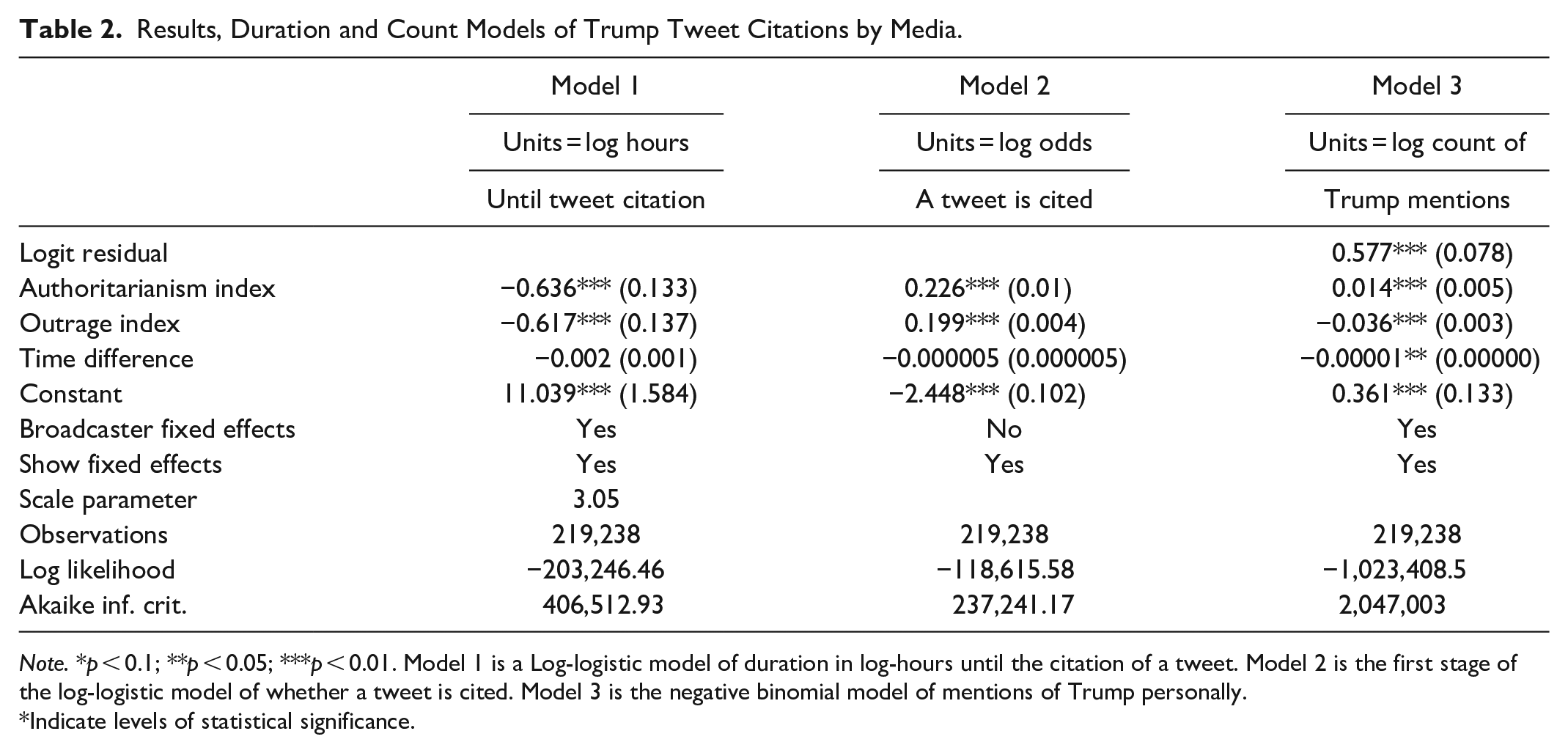
Note. *p < 0.1; **p < 0.05; ***p < 0.01. Model 1 is a Log-logistic model of duration in log-hours until the citation of a tweet. Model 2 is the first stage of the log-logistic model of whether a tweet is cited. Model 3 is the negative binomial model of mentions of Trump personally.
Indicate levels of statistical significance.
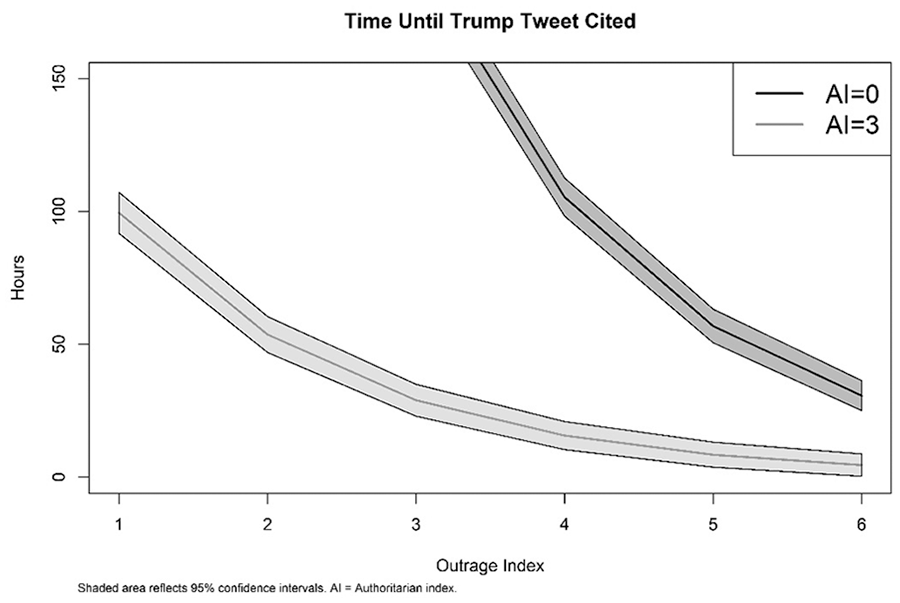
Predicted duration (in hours) to tweet citation by authoritarian and outrage indices.
Figure 5 presents predicted probabilities for whether a news program cites a tweet at different levels of authoritarianism with 95% confidence intervals as derived from Model 2. Again, the same relationship between outrage and authoritarianism and media responsiveness is evident. Going from the minimum to the maximum on the authoritarian and outrage indices increases the predicted probability that a tweet is cited by 14 percentage points.
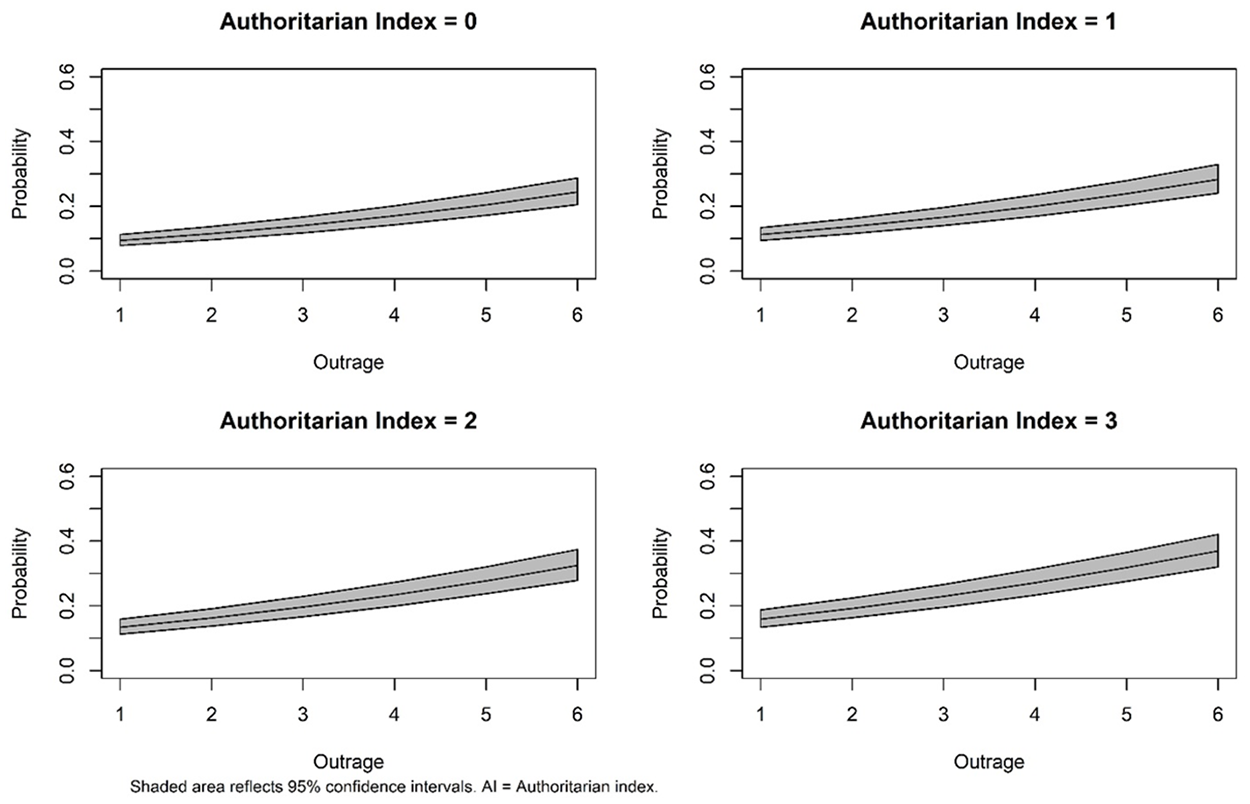
Predicted probability of tweet citation by authoritarian and outrage indices.
Finally, Figure 6 reports predicted count results for Model 3, which are mixed and unexpected. Increasing the authoritarian index of a tweet from the minimum to the maximum increases the number of times Trump is personally mentioned in the transcript by about 4, but moving from minimum to the maximum in outrage decreases the expected count by approximately the same amount. The positive effect of the residuals suggests an indirect relationship for outrageous and authoritarian messaging on mentions. Taken together, these results may suggest that direct mentions of Trump are not an effective proxy for distinguishing between general news commentary about Trump and named accreditations of his Twitter messages. We consider two explanations for this result. First, images of tweets as they would appear on social media platforms frequently accompanied discussions of Trump’s tweets in television news, meaning that broadcasters may not additionally have needed to say (in a way that would be captured by closed-captioning transcripts) that they were discussing Trump’s tweet. Second, our results could indicate that tweet-accrediting language is being drowned-out by very high levels of ambient Trump mentions, since political news programs should be expected to have talked regularly about Trump whether they were discussing a tweet or not. Taken together, Models 1 to 3 unambiguously support our hypothesis that more authoritarian—and therefore more trust-reducing—social media messages are more readily circulated by traditional news outlets, but more research is needed to confirm that these redistributed messages remain identifiable as social media posts.
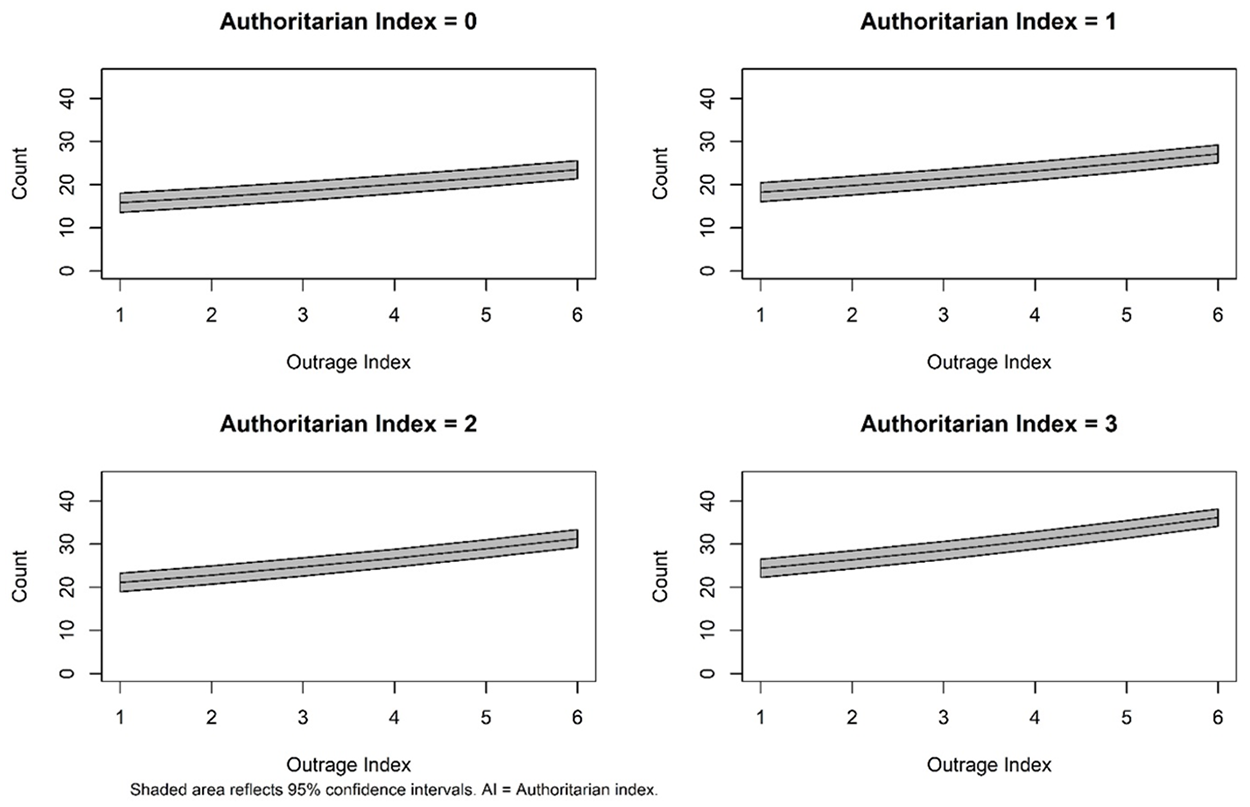
Predicted count plots by authoritarian and outrage indices.
Trust and Democracy
Social media messages are widely recirculated by the mainstream media to viewers outside social media platforms. Our findings confirm that the mainstream media’s attention toward social media as a source of news content is non-uniform: media corporations select social media content to recirculate that serves their interests as firms vying for viewership in a competitive and polarized media environment. In the United States, these market pressures induce media corporations to treat more inflammatory and uncivil social media messages as breaking news, repackaging them more often and more quickly to audiences who are keen to use such messages to confirm their preexisting ideological positions (Iyengar & Hahn, 2009). We find this result even amidst the din of discussion about Trump: our models identify a 14 percentage point difference in the likelihood that a tweet is directly cited between the least and most trust-reducing messages even against a latent backdrop probability of direct citation of nearly 50%.
This preference toward conflictual messages makes sense for media corporations in the short run, but it threatens the long-term health of legacy news reporting. Exposure on social media platforms to the same antimedia rhetoric and ideologically extremizing news that mainstream media corporations are recirculating is known to reduce trust in legacy broadcasting (Anderson & Auxier, 2020; Gottfried et al., 2020b; Forgette & Morris, 2006; Mitchell et al., 2020; Stier et al., 2020; Strömbäck et al., 2020), and that reduced trust eventually leads viewers to turn away from legacy broadcasters altogether (Schulze, 2020; Tsfati, 2020; Tsfati & Cappella, 2003). Such a trend is already visible, especially with respect to perceptions of information about and from Trump himself. Early in Trump’s presidency, 60% of Americans thought Trump’s Twitter posts were easy to misunderstand, 71% thought they were a risky form of communication, and even 49% of Republicans felt this activity did not send the right message to world leaders (SSRS, 2017). As of late 2020, more Americans turned to social media for their political news than TV, radio, or print (Mitchell et al., 2020), a majority of Americans believed it was important to receive messages directly from candidates or their campaigns on social media (Oliphant, 2020), 45% of conservative Republicans reported receiving their news primarily through Trump’s social media accounts (Oliphant, 2020), 54% of Republicans believed Trump himself reports more factual claims than federal agencies and legacy news (Mitchell et al., 2020), candidates and elected representatives from all parties regularly communicated with the public using a personal social media account (Van Kessel et al., 2020), and fewer than half of Americans were confident in the news media (Gottfried et al., 2020b).
Our analysis does not directly investigate how news organizations that cited Trump’s tweets presented those tweets to their audiences, and this influences the extent to which exposure to trust-reducing messages in the legacy news in fact affects trust toward mainstream broadcasters. Even if all media corporations recirculated the same messages, how any particular outlet presents a message (and how its viewers are likely to respond to it) is ideologically conditioned. Platforms who appeal to conservative audiences will tend to present trust-reducing messages from conservative politicians in a friendlier light, while platforms appealing to progressive audiences will tend to present the same messages in a negative light (and vice versa). Indeed, many of the programs that talked about Trump’s tweets discussed them critically and called attention to their harmful nature, which, for at least some viewers, may have counteracted the tweets’ propensity to diminish trust in the media.
Notwithstanding the possibility that discrete presentations may enhance trust for some viewers in some cases, we worry that even critical reproductions of these messages nevertheless threaten an aggregate degradation of trust in legacy reporting. First, this is because publically discrediting claims in this way can backfire. Oeldorf-Hirsch et al. (2020) find that validation labels that indicate whether the content of a meme or news article is “confirmed” or “disputed” do not improve credibility perceptions toward individual news articles, and a study by the Pew Research Center has found that labeling social media posts as “disputed” contributes to beliefs of partisan censorship by social media corporations (Vogels et al., 2020). Second, exposure to ideologically disconfirmatory information reduces trust in a source more than exposure to ideologically confirmatory information rebuilds it (Gottfried et al., 2020b; Kampen et al., 2006). When viewers agree with what they see, they keep watching. When they disagree, viewers stop watching and turn to more intensely polarized sources of political information, sources which are unlikely to engage in reporting behaviors designed to rebuild trust in traditional outlets. Thus, although additional research is required to measure the impacts of mainstream media recirculation of trust-reducing social media messages, especially as this is conditioned by the way such messages are presented, preliminary results warn that the long-run consequences of legacy broadcasters recirculating trust-reducing messaging is, fittingly, a reduction in trust.
Diminishing trust in legacy news reporting threatens more than the financial futures of broadcasting corporations. As put by Tsfati and Cohen (2005), “The news media’s role [in the democratic process] is both to inform the citizenry in a fair and balanced way and to hold the government accountable for its actions. Without trust in the conduit of political information, trust in the fairness of collective decision making is likely to be undermined” (32; Liebes & Ribak, 1991). “It is impossible,” Tsfati and Cohen (2005) add, “to trust democracy unless one perceives that the electorate is well and fairly informed, possessing an accurate picture of the issues at hand” (32). Some take the causal connection between trust in news reporting and trust in democracy to be even more tightly intertwined: Ward et al. (2016) conceive of trust in the media to be partially constitutive of what it means to trust in democracy at all.
If these accounts of trust in news and journalistic integrity are correct, then the widespread recirculation of trust-reducing social media messages by mainstream broadcasters directly endangers American democracy. According to Levi (1998), “a trusting citizenry and a trustworthy government are the sine qua non of contingent consent” (96). Trust represents an appraisal of the risks associated with another’s future behaviors under conditions of uncertainty (Tsfati & Cappella, 2003; Tsfati & Cohen, 2005), which, in democratic contexts, pertains to out-of-power minorities’ perceptions of majority parties’ willingness to exploit their powerful position to undercut fair competition (Misztal, 2001; Sabel, 1993). Citizens who trust their government are more willing to abide the democratic process, as the perceived risk doing so is lower, which in turn “enables governments to act without having to resort to coercion or the use of force for every decision undertaken” (Gamson, 1968; Kampen et al., 2006, p. 387). And, trustworthy states are empowered to tackle more complex problems and pursue more expansive liberal policy agendas, thanks to citizens’ higher tolerance of greater state capacity (Hetherington, 2005; Hetherington & Husser, 2012). Consequently, by recirculating trust-reducing social media messages, broadcast news networks in the United States may be helping create a political environment inhospitable to solving national economic, racial, environmental, and health crises.
Our findings show that trust-reducing social media messages are widely recirculated to viewers outside social media by mainstream broadcasters, but empirical questions remain regarding how exposure to these messages affects democratic trust at the individual level. It may be that viewers who encounter social media messages on broadcast television react differently to those messages they would if they encountered the same message on a social media platform. Visual reproductions of social media messages may affect viewers differently than mere discussions of message content, which would imply differential impacts on democratic trust across different legacy news media. And, as more and more citizens turn to social media as a primary source of political news, it is unclear how legacy news responses to this growing source of market competition will affect their selection, repackaging, and recirculation of trust-reducing messages. Despite lingering uncertainty, however, the potentially significant consequences of systematic degradation of public trust in democracy warrants immediate consideration about possible policy responses to the way social media posts are moderated and circulated, both inside and outside social media platform spaces.
Supplemental Material
sj-pdf-1-apr-10.1177_1532673X211023931 – Supplemental material for Mainstream Media Recirculation of Trust-Reducing Social Media Messages
Supplemental material, sj-pdf-1-apr-10.1177_1532673X211023931 for Mainstream Media Recirculation of Trust-Reducing Social Media Messages by Devin J. Christensen, John Lovett and John A. Curiel in American Politics Research
Footnotes
Declaration of Conflicting Interests
The author(s) declared no potential conflicts of interest with respect to the research, authorship, and/or publication of this article.
Funding
The author(s) received no financial support for the research, authorship, and/or publication of this article.

Supplemental Material
Supplemental material for this article is available online.
Notes
Author Biographies
References
Supplementary Material
Please find the following supplemental material available below.
For Open Access articles published under a Creative Commons License, all supplemental material carries the same license as the article it is associated with.
For non-Open Access articles published, all supplemental material carries a non-exclusive license, and permission requests for re-use of supplemental material or any part of supplemental material shall be sent directly to the copyright owner as specified in the copyright notice associated with the article.
