



Abstract
Presidents often make references to their predecessors in their oral remarks—a rhetorical tool that can advance support for their policies, define their presidency, and achieve political gains. And yet, despite the frequency that this rhetorical tool is used and its possible impact, references to former presidents have so far defied a systematic empirical research. To fill in this void in the literature, we examine the frequency of references to presidents, the identity of referenced presidents, and the policy context of each reference in all oral references made by presidents Reagan through Trump. We demonstrate that mentioning former presidents is a political tool that presidents use routinely in their public speeches. We find that presidents use this tool strategically—controlling the timing and identity of references and in connection to their policy appeals.
On May 1, 2017, President Donald J. Trump tweeted that “President Andrew Jackson, who died 16 years before the Civil War started, saw it coming and was angry. Would never have let it happen!” This is one example of a president referring to one of his predecessors, a phenomenon quite common among American presidents. Yet, we know very little about the rhetorical use of such references. What explains the frequency and timing of the use of this rhetorical tool? Which of the numerous former occupiers of the office do sitting presidents refer to? What is the context of these references? Answering these questions can advance our understanding of the reasons and possible impact for using this rhetorical tool.
To systematically assess presidential references to former presidents, we examined all oral mentions of former presidents by Ronald Reagan to Donald J. Trump, granting us a robust sample of six presidents that amount to nearly 12,000 individual references to past presidents. We compiled all references from the American Presidency Project and collected data about the date, location, and policy context in which they were made. We then examined who is referenced by each president, when, and in what political and policy context. We demonstrate that presidents use this rhetorical tool routinely and strategically as part of their public appeals.
Referencing Former Presidents
Presidents routinely make public remarks, which range from major addresses to the nation such as the State of the Union Address or a speech to the nation in various locations, to news conferences, and occasional remarks at the White House or on tour. The speeches presidents give are widely covered by the news and receive significant public attention as well as scholarly interest (Barrett, 2007; Coe & Bradshaw, 2014; Cohen, 2008, 2009; Edwards & Wood, 1999; Eshbaugh-Soha, 2013; Miles, 2014; Peake & Eshbaugh-Soha, 2008). Scholars from various fields study these speeches in an effort to assess the decision when to speak and to what forum (Brace & Hinckley, 1993; Cohen, 2008; Eshbaugh-Soha, 2010, 2013; Hager & Sullivan, 1994; Powell, 1999), what presidents say (Coe et al., 2017; Jacobs et al., 2003; Kuehl, 2012), and where they say it (Heith, 2013; O’Brien, 2019); as well as the effect of these speeches on public support for policies they mention (Cavari, 2017; Cohen, 1995; Edwards, 2003; Hill, 1998; Kernell, 2007; Rottinghaus, 2010; Villalobos & Sirin, 2012), on their own approval (Cohen, 2010; Cohen & Powell, 2005; Druckman & Holmes, 2004; Kelleher & Wolak, 2006; Ragsdale, 1984; Trager & Vavreck, 2011), and on policy (Canes-Wrone, 2006; Dimaggio, 2015; Eshbaugh-Soha, 2006; Hawdon, 2001; Whitford & Yates, 2009).
Studies of presidential rhetoric vary in what they measure. A large body of work in political science examines the policy substance in presidential rhetoric (Cavari, 2017; Cohen, 1995; Whitford & Yates, 2009; Wood, 2007). Other, mostly in rhetorical and communication studies, examine the choice of words as it relates to the situation of the speech (Zarefsky, 2004). These studies attempt to identify genres of presidential rhetoric (Campbell & Jamieson, 2008), the style of rhetoric of different presidents and how it has evolved over time (Hart, 2020; Stuckey, 2020), and the contribution of locations and events in the rhetorical message (Beasley, 2014; Parry-Giles & Parry-Giles, 2000; Stuckey, 2006).
In this paper, we focus on one rhetorical theme that is used routinely, but has so far defied a systematic empirical analysis—references to past presidents. Only 46 people have held the office, most of whom are among the most recognized political actors in the United States (Delli Carpini & Keeter, 1996). Several of these presidents are hailed for creating the American political system rather than being mere holders of the office (Abbott, 1990). They are widely viewed as responsible for or associated with contemporary policies and events and are held as leaders of their parties in the public mind (Cavari, 2017; Jacobson, 2019). Referencing former presidents can therefore carry significant weight in the public mind. Presidents can take advantage of the popular attachments to these men and utilize them in their rhetorical appeals to advance support for policies, provide legitimacy to their own presidency, and score political and electoral points.
Advancing support for policies
In their rhetoric, presidents can invoke the memory of former presidents to establish their interpretation of events and bolster their argumentation about policy. These references are “rhetorical ploys that invite comparisons, offer justifications, and provide gravitas to the president on the subject matter that he is addressing” (Brown, 2007, p. 125). The use of references to lend support for policies is illustrated in three existing studies that examine references to former presidents. Abbott (1990) demonstrates that Franklin Roosevelt referenced and reinterpreted the “great presidents”—mostly Washington, Jefferson, Jackson, and Lincoln—to justify and frame his policy initiatives. Building on this work, Brown (2007) takes a more quantitative approach to demonstrate how Clinton interchangeably referenced four exemplary presidents—Jefferson, Lincoln, T. Roosevelt, and F. Roosevelt—throughout his campaigns and terms in office to justify his actions among various constituencies. Finally, Edwards (2009) examines references of three presidents—Reagan, Clinton, and W. Bush—to one former exemplary president—Truman. He shows that these presidents invoked the memory of Truman to establish their interpretation of events and bolster their argumentation about policy. While each of the three presidents invoked Truman’s authoritative standing on foreign policy, they appropriated Truman for different foreign policy needs: Reagan to fight communism, Clinton to promote American leadership in the world, and Bush to sanction his fight in the war on terror.
Establishing legitimacy
By mentioning their predecessors, presidents can symbolically affect how their own presidency is politically defined. Presidents are admired men, who can express some ideal behavior that can be imitated by political actors to establish their own public legitimacy (Abbott, 1990). Emrich et al. (2001) demonstrate that messages that invoke image-based rhetoric bring about a strong symbolic response. This rhetoric type reaffirms supporters’ shared identity with the leader, enhances their perceptions of the leader’s abilities, and shields the leader from “negative attributions in the context of crisis [or] decline” (Haslam et al., 2001). The image-based rhetoric available to politicians include historic events, shared experiences, and cultural icons, all of which can be captured by referencing a former president. Though past presidents vary in their success, achievements, and public perception, most former presidents enjoy a lasting legacy (positive or negative) and are perceived as part of the national identity (Shogan, 2007). These are symbolic rhetorical elements that can be used by presidents to craft their own image. Abbott (1990) shows that FDR’s use of “the greats” helped him define himself as an exemplary president. Brown (2007) shows that Clinton used this rhetorical tool to buttress his authority, and lend him credibility. Finally, Edwards (2009) demonstrates that presidents Reagan, Clinton, and W. Bush associated themselves with Truman to establish themselves as the natural heirs to Truman’s legacy of foreign policy leadership.
Achieving political and electoral gains
Referencing former presidents can also serve as a political tool to bolster public and partisan support, and to achieve electoral gains. Although all presidents carry a partisan label (Brewer, 2009; Cavari, 2017; Jacobson, 2019), some presidents enjoy a general public support that is above the political fray, while others are viewed by their party labels. Similar to their political use of direct references of the parties (Coleman & Manna, 2007), presidents can reference former presidents strategically to appeal to various constituencies. They can mention more presidents to bolster their role as president, mention exemplary presidents or presidents from both parties to demonstrate a bipartisan appeal, or mention the “greats” of their party in order to appeal to their own partisans. Brown (2007) demonstrates this partisan use of references to former presidents by tracing the evolution of Clinton’s reference of exemplary presidents. She shows that throughout his presidency Clinton altered his references to the exemplars in response to the political environment as part of his rhetorical efforts to emphasize varying ideological and partisan traditions.
Despite the importance and possible effect of references to former presidents, we have very little knowledge of the use of this rhetorical tool. The three main works on this topic (Abbott, 1990; Brown, 2007; Edwards, 2009) examine references of a handful of presidents (F. Roosevelt, Reagan, Clinton, and W. Bush) to a few exemplary presidents. 1 Yet, as we show below, presidents routinely reference many of their predecessors, many of whom do not enjoy the same public prestige that exemplary presidents have. Who do presidents mention and why? Moreover, existing studies either focus on references of one president (Abbott, 1990; Brown, 2007), or compare a few presidents but focus on references to one president (and with regards to one policy domain) (Edwards, 2009). But, presidents may vary in the extent that they reference former presidents, the timing of these references, and the rhetorical context of these references. What explains these variations?
A systematic assessment that considers the variation among presidents in using this tool—when, who, in what context, and how these change over time and across presidents—can therefore allow us better to generalize about the use of this tool. These generalizations can advance our understanding of the strategic references to former presidents. Presidents use speeches to further their own purposes, gain approval of various groups, enhance their popularity and electoral support for themselves and for their parties, and increase support for their policies and actions. In their speeches, they make rhetorical choices about the best way to achieve their goal in the context of the specific situation (Zarefsky, 2004). We expect that the choice of referencing a former president, like other phrasing choices they make, is strategic. Understanding how often they incorporate former presidents in their speeches, who they mention, and under what conditions, therefore, can help us understand the strategic use of this tool and its possible impact.
In this paper, we seek to fill in this void in existing literature and provide a systematic analysis of presidential references to former presidents that includes all references of six presidents (Reagan through Trump) to all former presidents (Washington through Obama). Using these data, we examine how often do presidents mention former presidents? When do they mention former presidents? Who do they mention? And in what context?
The paper develops as follows. In the next section, we develop a theory of presidential references to former presidents that provides a series of expectations about timing, identity, and context of using this rhetorical tool. We then present our data of presidential references—including all references by presidents Reagan (1981) to Trump (2020). In the analysis section, we use various statistical models to test our expectations. We conclude with a summary of our findings, a discussion of the limitations, and a proposal for extending the research on this topic.
When, Who, and about What?
Existing work suggests that presidents routinely reference their predecessors and that in doing so they can advance support for their own policies, provide legitimacy to their presidency, and score political and electoral points. These references provide a powerful rhetorical tool. Given presidents strategic use of speeches and rhetorical choices, we expect presidents to be strategic in their decision when to reference former presidents, who to reference, and in what context. We discuss each of these below.
When?
Referencing former presidents is a rhetorical tool and as such we expect that the extent and timing of its use as well as the identity of the presidents mentioned are affected by the political environment. Presidents are tuned to the political environment and adjust their actions accordingly. A rich body of scholarly work suggests that the decision of presidents to go public is affected by the political cycle (i.e., honeymoon period, election year, time in office), the balance of political power (i.e., presidential approval, relations with Congress, polarization), and the policy environment (i.e., unemployment, troop deployment) (see, e.g., Brace & Hinckley, 1993; Cohen, 2010; Eshbaugh-Soha, 2010, 2013; Hart, 1987; McGauvran & Eshbaugh-Soha, 2017; Powell, 1999; Ragsdale, 1984).
The few works on presidential references to former presidents suggests that the frequency of presidential references to former presidents will also be affected by some of these factors. Brown’s study of Clinton’s references to former presidents (Brown, 2007) suggests that, as presidents enter office, they are likely to connect themselves with the people who occupied the office before them—the one they replaced, former presidents from their own party or exemplary presidents they wish to be associated with. As they approach their re-election, presidents may increase their appeal to voters by, once again, contrasting themselves from their predecessors or legitimizing their actions by referencing exemplary presidents. Toward the end of their presidency, presidents are focused on their legacy. During this time, they may want to establish their role in the chain of historical presidents and, therefore, make more references to former presidents.
Hypothesis 1a (honeymoon): Presidents will make more references to their predecessors during their honeymoon period.
Hypothesis 1b (election): Presidents will make more references to their predecessors during election years.
Hypothesis 1c (legacy): Presidents will make more references to their predecessors during their final years in office.
Adding to the effect of the political cycle, we expect presidents to respond to the political conditions they face. Specifically, given the role of presidential references to former presidents for generating public legitimacy, we can expect that presidents will use it more often when they lack public prestige (low approval) (Andrews-Lee & Liu, 2020), or political support (weak support in Congress) (Brown, 2007).
Hypothesis 1d (approval): Presidents will make more references when their approval is low.
Hypothesis 1e (divided government): Presidents will make more references when facing a divided government.
Who?
Although presidents share their experience in the office with all of their predecessors, they are likely to refer to some presidents more than others. First, consistent with existing work, we expect that presidents will reference the great, glorified, exemplary presidents (Abbott, 1990; Brown, 2007). Americans are most familiar with these presidents, are surrounded by their symbols and statutes that maintain their memory, and are taught about them as American Heroes. Thus, it is only natural that presidents will reference and draw connections to exemplary presidents as a means of connecting to American political culture (Abbott, 1990), and furthering the national narrative. By referencing an exemplary, glorified predecessor, presidents can trigger nostalgia and positive sentiments (Cheung et al., 2013; Sedikides & Wildschut, 2016) and prime themselves in the same category of “the greats.” This is strengthened when referring to deceased leaders. Voters tend to idealize deceased leaders and perceive them as more charismatic and morally virtuous in death than they were perceived in life (Allison et al., 2009; Steffens et al., 2017). By making a personal association to a deceased president, presidents can suggest that they represent the contemporary iteration of the beloved deceased predecessor (Haslam et al., 2001).
Hypothesis 2a (exemplary): Presidents will make more references to exemplary presidents, especially toward the end of their term in office.
Second, we expect presidents to reference their most recent predecessors, especially the one they replaced in office. When entering office, presidents need to decide whether to maintain their predecessor’s policy agenda or reform it. In doing so, they are expected to make reference to these presidents in justifying their actions. For example, Franklin D. Roosevelt frequently invoked his immediate predecessor, Herbert Hoover, to distance himself from the latter’s economic policies (Abbott, 1990). Similarly, Clinton invoked George H.W. Bush to distance himself from his policies in regards to delegating governing to the states as it related to the status of the middle class (Brown, 2007).
Hypothesis 2b (immediate): Presidents will make more references to their immediate presidents, especially in early periods of their term in office.
Third, presidents may also consider the party of their predecessors when deciding who to mention. Carrying with them a strong party label (Cavari, 2017; Jacobson, 2019), we expect presidents to mention presidents from their own party in order to align themselves with their party predecessors, showing their strong connection to the past commitments of the party. Yet, presidents can also invoke former presidents from the other party as a political tool to reach across the aisle and appeal to the other party by triggering their sense of nostalgia to the leaders of the out-party. This may be especially true during periods of divided government when presidents find it difficult to work with the current out-party (Binder, 2004). Brown (2007) demonstrates this pattern using President Clinton’s references of former presidents. She shows that Clinton increased his bipartisan references following the 1994 midterm elections, in which Republicans gained control of Congress and with it, the return of divided government. This suggests that presidents will more likely mention past presidents from the out-party during periods of divided government.
Hypothesis 2c (in-party): Presidents will make more references to presidents from their own party.
Hypothesis 2d (out-party): Presidents will make relatively more references to presidents from the out party during periods of divided government.
About What?
Finally, consistent with the Going Public theory of presidential rhetoric (Kernell, 2007), with Abbott’s (1990) research on references to exemplary presidents, and with Edwards (2009) work on references to President Truman, we expect that presidents use the rhetorical tool of naming former presidents in order to advance and justify their policy objectives. Abbott (1990) posits that presidents use of this tool for policy initiatives has two main functions: to link “cultural beliefs to potential common courses of action” and to provide presidents with “an expression of an ideal behavior to be imitated” (p. 10). We, therefore, expect a policy context in presidential references to former presidents. This will be first revealed in that a significant share of references will be within a policy context. And, second, that the policy context of these references would be aligned with the policy priorities of presidents.
Hypothesis 3a (policy focus): The context of most references to former presidents would be about policy.
Hypothesis 3b (policy priorities): The policy context of references to former presidents by each president would be correlated with their policy priorities.
Data
Our data include all oral remarks of presidents Reagan through Trump, which we obtained from the American Presidency Project. 2 To identify references to past presidents we searched all oral remarks of each president for references of their former presidents—from George Washington to their immediate predecessor (Jimmy Carter through Barack Obama, respectively). In our search scheme we conducted a series of searches that include presidents’ surnames (e.g., “Reagan”) and common nicknames for certain presidents that are often recognized by their nicknames, specifically Franklin D. Roosevelt (“FDR”), Dwight Eisenhower (“Ike”), John F. Kennedy (“JFK”), and Lyndon B. Johnson (“LBJ”). We created a dataset of all paragraphs that include a name of former presidents. Our unit of observation is a mention of a former president. Therefore, when a paragraph mentioned more than one president, we multiplied the paragraph to include one observation per president mentioned. In total, our data include 11,769 mentions of past presidents.
Table 1 summarizes the total number of mentions made by the six presidents. President Clinton leads the six presidents with 4,151 references that amount to over 500 on average per year in office. References of the other six presidents are significantly less voluminous: Reagan with 227 per year, H.W. Bush with 260 per year, W. Bush with 203 per year, Obama with 218 per year and Trump, the second highest, with 350 per year.
President Referenced by Reagan through Trump.
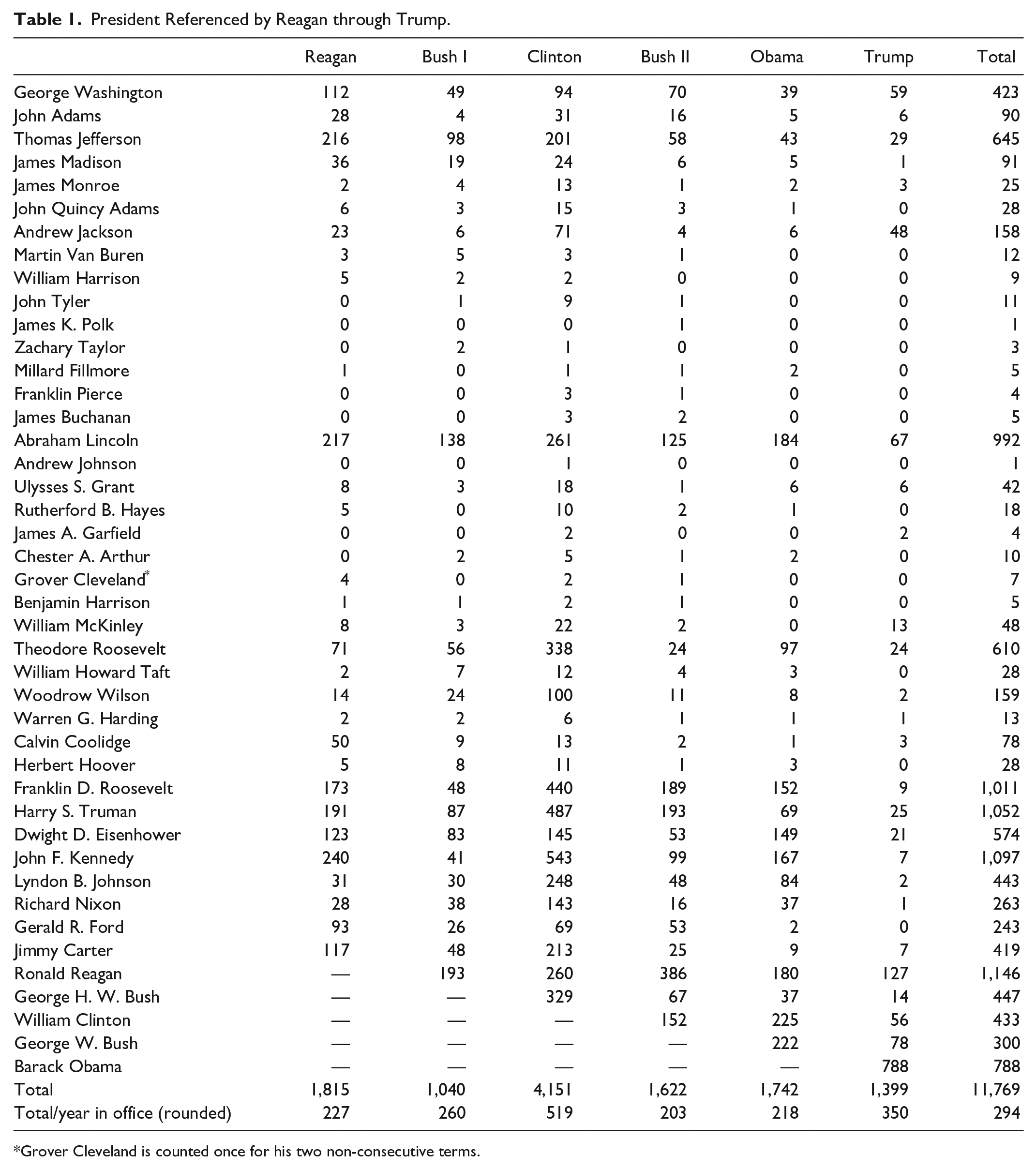
Grover Cleveland is counted once for his two non-consecutive terms.
To illustrate how frequent president use this tool, we plot in Figure 1 the number of references (per month) of each president throughout his time in office. Each dot is the sum of references in one month. The smoothing line is a locally weighted regression line of the sum of references over time.
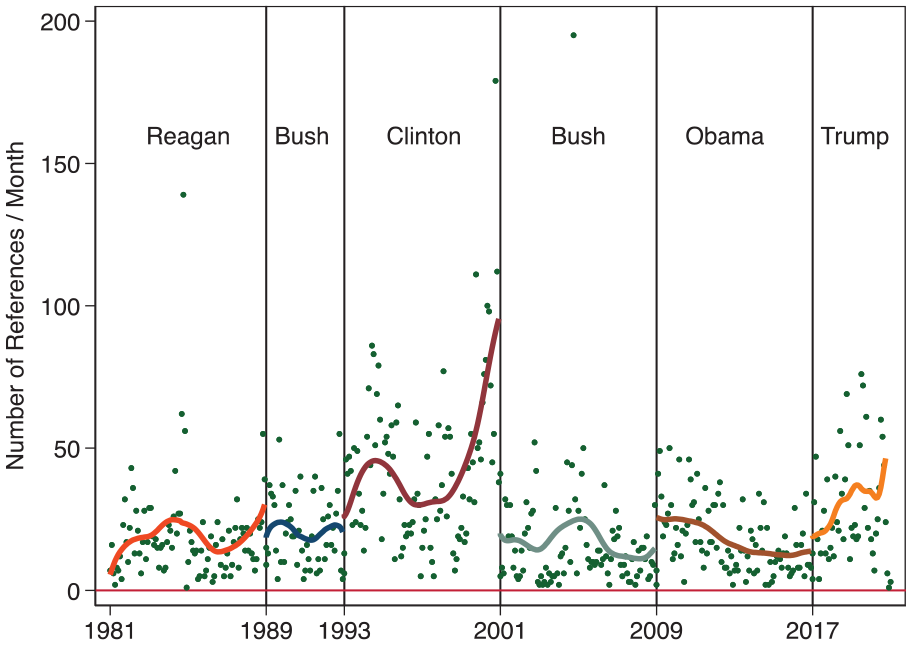
Number of references over time, for each of the six presidents.
The figure shows that there is hardly a month without references to previous presidents, indicating that presidents routinely refer to their predecessors. And yet, we find significant variation over time—with several months with extensive mentioning of former presidents while others with only a handful of references. The smoothed line also suggests an overall trend throughout a president’s term in office—picking up early in the president’s term, a decline and then an increase during the presidents’ final months in office.
Considering the identity of the presidents mentioned, Table 1 reveals that each of the 43 presidents (not including Trump and counting Cleveland once) are mentioned by the six presidents in our sample. Several presidents are mentioned many times, while others are rarely mentioned. The top five presidents are Lincoln (992 times), F. Roosevelt (1,011), Truman (1,052), Kennedy (1,097), and Reagan (1,146). But nearly half (19; 44%) of all presidents have been mentioned by the six presidents we examined more than 100 times in total.
Among the six presidents in our sample, we see significant variation in their choice of reference. Figure 2 plots the relative references of all presidents by each of the six presidents. Note that the six presidents vary in the number of presidents they can refer to (from 38 to 43 respectively, noting the duplicity of President Grover Cleveland). President George H.W. Bush could mention all presidents that were mentioned by Reagan and also mention Reagan himself. Clinton added H. W. Bush; W. Bush added Clinton; Obama added W. Bush; and Trump adds Obama. But, each president can decide who and how often they mention each of his predecessors. Our interest here is not only in who is mentioned more by each president but also to what extent presidents mentioned various presidents—a count of presidents and the distribution of this count. For this purpose, we added two measures at the foot of each panel: A simple count of the presidents that were mentioned by each president and the Shannon H equitability measure of the diversity in these mentions. 3
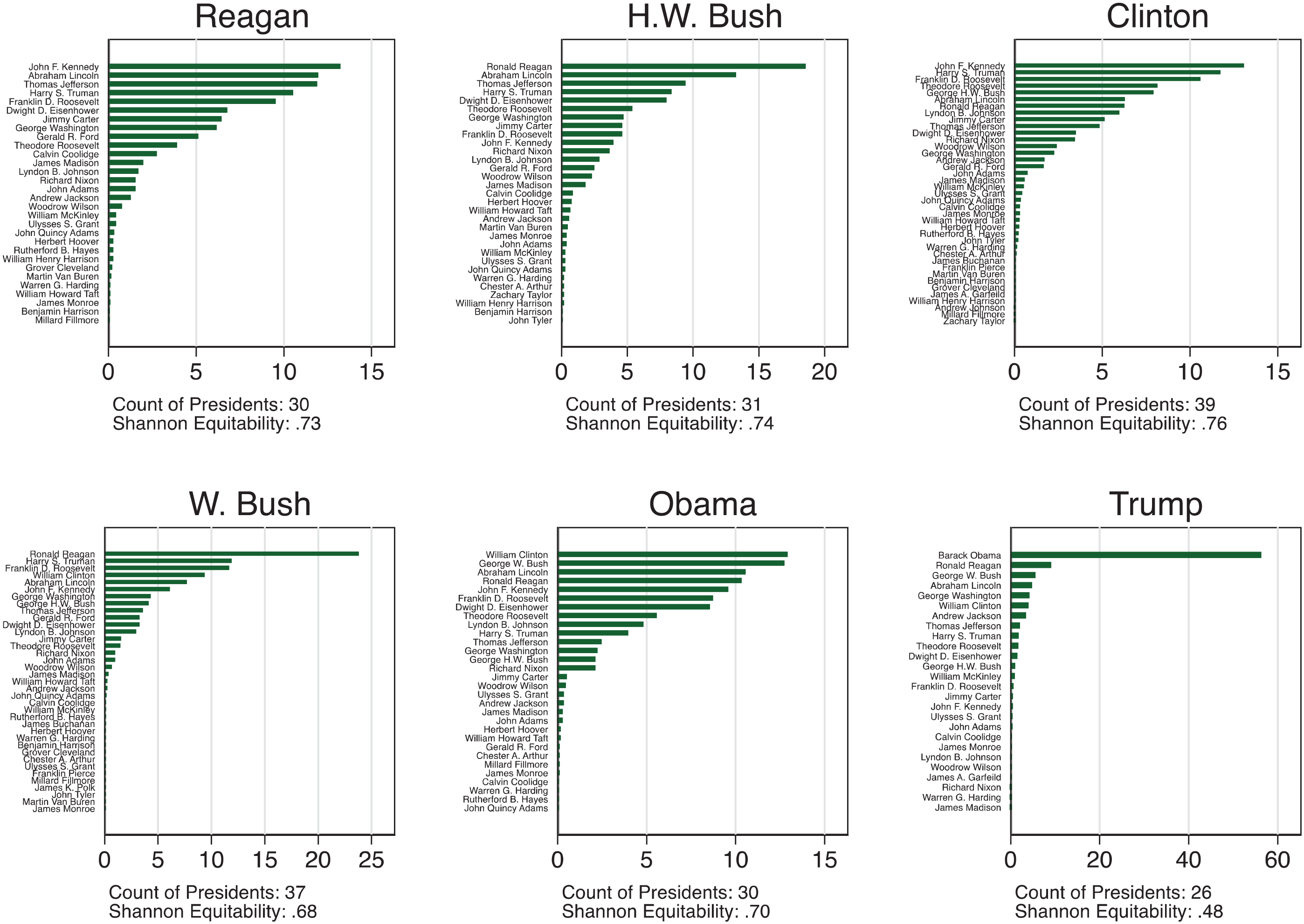
Ranking of mentioned presidents, by the six presidents in our sample.
The figure illustrates the variation in identity of presidents referenced and the distribution of these references. The simple count yields some variation between presidents. President Clinton leads with mentioning almost all his predecessors (39, leaving aside only President James Polk; mentioning 98% of former presidents). President George W. Bush mentioned 37 presidents (not referring to James Polk, Zachary Taylor, Andrew Johnson, and James Garfield; 90%). Presidents Ronald Reagan (30; 79%), George H.W. Bush (31; 79%), and Barack Obama (30; 71%) mentioned fewer presidents. And yet, differences between these presidents are small when compared to President Trump, who mentioned only 26 presidents (53%).
The Shannon H Equitability further illustrates the variation in references of former presidents by providing a measure of the spread of these references to former presidents. Equitability takes a value between 0 and 1, with 1 being complete evenness of references to all former presidents, and 0 being focused on a few presidents. Relying on this measure, we find three groups of presidents in their rhetorical use of this tool. Reagan (0.73), H.W. Bush (0.74), and Clinton (0.76) demonstrate relative evenness in their references. W. Bush (0.68), and Obama (0.70) show a less even distribution—W. Bush mentioned most presidents (37) but made substantial focus on Ronald Reagan, and Obama who mentioned fewer presidents (30) and highlighted a few presidents more than others. Although continuing the same downward trend, President Trump’s references seem to stand as a strong outlier—focusing mostly on his immediate predecessor, yielding an evenness measure of 0.48.
Presidents also vary in the choice of predecessors they mention. President Kennedy is the top choice of President Reagan and Clinton. President Reagan is the top choice for the two Bush presidents. Clinton is the president most mentioned by President Obama. While Obama couldn’t be mentioned by any other president except Trump, Trump reference(s) his immediate predecessor more than all of his other predecessors combined. The top five presidents each president mentioned vary considerably and include 12 different presidents: Washington (top five for one president), Jefferson (two presidents), Lincoln (five presidents), T. Roosevelt (one president), F. Roosevelt (three presidents), Truman (four presidents), Eisenhower (one president), Reagan (four presidents), H.W. Bush (one president), Clinton (two presidents), W. Bush (two presidents), and Obama (one president).
In sum, the variation in the frequency of mentions of former presidents and in the identity of presidents mentioned encourage us to search for systematic explanations for timing, identity and context of these references. We do that in our analysis below.
Analysis
Our analysis is divided into three parts. First, we examine the political determinants of timing (when) of references. Second, we examine the identity (who) of presidents mentioned. Finally, we examine the policy context (about what) of presidential mentions.
When?
Our first analysis focuses on the timing of presidential references of former presidents. Specifically, we test whether presidents use this rhetorical tool differently during honeymoon periods, elections, or toward the end of their presidency, and in response to the political environment—their own approval ratings and their relationship with Congress (divided government). We define honeymoon period as the first 100 days in office (January–April); elections periods include the final months before presidential elections (August–October); and end of presidency as the final year of a president (January–December of election year). 4 Presidential approval data are collected from the American Presidency Project. 5 We take the monthly mean of all surveys available in each month. Missing approval data are imputed over time. To allow for causal testing, we use the mean approval rating in the previous month. We define divided government as an ordinal variable taking 0 if unified government, 1 if the party of the president controls only one chamber (House or Senate) and 2 if the party of the president is in minority in both chambers. 6
To test the relative effect of each political factor, we estimate two regression models. The first is a Poisson count regression model in which the dependent variable is the number of presidential references per month (n = 474; M = 24.57; SD = 21.99). The second is a general least squares model in which the dependent variable is the proportion of references to former presidents per month made by each president of the total references the president has made in his term(s) in office (n = 474; M = 0.13; SD = 0.11). 7 In both models we account for differences between presidents by adding their fixed effects. To account for differences in presidential speechmaking routines and environmental factors that affect the number of speeches presidents make in each month (and therefore the opportunities to mention a former president), we include also a covariate of the sum of monthly oral remarks (M = 41.90; SD = 14.13). Table 2 below summarizes the regression results. Column 1 summarizes the count model. Column 2 summarizes the GLM model.
Estimating the Effect of Political Time.
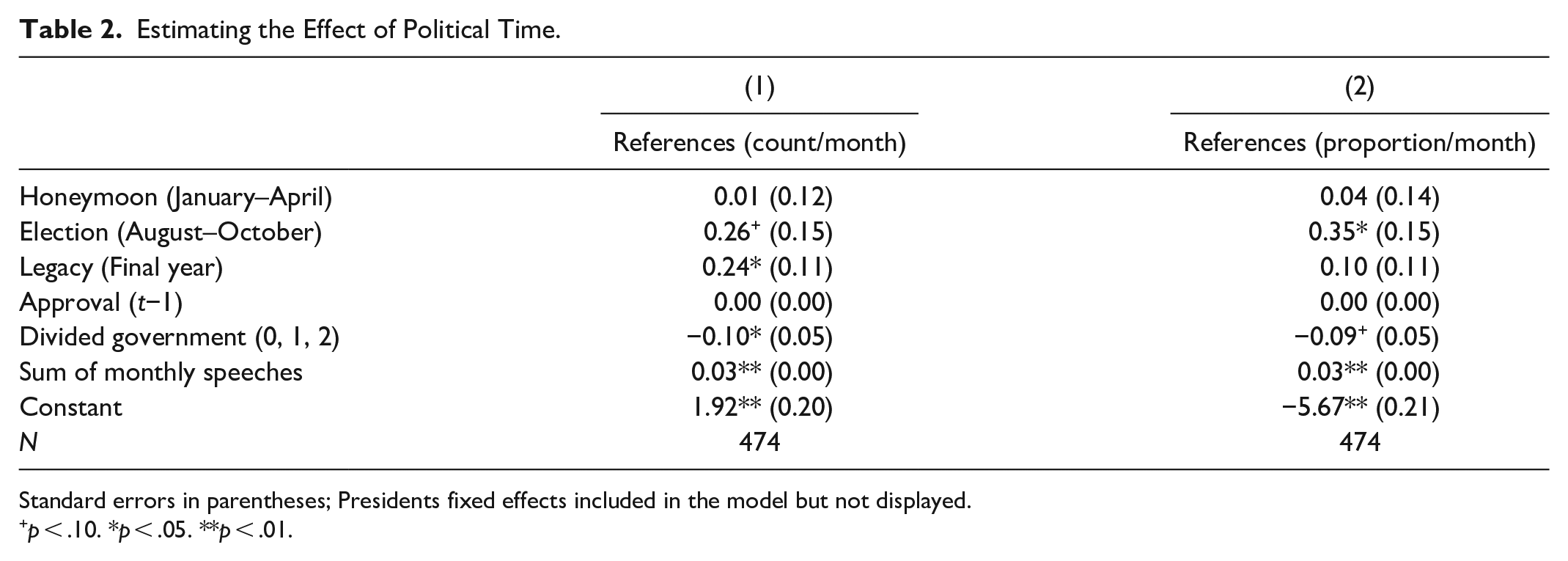
Standard errors in parentheses; Presidents fixed effects included in the model but not displayed.
p < .10. *p < .05. **p < .01.
The results partially support the election and legacy hypotheses. During elections and final months in office, presidents make more references to past presidents (hypotheses 1b and 1c). Although the results are statistically significant at conventional levels in only one of the two models (election in the proportional model, and legacy in the count model), the consistency of the direction of the estimates provide sufficient confidence in support of our hypotheses.
In contrast, we find no significant differences in mentioning of past presidents during honeymoon periods (hypothesis 1a). And, we find no support for our expectations regarding the effect of the political environment. Approval has no effect on references to former presidents (hypothesis 1d). Divided government has a statistically significant effect but the effect is opposite from our expectation—presidents make fewer references to former presidents during divided governments. 8
Who?
We next examine who presidents mention most. We expect that presidents will mention three categories of presidents – their own immediate predecessors, exemplary presidents, and presidents from their own party. We define immediate predecessors as the president who the naming-president replaced (Reagan for H.W. Bush, H.W. Bush for Clinton, etc.). We define exemplary presidents using the ranking of presidents and presidential leadership by the periodical Siena Presidential Expert Poll. The poll is issued during the second year of each administration, starting from 1982 to the most recent one in 2018. For each president, we use the poll that was issued during his presidency (Reagan, 1982, H.W. Bush, 1990, Clinton, 1994, and Trump, 2018). 9 For each president, we coded as exemplary president every president who is ranked at the top 10 of all presidents in each poll. 10 For partisan references, we examined only references to the seventh President (Jackson) forward because only then we can begin referring to the Democratic Party. The Republican Party had its first President only 30 years later (Lincoln, 1861) but there are very few references in between (see Table 1). Figure 3 summarizes the share of references to these presidents.
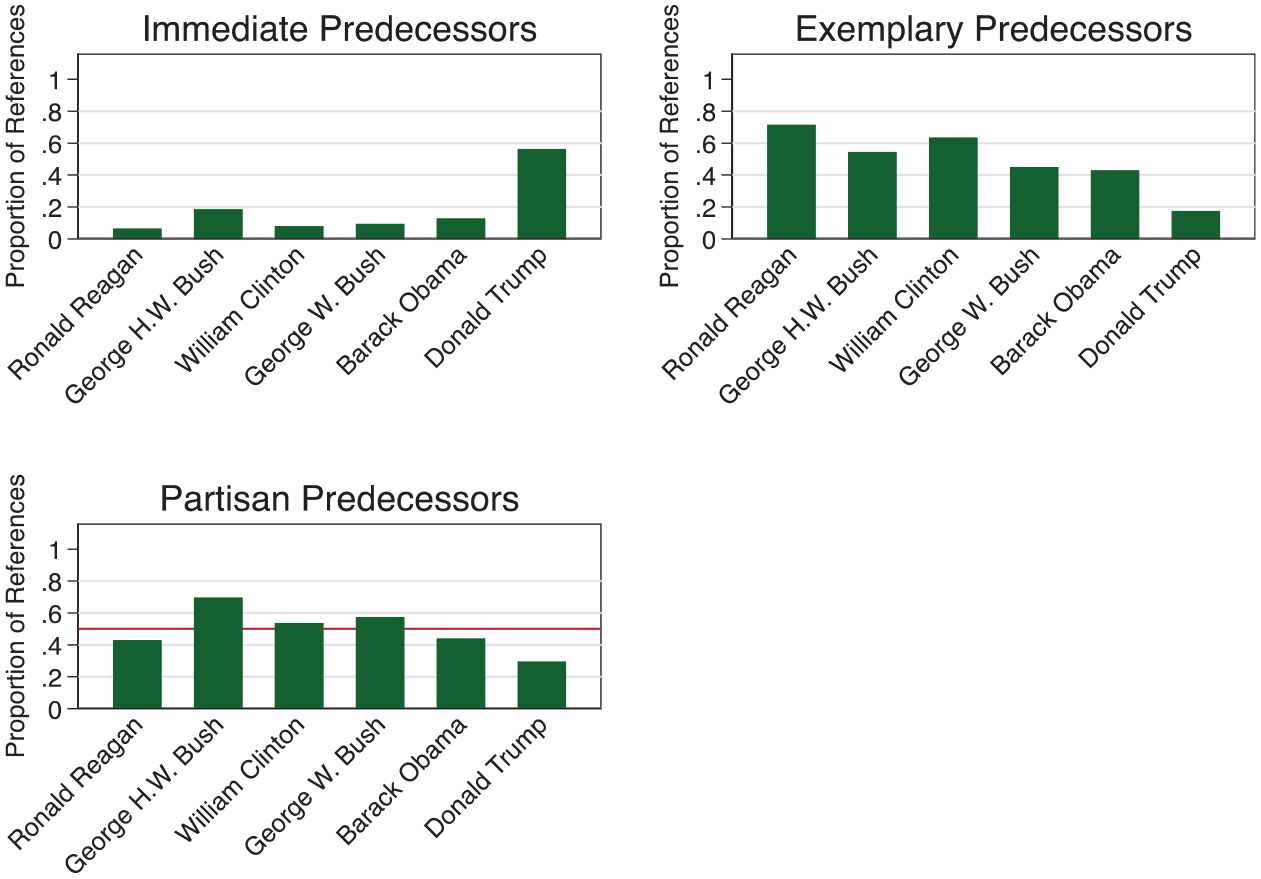
Identity of presidents referenced—immediate, exemplary, and partisan predecessors.
Immediate predecessors
The top left panel of Figure 3 summarizes for each president the proportion of their references to the past president who is their immediate predecessors. Presidents make significant references to the people who occupied the White House before them. At least 10 percent of references of all presidents were to immediate predecessors. One extreme exception is Donald Trump who mentioned Barack Obama nearly 60 percent of all his references to previous presidents. Beyond this, we find a high degree of mentioning of Reagan by H.W. Bush. This can be explained by the fact that Bush was part of the Reagan administration, and by the fact that Reagan is mentioned by most presidents who followed. Beyond these exceptions, we suggest there is some increasing pattern of references to immediate predecessors.
Exemplary predecessors
The top right panel in Figure 3 summarizes for each president the proportion of their references to exemplary presidents. Consistent with existing work, most of the references to previous presidents is to exemplary presidents (Brown, 2007). We find a trending decline in the proportion of references to former exemplary presidents though. President Trump may be an outlier here as well, but following in this trend.
Partisan predecessors
The bottom panel in Figure 3 summarizes the proportion of references each president made to his partisan predecessors. Because this category is binary (in-party vs. out-party), we added a horizontal line at 0.5 for reference. The figure demonstrates a clear downward trend—presidents are decreasingly referencing predecessors from their own party. Only H.W. Bush referenced presidents from his own party significantly more than former presidents from the out-party. This is explained by the fact that H.W. Bush is the only president in this list who followed a president from his own party, also considered an exemplary president. Reagan, Clinton, W. Bush, and Obama show a relatively even distribution. President Trump is an exception—focusing mostly on the out-party. The low proportion of Trump’s partisan references should be read with his overwhelming occupation with his immediate predecessor, Barack Obama.
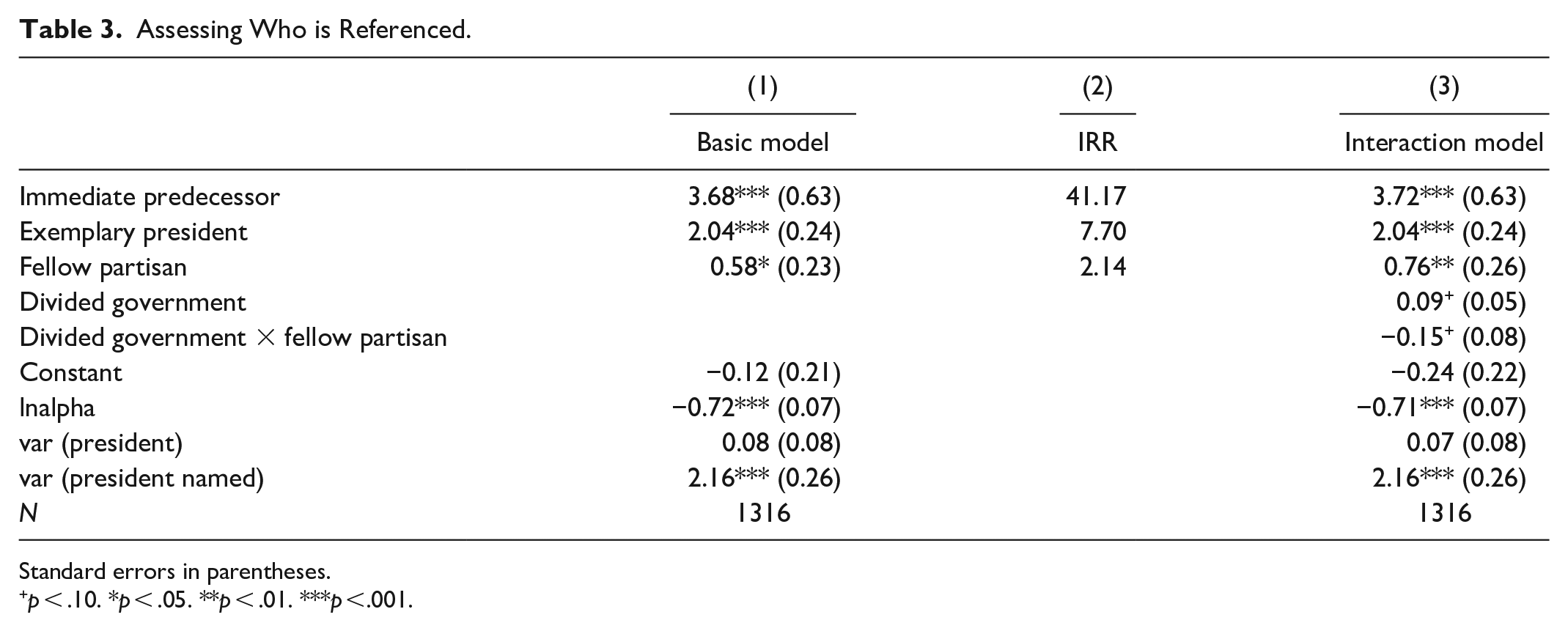
Going beyond these descriptive statistics, we examine the relative independent effect of each of these explanations by estimating the number of annual references of each of the six presidents for each category of past president in each year. We include our three categories of presidents as independent variables: exemplary, immediate, and partisan. Because the data are organized as panel data (president named, president), we estimate a multilevel model. Because our dependent variable is an over dispersed count (of references per year) (M = 8.87; SD = 19.73), we use a negative binomial estimator. The results are summarized in Table 3. Column 1 summarizes the point estimates; and column 2 summarizes the incidence rate ratio to allow for a comparison of effect size. In column 3 we summarize an interaction model to assess the conditional effect of divided government on references to co-partisans.
Assessing Who is Referenced.
Standard errors in parentheses.
p < .10. *p < .05. **p < .01. ***p <.001.
The results confirm our descriptive statistics. Presidents reference their immediate predecessors, exemplary presidents, and their partisan affiliates. The magnitude of the effect is different, however. A president is overwhelmingly likely to mention his immediate predecessor (an immediate predecessor is nearly 40 times more likely to be mentioned than a non-immediate predecessor). Less certain is for exemplary president or, even weaker effect, if the past president is from the same party as the president. Estimating the model without President Trump (not shown here) yields similar results but with weaker magnitudes.
The direction of the conditional effect of divided government supports our expectation (hypothesis 2d), but only at a 0.1 confidence level. During divided governments, presidents tend to reach across the aisle using names of former presidents from the out-party and focus less on their co-partisans. The effect, however, is small and the level of significance requires caution in generalization.
About What?
Finally, we examine the policy substance in presidential references—are presidents using this tool as part of their policy oriented goal of going public? For this purpose, we human-coded each paragraph that references a former president in search for policy context using the Policy Agendas Project codebook. The codebook includes 20 major policy topics and 220 subtopics. 11 Using the coded dataset, we examine differences in the issue agenda of presidents in their mentioning of former presidents. To compare the issue agenda in these references to the overall presidential agenda in presidential rhetoric, we used an available dataset of the policy agenda in occasional remarks made by presidents Reagan through Obama (N = 2,286 speeches). In occasional remarks we mean all oral remarks that are not categorized into major, ritual, or purposive speeches. The advantage of the occasional remarks is that they capture the routine agenda of presidents—frequent speeches to various audiences in various locations. This is also the largest category of oral remarks amounting to over 70% of all oral remarks. The dataset includes policy hand coding of each sentence in a sample of 25% of those speeches (N = 227,502 sentences).
On average, nearly three quarters (74%) of all president-naming paragraphs mention also a specific policy. Figure 4 summarizes the policy agenda of the six presidents in their references to their predecessors (of the total paragraphs that mention a policy). Each bar represents the share (percent) of paragraphs that discuss each policy domain. At the foot of each panel, we enclosed the percent of paragraphs that include a policy focus, the number of policy domains mentioned in these references, and the Shannon Equitability as a measure of the diversity of policies mentioned in those paragraphs. 12
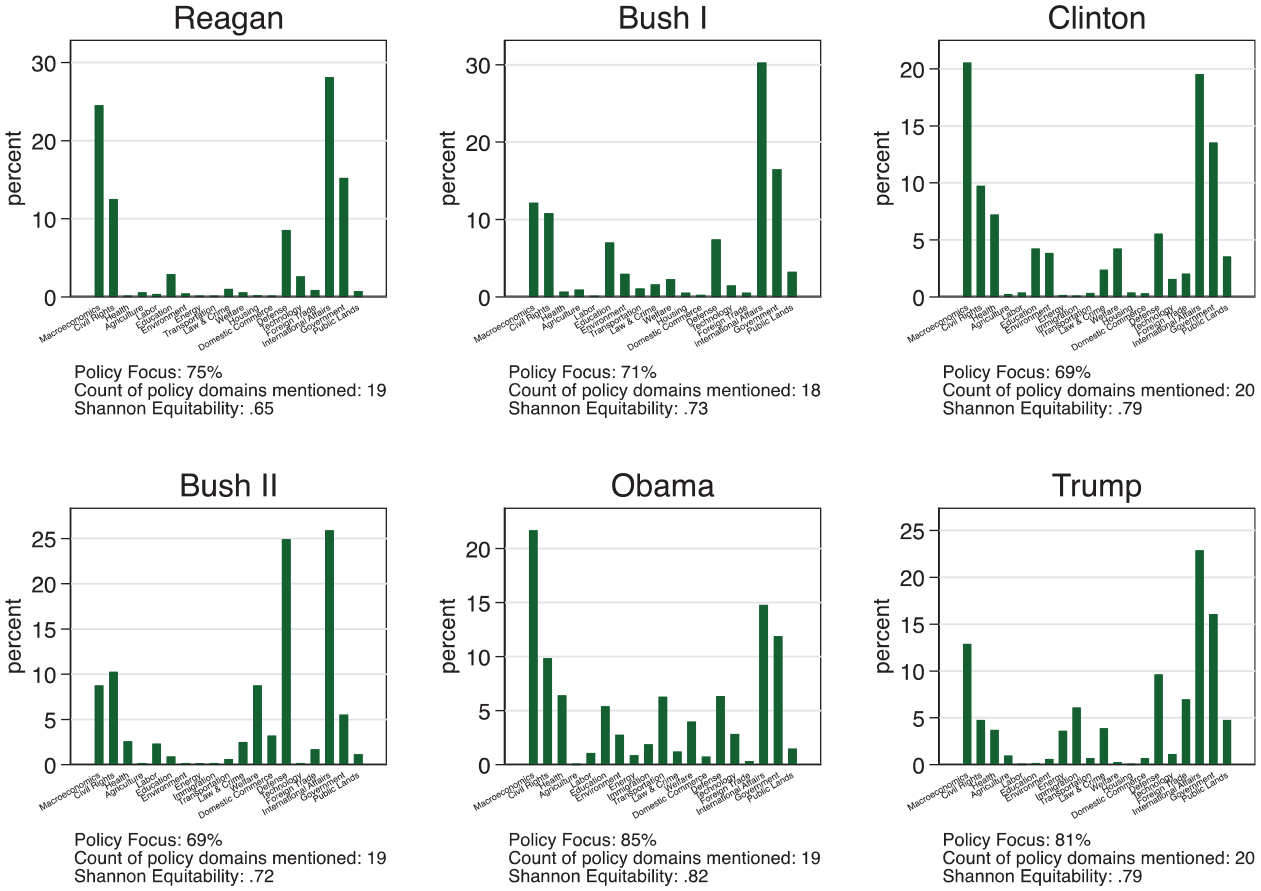
Policy agenda in presidential references to former presidents.
The majority of paragraphs that mention a former president, also mention a specific policy. The share of paragraphs that mention a specific policy ranges from 69% (Clinton and Bush II) to 85% (Obama). Figure 4 further illustrates that presidents make reference to former presidents when discussing almost all policies—count ranges from 18 to 20, which is the maximum possible domains. Diversity varies considerably, however. At one extreme is President Reagan (Equitability of 0.65), who focused on specific topics (macroeconomics, civil rights, defense, international affairs, and government), and paid little attention to most other policy domains. At the other extreme is President Obama (Equitability of 0.82), who mentioned former presidents in the context of a wide range of policies. The evidence here supports hypothesis 3a and suggests that mentioning former presidents is an integral part of the going public effort—to appeal to voters in order to enhance support for their policy initiatives.
To examine the variation in policy focus further, we assess how this variation is compared to the variation in the policy agenda of each president as reflected in their routine public remarks. We demonstrate the alignment of our two series—presidential references to former presidents and overall rhetorical agenda of these presidents—by examining the policy scope and policy scale in each. For policy scope, we compare the diversity of policy rhetoric in references to former presidents and in occasional remarks. A similarity in the diversity of each dataset will indicate that the policy agenda of presidents when mentioning former presidents is similar to that of their overall policy agenda. For policy scale, we assess the correlation in policy focus between the two series. A strong correlation will indicate that when presidents are focusing on a policy issue in their rhetoric, they routinely include references to former presidents in their public appeals.
Scope
Figure 5 summarizes the Shannon Equitability measure in each year for the two series. Note the upward trend of both series—presidents are talking policy today more than they did in the past. As can be expected, the evenness is higher in the overall presidential agenda (more speeches coded, and coding is at the sentence level), but differences in most years are small and trends are similar. The primary exception is President George W. Bush, where we find the policy scope in presidential references to be substantially smaller. Yet, for most presidents, in most years, the policy variation in their references to former presidents reflects the variation in the policy variation in their rhetorical agenda.
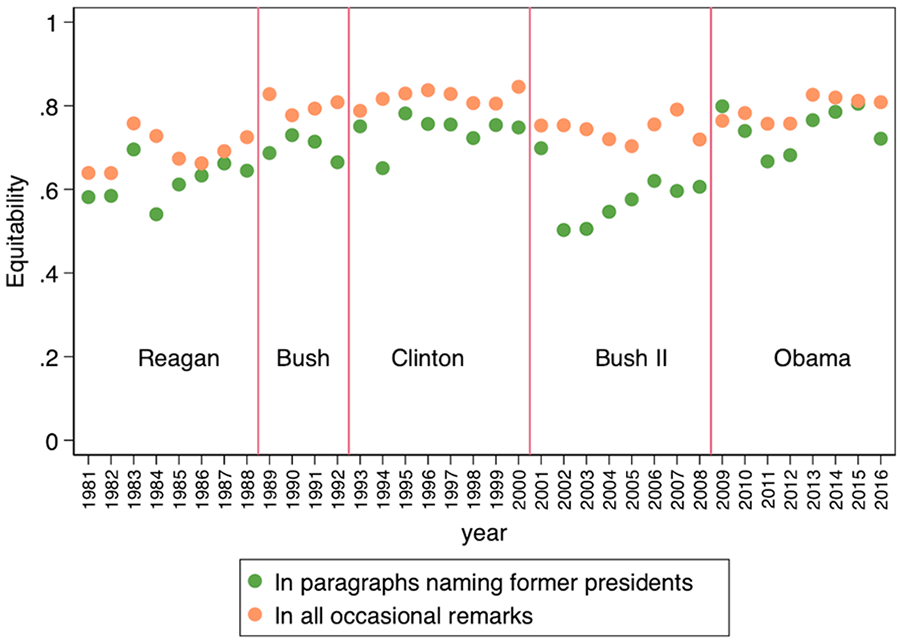
Comparing the policy variation in referencing former presidents and the rhetorical agenda of each president.
Scale
We demonstrate the similar scale in the policy agenda between the two series by calculating the Pearson correlation in the percent of focus on each issue. Figure 6 summarizes the results and demonstrates that while most topics are sporadically mentioned, when presidents focus their attention on an issue it is also reflected in their references to former presidents.
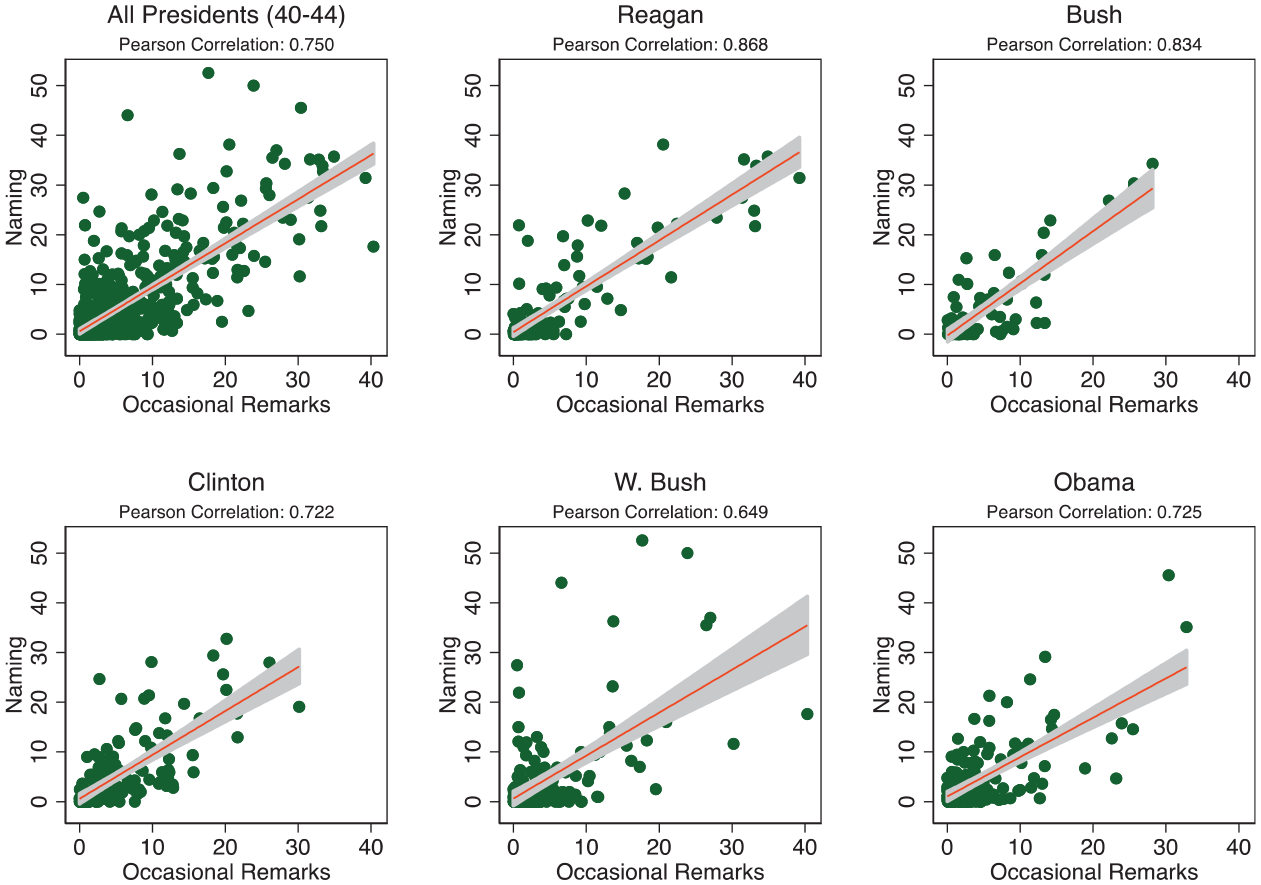
Correlation of policy agenda between presidential references and occasional remarks.
Our analyses of the scale and scope of the policy context in relation to the presidents’ overall policy focus reveal that presidents reference former presidents as an integral part of their rhetorical agenda (hyothesis 3b). Most of their references are within a policy context (74% on average), the diversity of topics in their rhetorical agenda is similar to the diversity of topics mentioned in paragraphs in which they reference former presidents, and the more a president focuses on a policy, the more he is referencing former presidents in his discussion.
Discussion
Much has been written on what presidents say, where they say it, and to what audiences, but analyses of references by sitting presidents to their predecessors has received little systematic scholarly attention. Existing work suggests that the popularity of past presidents, the partisan label they carry and the policy or political legacy that they are associated with, make them a strong rhetorical symbol that can enhance presidential appeals. This work, however, has focused either on the references of a single president to various exemplary presidents (Abbott, 1990; Brown, 2007) or on references of several presidents to a single (exemplary) president (Edwards, 2009). To allow generalization of the use of this tool, we depart from these earlier studies and analyze the timing, identity, and policy context of all references that six presidents, Reagan through Trump, made to all of their respective predecessors. In doing so, we demonstrate that presidents are strategic in using this rhetorical tool, considering when to reference a former president, who to mention and in what policy context.
Our main findings are as follows. Presidents routinely reference most of their former presidents. They mention presidents more often during election years and in their final months in office. But the quantity of references is not associated with approval, and, surprisingly, is negatively associated with divided government. On average, presidents mentioned 80% of their respective predecessors, albeit with significant variation—Clinton mentioning almost all, and Trump mentioning only half of the people who occupied the office before him (53%). The strategic use of this tool is evident in their personal choice. While presidents are more likely to mention exemplary presidents, their co-partisans, and, to a lesser extent, their immediate predecessors—the choice of presidents varies considerably between presidents. Finally, we find that presidents mention former presidents as an integral part of their policy appeals—most of their references are tied to a specific policy, and the policy agenda in their references is aligned with the overall policy agenda of their speeches.
The null findings of approval as an explanatory variable may be explained by the routine and broad use of the rhetorical tool of presidential reference. Presidents may strategically use this tool when approval is high or low—choosing which president to mention and in what context. The number of references may not be affected by approval, but who they mention and in what context may be associated with approval. This proposition receives some support in our analysis of the effect of divided government on references to former presidents. While presidents mention fewer presidents during divided government, we find evidence of a different strategic use of this tool during divided government. When they do not have full control of Congress, presidents try to reach across the aisle—they reference more out-party predecessors and fewer predecessors from their party. Presidents may be mentioning former presidents less during divided governments, but they are more selective in their choice of references.
We further suggest that the systematic analysis of references tells a story of its own that can help citizens and academics understand deeper levels of presidential rhetoric and the role of history in it. The decline in presidential references to exemplary presidents may indicate a change in the role of history and cultural identity in the public sphere. The increasing trend of references to out-partisans may indicate the difficulty of making a rhetorical appeal to unity during the current polarized politics. And, the upward trend of policy context further suggests a change in the nature of presidential rhetoric that becomes more instrumental and constructive. In unearthing these trends, this study proposes new areas of research on presidential rhetoric.
Further work needs to address the motivation for referencing former presidents. First, while we account for the policy context of these references, we do not assess whether referencing former presidents is used to justify a policy or to distance themselves from policies they oppose and seek to change. Related, we do not assess the tone of president’s references to their predecessors. While the areas we have explored provide a glimpse into the contexts in which presidents reference their predecessors, analyzing the tone of these references can shed light on the way in which presidents speak about their predecessors. The literature on presidential rhetoric and tone finds that the tone of a president’s remarks influences the way the public views the handling of a given event or scenario by a president (see, e.g., Eshbaugh-Soha & Linebarger, 2014).
Second, in the present study we do not examine the effect of “political time” (Skowronek, 1993) and how it relates to references presidents make to their predecessors. Such an analysis should explore whether political time relates to presidential references to their predecessors. To test this, we would need to go back in time in order to systematically compare references to former presidents in different political regimes.
Footnotes
Declaration of Conflicting Interests
The author(s) declared no potential conflicts of interest with respect to the research, authorship, and/or publication of this article.
Funding
The author(s) received no financial support for the research, authorship, and/or publication of this article.
