




Abstract
Capital punishment remains legal in most U.S. states even though only a small number of them regularly impose it. I attribute the persistence of death penalty statutes to the existence of direct democracy institutions in about half the states. Applying a longitudinal research design that leverages annual estimates of state death penalty opinion, I show that these institutions strengthen the connection between public opinion and capital punishment’s legality, indicating that they foster policy responsiveness. By extension, because citizens have generally favored capital punishment, I find that direct democracy states are more likely to have the death penalty. I also demonstrate that direct democracy increases the likelihood that policy will be congruent with majority opinion, especially in states where opinion leans strongly in one direction. The representation-enhancing effect of direct democracy, however, does not extend to the punishment’s application, as measured by states’ issuance of death sentences.
Long-term trends suggest the death penalty is in decline in the U.S., especially when measured in terms of usage. Over the past two decades, death sentences have declined precipitously as attention to wrongful convictions has risen (Baumgartner et al., 2008). Moreover, in many of the states that continue to issue death sentences, executions have become so rare that the punishment is effectively a more expensive form of life without parole (LWOP). Indeed, the condemned usually have their sentences reduced to LWOP on appeal (Baumgartner et al., 2018). But the minority of inmates who are denied such relief may, too, ultimately be spared, due to both the slow pace of the appeals process and the high frequency of stays of execution. As further evidence of the penalty’s decline, several governors have recently imposed moratoria on executions. In short, with the exception of a small number of states—most notably Texas—capital punishment is virtually extinct in practice, instead serving a mostly symbolic purpose (Steiker & Steiker, 2016).
Although several states have abolished capital punishment since the turn of the century, the fact is that the death penalty remains a legal punishment in 28 states at the time of this writing. The question motivating this study is why a public policy that is significantly costlier than the alternative while usually resulting in the same outcome is still on the books in the majority of states. To be sure, public opinion, which remains supportive of the death penalty in the abstract, is part of the explanation (Baumgartner et al., 2008, 2018; Erikson et al., 1993; Lax & Phillips, 2012). As Progressive reformers theorized over a century ago, however, the ability of public opinion to shape policy may depend on whether a state permits direct democracy. Building on this argument, I contend that the initiative and popular referendum have provided an extra layer of protection to death penalty statutes by directly and indirectly improving government’s responsiveness to public preferences. Additionally, this study is the first to address the related question of whether, and under what conditions, direct democracy promotes congruence between majority opinion and death penalty policy. While there may seem to be a fine line between policy responsiveness and congruence, it is important to draw a distinction between the two: the fact that state policy generally changes in response to public opinion does not imply that opinion majorities always prevail (Lax & Phillips, 2009a, 2012; Lewis & Jacobsmeier, 2017). Crucially, Progressives’ arguments in favor of direct democracy implied that these institutions would foster not merely responsiveness but congruence as well (Bowler et al., 1998; Sullivan, 1893). Also unlike earlier work, I explore whether direct democracy’s potential to improve policy representation is reflected in states’ proclivity to issue death sentences.
As a result of recent methodological advances allowing for the generation of time-varying, state-level public opinion estimates, I am able to employ a longitudinal research design, which offers significant advantages over the more conventional cross-sectional approach in assessing policy representation. Using cross-sectional time series data covering all 50 states in the nearly half century from 1961 to 2007, I evaluate the determinants of the death penalty’s legality. The results demonstrate that direct democracy serves to increase the probability that states will enact and retain death penalty laws by enhancing responsiveness to public opinion. Subsequently, I show that direct democracy helps induce policy congruence, particularly as public opinion becomes more one-sided. The final set of analyses, using data on all death sentences issued between 1977 and 2007, nonetheless reveal that direct democracy does not encourage the imposition of capital punishment, even in states where the death penalty is highly popular.
Public Opinion, Direct Democracy, and the Death Penalty
Scholars understand policy representation in terms of two similar yet conceptually distinct dimensions: responsiveness and congruence (e.g., see Campbell, 1981; Eulau & Karps, 1977; Kuklinski, 1979; Lax & Phillips, 2012; Lewis & Jacobsmeier, 2017). Responsiveness is defined as the extent to which “policy reacts to public opinion” (Lewis & Jacobsmeier, 2017, p. 443). In order for a state to exhibit responsiveness, there must only exist a positive correlation between opinion and policy. Congruence refers to whether “policy actually matches majority opinion” (Lax & Phillips, 2012, p. 148). The presence of incongruent policy is not evidence that public opinion is entirely inconsequential. Lax and Phillips’s (2012) findings underscore this point, showing that state policy is responsive to public opinion despite being inconsistent with majority preferences about half the time. Put another way, although opinion and policy are often not in alignment, they generally move in the same direction (see also Lax & Phillips, 2009a).
Unlike earlier researchers (e.g., see Treadway, 1985), contemporary political scientists are generally in agreement that public opinion is a primary determinant of state policy (Caughey & Warshaw, 2018; Erikson et al., 1993; Gray et al., 2004). Moreover, public opinion’s role should be amplified in the case of the death penalty, given the issue’s high salience and nontechnical nature (Mooney & Lee, 1999a, 1999b, 2000). Public opinion may not matter equally across the states, however. Institutional arrangements, principally whether a state allows for direct democracy, may systematically condition the effect of opinion and, in doing so, account for interstate policy variation (Lupia et al., 2010).
Progressive reformers who advocated for direct democracy on instrumental grounds were among the first to argue that direct democracy would strengthen the link between public opinion and public policy (Bowler et al., 1998). Consistent with their argument, direct democracy served to increase state government expenditures during the first half of the 20th century (Matsusaka, 2000), when there was public demand for government at all levels to establish the social safety net (Amenta & Carruthers, 1988; Ellis & Stimson, 2012). The rightward shift in public opinion starting in the 1970s (Enns & Koch, 2013; Stimson, 1991) provided an opportunity for conservatives to use direct democracy to advance key parts of their agenda, however. During the final decades of the 20th century, direct democracy states were predisposed to enact tax limitation measures and to take steps to reduce the size of government (Matsusaka, 1995). Conservatives also experienced considerable success in using direct democracy to influence policy on wedge issues, as evidenced by direct democracy states’ greater tendency to have in place restrictive abortion laws (Arceneaux, 2002; Gerber, 1996); anti-minority policies, including same-sex marriage bans, English-only laws, and affirmative action bans (Lewis, 2013; Lewis & Jacobsmeier, 2017); and, most notably for my study, the death penalty (Gerber, 1999). Direct democracy’s ability to promote both liberal and conservative policy change demonstrates that these institutions, despite recently becoming associated with conservative cultural politics, do not inherently move policy in any one ideological direction. Indeed, whether direct democracy increases the likelihood that a state will adopt a given policy is contingent on median voter preferences, which vary across issues and evolve over time (Gerber, 1999; Lupia & Matsusaka, 2004).
Over the course of U.S. history, voters have changed death penalty policy through direct democracy on only a handful of occasions, seemingly casting doubt on the claim that direct democracy is responsible for the continued existence of the death penalty in the U.S. 1 Drawing from the literature on direct democracy and public policy, however, I argue that direct democracy has primarily influenced death penalty policy indirectly, meaning these institutions have been able to affect public policy without voters having to actually utilize them. Proponents of this “gun behind the door” theory argue that direct democracy alters the behavior of legislators by incentivizing them to pass legislation that approximates median voter preferences (Gerber, 1996, 1999). Consider a scenario in which the status quo policy is distant from the ideal point of the median voter but close to that of the legislature. Ordinarily, lawmakers may not feel compelled to pass a new policy under these circumstances. If, however, there exists a credible threat that voters will pass an initiative in line with their preferences, the legislature may pass a more moderate version of the policy with the goal of preempting extreme change. In the case of the death penalty, lawmakers opposed to, or conflicted about, capital punishment can enact legislation that legalizes the practice but also severely restricts its application, such as by limiting the crimes that qualify for it or allowing juries to consider a wide array of mitigating factors in their sentencing phase deliberations. Because policy change can also come about by repealing existing legislation, similar dynamics should be at play under the popular referendum: In the hope of forestalling the complete repeal of legislation by the voters, the legislature may amend the law so that it more closely reflects public preferences.
Just as direct democracy can promote the enactment of popular laws, it can also discourage legislative policy change that collides with public opinion. Indeed, lawmakers in direct democracy states should be particularly wary of enacting unpopular legislation due to the possibility that it will later be replaced with direct legislation that is even less desirable to the legislature than the previous status quo (Gerber, 1996, 1999). Direct democracy’s ability to deter unpopular legislative action means that these institutions promote not only the adoption but also the continued existence of popular policies. Additionally, it should be noted that when it comes to an issue as salient and fundamental as the death penalty, a ballot proposal need not exist in print and have the backing of powerful interest groups in order for lawmakers to perceive a direct democracy threat as credible. Legislators are likely aware that subverting majority will on such an issue could trigger a public outcry capable of culminating in a successful popular campaign.
Direct democracy can operate as an indirect catalyst for policy change even when lawmakers and voters have similar preferences. Provided the issue at hand is sufficiently salient, direct democracy may serve to hasten sympathetic legislators’ response to changes in opinion (Arceneaux, 2002; Lewis & Jacobsmeier, 2017). In their attempt to secure reelection, lawmakers routinely tout their role in passing popular policies (Mayhew, 1974). Collectively, they advertise legislative accomplishments that they feel will help their party win control of government (Downs, 1957). The ability of both individual politicians and parties to engage in credit claiming, however, is compromised if such policies are passed through direct democracy instead of the regular legislative process (Lewis et al., 2014). It is in their interest, then, to act before voters take matters into their own hands. Direct democracy also can assist legislators striving to represent public opinion by creating institutional opportunities for voters to send unambiguous signals about their preferences on specific issues to government. Smith (2001) presents suggestive evidence that direct democracy serves this function, finding that district-level initiative results help predict how lawmakers will later vote on related legislation.
Even if the legislature of a direct democracy state were to change death penalty policy in defiance of public opinion, citizens would later be able to align policy with their preferences by waging an initiative or popular referendum campaign. Unlike traditional legislative referenda, initiatives and popular referenda originate from the citizenry, enabling voters to circumvent the representative system in passing or repealing laws, respectively. Consider, for example, the case of Nebraska, a direct democracy state whose legislature abolished capital punishment in 2015 despite the conservative, pro-death penalty orientation of its citizens. While this particular development was inconsistent with my theoretical argument, the popular referendum allowed voters to quickly reinstate the punishment themselves, thus helping induce policy congruence. In a non-direct democracy state, by contrast, policy would have likely remained inconsistent with public opinion. Nebraska’s experience illustrates how direct democracy provides a two-pronged bulwark against unresponsive elites.
Nevertheless, some research casts doubt on the theory that direct democracy improves policy representation (Burden, 2005; Caughey & Warshaw, 2018; Lascher et al., 1996; Lax & Phillips, 2012; Monogan et al., 2009). Because these studies typically analyze a broad set of public policies or the general ideological orientation of state policy, however, the findings are not necessarily applicable to a morality issue such as the death penalty. The technical simplicity and high salience of morality issues results in them having lower information barriers than other issues (Haider-Markel & Meier, 1996; Mooney & Lee, 1999a, 1999b, 2000; Stimson & Carmines, 1980). In part because of this, morality issues uniquely stoke citizen interest and participation in politics (Biggers, 2014; Mooney, 2001). Since it is relatively easy for citizens to form opinions about the death penalty, monitor the current state of policy, and coherently communicate their opinions to government, lawmakers may be concerned about the threat of direct legislation and thereby feel particularly pressured to follow public opinion. Furthermore, in the event that the legislature resists popular will, the public has the motivation and information necessary to unilaterally change policy (Biggers, 2014). It is also probably the case that citizens’ increased attention to and knowledge of death penalty policy reduces the need for interest groups to act as intermediaries between themselves and lawmakers. This is significant because the absence of a relationship between direct democracy and policy representation is sometimes attributed to the outsized policymaking role played in direct democracy states by interest groups (Lascher et al., 1996), whose views may be unrepresentative of public opinion (Schattschneider, 1960; but see also Boehmke, 2002).
Evaluating Policy Representation With a Longitudinal Research Design
With limited exceptions, studies evaluating the effect of direct democracy on policy representation employ a cross-sectional research design (e.g., see Gerber, 1999; Lax & Phillips, 2012). The dominance of this approach is largely due to the difficulty scholars historically faced in obtaining time-varying estimates of policy-specific opinion at the state level. As others have noted (e.g., see Lax & Phillips, 2009b), there exists a paucity of public opinion polls with representative state samples. Erikson et al.’s (1993) seminal work represented a significant step forward in developing subnational opinion estimates by introducing the method of disaggregation, which allows researchers to generate state-level opinion estimates by pooling large numbers of national surveys. A major drawback to this approach, though, is that the researcher must typically utilize surveys spanning multiple years in order to obtain sufficient within-state samples, thereby making it unsuitable for generating time-varying estimates. This problem has since been overcome by multilevel regression and poststratification (MRP), a technique developed by Gelman and Little (1997) and popularized by Lax and Phillips (2009a, 2009b, 2012). Now regarded as the gold standard for inferring subnational opinion estimates from national surveys, this method involves first modeling individual-level opinion as a function of demographics and state-level factors and then weighting the predictions by population data (Lax & Phillips, 2009b). In contrast to disaggregation, MRP has been demonstrated to produce reliable estimates of opinion using national surveys with as few as 1,400 respondents. Therefore, although MRP has mostly been utilized within the context of cross-sectional analyses, it is possible to produce yearly estimates under this approach.
Previous research provides only a partial picture of the relationship between direct democracy and policy representation when it comes to the death penalty. In addition to narrowly conceiving of policy representation as responsiveness, this research employs a static measure of opinion in combination with a cross-sectional research design (Gerber, 1999). It is preferable to study policy representation with longitudinal designs that make use of time-varying estimates of opinion (Lewis & Jacobsmeier, 2017), and this is especially true in the case of the death penalty given the highly variable nature of state public opinion on the issue (Pacheco, 2014; Shirley & Gelman, 2015). Even in the absence of policy change, a longitudinal approach is better equipped to gauge policy responsiveness because it can capture if a state failed to adopt a policy despite growing public support for it over time or, conversely, defied popular will in refusing to end an increasingly unpopular policy. Similarly, policy congruence can result from not just policy coming into alignment with opinion, but the reverse as well (Lewis & Jacobsmeier, 2017). Longitudinal designs that exploit time-varying opinion data provide a fuller assessment of policy congruence than cross-sectional ones by accounting for states’ ability to transition into and out of congruence purely as a result of changes in opinion.
Another benefit of longitudinal designs is that they allow for temporal variation in state policy. In doing so, they account for the possibility that the preferences of a stable and enduring opinion majority are reflected in policy in some years but not others. Cross-sectional analyses, by contrast, cannot handle time-varying measures of policy, and so may be misleading in their evaluations of policy congruence. Further, longitudinal analyses more accurately measure responsiveness by providing insight into the speed at which states react to opinion. This is a particularly important feature given that there can be lengthy gaps between two otherwise similar states adopting the same policy, as was the case with the death penalty following Furman v. Georgia (1972), the Supreme Court case that invalidated all death penalty laws in the U.S. Not until 1994, for example, did Kansas reinstate the death penalty—a full two decades after most other states had done so, even though a majority of Kansans supported capital punishment during the entire intervening period (Shirley & Gelman, 2015). A cross-sectional analysis would incorrectly give the impression that Kansas is no less responsive to public opinion than comparable states that reacted to Furman with greater urgency.
Longitudinal analyses also are able to establish causality with greater confidence than cross-sectional ones (Stimson, 1985). A major obstacle cross-sectional analyses face in inferring causality is the lack of temporality between the independent and dependent variables. Because longitudinal data have a time dimension, there is greater assurance that the appearance of the proposed causal factor preceded the occurrence of the outcome. As a result, it is less likely that any observed relationship between variables is merely correlational. Longitudinal designs are of particular utility when assessing opinion–policy linkages, given that policy change causes shifts in opinion, and not simply vice versa (e.g., see Wlezien, 1995).
Testing the Representation-Enhancing Effect of Direct Democracy on Death Penalty Policy
Through a series of cross-sectional time series models, I evaluate whether direct democracy fosters policy representation with regard to the death penalty. I first examine the determinants of the death penalty’s legality. Given the high levels of public support for capital punishment over time (Shirley & Gelman, 2015), the presence of direct democracy should increase states’ probability of having the death penalty if these institutions indeed enhance responsiveness to public opinion. To more directly test the idea that direct democracy promotes policy responsiveness, I also compare public opinion’s effect in states with and without direct democracy. The next set of analyses assess whether direct democracy assists in making policy congruent with majority preferences, and not merely more reactive to them. I further expect that the existence of a strong consensus in public opinion improves direct democracy’s ability to induce policy congruence, since larger opinion majorities have greater capacity to pressure and communicate their preferences to government.
Hypothesis 1: Direct democracy states are more likely to have a legal death penalty than non-direct democracy states.
Hypothesis 2: The effect of public opinion on the death penalty’s legality is greater in direct democracy states than in non-direct democracy states.
Hypothesis 3: Death penalty policy is more likely to be congruent with majority opinion in direct democracy states than in non-direct democracy states.
Hypothesis 4: Increases in opinion majority size are more likely to result in congruent death penalty policy in direct democracy states than in non-direct democracy states.
Beyond deciding whether to allow capital punishment, state governments also have a hand in determining how often the punishment is imposed. While the decision to seek death in individual cases ultimately rests with locally elected prosecutors, their discretion is limited by legislative statutes that specify which homicides are capital eligible. State law also governs the sentencing phase of capital trials, thus affecting a prosecutor’s prospects for securing a death sentence following a conviction. The criminal codes of death penalty states typically stipulate the aggravating and mitigating factors that the prosecution and defense, respectively, can present to the jury during this phase, as well as the rules of evidence (Jacobs et al., 2005). Moreover, some state governments permit the imposition of the death penalty even if the original jury failed to reach a unanimous verdict. In part because of lawmakers’ role in controlling the death penalty’s application and scope, public opinion influences the frequency with which states impose the punishment (Nice, 1992; Norrander, 2000). 2 This relationship should be stronger in direct democracy states, given the ability of these institutions to improve policy representation.
Hypothesis 5: Direct democracy states issue more death sentences than non-direct democracy states.
Hypothesis 6: The effect of public opinion on the issuance of death sentences is greater in direct democracy states than in non-direct democracy states.
Explaining the Legality of the Death Penalty
Using logistic regression with state random effects, I examine the factors that influence whether the death penalty exists as a legal punishment for first-degree murder. Following Shirley and Gelman (2015), if a state rewrote its death penalty statute between Furman and Gregg v. Georgia (1976), the Supreme Court case that reaffirmed the constitutionality of the death penalty, I code the intervening years as ones in which the state had the death penalty. By minimizing the impact of the Supreme Court’s intervention on this variable, I am able to more accurately capture the degree to which states’ internal political actors supported the death penalty during the study period. 3 The dataset begins in 1961, shortly after which an abolitionist wave occurred in the U.S. Subsequently, death penalty supporters succeeded in reinstating capital punishment in several states, but that trend started to reverse itself in the beginning of the 21st century. Still, capital punishment was on the books in the vast majority of state-years. 4 In order to account for the various waves of policy change, the models are specified with variables for year, year squared, and year cubed.
Twenty-five states allow citizens to influence policy through initiatives or popular referenda. 5 As is common in the literature (e.g., see Arceneaux, 2002; Lewis & Jacobsmeier, 2017), I account for the presence of either of these direct democracy institutions with a dummy variable. 6 In order to test the first hypothesis, I begin by modeling direct democracy as a main effect only. I later interact this variable with public opinion, as I am particularly interested in whether direct democracy promotes policy responsiveness.
I obtained yearly state-level estimates of death penalty support from Shirley and Gelman (2015), who had computed them for the years 1953 to 2006 using a Bayesian variant of MRP introduced by Park et al. (2004). 7 They utilized similarly worded survey questions from Gallup and the General Social Survey asking respondents whether they favored the death penalty “for persons convicted of murder.” In an effort to validate this inferred measure, I compared the opinion estimates to those from the 1990 and 1992 Senate National Election Study (SNES) surveys, which similarly queried respondents on their death penalty views. As Norrander (2001) points out, the SNES is functionally equivalent to regular state polls. 8 Unlike standard national polls, whose samples are designed to be representative at only the national level, the SNES utilizes a state-based sampling frame. In an earlier work (Norrander, 2000), she aggregated responses to the SNES’ death penalty question by state over the two years in which it was asked. I averaged Shirley and Gelman’s (2015) 1990 and 1992 estimates for each state, and then correlated those averages with Norrander’s reported estimates of death penalty support. As Figure 1 shows, the two measures correlate strongly (r = .72). Other research finds a similarly strong correlation between opinion estimates derived from MRP and state-level surveys (Lax & Phillips, 2009b).
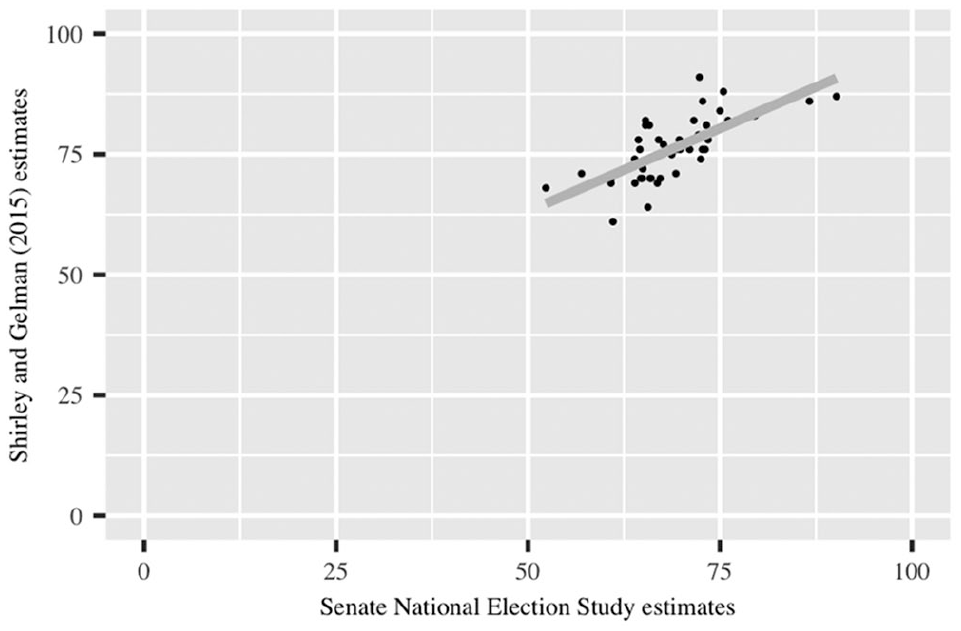
Validating death penalty opinion estimates.
Figure 2 displays states’ levels of public support for the death penalty in 15-year intervals from 1960 to 2005. As mentioned previously, a majority of Americans consistently favored the death penalty during this time period. However, there was considerable within-state variation in public opinion over time, with support precipitously rising after Furman and then peaking in the 1990s, after which it began to gradually decline. 9 The highly variable nature of death penalty opinion, in particular, confirms that there is utility in evaluating policy representation vis-á-vis the death penalty with longitudinal data. In order to ensure that state governments are in fact responding to citizens’ death penalty-specific views, and not their general ideological orientations, I also include Berry et al. (1998)’s measure of citizen ideology, where higher values represent more liberal publics. 10 I lag both variables by one year in order to give state governments a reasonable amount of time to respond to changes in the opinion environment.
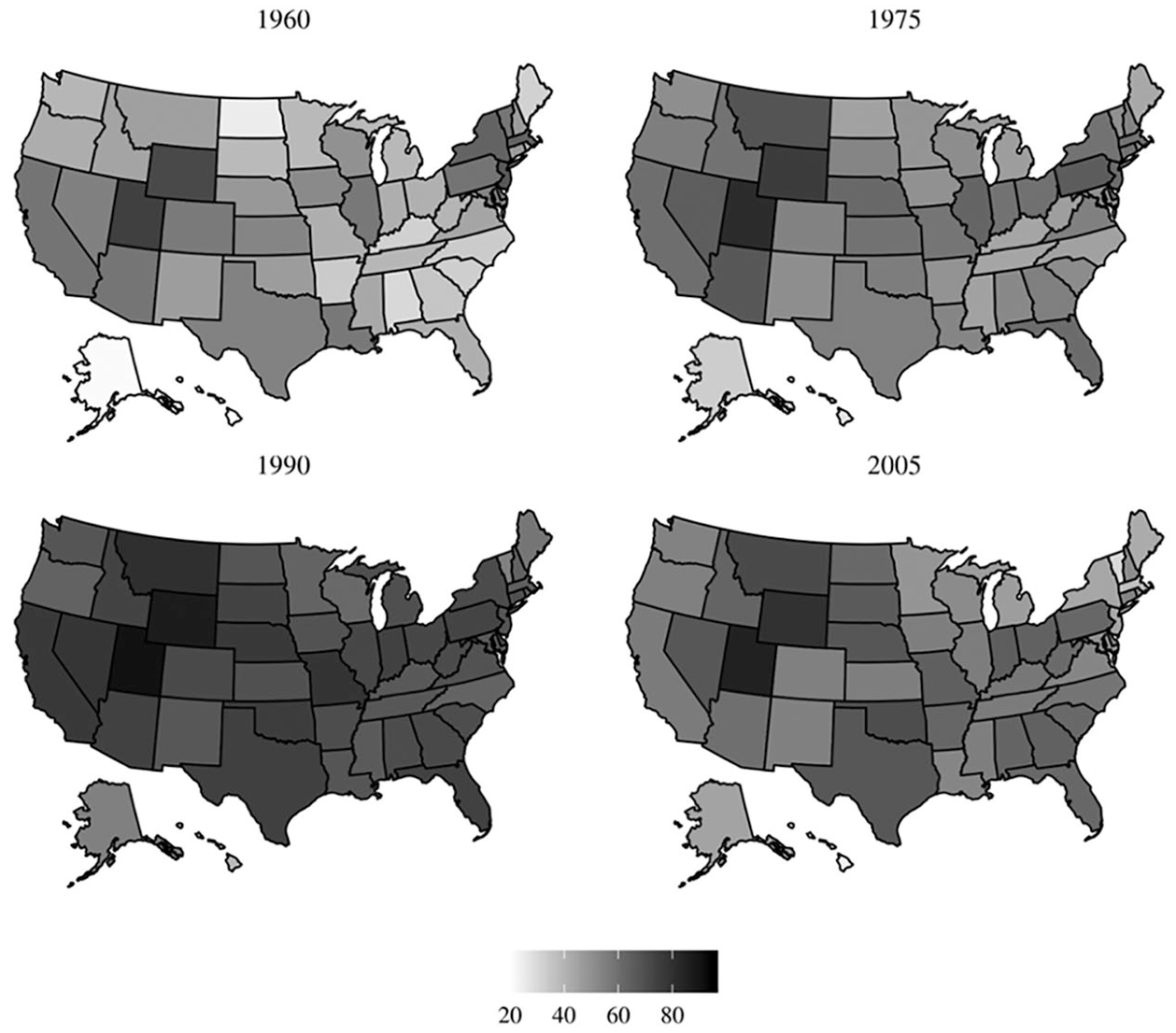
Death penalty support by state over time.
Other institutions besides direct democracy may condition the effect of public opinion and, in turn, help explain the death penalty’s varying legal status across the U.S. Compared to their counterparts in states with pure appointment systems, judges who are required to undergo popular or retention elections should be less insulated from public opinion and thus more hesitant to invalidate their states’ death penalty statutes. Consequently, I create an indicator for the states with supreme court elections. It is also worth considering the potential impact of legislative term limits, although it is unclear as to whether they will serve to enhance or moderate policy representation. On the one hand, term limits may weaken lawmakers’ incentive to follow public opinion by reducing electoral pressure (Carey et al., 2006). On the other, the higher levels of turnover in term-limited legislatures could facilitate the replacement of unresponsive incumbents (Lax & Phillips, 2012). I thus specify the models with a dummy variable for states with term-limited legislatures. 11 I interact both of these institutional controls with public opinion as well, since there is reason to believe the direction of their effects will be dependent on the level of support for the death penalty. 12
There exist several factors that may influence death penalty policy irrespective of the state of public opinion. First, because conservative elected officials should be more supportive of capital punishment, I include Berry et al.’s (2010) NOMINATE measure of state government ideology, where higher scores denote more liberal governments. Second, I take into consideration a state’s level of racial threat, operationalized as the black share of the population and its squared term. Some scholars argue that the modern death penalty serves as a means by which whites attempt to impose social control on large black populations, as lynchings did following emancipation (Jacobs & Carmichael, 2002; Jacobs et al., 2005). Third, Fisher and Pratt (2006) argue that states with traditionalistic political cultures, which place high value on maintaining law and order, are more likely to have the death penalty than those with moralistic or individualistic cultures. Hence, I distinguish the sixteen traditionalistic states from the others with a dummy variable. 13 Fourth, due to the tendency of states to emulate policies adopted by their neighbors—a phenomenon known as regional diffusion (e.g., see Berry & Berry, 1990)—I control for the number of neighboring states with the death penalty in the previous year. Finally, legislators, under the belief the death penalty serves as a deterrent to murder, may respond to rising homicide rates by enacting and fighting to preserve death penalty statutes. I use one-year lagged estimates of states’ homicide rates sourced from the FBI’s Uniform Crime Reports. 14
Table 1 presents the logistic regression estimates. Recall that the dependent variable is whether the state allows capital punishment for first-degree murder. Model 1 tests the independent effect of direct democracy on this variable, as called for by the first hypothesis. The coefficient for direct democracy is large, positively signed, and statistically significant (β = 5.94, p = .017), indicating that the death penalty is more likely to exist in states with the initiative or popular referendum. The size of the effect can be more easily understood in terms of predicted probabilities. Controlling for other factors, the presence of direct democracy increases the probability that a state will have the penalty by 10%, from 73% to 83%. When considered together with the fact that capital punishment enjoyed majority support in 71% of state-years, this finding provides preliminary support for the argument that direct democracy fosters responsiveness to public opinion. By successfully running—or threatening to run—pro-death penalty campaigns, citizens have been able to help ensure that the death penalty is added to, and later not eliminated from, the criminal code. Several of the coefficients for the other variables are in the expected direction and statistically significant as well. All else equal, states with conservative governments are more likely to have the death penalty, and the racial threat and political culture explanations offered in previous research receive support (Fisher & Pratt, 2006; Jacobs & Carmichael, 2002). More important for my purposes, public opinion is a significant predictor of policy even when controlling for citizen ideology, suggesting that states are responsive to citizens’ policy-specific views, not just their general ideological orientations.
Logistic Regression Models of the Death Penalty’s Legality, 1961 to 2007.
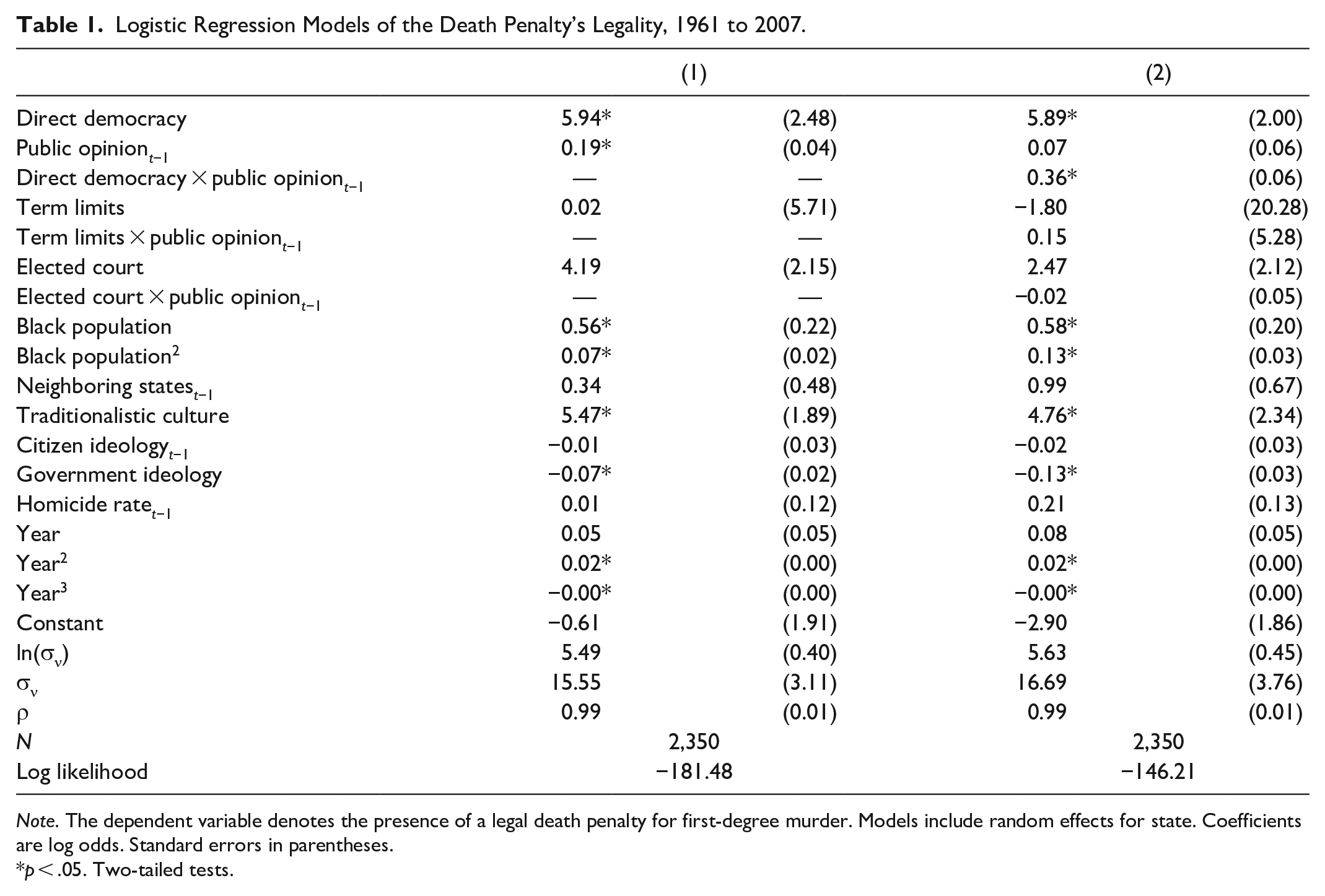
Note. The dependent variable denotes the presence of a legal death penalty for first-degree murder. Models include random effects for state. Coefficients are log odds. Standard errors in parentheses.
p < .05. Two-tailed tests.
Model 2 more directly tests whether the initiative and popular referendum promote policy responsiveness by introducing an interaction term for direct democracy and public opinion. In line with the second hypothesis, the coefficient for this interaction is positive and statistically significant, confirming that public opinion is more influential in direct democracy states (β = 0.36, p = .000). The marginal effects plot in Figure 3 allows for a more intuitive interpretation of this interactive relationship. It shows that in the average direct democracy state, each one percentage point increase in support for capital punishment raises the probability that it will be legal by about 0.6%. While the marginal effect of opinion for non-direct democracy states is positive as well, it is considerably smaller and indistinguishable from zero. Further, the results rule out the possibility that other institutions common to direct democracy states—namely legislative term limits and judicial elections—are responsible for their amplified responsiveness, as evidenced by the statistically insignificant coefficients for these variables’ interactions with public opinion. Overall, the results strongly suggest that direct democracy enhances or, perhaps more accurately, induces responsiveness in regard to the death penalty’s legality.
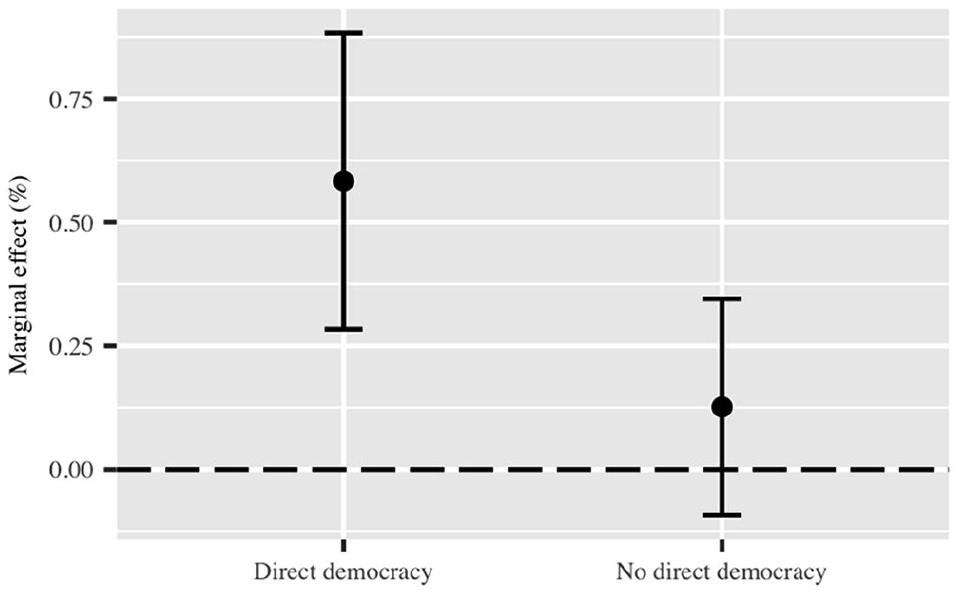
Marginal effects of public opinion on probability of a legal death penalty by direct democracy.
Explaining Policy Congruence
Although the results in the previous section demonstrated that direct democracy amplifies the effect of public opinion on policy, that does not necessarily mean that these institutions aid in bringing the two into alignment (e.g., see Lax & Phillips, 2012). The next set of models address this shortcoming by examining the effect of direct democracy on policy congruence, as opposed to policy responsiveness. I again estimate logistic regressions with state random effects, but the dependent variable now indicates whether policy matches the previous year’s majority opinion. Retentionist (death penalty) states with at least majority support for the death penalty and abolitionist (non-death penalty) states with less than majority support for the penalty are coded as having congruent policy. Conversely, policy is classified as being incongruent in abolitionist states where the penalty commands majority support as well as in retentionist states where only a minority of citizens favor capital punishment. In total, death penalty laws reflected majority opinion in 68% of state-years from 1961 to 2007, but there was a strong tendency for policy and opinion to come into congruence over time, which I capture with a linear term for year. 15
An indicator for the direct democracy states again serves as a primary independent variable of interest. States where public opinion on the death penalty is more one-sided should, too, be more likely to have congruent policy, but this relationship is likely to be stronger in those with direct democracy. I thus add an interaction between direct democracy and a variable measuring the size of the opinion majority, which I calculate with the following formula: |50 − public opiniont−1|. 16
The models, of course, account for plausible alternative explanations for policy congruence. I retain the controls for the other institutions believed to modify the impact of opinion on policy—legislative term limits and judicial elections—and interact them with opinion majority size as well. 17 I also create a lagged variable measuring the change in public opinion from one year to the next, because states experiencing constant shifts in public opinion should have more difficulty attaining policy congruence than states where public opinion is relatively stable (Lewis & Jacobsmeier, 2017).
The logistic regression results are featured in Table 2. The positive and statistically significant coefficient for direct democracy suggests that the initiative and popular referendum foster policy congruence (β = 1.18, p = .001), as predicted by the third hypothesis. In order to gain a better handle on the substantive size of the effect, I again generate predicted probabilities. The model projects that, all else equal, a direct democracy state has a 78% probability of having congruent policy, compared to 61% for a non-direct democracy state. With the exception of year, the only other predicator that achieves statistical significance is opinion majority size. The positive coefficient indicates that as the opinion majority becomes larger, so does the probability that the state will have congruent policy.
Logistic Regression Models of Policy Congruence, 1961 to 2007.
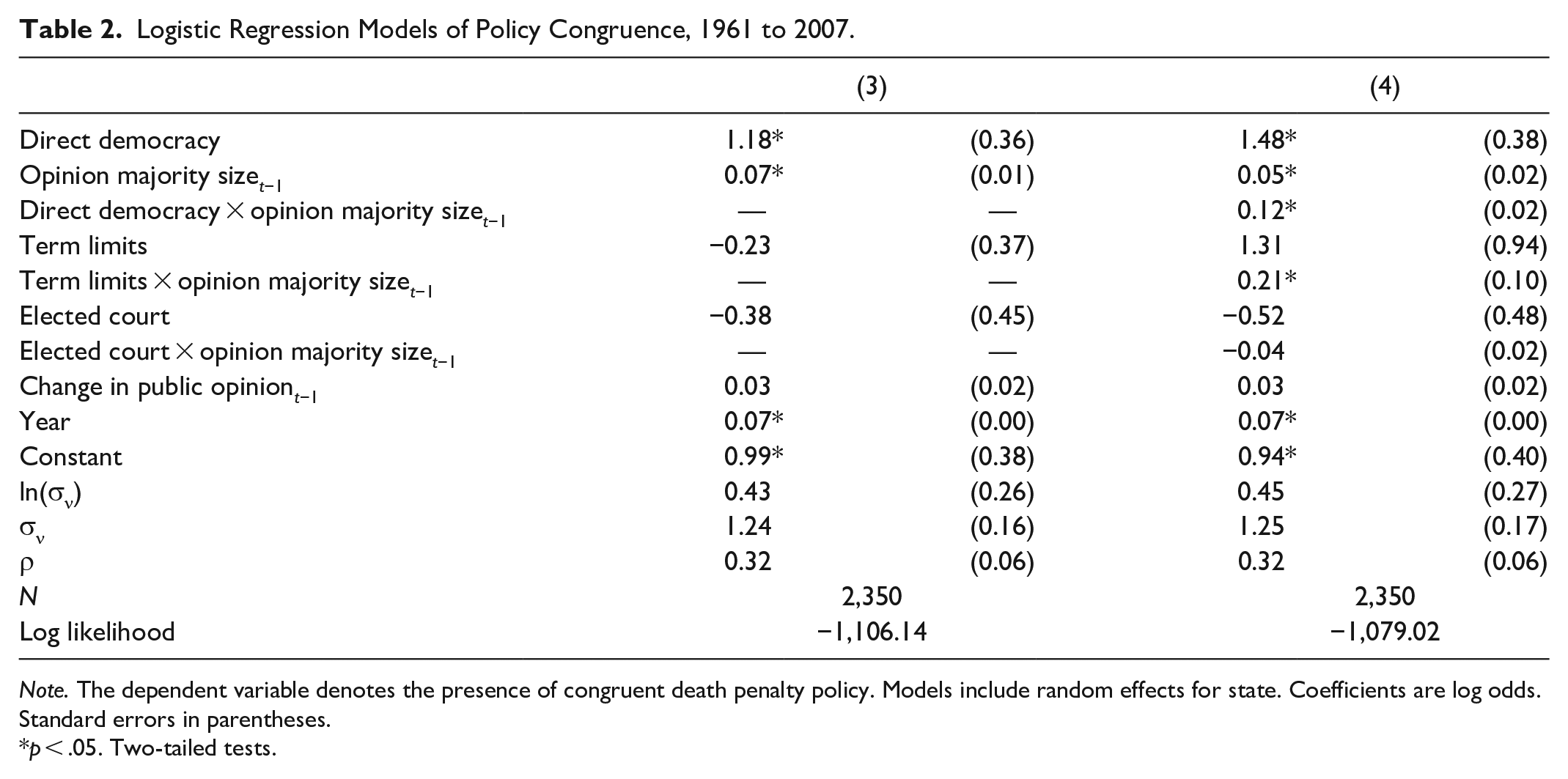
Note. The dependent variable denotes the presence of congruent death penalty policy. Models include random effects for state. Coefficients are log odds. Standard errors in parentheses.
p < .05. Two-tailed tests.
Model 4 assesses the combined effect of direct democracy and opinion majority size on policy congruence. Consistent with the fourth hypothesis, the interaction between these two variables returns a positive and statistically significant coefficient (β = 0.12, p = .000), suggesting that as public opinion becomes less divided, direct democracy’s ability to promote policy congruence improves. Figure 4 plots the predicted probabilities for direct democracy and non-direct democracy states at different levels of opinion majority size. In either type of state, as the margin by which citizens favor or oppose the death penalty grows, so does the chance that it will have matching opinion and policy. Only for direct democracy states, however, does this relationship resemble a logarithmic growth curve, with small initial increases in opinion majority size leading to sharp increases in the probability of having congruent policy. The size of the effect is indeed impressive. An increase in opinion majority size from 1% to 20%, for example, raises the probability that the typical direct democracy state will have congruent policy by 41%. In non-direct democracy states, by contrast, increases in opinion majority size yield steadier and more modest effects. The result also reveal that term limits, but not judicial elections, empower opinion majorities once they reach a certain size. 18
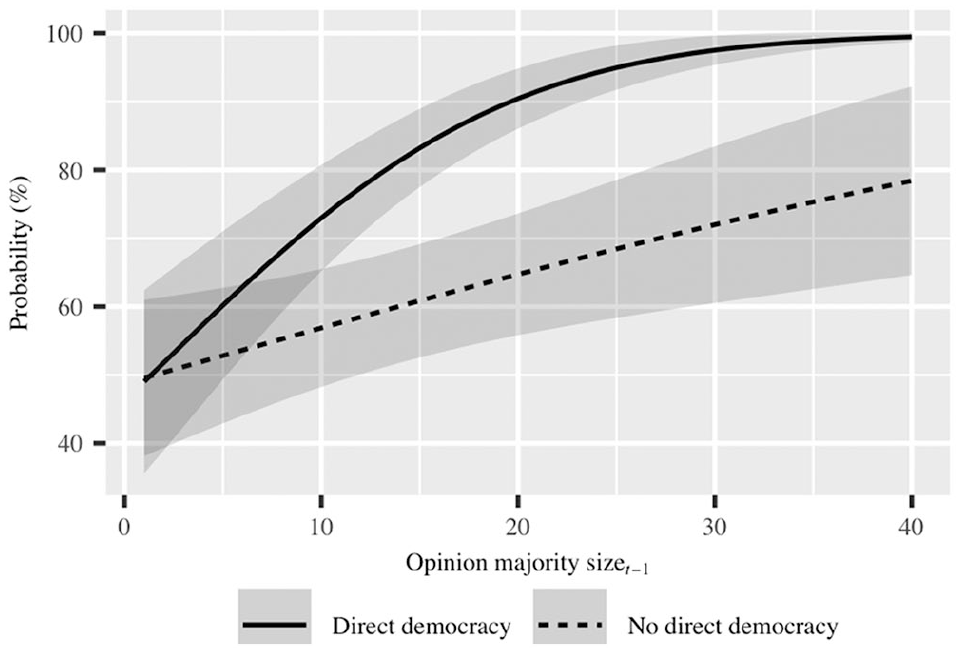
Impact of opinion majority size on probability of congruent death penalty policy by direct democracy.
Explaining Death Sentences
It is possible for the death penalty to exist as a symbolic policy, meaning states can technically allow the punishment but rarely, if ever, impose it (Steiker & Steiker, 2016). Does direct democracy have policy consequences that are substantive, as opposed to symbolic, in nature? I attempt to shed light on this question by analyzing the number of death sentences issued by each state from 1977 to 2007 with zero-inflated negative binomial (ZINB) regression. 19 I opt for this modeling approach because the dependent variable is an overdispersed count that can assume a value of zero as a result of two distinct data-generating processes (Long, 1997). 20 As Jacobs et al. (2005) point out, a state would not issue any death sentences if it either lacked a legal death penalty or did not impose the punishment despite having the option do so. 21 Due to the panel nature of the data, I cluster the robust standard errors by state. I also specify the models with variables for year and its squared term, to account for the rise and decline in death sentences that occurred in the post-Gregg era (Baumgartner et al., 2018).
The ZINB models estimate two separate equations: a logit predicting the absence of death sentences and a negative binomial predicting death sentence counts greater than zero. The covariates thought to influence the death penalty’s legality should be highly similar to those that affect the imposition of the punishment, so I largely retain the specifications used in Models 1 and 2. Two controls, though, are exclusive to the ZINB models. The first is the natural logarithm of state population, which accounts for the fact that death sentences should be more common in more populous states. The second indicates whether the death penalty exists as a legal criminal sanction in the state. This variable should be strongly associated with the absence of death sentences, but since having a legal death penalty is a precondition for issuing any death sentences, it would be inappropriate to include it in the negative binomial portion of the model. 22 I lag most variables by one or two years. 23
The ZINB results appear in Table 3. Contrary to expectations, Model 5 shows that direct democracy exerts no independent effect on death sentences. Public opinion, despite failing to predict the absence of death sentences, emerges as a significant predictor in the negative binomial portion of the model. Specifically, a 10-point rise in support for the death penalty—the equivalent of a one standard deviation increase—is predicted to lead to nearly two additional death sentences, on average. Relatedly, the logit coefficient for citizen ideology attains statistical significance, indicating that states with liberal publics are more likely to not issue any death sentences. Death sentences also occur more frequently in states with elected supreme courts, higher homicide rates, larger populations, and traditionalistic political cultures.
Zero-Inflated Negative Binomial Regression Models of Death Sentences, 1977 to 2007.
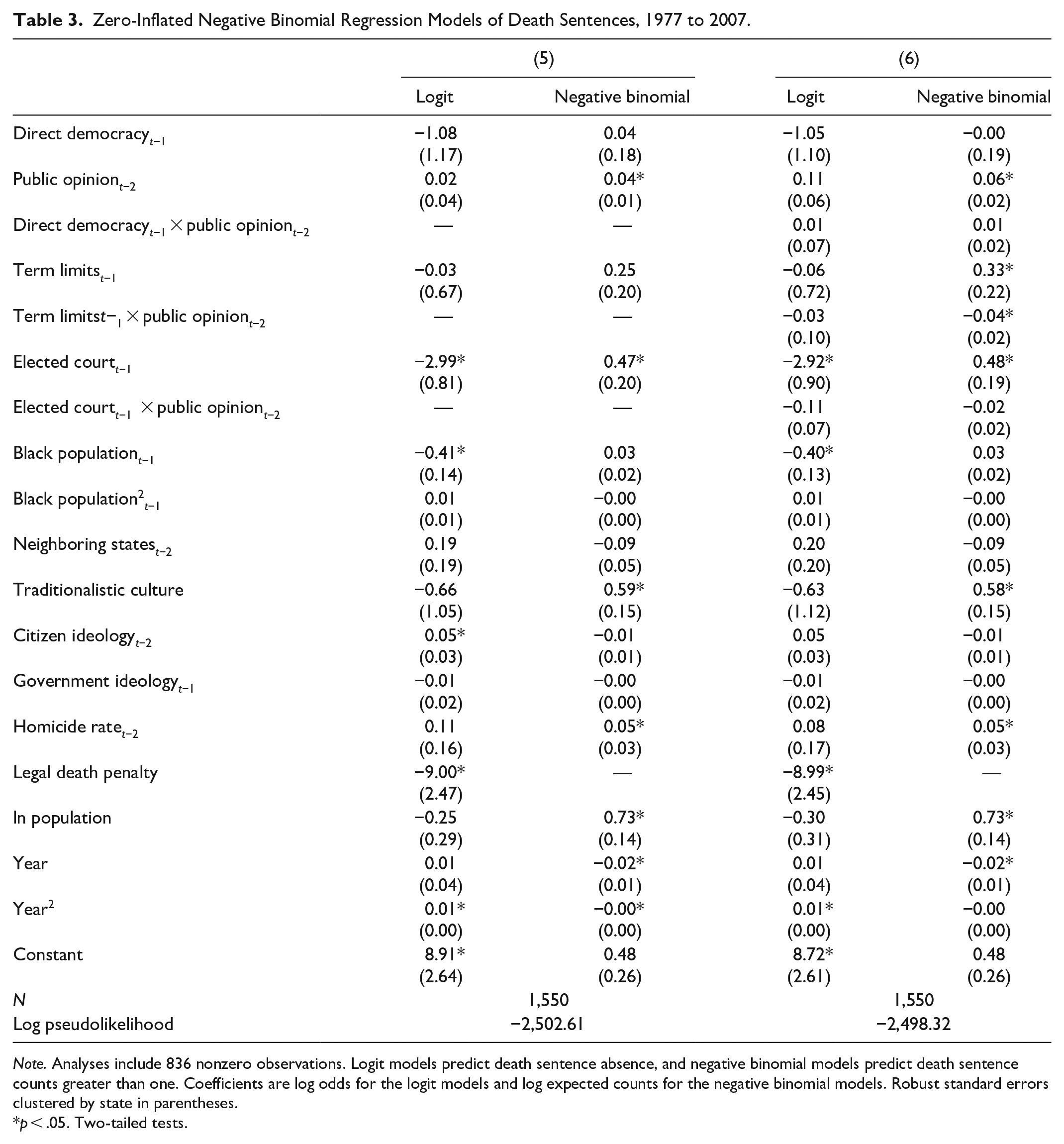
Note. Analyses include 836 nonzero observations. Logit models predict death sentence absence, and negative binomial models predict death sentence counts greater than one. Coefficients are log odds for the logit models and log expected counts for the negative binomial models. Robust standard errors clustered by state in parentheses.
p < .05. Two-tailed tests.
Model 6 adds the institutional and opinion interactions. In both equations, the coefficients for the interaction terms featuring direct democracy are statistically insignificant, implying that even in states where public support for the death penalty is high, direct democracy does not encourage the issuance of death sentences. Only term limits serve to condition the effect of opinion. The statistically significant, negative coefficient for the associated interaction term in the negative binomial equation indicates that this institution weakens the relationship between public opinion and the number of death sentences imposed. In sum, the ZINB results run counter to the fifth and six hypotheses, demonstrating that direct democracy is not a driver of death sentences, regardless of citizens’ level of enthusiasm for capital punishment.
Conclusion
Longitudinal analyses allow for more complete examinations of policy representation in the states (Lewis & Jacobsmeier, 2017). However, only recent breakthroughs in measuring state opinion have made it possible for scholars to conduct such analyses. This study explored whether direct democracy promotes policy representation with regard to the death penalty using Shirley and Gelman’s (2015) estimates of state opinion, among other cross-sectional time series data. The first set of logistic regression models showed that direct democracy states are more likely to have a legal death penalty—a finding driven by their enhanced responsiveness to opinion. I then demonstrated that direct democracy promotes policy congruence, especially as the opinion majority grows in size. The results from my analyses of death sentences, however, seemingly contradict the notion that direct democracy fosters policy representation. Considered together, the findings comport with Gerber’s (1996, 1999) explanation regarding the mechanism by which direct democracy strengthens the connection between opinion and policy: In an effort to appease pro-death penalty publics, lawmakers who may have otherwise disallowed capital punishment are willing to permit it so long as it is seldom applied. The end result is that direct democracy yields primarily symbolic, rather than substantive, policy consequences. 24
That direct democracy has encouraged states to maintain, but not apply, capital punishment implies that a largely symbolic death penalty is sufficient to placate the generally punitive public. A possible explanation for this is that elites, whom voters rely upon for information about policy issues (Lupia & McCubbins, 1998), are not interested in actually applying the penalty due to concerns about cost, innocence, or racial bias, and so rarely bring their states’ usage of it, or lack thereof, to the public’s attention. Citizens’ apparent satisfaction with a death penalty that exists more in law than in practice seems to support Edelman’s (1964, 1971, 1988) classic argument that the public understands politics through the symbolic actions taken by government to maintain quiescence.
One limitation of my study is that the findings are not necessarily generalizable to other issues. Citizens are highly attentive to and feel strongly about morality issues such as the death penalty, as reflected in the fact that direct democracy campaigns centered around them have unique ability to stimulate voter turnout (Biggers, 2014). Given that citizens are better equipped to organize pressure campaigns around morality issues, legislators may be especially worried that initiative and popular referendum threats involving these issues will materialize and, ultimately, produce undesirable policy change. This could explain why the extant literature suggests that the representation-enhancing effect of direct democracy is confined to “hot-button” issues like abortion and gay rights (Arceneaux, 2002; Gerber, 1996, 1999; Lewis, 2013; Lewis & Jacobsmeier, 2017). Indeed, studies examining an array of policies of varying salience and technicality typically find, at best, a weak connection between direct democracy and policy representation (Lascher et al., 1996; Lax & Phillips, 2012), as does other work comparing the general ideological orientation of state publics to that of state policy (Burden, 2005; Caughey & Warshaw, 2018; Monogan et al., 2009). As my findings help make evident, however, it would be wrong to conclude from this research that the Progressive hope that direct democracy would enhance policy representation has gone entirely unrealized.
In addition, this study adds to the extensive literature documenting direct democracy’s tendency to adversely affect political minorities (e.g., see Gamble, 1997; Haider-Markel et al., 2007; Lewis, 2013). It is not a stretch to classify the death penalty as an anti-minority policy. A long line of scholarship demonstrates that the penalty is applied disproportionately to black defendants, and particularly those with white victims (e.g., see Baldus et al., 1983). Perceptions that capital punishment is administered in a racially discriminatory manner have long motivated the NAACP’s opposition to it, and they likely also contribute to black Americans’ lower levels of support for the practice (Peffley & Hurwitz, 2007; Peffley et al., 2017; Shirley & Gelman, 2015). Moreover, there is some evidence that the death penalty operates as a tool for maintaining and reinforcing the existing racial hierarchy (Jacobs & Carmichael, 2002; Jacobs et al., 2005). That direct democracy states are more likely to have the death penalty thus buttresses the view, espoused by some of the Founders in the Federalist Papers, that pure democracy uniquely exposes minority groups to the rule of a tyrannical majority (Hamilton et al., 1999 [1787]).
Finally, the findings have implications for the future of capital punishment in the U.S. Although I found that direct democracy increases the probability that a state will have the punishment, theory and real-world events suggest that direct democracy is not inherently pro-death penalty. As explained previously, these institutions instead increase the influence of public opinion (Lupia & Matsusaka, 2004), and it just so happens that the public strongly favored the penalty during most of the time period covered in this study. In recent years, however, public opinion has begun to turn against the death penalty, as citizens have become more aware of the criminal justice system’s fallibility (Baumgartner et al., 2008). In some direct democracy states, support for capital punishment has likely declined to the point that lawmakers believe if they were to abolish it legislatively, popular efforts to reinstate it would fail. Colorado legislators likely concluded as much before they decided to repeal their state’s statute in 2020. Should opinion continue to move in this direction, in fact, direct democracy states may begin to lead the way in abolishing the penalty, as legislators come to sense citizen-led campaigns to do so are imminent. This would not be the first time that direct democracy has advanced the abolitionist cause. Twice in the 20th century, Oregonians abolished the death penalty through the initiative process. While they would reverse these decisions in later initiative campaigns, the fact remains that direct democracy can also aid death penalty opponents in achieving their policy goals.
Supplemental Material
Appendix_PDF – Supplemental material for Public Opinion and Death Penalty Policy Under Direct Democracy Institutions: A Longitudinal Analysis of the American States
Supplemental material, Appendix_PDF for Public Opinion and Death Penalty Policy Under Direct Democracy Institutions: A Longitudinal Analysis of the American States by Christian Caron in American Politics Research
Footnotes
Declaration of Conflicting Interests
The author(s) declared no potential conflicts of interest with respect to the research, authorship, and/or publication of this article.
Funding
The author(s) received no financial support for the research, authorship, and/or publication of this article.

Supplemental Material
Supplemental material for this article is available online.
Notes
Author Biography
References
Supplementary Material
Please find the following supplemental material available below.
For Open Access articles published under a Creative Commons License, all supplemental material carries the same license as the article it is associated with.
For non-Open Access articles published, all supplemental material carries a non-exclusive license, and permission requests for re-use of supplemental material or any part of supplemental material shall be sent directly to the copyright owner as specified in the copyright notice associated with the article.
