




Abstract
This study presents a bibliometric network analysis, with a specific focus on citation networks of textile-based human respiration monitoring sensors. Drawing on 47 core publications, keyword analysis, research clustering, and main path analysis (MPA), revealed three interconnected research streams: (1) textile-integrated wearable respiratory monitoring systems for clinical and daily monitoring, (2) structure-engineered knitted and fibre-optic sensors exploring sensing mechanics, and (3) humidity-responsive nanomaterial textile sensors for breath monitoring, which often integrated into face masks (Figure 1). MPA traced the maturation of the research field from feasibility demonstrations to validated and user-centric applications, achieved through iterative advances in materials, design, and system integration. These trajectories are synergistic, with knowledge flowing across clusters to drive convergence and pointing toward hybrid, multi-modal sensing platforms as the emerging paradigm for pervasive respiratory health monitoring.
Keywords
Introduction
Smart textiles constitute an emerging paradigm in healthcare, driven by breakthroughs in electronic device miniaturization, wireless communication systems, nanotechnology, and advanced materials science. 1 These converging innovations have enabled the seamless integration of sensing, monitoring, and therapeutic functions into textile substrates, thereby transforming conventional fabrics into dynamic platforms for medical applications. Among the diverse applications of wearable technology, respiration monitoring has attracted particular attention because of its central role in assessing cardiorespiratory health in daily life settings.2,3
Respiration is a fundamental physiological process, deviations in respiratory rate or breathing patterns often serve as early indicators of systemic dysfunction.
4
Respiratory rate is recognized as a critical vital sign, reflecting metabolic state and signaling the onset of conditions such as sleep apnea, chronic obstructive pulmonary disease (COPD), heart failure, and respiratory infections including COVID-19.5,6 Accurate and continuous monitoring of respiration is indispensable for both clinical diagnosis and preventive healthcare. Conventional respiratory monitoring systems, while clinically validated, frequently depend on bulky and invasive instrumentation that constrains patient mobility and renders them impractical for prolonged or ambulatory applications.6–8 These limitations have spurred the development of wearable sensing platforms that are unobtrusive, comfortable, and seamlessly integrated into daily life. Textile-based sensors have emerged as a transformative solution, embedding sensing capabilities directly into garments, bedding, and accessories.
9
The rapid expansion of research in textile-based respiration monitoring has produced a vast body of literature encompassing diverse technological approaches. While existing reviews have provided valuable narrative perspectives, their reliance on subjective categorization risks can introduce bias and limit the representativeness of the evidence base.
10
As a result, it may underrepresent the intellectual structure and evolutionary trajectory of the field, which bibliometric science-mapping approaches are designed to reveal.
11
This fragmentation could pose challenges for cross-disciplinary synthesis and the identification of novel opportunities. To address this gap, the present review adopts a data-driven methodology, applying Citation Network Analysis (CNA) together with Main Path Analysis (MPA) to provide an objective mapping and synthesis of the knowledge landscape.
12
Instead of relying solely on predefined categories or thematic groupings, they track how ideas evolve through actual citation behavior. This allows us to uncover the organic development of the research field and bring attention to influential contributions that might be overlooked in traditional literature reviews (Figure 1). Abstract of research streams in respiration monitoring textiles.
This study pursues three analytical objectives related to clustering: • To trace historically significant research trajectories through MPA, clarifying how ideas have evolved and branched. • To identify distinct technological paradigms and their foundational principles, and application scopes. • To examine how these trajectories interconnect within the broader citation network, revealing knowledge transfer and paradigm shifts.
This review provides an objective mapping of the intellectual structure of textile-based human respiration sensing. By applying CNA and MPA, the organization of the textile-based human respiration sensing field is derived directly from citation networks, reducing selection bias and uncovering seminal works and connections often overlooked in narrative reviews. MPA traces the historical flow of ideas, revealing how technologies have evolved and branched over time, while quantitative clustering identifies coherent paradigms. Together, these methods establish a systematic framework for understanding the field and situating current approaches within their broader evolutionary context.
Methods
Traditionally, researchers have conducted systematic literature reviews manually to define their research scope and understand how related studies organise their knowledge. The process of reading all relevant articles in the field requires extensive time, often ranging from six months to multiple years. 13 The extended duration of systematic literature reviews creates delays that prevent organizations from making prompt decisions in their fields. Systematic literature reviews (SLRs) maintain their rigorous and replicable nature. However, their strict application of inclusion and exclusion criteria leads to the accidental exclusion of important research findings. 14 The flexible approach of CNA enables researchers to analyse a wide range of relevant publications which supports fast research operations in dynamic scientific fields. 15 This research uses citation network analysis through specialized bibliometric tools CitNetExplorer and Pajek to study direct citation links, thematic patterns and structural elements of the research field.
The research methodology shows in Figure 2 is structured into two sequential phases to ensure rigour and transparency. In the systematic literature curation phase, the study adheres to the PRISMA (Preferred Reporting Items for Systematic Reviews and Meta-Analyses) framework to identify, screen, and select the core literature corpus, thereby establishing a reliable foundation for subsequent analysis. Building on this curated dataset, the bibliometric network analysis phase applies a suite of complementary analytical tools to map the intellectual structure, thematic evolution, and dynamic development of the textile-based human repiration sensing field. CitNetExplorer is employed to conduct direct citation and temporal analyses and Pajek is applied to perform advanced structural evaluations. Together, these methodological steps provide a comprehensive and multi-dimensional understanding of the research domain. Methodology flow chart.
Data acquisition
For this review, literature was retrieved exclusively from the Web of Science (WoS) database at 1st Decmeber 2025. The research focus is on textile-based respiration monitoring, a field that intersects materials science, biomedical engineering, and wearable technology. WoS provides reliable, comprehensive coverage of relevant journals and conference proceedings. This approach ensures that the review is grounded in scientifically validated sources, enhancing the credibility and reproducibility of the findings. There are 368 articles identified through a systematic search of the Web of Science (WOS) using keywords across three main categories: “textiles”, “breathing monitoring” and “sensors”. The inclusion terms were TS=(“textile-based” OR “fabric-based” OR “smart textiles” OR “wearable textiles” OR “weave*” OR “knit*” OR “yarn” OR “fabric” OR “embroidery”) AND TS=(“breathing” OR “breath” OR “respiratory” OR “respiratory monitoring”) AND TS=(“sensor” OR “sensing device” OR “strain sensor” OR “pressure sensor” OR “piezoresistive” OR “capacitive” OR “sensing”). Since this article focuses on human respiration monitoring, other applications of such sensors for physical monitoring and non-human applications were excluded. The screening process is shown in Figure 3 using the PRISMA framework.
16
After the screening process, 88 articles were identified using CitNetExplorer to identify citation networks and thematic clusters. 41excluded papers that were not assigned to a cluster by CitNetExplorer’s algorithm due to insufficient citation links to other papers within our final dataset. Finally, 47 articles are included in this review. PRISMA flowchart illustrating the article screening process, culminating in the final set of studies included in the review.
CitNetExplorer
The principal objective of employing CitNetExplorer is to partition a corpus of publications into distinct and non-overlapping clusters. 17 Each publication is assigned to exactly one cluster to ensure methodological consistency and interpretive clarity. Although multi-cluster assignment is conceptually feasible, it introduces substantial technical complexities and potential ambiguities in interpretation. For this reason, the single-cluster assignment strategy is adopted as a pragmatic and robust design choice.
Clustering in CitNetExplorer is guided by a custom quality function that builds on the established modularity concept in network science. 17 This approach is closely related to the constant Potts model introduced by Traag et al. 18 and draws inspiration from the work of Newman and Girvan.19,20 A key advantage of this approach is to avoid the resolution limit problem that often undermines conventional modularity measures. 21 As a result, the clustering process achieves greater accuracy and reliability.
A resolution parameter controls the level of granularity in the clustering solution. Higher values produce more clusters, yielding a fine-grained partitioning of the publication set, while lower values result in fewer clusters and a coarser representation of the network. In this review, the default resolution parameter (set to 1) was adopted. 17 This setting provides a balanced view of the literature, avoiding both excessive fragmentation and an overly aggregated network structure, and is well-suited to identifying the principal research fronts within the field.
Main path analysis (MPA) with Pajek
To trace the developmental path of the textile-based human respiration sensing research domain, MPA was conducted using Pajek, a software package known for its advanced capabilities in path decomposition. 22 Following the seminal procedure introduced by Hummon and Doreian, 23 the citation networks of the three clusters identified through CitNetExplorer were imported separately into Pajek. To preserve the distinct intellectual traditions within the field, the citation networks for each of the three clusters were analysed separately in Pajek. While this approach provides a clear view of each sub-domain’s internal evolution, it inherently limits analysis of cross-disciplinary fertilisation between clusters. For each cluster, the largest connected component was extracted to ensure analytical coherence. Strongly connected components within these subnetworks were subsequently collapsed, and citation loops were removed, thereby transforming the networks into directed acyclic graphs (DAGs), a prerequisite for MPA.
Traversal count algorithms were then applied to quantify the significance of citation links. In this review, the Search Path Count (SPC) method was employed. The SPC algorithm was chosen over alternatives such as the Search Path Link Count (SPLC) because it considers all possible search paths through the network, providing a more comprehensive weighting of the publication’s role in connecting the earliest knowledge to the latest developments.23,24 Based on these traversal counts, the most influential citation chains were identified. To extract the main path of these chains, a key-route search approach was applied. This study utilised the “global” key-route search, which identifies the most significant citation links regardless of their position in the network. The search was configured to identify the top 10 links by traversal count as seeds for the main path, ensuring that the resulting network captured the most pivotal knowledge transfers. The Pajek output illustrates how knowledge flows, revealing the central publications that act as brokers between different research phases.
The resulting visualisation serves as the empirical foundation for the results section, enabling a chronological tracing of how core concepts, such as sensor fabrication techniques and signal processing methods, have evolved and converged in literature.
Results
Descriptive statistics
Figure 4 shows the result of times cite and publication overtime by WOS of the 47 articles in this review. The evolution of publications and citations in textile-based human respiration sensing illustrates a prototypical research lifecycle, which transitions from proof-of-concept to technological maturation. Times cite and publication overtime.
Before 2013, annual publication output was negligible, which reflects the field’s embryonic status at the intersection of textile engineering, flexible electronics, and biomedical sensing. This early phase coincided with foundational work on conductive textiles and polymeric materials. 25 These articles built the groundwork for sensor integration into wearable platforms. Between 2013 and 2019, a period of steady growth emerged, which may be driven by advances in materials science, particularly the adoption of graphene, PEDOT: PSS and silver nanowires in textile and wearable sensors.26,27 The acceleration from 2018 to 2022 marks a pivotal inflection point, with publication volume peaking in 2022. This surge aligns with the global COVID-19 pandemic, which catalyzed demand for remote respiratory monitoring solutions and intensified research funding across biomedical and engineering domains. 28 After 2022, the publication rate exhibits a modest decline, suggesting a shift from exploratory research toward translational development. This plateau likely reflects the field’s transition into clinical validation, regulatory engagement, and commercial prototyping, where scholarly output becomes more application-focused and less frequent.
Citation growth over the period closely mirrors the publication numbers, reflecting the expanding scholarly footprint in the textile-based respiration sensing field. As publication volume increased, so did the visibility and referencing of foundational studies, particularly those offering scalable fabrication methods and sensor integration strategies.29,30 Post-2022, although the publication rate exhibits a modest decline, citations continued to rise through 2024. This may underscore the enduring relevance of prior work and its integration into broader wearable technology ecosystems.
Top 5 research area, publisher, countries/regions and affiliation with department of the 47 selected articles.

The research area indicated that textile-based respiration sensing is primarily focused on the development of functional sensor systems that are both sensitive and integrable. The dominance of Engineering (51.1%) and Instruments & Instrumentation (46.8%) reflected the field’s dual emphasis on mechanical robustness, integration, and manufacturability alongside sensor accuracy, calibration, and miniaturization. Moreover, progress in respiratory signal transduction further relied on contributions from Materials Science (34%) and Chemistry (31.9%), which enabled the creation of conductive yarns, piezoelectric nanofibers, strain-sensitive coatings, and humidity-responsive materials. Physics (21.3%) provided complementary support, particularly through modeling efforts that explained how fabric-based sensors convert respiratory activity into measurable signals via capacitive and piezoresistive mechanisms. The research data showed that textile-based respiration sensing exists as a multidisciplinary field uniting engineering with materials science, chemistry, and biomedical applications.
The distribution of publishers indicated that knowledge dissemination followed two primary pathways, including technical validation and rapid material innovation. The prominence of IEEE (29.8%) as the leading publisher reflected the framing of this research as a sensing and electronics challenge, emphasizing signal acquisition, processing, and system integration. Meanwhile, MDPI (14.9%), with its strong portfolio of journals in materials and sensors, illustrated the textile-based respiration sensing field’s dynamic nature and the priority placed on rapidly communicating advances in sensitive materials and fabrication techniques.
Geographically, leadership was concentrated in nations and institutions with strategic expertise in advanced textiles and biomedical engineering. The Chinese institutions Tianjin Polytechnic and Donghua University led the world in fundamental material innovation through their 38.3% output, which made China the main center for developing future respiration sensing fabrics with enhanced sensitivity, durability, and comfort. In contrast, the University of Southampton demonstrated European contributions through its integrated application model. The University of Southampton united researchers from Electronics and Engineering and Medicine through its NIHR Biomedical Research Centre to develop medical devices from materials that received clinical approval for patient use. Italy (19.1% of publications) maintained a major position in the field because of its established expertise in technical textiles and sensor technology, which strengthened European development of application-specific solutions.
Citation network clustering by CitNetExplorer
The PRISMA framework facilitated screening of 88 articles, resulting in 47 relevant studies on textile-based human respiration sensing identified through CitNetExplorer. The analysis revealed three distinct clusters show in Figure 5, each cluster representing different methodological approaches to the development of wearable respiratory monitoring systems. CitNetExplorer clustering results.
Cluster 1 reflected the foundational approach, which employed piezoresistive, capacitive, and triboelectric sensors integrated into textiles to design respiration monitoring systems that prioritized user comfort and experience. Cluster 2 highlighted structure-engineered knitted and fiber-optic sensors for respiratory monitoring. This cluster combined optical and photonic precision techniques, particularly the use of FBG and polymer optical fibers (POF), with textile-integrated designs that enabled dual monitoring of respiration and cardiac activity. These approaches demonstrated versatility across magnetic resonance environments and sports performance assessment, while the knitted architectures enhanced wearability, signal fidelity, and user comfort. Cluster 3 illustrated the recent material-driven innovations, focusing on humidity-sensitive fabrics incorporating Graphene oxide, MXene, and hydrogel composites to achieve highly sensitive, multifunctional, non-contact sensing.
According to this clustering approach, the research field was categorized into three streams, which are garment engineering, sensing precision, and nanomaterial innovation. These streams followed distinct timelines, reflecting divergent technological trajectories. The identification of clusters demonstrated that researchers often pursued established pathways while conducting studies that remained disconnected from the central research areas. The 41 articles without clusters demonstrated a wide range of research approaches in the field of textile-based respiration sensing, rather than indicating any methodological flaws. These articles may present four possible scenarios, including pioneering contributions, interdisciplinary bridges, highly specialized methods, and genuine outliers with distinct application contexts. Their presence underscored that textile-based respiratory sensing was simultaneously consolidating into three major trajectories and diversifying into novel directions, offering opportunities for synthesis and future cluster formation.
Clusters and main path analysis (MPA) with Pajek
Cluster 1: Textile-integrated wearable systems for respiratory monitoring
Cluster 1 articles summary.

Cluster 1 demonstrated a mature and holistic research pipeline that spanned foundational material science investigations, explorations of novel sensing principles, rigorous engineering optimisation, and human-centred design approaches (Figure 6). The strongest thematic emphasis lay in system integration and clinical validation, reflecting a commitment to translational impact. Rather than merely proving sensor functionality, these studies addressed ancillary challenges essential for real-world deployment. Power management was explored in triboelectric systems, wireless connectivity was integrated into chest bands and smart T-shirts, motion artefact mitigation was addressed in chest bands, fiber-optic systems, and piezoresistive fabrics, comfort and washability were tested in coated fabrics and garment prototypes, and advanced data processing algorithms were applied in fiber-optic and smart bed systems. MPA of cluster 1. Progression of wearable sensor technology, from proof-of-concept garments to engineered, multi-sensor smart textiles, advancing toward flexible, manufacturable systems for clinical healthcare monitoring.
The cluster highlighted the potential of textile-integrated respiratory monitoring systems to enable unobtrusive, long-term, and everyday health tracking across healthcare, sports, and daily life, thereby extending respiratory monitoring beyond hospital settings into real-world environments.
The MPA shows a clear path in the development of textile-integrated wearable systems for respiratory monitoring (Cluster 1), involving six key studies that build sequentially upon one another from 2013 to 2024, as illustrated in Figure 5.
The path begins with Guo et al., 45 who first demonstrated the feasibility of garment-based sensing systems using coated piezoresistive fabrics for comfort, rather than a rigid belt. Their team developed a vest by coating elastic knitted fabrics with conductive silicone to monitor chest and abdominal respiratory motions. The textile sensor was validated against a commercial piezoelectric respiratory belt and showed excellent agreement between the two devices in both time and frequency domains. This research proved that textile sensors could unobtrusively monitor breathing rhythms, distinguish chest-versus abdomen-dominant breathing, and even detect sleep apnea.
Building on this textile-based sensor for respiration monitoring, Atalay et al. 30 advanced the field by introducing a weft-knitted strain sensor specifically tailored for respiration belts. A key difference from the previous design lies in the textile–sensor integration method: whereas Guo et al. 45 coated fabrics with conductive silicone, Atalay et al. 30 embedded conductive yarn directly into the fabric, yielding better material compatibility. Their study used silver-coated nylon yarn embedded in elastic interlock structures and developed an electro-mechanical model based on Peirce’s loop geometry and Kirchhoff’s circuit laws. This work provided a theoretical framework linking textile structure to changes in electrical resistance. Experimental results demonstrated that the developed textile sensor exhibited linear behavior and consistent performance within breathing-related strain ranges.
Then, Massaroni et al. 36 further highlighted the technology’s scalability, suggesting that textile sensors could extend beyond garments into ambient healthcare environments. This was demonstrated through a systematic characterization of piezoresistive textile elements, including sensitivity, hysteresis, and calibration curves. They fabricated a smart textile with six sensing elements and tested it on volunteers, validating respiratory frequency against motion capture data. Results showed differences below 1% during quiet breathing and below 4% during tachypnea.
Carbonaro et al. 37 brought textile sensing technology to ambient healthcare through the development of a mattress containing 195 piezoresistive sensors. The smart bed system used machine learning to identify sleeping positions and frequency-domain signal processing to calculate breathing rates. Results were validated against reference standards, demonstrating high precision. To address parasitic resistances, the fabric was sliced into strips, enhancing performance and reducing material use. This study demonstrated in-bed respiratory monitoring and extended textile sensing beyond garments.
Unlike resistive or capacitive sensors, Elgeziry et al. 42 introduced a diversification of sensing principles through resonant spiral resonator (SR) tags printed on nylon fabric. This novel approach operated contactlessly via near-field coupling between the textile tag and reader antenna, where abdominal expansion during breathing modulated the coupling distance to generate a periodic signal for deriving respiratory rate. Validation against a nasal cannula with thermistor confirmed measurement accuracy. This work broadened the technological repertoire of textile respiratory monitoring by enabling continuous, non-invasive detection without tight straps or direct skin contact.
The main path culminates in two studies by the same first author. Ali et al. 38 created a flexible capacitive textile sensor manufactured by screen printing on polyester/cotton fabric, potentially representing the first printed sensor applied in the field of respiratory monitoring. The sensor was validated through ANSYS simulation and experimental verification. The design showed a 6.2% cumulative frequency change during phantom tests and achieved 98.68% accuracy in human trials. This study identified a 1:3:1 electrode ratio (sensor: reflector: ground) configuration compared to manual breath counting. The researchers achieved reproducible screen-printed electrodes through optimization.
Later, Ali et al. 39 improved their previous work through new design principles and dielectric material selection. They tested 125 different electrode configurations to achieve maximum sensitivity while reducing interference and discovered that thicker dielectric materials improved frequency response. The sensor achieved 99.39% accuracy during capnography testing compared with Creative PC-900B mask, a gold standard for respiratory rate monitoring applications evaluation. Moreover, it demonstrated high signal-to-noise ratio and excellent resistance to movement artifacts. This research developed an established capacitive textile sensor method, validating theoretical results through experimental testing to create non-invasive wearable devices that match hospital standards of precision.
This MPA outlines the evolution of textile-based respiratory sensing from an emerging concept to a clinically relevant technology. The research identifies three fundamental patterns that explain how textile-based respiration sensing technology has developed. The study investigates ways to improve sensor performance by developing new materials and implementing advanced design methods. The technology has expanded its sensing capabilities through the implementation of piezoresistive, capacitive, and resonant detection methods. The field conducts clinical benchmarking tests to verify its devices after completing initial proof-of-concept evaluations. Together, these developments have improved accuracy, reliability, comfort, and scalability. The progression culminates in near-clinical-grade systems such as Ali et al.’s capacitive sensors, reflecting a decade of iterative innovation toward medical-grade wearable technologies.
Cluster 2: Structure-engineered knitted and fiber-optic sensors for respiratory monitoring
Cluster 2 articles summary.

The first subgroup of studies focused on knitted piezoresistive sensors47,50,53,62–64 employing conductive yarns such as silver-plated filaments. These works emphasised comfort, durability, and seamless garment integration, with particular attention to knitting structures, washability, and calibration. The second subgroup explored optical fiber-based approaches, including POFs, FBG sensors, and luminescence mechanisms.48,49,51,52,55–60 These optical systems demonstrated high precision, compatibility with magnetic resonance environments, and applicability in sports and clinical contexts, though they often faced challenges of fabrication complexity and motion artifacts. The third subgroup introduced novel and sustainable sensing materials, including interdigitated capacitive sensors fabricated from e-waste and RFID-based temperature sensing yarns embedded in facemasks.54,61 These innovations highlighted cost-effectiveness, scalability, and environmental sustainability as emerging priorities in wearable sensor design.
Beyond single-parameter measures, this cluster of research often integrated multi-parameter monitoring, combining respiratory signals with heart rate or electrocardiogram (ECG) data. These systems were particularly relevant for sleep studies, apnea detection, and patient monitoring in clinical environments, offering diagnostic accuracy comparable to gold-standard methods such as polysomnography. Although these articles adopted distinct methodological approaches, they collectively illustrated structural textile innovation. Whether through yarn-level engineering, such as silver-plated yarns or weave optimization (plain, honeycomb, and satin), or through fiber-optic embedding, these sensors advanced the development of wearable systems. Together, they demonstrated pathways toward creating garments that were accurate, durable, MR-compatible, and environmentally sustainable.
This main-path analysis of Cluster 2 forms a small tree-like structure (Figure 7), with Zhang et al.
58
serving as the trunk that merges the branches from Krehel et al.
48
and Lo Presti et al.
49
They are the two parallel foundational studies of this main path. Early work by Krehel et al.
48
demonstrated the feasibility of embedding POFs in textiles for intensity-modulation sensing, such as detecting chest movement. The study also highlighted key integration challenges, which included fiber routing significantly impacted signal consistency, mechanical coupling that determined strain transfer and could cause stress concentrations, and improper attachment that created pressure points compromising comfort and long-term wearability. This identification of specific failure points provided subsequent researchers with a systematic framework to optimize textile integration, guiding decisions on fiber routing, interfacial material selection, and attachment design, thereby accelerating the development of reliable, wearable POF sensors. MPA of cluster 2. Evolution of optical fiber textiles, from rigid, single-fiber sensing to flexible, multiplexed, and structurally engineered designs, culminating in a 3D-knitted wearable device.
Lo Presti et al. 49 broadened the scope of optical sensing technologies by embedding interrogation systems within textile structures and employing multiplexing along a single fiber. This innovation facilitated multi-site monitoring without extensive electrical wiring and underscored practical utility in a sports application, namely archery. The study demonstrated the potential of smart textiles for real-world performance monitoring, specifically in sports-specific applications. However, barriers such as comfort, routing, instrumentation complexity, and durability were identified, which pushed researchers to seek optical mechanisms with simpler readout or textile methods that preserve comfort and manufacturability.
Building on both optical traditions, Zhang et al. 58 synthesized lessons from Krehel et al. 48 and Lo Presti et al. 49 to reduce mechanical stress on fibers while retaining optical advantages. The study proposed stitched side-luminescent and photosensitive POFs that address electromagnetic interference and enhance sensitivity. This approach mitigated macro-bending stress and improved comfort and fatigue trade-offs associated with earlier optical methods. While the work advanced textile-integration techniques, it also highlighted manufacturability and cost constraints and therefore encouraged subsequent exploration of purely textile electrical-sensor approaches.
Zhou et al. 58 translated the prior textile-integration challenges into knit-level engineering, deliberately designing knit geometries, stitch densities, and conductive yarn placements to enhance strain transfer while tuning baseline resistance and gauge factor. This approach enabled reproducible, scalable manufacturing of resistive/strain sensors that explicitly balance high sensitivity with wearer comfort.
Finally, Jansen et al. 63 address the key integration challenges of compatibility and durability by developing a washable, multi-size BioStrap. This device is a 3D-knitted resistive strain strap that integrates silver-coated nylon yarn with lead wires and snap-on electronics. The system was validated in a multi-subject exercise study against a COSMED metabolic gold-standard, revealing practical hurdles such as motion artifacts, sweat-induced corrosion, and the need for robust statistical agreement metrics.
This main path shows the sensor development process from demonstrating technical feasibility with advanced optics to manufacturable engineering solutions for everyday wearables, but trading some instrumentation precision for comfort, cost, and real-world robustness. The evolution traced across these articles does not imply that fiber-optic approaches failed; rather, it illustrates how different sensing paradigms complement one another and collectively advance the field. The result points toward hybrid designs and standardized validation as the next milestones.
Cluster 3: Humidity-responsive and nanomaterial-enhanced textile sensors for breath monitoring
Cluster 3 article summary.

Most of the sensors operate on resistive sensing principles. GO based sensors65,71–73 showed high sensitivity and breathability when integrated into textile substrates. Silk fabrics coated with GO 65 enabled precise detection of respiration rate and depth. Moreover, non-woven fabrics containing GO and bovine serum albumin71,73 differentiated between nose versus mouth breathing and even between spoken words. Diamine-decorated GO combined with mesoporous silica nanospheres 72 further improved hydrophilicity, response speed, and multifunctionality, including cough detection and fingertip proximity sensing. MXene-based sensors69,74 provided enhanced robustness and linear humidity response. Large-scale Ti3AlC2 MAX phase synthesis 69 enabled the composite of MXene-based transparent heaters and breath sensors with a strong correlation between humidity and current. The MXene/MWCNT composite fabric 74 enhanced mechanical stability, ensuring accurate respiration monitoring under deformation. In another way, polymer- and hydrogel-coated fabrics70,71 added flame-retardant properties, flexibility, and non-contact sensing. The polyacrylamide hydrogel composite 70 achieved over 300-fold increases in conductance across humidity levels. GO/hydrogel composites 71 balanced sensitivity with comfort and breathability. Conductive polymer and metallic coatings67,68 enabled resistance-based monitoring, with silver nanoparticle threads 67 providing passive sensing via chest straps. PEDOT-Cl vapour-coated cotton fabrics 68 supported long-term mask-based monitoring with stable signals indoors and outdoors. Finally, fibrous capacitive structures 66 offered frequency-dependent sensitivity, with an all-in-one fibrous sensor fabricated by winding and sputtering showing reliable performance at 5 kHz and suitability for smart mask integration.
The results of Cluster 3 highlight a clear trajectory of humidity sensor development, from basic humidity detection to multifunctional, durable, and wearable textile sensors capable of differentiating diverse respiratory patterns and integrating seamlessly into garments or protective equipment. Moreover, a distinctive feature of this group is the predominance of face mask integration. This orientation clearly responds to the COVID-19 pandemic by leveraging widespread mask use as an opportunistic sensing platform. The humidity-based sensing mechanism is particularly suited to this application, detecting moisture in exhaled breath with exceptional sensitivity.
Cluster 3 is a relatively small group, with only 10 articles, but 6 articles are from the MPA. The results show that the progression of core ideas in Cluster 3 is highly concentrated. The citation relationship shows a divergent path from common sources, as illustrated in Figure 8. The main path citation relationship reveals two distinct developmental directions in the evolution of textile-based humidity sensors. Both journeys began with the same foundational work by Li et al.
65
and Wang et al.
73
Li et al.
65
demonstrated the feasibility of using natural silk fabrics as breathable and biocompatible substrates for respiration monitoring in combination with GO. Wang et al.
73
introduced GO coating on non-woven fabrics to enhance comfort, breathability, and hygroscopicity, thereby addressing usability challenges in wearable sensors. These two studies provide proof of feasibility and the prioritization of comfort, upon which subsequent research was built. MPA of cluster 3. Advancement of textile-based humidity sensors, from GO-textile foundations emphasizing comfort and breathability to dual pathways improving safety, fire resistance, durability, and scalability, converging toward practical wearable applications.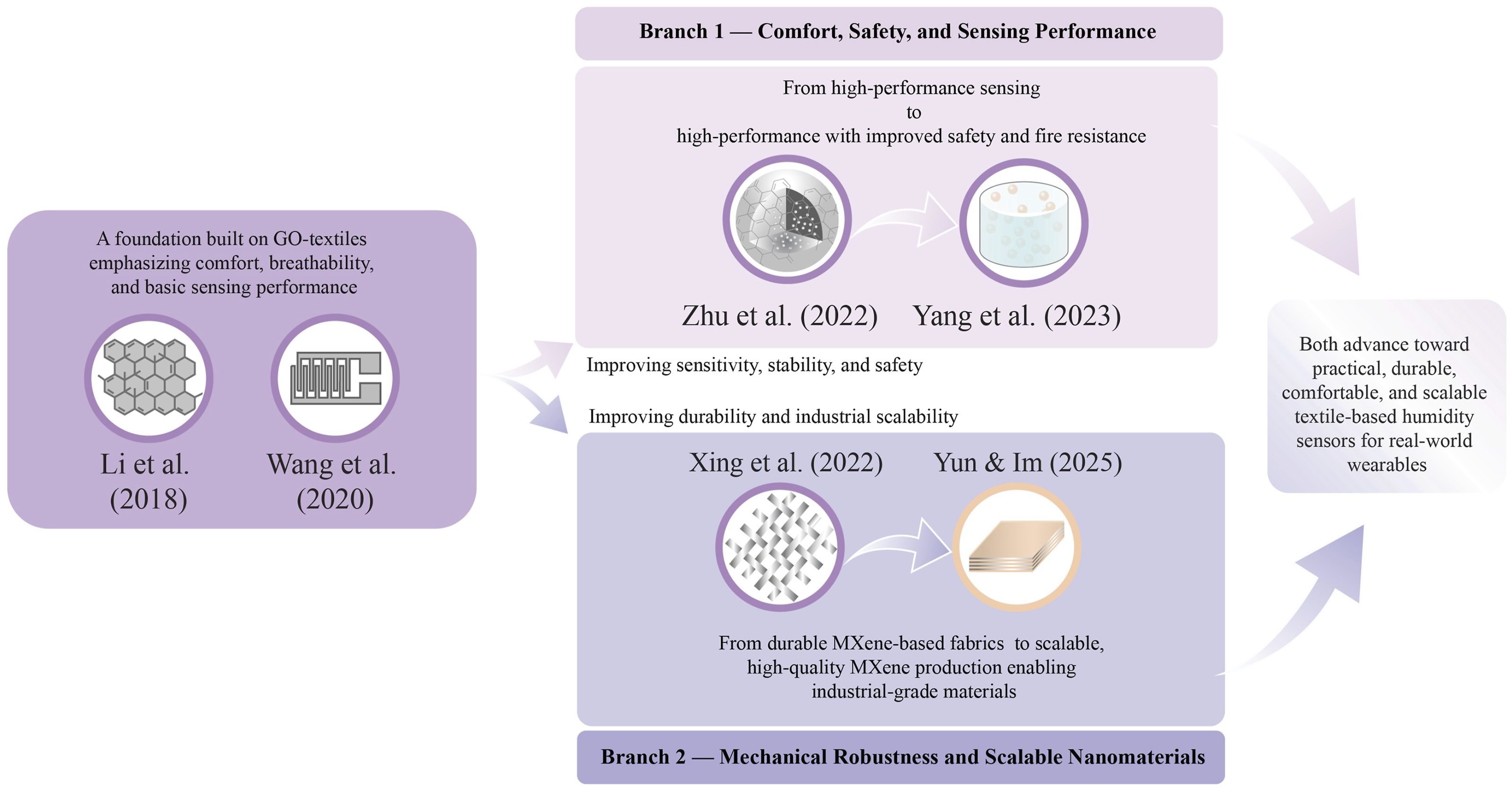
The path then split into two parallel and critical developments that addressed core technical challenges. Building on previous textile innovations, Zhu et al. 72 advanced the textile humidity sensor by integrating diamine-decorated graphene oxide (GO–NH2) with mesoporous silica nanospheres (mSiO2). The sensor achieved high sensitivity (14.8 MΩ/%RH) and low hysteresis (2.71% RH). However, the authors noted that performance could degrade under long-term mechanical stress or repeated washing, and the scalability of screen-printing fabrication for mass production remained uncertain. Yang et al. 71 introduced hydrogel-coated fabrics further specialized this trajectory. The study achieved response and recovery times of approximately 2.5 s and 3.2 s, respectively, faster than Zhu et al. 72 ’s reported 12–13 s and thus represented a significant improvement. Moreover, it passed the vertical burning test, enhancing safety features. By citing Zhu et al. 72 and employing flame-retardant hydrogel coatings, Yang et al. 71 effectively coupled performance optimization with safety features and multifunctional adaptability in textile-based sensing systems. In summary, this first direction illustrates a progression from feasibility and comfort toward performance refinement and protective features, shaping a pathway focused on textile substrates and functional coatings for safe, high-performance wearable sensors.
The second direction also originated from the foundational works of Li et al. 65 and Wang et al. 73 but diverged through the contributions of Xing et al. 74 Xing et al. 74 introduced MXene/MWCNT hybrid electronic fabrics, which addressed the mechanical robustness and stability of textile sensors under deformation. The developed fabric sensors coated with MXene and multi-walled carbon nanotubes (MWCNTs) exhibited strong mechanical properties and humidity response, facilitating reliable performance during bending, stretching, and real-time respiration monitoring. Their contribution demonstrated that hybrid nanomaterial coatings could overcome durability challenges, making textile sensors more practical for everyday use. This marked a shift toward long-term stability and robustness, essential for wearable healthcare applications. This durability-focused trajectory was then extended by Yun and Im 69 who developed a eutectic molten salt method for the large-scale synthesis of Ti3C2Tx MXene. This innovation achieved unusually large MAX phase crystals, which in turn yielded large MXene flakes (3–12 μm) with superior electrical conductivity and optical transparency. The work addressed a critical bottleneck in the field by providing a pathway to large-scale and reliable MXene production. Yun and Im 69 ’s work enabled transparent, flexible devices suitable for industrial applications, pushing MXene research from laboratory prototypes toward commercialization. However, the synthesis required high-temperature process (1300 °C), and questions regarding reproducibility and cost-effectiveness for industrial-scale manufacturing remain significant limitations. The second direction represents a pathway centered on nanomaterial engineering and scalability, evolving from durability improvements to industrial-scale production and transparent device integration.
Both directions highlight how the field has bifurcated into complementary streams, with one advancing textile-based approaches that prioritize comfort, sensing performance, and safety, while the other focuses on nanomaterial engineering to achieve greater mechanical robustness and scalable manufacturing.
Discussions
This review employed CitNetExplorer for research group clustering, and Pajek for main path analysis MPA to map the structure and evolutionary trajectories of textile-based human respiration sensor research. The analysis indicate that these groups are not isolated but rather complementary and mutually reinforcing axes of innovation, with knowledge and technological paradigms flowing across their boundaries.
Converging technological paradigms in smart health monitoring
Prior technical reviews of textile respiration monitoring and smart garments typically present the field as a linear progression toward the “ultimate smart garment,” organising sensors and applications into thematic chapters such as material, sensing mechanism, or construction methods. This bibliometric mapping both confirms and challenges these taxonomies. It confirms that these themes exist but reveals that they are not sequential stages of one unified field. According to the clustering shown in Figure 5, wearable respiratory monitoring can be interpreted as falling into three distinct technological paradigms, each defined less by raw-material selection than by application context and intended objectives. The first paradigm (Cluster 1), mechanical deformation sensing, converts chest wall displacement into electrical signals using piezoresistive fabrics, capacitive elements, or inertial sensors. Its robustness against motion artifacts and ability to capture multiple parameters make it particularly suitable for ambulatory monitoring, sports physiology, and sleep apnea screening. The second paradigm (Cluster 2), optical and structural engineer, employs optical fibers or conductive yarns to achieve high-reliability strain transduction. This approach offers clinical-grade accuracy, low hysteresis, and MRI compatibility, positioning it within diagnostic domains such as polysomnography and cardiopulmonary monitoring during MRI examinations. The third paradigm (Cluster 3) represents a shift from physical to molecular sensing, relying on nanomaterials such as GO or MXenes to detect exhaled humidity. While this approach demonstrates high sensitivity and holds promise for low-cost, flexible, and potentially non-contact devices, it remains vulnerable to environmental interference.
These three technological paradigms should be viewed as complementary and converging pathways toward a future of holistic health monitoring. Rather than competing, each cluster addresses a distinct layer of the broader challenge. Their integration is what enables the realization of integrated systems physiology, embodied in smart garments capable of simultaneously monitoring respiratory mechanics, airway humidity, and biochemical markers. Such integration has the potential to support chronic disease management, optimize athletic performance, and advance personalized medicine. Significantly, the evolution of this field is driven not solely by material choice but by context-specific engineering, whereby the same sensing principle may be optimized differently for daily wear, MRI compatibility, or laboratory precision. In this way, sensing methods and raw materials may be regarded as the common genetic foundation, while application environments act as evolutionary pressures that shape distinctly adapted technological pathways in wearable respiratory monitoring.
MPA transformation and paradigm shift across clusters
The main path analyses present distinct but interlocking evolutionary logics that narrate the maturation of wearable respiratory monitoring together. Cluster 1 demonstrates a linear progression (Figure 6) from early piezoresistive proofs of concept to clinically benchmarked capacitive systems, reflecting the central drive of the research field for medical validation and wearability. This trajectory functions as the primary translational engine, applying advances from other groups, such as knit-sensing insights from Cluster 2 and novel conductive nanomaterials from Cluster 3, to enhance garment-level systems in terms of performance, comfort, and manufacturability. In contrast, Cluster 2 illustrates a pivot from precision to pragmatism (Figure 7), moving from high-resolution optical demonstrations (FBG/POF) to manufacturable knitted piezoresistive sensors. This shift highlights a transfer of knowledge, in which the detailed understanding of mechanical coupling and respiratory strain gained from optical studies was used to design simpler, more practical textile sensors. These sensors provided the mechano-transduction principles that support textile sensor development. Cluster 3 exhibits a bifurcated trajectory (Figure 8) catalyzed by the COVID-19 pandemic, which created an urgent application pull through the widespread adoption of face masks.75,76 Innovations in humidity-active nanomaterials such as GO offered alternative sensing modalities and advanced composites, feeding back into the broader field by enabling hybridization with Cluster 1 garment-integrated systems or Cluster 2 textile structures engineering.
The citation network highlights a knowledge transformation process in which fundamental discoveries in nanomaterial response (Cluster 3) and precise structure-property relationships (Cluster 2) are progressively translated into the integrated systems of Cluster 1. This reflects a paradigm shift from technology-push approaches, focused on isolated sensor demonstrations, to user- and application-pull approaches, emphasizing reliable systems for real-world physiological monitoring. Across all trajectories, the unifying goal is unobtrusive, continuous monitoring, whether achieved through a smart knit, a coated mask, or a full garment. The convergence of these paths points toward hybrid systems as the next paradigm, combining responsive nanomaterials with engineered textile architectures, integrating multi-modal sensing mechanisms for cross-validation, and prioritizing design-for-manufacture and clinical validation. This continuous cross-pollination is propelling the discipline from fragmented technological demonstrations toward a cohesive framework of textile-based respiratory informatics.
Limitations
This review is subject to several limitations related to data sourcing and methodological scope, which may affect the comprehensiveness of its conclusions.
The exclusive reliance on articles indexed in the WOS restricted the dataset to 47 publications. While WOS provides access to high-impact journals, this choice likely excludes relevant contributions from grey literature, patents, preprints, and technical industry reports. Such sources often capture applied innovations and commercial developments that precede or complement academic publishing. Their omission introduces a bias toward theoretical research and underrepresents practical implementation and industry-driven advances.
Moreover, the analytical framework also imposes constraints. Bibliometric tools such as CitNetExplorer and Main Path Analysis (MPA) emphasis citation frequency and structural connectivity. This approach benefits established and highly cited works while overlooking emerging or niche studies that have not yet accumulated citations. As a result, recent and fast-moving topics, such as AI-based signal processing or sustainable material innovations, may not be adequately represented. Furthermore, while MPA provides a structured view of knowledge evolution, it reduces complex interdependencies into linear or bifurcated pathways. This simplification risks obscuring parallel developments and cross-disciplinary influences that do not conform to dominant citation trajectories.
These limitations suggest that the analysis offers a structured overview of academic literature but does not fully capture the broader ecosystem of textile-based respiratory sensing. Future work would benefit from integrating broader data sources and complementing bibliometric mapping with qualitative methods to achieve a more holistic understanding of technological progression in textile-based respiratory sensing.
Conclusion
This review employs CNA and MPA to trace the intellectual evolution and thematic structure of research on textile-based human respiration sensors. An examination of 47 core publications reveals that the field is not composed of isolated technological strands but rather forms an interwoven tapestry of innovation. From this synthesis, three deeply interconnected trajectories emerge: 1) textile-integrated wearable systems for respiratory monitoring; 2) structure-engineered knitted and fiber-optic sensors for respiratory monitoring; and 3) humidity-responsive nanomaterial-enhanced textile sensors for breath monitoring.
Convergence has become the dominant trajectory in wearable sensor development. Initial divergence into specialized domains, such as materials science, textile engineering, and clinical integration, is progressively being replaced by integrative and synergistic approaches. The advancement of textile-based respiratory monitoring is situated at this intersection, where responsive nanomaterials and engineered fabric architectures merge to support multimodal, comfortable, and clinically robust sensing systems. Achieving this vision will depend on the implementation of standardized validation frameworks, scalable manufacturing pathways, and a human-cantered design philosophy that reconciles technical performance with wearability and privacy considerations.
Footnotes
Acknowledgments
The authors gratefully acknowledge the support of the Hong Kong Polytechnic University (PolyU) Presidential PhD Fellowship (PPPFS) and the PolyU–Zhongshan Technology and Innovation Research Institute during the preparation of this review. We also thank our colleagues for their valuable comments and suggestions, which helped improve the quality of this work.

Author contributions
Lai-Ching Wong: Conceptualization (lead), Data curation (lead), Investigation (equal), Methodology (equal), Validation (lead), Writing – original draft (lead).
Ka-Po Lee: Conceptualization (support), Methodology (equal), Validation (support), Writing – original draft (support).
Ruixin Liang: Conceptualization (support), Validation (support).
Miyuki P.S. Cheng: Conceptualization (support), Methodology (lead).
Joanne Yip: Investigation (equal), Methodology (equal), Supervision (lead), Funding acquisition (lead).
Funding
The authors disclosed receipt of the following financial support for the research, authorship, and/or publication of this article: This work/project was supported by the Research Grants Council Research Impact Fund of the Hong Kong Special Administrative Region, China (Project No. R5039-23).
Declaration of conflicting interests
The authors declared no potential conflicts of interest with respect to the research, authorship, and/or publication of this article.
Data Availability Statement
All data that support the findings of this study are included within the article.