




Abstract
This research analyses Spanish broom fibres (Spartium junceum L.) as possible reinforcement in polymer composites. It includes fibre extraction, characterisation, and composite construction. We extracted the Spanish broom fibres by water retting for 30 days, followed by hand washing and air drying. The fibres were spun into skeins using circular spinning. The fibres exhibited a density of 1.27 ± 0.03 g/cm3 and an average diameter of 170 ± 1.80 μm. The SEM investigation revealed a rough, uneven surface with microfibrils and spaces, that are typical of lignocellulosic fibres. Cellulose, hemicellulose, and lignin were detected using FTIR analysis. TGA revealed three weight-reduction phases, with the most significant cellulose degradation temperature around 319°C. XRD analysis revealed a 48.09% crystallinity index and 15.7 nm crystallite size. Single fibre tensile testing showed an elastic modulus of 20.51 ± 5.30 GPa, a fracture stress of 486.17 ± 129.16 MPa, and a fracture strain of 1.57 ± 0.43%. Spanish broom yarn and polyester resin were used to create unidirectional composites. Results indicate that both unreinforced polyester and SJL fibre-reinforced composites have enhanced mechanical characteristics, with maximum stress of 29.79 ± 0.79 MPa and Young’s modulus of 3.10 ± 0.25 GPa. This work highlights the significance of employing Spanish broom fibres as a green reinforcing material for polymer composites and suggests future research options.
Introduction
In recent years, there has been increasing interest in natural fibres as sustainable alternatives to synthetic materials across a range of applications. Among these, plant-based fibres have garnered significant attention due to their renewability, biodegradability, and favourable mechanical properties.1–3 Spanish broom (Spartium junceum L.), a shrub native to the Mediterranean region, has been identified as a promising source of natural fibres, that may have significant applications in the textile and composite materials industries.4–6
The fibres of the Spanish broom have a longstanding history of utilisation, tracing back to ancient civilisations. The Greeks, Romans, and Carthaginians employed these fibres in the production of ropes, nets, bags, sails, and garments.7,8 In the early 20th century, there was a resurgence of interest in the cultivation of Spanish broom, especially in coastal karst regions. 4 Nevertheless, the production of fibre was predominantly discontinued in the 1950s as a result of economic considerations and the labour-intensive characteristics of conventional extraction techniques. 9
Recent technological advancements, coupled with heightened environmental awareness, have rekindled interest in the fibres derived from Spanish broom. Contemporary extraction methodologies, such as microwave-assisted processing, have facilitated the efficient production of high-quality fibres. 10 Fibres derived from Spanish broom demonstrate advantageous attributes, including a high cellulose content of 91.7% and enhanced tensile properties compared to other bast fibres, such as flax. 9
A renewed interest in using Spanish broom fibres has emerged within the textile industry’s quest for high-quality fabric manufacturing. 11 Technical textiles benefit greatly from the use of these fibres because of their flax-like characteristics. 12 Many parts of Italy, particularly Calabria, have seen a renaissance of Spanish broom fibre textiles in recent years. 8
Spanish broom fibres exhibit potential applications in composite materials beyond their use in textiles. Studies indicate that these fibres can function as effective reinforcement within polymer matrices, especially in biodegradable composites. 13 Research has investigated the incorporation of Spanish broom fibres with biopolymers like polylactic acid (PLA) to create green composites exhibiting improved mechanical properties.9,12,14,15
Integrating Spanish broom fibres into composite materials presents numerous benefits. These natural fibres exhibit desirable mechanical properties, including high specific strength and stiffness, while maintaining a low overall density. Moreover, their inherent biodegradability makes them an environmentally friendly choice. 5 The utilization of Spanish broom fibres also supports sustainable practices, as it aligns with circular economy principles by enabling the complete use of the plant in diverse applications, thereby minimizing waste. 16
Recent research endeavours have focused on enhancing the extraction and processing methodologies for Spanish broom fibres, with the aim of augmenting their efficacy in composite materials. Researchers have investigated several approaches to enhance the interface between these fibres and the matrix material, hence enhancing the general efficiency of the composites. These methodologies encompass the implementation of alkaline treatments, the integration of nano-clays, and the employment of coupling agents, all of which are designed to enhance the adhesion between the fibres and the surrounding matrix.17–19
As investigations in this area advance, there is increasing promise for Spanish broom fibres will play a role in the development of sustainable, high-performing materials. The integration of conventional wisdom with contemporary scientific methods presents exciting opportunities for the application of these fibres in sophisticated uses, ranging from technical textiles to structural composites.
In this work, we take a close look at Spanish broom fibres, exploring their history, how they’re currently being studied, and their promising future uses in composites and filaments. What sets our research apart is its focus on the latest developments in fibre processing, sustainability, and creative applications-going beyond earlier studies that mainly examined basic mechanical properties. By highlighting both recent breakthroughs and the challenges that remain, our study shows how Spanish broom fibres could play a key role in developing new, environmentally friendly materials. We also offer fresh perspectives and research directions that haven’t been covered in previous work.
Materials and methods
Materials
Spartium junceum L. (SJL), also known as Spanish broom (SB) or weaver’s broom, is a plant belonging to the Spanish broom plant.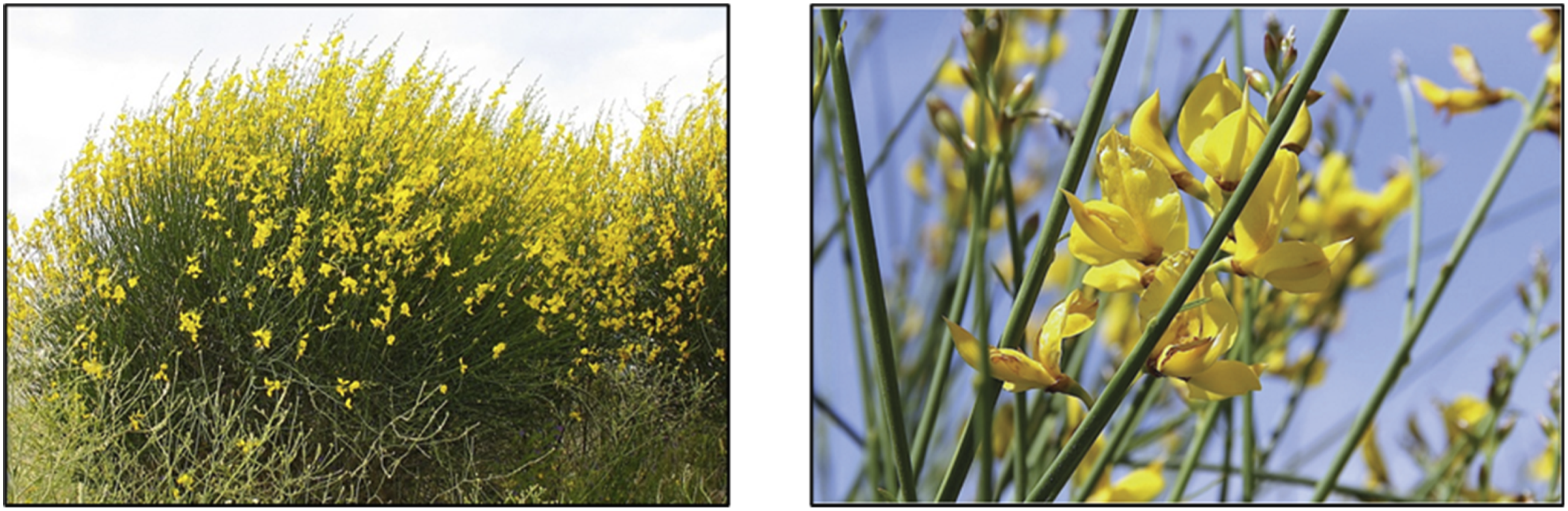
Although native to southern Europe and the Mediterranean region, including Turkey, North Africa and the Middle East, it is taking over many parts of the world – in tropical, subtropical and temperate regions. In fact, SJL is recognized as an invasive and harmful weed in the USA, the Canary Islands, Uruguay, Argentina, Peru, Bolivia, the Azores, South Africa, and the Dominican Republic. 21
Methods
Fibre extraction
The investigated fibres are obtained from the stems of a plant called Spanish Broom. These were stem collected in eastern Algeria region of Setif. Then, the esparto was soak in water for another month (max period) (water retting). After retting the fibres were pulled by hand out of the moist stems. The extracted fibres were washed and air-dried at room temperature prior to being placed on the analysis (Figure 2). SJL fibre extraction steps. (a) Water retting (30 days); (b) Fibre extraction; (c) Fibre rinsing; (d) Fibre steaming; (e) Raw fibre.
Yarn from SJL fibres (SJLFs)
Circular spinning is the method we used to transform SJL fibres (SJLFs) into yarn. The purpose of spinning raw SJL fibres is to transform them into yarns that can be used as reinforcements in composite materials. The spinning process is divided into three basic steps to convert the twisted fibres into yarns, namely: - The first step involves stretching the fibres longitudinally (Figure 3(a)); - The second step consists of twisting the fibres while pressing them together in one direction, which is the axis of the produced yarn. The greater the number of turns, the smaller the diameter of the thread and the greater its strength (Figure 3(b)); - The third step involves winding the resulting yarn onto a bobbin (Figure 3(c)). Spinning steps for SJL fibres. (a) Fibre stretching; (b) Fibre twisting; (c) Yarn winding.

Development of a unidirectional composite material: SJL/polyester
The SJL/polyester composite material was developed through contact moulding. The composite was directly fabricated in the form of specimens designed for tensile testing according to the ASTM D3039 M standard.
22
Initially, the specimen shape was created on a wooden mould (Figure 4(a)). The mould had dimensions identical to the specimen (length 140 mm, width 10 mm, height 3 mm). Once the fibres were positioned and secured (Figure 4(b)), they were embedded in polyester resin (Figure 4(c)). After polymerization, the specimens were removed from the mould (Figure 4(d)). Subsequently, they were placed in an oven at 60°C for 2 hours. Preparation of raw SJL yarn / polyester specimens. (a) Placement of the yarns into the moulds; (b) Preparation of the polyester; (c) Pouring of the polyester into the moulds; (d) Curing of the specimens.
Characterization
Diameter measurement
The irregular shape of natural fibres makes it difficult to accurately measure the diameter. At room temperature, SJLF diameters were measured at 5X magnification using an Olympus BX51 optical microscope. Representative sampling required a choice of roughly ten fibres from several areas of the extracted batch; each fibre was measured at three different locations along its length, generating a total of 30 diameter measurements. The SJLFs exhibited a round cross-sectional shape, as evidenced by observations. The average fibre diameter was derived from measurements taken at three distinct and independently selected points. This method provides a statistically relevant representation of the fibre diameter distribution.
Density measurement
The density of SJL fibres was measured by the liquid pycnometer method in ethanol (ρ = 0.819 g/cm3). Weighing was performed by a precision analytical balance with an accuracy of (10-4). The fibres were subjected to steam at 60°C to diminish their moisture content to below 5%. The resulting fibres were then cut into 4 mm fragments to suit the pycnometer. Density was determined using the following formula
23
:

Scanning electron Microscopy (SEM)
The morphological examination of the samples was conducted using a scanning electron microscope (SEM) model Supra 55 VP from Carl Zeiss AG, which was operated at an accelerating voltage of 10 kV. During examination, a thin layer of gold was applied to the fibres to attenuate electrical charges and facilitate microscopic image acquisition.
Fibre moisture content measurement
The fibres (weighing 5 g) were dried at a temperature of 105°C using a moisture balance (Sartorius M45 type moisture meter) until a constant mass (0% moisture) was achieved, in accordance with standard NF V03-903. Subsequently, the fibres were exposed to ambient air for 48 h; however, this exposure took place under controlled laboratory conditions. Specifically, the relative humidity was maintained at 50 ± 5% and the temperature at 23 ± 2°C, in line with standard conditioning protocols for natural fibre testing. This controlled environment ensures consistent moisture equilibration across all samples. After conditioning, the fibres were then weighed on a balance to determine their moisture content.
Fourier-transform infrared analysis (FT-IR)
FT-IR spectroscopy is one of the most accurate techniques for identifying chemical functional groups in natural fibres. Approximately 2 mg of FJL were ground, mixed with potassium bromide (KBr) and shaped into pellets. FT-IR spectra of the fibers were obtained using a Perkin-Elmer spectrometer by determining the reflectance of the samples in the range 500 to 4000 cm1.
Thermogravimetric analysis (TGA)
Thermogravimetric Analysis (TGA) was employed to assess the thermal behaviour of the fibres by measuring weight loss relative to temperature. The analysis was conducted utilising a TA (Shimadzu TGA-51) thermal analyser. The experiment utilized aluminium pans, heated at a rate of 20°C/min, with the temperature ranging from 25°C to 600°C in a dynamic nitrogen atmosphere.
An important factor in thermal stability assessment of natural fibre is the kinetic activation energy (Ea). Derived from Broido’s equation
24
:

X-ray diffraction
X-ray diffraction (XRD) is an effective technique for characterising the crystalline and amorphous constituents of natural fibres. The samples were analysed with a diffractometer (Bruker D-8) with a CuKα radiation wavelength of 0.154 nm, operating at a voltage of 30 kV and a current of 30 mA. In continuous scan mode at 25°C, spanning a 2θ range of 5 to 60 with a step size of 0.02. The fibre crystallinity index, CI%, was computed using Segal’s equation
25
:


β denotes the whole width at half maximum of the peak, K = 0.89 is the Scherrer constant, θ indicates the corresponding Bragg angle, and λ denotes the wavelength of the radiation.
Mechanical characterization
Single fibre tensile test
Tensile tests on the various fibres of SJL were conducted in accordance with ASTM D3379-75 27 using a universal testing machine (Zwick-Roell) equipped with a 5 kN load cell. Tests were performed on 30 fibres at a speed of 1 mm/min under ambient temperature conditions, with a gauge length of 40 mm.
The mechanical properties determined from the stress-strain curves are: the ultimate tensile stress (σ), the elastic modulus (E), and the strain at break (ε) of the raw SJL fibres.
Tensile testing of unidirectional composite
Tensile tests on the polyester specimens and the unidirectional SJL/Polyester composite specimens were carried out at ambient temperature using a Zwick-Roell Z100 tension/compression testing machine. The tensile properties were obtained by following the ASTM D3039 M with a crosshead speed of 3 mm/min. Based on the load-displacement curve, the tensile strength of the composites was derived.
In this study, tensile tests were conducted on unreinforced polyester specimens and UD composites (polyester reinforced with raw SJL yarn).
Results and discussions
Diameter measurement
As shown in Figure 5, the diameter of SJLF is measured by an optical microscope image. The SJLF has an average diameter of 170 ± 1.80 μm. The deviation value suggests that the fibre morphology exhibits a relatively uniform characteristic. SJLF optical microscope picture.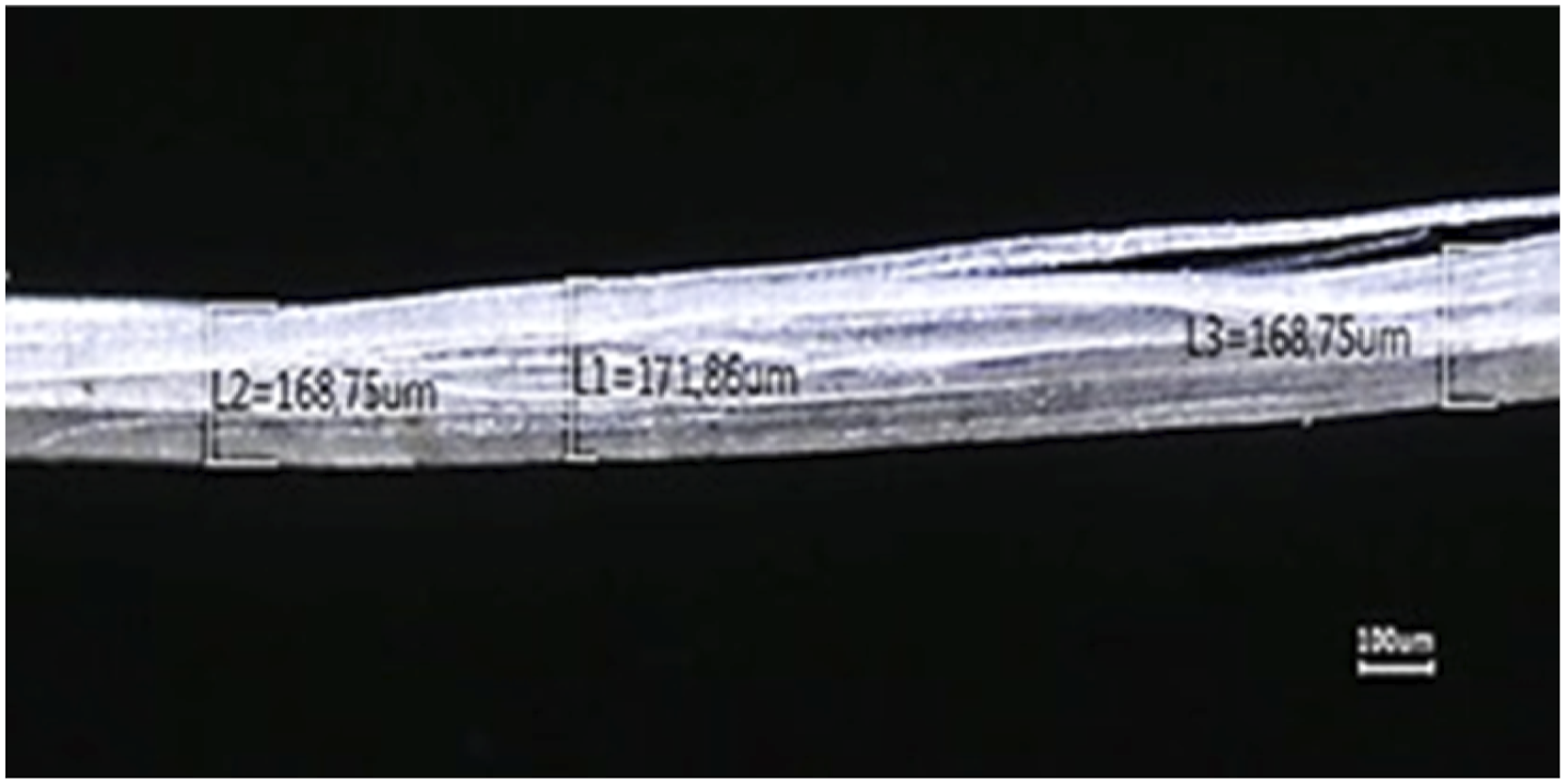
Density measurement
Comparative analysis of physical and mechanical properties of Spanish broom and selected natural fibres.

Values for Spanish broom are from this study; other data are from the referenced literature. ‘–’ indicates data not available. Properties of natural fibres vary with extraction method, plant maturity, and testing conditions.
Scanning electron microscopy (SEM)
On the SEM images cross-sections (Figure 6 (a)) of SJL fibres are presented as a rough and irregular surface, with visible microfibrils and voids, typical of lignocellulosic fibres. Its lightweight nature with moderate to high tensile strength makes it comparable to other bast fibres such as flax and hemp. These structural features make up mechanical properties. Images show the irregularity and multi-layered build-up of native polypeptides, indicating opportunities for textiles and composites while illustrating a sustainable source of natural fibres. SEM SJLFs. (a) Cross section (b) Longitudinal section.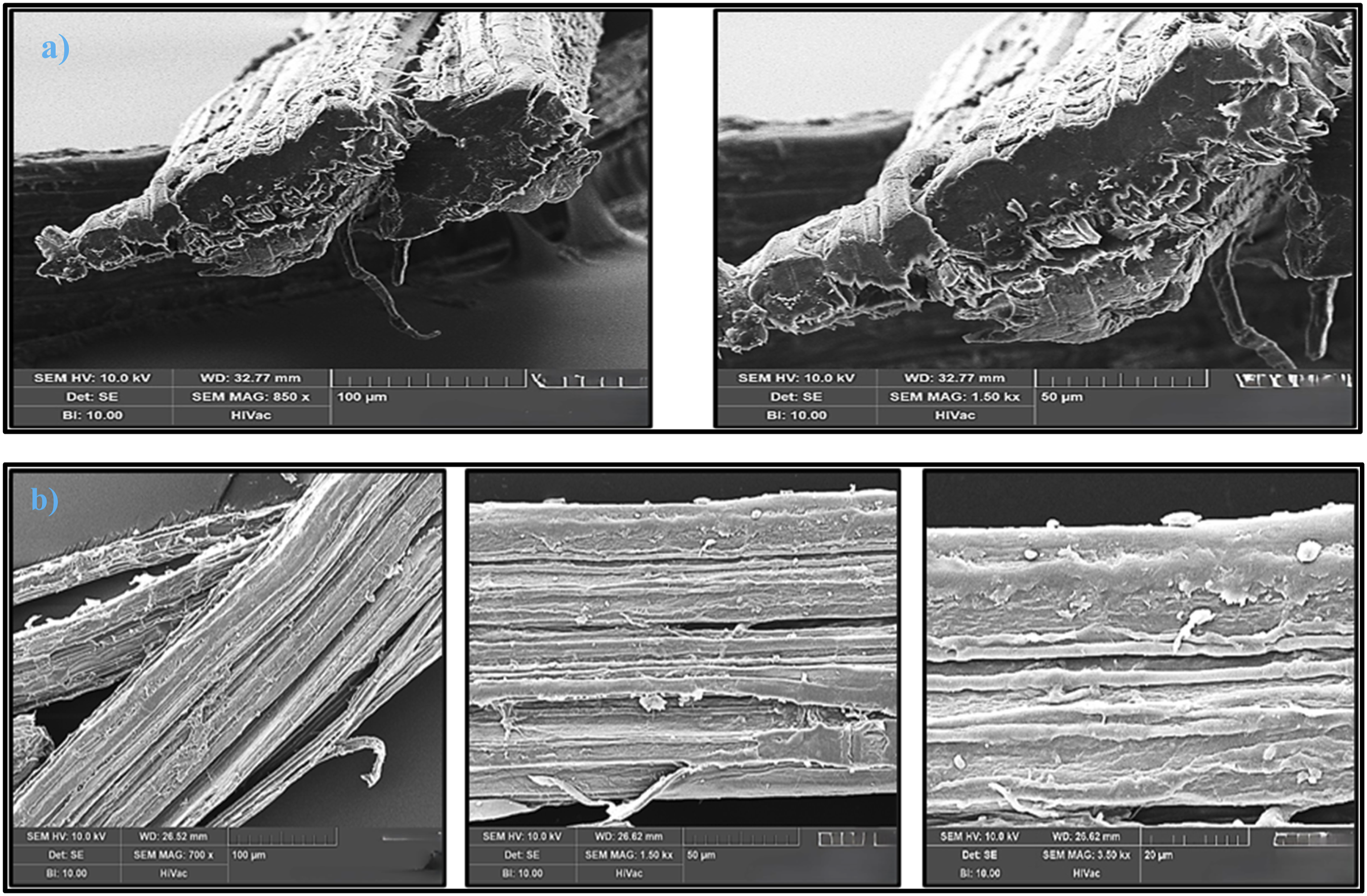
The provided SEM images of longitudinal sections of SJL fibres at varying magnifications (700x, 1.5kx, and 3.5kx) reveal key structural characteristics typical of natural plant fibres (Figure 6(b)). The fibres have a stratified, fibrillar structure characterized by discernible longitudinal striations and lamellar arrangement, reflecting their lignocellulosic content. At lower magnifications (700x), the fibres manifest as bundles with coarse surfaces and a certain degree of separation between layers, presumably resulting from mechanical or chemical processing. At elevated magnifications (1.5kx and 3.5kx), the lamellar structure is accentuated, revealing dense configurations intermingled with micro-voids and fissures. These characteristics indicate the existence of cellulose microfibrils integrated within a matrix of hemicellulose and lignin, typical of bast fibres. 38
In comparison to other natural fibres like flax and hemp, SJL fibres exhibit similar structural characteristics, including fibrillar alignment and layered morphology.39–41 SJL fibres may have a rougher texture and less regularity in fibril organization owing to variations in their biochemical makeup and growing circumstances. Flax generally exhibits a smoother surface and a more compact fibrillar structure owing to its elevated cellulose concentration and reduced lignin level in comparison to SJL. 42 The structural changes affect mechanical qualities ; SJL fibres are probably less tensile but more flexible owing to their elevated lignin concentration, rendering them appropriate for certain applications like ropes or matting instead of fine textiles. 13
The SEM data underscore the promise of SJL as a natural fibre source with distinctive structural features that may be used for various purposes via suitable processing techniques.
Measurement of fibre moisture content
This analysis determined the moisture content in the SJL fibres to be 5.10%. The moisture content of natural fibres significantly impacts the characteristics of composites derived from these materials.35,43 Natural fibres are hydrophilic, which means they have a propensity to draw moisture from their environs. From a mechanical standpoint, this attribute poses a constraint by impeding the effective interfacial adhesion with hydrophobic matrices. As a consequence, composites that exhibit reduced moisture content typically exhibit enhanced mechanical properties. 44 Sansevieria roxburghiana, Cocos nucifera, Pithecellobium dulce, Parthenium Hysterophorus and Shwetark were reported to contain 7.85, 5.46, 6.24, 8.60 and 8.80 % of moisture content, respectively.35–37,45,46 To achieve optimum strength and dimensional stability, a reduced moisture content is beneficial. The moisture content of plant fibres generally varies between 6% and 12%,47,48 necessitating a reduction to below 3% prior to processing to avoid adverse effects and ensure the production of high-quality moulded products.
FT-IR (Fourier-transform infrared) analysis
The FTIR analysis of plant fibres offers a comprehensive look into their chemical structure, revealing key functional groups and bonds associated with cellulose, hemicellulose, and lignin, which are the primary components of plant fibres. The Figure 7 shows an infrared (IR) spectrum, specifically a Fourier Transform Infrared (FTIR) transmittance spectrum, which provides information about the functional groups present SJL fibres. Starting with the broad peak 3344 cm-1 and 3263 cm-1, It pertains to O–H stretching vibrations, signifying strong hydrogen bonding and the presence of hydroxyl groups in cellulose and lignin.
49
The peak at 2978 cm-1 arises from C–H stretching vibrations of aliphatic hydrocarbons, often associated with methylene (CH2) groups in cellulose and hemicellulose.
50
Peaks at 2086 cm-1 and 2122 cm-1 can both be attributed to triple bond stretching vibrations, such as C≡C (alkynes) or C≡N (nitriles). The peak at 2086 cm-1 suggests the presence of a small quantity of such groups, as indicated by its relatively low intensity. Similarly, the peak at 2122 cm-1 reflects triple bond stretching, possibly occurring in an unsaturated or substituted chemical environment. Together, these peaks indicate the potential presence of alkyne or nitrile groups in minimal concentrations.
51
In the mid-infrared region, the peak at 1640 cm-1 corresponds to C = O stretching vibrations, typically associated with carbonyl groups found in hemicellulose or conjugated structures in lignin. The peak at 1425 cm-1 reflect C–H bending vibrations in CH2 groups, a hallmark of cellulose and hemicellulose.
52
The band at 1370 cm-1 represents C–H bending in CH3 groups, often linked to lignin’s methyl functionality.
53
Peaks between 1330 and 1310 cm-1 indicate O–H bending and CH2 wagging, confirming the presence of cellulose hydroxyl groups.
54
A significant peak at 1250 cm-1 corresponds to C–O stretching vibrations in aryl ethers, characteristic of lignin’s aromatic compounds.
55
The peak at 1153 cm-1 arises from C–O–C asymmetric stretching, signifying glycosidic linkages in polysaccharides such as cellulose and hemicellulose. Between 1100 and 1050 cm-1, C–O stretching vibrations dominate, associated with secondary alcohols and ethers.
56
The strong peak at 1019 cm-1 is related to the C–O and O–H stretching vibrations in fibre.
57
Finally, the peak at 893 cm-1 confirms the β-glycosidic linkages, fundamental to the structural integrity of cellulose and monosaccharides.
58
FTIR spectra of SJLFs.
These findings may indicate the existence of the major constituents of natural fibre (hemicellulose, cellulose, and lignin) similar to widely used natural fibres such as hemp, jute, and kenaf. 50
Thermogravimetric (TG) analysis
Comprehending the thermal properties of natural fibres is crucial for the production of polymer composites at elevated temperatures while preserving the integrity of the fibres.
59
As natural fibres, including SJL fibres, consist of lignin, cellulose, and hemicellulose, their thermal stability can impact their effectiveness as composite reinforcements. Compared to synthetic fibres, thermal stability is a limiting factor for natural fibres, making the examination of SJL fibres’ degradation temperature crucial for optimizing their use in composites. Figure 8 presents the TG/DTG curves of the fibres. Consistent with existing studies on lignocellulosic fibres,60,61 the TG curve of SJL fibres exhibits three weight loss steps. The initial weight loss of 8.75 % occurred between 31 and 100°C as a result of evaporation of moisture absorbed in the fibres, indicative of their hydrophilic nature.
62
Structural water (also called bound water) is chemically bound to the polymer chains of cellulose, hemicellulose, and lignin by hydrogen bonding. In our TGA analysis, the weight loss observed between 100°C and 200°C (around 3–4% of the total weight) corresponds to the elimination of this bound water, which requires higher temperatures to be eliminated compared with free water or moisture (eliminated below 100°C). This structural water contributes to the stability of the crystalline regions of the cellulose and affects the mechanical properties of the fibre. The first notable weight loss transpires between 200°C and 300°C, peaking in the DTG curve at 246°C, resulting in a weight drop from 92% to 81%, which is ascribed to the thermal breakdown of hemicellulose.63,64 This thermally unstable polysaccharide decomposes into volatile molecules, such as carbon dioxide and light hydrocarbons. The second major event is observed between 300°C and 400°C, with a steep weight loss from 81% to 10%, which corresponds to the maximum degradation rate of α-cellulose, as highlighted by the derivative thermogravimetric (DTG) curve peak at 319°C.
61
Thermal property of SJLFs. (a) TG and DTG curves. (b) Broido’s plot.
A similar peak was seen in many natural fibres, namely bagasse, pine, rice husk, hemp, jute, kenaf, and bamboo fibres, at temperatures of 313.9°C, 328°C, 322°C, 308.2°C, 298.2°C, 309.2°C, and 321°C, respectively. 23 Lignin, a cross-linked aromatic polymer, is the most difficult constituent to decompose. Its decomposition typically spans the entire temperature range, starting around 200°C and continuing gradually up to 500°C, leaving a residual mass of approximately 6%, which represents the inorganic ash content of the fibres.
Regarding the second thermal property, the kinetic activation energy (Ea) of natural fibres is ranged from 60 to 170 kJ/mol. For this SJL fibre, the energy, interpolated from Broido’s graph (Figure 8 (b)), is ∼ 78.80 kJ/mol. This energy is greater than that of F. religiosa root fibre (68.02 kJ/mol) 65 and aerial roots of Banyan (75.45 kJ/mol). 66 It is also lower than that of Passiflora foetida (85.46 kJ/mol) 67 and Abutilon Indicum 86.95 kJ/mol. 68 The thermal characteristics of SJL fibres indicate that they are appropriate for use as reinforcements in composite applications, such as thermoplastic polymers with processing temperatures of up to 270°C.
X-ray diffraction
Figure 9 shows a representative diffractogram of SJLF. It shows two distinct diffraction peaks around 18° and 22.2°, both of which are relatively sharp in the majority of natural fibres.
69
The peak at 2θ = 18.30° confirms that SJLFs have an amorphous composition. The peak at 2θ = 22.6° indicates that the fibre displays crystalline properties. The observed peaks suggest that the fibre displays semi-crystalline properties. The interaction between hydroxyl and carbonyl groups within the structure of fibre may also yield these outcomes.
23
XRD pattern of SJLF.
The crystallinity index (CI) measured is 48.09%, surpassing that of other cellulosic fibres, such as T. procumbens fibre (34.46%), 69 F. religiosa root fibre (42.92%), 70 and G. tilifolia fibre (41.7%) 71 and lower than that of Saharan aloe vera cactus fibre (52.6%), 71 Spathes of male date fibre (57.82%) 23 and K. Africana fruit fibre (59%). 72 The Scherrer formula was employed to calculate the crystallite size (CS). A CS measurement of 15.7 nm was obtained. This value significantly exceeds that of Phaseolus vulgaris fibre (4.07 nm) and cotton fibre (5.5 nm), while being lower than that of Raffia textilis fibre (32 nm) and Tridax procumbens fibre (25.04 nm). 23 An increased crystallite size diminishes the water absorption capacity and chemical reactivity of the raw material at a certain degree of crystallinity, which is a commonly seen result.
Mechanical characterization
Single fibre tensile test
The tensile strength of a natural fibre is determined by its chemical composition and extraction process, specifically the cellulose, hemicellulose, and lignin content. Figure 10 shows the stress-strain curves for a sample of 27 SJL fibres. The calculations are based on the assumption that the analysed fibres had a circular cross-section. As the results show, the fibres exhibit linear elastic behaviour. Fracture is identified as brittle, a characteristic often associated with cellulosic fibres.
61
The main causes of this behaviour are the degradation of the primary cell wall and the subsequent separation of the fibre cells. SJLF has a modulus of elasticity of 20.51 ± 5.30 GPa, a stress at break of 486.17 ± 129.16 MPa and a strain at break of 1.57 ± 0.43%. Stress-strain curves of SJLFs.
Tensile testing of unidirectional composite
To study the contribution and influence of SJL yarns as reinforcement in polyester matrix composites, and to assess the homogeneity of the materials obtained, we carried out tensile tests on two types of test specimens: Unreinforced polyester specimens and specimens of unidirectional (UD) composites reinforced with SJL yarn.
Figure 11 gives an overview of the stress-strain curves of the polyester matrix as well as the UD composite material reinforced with SJL fibres. In Figure 11(a), the polyester matrix has a nonlinear stress-strain curve, showing that as strain increases, stress also increases, but at a decreasing rate. The three specimen curves are consistent, with an average maximum stress of 21.57 ± 7.16 MPa at a strain of approximately 6.13 ± 3.37%, and a Young’s modulus of 1.62 ± 0.41 GPa. This indicates moderate strength, ductility, and stiffness common for polymeric materials. Conversely, the UD composite material exhibits a higher slope of the stress-strain response in curve (Figure 11(b)), which is related to the stiffness increase associated with the fibre reinforcement. In contrast, a much lower strain of 1.73 ± 0.23% yet an average maximum stress of 29.79 ± 0.79 MPa is achieved by our composite, with a much larger Young’s modulus of 3.10 ± 0.25 GPa. Result from the 3 test specimens is consistent following good reproducibility into mechanical performance. Stress-strain curves (a) Polyester (b) SLJFs/Polyester composite.
Polyester matrix serves as a base material with reasonable strength and ductility, while the fibre component significantly increases stiffness and strength but reduces ductility in the composite compared to the base matrix. This explains the increased Young’s modulus and maximum stress of the composite, which makes it more appropriate for structural applications where greater mechanical performance is required but with lower strain-to-failure than common. In fact, the polyester matrix is effectively changed into a stiffer and more rigid material by virtue of incorporating SJL fibres, which increases its applicability in load-bearing applications.
The fracture surfaces of the unidirectional (UD) polyester composite reinforced with SJL fibres, as shown in the Figure 12, reveal key failure characteristics. The first image highlights a brittle fracture with a clean break along the length of the composite, consistent with the inherent brittleness of the polyester matrix. The unidirectional alignment of the fibres is evident, with no significant deformation observed in the matrix. The second image provides a close-up view, showing fibre pull-out and exposed fibres at the fracture edge, indicating weak interfacial bonding between the SJL fibres and the polyester matrix. Some fibres appear intact and undamaged, while others display frayed ends, suggesting partial fibber breakage or insufficient load transfer. These observations point to potential improvements in fibre-matrix adhesion and matrix toughness to enhance the composite’s mechanical performance. Fracture facies of composite UD SJL fibre/polyester.
Conclusion
• The study investigated the characteristics and potential applications of Spanish broom (Spartium junceum L.) fibres as reinforcement in polymeric composites. • Fibres were extracted via water retting, manually processed, and converted into yarns using circular spinning. • Characterization revealed an average fibre diameter of 170 ± 1.80 μm and a density of 1.27 ± 0.03 g/cm3. • SEM analysis showed a rough, irregular surface with visible microfibrils and voids. • FTIR analysis highlighted the presence of cellulose, hemicellulose, and lignin. • TGA showed three weight loss stages, with primary cellulose depolymerization at ∼319°C. • XRD analysis provided a crystallinity index of 48.09% and a crystallite size of 15.7 nm. • Single fibre tensile tests indicated a modulus of elasticity of 20.51 ± 5.30 GPa, a stress at break of 486.17 ± 129.16 MPa, and a strain at break of 1.57 ± 0.43%. • Unidirectional composites were fabricated using SJL yarn and polyester resin. • Tensile tests on composites showed improved mechanical properties compared to unreinforced polyester, with maximum stress and Young’s modulus of 29.79 ± 0.79 MPa and 3.10 ± 0.25 GPa, respectively. • The results demonstrate the promise of Spanish broom fibres as a bio-based reinforcement for polymer composites, with potential applications in automotive, construction, and consumer goods industries.
Future research should address chemical surface treatments, explore alternative bio-based matrices, expand mechanical testing to include flexural, impact, and interfacial shear strength, conduct long-term durability and water absorption assessments, and incorporate hypothesis-driven statistical analysis to provide a more comprehensive evaluation of Spanish broom fibre composites. These directions are necessary to overcome the current study’s limitations, which include the exclusive use of untreated fibres and polyester matrix, reliance solely on tensile testing, limited statistical analysis, and the absence of durability and moisture uptake investigations.
Footnotes

Funding
The authors disclosed receipt of the following financial support for the research, authorship, and/or publication of this article: The authors are thankful to United Arab Emirates University for Funding this work through Project code: 12N233 and 12R287
Declaration of conflicting interests
The authors declared no potential conflicts of interest with respect to the research, authorship, and/or publication of this article.