




Abstract
Numerous workers across various industries, from construction and transportation to agriculture and emergency response, face harsh working environments characterized by cold temperatures and intense winds. These conditions present serious health and safety risks, which may result in hypothermia. Although established standards, such as ISO 11092, are crucial in measuring the thermal resistance of textile assemblies, an essential factor is often overlooked: the influence of wind speed and direction. In this context, this article aimed to address this gap in current knowledge by investigating the effects of wind on the thermal resistance of nonwoven textile assemblies, to develop a more effective protective clothing system for harsh environments. This study investigated the effect of horizontal and vertical wind speeds on the thermal resistance of a technical bio-based nonwoven assembly, composed of milkweed, kapok and polylactic acid, aiming to understand how forced convection influences heat transfer in real-world conditions. Three samples (A, B, and C) were tested under wind speeds ranging from 0 to 4 m·s−1, and their thermal resistance was measured in both horizontal and vertical wind directions. Results showed that increasing wind speed consistently decreased thermal resistance for all samples. Vertical wind demonstrated a more pronounced effect, with reductions in thermal resistance reaching 81% for Sample C compared to 51% under horizontal wind. Comparison of experimental and theoretically predicted thermal resistance values using the models presented in the ISO 9920 standard, indicated significant discrepancies.
Introduction
When exposed to cold temperatures, defined in the ISO 15743 standard 1 as an ambient temperature below 10°C, the human body starts to lose heat faster than it can be produced, thus causing the temperature to drop in some or all parts of the body. This temperature drop accompanied by high velocity winds could lead to serious health risks that can be life-threatening. 2 Data collected from YUL Airport station, in Quebec, Canada, in February 2024 showed an average temperature of −3.1 ± 5.1°C and an average wind speed of 3.6 ± 1.8 m·s−1. 3 To achieve thermal comfort in cold and windy environments, it is important to wear clothes with appropriate thermal insulation. By thoroughly characterizing the thermal properties of the materials used for protective clothing in cold conditions, it is possible to optimize their overall performance and provide the best possible protection to the wearer without hindering the physical comfort and freedom of movement. 4 Measurement of the thermal resistance of nonwoven assemblies using ISO 11092 standard 5 has been a widely accepted guideline for the textile industry.6,7 This standard has introduced a method to calculate the thermal resistance of textile assemblies using a sweating guarded hotplate (also known as the skin model) to simulate the heat and moisture generated by the human skin. It mandates tests where assemblies are exposed to a wind speed of 1 m·s−1 parallel to the surface at an ambient temperature of +20°C and a relative humidity of 65%. However, these conditions are not representative of Canadian winters or northern climates.
Heat transmission through clothing assemblies occurs through conduction, convection, radiation, and evaporation. 8 In the literature, most studies done on thermal resistance of nonwoven assemblies took conduction and/or radiation into consideration and neglected the effects of convection.9–12
An et al., focusing on nonwoven assemblies in sleeping bags, found that lower fill weight creates larger air channels, promoting heat loss through convection. 13 However, their controlled lab setting does not account for real-world compression of the material nor the wind velocity, which can significantly impact air gaps and thermal performance. Moving on to wind speed’s influence, Zemzem et al. conducted an experimental study on three synthetic textile assemblies. 14 Their research revealed a strong correlation between wind speed and thermal resistance, highlighting wind’s role in heat transfer. However, their study did not account for the direction of the incident wind. Another study by Holmer et al. investigated the impact of wind speed on the insulation value of four clothing ensembles. 15 Their findings supported the negative correlation between wind speed and thermal resistance. However, like Zemzem et al.’s research, their study did not consider the influence of wind direction nor the weight per unit area of the same assembly. Das et al. conducted an experimental study on multilayered polyester assemblies with different air gaps between layers. 16 They compared thermal resistances using the ASTM D1518-14 standard 17 testing method under various convective modes. Their research emphasizes the role of air gaps, showing a decrease in thermal resistance under forced convection compared to non-convective mode and natural convection. However, their focus on the standard testing method does not encompass the full range of wind conditions textile assemblies encounter in real-world use. ISO 9920 standard 18 analyzed the thermal insulation of some textile assemblies while considering different values for wind speed and air permeability and presented equations to estimate it. This standard highlights the need for a balance between breathability for moisture management and wind resistance for warmth, as fabrics with higher air permeability might offer lower thermal resistance. Ke et al.’s work focused on clothing ventilation and its impact on thermal insulation.19,20 They studied the influence of wind speed and penetration on local clothing ventilation, using various clothing ensembles. Their research underlines the importance of design features like collars and hoods in mitigating wind infiltration and maximizing thermal comfort. Their research focused on wind blowing perpendicular to the clothing surface and neglected other directions. Shekar et al. measured the thermal resistance of various paratrooper clothing ensembles under simulated conditions. 21 They analyzed the relationship between thermal resistance and factors like the amount of insulating material (fill weight), breathability of the fabric, and the down filling ratio to conclude with a predictive model for thermal resistance. The wind speed and direction were not incorporated as variables within the study’s conditions. Shen et al. investigated the impact of wind velocity and air permeability on heat transfer in porous textile structures using computational fluid dynamics. The study revealed that higher wind velocities and increased air permeability significantly reduce thermal resistance due to enhanced convective heat transfer. 22 While the numerical model provided valuable insights into the relationship between material porosity and external wind parameters, it did not account for wind direction. Shen et al. also explored the role of trapped air layers in enhancing the thermal resistance of multilayer fabric assemblies. 23 Using simulation techniques, the study quantified the insulating effect of air gaps and reveals that larger, evenly distributed air pockets significantly reduce heat transfer through conduction and convection. However, the research did not consider the influence of external wind or fabric compression, which can alter air gap size and distribution in real-world conditions. Tu et al. investigated how wind speed and textile permeability jointly affect the thermal resistance of clothing assemblies. 24 The study revealed a strong negative correlation between wind speed and thermal resistance, with higher permeability fabrics showing greater heat loss due to increased convective transfer. While the findings provide critical insights into the interplay between wind and permeability, the study did not consider wind direction. Oğlakcıoğlu et al. examined the potential of electro-spun thermoplastic polyurethane (TPU) coatings in enhancing the wind resistance and thermal comfort of knitted fabrics. 25 The study found that TPU coatings significantly improve thermal resistance by reducing air permeability. However, the research primarily focused on static wind conditions, leaving the impact of varying wind speeds and direction unaddressed.
While existing studies have shed light on the thermal properties of various materials, to the best of our knowledge, a comprehensive examination of the combined effects of wind speed, direction, and the weight per unit area on the insulating properties of bio-based textile assemblies remains unexplored. This article investigates the thermal resistance of a technical bio-based nonwoven assembly under various wind conditions. The study focuses on assemblies of different weights and aims to quantify how wind speed and direction (perpendicular and parallel to the surface) affect their insulating properties. Three wind speeds (1, 2, and 4 m·s−1) will be used, along with the static condition (no wind), to test the thermal resistance while maintaining constant thermal and humidity conditions in the surrounding environment. To achieve this controlled environment, a skin model apparatus (guarded hotplate) will be used together with a controlled wind source. By analyzing the thermal resistance under these varying conditions, this study seeks to gain a deeper understanding of the bio-based textile’s performance as a thermal insulator. The study will also compare the thermal resistance values with the ones obtained using the proposed equations for clothing insulation in ISO 9920 standard. 18
Materials and methods
Materials
The technical bio-based textile assembly “BTA” used in this study is a nonwoven textile assembly composed of a single layer containing a mix of milkweed, kapok and polylactic acid (PLA) fibers (Figure 1(a)) sandwiched between two films of PLA solid fibers (Figure 1(b)), to maintain the structural integrity of the mattress of fibers. The ensemble is covered with one layer of nylon protective film on each side (Figure 1(c)). Milkweed plants (Asclepia syriaca) are native to North America, and they are known for their milky sap, buoyancy, and water resistance. Milkweed fibers are hollow and have a natural waxy coating that repels water and presents unique properties, such as lightness, and good thermal insulation.
26
Kapok is a natural fiber that comes from the seed pods of the kapok tree, which is native to tropical regions of Central and South America, Africa, and Asia. The kapok fiber is known for its buoyancy, softness, and water resistance. The fibers are naturally hypoallergenic which make them good for thermal insulation.
27
PLA is a type of biodegradable plastic that is made from renewable resources such as cornstarch, sugarcane, and other plant materials. PLA fibers are known for their softness, smooth texture, and high moisture-wicking properties, which make them ideal for use in textiles. They are also lightweight, breathable and present good technical performance, since PLA’s mechanical properties are like those of polyethylene terephthalate (PET).
28
Different components of BTA samples.
Methods

Specifications of the nonwoven assemblies.

The thermal resistance of the studied samples was measured using a skin model apparatus, shown in Figure 2, that was developed based on the bench test presented by ISO 11092 standard.
5
The designed skin model consisted of two aluminum plates, heated and maintained at 35°C. The top plate holds the measuring zone and a ring guard zone around it, and the bottom plate also plays the role of a guard zone under the measuring zone. The surrounding guard zones establish an adiabatic boundary around the measurement zone. Each zone has its own independent heater and temperature control unit. The skin model is controlled in a way to measure the temperature difference between the measurement zone and the ambient air using type K thermocouples. The power generated to the measurement zone to maintain its temperature at 35°C is also measured. Modified skin model with the horizontal wind tunnel (a), and vertical wind tunnel (b).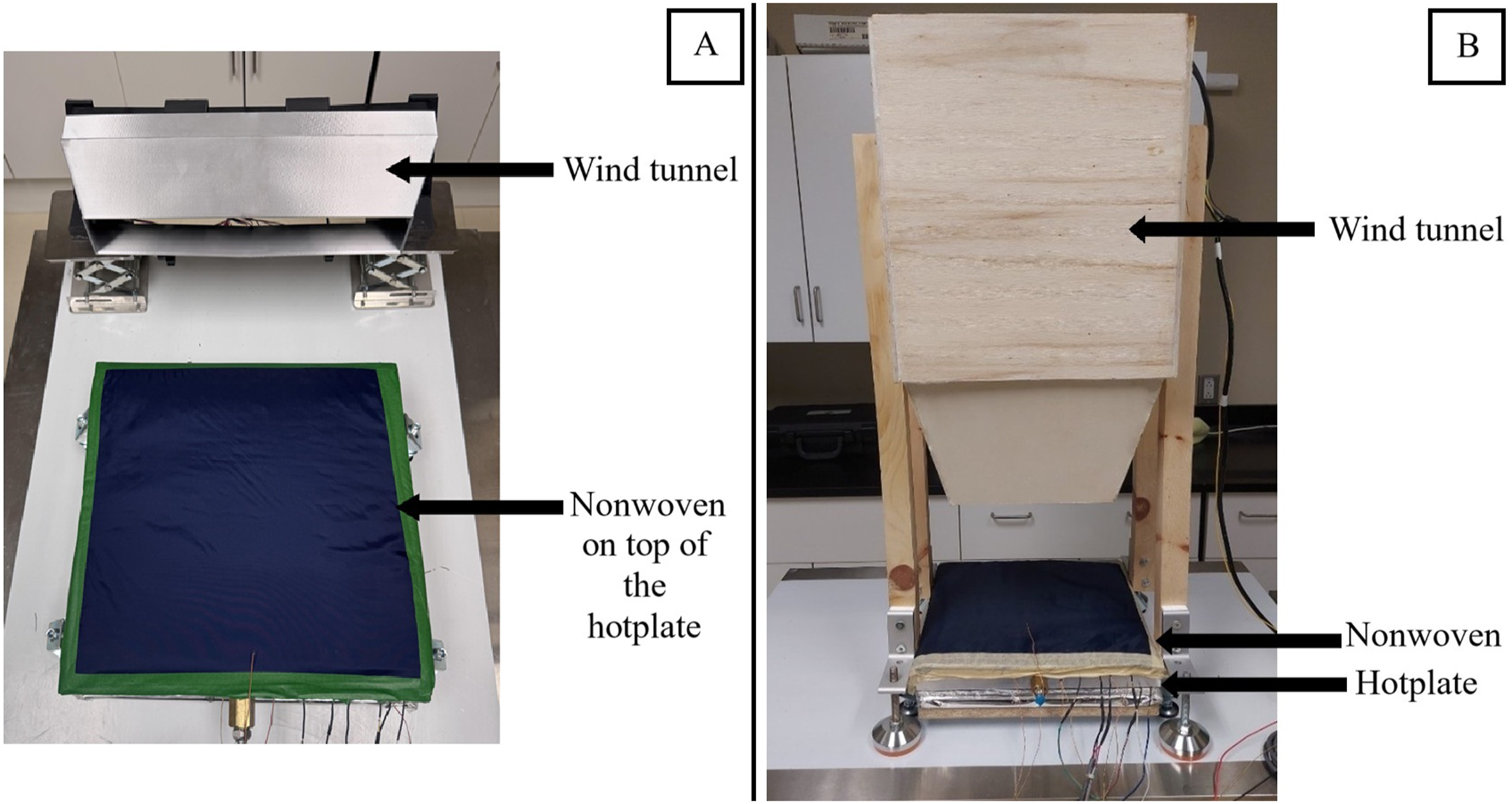
The modified skin model was then validated under the same conditions that are mentioned in the standard: 20°C ambient temperature, 65% relative humidity and 1 m·s−1 horizontal wind speed. Thermal resistances of 3 nonwoven assemblies were tested on the modified bench test and were compared with the results of an independent laboratory that tested the samples using the ISO 11092 standardized bench test. 5 The differences between the thermal resistances were less than 5%.
Wind speed measurement in horizontal and vertical direction.

After reaching a thermal steady state (35.0 ± 0.2°C), a minimum of 20 min of data was collected (one value each second). These data were then averaged to determine the thermal resistance using equation (2):
5
R
ct
is the thermal resistance of the tested sample, in m2·°C·W−1; A is the area of the tested sample, in m2; T
m
the temperature of the measuring zone of the plate, in °C; T
a
is the temperature of the air, in °C; H is the heating power supplied to the measuring zone, in W;
R ct0 is the thermal resistance of the boundary layer above the tested sample, in m2·°C·W−1. This parameter varies in function of wind speed and direction. Consequently, its value has been determined for each test conditions.
The calculated values of the thermal resistance where then multiplied by 0.155 to present the values in clo, where 1 clo stands for the thermal insulation required for a person at rest to maintain comfort in a 21°C environment with 50% relative humidity. 32
The BTA samples of different weights per unit area were tested under a temperature of 20°C, 65% relative humidity while varying the wind speed (V0, V1, V2 and V3) in 2 directions (horizontal and vertical). Three replicates were performed for each sample under the same conditions.
Results and discussion
Bare plate thermal resistance, Rct0
The thermal resistance at the surface of the hotplate, denoted as R
ct0
, was calculated for various wind conditions while maintaining a constant temperature of 20°C and relative humidity of 65%. The results are presented in Figure 3. The data reveals a consistent trend: with increasing wind speed in either direction, the R
ct0
value decreases. This observation can be attributed to the enhanced air movement caused by the wind. This movement disrupts the stagnant air layer on top of the hotplate, continuously replacing it with air at ambient temperature. Consequently, the thermal resistance between the hotplate and the surrounding environment diminishes. Bare plate thermal resistance under different wind conditions.
Thermal resistance, Rct
The graphs presented in Figure 4 illustrate the thermal resistance of the three BTA samples (Sample A, Sample B, and Sample C) as a function of wind speed (V0, V1, V2, V3) for both horizontal and vertical wind conditions. As wind speed increases from V0 to V3, thermal resistance shows a significant decline in all samples, under both wind directions, reflecting a reduction in insulation due to enhanced convective heat loss within the structure of the sample. Thermal resistance of BTA samples, A, B and C, in function of wind speed and direction.
The transition from V0 (no wind) to V1 shows a marked decline in thermal resistance. This initial drop can be explained by the onset of forced convection as wind begins to infiltrate the sample’s structure. For all three samples, this transition results in a significant decrease in thermal resistance as the material is no longer solely relying on natural convection and radiation for insulation. The presence of wind introduces convective heat loss mechanisms inside the nonwoven textile structure that reduces the insulating effectiveness. For example, Sample A’s thermal resistance drops by approximately 29% and 46% with the increase of wind speed from V0 to V1 in the horizontal and vertical direction, respectively. Similar trends are observed for the other samples.
In the case of horizontal wind, thermal resistance decreases with increasing wind speed due mainly to the effects of forced convection within the samples, as higher wind speeds promote heat transfer. Sample A experiences a 38% drop in thermal resistance when wind speed increases from V1 to V3, while Sample B shows a larger reduction of about 55%, and Sample C a similar 51% reduction.
The impact of vertical wind on thermal resistance is even more pronounced. Vertical wind can more easily penetrate the internal structure of the samples, disrupting the trapped air pockets that contribute to insulation and facilitating forced convection within the sample itself. 33 This leads to a greater heat transfer rate and a corresponding decrease in thermal resistance. For Sample A, the thermal resistance decreases by 69% when the wind speed increases from V1 to V3, compared to the 38% drop observed under horizontal wind. Samples B and C show similar trends, with reductions of 77% and 81%, respectively. These larger reductions in thermal resistance under vertical wind are likely attributed to the increased air penetration into the material, which disrupts the insulating air layers and promotes more efficient heat transfer, which is consistent with the findings reported by Tu et al. 24 and Zemzem et al. 14
Mass per unit area
The graphs shown in Figure 5 convincingly demonstrate a positive correlation, under the same wind speed in the same direction, between the sample mass per unit area and its thermal resistance. Samples with a higher mass per unit area consistently exhibit greater thermal resistance. The sample with higher mass per unit area have a greater number of fibers that trap air more effectively creating a stagnant air layer that acts as a good insulator, thus increasing the thermal resistance. At wind speeds of around 4 m·s-1 (V3), particularly under vertical wind, the data suggests that the samples reach a point where air penetration within the material is elevated, and additional increases in wind speed might not significantly impact thermal resistance. This is evident in the plateauing of thermal resistance values near 0.5 clo for all samples under vertical wind conditions (V3). This plateau indicates that the internal structure of the BTA nonwoven assemblies has become fully penetrated by air, and the heat transfer has reached a maximum for forced convection at this wind speed. Consequently, beyond this threshold, further increases in wind speed contribute little to the decline of thermal resistance. Thermal resistance of BTA in function of the mass per unit area under different wind conditions.
Comparison with ISO 9920 model
ISO 9920 standard
18
proposed a methodology to consider the effects of walking speed and wind speed and direction on the thermal resistance of a clothing ensembles. Given by equation (3):
R
ct0,r
is calculated using equation (4):
And I
T,r
is determined by equation (5):
The relative wind speed presented by equation (6):
Figure 6 shows the difference between the thermal resistance calculated using the equation (3) presented in ISO 9920 standard and the experimental thermal resistance measured using the skin model of the three BTA samples. Thermal resistance using ISO 9920 equations versus experimental data of BTA samples under different wind conditions.
In all three samples, the thermal resistance values predicted by ISO 9920 remain relatively constant with the increase in the wind speeds, showing a much slower decrease than the experimental data for both horizontal and vertical winds.
Sample A under ISO 9920 reports a decrease of around 16% in the thermal resistance when the wind speed increased from 1 m·s−1 to 4 m·s−1. In contrast, the experimental data shows a decrease of 38% and 51% of the thermal resistance values with the same increase of wind speed in horizontal and vertical direction, respectively. This represents a substantial difference between the experimental and ISO 9920 values, with the experimental data showing a much greater sensitivity to wind. Around 4 m·s−1, the measured value of the thermal resistance was 50% and 79% lower than the predicted value in the horizontal and vertical direction respectively.
Similarly, for Sample B, the ISO 9920 standard predicts a drop of 19% in thermal resistance, while the experimental results show significant declines in thermal resistance. At 4 m·s−1, the difference between the experimental thermal resistance and the predicted values was 57% for horizontal wind and 83% for vertical wind. Sample C presents similar differences, 50% in the horizontal direction and 83% in the vertical direction.
The standard is based on studies using thermal manikins in controlled environments, where clothing insulation values are calculated as a combination of the clothing itself, the trapped air layers within the clothing, and the boundary air layer around the body. This approach allows for consistent baseline measurements but assumes limited variation in boundary air disruption, underestimating forced convection impacts in highly permeable materials at higher wind speeds.
Conclusions
The findings from the experimental data suggest that when assessing the thermal resistance of nonwoven assemblies, it is essential to account for the effects of wind speed and direction. As wind speed increases, thermal resistance decreases for both horizontal and vertical wind directions. Moreover, vertical wind exhibits a more significant impact on reducing thermal resistance compared to horizontal wind, primarily due to its enhanced ability to penetrate the sample’s structure and increase forced convection.
The mass per unit area of the samples also plays a crucial role in determining thermal resistance. Samples with higher mass per unit area exhibit greater thermal resistance due to their increased ability to trap air and create a stagnant air layer. However, this effect becomes less pronounced at higher wind speeds, especially in the vertical direction, where air penetration saturates within the sample’s structure.
The discrepancies between the ISO 9920 standard and the experimental results underscores the need for caution when relying on the ISO 9920 values in practical applications. The standard values are likely to overestimate the thermal insulation of clothing or permeable materials when exposed to dynamic, wind-driven conditions. The standard may serve as a useful starting point for static conditions, but it underrepresents the real thermal resistance of nonwovens exposed to wind. Such considerations are crucial for industries reliant on thermal protection materials, particularly in outdoor or extreme environments where wind plays a significant role in heat transfer.
Limitations
This study presents initial findings on the effect of wind on the thermal resistance of BTA nonwoven assemblies. However, it’s important to acknowledge certain limitations. Firstly, the wind speed range tested was limited to 0–4 m·s−1, which may not fully capture the impact of greater wind conditions encountered in real-world scenarios. Secondly, the study focused on a single type of nonwoven assemblies with varying weights per unit area, limiting the generalizability of the findings to other types of textiles and their compositions. Future research should expand the range of wind speeds tested, investigate the impact of wind on a wider variety of textile materials, and consider the influence of other environmental factors such as humidity on thermal performance. Additionally, this study was conducted at the fabric level and in real-life applications the clothing is worn as a garment, thus zippers, seams, and closures significantly impact airflow dynamics, influencing thermal resistance. These factors were overlooked in this study, but more research should be done to show the effects of these elements on the overall performance of the textile assembly.
Footnotes
Acknowledgments
The authors would like to express their gratitude to the industrial partners in Logistik Unicorp Inc and Eko-Terre. The authors also thank Dr Marwa Sta for her assistance.
Declaration of conflicting interests
The authors declared no potential conflicts of interest with respect to the research, authorship, and/or publication of this article.
Funding
The authors disclosed receipt of the following financial support for the research, authorship, and/or publication of this article: This work was supported by a financial support of our industrial partners, Logistik Unicorp Inc and Eko-Terre, as well as a grant from PRIMA Québec (N° R23-13-001) and the Natural Sciences and Engineering Research Council of Canada (ALLRP 566738 - 21).
Declaration of generative AI and AI-assisted technologies in the writing process
During the preparation of this work, the authors used ChatGPT 4o to improve readability and language. After using this tool, the authors reviewed and edited the content as needed and took full responsibility for the publication’s content.
