




Abstract
In this paper, the magnetron sputtering technology was used to deposit rare earth Er3+ doped Ti/ZnO films on the polyester substrate with different sputtering power and sputtering time to simultaneously achieve structural coloration and enhanced luminescence, thereby creating a series of ecological luminous textile. SEM, XRD analyses, luminescence properties assessments, surface structure color evaluations and bonding fastness tests were conducted to compare the properties of the samples. The results showed that: (1) Compact, uniform Er3+-doped nanoparticles with good luster on fiber surfaces are presented. (2) Luminescence intensity peaked at 130 W sputtering power and 80 min sputtering time. (3) Different sputtering parameters result in differentiated color effect and purity. (4) Excellent bonding fastness was valued for sustainable applications.
Keywords
Introduction
Luminous textile, as a kind of functional textile that is widely applied in many fields, can produce a variety of colors of light after the excitation of light irradiation. Its application strengthens the safety of the textile as well as its artistry and style, ensuring excellent market expansion potential and competitive advantages. 1
Currently, the common preparation of luminous textile is to first manufacture luminous fibers and then weave them. 2 However, this method often brings a series of problems due to the large inorganic luminous powder particles, such as the increased complexity of the production process, the reduced spinnability of the fibers, the weakened mechanical strength, the unsatisfactory luminous effect 3 as well as a lack of softness and comfort. The further exploration of novel luminous textile prepared by finishing technique on the premise of maintaining color fastness is needed.
Magnetron sputtering technology is widely used in the surface modification of textile products. It is characterized by low temperature, high speed, capability of crystallization, easy control and environmental protection, 4 which can efficiently produce functional films with high purity, excellent compactness and uniform distribution, 5 in the meanwhile, it can also provide strong binding fastness between the film and the substrate. 6 Instead of preparing luminous fibers, the utilization of magnetron sputtering technology can function directly on the surface of the textile to endow it with luminous properties 7 through structural color effect basing on the principle of thin film interference. However, current applications of magnetron sputtering in textiles primarily focus on basic functional coatings, with limited exploration of its synergistic potential with advanced luminescent materials like rare-earth-doped semiconductors.
Structural color in textile coloration.

Studies in luminous textile usually focus on semiconducting materials while ZnO being one of the most commonly used semiconductors.14,15 At room temperature, ZnO is an insulator with a 3.37 eV band gap. External excitation like photoionization or electron beams can create electron-hole pairs, which emit photons upon recombination, producing luminescence at ∼369 nm UV. However, ZnO’s luminescent properties are influenced by intrinsic and impurity defects,16,17 impacting its performance and applications. 18
Many scientific research and development results have proved that doping a small number of rare earth materials can effectively improve the luminous properties of ZnO 19 through energy transfer, 20 replacing or filling defective positions of ZnO 21 and altering the morphology and crystallinity of ZnO. 22 Nano-metal/semiconductor composite film combines the advantages of metals and semiconductors to perform well in optoelectronics, energy conversion, and energy materials, possessing high research and application value. 23 Despite these advancements, the integration of rare-earth-doped ZnO films with structural color technology for textile applications remains unexplored, particularly regarding the interplay between sputtering parameters and luminescent performance.
In this paper, through direct current (DC) reactive sputtering and direct current/radio frequency (DC/RF) reactive sputtering, titanium (Ti) film is coated on the surface of the polyester textile for its decent reflection and temperature resistance nature, followed by the incorporation of rare earth erbium (Er3+) 24 doped zinc oxide (ZnO) film to prepare structural colored textile under different sputtering conditions, whose luminous properties are studied and analyzed. We hypothesize that this design enables a luminescent textile product that can simultaneously improve luminescent deficiencies of ZnO through rare-earth doping while leveraging structural color effects to improve color vibrancy via an environmental and economical method. In comparison with the conventional ways, this methodology not only mitigates environmental pollution but also reduces the costs, thereby enhancing the market competitiveness of the products.
Experimental
Materials
The materials used in this work include polyester woven fabric (15 × 15 cm, 120 g/m2), zinc (Zn) and titanium (Ti) targets (Ф 76.2 × 3 mm, 99.995%, Zhongnuo New Material (Beijing) Technology Co., LTD) and erbium sesquioxide target (Er2O3, Ф 76.2 × 3 mm, 99.99%, Zhongnuo New Material (Beijing) Technology Co., LTD).
Preparation of Ti/ZnO:Er3+ based structural-colored textile
In this study, ZnO film was produced through the reaction of Zn target under oxygen and argon condition as Zn target is more stable and efficient during magnetron sputtering. And when preparing Er3+ doped Ti/ZnO film, the DC/RF reactive sputtering method was applied for it possesses the advantages of both DC sputtering and RF sputtering, 25 which can achieve a high deposition rate and maintain the stability of the plasma. 26 However, if the sputtering power is too low or the duration is too short, it may result in inadequate loading, leading to a low purity and saturation of the structural color. Conversely, excessively long sputtering durations may cause the accumulation of nanoparticles and cracking of the film, therefore, different sputtering power and duration were set and studied in this work to compare performance of the corresponding resultant samples. 27
The polyester woven fabric is pretreated to prevent impurities or slurry on the fabric from interfering with the final experimental results. Wash the fabric samples with warm water and professional soap, then soak it in deionized water for 10 min to remove the remaining impurities, finally, place it in an electrothermal blowing dry box at 50°C for 40 min.
Position the pretreat fabric on the sample stage, 15 cm away from the target(s). The background vacuum, the working pressure and the rotation speed of the sample table were set to be 1.5 × 10⁻³ Pa, 0.8 Pa and 10 r/min.
The specific preparation process parameters of different samples.

Structural characterization
Scanning electron microscopy (SEM)
Hitachi TM4000Plus bench scanning electron microscopy was used to characterize the microstructure of the samples before and after coating (accelerating voltage = 15 kV, current mode = mode 3, vacuum mode M). In order to obtain better image quality and avoid charge accumulation, the samples (0.5 × 0.5 cm) are sprayed with gold for about 1 min prior to sputtering. Images with magnifications of × 1500 and × 2000 were presented in this paper.
X-ray diffraction (XRD)
The crystal structure and properties of the sample were studied with Rigaku MINIFLEX600 X-ray diffractometer (scanning angle = 10°–90°(2θ)). When irradiating the sample, X-ray will interact with the atoms in the crystal, and therefore present diffraction phenomenon in different degrees. 28 According to the position and shape of peaks in diffraction patterns, the crystal structure, lattice constant and relative content of the material can be determined.
Optical tests
Photoluminescence
Hitachi F-7100 fluorescence spectrophotometer was used to measure the fluorescence intensity of the sample (2.5 × 2.5 cm) under different excitation wavelengths (EX = 310/330 nm, λ = 360–500 nm), therefore to infer sample’s ability to store the energy when being irradiated and later on release this energy of light for the purpose of illumination and mark. 29
Structural color
In this study, the datecolor800 color spectrometer was used to test and analyze the surface color of the fabric, compare the color difference of different fabrics, and record the L*, a*, b*, C*, h* values and reflectance curves of the sample. The samples are rotated and tested in triplicate to obtain more comprehensive and representative color information during the measurement, then the mean values are taken.
L*, a*, b* are the color triples in the Lab color space. Luminosity (L*) signifies brightness, ranging from black to white (0–100), a* represents the red–green hue (h*) while b* indicates the yellow–blue hue. 30 Chroma (C*) stands of the saturability of the color ranging from 0 to 100. These parameters precisely describe and compare colors, forming the basis for color difference calculations. Hue (h*) is determined by the wavelength of the light transmitted, emitted, or reflected by an object. 31
Spectral reflectance data and spectral reflectance characteristic curves provide detailed descriptions of complex characteristics of the object, such as the selective absorption process of incident light, the scattering phenomenon of light, and the specular reflection exhibited on the object’s surface.
Fastness
Basing on GB/ T3921-2008 “Textile Color Fastness Test-Color Fastness to soaping”, the soaping fastness of samples was used to indirectly characterize the bonding fastness between nanocomposite films and textiles. Duplicates were carried out for accuracy.
White cloth of the same size is sewn on the uncoated surface of the sample (3 × 5 cm), and then placed in a beaker with 150 mL deionized water and an appropriate amount of soap solution, stir the mixture at 45°C for 10 min followed by cleaning and drying. Then the samples are rated against the standard sample card. 32 Larger the rating value represents better color fastness, which can indirectly demonstrate higher binding fastness between the composite film and the fabric, more difficult of the film transfer, and longer usage of the textile. 33
Results and discussion
Structural characterization
Scanning electron microscope (SEM)
Through the comparison among SEM images of different samples, the influence sputtering time and power have over the distribution and characteristics of samples was discussed. Figure 1 shows the SEM images of the fabrics before and after coating. SEM images of original polyester fabric as a control as well as sample #3, and samples #5–8.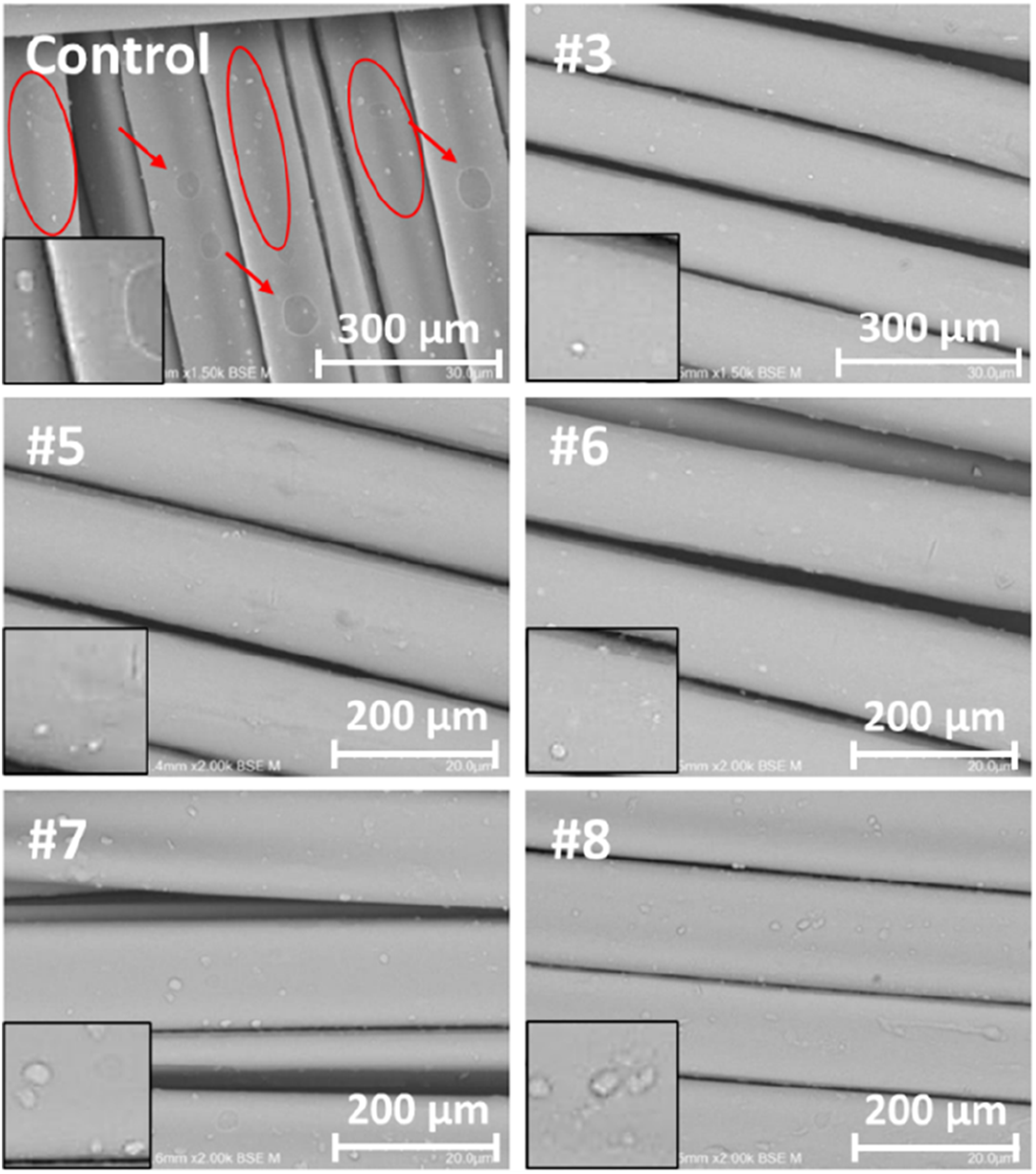
Figure 1 (Control) depicts the surface morphology of the untreated polyester woven fabric (×1500), revealing defects and damages on the surface of the fibers along with numerous elliptical pits. In the meanwhile, the elliptical damage on the fabric surface is notably reduced in sample #3 (40/120 W, 40 min, × 1500). The resultant nano-film exhibits an overall relatively uniform and compact appearance, with mere traces of agglomerations and stray points, and possesses an impressive luster.
Figure 1 (#5–8, × 2000) display the surface microstructures of the fabrics after being sputtered at a power of 35/110 W for durations of 40, 60, 80 and 100 min, respectively. The fibers on the surface of the samples appear smooth, with nanoparticles of the nano-film evenly distributed and relatively uniform in density, free from significant agglomeration. As the sputtering time increases, there is a trend towards a denser distribution of particles on the surface and a slight decrease in smoothness. Slight agglomeration of nanoparticles on the surface of the samples can be observed when sputtered an extended period of time. During the preparation process, due to the simultaneous sputtering of targets at two different voltages, occasional fine cracks may appear in the thin film on the fiber surface. However, such cracking is minimal overall and has a negligible impact on the structural color displayed by the sample surface.
Upon observing the images collectively, it can be seen that despite variations in the thin film structure, the nanocomposite films on the surface of polyester woven fabric, after being subjected to different sputtering durations, remain tightly bonded internally. No cracking or detachment of particles on the film surface is evident. This robustly demonstrates that the Er3+-doped Ti/ZnO films prepared by DC/RF magnetron sputtering can uniformly, densely, and continuously coat the surface of the fabric.
X-ray diffraction (XRD)
Since samples #1–8 differ only in sputtering parameters, the representative sample #3 is selected for detailed XRD measurement (see in Figure 2). XRD pattern of sample #3.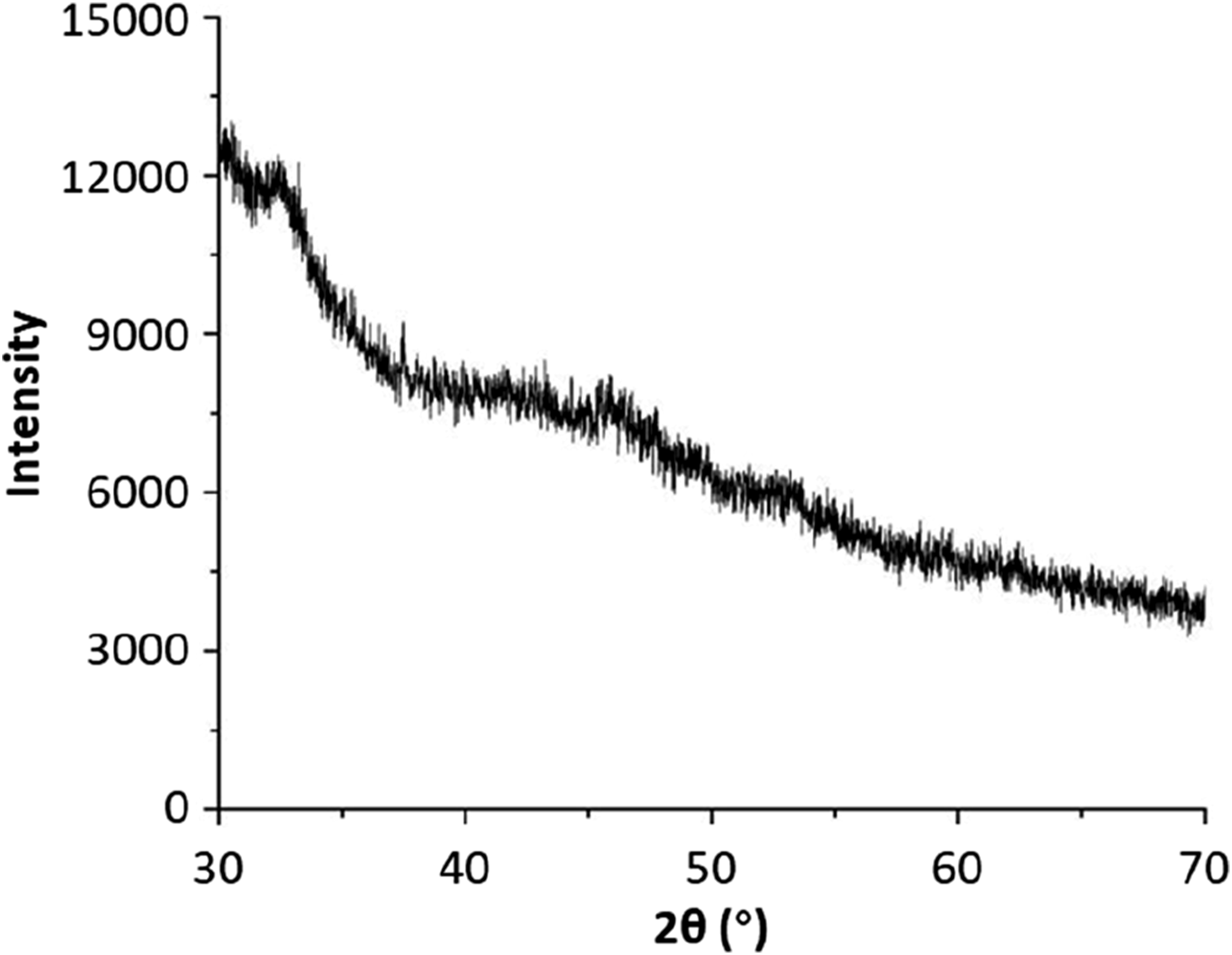
To be expected, as a polymer, the substrate (polyester) tends to present a complex curve in XRD result. Normally speaking, regarding the characteristic diffraction peaks of Ti, the position for the (111), (200) and (220) crystal planes are approximately at 2θ = 32.0°, 50.4°, and 65.0°, respectively (JCPDS Card No. 36-1451) while those of ZnO correspond to reflection peaks of (100), (002), (101), (110) and (103) crystal planes that present at 2θ = 31.7°, 34.4°, 36.2°, 57.3° and 62.5°, respectively (JCPDS Card No. 89-1397). 34 Sample #3 exhibited a diffraction peak at around 32°, which aligns with the diffraction peak position of the (111) and (100) plane. However, the intensity of this peak is relatively low, and no other prominent diffraction peak features are present. This phenomenon may contribute to the partial oxidation of the Ti film into a TiO2 film, which leads to the obscuring of crystalline structure characteristics of the Ti film and its primary existence as an amorphous structure on the fabric surface. 35 Additionally, factors such as the doping of rare earth element, differences in instrumentation, temperature during the magnetron sputtering process, and parameter settings contribute to the difficulty in forming a crystalline structure and result in a lower degree of crystallization.
Optical tests
Photoluminescence
Taking into consideration of the characteristic wavelength of ZnO
36
and the characteristic emission light of Er, several excitation wavelengths under 380 nm were tested and that at 310 nm and 330 nm were selected to display the photoluminescent characteristics of samples #1–4 (Figure 3) and #5–8 (Figure 4). PL spectra of samples #1–4. PL spectra of samples #5–8.

In the PL spectra of samples #1–4 at 310 nm excitation wavelength, the wave peaks are all around 432 nm while samples emit violet light. The peak heights of sample #1 (40/100 W) and sample #4 (40/130 W) showed minimal difference with high fluorescence intensity, which proves fair luminous effect. However, the fluorescence intensity at the wave peak of sample #2 exhibited a notable decrease when compared to that of sample 1#. Conversely, the fluorescence intensity at the wave peak of sample #3 showed a recovery relative to sample #2, positioning approximately midway between the intensities of samples #1 and 4.
In Figure 4, the wave peaks of samples #5–8 also situate at ∼432 nm with violet light emission. The luminescence spectral curve of sample #5 (40 min) is relatively flat with low fluorescence intensity which has improved in sample #6 (60 min). However, the fluctuation of the luminous spectrum of the sample #7 (80 min) increased significantly while fluorescence intensity at the peak far exceeded that of samples #5, #6 and #8, indicating that it exhibits the best luminous performance of all. On the contrary, the fluorescence intensity at the peak of sample #8 (100 min) has dramatically reduced to the lowest among #5–8, indicating poor luminescence performance.
From the analysis above, it can be seen that Er3+ doped Ti/ZnO nano-films co-sputtering with Zn target (DC) and Er2O3 target (RF) showed a trend of first decreasing and then increasing in luminescence property with the enhancement of RF power and reached the maximum value at 130 W in our study, demonstrating that in a certain range, larger proportion of Er3+ in the films benefits the photoluminescent performance of the material. On the other hand, with fixed sputtering power, the luminescence performance increased first and then decreased with the extension of sputtering time, the fluorescence intensity reached the maximum value with a sputtering time of 80 min, this trend can be attributed to the excessive thickness of the film produced under an extended sputtering duration which hindered the presentation of its luminescent potentiality. 31
Structural color
The specific color manifestation of an object originates from the combined effects of physical phenomena such as scattering, interference, and diffraction of light on its surface microstructure. This type of color that arises due to structural characteristics is referred to as structural color.
37
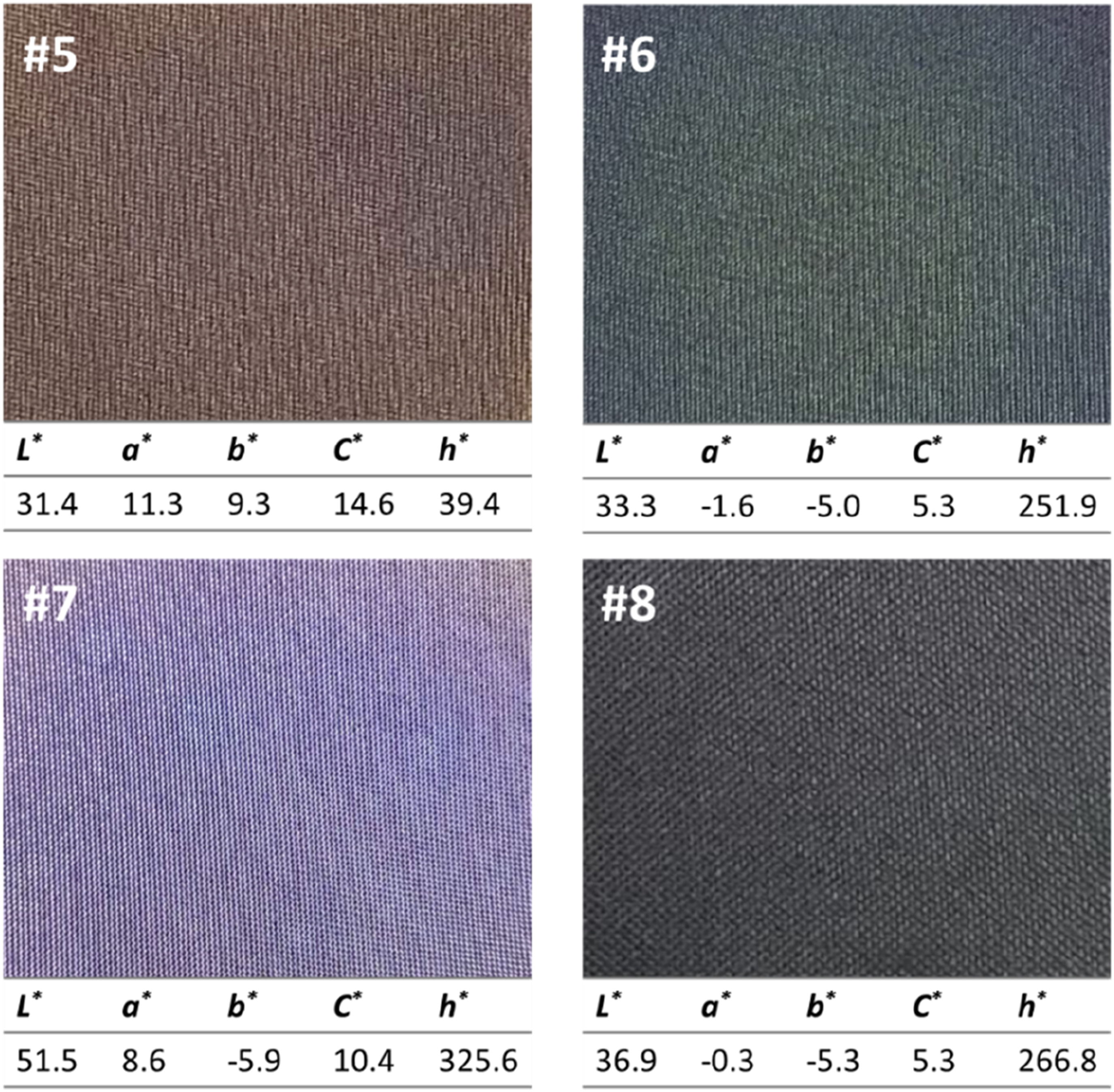
The photographs as well as characteristic colorimetric values (L*, a*, b*, C*, h*) of samples #1–4, #5–8 are presented in Figures 5 and 6. Photographs and colorimetric values of samples #1–4. Photographs and colorimetric values of samples #1–4.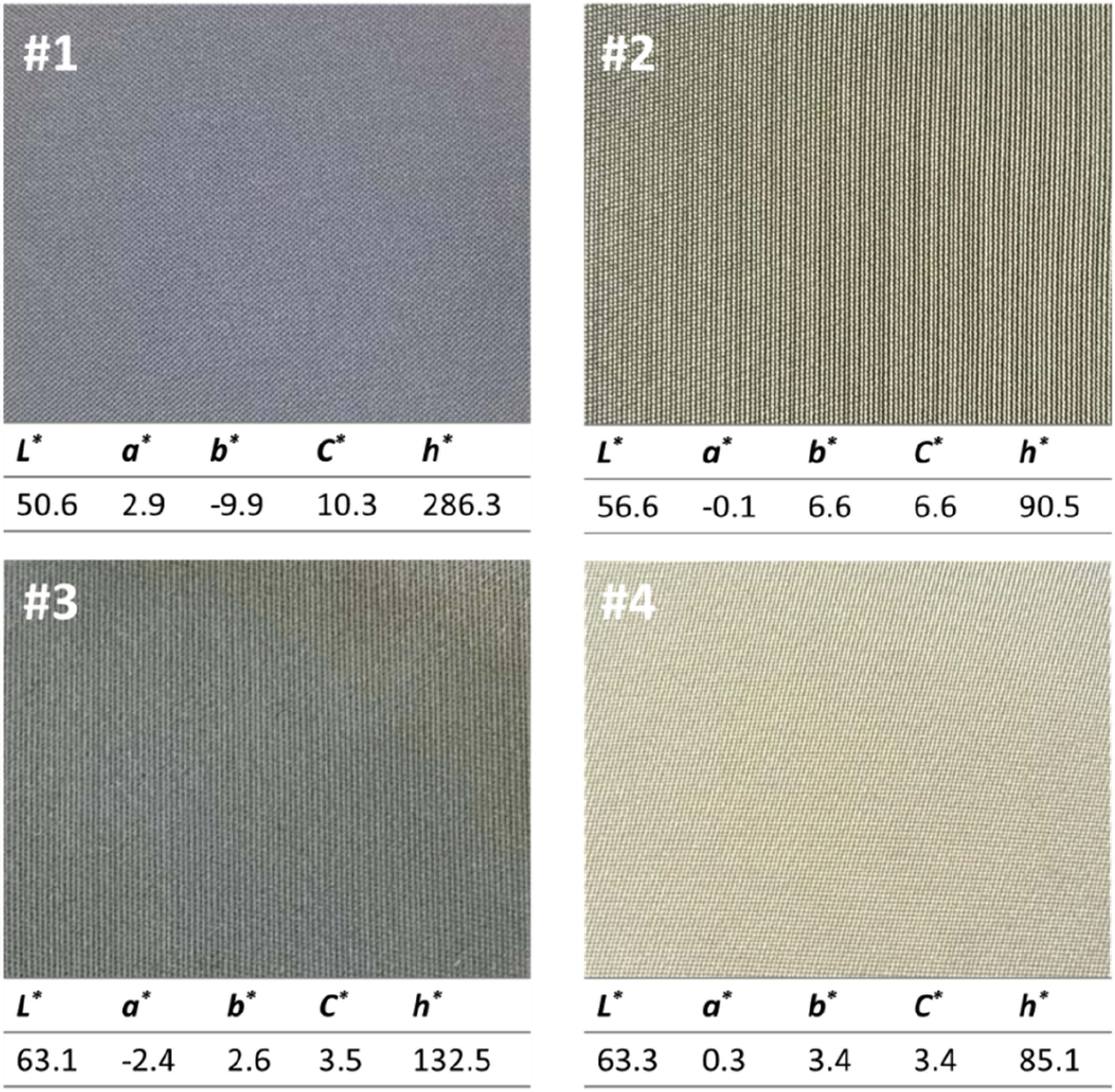
It can be seen that the fabrics sputtered under different power give a variety of structural color from a certain category. Samples #1–4 showed L* and C* values ranging between 50.6–63.2 and 3.4–10.3, respectively, demonstrating higher brightness and lower purity in color under increased sputtering power. Both negative and positive a* and b* values were presented, indicating that samples are in different quadrants and positions in the color space. Sample #1 possessed the highest a* value and the lowest b* value, corresponds to its composition of red and blue colors while sample #3 being the opposite (composition of green and yellow colors). In the meanwhile, the h* values of samples #1–4 are in line with their purple, green, cyan and green–yellow colors.
Samples #5–8 exhibited distinct structural colors that are brown, cyan, purple and dark grey when observing with naked eyes. Among the four, sample #7 has the highest L* value, presenting the brightest color. Sample #5 possesses the biggest a*, b* and C* values, which match well with its red and yellow lights in the photo, while representing the highest color purity. Judging from value h*, samples #5–8 correspond with orange, blue, rose and purple color respectively.
As presented in Figure 7(a), the maximum reflected wavelength of sample #1 is at 430 nm, corresponding to short-wave blue light as observed in Figure 5. Samples #2 and #4 possess similar wide semi-reflective peaks in the wavelength range of 550–600 nm which agree with their yellowish light as well as approximate h* values shown in Figure 5. Sample #3, however, has its wide characteristic peak in the range of 480–520 nm, relating to cyan-green color. Reflection curves of sample #1–4 (a) and samples #5–8 (b).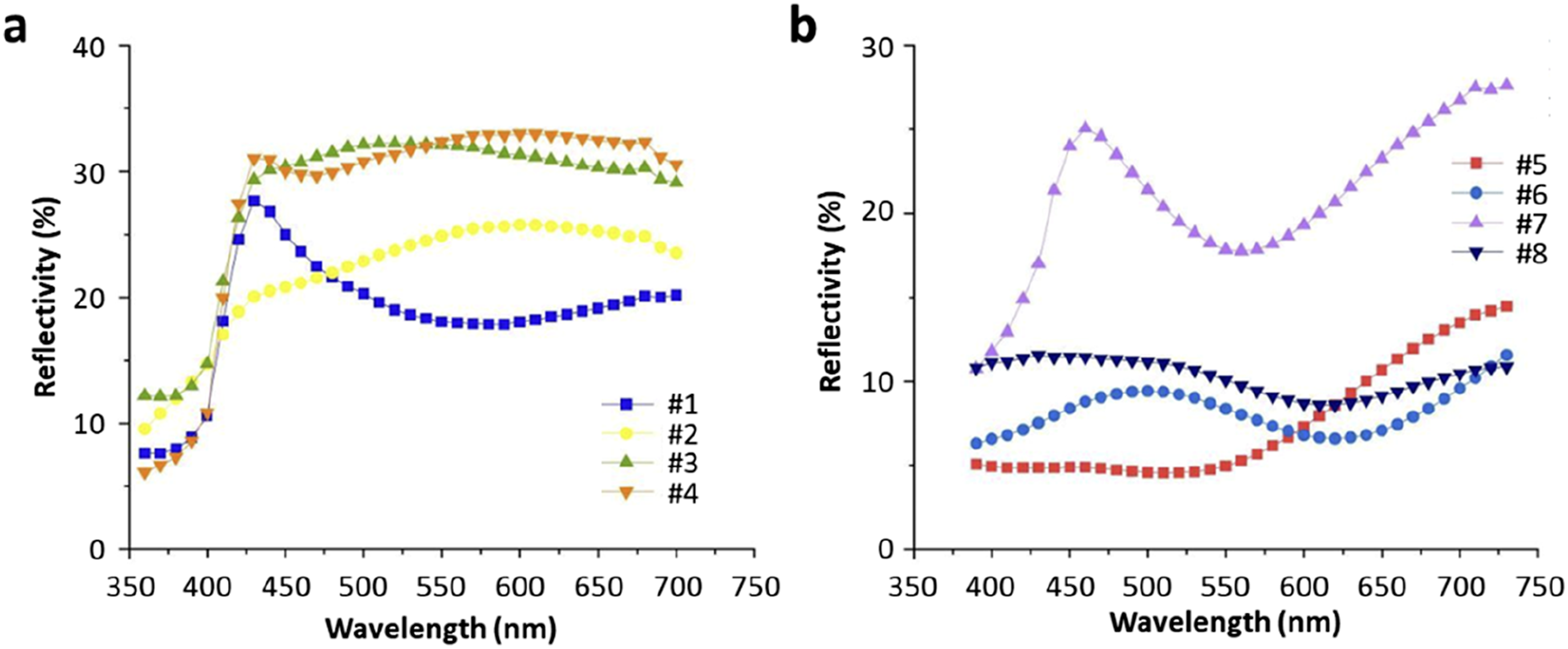
Shown in Figure 7(b), all four samples possessed wide semi-reflective peaks in the wavelength range of 600–730 nm which corresponds to red light. Sample #5 exhibited the lowest reflection in the short wavelength range, which is consistent with its biggest b* value in Figure 6. Sample #6 had a characteristic reflective peak at 500 nm, correspond to green-cyan color in the photograph. Sample #7 presented an evident characteristic peak at 460 nm which gives out blue light while sample #8 showed wider semi-reflective peak in the range of 430–490 nm that conforms to cyan-blue light.
It can be seen that samples #1–4 and 7 presented stronger fluorescence intensity than samples #5, 6 and 8, which indicates higher reflectance as well as the brightness of the samples, coinciding with their corresponding L* values (see in Figures 5 and 6).
To be noted, uneven yellow color observed in photographs (sample #6 in particular) may due to the oxidation of Ti film and the dark color presented in sample #8 is likely contribute to the fact of an extended sputtering time where thicker film inhibits interference and scattering effect of the light.
Color fastness to soaping of the samples.

Fastness
In the color fastness test, the Er3+-doped Ti/ZnO nanofilm fabric samples resulted in slight fade in color of the fabric sample surface, showing no obvious color transfer to the white fabric backing after the test. The color fastness to soaping of all samples were all in the level of 4-5, indicating that the perceived colors of the samples remained almost unchanged after the washing process, demonstrating excellent performance in color fastness to soaping. This shows that the Er3+-doped Ti/ZnO nanofilm on the fabric surface exhibits good bonding strength with polyester fabric.
Conclusions
In this study, polyester woven fabric was utilized as the substrate for the preparation of Er3+-doped Ti/ZnO nanofilms through magnetron sputtering technology, the structures and properties of the resultant fabrics were characterized and analyzed.
Upon sputtering, the nanoparticles on the fiber surface exhibited a dense and uniform distribution with good gloss. However, as the sputtering duration increased, although the particle distribution became more compact, the overall uniformity and smoothness decreased.
The samples obtained by this method possessed significant structural color effect. As the sputtering power enhance, the luminescent intensity of the fabrics first declined then peaked at 130 W, while increased sputtering time caused the opposite trend, with maximum fluorescence at 80 min, suggesting that the photoluminescence performance is closely related to the incorruption of rare earth element Er and would be hindered by an excessive sputtering process. Samples with different sputtering powers exhibited similar shades of structural color while the structural color effect was more pronounced with better color saturation for samples subjected to different sputtering time. Notably, all fabrics exhibited decent color fastness to soaping, which indicates strong binding fastness between the composite film and the fabric, revealing minimal likelihood of detachment and a prolonged service life.
However, the luminescent textiles in this study encountered flaws such as low color purity, uneven coloration and certain dispersion due to possible improper Er3+ doping ratio, inadequate sputtering duration, and equipment voltage/power fluctuations. Future research aims at optimizing the magnetron sputtering technique to improve the photoluminescent performance of the material as well as meeting diverse needs in structural color.
Statements and declarations
Footnotes
Conflicting interests
The author(s) declared no potential conflicts of interest with respect to the research, authorship, and/or publication of this article.
Funding
The author(s) disclosed receipt of the following financial support for the research, authorship, and/or publication of this article: This work was supported by The Fujian Natural Science Foundation Project (Nos. 2023J011404, 2023J011405, and 2024J011179) and The Fuzhou Major Science and Technology Projects (Nos. 2024-ZD-006 and 2024-ZD-007).
