




Abstract
In modern healthcare, environmental issues, including the extensive use of non-biodegradable materials and rising medical waste, are critical concerns. Addressing these challenges, this study developed environmentally friendly alginate/chitosan hydrogel composites reinforced with nonwoven textiles from industrial cotton waste and enhanced with the natural antibacterial agents neem and turmeric. The composites were prepared with varying concentrations of alginate/chitosan hydrogels (0.75%, 1.25%, 1.75%) and different nonwoven fabric densities (50, 100, 150 GSM). Key findings reveal that neem-treated samples exhibited the highest wound exudate absorption (420%) at 150 GSM and 0.75% hydrogel concentration, whereas turmeric-treated samples provided optimal moisture management, with an overall moisture management capacity (OMMC) of 0.45 at 150 GSM and 1.75% hydrogel concentration. Additionally, turmeric-treated samples achieved higher air permeability (108 mm/sec) compared to neem-treated samples (62 mm/sec) at 1.75% hydrogel and 150 GSM. In terms of mechanical properties, neem treatment resulted in superior tensile strength (32.05 N), while turmeric treatment improved flexibility, with an elongation of 13.98%. These results indicated the composite’s potential for wound dressing applications, with neem treatment suitable for high absorbency and tensile strength, and turmeric treatment ideal for moisture management and flexibility. This sustainable hydrogel composite offers a promising, biodegradable alternative for effective wound care and medical waste reduction.
Introduction
In the current era medical waste has become a critical environmental issue. In the United States alone, healthcare facilities generate approximately 5.9 million tons of medical waste each year, with non-biodegradable wound dressings contributing significantly to this volume. Globally, it is estimated that 25% of healthcare waste is hazardous and poorly managed, leading to pollution and potential health risks. During the COVID-19 pandemic, global medical waste surged, with an estimated eight million tons of plastic waste generated from healthcare settings, much of which consisted of single-use, non-biodegradable materials. This highlights the urgent need for biodegradable wound dressings to reduce healthcare’s environmental impact and contribute to sustainable waste management solutions.1–3
The natural antibacterial, anti-inflammatory, and wound-healing qualities of, neem (Azadirachta indica) and turmeric (Curcuma longa) make them excellent choices for biomedical applications. Compounds contained in neem leaves include Nimbin, nimbidin, and azadirachtin which have effective antimicrobial effects.4,5 An active compound in turmeric known as curcumin provides it with strong antibacterial, antioxidant, and anti-inflammatory effects.6,7 Due to their antimicrobial activity and therapeutic potential, these natural agents have been formulated in topically applied creams or ointments.8–10
Hydrogels, due to high water content and biocompatibility have gained attention as carriers for these natural antibacterial agents. Polymeric materials with water content in their structure are passively developed via cross-linking into a hydrogel on the surfaces.11–13 The biocompatibility and degradability of polymeric biomaterials have led to a growing interest in their use in medical applications. Both sodium alginate and chitosan were used due to their low toxicity, abundant supplier options as well as promising properties for hydrogel formation.14–16 The main component of chitosan, a weak cationic polysaccharide, is β(1→4) linked glucosamine units, with a minor quantity of N-acetylglucosamine unit.17–19 In addition to its natural antibacterial properties, chitosan is a biopolymer known for its biocompatibility, biodegradability, and non-toxicity, as well as its excellent film-forming capabilities.20–22 Sodium alginate, an anionic polysaccharide derived from brown seaweeds like Laminaria Digitata and L. hyperborea, consists of linear copolymers of α-
Alginate/chitosan biopolymers are combined to improve the hydrogel’s mechanical properties and strength. They also provide a basis for the addition of other useful ingredients, such as turmeric and neem. Hydrogels have limited mechanical stability despite having many advantageous properties for wound treatment.28–30 However, this may limit the ability to maintain hydrogels at the wound site and impact patient compliance. This work proposes the utilization of industrial cotton waste nonwoven to reinforce these hydrogels, to improve their functional properties. The soft, naturally occurring fiber cotton is very absorbent, breathable, and comfortable which makes it an ideal material for wound dressings. 31 Many studies have shown that neem and turmeric can be incorporated into chitosan/alginate hydrogel.32–34 However, incorporating industrial cotton nonwoven into hydrogel composites has not yet been studied. Most current studies focus on synthetic polymer matrices or single natural extracts, respectively, and do not investigate the synergies to be gained from combining them in a textile-based system. To fill these gaps, this work systematically examines the formation and characterization of chitosan/alginate hydrogels, industrial cotton nonwoven textiles, and hydrogel composites containing neem and turmeric. It aims to evaluate the composites’ suitability for wound care applications and evaluate their functional qualities. This provides significant new insights into the effective application of natural antibacterial agents in cutting-edge wound dressing materials.
Materials and methods
Materials
Sodium alginate (C6H9NaO7), Chitosan (C12H24N2O9), and Calcium chloride dehydrate (CaCl2H4O2) were purchased from “DAEJUNG Chemical Reagents, Korea”. Cotton waste fibers (Length = 12.86 mm, Uniformity = 55.59 %, SF = 48.3 %, MIC = 2.54, Str = 15.50 g/tex) Turmeric and Neem were procured from the local market.
Methods
Non-woven sheet development
The industrial cotton waste fibers were manually opened and processed using machines from Dongwongroll Co. Ltd in Incheon, South Korea. The production involved two stages: 1. Web formation, with fibers passing through a Course Opener, Fine Opener, Reserve Hopper Feeder, Mini Carding Machine, and Cross Lapper; 2. Web bonding, where the web was processed with a Pre-Needle Punching Machine and then a Post Needle Punching Machine with a 10 mm depth. This process developed three nonwoven fabrics of 50, 100, and 150 GSM.
Nonwoven hydrogel composite development
Aqueous solutions of sodium alginate and chitosan (1:1 ratio) were prepared with concentrations of 0.75%, 1.25%, 1.75%, and 0.2 M calcium chloride (CaCl2). Sodium alginate solutions were prepared on a magnetic stirrer at 700 RPM for 24 hours.
The chitosan solutions were prepared by adding 1% acetic acid to solutions and stirring on a magnetic stirrer at 900 RPM for 6 hours. The Alginate/chitosan solutions were combined in a 1:1 ratio and stirred at 900 RPM for 4 hours. After the chitosan/alginate solution formed, the 5% Neem powder and Turmeric powder were added. The industrial cotton nonwoven fabrics were immersed in the sodium alginate/chitosan/Neem, sodium alginate/chitosan/Turmeric solution for 30 minutes at room temperature. Afterward, the samples were transferred to the CaCl2 solution for 30 minutes at room temperature. Finally, the samples were dried in an oven at 40°C for 24 hours. The process flow of alginate/chitosan/Neem and alginate/chitosan/turmeric-based industrial cotton waste nonwoven hydrogel composites is shown in Figure 1. Systematic diagram of process flow.
Design of experiment with sample description.

Characterization
Scanning electron microscopy analysis
A Quanta 250 EFI scanning electron microscope was used to study the morphology at different magnification settings.
Fourier Transform Infrared Spectroscopy analysis
Using transmittance mode and a wave number range of 4000 to 600 cm−1, Fourier Transform Infrared Spectroscopy (FTIR) was used to detect the presence of sodium alginate groups inside the hydrogel.
Mechanical characteristics analysis
In compliance with ASTM D5035-19, the samples’ tensile strength was determined using a LLOYD universal tensile strength tester. The “grab method” was used, where a 15.24 cm × 10.16 cm sample was gripped and steadily stretched until rupture at room temperature. The force at break and elongation was then recorded.
Comfort characteristics analysis
An air permeability tester was used to measure air permeability in accordance with ASTM D737. The air permeability test measures the rate of airflow passing perpendicularly through a fabric under specified conditions. In this method, a sample is placed in an air permeability tester, which creates a controlled pressure differential across the fabric’s surface. Air is then forced through the material, and the instrument measures the flow rate in millimeters per second (mm/s) of fabric. Moisture management qualities were assessed using an SDL ATLAS Moisture Management Tester (MMT) according to AATCC 195. In this test, a fabric sample is placed between two sensors and a small amount of water is drop onto its surface. The MMT measures the fabric’s ability to absorb, spread, and transfer moisture across and through its layers by tracking changes in electrical conductivity as water moves.
Wound exudate absorbency %
The hydrogels’ capacity to absorb wound exudate was evaluated in compliance with EN 13,726-1: 2002. An aqueous solution containing 0.368 g of (CaCl2 x 2H2O) Calcium chloride dehydrate, 2.298 g of Sodium chloride (NaCl), and 1 L of water was pre-heated at 37°C. All the developed samples were cut in dimensions of 3 × 3 cm, weighed, and put in the petri dishes. Then the solution was poured on the sample corresponding to 100 times its mass and placed in a laboratory oven at 37°C. After 2 h, the samples were removed from the oven and hung with the tweezer for 30 sec for excessive fluid removal. Then the fluid absorption was calculated as given below:
Antibacterial test
The antibacterial activity of pure cotton fabric, hydrogel-coated cotton fabric, and hydrogel composites embedded with neem and turmeric powders was quantitatively assessed using the AATCC 100 standard antibacterial test method. The treated fabrics were tested against Staphylococcus aureus (a Gram-positive bacterium) to determine the percentage reduction (% R) of bacterial colonies.
Results and discussion
Chemical structure analysis
The FTIR spectrum of industrial cotton waste nonwoven (CWN), chitosan/alginate hydrogel industrial cotton waste nonwoven composite (CWNH, 150GSM, 1.75% concentration), chitosan/alginate/Neem hydrogel industrial cotton waste nonwoven composite (CWNHN, 150GSM, 1.75% concentration, 5% Neem), and chitosan/alginate/Turmeric hydrogel industrial cotton waste nonwoven composite (CWNHT, 150GSM, 1.75% concentration, 5% Turmeric) is shown in Figure 2. FTIR spectrum of (CWN), (CWNH), (CWNHN), and (CWNHT).
The O-H stretching vibration around 3300–3500 cm−1, the C–H stretching vibrations around 2900 cm−1, and the C–O–C stretching vibrations around 1050 cm−1 are typical cellulose-corresponding peaks in the FTIR spectra of pure cotton nonwoven fabric. 35 Additional peaks are seen for the cotton nonwoven fabric containing alginate/chitosan hydrogel, suggesting the presence of both alginate and chitosan. These include peaks near 1560–1570 cm−1 and 1310–1320 cm−1, which represent the N–H bending and C–N stretching in chitosan, and peaks near 1590–1600 cm−1 and 1410–1420 cm−1, which correspond to the asymmetric and symmetric stretching of carboxylate groups in alginate. 36
Along with potential peaks about 1450–1460 cm−1 for aromatic ring vibrations, the cotton nonwoven fabric containing alginate/chitosan/Neem hydrogel exhibits additional peaks around 2920–2930 cm−1 and 2850–2860 cm−1, owing to C–H stretching in Neem. Comparable peaks can be seen in the spectra of the cotton nonwoven fabric containing alginate, chitosan, and turmeric hydrogel around 1510–1520 cm−1, which indicates that the curcumin component of turmeric is undergoing C = O stretching. Additional peaks can be seen around 1620–1630 cm−1, which corresponds to the C = C stretching of aromatic rings. The effective integration of alginate, chitosan, neem, and turmeric into the cotton nonwoven textiles is confirmed by these spectral changes.
Morphological structure analysis
The SEM images of (a) (CWN), (b) (CWNH), (c) (CWNHN), and (d) (CWNHT) are shown in Figure 3. The images from the scanning electron of the cotton nonwoven fabric containing alginate, chitosan, and neem hydrogel reveal more surface roughness and particle debris, which is probably because neem powder was added. The presence of Neem particles within the hydrogel matrix on the fiber surface is indicated by this rough roughness. The pure cotton nonwoven fabric’s SEM pictures show a homogeneous, smooth fibrous structure that is typical of untreated cotton fibers. On the other hand, the SEM pictures of the cotton nonwoven fabric with the alginate/chitosan hydrogel demonstrate a distinct layer on the fiber surface, signifying the hydrogel’s successful deposition. There appears to be a better connection between the hydrogel components and the cotton fibers with this coating because it is more consistent and continuous. SEM images of (a) (CWN), (b) (CWNH), (c) (CWNHN), and (d) (CWNHT).
Like the pure cotton and alginate/chitosan-coated samples, the SEM images of the cotton nonwoven fabric with alginate/chitosan/turmeric hydrogel show a rougher and more diverse surface morphology. The successful integration of turmeric into the hydrogel matrix is demonstrated by the visible presence of turmeric particles as scattered aggregates on the fiber surface. The SEM pictures show clear morphological alterations and the effective incorporation of the appropriate hydrogels and additives into the cotton nonwoven textiles.
Wound dressing air permeability analysis
The air permeability of the hydrogel composites reinforced with cotton and treated with neem and turmeric was investigated across varying hydrogel concentrations (0.75, 1.25, 1.5) and different GSM values of cotton nonwoven (50, 100, 150) as shown in Figure 4. The results indicate a consistent trend where increasing the hydrogel concentration results in decreased air permeability for both neem and turmeric-treated samples. Specifically, for neem-treated samples, the air permeability values dropped from 174 mm/sec at a hydrogel concentration of 0.75 and GSM of 50 to 62 mm/sec at a concentration of 1.75 and GSM of 150. Similarly, turmeric-treated samples exhibited a reduction in air permeability from 230 mm/sec to 108 mm/sec under the same conditions. Air permeability of all developed samples.
This decrease in air permeability with higher hydrogel concentrations can be attributed to the increased density and reduced porosity of the hydrogel, which restricts airflow through the composite. Additionally, a higher GSM value, indicating a denser fabric structure, further decreases air permeability, as observed in both neem and turmeric-treated samples.
Comparing the two treatments, turmeric-treated samples consistently showed higher air permeability than neem-treated ones across all hydrogel concentrations and GSM values. This suggests that turmeric treatment may impart a less dense or more porous structure to the hydrogel composite, facilitating greater airflow. Conversely, neem treatment appears to result in a more compact structure, thereby reducing air permeability.
Wound dressings moisture management analysis
The results demonstrate a clear trend where the OMMC improves with increasing hydrogel concentration for both neem and turmeric-treated samples as shown in Figure 5. For neem-treated samples, the OMMC values increased from 0.32 at a hydrogel concentration of 0.75 and GSM of 50 to 0.44 at a hydrogel concentration of 1.75 and GSM of 150. Similarly, turmeric-treated samples showed an improvement from 0.31 to 0.45 under the same conditions. OMMC of all developed samples.
Significant effect of GSM on OMMC. Greater OMMC values correlate with greater GSM values, suggesting improved moisture management in denser nonwoven. At the maximum hydrogel concentration of 1.75, for example, neem-treated samples showed a rise in OMMC from 0.32 at 50 GSM to 0.44 at 150 GSM. Samples treated with turmeric had a similar trend, with OMMC rising from 0.31 to 0.45.
Compared to the neem-treated samples, the turmeric-treated samples consistently showed slightly higher GSM values and OMMC values across all hydrogel concentrations. This implies that the application of turmeric could improve the composite’s ability to regulate moisture more successfully than neem treatment. Samples with turmeric had an OMMC of 0.45 at the maximum hydrogel concentration and GSM, whereas samples treated with neem had an OMMC of 0.44.
In conclusion, hydrogel concentration and GSM have a major impact on the hydrogel composites’ ability to control moisture. Higher hydrogel concentrations and GSM values improve the OMMC; turmeric therapy offers a minor benefit over neem treatment. These results imply that hydrogel composites with greater concentrations and GSM values especially those treated with turmeric would work best for applications needing better moisture management.
Strength and elongation characteristics analysis
As seen in Figure 6, the tensile strength and elongation of the hydrogel composites treated with neem and turmeric and reinforced with cotton were assessed across a range of hydrogel concentrations (0.75, 1.25, 1.5), and GSM values of nonwoven cotton (50, 100, 150). For both neem and turmeric-treated samples, the data show that tensile strength often rises with greater hydrogel concentrations. As an example, samples treated with neem showed an improvement in tensile strength, which increased from 13.70 N at a hydrogel concentration of 0.75 and 50 GSM to 32.05 N at a concentration of 1.75 and 150 GSM. Tensile strength and elongation of all developed samples.
Similarly, samples treated with turmeric showed a rise from 7.60 N to 25.20 N. There is a trade-off between strength and flexibility, though, as this gain in tensile strength is followed by a loss in elongation. Samples treated with neem showed a decrease in elongation values from 33.60% to 12.20%, while samples treated with turmeric showed a decrease from 33.90% to 13.98%.
Higher GSM values for both treatments result in better tensile strength but lower elongation, demonstrating the influence of GSM. For instance, neem-treated samples showed a drop in elongation from 32.08% to 12.20% and increased tensile strength from 14.50 N at 50 GSM to 32.05 N at 150 GSM at a hydrogel concentration of 1.75. Samples treated with turmeric showed a similar trend: elongation dropped from 32.40% to 13.98% and tensile strength increased from 11.50 N to 25.20 N. When comparing the two treatments, samples treated with neem consistently showed greater tensile strength than samples treated with turmeric at all hydrogel concentrations and GSM values. This suggests that neem treatment may enhance the structural integrity of the composite more effectively than turmeric. On the other hand, turmeric-treated samples exhibited slightly higher elongation values at lower GSM, indicating better flexibility. Neem-treated composites with higher hydrogel concentrations and GSM values are ideal for high-tensile strength applications. Conversely, turmeric-treated composites with lower GSM values and hydrogel concentrations are more suitable for applications needing greater flexibility.
Antibacterial characteristics analysis
Percentage reduction of Staphylococcus aureus for various samples.

The untreated pure cotton fabric showed almost no antibacterial activity, as evidenced by a 0.80% reduction in Staphylococcus aureus. This result is consistent with the inherent properties of cotton, which lacks any antimicrobial functionality. Cotton fabric coated with the alginate-chitosan hydrogel demonstrated a moderate antibacterial effect, with a 57.50% reduction in bacterial colonies. The antibacterial activity is attributed to chitosan, which is well-documented for its ability to disrupt bacterial cell walls, particularly those of Gram-positive bacteria such as Staphylococcus aureus. The incorporation of neem powder into the hydrogel significantly enhanced the antibacterial activity, achieving an 87.55% reduction in Staphylococcus aureus. Neem contains bioactive compounds such as azadirachtin, nimbin, and nimbolide, which exhibit potent antibacterial properties. The synergistic effect of neem and chitosan within the hydrogel matrix contributed to the highest antibacterial activity among the tested samples. The uniform distribution of neem powder in the hydrogel likely enhanced its contact with bacterial cells, leading to improved efficacy. 37
The hydrogel composite embedded with turmeric powder demonstrated an antibacterial activity of 79.30%. Turmeric contains curcumin, a bioactive compound with known antimicrobial properties. While the reduction was slightly lower than that of the neem-incorporated hydrogel, the result confirms the ability of turmeric to inhibit bacterial growth. The slightly lower activity compared to neem may be due to differences in the potency of their bioactive compounds or their interaction with the hydrogel matrix. The results highlight the effectiveness of incorporating natural antimicrobial agents like neem and turmeric into the hydrogel matrix. Neem exhibited superior antibacterial activity compared to turmeric, possibly due to its broader spectrum of bioactive compounds and higher potency against Gram-positive bacteria. The hydrogel matrix, composed of alginate and chitosan, served as an excellent delivery system, enhancing the adhesion of antibacterial agents to the cotton fabric and promoting sustained antibacterial effects.
For wound dressings, antibacterial activity is primarily tested against Staphylococcus aureus, a prevalent wound pathogen responsible for surgical site infections, diabetic foot ulcers, and chronic wounds. It forms biofilms, making infections harder to treat, and causes conditions like necrotizing fasciitis and cellulitis. Therefore, this study investigated the antibacterial activity only against the S. aureus bacteria. However, further investigations against a broader range of microbes are needed in future for applications where such testing is crucial.
Wound exudate absorbency% analysis
Fluid absorbency % of all samples against different time intervals.

The fluid absorbency % of all samples is shown in Figure 7. Higher alginate/chitosan hydrogel concentrations often improve absorbency because there are more hydrophilic groups available to bind and hold onto water. Greater GSM can include more hydrogel, which increases fluid retention. As demonstrated by the inconsistent outcomes for the samples with a 1.75% concentration, there is an interaction between the hydrogel concentration and fabric density. Turmeric and neem both contribute to varying degrees of absorbency. Turmeric appears to improve absorbency more consistently at higher concentrations (1.75%) due to its bigger particle size and the possibility for more uniform distribution throughout the hydrogel matrix. Fluid absorbency %age of all developed samples.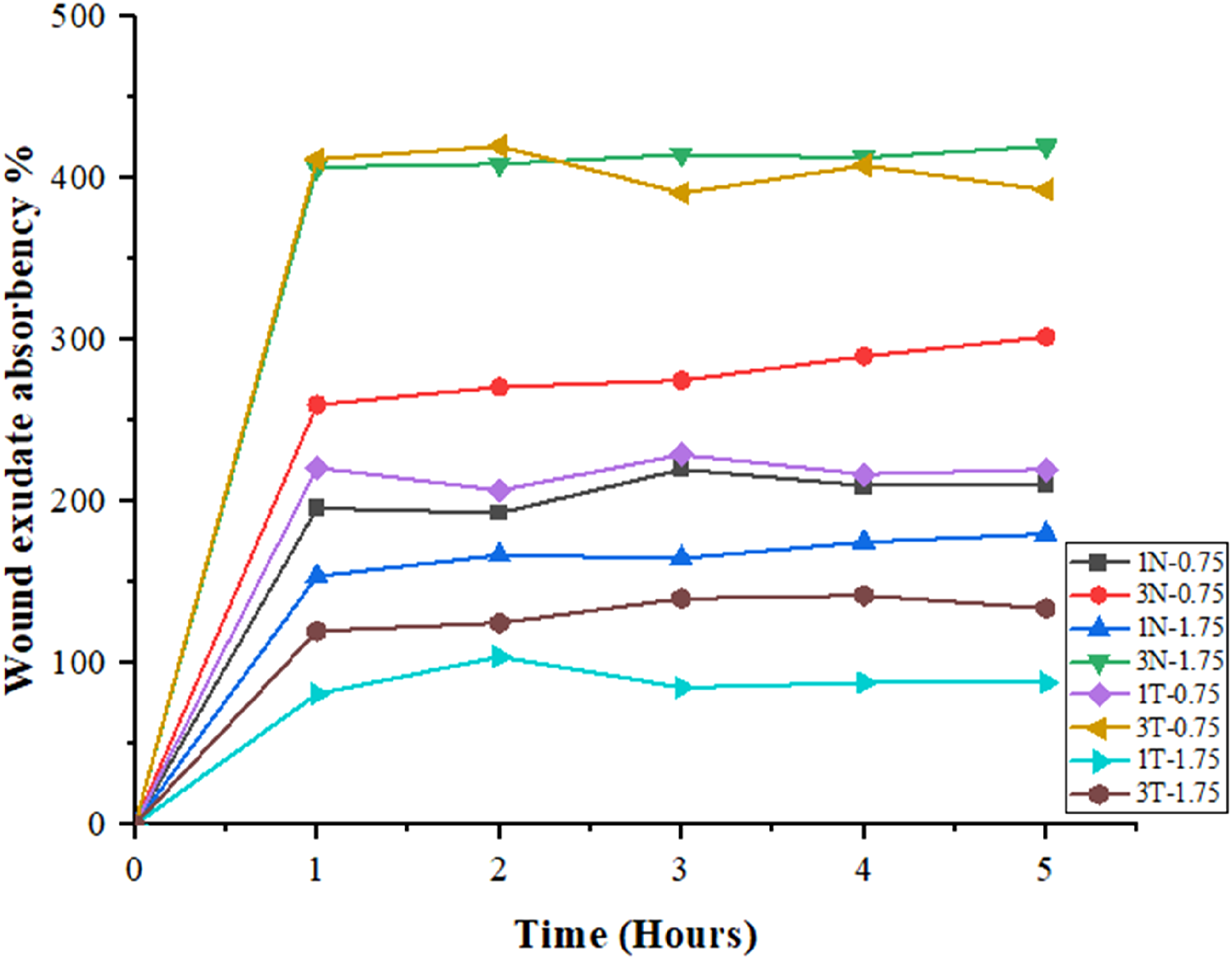
Sample 3N-0.75 (Neem 0.75% concentration, 150 GSM) is the best among all samples based on wound exudate absorbency. In comparison to all other samples, this one has the highest wound exudate absorption percentage (420%), demonstrating its exceptional capacity to hold and absorb fluids. Being very absorbent is essential for managing wounds effectively because it keeps the surrounding tissue moist and speeds up the healing process. Sample 3N-0.75 is the best due to its high absorbency, effective combination of hydrogel concentration and fabric GSM, and the beneficial properties of Neem, which collectively contribute to its superior performance in absorbing wound exudate.
Conclusion
This study examined several hydrogel concentrations (0.75%, 1.25%, and 1.75%) and nonwoven fabric GSMs (50, 100, and 150 GSM) to evaluate hydrogel composites reinforced with cotton nonwoven fabric treated with neem and turmeric. The findings revealed that neem-treated samples exhibited the highest wound exudate absorbency, reaching 420% at 150 GSM and a 1.75% hydrogel concentration. Turmeric-treated samples excelled in moisture control, with an OMMC of 0.45 at 150 GSM and a 1.75% hydrogel concentration. As the hydrogel concentration increased, air permeability decreased. At 1.75% hydrogel and 150 GSM, turmeric-treated samples had a higher air permeability (108 mm/sec) compared to neem-treated samples (62 mm/sec). Regarding mechanical properties, neem-treated samples demonstrated better tensile strength (32.05 N) than turmeric-treated samples (25.20 N), although the elongation of neem-treated samples was lower (12.20% vs 13.98%). Therefore, neem treatment is ideal for high absorbency and tensile strength, while turmeric treatment provides superior flexibility and moisture management, making each treatment suitable for different application requirements. Furthermore, the developed alginate/chitosan hydrogel composites reinforced with nonwoven textiles made from industrial cotton waste, and containing the natural antibacterial agents turmeric and neem, offer a novel approach to wound care. They not only utilize industrial cotton waste but also help reduce textile waste, a major environmental contaminant. The developed hydrogel successfully exhibits antibacterial activity against S. aureus, a common wound pathogen. However, its effectiveness against a broader range of microbes still needs to be explored for applications where such testing is essential.
Future Perspectives
Future studies could focus on optimizing the turmeric and neem-treated hydrogel composites for specific wound types like diabetic ulcers or pressure sores, enhancing moisture control and antibacterial properties. Additionally, incorporating other biodegradable materials or bioactive agents could improve the composites’ functionality. Research into multi-layered wound dressings and controlled drug release could further advance treatment options. Scaling up production for large-scale use could offer a sustainable and cost-effective solution to medical waste, aligning with global sustainability goals in healthcare.
Footnotes
Acknowledgments
The authors appreciate the support from Researchers Supporting Project number (RSPD2025R950), King Saud University, Riyadh, Saudi Arabia.
Declaration of Conflicting Interests
The author(s) declared no potential conflicts of interest with respect to the research, authorship, and/or publication of this article.
Funding
The author(s) disclosed receipt of the following financial support for the research, authorship, and/or publication of this article: This work was supported by the College of Dentistry, King Saud University RSPD2025R950.
