




Abstract
Linear density, as an important index of industrial filament production, has a vital impact on the performance of filament products, but there are few relevant studies. In order to further investigate the effect of the change of linear density on the performance of polyester filament in the process of industrial filament production. By replacing different spinnerets, five kinds of polyester full-stretch filament with different linear densities were prepared and named FDY. By testing and analyzing five kinds of polyester FDY filament, the differences in structure and properties of five kinds of FDY filament are discussed. The morphology, molecular structure, thermal and mechanical properties of five kinds of polyester FDY filaments were characterized by means of scanning electron microscopy, Fourier infrared spectroscopy, X-ray diffraction, differential scanning calorimetry, thermogravimetric analysis, filament color and mechanical properties. The results show that the molecular structure, crystallinity and orientation of polyester FDY filament are not affected by changing the linear density by changing the spinneret. In terms of heat, the melting point temperature and enthalpy of polyester FDY filament increase as linear density increases. In terms of optics, the lower the linear density of FDY, the lower the reflectivity of FDY. As the wavelength increases, the reflection of FDY decreases first and then increases. The reflectance is minimal when the wavelength is 670 nm. In terms of mechanical properties, the breaking strength and elongation at break of polyester FDY decrease with the decrease of linear density. In this study, it is found that changing the linear density by changing the spinneret has specific effects on the performance of polyester filament in various aspects, which has guiding significance for the analysis of influencing factors on the performance of industrial filament in the process of industrial production.
Introduction
Polyester filament for fully drawn yarn (FDY) is a fully stretched filament with high strength and high modulus. With the help of high spinning tension at high spinning speed, the fully drawn filament has a high orientation, which changes the structure of the molecular orientation arrangement inside the traditional polyester filament, and improves the shortcomings of poor dyeing and low softness of polyester. FDY fabrics feel smooth and soft, and are often used in weaving imitation silk fabrics. The dyeability of the fully drawn filament is better than that of the conventional polyester filament.1,2 With the increase of the output of polyester FDY filaments, various specifications of products have been developed and produced, but their performance are different, in order to improve the production efficiency, it is necessary to study the effect of linear density of fully drawn filament and the number of spinneret holes on the performance of the filament.3,4
Melt spinning has the advantages of fast spinning speed, high production efficiency and soft production conditions, and is widely used in industrial production.5 The FDY process has the characteristics of one-step forming and can be directly used for post-textile processing. Melt spinning method for the preparation of polyester FDY filament is more strict in the spinning process, the current research mainly focuses on spinning slice, filtration conditions, cooling conditions and other fields.6,7 FDY process after the production of polyester FDY filament is generally completed at the same time, the stretching temperature can improve the movement of the macromolecular chain, so that it is easier to arrange in the direction of external force, heat setting can improve the crystallization zone that has not been recrystallized during the stretching process and eliminate the residual stress in the molecule, and increase the thermal stability of the fiber.8–10 In the spinning process, due to mechanical factors during processing, the internal inhomogeneity of the polymer melt, external conditions and other reasons, the spinning process often appears unstable conditions, such as extrusion swelling, tensile resonance, melt rupture and other phenomena.11,12 For example, in the process of tensile resonance, when the tensile ratio exceeds the critical point, the mass of the tow will fluctuate, resulting in the fracture of the filament or the uneven thickness of the fiber.13,14 The addition of particle filler will reduce the tensile viscosity of melt, resulting in unstable uniaxial tensile flow, necking and tensile resonance phenomena in spinning process.
At present, there are few researches on the structural properties of recycled polyester yarn and filament with different linear densities. The performance difference of FDY filament with different filament density is analyzed in different textile products.15,16 Abdul Jabbar et al. studied the effect of polyester filament and elastic filament density on yarn strength, elongation, evenness and hair by analyzing the effect of polyester and spandex filament density on the physical and mechanical properties of twin-core cotton yarn. 17 Yan ping and Hong studied the effect of filament density on thermal comfort by analyzing the compression behavior and air permeability of WKSF.18,19 To explore the influence of filament density on the performance of various polyester filament and the stability of filament in different production lines is very important. On the basis of the above research, the effect of linear density change on the performance and stability of dark polyester filament was investigated. This paper mainly characterized the appearance structure, thermal properties and mechanical properties of five kinds of polyester FDY filament. It provides theoretical basis for developing differentiated products in different fields of fully drawn filament.
Materials and methods
Materials
Five kinds of polyester FDY filaments of different specifications were used, named as FDY1, FDY2, FDY3, FDY4 and FDY5 respectively. The picture of five kinds of polyester FDY filament is shown in Figure 1, and the specification and process sheet are shown in Table 1. The number of spinneret holes represents the number of spinneret holes on the spinneret and is numerically equal to the number of fibers in the filament bundle. Box temperature is the air temperature in the production box. Oil content of chemical fiber refers to the percentage of dry weight of oil agent on chemical fiber to dry weight of oil fiber. The winding speed refers to the winding length of the fiber per unit time. Sample of polyester FDY filament. Process sheet for five kinds of polyester FDY filament.

Methods
Five different specifications of polyester FDY filament are manufactured by melt spinning machine, the production machine is shown in Figure 2. Melt spinning machine.
Figure 3 shows the production flow diagram of polyester FDY. It is convenient to control the linear density of polyester FDY directly by replacing spinneret than by controlling the external environment, melt flow rate and drafting mode. The size of the spinneret holes on the spinneret plate is different, and the fineness and linear density of the polyester FDY produced are also different. Production flow chart of fully drawn polyester filament.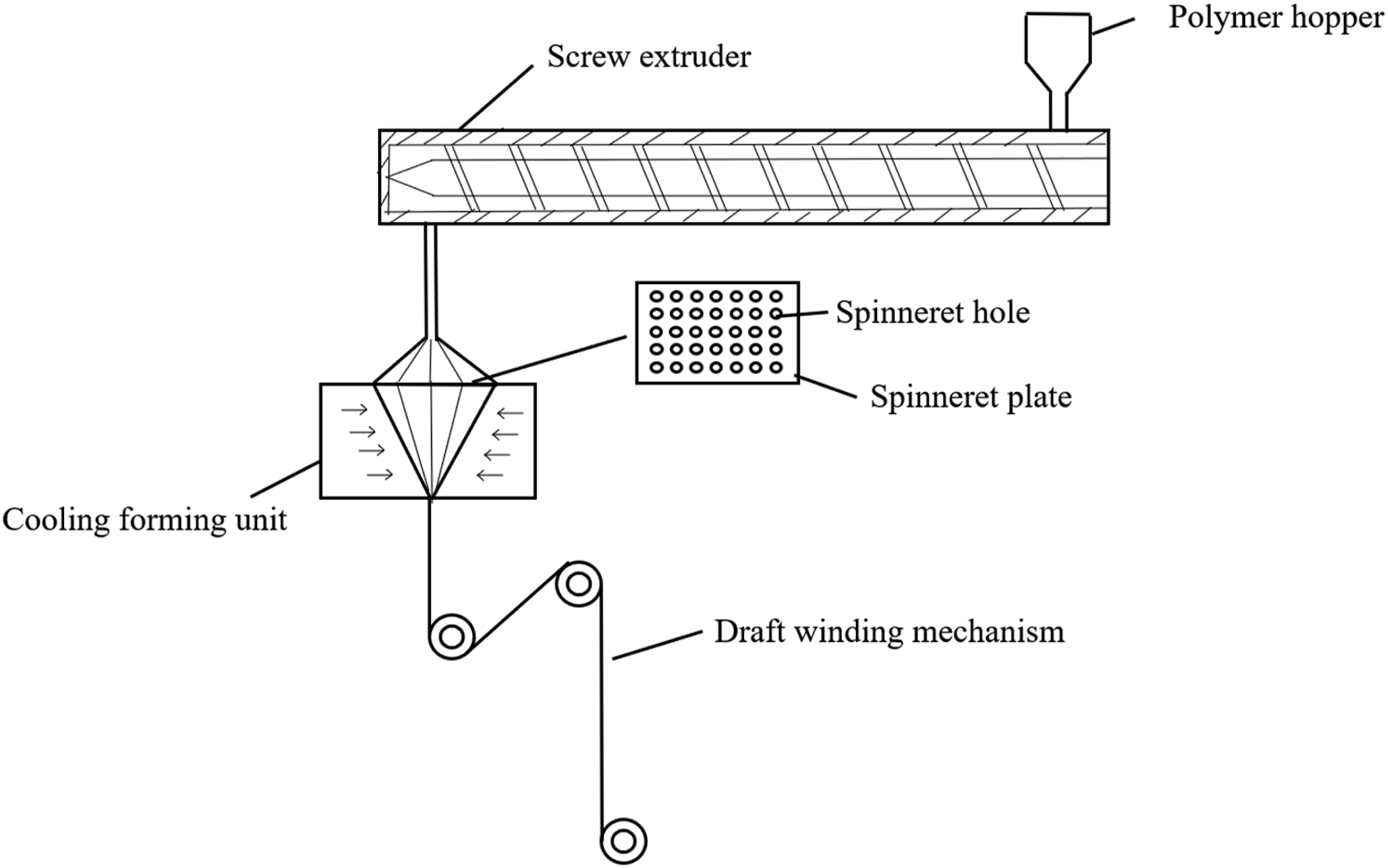
Characterization and measurement
Surface morphology analysis
The longitudinal surface morphology and cross section morphology of the fibers were observed by SU8010 field emission scanning electron microscope (SEM) of Hitachi. The Y172 Ha slicer of Changzhou Textile Instrument Factory was used to make the sample for cross section observation. The magnification of longitudinal surface observation is 1000 times, and the magnification of cross section morphology observation is 3000 times.
Molecular structure analysis and orientation and crystallinity analysis
The functional groups, chemical bonds and molecular structures of FDY were observed by Thermo Fisher’s Nicolet6700 infrared microspectral imager. The spectrum range of FDY was 650∼4000 cm−1 by ATR method. The samples were powdered fibers.
D8 X-ray diffractometer of Bruker was used to determine the crystallinity of polyester filament. The test sample was a fiber bundle of about 30 mm in length and about 3 mm directly. The orientation of polyester filament was measured by 18 KW rotating target X-ray diffractometer of Rigaku Corporation.
Thermal stability analysis
The DSC8500 differential scanning calorimeter of PE Company of USA and TGA8000 thermogravimetric analyzer of NETZSCH Company of Germany were used to test the thermal performance. No special requirements for test samples.
Thermal performance test. The experiment was carried out with DSC8500 differential scanning calorimeter under N2 atmosphere. The temperature was raised from 30 to 290°C at 10°C/min. After holding for 3 min, the temperature was lowered to 30°C at 10°C/min, and then the temperature was raised to 290°C at 10°C/min. TGA8000 thermogravimetric analyzer is used for thermogravimetric analysis. The test conditions were carried out in N2 atmosphere and the temperature was raised from 30 to 800°C at a rate of 10°C/min.
Color analysis
The color analysis of polyester FDY filament was performed by Datta’s Datacolor850 color matching instrument with wavelength range of 360-700 nm, wavelength resolution of 2 nm, reporting interval of 10 nm and luminosity range of 0%–200%.
Mechanical analysis
The tensile property of polyester filament was tested by YG061F electronic single fiber strength meter of Laizhou Electronic Instrument Co., LTD, and the tensile property of polyester single fiber was tested by XQ-1 fiber strength and elongation meter of Shanghai New Fiber Instrument Co., LTD. The dynamic friction coefficient tester LFY-110 developed by Shandong Textile Science Research Institute was used to test the dynamic friction of filament. The friction coefficient of single fiber was measured by XCF-1A fiber friction coefficient tester of Shanghai New Fiber Instrument Company.
Mechanical properties test. Filament tensile test refer to GB/T14344-2008 “Test method for Tensile properties of chemical fiber filament”, tensile interval is 500 mm, tensile rate is 500 mm/min, and 10 samples of each fiber are tested. In the fiber tensile test, refer to GB/T14337-2022 “Test Method for Tensile Properties of Chemical Fiber Short Fibers”, the pre-applied tension is 0.15 cN/dtex, the tensile speed/moving distance of the dynamic clamp per minute (expressed as a percentage of the nominal separation length) is 100%, the nominal separation length is 20 mm, and 50 fibers are tested for each sample. The test speed of filament dynamic friction test is 100 m/min, the test envelope Angle is 180°, the test speed is 5 s, the test environment is 20°C, and the ambient humidity is 65%, and 10 samples of each filament are tested. The friction test of single dimension adopts the mode of friction roller rotation. The friction roller is made of aluminum alloy, the tension pinch load is 0.2 cN, the friction roller speed is 30 r/min, the test time is 15 s, and 20 effective measurements are made for each fiber.
Results and discussion
Surface morphology analysis
As shown in Figure S1 of Appendix, the transverse and longitudinal surface morphology of five kinds of FDY polyester filaments are investigated, there is no significant difference in the cross section morphology for the five FDY filaments. Their cross-sectional shapes are close and have no obvious porous or defects in the inner structure. It shows that production lines are well to spin these filaments. In addtion, the longitudinal surfaces of the FDY samples are smooth and there are no obvious defects in the whole. There is no obvious difference in the microscopic morphology of the transverse and longitudinal sections of the five FDY filaments, and the effects of the number of spinerets can be neglected, which indicates that the spinnability process parameters are well set, which indicates that the quality of the fibers is stable during the spinning process.
The infrared spectra of FDY polyester
In order to explore the structure and composition of polyester FDY filament, infrared spectroscopies of FDY filaments are analyzed. Take FDY1 as an example, the specific data is shown in Figure S2 of Appendix. The five FDY polyester filaments are essential, so their functional groups are the same. As shown in Figure S2, the infrared spectrogram shows the functional group and chemical bond composition of FDY filaments. 1716 cm−1 is the stretching vibration peak of C = O, 1248 cm−1, 1099 cm−1, 1018 cm−1 is the stretching vibration absorption band of C-O, 1409.53 cm−1, 1340 cm−1 is the skeleton vibration of benzene ring. 725 cm−1 is caused by in-plane swing of CH2 on the para-substituted benzene ring. These peaks are typical characters of polyester, and there are no shoulder peaks. It shows that change of spinneret has no effect on polyester components for introducing new groups.
Degree of order and orientation crystallinity
In order to explore whether the orientation of the five FDY filaments is different, the crystallinity of the five FDY filaments is analyzed by X-ray diffraction method, as seen in Figure 4. The experimental results are listed in Table 2. XRD spectra of crystallinity of five kinds of polyester FDY filament. Orientation and crystallinity of polyester FDY.

It can be seen from Figure 4 that the sharpness of the peak and the diffraction intensity in the X-ray diffraction pattern can be used to analyze the crystallinity of a substance, and the sharper the peak and the larger the diffraction intensity indicate the greater the crystallinity. JADE software was used to analyze and fit the spectrum, and the intensity of the amorphous peak was obtained. Then, the corresponding curve above the peak was fitted to be stable, and the crystallinity of five kinds of FDY polyester filament was obtained. It can be seen from Table 2 that among the five kinds of polyester FDY, FDY4 has the lowest orientation and the highest crystallinity, while the other four kinds of polyester FDY have little difference. This indicates that FDY4 contains more regularly arranged crystal regions, but the orientation of the amorphous region and the average orientation of the fiber macromolecules along the fiber axis are lower.
Thermal properties of five kinds of FDY filaments
DSC results of five kinds of polyester FDY filament.


DSC curves of five kinds of polyester FDY filament.
TG results of five kinds of polyester FDY filament.

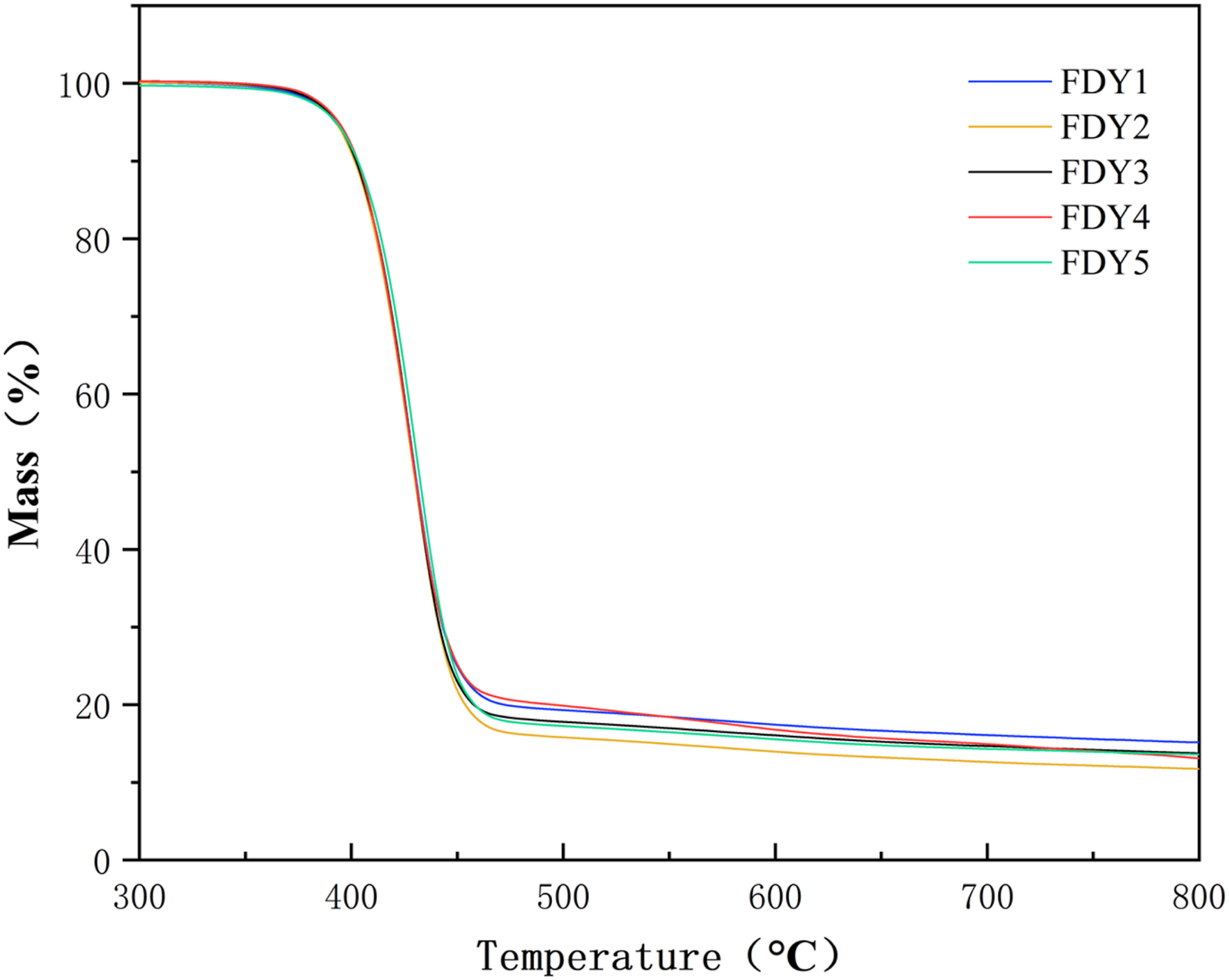
TG curves of five kinds of polyester FDY filament.
As can be seen from Table 3 and Figure 5, the melting temperature of the five FDY polyester filaments is slightly different. The melting enthalpy of FDY5 was the highest, 41.759 J·g−1, and the melting enthalpy of the other four FDY polyester filaments was around 38 J·g−1. The melting temperature of FDY4 polyester filament is the highest, 253.88°C, and that of FDY3 polyester filament is the lowest, 247.33°C. The melting temperature of the other three FDY polyester filaments is around 250°C. It can be explained that FDY4 has the highest crystallinity and has relatively high melting temperature.
It can be seen from Table 4 and Figure 6 that there are differences in the thermal stability of the five FDY polyester filaments. The weight loss temperature of FDY4 and FDY3 polyester filaments is 394.045°C and 393.146°C respectively, while the weight loss temperature of the other three FDY polyester filaments is around 392°C. At 799.7°C, the mass residue rate of FDY1 polyester filament is the highest, about 15.14%; and that of FDY2 polyester filament is the lowest, about 11.74%, indicating that under the condition of the same linear density of single fiber, the more the number of single fibers composed of FDY filament, the worse the thermal stability of polyester FDY filament. It may be explained that in the polyester production line, the greater the number of single fibers that make up the polyester FDY filament, the greater the possibility of surface friction between the single fibers, the more damage to the fiber surface, resulting in poor thermal stability of the filament.
Colors of FDY polyester filaments
Color analysis of standard samples.

Color analysis of five FDY samples.

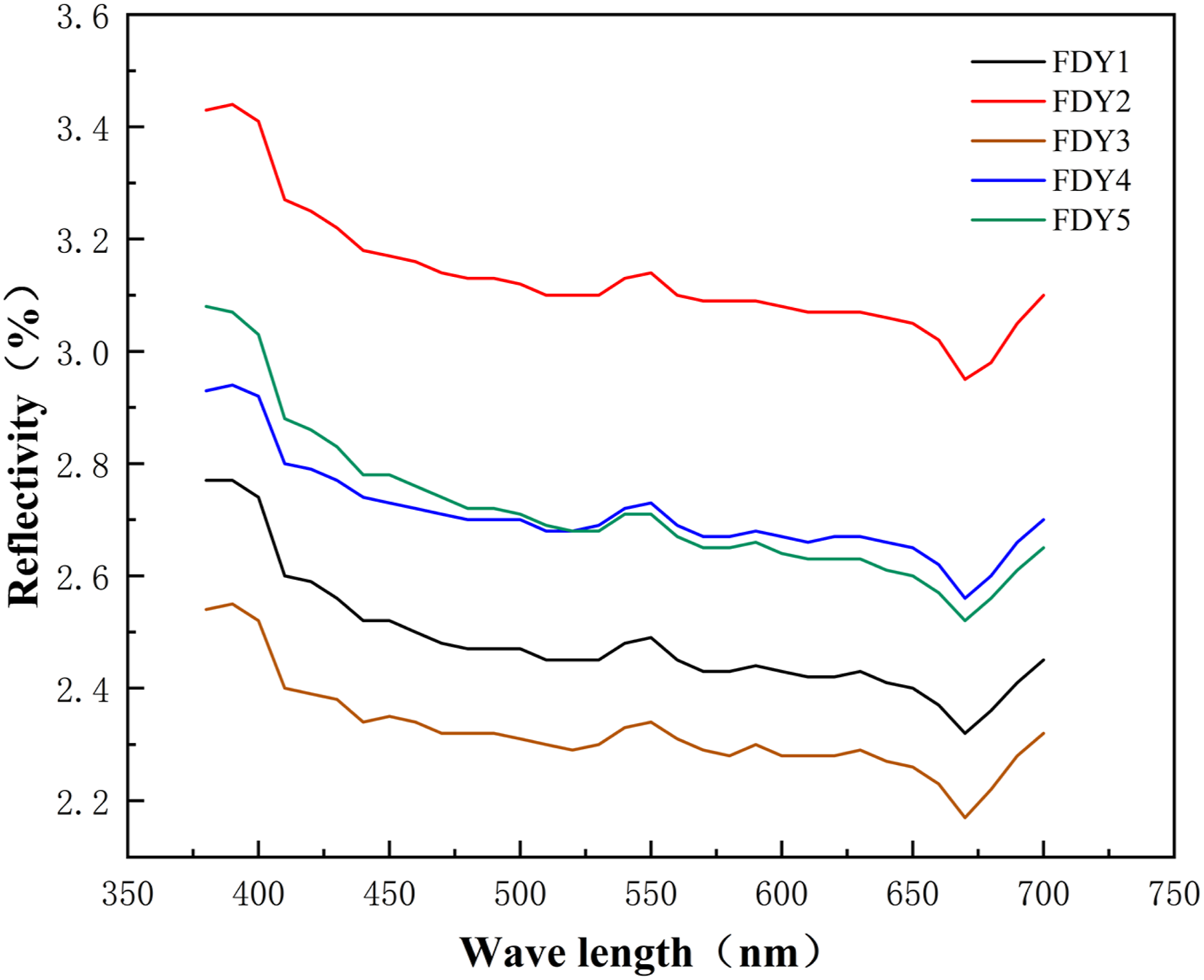
Reflectance values at different wavelengths.
As can be seen from Tables 5 and 6, among the five kinds of polyester FDY filament, FDY3 has the largest K/S value and the deepest color; FDY1 has the smallest K/S value and the lightest color. In the CIELAB color space, the brightness sensation of the color is represented by L, black is at the bottom corresponding to L = 0, and white is brightest at the top corresponding to L = 100. Axis A and axis B jointly represent the characteristics of color, the positive direction of axis A represents the change of red, the negative direction of axis A represents the change of green; The positive direction of the B axis represents the change in yellow, and the negative direction of the B axis represents the change in blue. The values of A and B represent the color component of the color perception, when the values of A and B are 0, the saturation of the color is 0. Table 6 shows that CIEL value from big value to small value is FDY1 followed by FDY4, FDY5, FDY2 and FDY3, and the difference is not significant, in addition, FDY1, FDY4, FDY5, FDY2, FDY3, black level also increases accordingly, the K/S value in the table also proves this point. Of course, according to the experimental data, the color depth of FDY filament is not strictly arranged in accordance with the size of the linear density, but is related to many factors such as production conditions, temperature, humidity and so on.
As can be seen from Figure 7, in the range of 380-700 nm wavelength, with the increase of wavelength, the reflectance value of the five kinds of polyester FDY filament decreases firstly and then increases. The reflectance is minimal when the wavelength is 670 nm. On the whole, the reflectance values of the five kinds of polyester FDY filament from large to small are: FDY2, FDY5, FDY4, FDY1, FDY3. The lower the linear density of polyester filament, the lower the reflectance value of polyester FDY filament.
Mechanical properties of five kinds of FDY polyester filaments
Mechanical properties of five kinds of polyester FDY filament.

Mechanical properties of five kinds of polyester FDY single fiber.

Dynamic friction of FDY filament.

Single fiber friction of FDY filament.

It can be seen from Table 7 that the breaking strength of five kinds of polyester filament is FDY2, FDY5, FDY4, FDY1 and FDY3 in descending order. The elongation at break was ranked in descending order as FDY5, FDY2, FDY4, FDY1 and FDY3. According to this, the filament density of FDY5, FDY4, FDY1 and FDY3 is reduced, which can be divided into 73 dtex, 61 dtex, 55 dtex and 45 dtex. The number of fiber roots composed of the filament is 24. The breaking strength and breaking elongation of the four filaments gradually decrease with the decrease of the linear density.
As can be seen from Table 8, the breaking strength of the five kinds of polyester single fibers is respectively FDY5, FDY4, FDY2, FDY1 and FDY3. As the linear density of the single fiber decreases, the breaking strength of the polyester single fiber decreases. Overall, the fracture strength of the five fibers did not differ numerically, except that the fracture strength of FDY3 single fiber was slightly lower, and all four fibers remained at the same level. Among the five kinds of polyester single fiber, FDY4 single fiber has the highest breaking strength and elongation at break, and FDY3 single fiber has the lowest. FDY4 single fiber has the best tensile properties and strong resistance to external damage. The factors affecting the tensile properties of fiber can be divided into external factors and internal factors, when the instrument test conditions and environmental factors remain unchanged, mainly the role of internal factors such as fiber structure. The fracture strength of fiber is related to the crystallinity of fiber. The higher the crystallinity of the fiber, the more regions the fiber is arranged neatly, and the strength and modulus of the crystalline region of the fiber are relatively high. Therefore, the larger the crystalline region, the higher the crystallinity of the fiber, and the fracture strength of the fiber will increase in different degrees. The factors affecting the tensile properties of the fiber are also related to the size and distribution of the grain. When the grain size is large or the crystal zone is continuous, the fiber strength increases obviously.
As can be seen from Table 9, among the five kinds of FDY polyester filament, the dynamic friction coefficient of FDY2 polyester filament is the largest, which is 0.89, and the friction coefficient of the other four FDY polyester filaments is around 0.57. The dynamic friction coefficient of FDY2 polyester filament is the largest, mainly because the fiber number of FDY2 polyester filament is 36, while the fiber number of the other four FDY polyester filament is 24. As can be seen from Table 10, regarding the static friction force and static friction factor of polyester FDY single fiber, FDY2 single fiber is the largest, and FDY1 single fiber is the smallest. As for the dynamic friction and friction factor of polyester FDY single fiber, FDY3 single fiber is the largest and FDY1 single fiber is the smallest. The dynamic friction results of polyester FDY filament show that compared with the linear density of fiber, the number of fiber roots in the filament has a significant effect on the friction properties of the filament. Even if the fiber density is different and the fiber number is the same, the dynamic friction properties of polyester filament have no obvious change. When the number of fibers is different, the dynamic friction coefficient of the filament increases with the increase of the number of fibers.
Conclusions
Because the production raw materials of polyester filament enterprises are fixed, mainly by changing the size of the linear density to produce different specifications of products, so the linear density difference of the filament has important research significance. In order to better meet the needs of industrial filament production, the effects of different linear densities on the properties of polyester filament were studied by replacing spinneret. Five polyester FDY filaments with various linear density and numbers mainly used in the market were chosen to be analyzed, this paper designs the corresponding spinneret holes and produces the corresponding filament, and then studies the influence of the number and linear density of spinneret holes on the fiber properties. Through a series of experiments on FDY filament produced by different specifications spinneret, it is found that the stability of FDY filament produced by changing spinneret has no obvious effect. By studying the microstructure, molecular structure, crystal structure, thermal properties, color analysis and mechanical properties of polyester FDY filament with different linear densities, the following conclusions are obtained. The appearance and morphology of the five kinds of polyester FDY filament have no obvious difference, the longitudinal surface and the transverse section are smooth, and all have good spinnability. Infrared spectrum analysis shows that polyester filament has C=O, C-O, CH2, benzene ring and other functional groups. XRD results show that the orientation of FDY4 is the lowest and the crystallinity is the highest, and the orientation of the other four FDY polyesters is not different. It shows that the order degree of spinneret may be affected by complex factors. There is no obvious linear relationship between crystallinity and fiber orientation and linear density. The thermal properties show that the melting temperature and enthalpy of the fibers are higher when the on-line density is the same. In terms of color, there are slight differences in the color depth of the five FDY filaments. The CIEA value is different from the K/S value. The lower the linear density of FDY, the lower the reflectivity value of FDY filaments. With the increase of wavelength, the reflection of FDY decreases first and then increases. The reflectance is minimal when the wavelength is 670 nm. The effect of fiber density on fiber color is nonlinear. The mechanical properties show that the fracture strength and elongation of polyester FDY decrease with the decrease of linear density when the number of fiber roots is the same. The fracture strength of single fiber is greater than that of multiple filaments. In addition to the external environmental conditions, the main factors affecting the mechanical properties of fibers are internal factors such as the internal structure of fibers. The higher the crystallinity of the fiber, the larger the grain size or the more continuous phases in the crystallization zone, the better the strength of the fiber. The influence of the linear density difference on the properties of black polyester FDY filament is discussed. It has guiding significance for improving the production and quality of industrial filament products. With the further development of the research, it can provide a theoretical basis for further development of differentiated filament products with different characteristics.
Footnotes
Declaration of conflicting interests
The author(s) declared no potential conflicts of interest with respect to the research, authorship, and/or publication of this article.
Funding
The author(s) disclosed receipt of the following financial support for the research, authorship, and/or publication of this article: This work is jointly supported by Major scientific and technologic project of Fuzhou Science and Technology Project Plan (2022-ZD-007), supported by the Key Research and Development Program of Science and Technology Bureau of Ningbo City (2023Z082), by Natural Science Foundation Project of Shanghai “science and technology innovation action plan”(22ZR1400500), and supported by National Natural Science Foundation of China(52173218), by Jiangxi Provincial Administration for Market Regulation (GSJK202221).
