




Abstract
With the popularity of sports and fitness, the chances of sports injuries for people have increased. Orthopedic sutures play an important role in the treatment of musculoskeletal disorders. Ultra-high molecular weight polyethylene (UHMWPE) yarns, with excellent tensile, compressive, impact strength, abrasion resistance, and chemical stability, are competitive materials for the preparation of sutures, but the tensile properties of sutures in knotted and wet environments are more informative in practical applications. In this paper, the effects of different structural parameters, knotting methods, and environments on the physical properties of nonabsorbable UHMWPE sutures, including appearance, breaking force, and breaking elongation, were investigated. The results showed that sutures with circular cross-sections had the best tensile properties; the loop knot gave the suture the greatest breaking strength, but also the smallest elongation, and the more complex the knot, the greater the elongation of the suture; dry and wet conditions have a significant effect on the mechanical properties of sutures. It is expected that this study will provide theoretical support for the optimal design of sutures and provide a basis for doctors to choose the knotting method.
Keywords
Introduction
Since people are becoming aware of their physical health, sports and exercise are gaining traction in their lives. Consequently, as the frequency of exercise increases, people are more likely to suffer from musculoskeletal disorders. In addition, athletes are also prone to injuries during training or competition, and treatments are obviously even more important to their careers and lives. These patients need to be treated with orthopedic surgery. In orthopedic surgery, sutures, playing the role of connecting damaged skeletal or soft tissues, are of great research value. And the way the suture is tied in the process affects how it works. After the surgery, orthopedic sutures are long-lasting in the human body. Normal human movements have an impact on the ligaments and meniscus. The same thing happens to the sutures, so orthopedic sutures should have excellent mechanical properties. Overall, orthopedic sutures have, firstly, sufficient strength to resist forces, good knot security, and handling characteristics during the critical healing period, and secondly, they can improve tissue regeneration and reduce foreign body reactions.1–3 Medical sutures can be divided into absorbable and non-absorbable, natural and synthetic, monofilament, and multifilament based on different categories. Absorbable sutures are able to slowly fuse with the tissue after suturing, but their mechanical strength is damaged during degradation. Non-absorbable sutures do not degrade in the body and have a longer support time. Currently commonly used non-absorbable sutures are usually monofilaments or multifilaments composed of polyester (PET), polypropylene (PP), polyethylene (PE), polyamide (PA), etc. The above materials play an important role in surgery due to their excellent mechanical properties.4,5
The ideal suture meets the physical, mechanical, operating, and biological requirements.6,7 UHMWPE, with its excellent comprehensive performance, including outstanding mechanical properties, impact resistance, wear resistance, and chemical stability, 8 is the non-absorbable suture of choice for orthopedic surgeons today. 9 Because the tensile strength of absorbable sutures decreases rapidly as the suture degrades, non-absorbable sutures are recommended for these procedures where postoperative strength needs to be maintained for a relatively long period of time. 10 Kenichi et al. found that the fracture healing effect was similar in both groups of UHMWPE and soft steel cable at 6 months postoperatively by pull-out test and postoperative histologic study in the Beagle dog osteotomy model. 11 Besides, the material-induced tissue reactions, including peripheral inflammatory reaction and granulation tissue generation, were weaker in the UHMWPE group than in the soft steel cable group, showing the potential of UHMWPE in osteosynthesis. Onur et al used in vitro bovine medial meniscus to make an anterior-posterior vertical 2 cm incision and then did biomechanical testing after closing it horizontally with different #2 sutures, four of which were pure UHMWPE, UHMWPE +5 Polyester, UHMWPE + PDS, and pure polyester. It was found that the maximum destructive load of pure UHMWPE and UHMWPE + PDS was higher than that of UHMWPE + Polyester and pure polyester. 12
Physicians need to select suture materials and knotting methods in relation to the handling characteristics of the suture and the wound management. Several previous studies have evaluated the mechanical properties of different commercial UHMWPE sutures. Ultimate damage loads were determined in load-destruction tests performed at single loading speeds according to USP standards.13–16 Tensile experiments were carried out under specified loading conditions, and the knot safety of different raw materials as well as different knotting methods was investigated on the basis of knot strength and sliding resistance.17–19 Although newer sutures containing UHMWPE are stronger than ordinary polyester sutures, they tend to slip, so caution should be exercised with regard to the knot security of high-strength sutures. 20 It is found that most of the existing studies have focused on the comparison of the mechanical properties of UHMWPE and other materials and the knot security of the sutures, but the mechanical effects of the knotting method and wet state on the UHMWPE sutures have yet to be investigated. As that sutures are used in the environment of human body fluids that has an effect on the tensile properties of sutures. For example, in the study of Earle et al., there was a significant difference between the wet and dry strengths of UHMWPE for different knotting styles. 21 With this in mind, it is necessary to study the tensile properties of sutures in the wet state and different knotting methods.
In this paper, we have studied and compared the effects of different braided structural parameters, knotting methods, and environments (wet or dry) on the tensile breaking force and elongation at the break of the suture to help physicians optimize tissue fixation, making patient care more effective. It was found that sutures with hollow structures and round cross-sections had better mechanical properties than those with solid structures or with flat cross-sections; among the five knotting styles (loop knot, single knot, square knot, surgical knot, and triple knot), the loop knot gave the suture the greatest breaking strength and the smallest elongation. Moreover, the increase in the complexity of the knot increased the fracture elongation of the suture. Finally, dry and wet conditions have a significant effect on the results of mechanical properties testing of sutures.
Materials and methods
Materials
UHMWPE (100 D, 150 D, 200 D) multifilaments and polyester (600 D) multifilaments (Zhejiang Qianxilong Special Fiber Co., LTD, Zhejiang, China). The sutures were braided on a medical suture braiding machine (Xuzhou Henghui Braiding Machine Co., LTD, Jiangsu, China).
Preparation
Select different types of braiding machines according to the number of strands of the suture. Sample 2#solid and sample 4#hollow were braided on KBL-90-12-1 medical suture braiding machine, while sample 5#circle and sample 1.5 mm flat were manufactured on KBL-90-16-1 (Figure 1) and KBL-90-9-1 medical suture braiding machine respectively. Four sutures with different structural parameters were braided (Table 1). As mentioned earlier, both sample 2#solid and sample 4#hollow were 12-strand round sutures, but sample 2#solid, with a polyester core, was solid and sample 4#hollow was hollow. Sample 5#circle and sample 1.5 mm flat were designed to compare the tensile properties of sutures with round and flat cross sections. Sample 5#circle was a 16-strand round suture and sample 1.5 mm flat was a 9-strand flat cross-section that was 1.5 mm wide. Medical suture braiding machine (KBL 90-16-1). The structural parameters of the sutures.

Characterizations
All tests were performed under standard ambient conditions with a temperature of 20 ± 3°C and a relative humidity of 60 ± 3°C except tensile tests of sutures in wet state.
Basic parameter measurement
The diameter and the braid angle of the braided sutures were measured by taking images of them with an optical microscope (RX20-9108, Runxing Optical Instrument Co., Ltd, Shenzhen, Guangdong, China) and analyzing them. All the measurements were taken 10 times and were averaged.
Fourier transform infrared spectroscopy (FTIR)
Fourier transform infrared spectroscopy (FTIR) of UHMWPE monofilament spectra was acquired using a spectrometer (Nicolet iS10, Thermo Fisher Scientific (China) Co., Ltd, USA) over the range of 500-4000 cm−1, The scanning resolution is 0.05 cm−1.
Tensile test
Knotting tensile test
MTS EXCEDE E43 (MTS Systems Co., Ltd, Guangzhou, Guangdong, China) was used to test the tensile properties of the sutures to obtain the tensile load-displacement curves of the sutures (Figure 2). This experiment was used to determine the breaking force and displacement value at the break of the sutures. According to the standard set by YY 0167-2020 “Non-absorbable Surgical Sutures”, the samples were stretched at a constant speed of 200 mm/min until they broke, the distance between the upper and lower grips was 100 mm, the pre-tension was 2 CN, and all the samples were tested for five times and their average values were taken. MTS EXCEDE E43 tensile testing machine.
In this paper, the effect of different knotting styles on the breaking force and displacement value at the break of the sutures was investigated. The knotting styles, including loop knot, single knot, square knot, surgical knot, and triple knot, as shown in Figure 3, are getting increasingly complicated from left to right. Five knotting methods.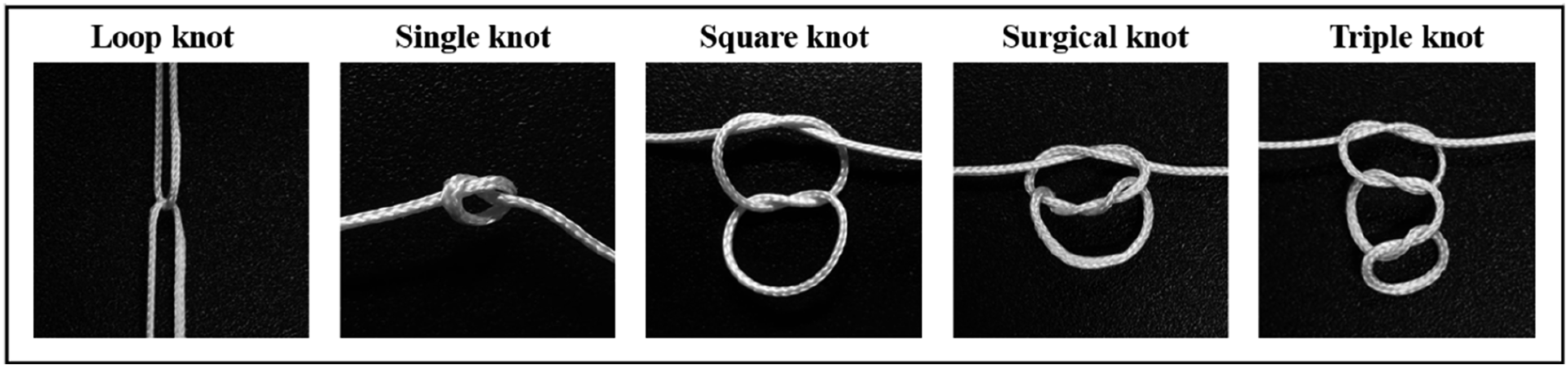
Wet state tensile test
Since the pH of human body fluids is maintained at 7.4 in the normal state,
22
PBS buffer was used as the wetting environment in the wet state experiments in order to approximate the environment where the sutures stay in the body. Tensile tests of the sutures in the wet state were performed by submerging the sutures in airtight bottles containing PBS buffer solution to prevent evaporation of water (Figure 4), and then leaving them at constant temperature (20 ± 3°C) for 36 h and 96 h, respectively. The tensile test method and parameters are the same as in 2.4.1. Schematic representation of a suture in PBS buffer solution.
Results and discussion
Basic parameters of sutures
As shown in Figure 5, the braiding structure of the suture was regular (1/1), which made the surface of the suture smoother.
23
Different monofilament colors provided suture lengths within each pitch. The differences in the fineness of the raw material, the number of braided strands, and the pitch length of the four samples resulted in differences in the diameter and the braiding angle. The diameters and braiding angles of the four samples measured are shown in Table 2. Optical microscope (OM) image of the sutures. The basic parameters of sutures.

FTIR analysis
The FTIR spectra of UHMWPE is shown in Figure 6. The four characteristic peaks of UHMWPE are visible. The sharp peak at 2915 cm−1 was assigned to the asymmetric stretching vibration of the –CH2– group, and the significant peak at 2846 cm−1 was due to the symmetric stretching vibrations of methylene. The smaller characteristic absorption of bending vibration and rocking vibration of methylene appeared at 1472 cm−1 and 718 cm−1 respectively. Overall, the FTIR spectrogram shows only the presence of methylene groups, which verifies that UHMWPE is a collection of methylene groups. UHMWPE has a molecular weight of 3 to 6 million, resulting in very long molecular chains that are more ductile and stronger than ordinary polyethylene. At the same time, as a collection of methylene groups, it has an orderly arrangement between the molecular chains. As a result, UHMWPE has excellent mechanical properties. The appearance of the sutures.
Tensile properties
Once an implant is placed in the body, it is required to support body tissues, resist internal stresses, and support tissue growth. Since sutures are connected to part of the body tissues, the tensile fracture properties are an important point in evaluating the mechanical properties of sutures. The main objective of this study is to comparatively analyze the effect of solid and hollow, circle and flat sutures and different knotting methods on mechanical properties. Additionally, considering that sutures function in the environment of human body fluids, it is necessary to compare the tensile properties of sutures in the wet and dry states.
Tensile properties of different structural parameters
The tensile performance curves of solid and hollow, circle, and flat sutures under different knotting methods illustrated the differences in the types of sutures with different material compositions. The composition of the fibers and the structure of the suture attach great importance to the tensile properties of the suture. Since the breaking strength curves of the samples behave similarly under various knotting methods, sample 2#solid and sample 4#hollow with a single knot and a surgical knot and sample 5#circle and sample 1.5 mm flat with a loop knot and a surgical knot are taken as examples here, as shown in Figure 7. It could be noticed that most of the tensile performance curves have a similar pattern: as the elongation increases, the breaking strength increases faster. At the very beginning of stretching, there is slippage between the filaments of each strand of the suture, between the monofilaments, and more microscopically, between the molecular chains.
24
As the molecular weights of the misaligned slips straighten and parallelize, new subvalent bonds are formed between the molecular chains. Therefore, as the displacement increases, the growth rate of tensile strength tends to be slow and then fast. Nevertheless, sample 5#circle with a loop knot (Figure (7(c)) showed an obvious difference: its elongation curve has two peaks, with the increase of displacement its force first increased and then decreased slightly and then increased again until the suture disintegrated. This could be attributed to the filament at the edge of sample 5#circle that was prone to stress concentration, so it will break first, resulting in a small decrease in force. Force-displacement curves of sutures with different structural parameters. (a) Sample 2#solid and sample 4#hollow with a single knot. (b) Sample 2#solid and sample 4#hollow with a surgical knot. (c) Sample #5circle and sample 1.5 mm flat with a loop knot. (d) Sample #5circle and sample 1.5 mm flat with a surgical knot.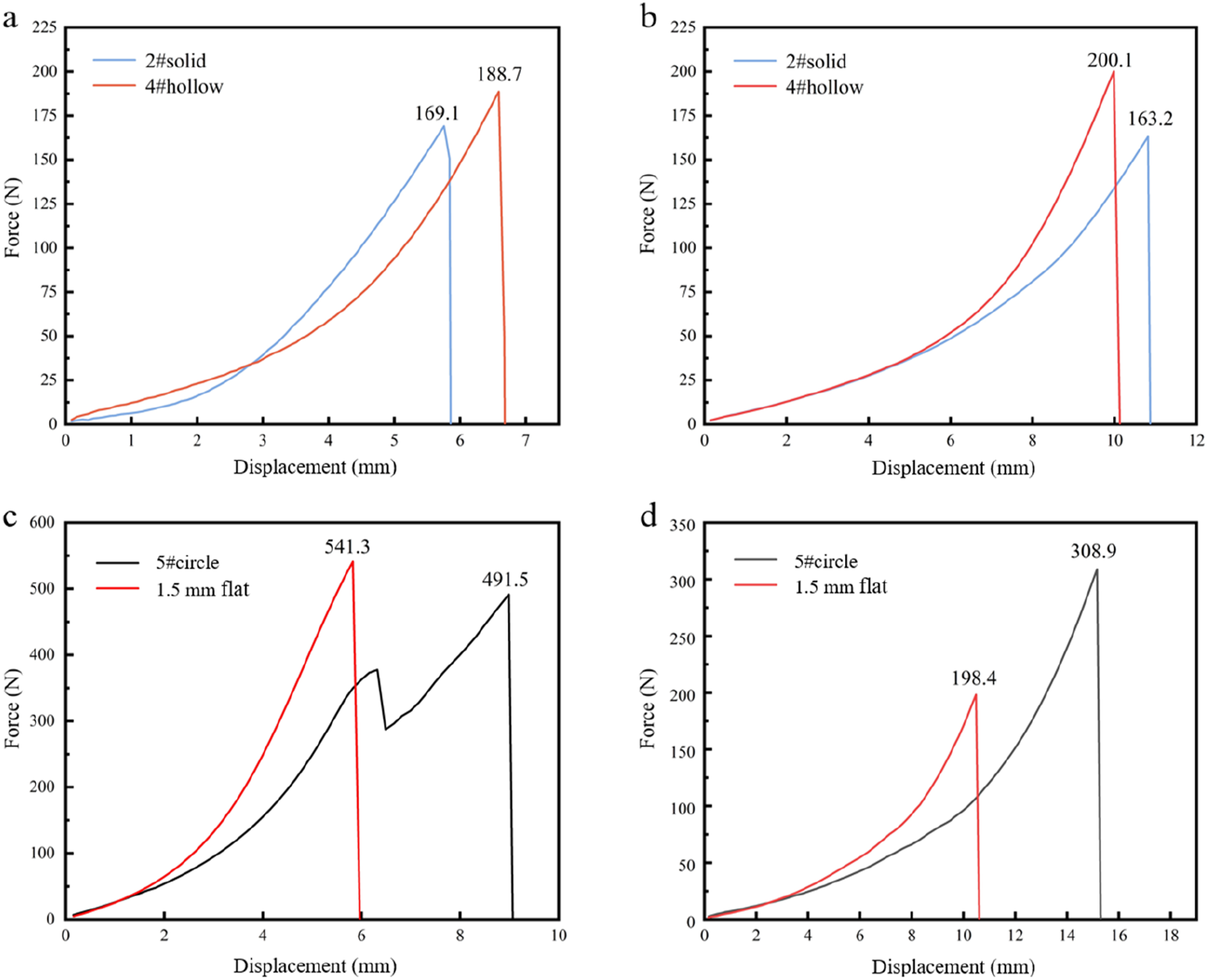
The breaking forces (N) and the displacement values (mm) at each rupture of the sutures.


The failure force or displacement of sample sutures with different knotting methods. (a) The failure forces of sample 2#solid and sample 4#hollow. (b) The failure displacements of sample 2#solid and sample 4#hollow. (c) The failure forces of sample #5circle and sample 1.5 mm flat. (d) The failure displacements of sample #5circle and sample 1.5 mm flat.
In the next tests, according to Figure 8(c), sample 5#circle exhibited significantly better breaking forces than sample 1.5 mm flat except at the loop knot. When a suture is tied in a loop knot, the area of contact between the two sutures is proportional to their diameter. Obviously, sample 5#circle has a smaller diameter, so it is prone to stress concentration than sample 1.5 mm flat when tying a loop knot, which results in its lower strength. Moreover, sample 5#circle presented considerably higher displacement values than sample 1.5 mm flat (Figure 8(d)). Because sample 5#circle had a smaller diameter than sample 1.5 mm flat, it had a smaller volume of the knot when subjected to stretching, which then got shifted out for a longer length, so it had more displacement. Considering that loop knot is a lesser used method of all knots in orthopedic surgeries, sutures with a circular cross-section are more favorable contenders from the mechanical properties point of view compared to flat ones. Generally speaking, sample 5#circle showed notably higher breaking forces and displacement values not only than sample 1.5 mm flat but also than sample 2#solid and sample 4#hollow. This is due to the fact that the UHMWPE filament used in sample #5circle has a larger denier and more braided strands compared to the other three samples. Since orthopedic surgical repairs athletic or pressure-bearing tissues, the mechanical properties of the sutures are required to be high. 26 Therefore, it is more appropriate to choose sutures with a high number of braided strands, a round cross-section, and a hollow structure.
Tensile properties of different knotting methods
Figure 9 shows the force-displacement curves of solid, hollow, circle, and flat sutures for different knotting methods to compare the differences in mechanical properties caused by different knotting methods. In this group of experiments, an interesting phenomenon emerged, which revealed that sutures tied with a loop knot showed the highest breaking forces regardless of the braid pattern. Sutures tied with other knots had similar breaking forces with no apparent pattern. The other four knotting breaking forces intervals for sample 2#solid, sample 4#hollow, sample 5#circle, and sample 1.5 mm flat tied with the other 4 knotting types ranged from 175 N to 200 N (Figure 9(a)), from 150 N to 180 N (Figure 9(b)), from 280 N to 340 N (Figure 9(c)) and from 180 N to 220 N (Figure 9(d)), respectively. Since the loop knot was formed by folding and interpenetrating the two sutures, the loop knot had superior mechanical properties compared to other knotting methods because the two sutures were simultaneously stressed during the tensile breakage process. Force-displacement curves of sutures with different knotting styles. (a) Sample 2#solid. (b) Sample 4#hollow. (c) Sample 5#circle. (d) Sample 1.5 mm flat.
From a displacement perspective, sutures tied with a triple knot exhibited larger displacement values than sutures tied with a surgical knot. These showed larger displacement values than sutures tied with a square knot, which in turn was larger than sutures tied with a single knot. The sutures tied with a loop knot had the smallest displacement values among the five ways. Briefly, the displacement values could be summarized as loop knot < single knot < square knot < surgical knot < triple knot. Our data support the hypothesis that the more complex the knot is tied, the more the suture is displaced, probably because the more complex the knot is the more coils are formed. When the suture is stretched, the coils are pulled taut and the knot becomes smaller while shifting out some of the thread length, creating a tensile displacement. Loop knot can be selected when the suture usage scenario requires higher strength, but it and a single knot don’t provide long-lasting effective tension. More complex knots can be selected when the suture usage scenario requires an elongation rate closer to that of a tendon. The surgical knot is the most widely used knot in orthopedic surgery 27 for its moderate force and displacement and it can be converted to a sliding knot depending on the situation.
Tensile properties of wet sutures
In order to be closer to the real use scenarios of sutures, we tied single knots of sutures of different structures, submerged them in PBS buffer solution, and placed them in a constant temperature environment for 36 h or 96 h. Figure 10 displayed the force-displacement curves of solid, hollow, circle, and flat sutures in dry or wet states. As shown in Figure 10(a), the tensile forces of sample 2#solid were lower in the wet state compared to the dry state, while displacement decreased with the enhancement of the immersion time. Similar to sample 2#solid, sample 4#hollow and sample 5#circle also showed overall superior mechanical properties in the dry state than in the wet state (Figures 10(b) and 9(c)). In general, the wet strength of fibers is less than the dry strength because the entry of water molecules weakens the intermolecular forces between the molecular chains, thus favoring the slip between the molecular chains. Then the same is true for UHMWPE filaments. Nevertheless, the results for sample 1.5 mm flat were the opposite; its wet breaking force was greater than its dry breaking force, as was its displacement, as shown in Figure 10(d). This might be attributed to its braid structure, with sample 1.5 mm flat being flat and tightly structured compared to the other three samples with circular cross sections. With this structure, the addition of water resulted in a uniform distribution of stresses, which increased the strength of the suture. This result suggested that sample 1.5 mm flat is more suitable for vivo use. Finally, we concluded that there is a significant difference between the mechanical properties of sutures in dry and wet conditions. Therefore, the tensile properties of the sutures in the wet state are more reflective of the actual use of the sutures. Force-displacement curves of sutures with dry or wet state. (a) Sample 2#solid. (b) Sample 4#hollow. (c) Sample 5#circle. (d) Sample 1.5 mm flat.
Conclusion
In this paper, the effects of different braiding structures, knotting methods, and environments on the mechanical properties of UHMWPE sutures are mainly investigated through tensile fracture experiments, and the mechanical characteristic images of sutures under different conditions are analyzed. In conclusion, a hollow suture with a round cross-section has better mechanical properties and is more suitable for orthopedic surgery; the increase in the complexity of the knotting method increases the fracture elongation of the suture, so the knotting method can be selected according to the elongation needs; and the loop knot can significantly increase the fracture strength of the suture; testing the mechanical properties of sutures in the wet state is more practically informative. However, the study of physical properties in this paper is limited without covering other mechanical properties such as impact, fatigue, creep, and friction properties.
Footnotes
Acknowledgments
The authors acknowledge the financial support from the National Nature Science Funds of China (52373058).
Declaration of conflicting interests
The author(s) declared no potential conflicts of interest with respect to the research, authorship, and/or publication of this article.
Funding
The author(s) disclosed receipt of the following financial support for the research, authorship, and/or publication of this article: Financial support from the National Nature Science Funds of China (52373058).
