




Abstract
To utilize the human body heat to trigger the shape memory smart textiles, shape memory polyurethane filaments (SMPUF) with three different transition temperatures were prepared based on modified polycaprolactone diol (PCL) by dry spinning. The chemical structure was characterized systemically. The shape memory properties, tensile properties, resilience, and viscoelasticity were studied comprehensively. The results revealed that the phase transition temperatures were close to human body temperature which measured 19.97°C, 27.33°C, and 30.37°C, respectively. Additionally, the fraction of hydrogen bonds in the samples was about 30% less than that of polyurethane filaments (PUF). The best shape fixity ratio was 88.5% and the shape recovery ratio was 96.7% belonging to samples with a transition temperature of 30.37°C. At 55°C, the elastic recovery was 45.2% higher than that at 22°C. As the temperature rose, the elastic modulus of SMPUF decreased until it reached that of PUF. The static and dynamic viscoelasticity of SMPUF indicated that the phase transition of the soft segment affects the movement of the molecular chain. SMPUF can be used as compression garments, and wearable orthopedic devices, such as the elastic bands prepared in this work.
Keywords
Introduction
The demand for functional and smart textiles is steadily increasing in today’s society. 1 Shape memory polymer (SMP), a stimulus-responsive material with good flexibility and adjustable modulus presents novel possibilities in this field. 2 The deformation of SMP can be fixed, and then the shape can recover to the initial shape triggered by specific external stimuli. Utilizing the shape memory effect, various applications such as thermo-responsive artificial muscles, 3 water-responsive all-weather apparel fabrics, 4 smart compression therapy garments, 5 and self-sensing polymer composites 6 have been investigated.
For thermo-responsive shape memory textiles, human body heat can be used as a stable and convenient source of stimulation. Following that point, some studies have been conducted. Shape memory polyurethane (SMPU) filament with a transition temperature (Ttrans) of 38.2°C was produced by melt spinning, and the shape recovery ratio was 98% at 50°C and 60% strain, but it decreased to 82% at 30°C. 7 To obtain excellent crease recovery of cotton fabric, SMPU (Ttrans = 44.1°C) was coated on the cotton fabric. The creased fabric recovered almost completely at 50°C, while the recovery was slow and partial at 35°C. 8 For the self-tightening suture, SMP (Ttrans = 36.°C) was prepared and could restore the permanent shape within 60 s at 37°C with a shape fixity ratio of 99% and shape recovery ratio near 100%. 9
All of the reports aforementioned used body temperature to trigger the shape memory effect, and while the best transition temperature of materials in these studies varied depending on the application, some of them may not be optimized for use at the transition temperature. Therefore, it is necessary to tune the transition temperature of SMP for subsequent production processes and the final applications. When applied to textiles, SMP filaments can be the most direct way to integrate into textile structures. Like other commonly used yarns, the preparation process and finished product require a range of properties from SMP filaments, particularly mechanical properties. 10 However, most studies have focused on the shape memory properties of SMP under various conditions, and few reports have been made on the matching of application-based transition temperatures and mechanical properties.
In this work, we are more concerned about studying the mechanical properties of SMPUF with varying transition temperatures and their response to temperature change during use. The goal is to satisfy the need for integrating SMPs directly into a variety of textile applications. SMPU filaments (SMPUF) triggered by human body temperature were prepared using PCL as a soft segment and MDI as a hard segment. PCL was modified via HDI in the presence of dibutyltin dilaurate (catalyst) at three M ratios in the range of 1.3∼3. To demonstrate the applications of SMPUF, shape memory elastic bands were prepared. DSC, FTIR, and XRD were investigated for the chemical structure. Shape memory properties were studied by the thermo-mechanical cyclic method. The effect of temperature, specifically within the phase transition temperature range, on the tensile properties, resilience, and viscoelasticity was investigated. The correlation of chemical structure, shape memory effect, and mechanical properties were systemically discussed. To demonstrate the applications of SMPUF, shape memory elastic bands were woven.
Sample preparation
Materials
Polycaprolactone diol (PCL), 1,6-hexamethylene diisocyanate (HDI), 4,4′-diphenylmethane diisocyanate (MDI), ethylenediamine (EDA), N, N-dimethylacetamide (DMAc), dibutyltin dilaurate, 166.67 dtex polyamide filaments, 83.33 dtex polyester filaments, 166.67 dtex polyester filaments. Commercialized polyurethane filaments (PUF) were used as the control sample.
Manufacturing of shape memory polyurethane filaments
The bulk polymerization method was used to prepare the shape memory polyurethane solution to spin SMPUF. Firstly, PCL was modified by HDI in the presence of dibutyltin dilaurate (catalyst) at a molar ratio of 1.3∼3 at 85°C under 101.3 kPa, reacting for 100 min 11 By modulating the modified polyester polyol, SMPU samples with three transformation temperatures (18°C, 26°C, 32°C) were designed. Three modified diol units were used to form spinning solutions for dry spinning respectively. 12 First, modified PCL and MDI were mixed to form the prepolymer, keeping at 80°C for 100 min, then the prepolymer was dissolved by DMAc. Second, the prepolymer solution was cooled to 10°C, and EDA was added while stirring. The chain extension reaction was then carried out to form a polymer solution, taking 75 min. Third, the polymer solution maintained a temperature of 40°C for 36 h, then pumped and sprayed through dry spinning equipment to form the filaments.
The multifilaments sample was 311.11 dtex, composed of 16 monofilaments, and 622.22 dtex, composed of 18 monofilaments. Based on the transition temperature, the samples were named SMPUF-18, SMPUF-26, and SMPUF-32, the number represents the transition temperature. The real shape memory filaments are shown in Figure 1. SMPUF-26 samples (311.11dtex): (a) concrete figure; (b) under optical microscope (×40).
Preparation of shape memory elastic band
The shape memory double covered yarn, as elastic yarn for the band, was manufactured with SMPUF-26 (622.22 dtex) as core and two 83.33 dtex polyester filaments as covering, by the hollow spindle technique. The core stretch ratio during wrapping was 2.8, the twist was 1050 twist/m. Then 37 pieces of covered yarns were wrapped in at warping machine (DZ328, Changzhou Bentuo Machine Co. Ltd, China). The elastic bands with warp-backed weaves were prepared at the belt loom (KYF4/64, DKY Machine Co. Ltd, China). The warp-backed weaves of the elastic band are shown in Figure 2(a). The warp yarns were shape memory double covered yarn and 166.67 dtex polyamide filaments, the weft yarn was 166.67 dtex polyester filaments. The shape memory elastic band (SMPUFB) was set at 150°C at a speed of 5 m/min. The commercialized polyurethane filaments elastic band (PUFB) was prepared as the control sample. Shape memory elastic band: (a) weave diagrams of each layer; (b) concrete image.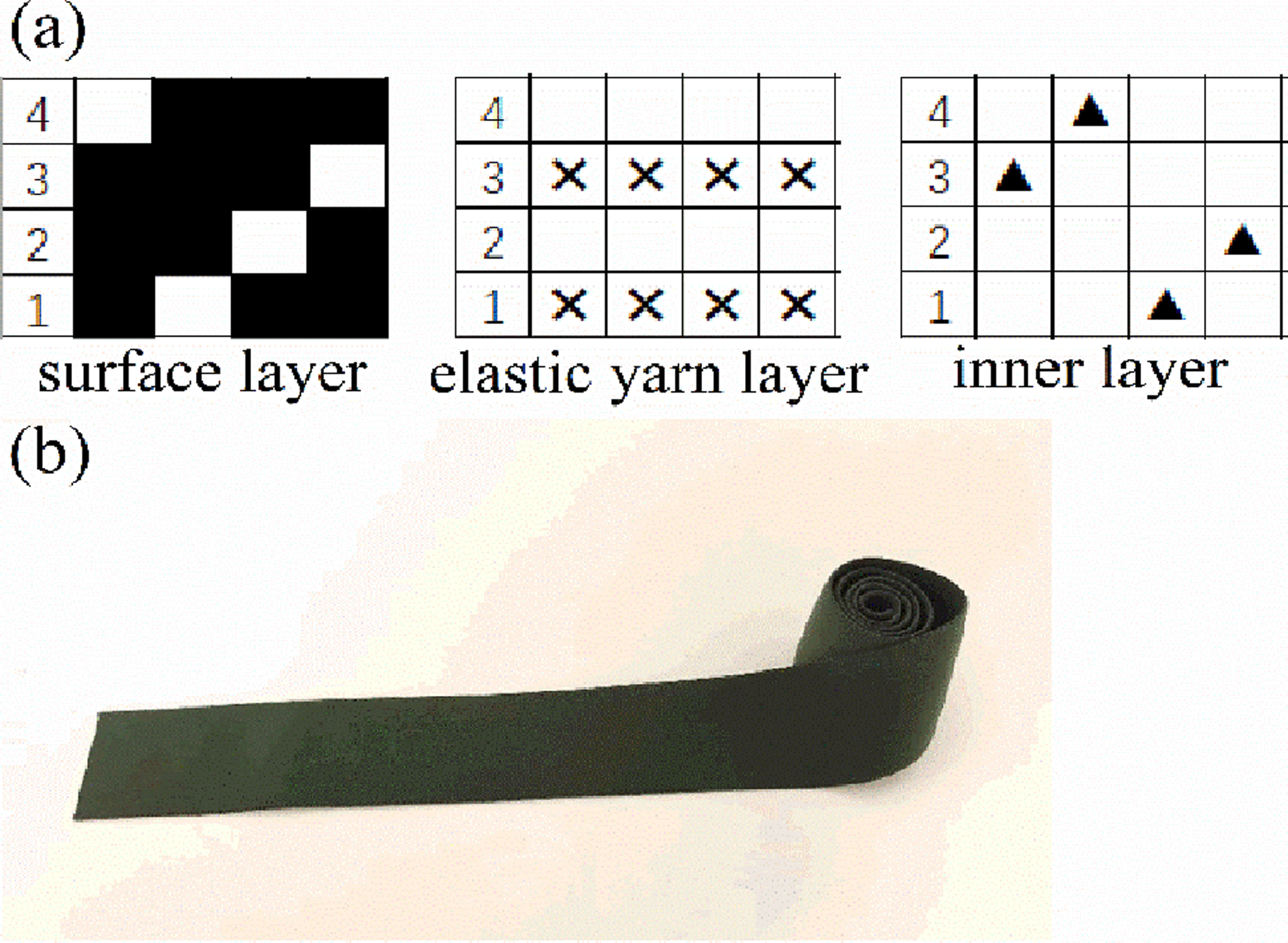
Characterizations
Differential scanning calorimeter analysis
The phase transition temperature as well as crystallization and melting behavior were investigated using a differential scanning calorimetry (DSC) instrument (DSC Q200, TA, USA). Referring to the standard GB/T 19,466.3- 2004 “Plastics-Differential scanning calorimetry (DSC)”, the samples were heated from −90°C to 60°C twice at a heating rate of 10°C/min.
Fourier transform infrared (FTIR) spectroscopy analysis
To investigate the characteristic groups of SMPUF and the hydrogen bond, FTIR analysis was carried out with a NICOLET is 10 FTIR analyzer (Thermo Fisher Scientific Co. Ltd, USA) with the experimental mode of attenuated total reflection (ATR) at 20.0 ± 2.0°C and relative humidity (RH) 65.0 ± 4.0%. The frequency range was 4000∼400 cm−1.
Wide angle X-ray diffraction (WXRD) analysis
The crystal structure of SMPUF was analyzed by WXRD with an X-ray diffractometer (D2 PHASER, Bruker AXS Co. Ltd, Germany). The X-ray tube is ceramic, Cu target, tube power 2.2 kW. The diffraction measurement was carried out in the 2θ angle range of 5∼40° at a rate of 0.2 s/step. The original sample and the sample heated to 55°C for 30 min were tested at ambient temperature (20.0 ± 2.0°C), respectively.
Thermo-mechanical cyclic test
Thermo-mechanical cyclic tests of SMPUF and shape memory bands were carried out using the dynamic mechanical analyzer (DMA Q800, TA, USA) operated in the controlled force mode to investigate shape memory properties. For the filament samples, the length was 6 mm. For the band samples, the width was 5 mm and the length was 6 mm. The shape memory behavior was recorded in the following way: (1) A sample was equilibrated at deformation temperature (Td) for 10 min with suitable preload force, recording the strain as ε0; (2) Apply an appropriate force, and the sample was cooled to fixing temperature (Tf) at 5°C/min, isothermal for 5 min, record the maximum strain as εm; (3) Remove the load force, record the strain as εu; (4) Ramp 5°C/min to recovery temperature (Tr), isothermal for 5 min, record the strain as εp. Shape fixity ratio (Rf) and shape recovery ratio (Rr) in the Nth cycle were calculated, and shape recovery speed (Vr) was obtained from the derivative of the recovery ratio to time (t),13,14 as follows:


The test temperatures would be referenced to the DSC results.
Tensile test at two different temperatures
All the tests were carried out at 20.0 ± 2.0°C (room temperature) and 55.0 ± 2.0°C (the melt transition final temperature according to DSC results), with a relative humidity (RH) 65.0 ± 4.0%.
Tensile break
Tensile properties of SMPUF and PUF were investigated with a universal tensile testing machine with pneumatic clamps (EZ-LX, SHIMADZU, Japan) as specified in standard FZ/T 50,006-2013 “Testing method for the tenacity of spandex filament yarns”. The sample length was 50 mm, the tensile speed was 500 mm/min and the pretension was 0.3 cN. On every sample, the test was conducted 10 times to get the average values.
Cyclic tensile recovery
Elasticity testing of filaments was carried out with the same instrument as tensile testing according to standard FZ/T 50,007-2012 “Testing method for the elasticity of spandex filament yarns”. The sample length was 50 mm, the tensile speed was 500 mm/min and the pretension was 0.3 cN. The sample was elongated from 0% strain (L0) to 300% strain (L1) and then cycled back to 0% for four repetitions. At the 5th elongation to 300%, the force (F1) was recorded, then delayed for 30 s, and the force (F2) was recorded. The sample was then returned to 0% for another 30-s delay. The 6th elongation was conducted to measure the length (L2) of the sample stretched to the pretensioned location. The test was conducted 10 times to get the average values. 300% strain elastic recovery (Er), stress decay rate (R), and plastic deformation rate (SD) were calculated as follows:



Elastic recovery and elastic modulus of shape memory bands were tested on an electronic tensile testing machine (YG028, Ningfang Instrument, China), using the constant rate of an extension method (CRE), according to standard FZ/T 60,021-2021 “Test method for physical properties of the belt”. Three measurements were taken for each sample to get the average values.
Tensile test with a progressive increase in temperature
In order to investigate the potential of SMPUF in environments with varying temperatures, all the tests were carried out at −5∼75°C (increased by 10°C), with a relative humidity (RH) of 65.0 ± 4.0%.
Uniaxial elongation tensile test
To control the temperature, the test was performed on DMA Q800, operated in the controlled strain mode. Based on the tensile properties of the samples and the instrument parameters, the sample was elongated to 100% strain. The sample length was 5 mm, the preload force was 0.3 cN and the tensile speed was 50 %/min. The samples were kept at the relevant test temperature for 10 min before testing. The test was conducted 3 times to get the average values.
Stress relaxation test
The relaxation test was also carried out using the DMA Q800 in the stress relaxation mode. The strain was 5% within the linear viscoelastic region of the samples and the relaxation time was 15 min. The sample length was 5 mm, the preload force was 0.3 cN, and the samples were kept at the relevant test temperature for 10 min before testing.
Dynamic mechanical analysis
The dynamic mechanical analysis (DMA) instrument was used to test the dynamic mechanical properties of SMPUF in the multi-frequency-strain mode. 20 filaments were arranged in parallel as a film for testing, and the length was 5 mm. The frequency was set as 1 Hz, the amplitude was 1.0% strain with force track 125.0%, the heating rate was 3°C/min and the temperature range was from −85°C to 100°C.
Results and discussion
Molecular structure and properties of SMPUF
Thermal properties
DSC analysis could characterize the thermal effects of the samples, and for the polyurethane samples with separated soft and hard segments, it is mainly the crystalline and melting behavior of the soft segments. The DSC curves of SMPUF samples and PUF are shown in Figure 3. The melting temperature (Tm), melting enthalpy (∆Hm), and crystallization enthalpy (∆Hc) are listed in Table 1. The melting temperatures of the SMPUF samples were all in the range of room temperature. Three types of SMPUF with distinct transition temperatures were produced by modifying polyester diols. The melting enthalpy of SMPUF samples is greater than that of PUF, which suggests it has a better orientation and a more regular structure. The soft segments’ phase transition induced changes in thermodynamic and mechanical properties, which led to SMPUF that can be triggered by temperature. For subsequent shape memory properties tests of SMPUF, the test temperature is set according to the melt transition initial temperature Tim and the final temperature Tfm, Td = Tr = Tfm, Tf = Tim. DSC curves: (a) the second heating curve; (b) the first cooling curve. DSC analysis results.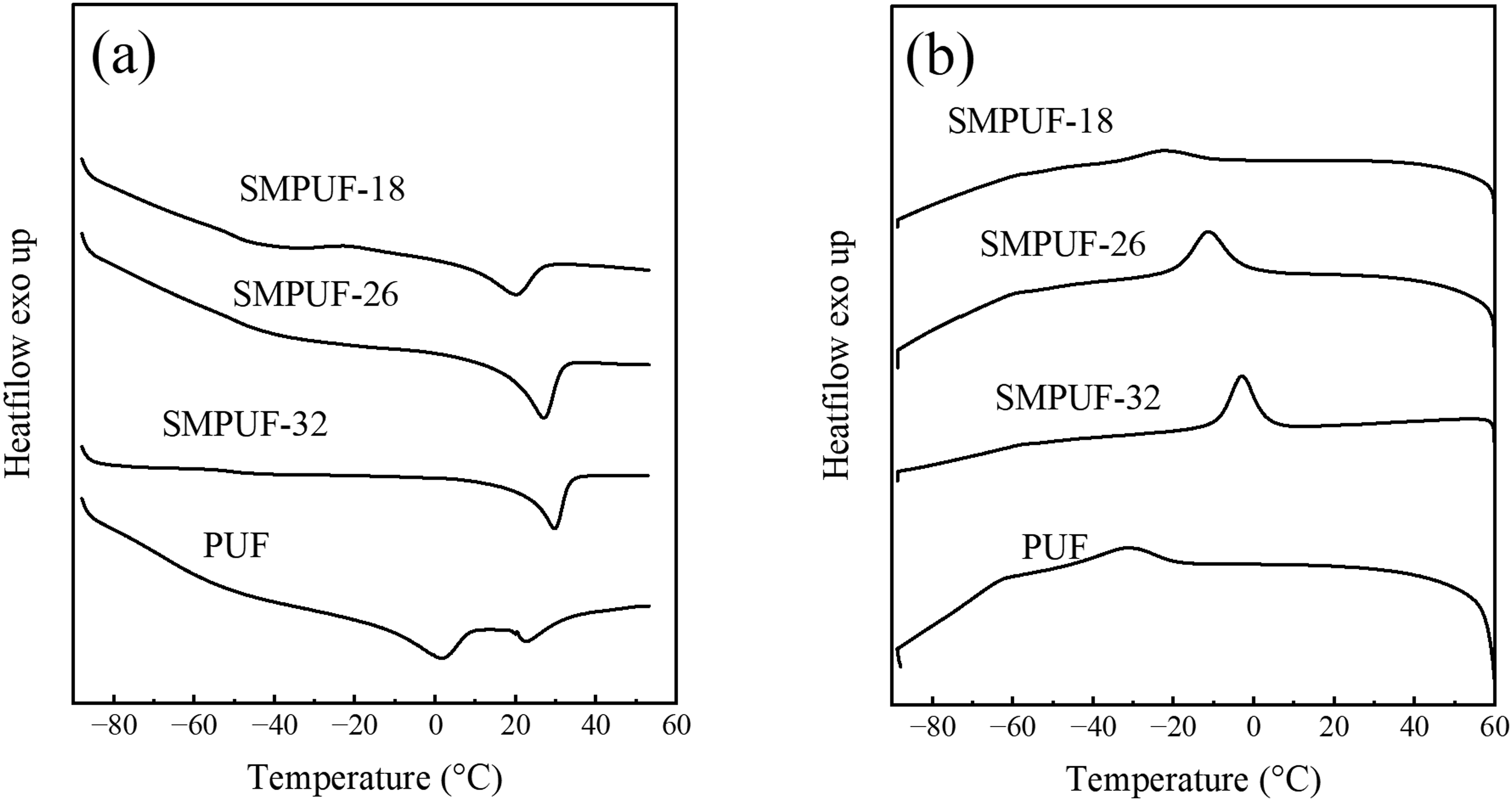

Molecular structure
The FTIR spectra of the samples are shown in Figure 4. For SMPUF samples, the absorption peak positions are similar. Specifically, the peak at 3325 cm−1 corresponds to the N-H stretching vibration, the C = O absorption peak is at 1724 cm−1, and the peak at 1636 cm−1 is attributed to the hydrogen-bonded urethane group, 1236 cm−1 and 1160 cm−1 represent the C-O-C stretching vibration peaks in the ester group, these bonds indicate that the samples are polyester polyurethane filaments. For the PUF, the peak at 3321 cm−1 is attributed to N-H stretching vibration. The peaks at 1731 cm−1 and 1637 cm−1 are urethane carbonyl and urea carbonyl peaks, respectively. Additionally, the strong absorption peak at 1103 cm−1 is an ether-bonding stretching vibration. As a result, it can be concluded that the PUF belongs to the polyether polyurethane filaments. For polyurethane materials, the hydrogen bonding reflects the phase separation condition of the material and has an impact on the mechanical properties. The carbonyl region from 1800 cm−1 to 1620 cm−1 in the spectra is relatively simple, therefore, a comprehensive analysis of the carbonyl region was conducted to calculate the hydrogen bonding ratio.
15
FTIR spectra of the samples.
Based on the second derivatives of the FTIR spectra, SMPUF identified 10 subpeaks and PUF had 6 subpeaks, with the additional peaks mainly consisting of free carbonyls. Hydrogen bonding in this region is primarily derived from ester carbonyls, carbamate carbonyls, and urea carbonyls. A tangent line at the lowest point of the spectrum served as the baseline for the fit, as depicted in Figure 5. Fit curve of C = O region: (a) SMPUF-18; (b) SMPUF-26; (c) SMPUF-32; (d) PUF.

Fitting results in the C = O region.

From Figure 5 and Tables 2 and Xb of the three types of SMPUF samples are similar but significantly lower than that of PUF, and their ordered hydrogen bonding content is higher than that of disordered hydrogen bonding, in contrast to PUF. It is suggested that SMPUF has a lower degree of microphase separation compared to PUF. This may have implications for mechanical properties. SMPUF-26 has a slightly higher Xb, which may indicate that it has more crystalline phases bound by ordered hydrogen bonds at the temperature tested.
Crystalline structure
The crystallization of SMPUF soft chain segments can be characterized by WXRD. The diffraction patterns are demonstrated in Figure 6. From Figure 6(a), the SMPUF samples show consistency in peak positions at room temperature, with two evident diffraction peaks of the soft segments at 2θ = 21.4° and 2θ = 23.7°, indicating their partial crystallinity. Conversely, PUF has two broad peaks in the range of 2θ = 5°∼25°, and no obvious diffraction peaks are observed. As demonstrated in Figure 6(b), while the temperature of the SMPUF samples was increased above the transition temperature of the soft segments, the diffraction peaks disappeared and the peak shape changed to a broad peak, similar to that of the PUF. This suggests that the crystals of the soft segments had melted, concurring with the results of the DSC analysis. Additionally, the crystalline states transition is reversible. This will result in the macroscopic properties of SMPUF to be temperature-responsive within a certain range. WXRD diffraction patterns: (a) original samples; (b) samples after heating.
Shape memory properties
Shape fixity ratio rate and shape recovery ratio of SMPUF.
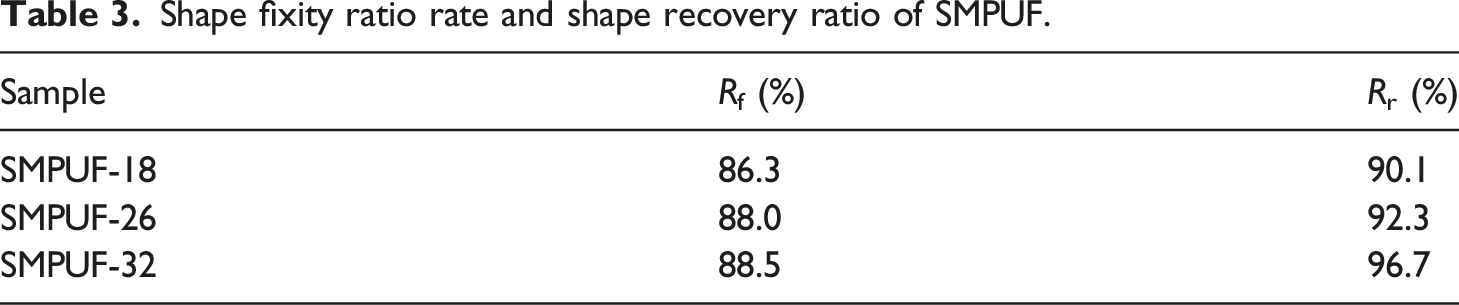

Shape recovery ratio of (a) SMPUF-18; (b) SMPUF-26; (c) SMPUF-32.
Effect of temperature on mechanical properties
Tensile break properties
The tensile break properties of SMPUF and PUF are displayed in Figure 8. In general, there are little variations in the breaking force of SMPUF samples at varying temperatures, whereas the elongation at break is more temperature-sensitive. Conversely, PUF is relatively unaffected by temperature. Specifically, PUF exhibits diffuse microcrystals near room temperature as visualized in the WXRD curves, while the reticulated macromolecular chains give it high elasticity like rubber. While SMPU-18 is almost at the transition temperature of 20°C, SMPU-26 and SMPU-32 are below their transition temperature, leading to incomplete phase transitions in most of the crystalline soft segments and hindering stretching. However, at 55°C, which exceeds the final transition temperature of the three SMPUFs, the more easily movable soft chain segments provide higher elasticity and increase the elongation at break. Moreover, due to the higher fraction of hydrogen bonds of PUF, which restricted the movement of molecular chains, the breaking elongation at 55°C was lower than that of SMPUF.
17
Effect of temperature on (a) breaking force; (b) elongation at break.
Cyclic tensile recovery properties
The cyclic tensile curves are shown in Figure 9. At 20°C, the loading path of the first cycle varied from the subsequent cycles of SMPUF, displaying clear linear and yield zones. As the transition temperature of the sample increased, the corresponding initial modulus and stress at 300% strain of SMPUF increased. While PUF exhibited a closer resemblance to rubber elasticity and a low initial modulus. The cyclic tensile curves of SMPUF are similar to those of PUF at 55°C. The stress of all samples exhibited the Mullins effect of a gradual decrease in the process of the tensile cycle.
18
Besides, the unloading curves of individual cycles largely overlapped. Fixed-point cyclic tensile curves at 22°C and 55°C.
The total energy was determined as the area under the loading curve, while the reversible energy was calculated as the area under the unloading curve. The resulting ratio, presented in Figure 10, serves as an indicator of the elastic recovery property and reveals the dissipation effect.
19
The first cycle exhibits the lowest percentage of all samples. A probable explanation is that, unlike the other cycles, the first cycle is mainly a slippage of folded chain segments and the reorganization of microstructural crystalline, resulting in the greatest energy loss. At 20°C, the SMPUF samples exhibit a lower ratio than the PUF. The crystallization of the soft segment likely hinders the activity at 20°C. As the stretching cycle increases, the movement of segment orientation and macromolecular chain gradually tends to balance, and the percentage becomes similar. At 55°C, the ratio of SMPU samples approaches that of PUF, indicating good elasticity. For PUF, there is little difference between the two temperatures. A possible explanation for this might be that the phase transition of PUF occurs below room temperature, so its properties remain stable and almost unchanged during use, especially with high elasticity. Reversible energy to total energy in each cycle of stretching: (a) test at 20°C; (b) test at 55°C.
The elasticity indicators calculated from the strain curve are shown in Figure 11. At the test temperature of 55°C, the 300% elastic recovery (Er), stress decay rate (R), and plastic deformation rate (SD) of SMPUF samples are close to that of PUF. At the test temperature of 20°C, SMPUF-18 also shows performance close to that of PUF, while SMPUF-26 and SMPUF-32 have lower Er and higher R and SD, especially SD. This is because the SMPUF has “memory deformation”. Cold stretching caused SMPUF to fix temporary deformation, forming “memory deformation”. In fact, at 20°C below the transition temperature, “memory deformation” may account for a larger proportion than plastic deformation for unrecoverable deformation.
20
This part of the deformation can be recovered at 55°C. The cyclic tensile recovery properties show that SMPUF has a similar elastic modulus to PUF at temperatures above Ttrans, as well as excellent resilience. At 20°C, SMPUF can fix temporary shape, which can improve the difficulty in wearing tight clothing. However, most textile productions are prepared at room temperature (15∼25°C). Therefore, the high modulus of SMPUF-32 at low temperature will be unstable in the production process at room temperature. Elasticity indicators at different temperatures.
Uniaxial elongation tensile properties
According to the above results, it is found that temperature has a great influence on the mechanical properties of SMPUF, so uniaxial tensile tests were carried out at progressively increasing temperatures and the results are shown in Figure 12 below. The stress at 100% strain decreases as the temperature increases, and the initial modulus also decreases. The mechanical properties of SMPUF are very sensitive to temperature, especially near the transition temperature. Take 5% strain to calculate the initial modulus, which is shown in Figure 13. The initial modulus of SMPUF-26 and SMPUF-32 are close to each other at the low temperature of −5°C, while that of SMPUF-18 is relatively low. The modulus of the SMPUF samples all decrease with increasing temperature, and the modulus of SMPUF remains steady after 45°C. This may be because SMPUF is a partially crystalline polymer, and according to the DSC results, the phase transition range is wide, for SMPUF-18, −5°C is close to the transition initiation temperature, while for the other two samples, no phase transition is initiated. When the temperature is higher than 45°C, the phase transition of the three samples is completed, and the melting of crystallization makes the molecular chain susceptible to external tensile deformation, so the modulus is low. The temperature-sensitive modulus of SMPUF helps to realize the application in smart sportswear. When used to prepare sportswear such as leggings, the modulus of SMPUF is high when the body temperature is low in a stationary state. After strenuous exercise, the body temperature rises and SMPUF can cause the leggings to tighten, providing appropriate pressure to the body. Uniaxial elongation tensile test at different temperatures: (a) SMPUF-18; (b) SMPUF-26; (c) SMPUF-32. Effect of temperature on the elastic modulus of SMPUF.

Stress relaxation properties
Stress relaxation reflects the viscoelastic properties of SMPUF. The conformation of the molecular chain undergoes constant changes under the influence of external forces. Figure 14 Illustrates the stress relaxation results, wherein stress decays over time and approaches a constant value. This may be because when an instantaneous strain was given to the SMPUF, the bond length and bond angle extended along the direction of the external force, and the chain segment moved to reduce its internal stress. Effect of temperature on stress relaxation: (a) SMPUF-18; (b) SMPUF-26; (c) SMPUF-32.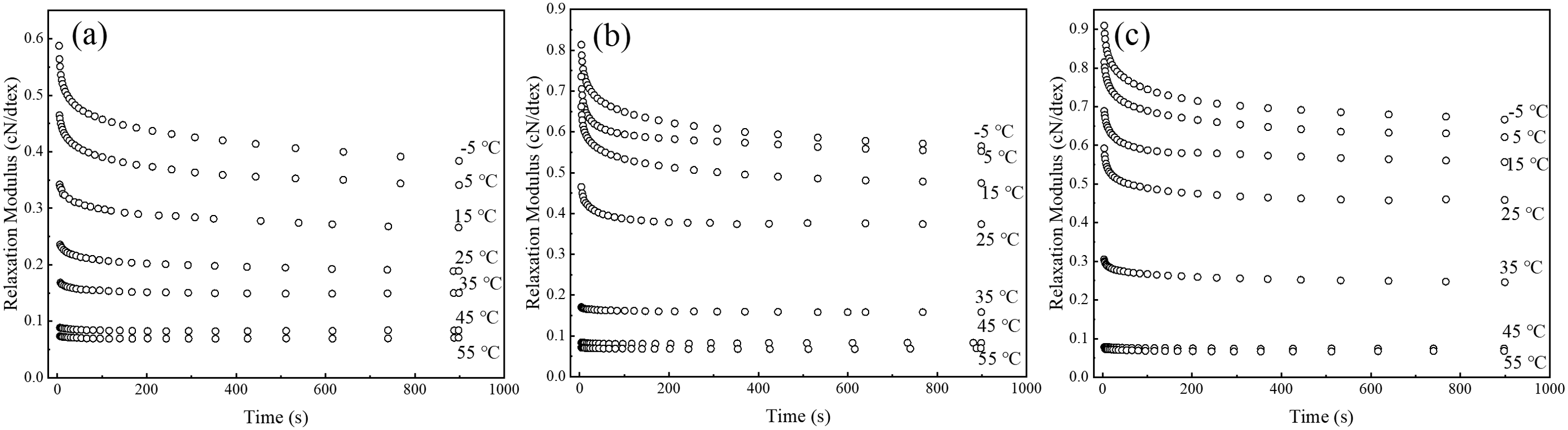
Furthermore, the stress relaxation properties of SMPUF are greatly impacted by temperature. With the temperature increase, the relaxation modulus decreases consistently. The closer it gets to the transition temperature, the larger the gap. At 45°C and 55°C above the termination temperature of phase transition, the smaller relaxation modulus value stabilizes. The partially crystallized soft segment probably impedes movement at low temperatures. Based on the DSC and XRD results, it can be observed that the uncrystallized portion of the soft chain segments increases with temperature. As the temperature increases, the resistance to the internal friction of the segment movement decreases and the initial internal stress decreases as well. During relaxation, higher temperature leads to higher mobility of the soft chain segments and lower resistance of the molecular chains in the process of stretching along the direction of the external force.
The viscoelastic model provides a more intuitive description of the viscoelasticity for SMPUF. The microstructure of SMPUF exhibits microphase separation of soft and hard segments, which undergoes continual change in response to temperature and external force. To describe these characteristics, the generalized Maxwell model with multiple relaxation units was used, as depicted in Figure 15.
21
Generalized Maxwell model.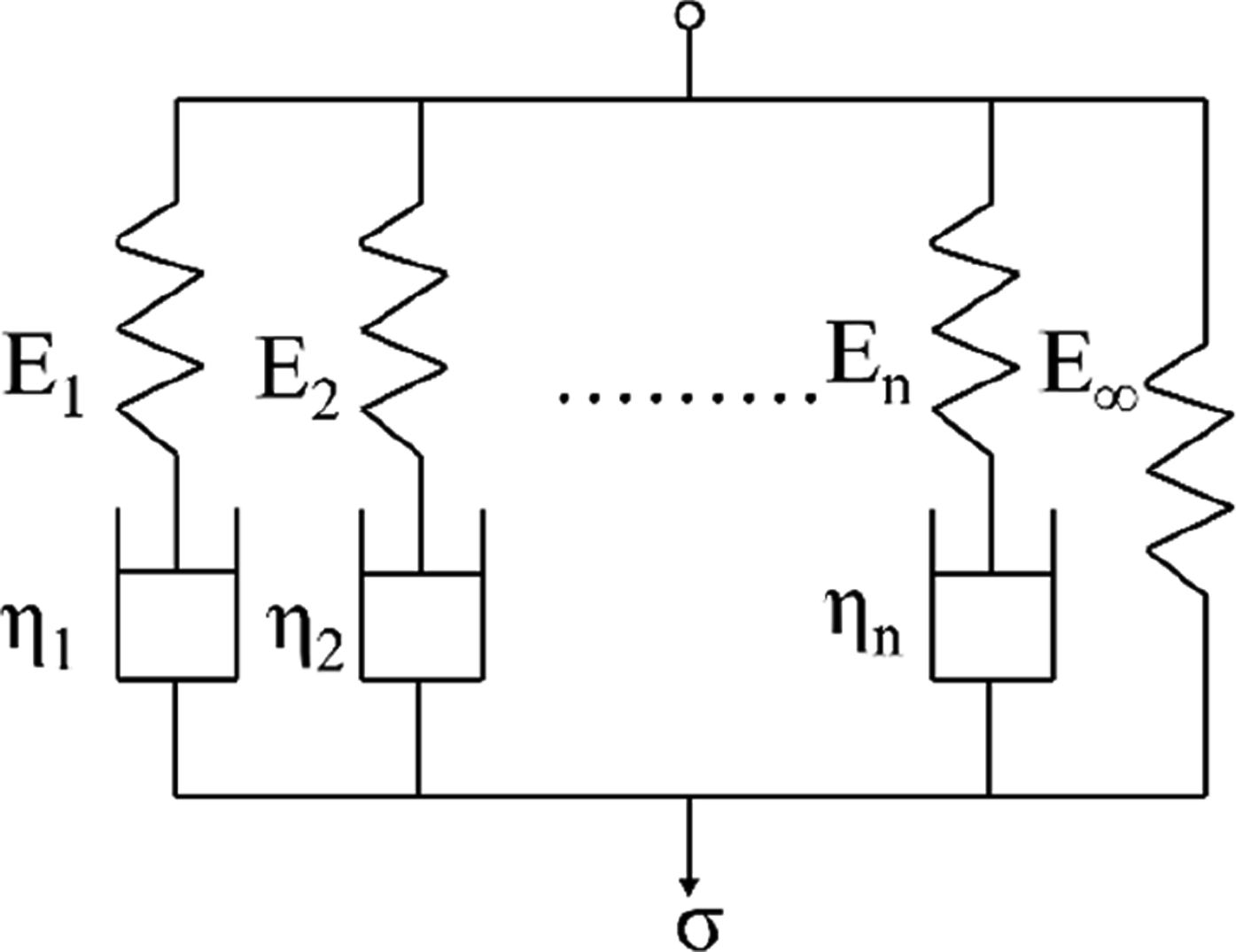
The stress relaxation equation of a single Maxwell unit can be expressed as:
The relaxation modulus is:
Express in the form of multiple Maxwell units in parallel, it is:
Based on calculations, when n = 3, the model will be a four-element model and the stress relaxation of SMPUF can be well simulated. Figure 16 Displays the results, demonstrating a good fit with R2 of all samples greater than 0.98. Stress relaxation data and fitting results at different temperatures.
Dynamic mechanical properties
The dynamic mechanical properties of SMPUF were investigated, as Figure 17. When the sample was heated from −85°C to 100°C, it changed from a glassy state to a highly elastic state, and the storage modulus decreased. There are three transition inflection points. The glass transition starts at about −40°C. The SMPUF shows a wide transition range from −10°C to 45°C, which is attributed to the melting transition of the soft segment. Corresponding to the loss modulus diagram, it starts at −10°C, and the loss modulus decreases at a slower rate. For PUF, a modulus platform has appeared at about 0°C. While SMPUF decreases slowly with increasing temperature until 55°C. As a result, the SMPUF sample’s performance is significantly impacted by temperature within the range of normal room temperature. Dynamic mechanical properties.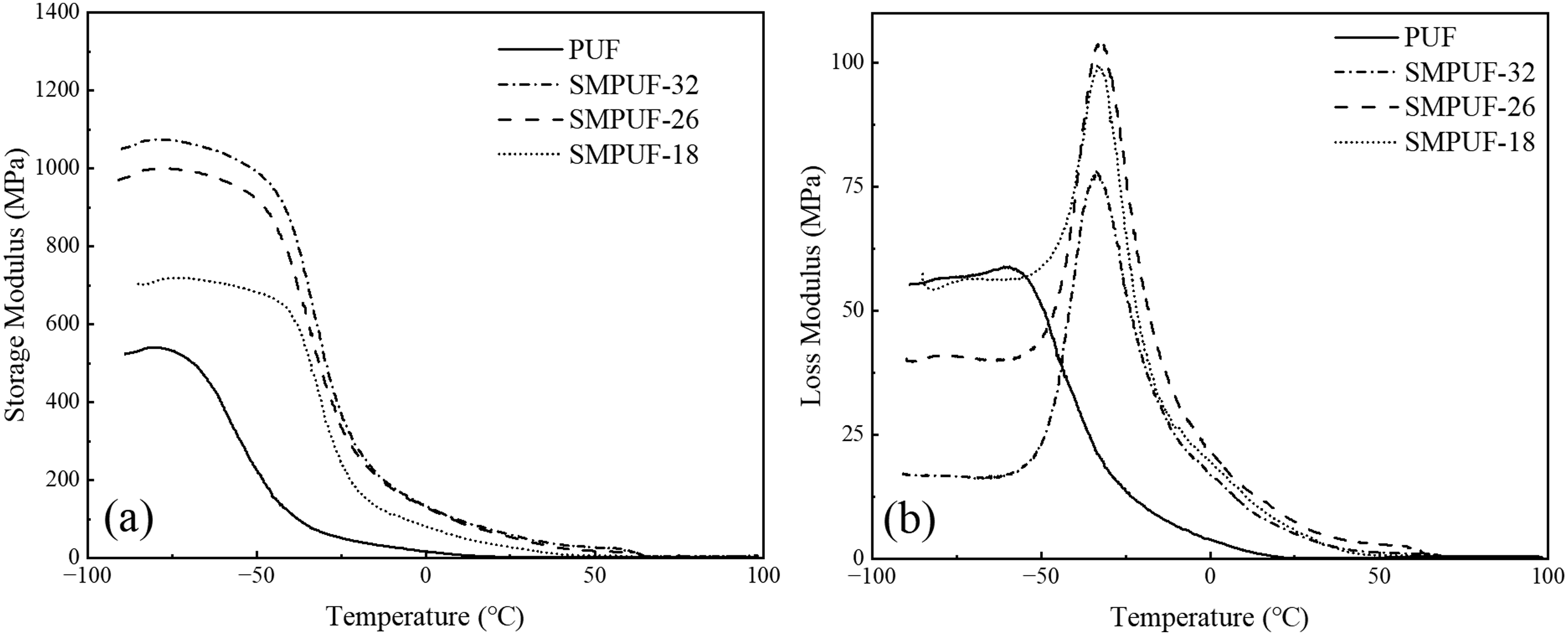
Mechanical and shape memory properties of SMPUF-based elastic band
Mechanical properties
Based on the results of the uniaxial tensile and stress relaxation test, SMPUF-26 was selected to prepare SMPUB, because it achieved properties similar to those of PUF at about 34°C, contrasted with SMPUF-32, and also had a better shape recovery ratio in comparison with SMPUF-18. The effect of temperature on the elasticity of the samples is illustrated in Figure 18. At 20°C, the elastic recovery ratio of SMPUFB was low. However, with a temperature increase to 55°C, it achieved an exceptional elasticity of 88.22%, similar to PUFB. Moreover, the modulus was also reduced by 42%. At 55°C, the modulus of SMPUFB was 27.0% lower than that of PUFB, making the elastic band easier to stretch with the same external force as under 20°C, as shown in Figure 18(c). These demonstrate that SMPUF is suitable for elastic bands. The lower modulus of SMPUFB above the transition temperature results in reduced pressure on the body during use, which avoids the discomfort caused by the over-tightening of PUFB. Effect of temperature on (a) elastic recovery; (b) elastic modulus and (c) demonstration of the change in elongation under the same force.
Shape memory properties
The thermo-mechanical cyclic tests of SMPUFB with T
r
= 34°C (the mean human skin temperature) were conducted, and the results are shown in Figure 19. Figure 19(a) shows the one cycle test, its shape fixity ratio was 85.8%. As the temperature rose to 34°C, the shape recovery speed decreased rapidly, meanwhile, the shape recovery ratio gradually stabilized, and reached 82.8% after a 5-min recovery period at 34°C, 86.1% after 20 min. Three cycles test that the time for shape fixation and recovery was both 5 min was depicted in Figure 19(b). The first cycle’s shape recovery ratio (T
r
= 78.6%) was considerably lower than the last two cycles, attributable to the viscoelasticity of filaments, causing irrecoverable deformation. The shape memory performance of the previous two cycles was similar, with an average of 85.9% shape fixity ratio and 94.8% shape recovery ratio. The SMPUFB display promises for use in compression clothing as the bottom band and waist parts. An elastic band with shape memory effect can make the process of wearing tight compression clothing easier than normal products by fixing a larger temporary shape. Meanwhile, the body temperature can trigger the temporary shape to recover to a smaller initial shape, stabilizing the garment on the body and providing pressure. Shape memory properties of SMPUB (a) recover at 34°C last 25 min for 1 cycle; (b) recover at 34°C last 5 min for 3 cycles.
Footnotes
Declaration of conflicting interests
The author(s) declared no potential conflicts of interest concerning the research, authorship, and/ or publication of this article.
Funding
The author(s) disclosed receipt of the following financial support for the research, authorship, and/or publication of this article: This work was supported by the Jiangsu Province Key Research and Development Program “Biodegradable temperature-sensitive intelligent polyurethane filament with application development” (Program number: BE2022131).
