




Abstract
Many conductive fabrics have been widely used as fabric strain sensors in recent years due to their excellent flexibility. In this study, high-tenacity polyester warp yarn and silver-coated nylon weft yarn were used to produce six types of conductive fabrics with different structures. The surface morphology of silver-coated nylon yarn was observed under a microscope, and the yarn was placed in an airtight container to test the effect of different humidity on the resistance of the yarn. DM6500 digital multimeter was used to test the resistance sensitivity, fatigue resistance, repeatability, and antistatic properties of conductive fabric samples. The results showed that the change in yarn surface material, external humidity, and strain affected the change in yarn resistance. Different weave structures affected the sensing performance of the fabric. The tighter the structure, the better the sensitivity and antistatic properties, the looser the structure, the better the fatigue resistance and repeatability. Two types of fabric and nylon gloves with different structural tightness are used to make intelligent data gloves. The results showed that both fabrics had good application prospects in limb movement detection.
Keywords
Introduction
With the rapid development of the information age, intelligent textiles with sensing functions have gradually attracted people’s attention. Due to their good skin adhesion, they can monitor the wearer’s pulse, body temperature, heartbeat, breathing, electroencephalogram, electrocardiogram, and other physiological indicators, which are widely used in medical and sports detection. As shown in Figure 1. Detection of wrist, finger, elbow, ankle, and knee bending signals by fabric strain sensor in motion detection, and detection of breath, pulse, and heartbeat signals in medical detection.
Traditional sensing equipment materials, such as metal, polymer, 1 carbon-based, and composite conductive materials, 2 are rigid. Their sensing performance is good, but their texture is relatively solid. It may cause damage to human skin if used as a sensing device on the human body surface for a long time. Textile materials are used for fabric strain sensors based on the excellent skin sticking and soft characteristics of daily clothing. Compared with traditional sensor, fabric strain sensor based on textile materials shows high comfort and repeatability advantages. 3 The sensing property of the fabric is that when the surface of the fabric is subjected to specific mechanical changes, the conductive yarn of the fabric will be deformed, resulting in changes in its resistance or voltage. This electrical signal reflects the size and distribution of the mechanical changes. The selection of conductive yarn has a significant impact on the sensing property of the fabric. Currently, most conductive yarns are coated with metal on the surface of the yarn by the coating method so that they can obtain conductive properties. 4 Because the price of gold is relatively high, the current choice of coated metal is mainly silver.
Silver-plated nylon yarn is widely used as a fabrication material for intelligent wearable sensors due to its high sensitivity to resistance changes. 5 Wang 6 used polyester fabric (PETF) as the base material, introduced 3-mercaptopropytrimethoxysilane (MPTS) to modify the surface of the fabric, and performed electroless silver plating on the modified PETF (M-PETF) to fabricate electrocardiogram fabric electrodes with better conductivity and washable resistance. Lee 7 developed a multi-channel band electromyography(EMG) measuring instrument using the mosaic weaving method. The knitted electrodes developed used conductive silver and non-conductive Bio Max functional yarns. Park 8 developed strain sensors using conductive yarns consisting of silver and nylon yarns to make a wearable strain sensor that monitors human respiration by attaching stretchable conductive yarns onto a textile substrate. Han 9 used silver-plated polyamide filament to assemble conductive gloves that monitor finger movement, bending rate, and bending angle.
Many factors affect the tensile resistance of a fabric. Tohidi 10 used an electrically conductive stainless steel polyester plain knit fabric to investigate the effect of fabric structural parameters (such as coil length) on the electromechanical properties of the sensor. Gao 11 obtained silver nanowires (AgNWs), silver nanorods (Agnes), and silver nanoparticles (AgNPs) by solvothermal method, respectively. Furthermore, adsorbed on cotton fabric, the influence of wire, rod, and granular silver nanostructures on cotton fabric’s electrical conductivity and wear resistance was studied. Ismar 12 discussed the effects of water and detergent solutions on silver-plated yarns. Water plays an essential role in the product washing process so it can cause more damage to the yarn surface than the detergent solution. Conductive textiles should be steam-maintained to reduce the number of routine washing and drying cycles and increase the use of steam clothing care to achieve the expected intelligent clothing life. 13 Tyurin 14 studied the electrical properties of conductive textiles using the van der Boer method. The Correlation of resistance variation of conductive knitted fabrics at tension perpendicular to the warp direction and tension at a specific angle to the warp direction of the fabric was studied. Li 15 studied the electromechanical properties of conductive yarns, two overlapping conductive yarns, and conductive knitted fabrics under unidirectional stretching. It shows that conductive fabrics usually exhibit two types of resistance. Length-dependent and contact resistance. Zhang 16 focused on the relationship between load and resistance of fabrics under uniaxial tension. From theoretical analysis and experimental study, it is found that the contact resistance of overlapping yarns in the fabric is the key factor affecting the sensitivity of fabric sensors. Erdem 17 used different conductive yarns, pin types, pin densities, and line positions to create conductive paths and studied the influence of these parameters on the resistance value. The results show that the type of conductive line, pin density, and line position are important factors affecting the resistance value. Han 18 studied the influence of spandex content, washing, and ironing process on the elasticity of the weft knit sensor by constant tensile test. The experimental results show that the elastane content affects the elasticity of the knitted fabric and thus significantly influences the sensor performance. Bickerton 19 proposed that not all conductive strands will touch each other within the fiber. As the fiber is stretched, the cross-sectional area will decrease, bringing more conductive fibers into contact with each other, thus increasing the available current paths and reducing the resistance of the fiber.
To investigate the influence on the sensing performance of the fabric strain sensor, the factors affecting the change in the resistance of the fabric and the yarn are discussed. Firstly, the sensing performance of the silver-plated nylon yarn is tested, and the influence of the yarn itself and the external environment on the yarn resistance is studied by comparing theory and practice. Secondly, the other six types of fabric, such as plain weave and honeycomb weave, were made with silver-plated nylon yarn. The influence of the fabric structure on the resistance of the fabric was studied, and the resistance sensitivity, fatigue resistance, repeatability, and antistatic properties of fabrics with different structures were tested. Finally, two types of fabric with different structures were selected to make the sensor, and a data glove was made by combining the knitted glove. The resistance change of the fabric strain sensor is tested by bending human fingers at different angles.
Materials and methods
Materials
The materials used include 33Tex silver-plated conductive nylon yarn manufactured by Jinan Yumo Technology and Trade Company Limited (Co., LTD) and 32Tex high-tenacity polyester yarn produced by Yiwu Hanyu Cotton Textile Co., LTD
Methods
Woven fabric preparation
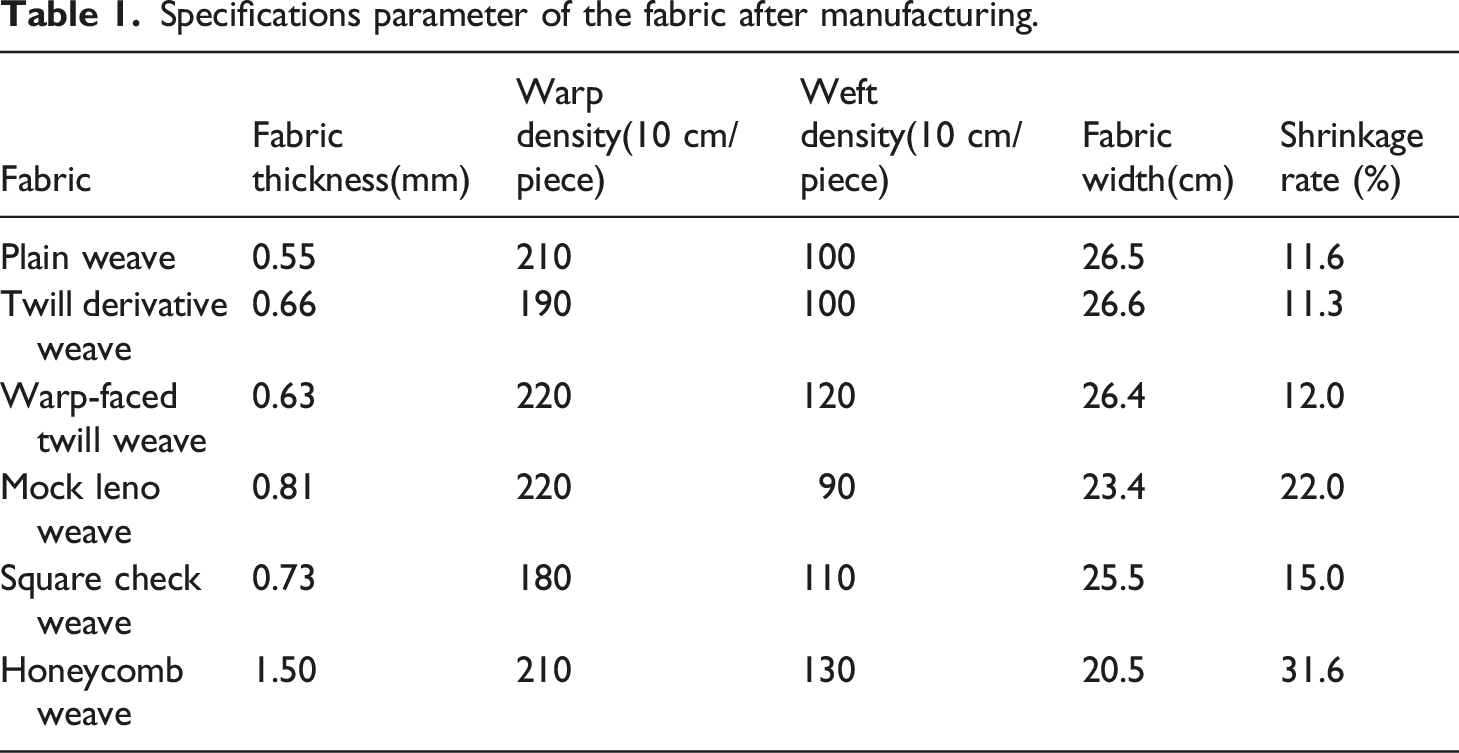
Specifications parameter of the fabric after manufacturing.

Schematic and physical picture design of six different weave structures. (a) Plain weave structures. (b) Twill derivative weave structures. (c) Warp-faced twill weave structures. (d) Mock leno weave structures. (e) Square check weave structures. (f) Honeycomb weave structures.
Calculation of theoretical and actual resistance of yarn
The electrical resistance variation of silver-plated conductive yarn was calculated using Ohm’s law and the equation of P. Xue.
20
Their equations are as below.



A 0 = Initial area
L = Deformed length
A = Deformed area
ν = possion’s ratio
ε = Strain
ρ = Intrinsic resistance
The DM6500 digital multimeter was used to measure the actual resistance of silver-plated nylon yarn under varying degrees of elongation. The theoretical resistance value is then calculated using the formula (4).
Yarn resistance test under different external conditions
First, the surface morphology of the fabric was analyzed by microscopic observation. A 16 cm silver-plated nylon yarn is cut and fixed at normal temperature and pressure for tensile testing. The resistance of the yarn was recorded every 2 weeks using a DMM6500 digital multimeter to test the resistance of the yarn. The resistance test clamp is employed to secure both ends of the yarn at standard temperature and pressure. A rubber-insulated gloves tensile resistance test fixture is utilized with the digital multimeter to monitor changes in yarn resistance and examine the impact of different tensile strains on resistance. Finally, the yarn was cut into 1m lengths, moistened to varying degrees with a humidifier in a closed container and the resistance was measured with a DM6500 digital multimeter every 15 s for 3 min. The effect of humidity on yarn resistance was discussed.
Test of fabric elongation and sensing properties
Using the YG028 fabric strength machine, according to the national standard GB/T3923.1-2013, the yarn clamping distance was maintained at 10 cm, the pre-tension at 2 N, the moving speed at 50 mm/min, and the stretching was started until the yarn breakage stopped. The breaking strength, time, and elongation of the yarn were recorded.
Wearing rubber-insulated gloves at normal temperature and pressure, stretched the fabric samples with different structures of 16 × 5 cm and recorded the resistance value with a DMM6500 digital multimeter. From the tensile strain and the resistance values of the measured inflection points, the theoretical value of the sensitivity GF is calculated from equation (5).
21

R 0 = Initial resistance
∆L = length variation
L 0 = Initial length
ε = Tensile strain
GF = Sensitivity
The fabric was clamped at both ends of the fabric with a resistance test fixture stretched with rubber-insulating gloves at standard temperature and pressure. To understand how the fabric is changed during the stretching process. The most common plain weave was selected, and modeled in 3D, the two ends of the weave were fixed, stretch was added to the two ends of the weave to stretch it horizontally, and the changes in the surface of the weave were recorded. The resistance value was recorded using a DMM6500 digital multimeter. The fabric was stretched 50 times, and the resistance value was recorded every 10. The fatigue resistance of fabrics with different structures was recorded to ensure that the resistance was still stable after repeated stretching. The fabric with different weave structures is periodically stretched. When stretched to the inflection point each time, the DMM6500 digital multimeter is used to record the resistance value at the inflection point and whether the resistance value remained relatively stable under the same strain variable during continuous cyclic stretching.
Test of antistatic properties of different fabrics
The selection of the friction voltage method, using the LFY-402 fabric friction static electricity meter, and seeing the GB/T 12,703.5-2010 standard “Fabric static electricity performance assessment”. Under the relative humidity of 45% and temperature of 20°C, take six kinds of structure, each sample 8 × 8 cm specification. After standing under standard atmospheric pressure for some time, the sample was clamped and rubbed against the standard nylon cloth on the rotating wheel with a rotation speed of 400 PRM. The peak strain of the sample was measured within 1 min. 22
Fabrication of fabric strain sensor and construction of sensor data acquisition equipment
Since the fabric is characterized by a large deformation capacity and a good resistance sensitivity, which can ensure an effective resistance change under strain, and has a high repeatability and fatigue resistance, the fabric could be used as a flexible sensor material23,24, as shown in Figure 3(a). The required size of the conductive fabric is prepared and wires are connected at both ends of the fabric to form fabric strain sensors, attached to the bending of the finger joint of the knitted glove, the fabric strain sensor and the resistance terminal of the ZH-To8R-14N1 8-channel resistance measurement module is connected with a wire, the power is turned on and the data is transmitted to the computer, and the resistance change data is obtained by using the serial tool as shown in Figure 3(b) and (c). Schematic diagram of finger bending test procedure for fabric strain sensor. (a) Schematic diagram of fabric strain sensor data collection equipment.(b) Schematic diagram of finger data collection by the serial tool.
Result and discussion
Breaking elongation performance of the yarn
Tensile breaking strength, tensile breaking Elongation, tensile breaking time, and elongation at break of warp and weft yarn.

Factors affecting the silver-plated nylon conductive yarn
Comparative analysis of theoretical and actual resistance of yarn
As shown in Figure 4, the yarn itself deforms as the elongation is raised, resulting in a constant elevated resistance of the yarn. However, there is a significant difference between the theoretical and actual resistance. The actual resistance is higher than the theoretical resistance at the same elongation. Comparison of theoretical and actual resistance of yarn at the same strain value.
The theoretical calculation assumed that the resistivity of the yarn remained constant, resulting in a linear change in total resistance. During the actual test, the silver (Ag) layer on the yarn surface did not change much when the fabric was initially stretched, so the yarn resistance did not change much. As the yarn continued to be stretched, the silver layer was gradually destroyed, resulting in a significant change in the resistance value. To study the factors that affect yarn resistance, it can be analyzed from two perspectives, The material itself and the external environment. 25 To study the factors that affect yarn resistance, it can be analyzed from two perspectives: the material itself and the external environment.
The effect of the material itself and the external environment on the resistance of the yarn
From the point of view of the yarn, Figure 4 inset was taken to show the microscopic surface morphology of silver-plated nylon yarn. During the stretching process, the silver particles on the surface of the yarn are fragmented.
26
The fragmentation of the silver particles on the yarn surface increased the contact area between the yarns and thus the resistance of the yarns. To further investigate the factors affecting the resistance of yarns, the contact constant between yarns can be defined as C and the separation coefficient as S. According to formulae (6)–(9), the calculation formula (10) for the resistance of yarns can be derived.



ρ x = density value of material
m = mass
L = length
Equations (6)–(9) can be substituted into equation (4) to obtain the expression of R, as shown in equation (10).
As shown in Figure 5(a), the resistance of the yarn increased continuously over 5 weeks. It can be seen that the resistance of the silver-plated nylon yarn increased by about 13% after being exposed to air for 35 days. As shown in Figure 5(b), the resistance change rate decreased with time under the same load. The resistance change rate on the 35th day is significantly lower than that on the 7th day. This indicates that Ag metal reacted with some components in the air when the silver-plated nylon yarn was exposed to the atmosphere. As time passes, the Ag content in the yarn is reduced, so that the resistance value constantly increases with time and the resistance change rate constantly decreases. Therefore, this conductive fabric is recommended to be kept out of direct contact with air as much as possible, sealed, and preserved to maintain its sensitivity and durability. Test of oxidation resistance of silvered yarn. (a)Yarn resistance curve with strain on days 7, 14, 21, 28, and 35. (b) Histogram of resistance change rate with strain value on the 7th, 14th, 21st, 28th, and 35th days of yarn.
As shown in Figure 6(a) and (b), the resistance variation is affected by strain rate and humidity. As the strain and humidity increased, the resistance value of the silver-plated nylon yarn gradually increased. In general, the more hygroscopic the fiber, the lower the resistance, and the less hygroscopic the fiber, the higher the resistance.
27
In this study, the resistance of the silver-plated yarn increased as the relative humidity increased. Since the water used in this study is deionized water, the resistivity of deionized water is much higher than that of ordinary water because it removes the ions in the water. Therefore, when the humidity is increased, the surface of the silver-plated yarn is coated with a film of water, and the continuity of the water film is increased with the increase in relative humidity.
28
As a result, the resistance of the silver-plated yarn will increase and its electrical conductivity will deteriorate. From the external environment of the yarn, both humidity and strain have a significant effect on the resistance of the yarn. Resistance test of silvered yarns under different humidity and strain conditions. (a) The curve of yarn resistance changes with strain for 3 times measurement. (b) The resistance change of yarn at different humidity.


RH r = reference humidity
Equations (11) and (12) can be substituted into equation (10) to obtain the expression of R, as shown in equation (13).
According to the observed difference between the theoretical and actual values of the yarn, it was found that the factors that affected the resistance could be divided into two categories, as shown in equation (13). The first term is the resistance change of the material itself caused by the size, and the second term is the resistance change caused by the change in material resistivity caused by the external conditions.
Properties of silver-plated nylon conductive fabric
Resistance testing of fabrics with different structures
As shown in Figure 7(a)–(f), the resistance values of woven conductive fabrics with different weave structures tended to first decrease and then increase with elongation, and the corresponding variable of the minimum resistance value is called the inflection point value. Throughout the stretching process, the inflection point values of different weave structures are varied. It can be seen that the inflection point values of plain weave, warp-faced twill weave, and twill derivative weave appear faster, while the inflection point values of honeycomb weave and mock leno weave are shown to appear slower. Curve of resistance values of different weave structures with strain. (a) Plain weave structures. (b) Twill derivative weave structures. (c) Warp-faced twill weave structures. (d) Mock leno weave structures. (e) Square check weave structures. (f) Honeycomb weave structures.
The entire stretching process can be divided into two stages. In the first stage, the fabric is stretched in the flexed state until the yarn shrinkage reaches 0. At this point, the resistance value changes from high to low until the minimum resistance is reached. In the second stage, elastic deformation of the yarn is applied and the resistance value is changed from low to high. As shown in Figure 8(a)–(f), the resistance change of the first stage is mainly related to the shrinkage rate of the fabrics, and the resistance of the second stage is mainly affected by the resistance performance of the yarn itself. The earlier the inflection point of the resistance is reached, the faster the elastic deformation occurs and the better the sensing performance. 3D diagram of fabric stretching from normal buckling to straightening and then from straightening to elastic deformation. (a) Overall 3D diagram of fabric buckling form. (b) Overall 3D image of fabric straightening shape. (c) Overall 3D view of fabric elastic deformation. (d) Transverse 3D image of fabric buckling form. (e) Transverse 3D image of fabric straightening shape. (f) Transverse 3D view of fabric elastic deformation.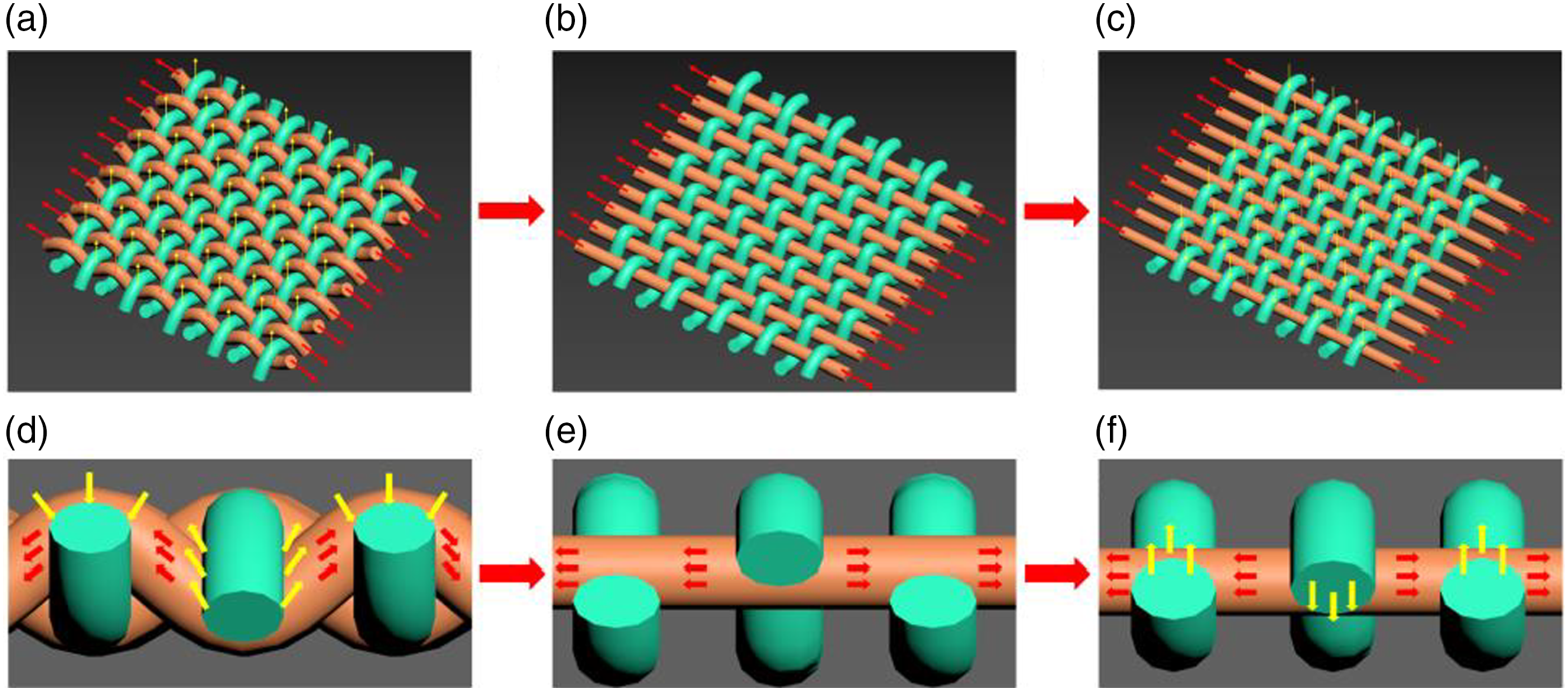
The turning point is achieved in the process of turning from the first stage to the second stage. In the first stage, because the fabric itself has experienced a certain rate of shrinkage after manufacture, the fabric produced in its natural state is not in the state of yarn straightening. The greater the rate of shrinkage, the longer it takes for the fabric to reach the stretch state. As can be seen from Table 2, honeycomb and perforated fabrics have a higher rate of shrinkage, while plain, twill derivative and warp-faced twill fabrics have a lower rate of shrinkage, so the time spent in the stretched state is shorter.
Sensitivity resistance of fabrics with different weave structures
As can be seen from Figure 9, there is the lowest point of sensitivity in the process of the conductive fabric being affected by strain. After repeated stretching, the lowest point can be measured between 1.5% and 8%. Based on the stretch results, it is assumed that the sensitivity of the conductive fabric shows a curve trend. The arrival time of the inflection point value is not the same for different structures, among which the inflection point value of the plain weave, warp-faced twill, and twill-derived weave is the fastest, which is about 1.5%. The inflection point value of the honeycomb weave and square check weave had the slowest speed, which was about 8%. The inflection point of a different fabric structure and the Gauge Factor (GF) value will be different. The inflection point value for a square check is 7.619%, honeycomb is 7.803%, mock leno is 3.890%, plain is 2.310%, twill derivative is 1.629% and warp-faced twill is 1.739%. The GF at the point of inflection was 2.697 for plain weave, 1.029 for twill derivative weave, 1.498 for warp-faced twill weave, 0.195 for square check weave, 0.069 for honeycomb weave, and 0.128 for mock leno weave. The process of stretching fabric is divided into two stages. The first stage is when the yarn in the fabric changes from a kinked state to a straightened state (the yarn slippage process), and the second stage is when the yarn is deformed (the yarn deformation process).29,30 The change curve of the resistance change rate of plain weave, twill derivative weave, warp-faced twill weave, mock leno weave, square check weave, and honeycomb weave fabrics with strain value and the inflection point value table of different weave structures.
In the first stage, when the length and width of the fabric were the same, the fabric with the higher shrinkage would have a higher degree of buckling in the natural state, and the fabric with the lower shrinkage would have a lower degree of buckling in the natural state. Under the same tensile strain condition, the higher the degree of buckling of the fabric compared to the fabric with the lower degree of buckling, the more parts of the yarn slipped and the fewer parts of the yarn deformed. However, yarn slippage itself only slightly affected the yarn resistance, which was mainly due to yarn deformation, cross-sectional area, and length change, and thus resistance change. Therefore, at the first stage, for the same elongation, the fabric with a higher degree of buckling will have a smaller change in resistance, while the fabric with a lower degree of buckling will have a larger change in resistance. As shown in Figure 10(a), the GF values of plain weave, warp-faced twill weave, and twill derivative weave varied widely, while those of honeycomb weave and mock leno weave varied little. GF values of different weave structures change the curve with strain. (a) GF values of fabrics with different structures vary with strain in the first stage of fabric stretching. (b) GF values of fabrics with different structures vary with strain in the second stage of fabric stretching.
In the second stage, the change in fabric resistance is caused mainly by the elastic deformation of the yarn itself. The yarns have been stretched. After the fabric has been stretched in the weft direction, the gap between the warp and weft yarns has also changed. The greater the shrinkage of the fabric, the greater the gap between the adjacent two warp yarns after the yarn has been straightened.
For the same fabric size, the greater the shrinkage of the fabric, the smaller the contact point between the warp and the weft. Therefore, the weft deformation area during stretching is reduced and the yarn resistance changes more slowly. Therefore, in the second stage, for the same elongation, the resistance of fabrics with a higher degree of buckling changes less, while that of fabrics with a lower degree of buckling changes more. As shown in Figure 10(b), the GF values of plain weave fabrics, warp-faced twill weave fabrics, and twill derivative weave fabrics varied widely, while those of honeycomb weave fabrics and mock leno weave fabrics varied little.
Fatigue resistance of fabrics with different weave structures
As shown in Figure 11, after 50 stretches, the resistance difference was measured between 0.01 and 0.001 each time. It shows that fabrics with different structures have good tensile recovery properties. Plain weave and warp-faced twill weave repeated stretching 50 times with a large change in resistance, and honeycomb weave repeated stretching 50 times with a small change in resistance. It can be seen that the tighter the weave, the poorer the repeatability, while the looser the weave, the better the repeatability. The resistance values of plain weave, twill derivative weave, warp-faced twill weave, mock leno weave, square check weave, and honeycomb weave fabrics were recorded once every 10 times of stretching, and the resistance curves of different fabrics were drawn with the increase of drawing times.
Repeatability resistance of fabrics with different weave structures
As shown in Figure 12, fabrics with different weave structures experienced periodic tensile changes under fixed elongation. The results showed that the resistance variation of the fabric showed periodic changes after repeated stretching. Since the woven fabric is interlaced by warp and weft, the yarn distribution has a strong periodicity and the fabric has a certain elasticity and can still recover the previous structure after repeated stretching. It is characterized by high repeatability. Periodic tensile curve of fabric resistance variation with the different structures under fixed strain.
Antistatic properties of conductive fabrics with different weave structures
Test of the antistatic peak voltage of six fabrics with a different structure.

Fabric strain sensor finger flexure performance test
As a fabric strain sensor, one kind of warp-faced twill weave structure with a relatively tight fabric structure and one kind of honeycomb weave structure with a relatively loose fabric structure are selected. The fabric strain sensor and knitted gloves are manufactured into data gloves, and the 8-channel resistance measurement ZH-To8R-14N1 is used to send the data to the computer to record the resistance changes of the fabric strain sensor when the fingers are flexed at different angles.
As shown in Figure 13(a) and (b), the two types of fabric are used as fabric strain sensors to detect the degree of finger bending. The resistance of the fabric strain sensor increases over time as the finger bends from 45° to 135°. The sensor made of a honeycomb structure and warp-faced twill structure showed significant resistance changes. Therefore, the fabric strain sensor can detect the bending of human fingers and can be applied to many aspects of human posture detection.
32
Fabric strain sensors detect finger resistance changes at different degrees of curvature. (a) The honeycomb weave structure is used as a fabric strain sensor to detect the change of resistance of fingers with different bending degrees. (b) The warp-faced twill weave structure is used as a fabric strain sensor to detect the resistance changes of fingers with different bending degrees.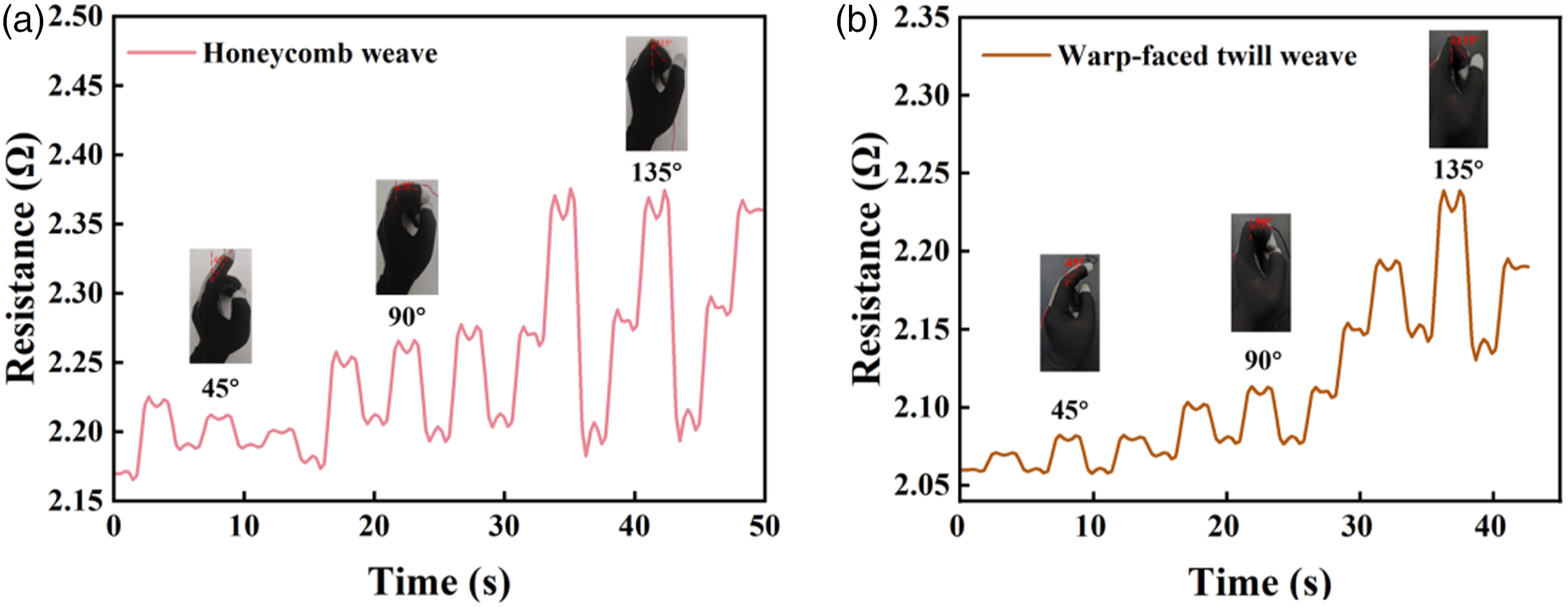
Conclusion
In this work, to explore the influence of factors on the sensing properties of fabrics, six different weaves were produced with silver-plated nylon yarns, and the influence of yarn material, external environment and different weave structure on the resistance of yarn. It was found that two factors affected conductive yarns. One is the change in resistivity caused by the change in the material of the yarns, and the other is the changed external environment of the yarns, such as moisture and elongation. As far as the fabric is concerned, its weave structure can influence its sensing performance. Throughout the continuous stretching process, the fabric undergoes two stages starting from the initial state. The first stage is when the yarn in the fabric changes from the original kinked state to the straightened state, and the second stage is when the yarn is changed from the straightened state to the yarn deformation. In this process, the transition point from the first stage to the second stage can be considered as the inflection point. The inflection point is reached at different times in fabrics with different weave structures. The tighter the weave structure of the fabric, the earlier the inflection point appears, and the looser the weave structure of the fabric, the later the inflection point value appears. At the same time, the sensitivity, fatigue resistance, repeatability, and antistatic properties of conductive fabrics with different structures were investigated. It was found that the tighter the fabric structure, the better the sensitivity and antistatic properties, the lower the fatigue resistance and repeatability; the looser the fabric structure, the lower the sensitivity and antistatic properties, the better the fatigue resistance and repeatability.
At the end of this study, a fabric with a relatively tight structure of warp-faced twill weave and a honeycomb fabric with a relatively loose weave were selected as fabric strain sensors. Together with knitted gloves, data gloves were made. And the 8-channel resistance measurement ZH-To8R-14N1 was used to record the resistance change of the fabric strain sensor when the fingers were bent at different angles. It is found that the resistance of these two fabric strain sensors varies significantly under different finger bending angles, so it can be applied to many aspects of human posture detection.
Footnotes
Acknowledgments
This work was supported by financial support from the National Natural Science Foundation of China (62201441), Shaanxi Province Innovative Talent Promotion Plan - Science and Technology Innovation Team (2022TD-29), Innovation Capability Support Program of Shaanxi (Program No. 2022KJXX-40), Natural Science Basic Research Program of Shaanxi (2021JQ--691), Scientific Research Program Funded by Shaanxi Provincial Education Department (20JK0652).
Declaration of competing interest
The author(s) declared the following potential conflicts of interest with respect to the research, authorship, and/or publication of this article: The authors declare that they have no known competing financial interests or personal relationships that could have appeared to influence the work reported in this paper.
Funding
The author(s) disclosed receipt of the following financial support for the research, authorship, and/or publication of this article: This work was supported by the National Natural Science Foundation of China (62201441), Science and Technology Innovation Team (2022TD-29), Innovation Capability Support Program of Shaanxi (Program No. 2022KJXX-40), Natural Science Basic Research Program of Shaanxi (2021JQ--691), Shaanxi Provincial Education Department (20JK0652).
