




Abstract
This paper proposes a design of a compact jeans textile wearable antenna with miniaturized structure. This textile antenna is designed for wireless broadband applications. This antenna is resonating at 3.4 GHz. This antenna is designed using FR-4, Jeans and Denim as a substrate. The shaft shape is mounted on three different substrates (FR4, denim, and jeans), and the antenna is designed, simulated, and the parameters are analyzed. In the proposed design, textile material (Jeans, Denim) is used as a substrate and copper is used to make ground & patch. The textile material is used because it is wearable, washable, very economical, and flexible. The simulated antenna parameters like bandwidth, return loss, radiation pattern, gain and efficiency are presented. The overall size of the antenna is 30 × 30 mm2. Due to its small size, the proposed antenna may have practical applications in the smart wearable textile fields.
Introduction
The development of wearable technology has gained significant attention in recent years, driven by the increasing demand for smart and flexible electronic devices. Among the various components required for wearable devices, antennas play a crucial role in enabling wireless communication. This paper presents a novel design of a compact jeans textile wearable antenna that offers miniaturized structure and excellent performance for wireless broadband applications.
Recently, wearable antennas have attracted much attention due to low-cost, light-weight, flexible, and easily integrated into clothing.1,2 We can utilize clothing as a substrate material with a copper sheet connected as an electrical component in clothing antenna structure, however this structure is prominent and rigid, inconvenient for the consumer, adds more weight, and can only be applied on a few sites on the fabric. However, in terms of conductivity and losses, such an antenna is quite effective. Another option is an antenna system made of conductive cloth that may be incorporated into a dress and maintained on the body. This sort of antenna has numerous advantages, such as being concealed, pleasant, foldable, light, and versatile. Several investigations on textile antennas have been conducted.3–6 Generally, the principal requirement for wearable antenna is based on textile materials and to integrate on the smart clothes. Conventionally, the wearable textile antenna must provide the required operating frequency and bandwidth. Simultaneously, these antennas need have omnidirectional radiation patterns. In recent years, some progresses have been made in wearable antenna.7–13 Farzad Khajeh-Khalili et al. discusses the design of a wearable MIMO antenna for wireless telecommunication and medical applications. The antenna is made of cotton fabric and a standard felt substrate, which increases the bandwidth compared to a microstrip antenna. The measured results of the fabricated antenna show good agreement with the simulations, and the antenna has a maximum gain of 8 dB at 5.5 GHz. 14
Varma et al. presents the design and performance analysis of two compact textile-based planar dipole and loop antennas for wearable communication applications in the 2.4 GHz ISM band. The antennas were fabricated on a 0.44 mm thin, camouflaged-military print, cotton jean cloth using conductive copper threads and sewing embroidery technique to create the radiating structure. The radiation pattern measurements are also reported in this work for free space and on-body scenarios. 15 Mallavarapu and Lokam discusses the design and analysis of wearable antennas for wireless communication systems. The proposed wearable antenna is tested for return loss, gain, and efficiency under different bending curvatures and proves to be robust and reliable. 16
Flores-Cuadras et al. introduces a novel ultra-wideband flexible antenna for wearable wrist-worn devices with 4G LTE communication. The antenna is built on a flexible and thin Kapton material, making it suitable for limited space applications. The antenna design is simple and can be manufactured using hybrid PCB technology. 17 Ur-Rehman et al. presents the design of a band-notched Ultra-WideBand (UWB) antenna for indoor and wearable wireless communications. The antenna uses an ultra-thin Liquid Crystal Polymer (LCP) substrate, which allows it to efficiently mitigate bending effects and perform well in on-body configurations. The performance of the antenna is analyzed through simulations and validated through measurements, showing excellent performance in the UWB frequency band. 18
Hasan et al. article proposes a compact coplanar waveguide (CPW)-fed circular monopole antenna. The antenna has a slotted circular patch and a reduced symmetrically slotted ground plane, which provide design flexibility and a broadband width, substantial gain, and consistent radiation pattern over a frequency range of 1.66–56.1 GHz. The antenna is low profile, lightweight, and low-cost, making it suitable for wideband communication. Experimental results show good agreement with simulations. 19 Zhou et al. presents a dual-band and dual-polarized circular patch textile antenna for on-/off-body wireless body area network (WBAN) applications. The antenna operates at 2.45 GHz with circular polarization and 5.8 GHz with vertical polarization. The performance of the antenna is evaluated in free space and on the body, and the effects of antenna bending are also discussed. 20
Pandimadevi et al. presents the design and simulation of a flexible wearable patch antenna using jute fiber as the substrate material. The antenna is designed to operate at a frequency of 3.23 GHz and is tested under normal, wet, on-hand, and bending conditions. 21 Memonde Paula et al. presents the construction of a breathable textile rectangular ring microstrip patch antenna for wearable applications. 22 Zhang et al. presents a new approach for designing and manufacturing a compact, low-profile, broadband, omnidirectional, and conformal antenna suitable for most wireless communication systems. The proposed antenna uses a customized flexible dielectric substrate with high permittivity and low loss tangent, and a multi section microstrip Stepped Impedance Resonator structure (SIR) to expand the bandwidth. The measured refection return loss (S11) showed an operating frequency band from 0.99 to 9.41 GHz, with a band ratio of 146%. 23
Shafique et al. presents the design and characterization of a compact and planar wearable ultra-wideband (UWB) antenna for wireless body area network (WBAN) applications. The antenna is fabricated on two different substrates: a thin and flexible high-end RT/Duroid 5880 substrate and a low-end FR4 substrate. The antenna structure consists of a rectangular radiating patch with a rectangular slot and a reduced ground plane to improve impedance matching characteristics. 24 Farooq et al. discusses the design and implementation of a frequency-reconfigurable textile antenna for wearable applications. The antenna operates in both the 2.45 GHz ISM band and the 5 GHz WLAN band, making it suitable for various wireless communication standards. The antenna is fabricated on a flexible Denim substrate and uses a single PIN diode to switch between the two operating bands. The performance of the antenna is evaluated in free space as well as on the body, and it is found to have low Specific Absorption Rate (SAR) values. 25 Malaisamy et al. presents the design of patch, spiral antenna for wearable applications.26,27 According to the published research, the design is intricate, and the patch size is huge. To address the aforementioned difficulties, a square patch with a shaft-shaped radiating element is introduced.
However, a compact wearable antenna prototype is still very challenging. Different textile materials and polymers have been proposed to be used as flexible substrates. The proposed antenna operates at a resonant frequency of 3.4 GHz, making it suitable for a wide range of wireless communication systems. The design utilizes a combination of FR-4, Jeans, and Denim materials as substrates, offering a unique integration of textile and electronics. The choice of textile materials such as Jeans and Denim brings several advantages, including wearability, washability, cost-effectiveness, and flexibility. These characteristics make the antenna seamlessly blend with clothing and provide a comfortable user experience. The antenna design incorporates copper for both the ground and patch elements, leveraging its excellent conductivity and compatibility with textile substrates. Through extensive simulations, various antenna parameters such as bandwidth, return loss, radiation pattern, gain, and efficiency have been evaluated and presented. These parameters serve as indicators of the antenna’s performance and effectiveness in wireless communication applications. With an overall size of 30 × 30 mm2, the compact form factor of the proposed antenna offers versatility in terms of integration into smart wearable textiles. Its small size opens up practical applications in various fields, including fitness trackers, healthcare monitoring devices, smart garments, and other wearable electronics. The antenna’s miniaturized structure enables unobtrusive integration into clothing while providing reliable wireless connectivity. This paper presents a wearable compact textile antenna operating at 3.4 GHz. It is flexible to suit the human body. It has low dielectric constant, which provides improved radiation. The work is arranged as follows: Initially the antenna design and antenna’s shape are elobrated, then the result and discussion are included. Finally, the signifance of the paper is presented in conclusion.
Antenna geometry
In this particular patch antenna design, there are two main components: the shaft shape and the vertical arm. The shaft and vertical arm serve as the radiating elements of the antenna, responsible for transmitting and receiving electromagnetic waves. The dimensions of the patch are provided as follows: The length (b) and width (a) of the patch are both 30 × 30 mm2, meaning the patch is a square shape with sides measuring 30 mm. The radius (r) of the shaft is 5 mm, indicating that the shaft has a circular cross-section with a diameter of 10 mm.
The vertical arm, connected to the shaft, has a length (L1) of 10.10 mm and a width (W1) of 2 mm. This arm extends vertically from the patch and contributes to the overall radiation pattern and performance of the antenna. On the back side of the antenna, there is a partial ground structure. The purpose of the ground structure is to provide a reference point and enhance the antenna’s performance by creating a proper impedance match. Lastly, the width (W2) of the horizontal arm, which is not explicitly described, is mentioned as 4 mm. This horizontal arm is likely connected to the partial ground structure and may serve as a feed line or a part of the overall transmission line configuration.
Antenna substrate(s)
A standard substate is FR-4, a type of fibreglass material covered with epoxy which is extensively used in printed circuit boards (PCBs). The thickness of the substrate is 1.6 mm, and the weight is 600 g/m2. Two of the antenna substrates consist of woven fabrics made from cotton yarns. They have a linear density of 55.6 Tex, a weight of 340 gsm for denim, 270 gsm for jeans with a twill pattern, and a thickness of 1 mm.
Shaft shape radiating element
The copper is coated on the shaft-shaped radiating element, and the width of the shaft is 2 mm. The density of copper is 8.94 g/mL. The shaft shape acts as the radiating element and is mounted on three different substrates (FR4, denim, and jeans). The antenna is designed, simulated, and the parameters are analyzed. To improve the antenna performance, certain slits are added to the shaft shape. The frequency with respect to the return loss relationship is investigated for all three substrates.
Figure 1 represents the proposed antenna and provides both front and back views. The antenna is initially designed using an FR4 substrate. To further explore the antenna’s performance and characteristics, the antenna design is extended using Denim and Jeans wearable materials. These materials are typically used in clothing which is chosen to investigate the antenna’s compatibility with wearable applications. Figure 2(a) and (b) present the front and back views of the fabricated antenna using the Denim and Jeans materials. These figures visually depict how the antenna looks with these wearable materials integrated into its design. Proposed antenna (a) front view (b) back view. (a) Front view of the proposed antenna. (b) Back view of the proposed antenna.

Result and discussion
Return loss
The performance of the suggested antenna when built on different substrates, namely FR-4, denim, and jeans are shown in the Figure 3. The antenna's resonance frequency, return loss, and S-parameters are discussed, along with corresponding figures. Initially, the antenna is constructed on an FR-4 substrate. At this configuration, the antenna resonates at a frequency of 3.19 GHz, as indicated by its resonance frequency. The return loss at this frequency is measured to be −34.95 dB, suggesting good impedance matching. Next, the same antenna design is implemented using denim as the substrate. In this case, the resonance frequency shifts to 3.48 GHz, and the return loss is recorded at −19 dB. The use of denim as a substrate slightly alters the antenna’s performance, resulting in a higher resonance frequency and a lower return loss. Frequency versus return loss plot.
Similarly, the antenna is also built on a jeans substrate, yielding a resonance frequency of 3.48 GHz and a return loss of −20 dB. The performance on the jeans substrate closely matches that of the denim substrate, with similar resonance frequency and return loss values. Figure 3 is provided to visualize the return loss versus frequency for the FR-4, denim, and jeans substrates. It shows the variation in return loss as the antenna is constructed on different substrates. The figure helps demonstrate that using denim or jeans as substrates reduces the return loss compared to using FR-4.
Furthermore, Figure 4 displays the simulated and measured S-parameters of the proposed wearable antenna. It indicates that the resonance frequency is achieved at 3.4 GHz, which aligns well with the resonance frequency obtained in the previous discussions. The measured S-parameters closely match the simulated ones, suggesting good agreement between the expected and actual antenna performance. Lastly, according to the simulation results, the S11 parameter of the designed antenna exhibits a bandwidth of 540 MHz. This bandwidth represents the range of frequencies around the resonance frequency where the antenna’s performance remains within acceptable limits. Simulate and measured S parameters of the proposed antenna.
Voltage standing wave ratio
The VSWR of an antenna is a measurement of how well its impedance matches the transmission line or system to which it is attached. A VSWR of 1 indicates a perfect match, in which all power is delivered from the source to the load without any reflections.
In an ideal scenario, the VSWR is always less than 2, indicating that no energy is reflected from the antenna. Therefore, in a practical setting, a VSWR value below 2 is desired, signifying minimized power loss and efficient energy transfer. For the antenna under the current study, the VSWR at the center frequency of 3.4 GHz measures 1.19, which is very close to the ideal value.
To provide a visual representation of the frequency versus VSWR relationship, Figure 5 is presented. This plot displays how the VSWR value varies with frequency. It helps to visualize the antenna’s performance over a range of frequencies and confirms that the VSWR at the center frequency of 3.4 GHz is close to the ideal value. Frequency versus VSWR.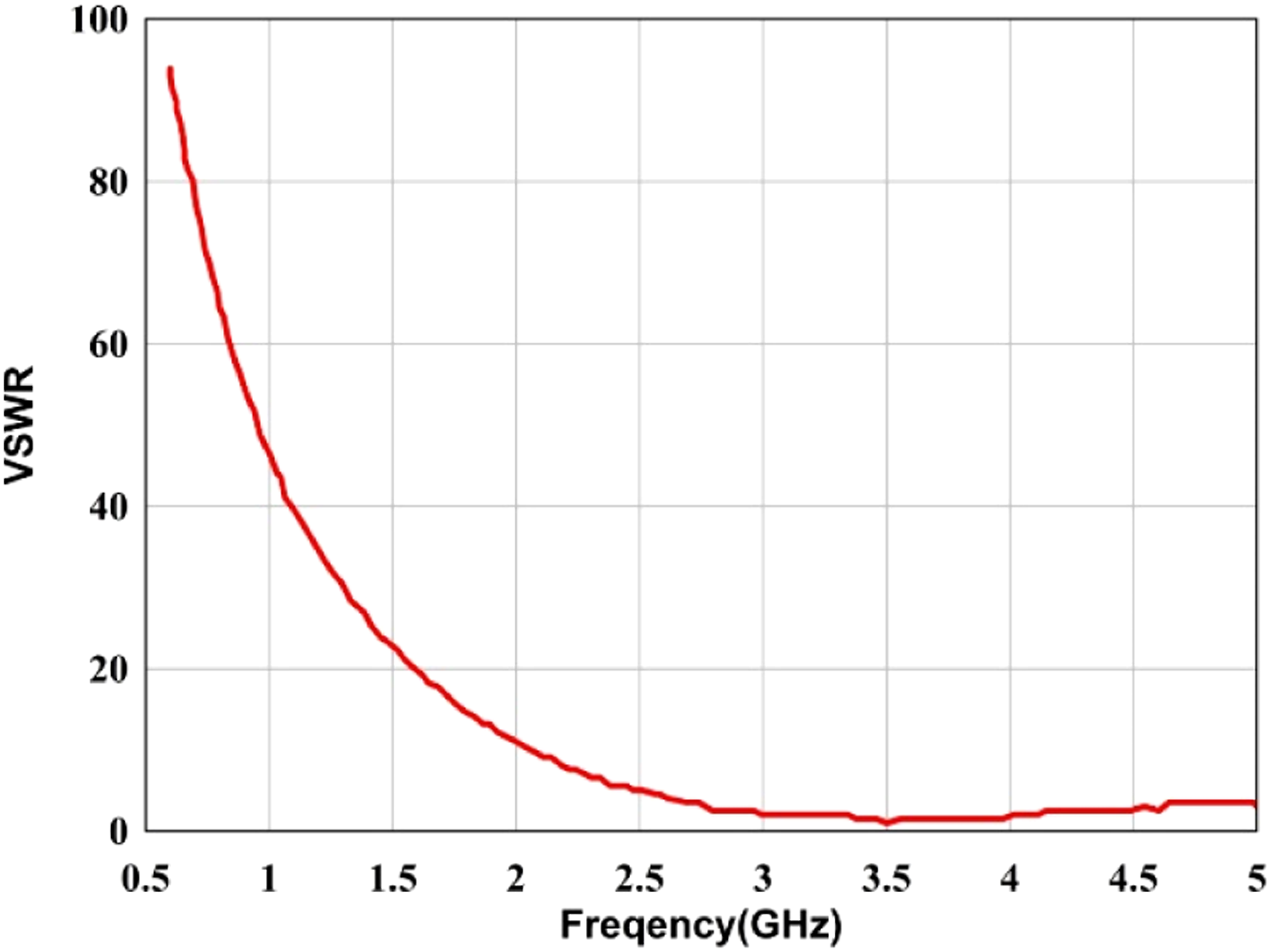
Radiation pattern
The predicted radiation patterns of the antenna in free space are depicted in Figure 6(a) and (b). Figure 6(a) shows the proposed antenna’s 3D diagram at a frequency of 3.4 GHz. It highlights that while the gain of the antenna was deemed satisfactory, it was observed that the antenna exhibits a broadside radiation pattern. In Figure 6(b), the 2-D radiation pattern of the proposed antenna is plotted at a frequency of 3.4 GHz. Radiation pattern of the proposed antenna (a) 3D (b) 2D pattern.
Surface current distribution
The surface current distribution density of the proposed antenna at a frequency of 3.4 GHz, as depicted in Figure 7. It states that based on the current surface distribution, the current flow of the antenna at 3.4 GHz is better. Surface current distribution refers to the distribution of electric current on the surface of the antenna. By analyzing the current distribution, it is possible to understand how the current flows across the antenna structure and how it contributes to the radiation of electromagnetic waves. Surface current distribution of the proposed antenna.
In this case, the surface current distribution density at 3.4 GHz is visualized in Figure 7. The phrase “better current flow” indicates that the distribution of current on the antenna’s surface at this specific frequency is considered more favorable or desired. It suggests that the current is distributed in a manner that enhances the antenna’s performance, such as improved radiation efficiency or more uniform coverage. The statement does not provide specific details about the characteristics or specific improvements observed in the current flow. However, the implication is that the proposed antenna design, at the given frequency of 3.4 GHz, exhibits a desirable distribution of surface current, which could positively impact its overall performance.
Comparison with existing literature.

Conclusion
This paper presents a novel design of a compact jeans textile wearable antenna with a miniaturized structure for wireless broadband applications. Through simulation, various antenna parameters including bandwidth, return loss, radiation pattern, gain, and efficiency are analyzed and presented. The proposed antenna demonstrates favorable performance in these aspects, validating its potential for practical applications in the field of smart wearable textiles. With an overall size of 30 × 30 mm2, the compact form factor of the antenna further enhances its usability and integration into various wearable devices. This miniaturized design opens up possibilities for incorporating wireless connectivity into a wide range of smart garments and accessories, enabling seamless communication and connectivity in everyday life. The design and analysis of the compact jeans textile wearable antenna showcased in this paper offer a promising solution for wireless broadband applications in the realm of smart wearables. The use of textile materials as substrates and the small size of the antenna contribute to its practicality and make it well-suited for integration into smart wearable textile fields.
Footnotes
Declaration of conflicting interests
The author(s) declared no potential conflicts of interest with respect to the research, authorship, and/or publication of this article.
Funding
The author(s) received no financial support for the research, authorship, and/or publication of this article.
