




Abstract
The importance of inter-yarn friction to ballistic fabric has been widely investigated. However, the couple effects of inter-yarn friction, fabric structure and number of layers have not been explored. Therefore, this paper put forward to investigate the ballistic performance of multi-layer fabric panels with different weave structure and inter-yarn friction. Three different structures (plain, sateen and UD-like), various number of layer (1-layer, 4-layer, 8-layer and 12-layer) and three levels of coefficients of friction were considered and their effects on the ballistic performance will be discussed through finite element (FE) method. The impact velocity is set as 475 m/s and the projectile is a 1 g steel flat cylinder with both the diameter and height of 5.5 mm. It has been found that the sateen fabric structure with 12-layer and higher coefficients of friction firstly reduces the projectile velocity to zero, while the corresponding plain structure and the UD-like structure reduce the projectile velocity to 125 m/s and 200 m/s individually, which indicates that when the number of layer and coefficients of friction are both much larger, the sateen fabric shows the best ballistic performance among the three structures. The reasons behind are as following. As far as the structure concerned, sateen structure has more interlacements than UD-like fabric and more straight sections than plain fabric. In addition, at higher coefficients of friction, this structure enables higher stress distribute in more layers and in larger areas than plain fabric and UD-like fabric and give rise to a layer-by-layer fracture but not fracture simultaneously.
Keywords
Introduction
With the advancement of fiber processing, the fabrics with high strength and high modulus fibers, especially filaments, are selected as the materials used for ballistic vest because of their lower density compared with metal and ceramics. Nowadays, the ballistic fabric widely used is unidirectional (UD) fabric, which is a flexible composite made from high performance filaments and resins. 1 However, this fabric is poor in air permeability and moisture penetrability. From the view of garments ergonomics, UD fabric is not comfortable for wearers. To solve the air permeability and moisture transmission, woven fabric is a better choice since the woven pattern inherits a great number of holes and pores because of the interlacement of warp yarns and weft yarns. Nevertheless, to be used as ballistic fabric, ballistic performance is of the most important requirements.2,3 Majumdar et al. 4 compared and analyzed the ballistic performance of multi-layer aramid plain fabric and its corresponding UD fabric under the ballistic impact with speed of 430 m/s and the diameter of 9 mm lead core bullet. They pointed out that the UD fabric is better than the corresponding plain fabric with respect to the ballistic performance. However, other scholars reported that the energy of projectile can be dispersed into a larger area through woven fabric by means of woven interlacement structure, leading to more energy absorbed.5–7 Owing to these advantages, woven structure is hot topic under ballistic investigations.
To woven fabrics, the woven pattern is one of the important factors affecting ballistic performance. Cunniff found that loose woven patterns and unbalanced weaves would result in inferior ballistic performance.
8
Tran et al. reported that the basket weave evidently shows more flexibility but lower energy absorption compared with plain weave.
9
Zhou et al.
10
compared and analyzed the ballistic impact energy absorption properties of single-layer weaves including plain,2/1 twill, 3/1 twill, 5-end satin and 7-end satin. It was found that plain weave has the most energy absorption and satin has the least. However, according to results from Figucia,
11
the ballistic performance of satin weave pattern outperforms basket or plain weave fabric since it has more floating straight yarns. It was reported that the transmission speed of longitudinal wave generated by shock wave in straight yarns is about
Inter-yarn friction is one of the important factors affecting ballistic performance
Based on previous investigations, although there are lots of investigations about the inter-yarn friction and structure weaves, little literatures could be found on the couple effects of weave structure and inter-yarn friction on the ballistic performance of fabrics. Different fabric structures would take effect to the ballistic performance because the crimp section and the straight proportion in one yarn in the fabric would be different. It has been found that more crimps would inferior the ballistic performance of the fabric 31 and more straight section would be much more helpful in longitudinal wave propagation. 8 Increasing the coefficients of friction would increase the ballistic performance. Since the weave structure and frictional coefficients show positive effects on the ballistic performance, it is hoped that there would be synergistic effects of the wave structure and coefficient of friction in ballistic impact. Huang et al. 32 studied the impact performance of different weaves (plain, 2/2 twill, 2/2 basket, and 3/1 twill) with different levels of coefficient of friction. Although this paper is associated with the coefficients of friction and weave structure, but it mainly focuses on low-speed impacts. The impact speed is lower than 30 m/s. However, the couple effects of weave structure and coefficients of friction on the ballistic performance of fabrics subject to high-velocity have not been investigated, especially multi-layer fabric system. Thus, this paper adopts the FE method to study the energy absorption mechanism of three types of fabric structures including UD-like, plain and sateen fabric in case of different layers and coefficients of friction levels under the high-velocity of ballistic impact. The experimental method is not suitable since the coefficients of friction are difficult to be improved to a larger extent by experimental method without other properties unaffected.33,34 In the FE simulation, the coefficients of friction and the structure of the fabric could be easily configured. Based on the FE models, the effects of parameters with respect to woven fabric architecture, coefficients of friction and number of layer on ballistic performance concerning energy absorption and stress distribution would be further dug out. Through those critical parameters analyses, it is expected that a new method would be obtained for engineering and developing of higher-performance ballistic fabrics.
Finite element modeling
The fabric parameters
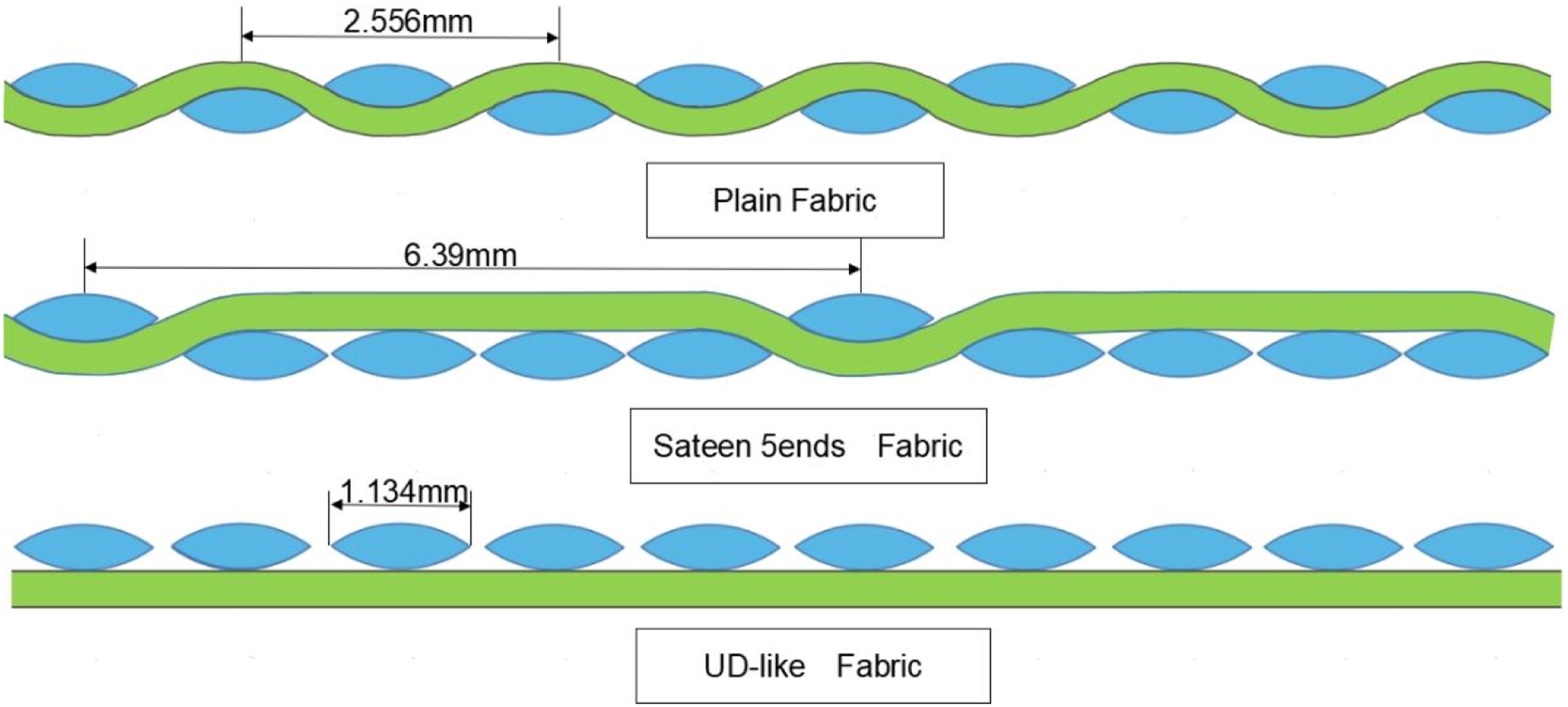
In this paper, three fabric patterns are modeled, including plain fabric, sateen fabric and UD-like fabric. The UD-like fabric is different from the current UD structure, which is just modelled as straight yarns and laminated in 0°/90° but without resin in it. The three fabric structures are selected because the crossovers in plain, sateen fabric and UD-like fabric is sequentially decreasing. In other words, the straight fragment in the yarn in the three above fabrics increases sequentially, as shown in the following pictures (Figure 1). The sateen fabric is a kind of 5-ends with step number of three. The schematics of those fabrics are shown in Figure 2. The warp and weft density are same and set as 7.8 ends/cm. The areal density for the three different fabric patterns is designed to be identical, which is set as 153.61 g/cm2. All the fabrics are constructed from yarns with a linear density of 93 tex. For all the three fabric patterns, the yarn cross-sections are supposed as convex lenticular. The largest thickness of it is set as 0.105 mm and the width of it is set as 1.134 mm. In UD-like fabric, the yarn path is straight for both of warp and weft yarns. To plain fabric, one unit of wavelength is 2.556 mm. To sateen fabric, one unit of wavelength is 6.39 mm. The three fabric structures (a) plain structure (b) sateen structure (c) UD-like structure. The dimension size of the yarns in different fabric structure.
The modelling of fabric panels and projectile
For each fabric pattern, four types of fabric panel are modelled and they are 1-layer, 4-layer, 8-layer and 12-layer individually. The corresponding three multi-layer fabric panel models are shown in Figure 3(a)–(c). The fabric in the current model is square and with the length of 7.54 cm. The coordination of the warp yarn is along the X direction and the weft yarn along the Z direction in the 3-D space. The projectile is generated to have the same geometry parameters as that in the ballistic impact experiment described in ref. 29. The projectile is a steel flat end cylinder with both the diameter and height of 5.5 mm. Both yarn and projectile are meshed by C3D8R elements, indicating a solid element type of 8-node linear brick, reduced integration, and hourglass control. The cross-section of the yarn has been meshed with ten elements, which is determined from the computational accuracy of the model and mesh sensitivity. The analysis used in this research is ABAQUS/Explicit. The fabric is placed in the X-Z plane and the projectile is impacted by the negative Y direction. Since sateen fabric pattern is not symmetric, the projectile is positioned in the center of all the fabric panels. All the freedoms of the projectile movement are restricted but it is allowed to move along the negative direction of Y-axis. The four sides of the fabric model are given fixed boundary conditions. The models for three fabric patterns, the dimension of yarns and projectiles. (a) UD-like fabric (b) plain fabric (c) sateen fabric with 5 ends and step 3 (d) projectile length (e) projectile diameter (f) the modelled projectile.
Material properties

The mechanical properties of Twaron® yarns and the projectile. 29

Coefficients of static friction and kinetic friction.

Validation
Before analyses, the validation of established models should be performed. In previous time, our team have published papers about the effects of inter-yarn friction on the failure of fabrics upon ballistic impacts.28,29 In these papers, the validation process is presented in details. The plain fabric model in current paper is same to the model in those papers and the impact condition is also same, so the validation process is no longer presented again. The difference among plain fabric, UD-like fabric and the sateen fabric is just the structure and all the other parameters are same in these three fabric models.
Results and discussion
Energy absorption
Figure 4 shows the time history of projectile velocity for the three fabric patterns at the three inter-yarn friction levels and four-layer number conditions. The slop of the curve represents the speed of projectile reduction and the transfer point that the curve gradually becomes flat is the failure moment of a panel. To the 1-layer and 4-layer fabric panel, the difference of overall energy absorption is most caused by the speed of projectile reduction. To the 8-layer and 12-layer ones, the slops of the plain fabric and sateen fabric panels are almost same but much steeper than the UD fabric panels. However, the sateen fabric panel presents the longer failure time than plain fabric. This has explained why the sateen pattern is the best for 12-layer fabric at all coefficients of friction. It's worth noting that the results in multi-layer fabric cases differ from those in single-layer fabric cases, where the sateen weave can perform best when the number of layers is sufficient and coefficients of friction is higher. The reasons may be as following. When the number of layers is single and coefficients of friction are lower, the sateen fabric structure is too loose, which can’t provide more resistance to the projectile. When the number of layers and coefficients of friction is increased, the sateen structure in ballistic energy absorption is highlighted. It inherits long float and interlacement. These floats are straight, which can make the longitudinal wave propagate fast. The interlacement transmits the stress from one yarn to the other crossed yarns, enable the stress distribute in larger area. Time history of projectile velocity for different multi-layer fabric panels.
Figure 5 shows the overall energy absorption of three fabric patterns at three coefficients of friction levels and 4 number of layer conditions. Compared with the overall energy absorption of 12-layer sateen fabric structures at CSF of 0.1 and CKF of 0.05, the overall energy absorption of it at CSF of 0.5 and CKF of 0.45 are greatly increased and more than 60%, but when the coefficients of friction are further increased, the overall energy absorption of it is not significantly increased. This finding indicates that the multi-layer sateen fabric with proper higher coefficients of friction can achieve a much higher energy-absorption. Overhigh inter-yarn friction contributes less to the ballistic performance and this findings has been witnessed in many papers.17–19 The overall energy absorption of three fabric structures at four number of layer cases and three levels of coefficients of friction.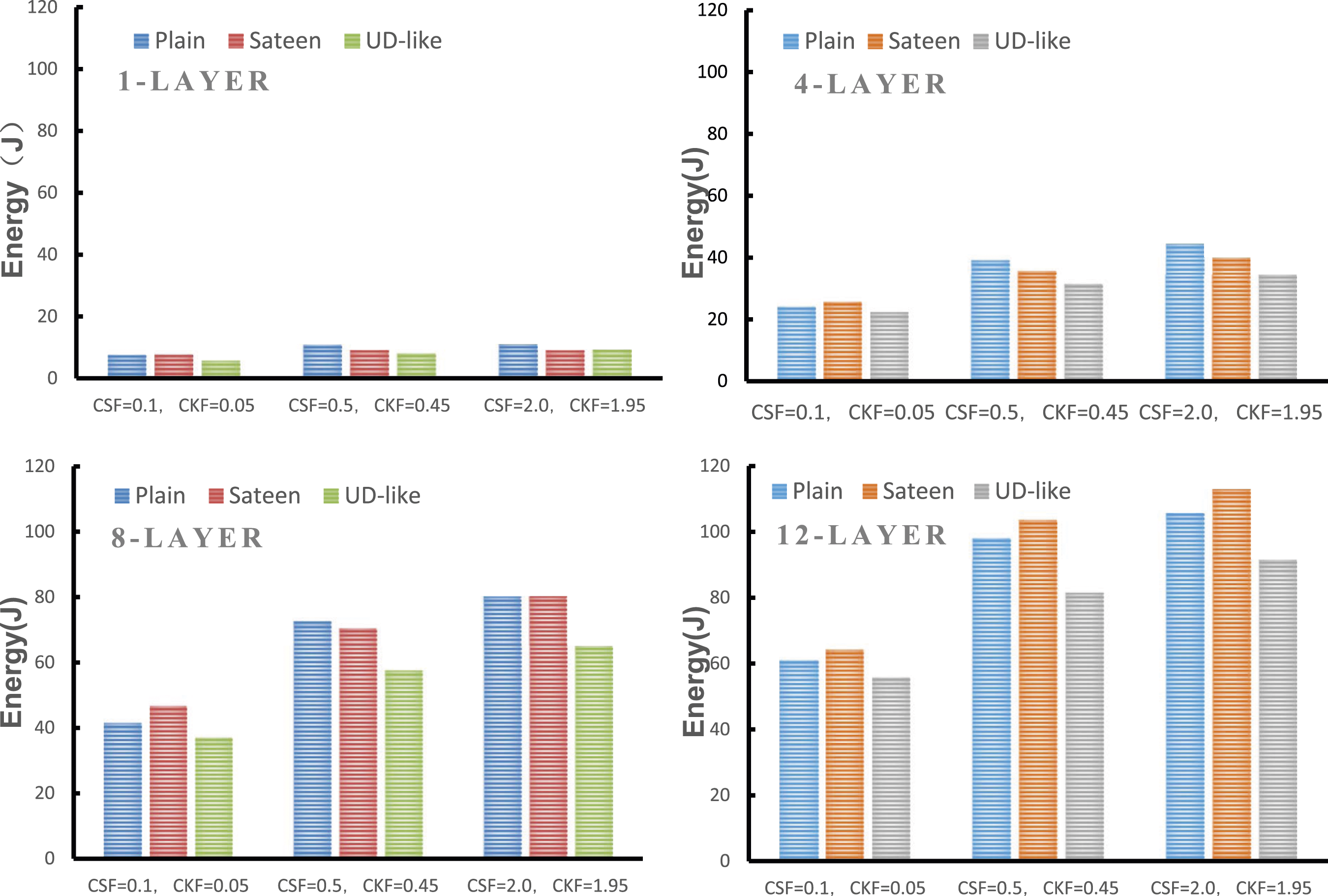
Stress distribution
Through above analyses, as the number of layers increases, the sateen fabric with higher coefficients of friction outperforms others with respect to ballistic performance. The reasons behind these phenomena are worth further exploring. Since the failure mechanisms of the multi-layer fabric panels are more related to the stress distribution on different layers, it is necessary to analyse the stress distribution to 12-layer fabric panels for the three fabric patterns at different coefficients of friction.
Figures 6–8 show the stress distribution on each layer for 12-layer fabric panel at 10 µs, 20 µs and 30 µs, respectively. The stress mentioned here is the Mises stress26. At 10 µs, to all the three patterns, there is a similar trend on the stress distribution with the increase of coefficients of friction, where the stress is distributed on much larger areas and the shape of stress area is more circular-like. Moreover, at higher coefficients of friction, the structure integrity of the first three layers is better kept. In addition, at higher coefficients of friction, the area of higher stress occupied to the sateen fabric from third layer to 10th layer is larger than those corresponding layers of plain fabric and UD-like fabric, which means sateen structure has the capacity of reducing stress concentration. At 20 µs, for the three patterns, almost the first 10 layers are broken at lower coefficients of friction, but at higher coefficients of friction, there are still 11 layers, 12 layers and 6 layers kept intact to plain fabric, sateen fabric and UD-like fabric individually. At this moment, the capacity of sateen fabric reducing stress concentration is much more obvious because the number of layers in sateen fabric taking more stress in the impact center is more than that of plain and UD-like fabric. At 30 µs, for 12-layer UD-like panel, all the layers totally fail no matter what the coefficients of friction they are and the 12-layer plain and sateen fabric just totally fail when the coefficients of friction are lower. In the higher coefficients of friction, for the plain one, the first 7 layers totally break but the last 5 layers partly break while for the 12-layer sateen fabric panel, there are still 6 layers that withstand the force intact and undamaged. This indicates that the sateen fabric can hold on longer. Compared with plain fabric, the sateen fabric has longer straight floats, and compared with UD-like fabric, sateen fabric has more interlacements. It has been demonstrated that the straight yarns show fast stress propagation speed
12
and the cross-section can diverse the transmission direction from primary yarns to secondary yarns.
4
The longer straight float of sateen fabric can transmit the stress in the center out much faster and the interlacement can transfer the stress from one yarn to the yarns crossed with it. Hence, the sateen structure can outperform the other two fabric structures regarding ballistic performance. The stress distribution on each layer for 12-layer fabric panel at 10 µs. (a) CSF of 0.1 and CKF of 0.05;(b) CSF of 2 and CKF of 1.95. The stress distribution on each layer for 12-layer fabric panel at 20 µs. (a) CSF of 0.1 and CKF of 0.05;(b) CSF of 2 and CKF of 1.95. The stress distribution on each layer for 12-layer fabric panel at 30 µs. (a) CSF of 0.1 and CKF of 0.05;(b) CSF of 2 and CKF of 1.95.


Failure modes
In the impact center, the primary yarns would simultaneously subject to the tensile stress and shear stress. The failure of the primary yarns means the failure of the fabric layer. The primary yarns are those yarns which directly contact with the projectile. Tensile stress is a type of stress that propagates along the yarn axis and shear stress is the stress from the action of projectile edges. Five ends of warp yarns in the first, fourth, eighth, and 12th layer in the fabric panels are selected as the representatives of the primary yarns. The first layer is the layer directly contacting with the projectile. The 12th layer is the one farthest from the projectile. The fourth and eighth are two layers in the middle. These four layers are selected in order to make sure that there are equal number of layers intervals (i.e., three layers) between the selected layers. The effects of fabric structure and the coefficients of friction on the tensile stress and shear stress distribution on those primary yarns will be discussed in the following sections.
The effects of coefficients of friction
The tensile stress distribution to the selected yarns at two coefficients of friction conditions and at different time points are plotted in Figure 9. At 5 µs, the amount of tensile stress in the primary yarns in each layer at CSF of 0.1 and CKF of 0.05 is different, where the primary yarns in the first, fourth and eighth layer bear less while the ones in 12th layer bear more. At this moment, the tensile stress taken by the primary yarns in the case of CSF of 2.0 and CKF of 1.95 in the 12th layer is less compared with that in the other layers. In addition, the distance of the yarns under tensile stretch is shorter in the case of CSF of 2.0 and CKF of 1.95 compared with that in the lower coefficients of friction. At 10 µs, the tensile stress is almost distributed on each primary yarns in each layer in lower coefficients of friction but the tensile stress is just concentrated on the primary yarns in the first and fourth layer in higher coefficients of friction. At 20 µs, the primary yarns in the first, fourth and eighth layers at CSF of 0.1 and CKF of 0.05 are totally broken and only those yarns in 12th layer are still under some tensile stress. At CSF of 2.0 and CKF of 1.95, the primary yarns in the first layer are broken, and the tensile stress is more in the primary yarns in fourth layer than those in the eighth layer and 12th layer. Based on the above analyses, the primary yarns at higher coefficients of friction would not bear the same amount of tensile stress, but gradual attenuation with the layer position. This type of tensile stress distribution is because the higher coefficients of friction would make the fabric a little bit stiffer.
28
Compared to the front layers at lower coefficients of friction, they need more force from the projectile to make the front fabric to deform. Figure 10 is the strain energy absorbed by different layers. The strain energy is caused by the deform of the fabrics. Normally, the layer which is positioned much more in back would absorb more strain energy since they last for longer,
35
as the tendency of strain energy of different layers in lower coefficient of friction. However, at higher coefficients of friction, the strain energy absorbed in the first five layers are much higher than that in the middle layers (sixth and seventh layers), which means that the first five layers in higher coefficient of friction consume more projectile impact energy in strain, which indirectly proofs above analyses. The tensile stress distribution on the 12-Layer sateen fabric panel at different coefficients of friction. The strain energy absorbed by each layer in 12-layer sateen fabric.
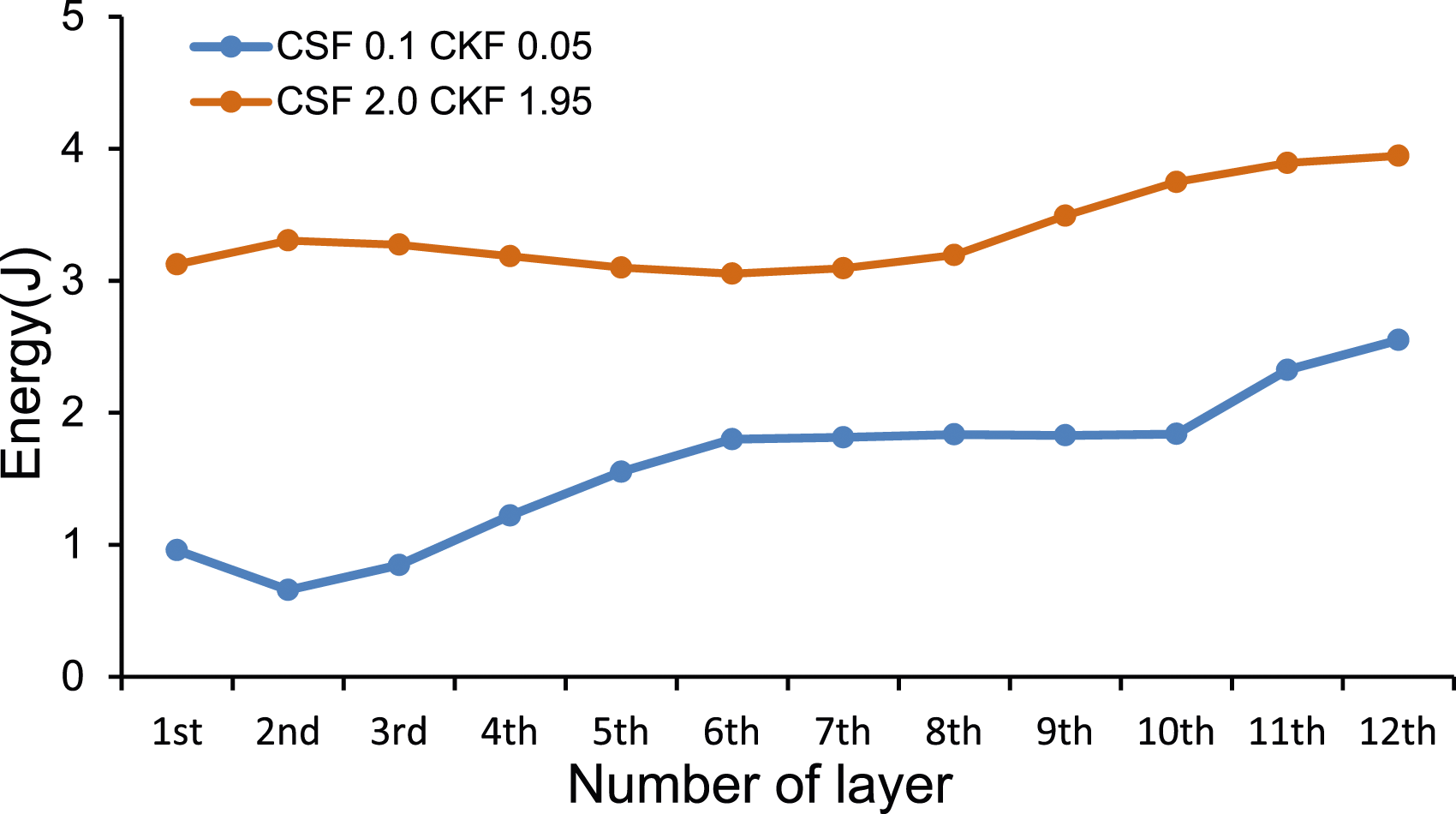
Figure 11 shows the shear stress distribution on the 12-layer sateen fabric panel at different coefficients of friction. At 5 µs, the first layer bears more shear stress at higher coefficients of friction than that at lower ones and the amount and the area of shear stress in the other 3 layers are almost same to the two levels of coefficients of friction. At 10 µs, the first, fourth and eighth layers bear more shear stress at higher coefficients of friction than the corresponding layers at lower case. At 20 µs, at lower coefficients of friction, since the fabric layers of first, fourth and eighth already fail, the shear stress on those layers is almost gone but the 12th layer just bears some shear stress. On the contrary, at higher coefficients of friction, the fourth, eighth and 12th layer bear more shear stress and the area of shear stress distributing on is larger. On a whole, in the whole process, the sateen fabric panel with higher coefficients of friction bear much more shear stress than that with lower one. The reason is also that the higher coefficient increases the stiffness of the fabric so that the capacity of sateen fabric with higher coefficients of friction to the shear action is enhanced. The shear stress distribution on the 12-Layer sateen fabric panel at different coefficients of friction.
The effects of fabric structure
Figure 12 shows the tensile stress distribution on the primary yarns in different fabric structures at CSF of 2.0 and CKF of 1.95. At 5 µs, the tensile stress in plain fabric, sateen fabric and UD-like fabric shows such a trend that the distance it propagates is longest in UD-like fabric, and shortest in plain fabric. The distance in sateen fabric is in the middle. It was reported that the less crossover in the fabric, the faster that the tensile stress wave would transmit to.
12
In these three fabric structures, UD-like fabric doesn’t have the crossovers and plain fabric has most crossovers, so the tensile stress propagation speed of sateen fabric is lower than UD-like fabric but higher than plain fabric. At 10 µs, the tensile stress wave arrives at the end of primary yarns and some of them reflect. Compared with plain fabric, the tensile stress wave in the primary yarns of UD-like fabric and sateen fabric reflects more compared with that in the plain fabric. Although the tensile stress wave of UD-like fabric propagates fastest among those three fabrics but the structure of it is the loosest since there is no interlacement in this structure. It was reported that the loose structure would deteriorate the ballistic performance.
8
Hence, the fourth layer in UD-like fabric panel breaks earlier at 20 µs. At 30 µs, the 12th layer of UD fabric panel totally breaks and that of plain fabric panel partly breaks while the 12th layer in sateen fabric is still intact and only 3 primary yarns are partly broken for eighth layer. The plain fabric panel fails earlier than sateen fabric because the tensile stress wave propagates slower. Based on the above analyses, among those three structures, the sateen fabric stands out. The tensile stress distributed on the primary yarns in different fabric structures.
Figure 13 is the shear stress distribution on the three fabric structures. It seems that there is no significant difference between 5 µs and 10 µs. At 20 µs, UD-like fabric panel has already failed more layers than plain fabric panel and sateen fabric panel, and the shear stress concentrate on the more layers in plain fabric and sateen fabric. At 30 µs, the UD-like fabric panel is completely no longer in force and the plain fabric panel almost totally fails, so the shear stress is almost gone in these two panels. There are still some shear stress in the selected eighth and 12th layer of sateen fabric since the sateen fabric doesn’t thoroughly lose efficacy at this moment. From the analyses above, the shear stress distribution in these three fabric panels is just depend on the state of the primary yarns and the structure show little effects on the shear stress distribution. The shear stress distributed on the primary yarns in different fabric structures.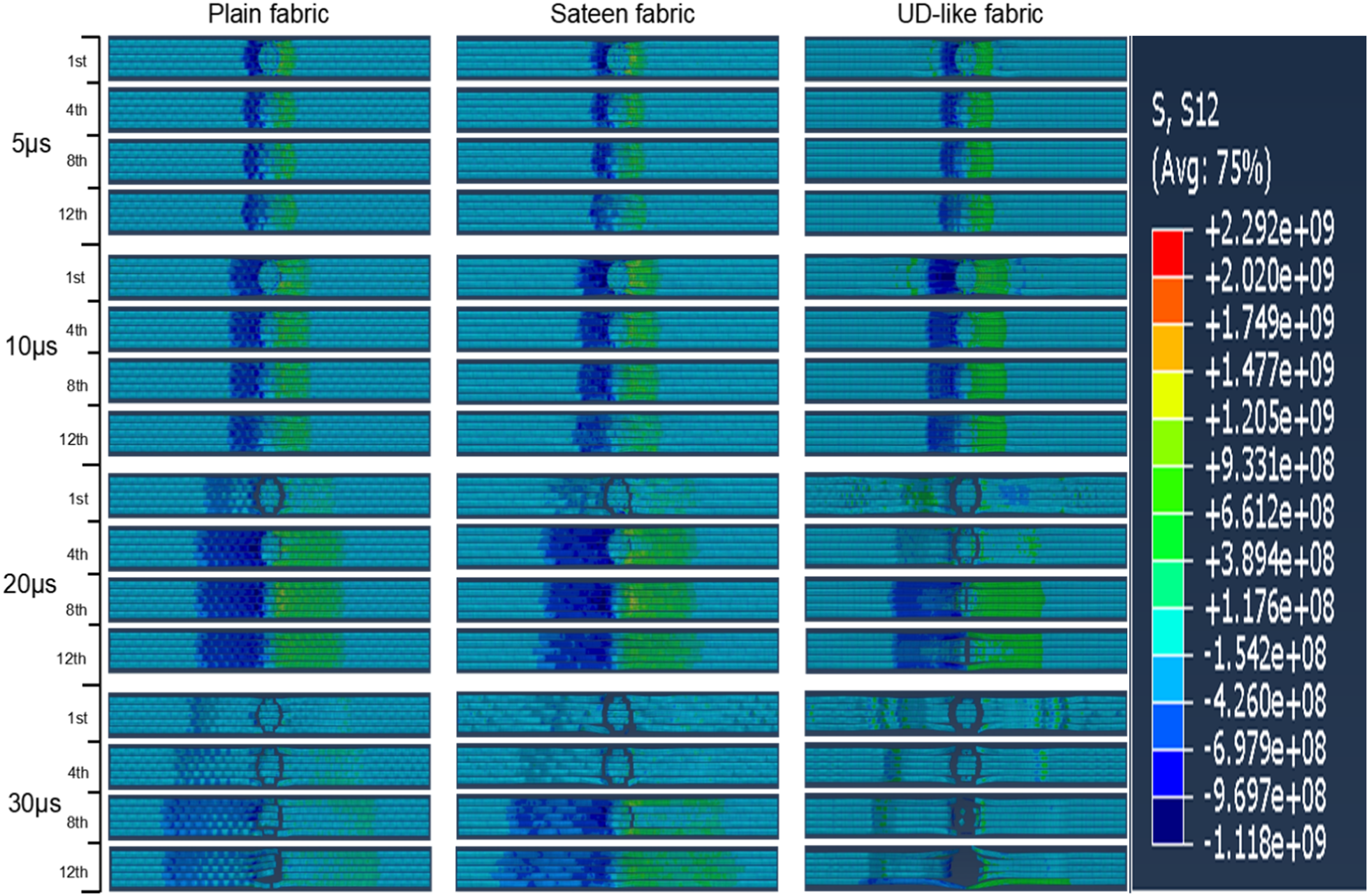
Conclusion
This paper has investigated the ballistic performance of three types of woven fabric pattern, including plain, sateen and UD-like with 1-layer,4-layer, 8-layer and 12-layer under lower and higher coefficients of friction by means of FE method. The energy absorption and stress distribution has been analyzed. For the multi-layer fabric system, the couple effects of fabric structure and the coefficients of friction play an important role in the energy absorption and stress distribution.
Compared with UD-like and plain fabric structures, sateen fabric structure becomes the best structure with respect to energy absorption with layer number of 12 and CSF of 2.0 and CKF of 1.95. The reason is that the satin fabric has both a plain weave interweaving structure and a straight yarn structure in the UD-like fabric. This characteristic is very helpful for sateen fabric in distributing the impact stress. The longer straight float of sateen fabric can transmit the stress in the center out much faster and the interlacement can transfer the stress from one yarn to the yarns crossed with it. The effects of coefficient friction are prominent to multi-sateen fabric because the tensile stress and shear stress of primary yarns in different layers at higher coefficients gradually attenuate as the layers of fabric are placed further back, resulting in layer by layer failure and make every layer contribute more. The weave structure plays a role on the tensile stress and it is proved that the straight yarn is much faster in transmit the tensile stress out than the crimped yarns.
With the investigation in this paper, sateen fabric with higher coefficient of friction provides a new method for future higher-performance ballistic vest design. In addition to the energy absorption of the fabric panel, the deformation of the fabric panel is another important property to the ballistic vest since the deformation of the fabric panel represents the blunt trauma that would be brought to the body. In the future, the deformation property of different multi-layer fabric panels needs to be further figured out.
Footnotes
Declaration of conflicting interests
The author(s) declared no potential conflicts of interest with respect to the research, authorship, and/or publication of this article.
Funding
The author(s) disclosed receipt of the following financial support for the research, authorship, and/or publication of this article: This paper is supported by Textile Vision Science & Education Foundation(J202205), and Discipline Strength Enhancement Plan of Zhongyuan University of Technology (GG202216) and the Fundamental Research Funds of Zhongyuan University of Technology (K2022YY002), and the Natural Science Foundation of Zhongyuan University of Technology(K2022QN021) and the School Start-up Fund Project of Changzhou University (ZMF21020365), and by 4th Leading Innovative Talents Cultivation Project of Changzhou City (CQ20210106).The whole work is also supported by Collaborative Innovation Centre of Advanced Textile Equipment and Technology Co-funded by MOE and Henan provincial Government and Henan International Joint Laboratory of New Textile Materials. The Ballistic Research Group at the University of Manchester is also gratefully appreciated.
