




Abstract
A new welding protective clothing system has been proposed to enhance the protective performance, comfort, and safety of welding protective clothing, considering the hazards associated with welding processes. The structure and fabric of the protective clothing carrier were redesigned, and a safety and protection system based on Internet of Things technology was developed. Objective tests and subjective evaluations were conducted on the protective clothing system. The results of objective tests showed that compared to regular welding protective clothing, the new protective clothing exhibited significant improvements in flame resistance, light resistance, and mechanical performance, with relatively lower vapor resistance. In subjective evaluations, the subjective evaluation scores (on a 5-point scale) of the new welding protective clothing were 26.46% and 27.95% higher than those of regular welding protective clothing, respectively (p ≤ .05). Furthermore, the protective clothing system demonstrated a highly sensitive monitoring and feedback mechanism during testing, which can enhance workers’ ability to withstand risks and improve their psychological safety. The research on welding protective clothing with safety functions not only provides reference for innovative design of traditional welding protective clothing, but also lays a theoretical foundation for further research on other types of protective clothing.
Keywords
Introduction
Welding is one of the specialized operations that is crucial for current industrial production and facility maintenance. 1 Welding is widely used in China by various sectors. In the machining industry, welding is a high-density activity, especially for manufacturing and repairing ships, containers, automobiles, pressure vessels, and other industrial products. 2 With the development of mechanization, the use of mechanized equipment for welding operations is increasing,3–5 However, in developing countries, welding activities are still often performed manually, and therefore, attention must be paid to the safety of welders.6,7
Welding protection clothing is a crucial measure to preserve the individual safety of welders since it can shield most body parts from externally harmful substances and is frequently referred to as the second skin of the human body. 8 The flame-retardant performance of materials, thermal and humidity comfort are the main topics of current research for welding protective clothing. For example, Wei 9 studied the effect of graphene coating on the thermal conductivity of welding protective clothing fabrics and found that graphene coating could reduce the temperature rise of the fabric about 30% from 27°C to 19°C. Stefan Bauer 10 conducted a series of analyses of light protection measures for welding protective clothing and proposed an improved method for welding protective clothing based on the idea of solar ultraviolet protection factor. Kim et al. 11 evaluated the performance of materials for protective clothing used for welding in a hazardous shipbuilding work environment and found that among the materials selected, carbon dioxide/aramid blended fabrics appeared to be suitable for welding protective clothing. Cui et al. 12 developed four new welding garments based on ergonomic principles and tested these garments for ease of donning and doffing, motor dexterity, and visual performance.
Based on an analysis of existing research, the monitoring of risk factors that arise during welding operations to meet the needs of welders’ physiological and psychological safety is clearly lacking in the current studies. 13
As a result, this paper began by analyzing the design method of welding protective clothing from the perspective of environmental factors and worker needs. Next, the basic performance and functionality of the protective clothing were discussed in depth respectively, which served as the foundation for designing and manufacturing the protective clothing. After testing and verifying the designed welding protective clothing system, suggestions for improvement and potential directions for future development of the welding protective clothing were summarized and proposed.
Design method
Basic property
The most frequent welding materials used in welding operations are different kinds of metals, each of which has a very different melting point. The melting point produced during welding is easily spewed onto clothing, where it can cause melt holes and possibly injure people’s skin. So, the fabric of welding protective clothing should perform well against the impact of molten metal and have good flame retardant properties. 14 Second, because welding protective clothing must be frequently chemically cleaned, there are strict specifications for the fabric’s tearing and breaking strengths. Furthermore, there are stringent requirements for the light resistance of protective clothing when a welding arc is present. 15

Function
In addition, the high temperature environment makes it simple for workers to experience heat stress, 21 and dangerous gases in the air (like carbon monoxide) can result in a range of adverse reactions, including fainting and shock. For these reasons, it’s crucial to continuously monitor workers’ physiological indicators (such as heart rate, blood oxygen, body temperature, etc.).
Design scheme
Fabric
Fabrics for welding protective clothing must meet strict requirements, including wear-resistance, light-resistance, flame-resistance, and other qualities. In this paper, a new triple -layer composite protective fabric was used as the main fabric of protective clothing, in which polyimide composite material (Kaidun New Material Co., China) serving as the outer shell, Kevlar®-29 fiber (E. I. du Pont de Nemours and Company, USA) serving as the insulation layer, the blend of 50% flame-resistant viscose (Xinneng Textile Technology Co., China), 40% CoolMax® fiber (DuPont, USA) and 10% Merino wool (Aoyang Fleece Co., China) fiber serving as the inner layer of the protective clothing. The three-layer structure of the fabric is shown in Figure 1. Schematic diagram of the three-layer structure of the fabric.
As one of the best organic synthetic fibers for high temperature resistance, polyimide composites can withstand temperatures between 250 and 350°C and perform better than aramid and polyphenylene sulfide fiber in terms of light resistance, water absorption, and heat resistance.22,23 Kevlar® fiber has a unique combination of toughness, strength, and high temperature resistance, which can improve the fabric’s ability to provide thermal protection. 24 CoolMax® fiber is a moisture-wicking and breathable fiber developed by DuPont, with strong breathability and good moisture control, thus enhancing the comfort of the wearer. 25 Merino wool fiber was used to further enhance the contact comfort of the fabric. The warp density of the fabric was set to 300 ends/10 cm, and the weft density was set to 250 picks/10 cm.
Phase change materials have been shown to reduce the risk of thermal radiation and thermal exposure in high temperature environments.26,27 The microencapsulation of phase change materials can solve the problem of melt exudation of phase change materials during the phase change process, improve the environmental adaptability of phase change materials and expand their applications. In this study, the PCM slurry was applied to the inner fabric by dry coating process using an automatic coating squeegee.
28
The phase change material was made of paraffin wax with a melt temperature of 35°C, which is below the skin burn threshold (44°C), in order to absorb more heat before the skin burns.
29
The cross-section of the fabric is shown in Figure 2. Schematic diagram of the cross section of the fabric.
Meanwhile, considering the requirements of moisture-wicking performance of underwear in the high-temperature environment during welding, a blend of CoolMax fiber and cotton fiber was designed to make the underwear. Moreover, to meet the subsequent functional needs, the fabric on the lower front chest of the underwear was replaced with a stainless-steel fiber fabric (as shown in Figure 3). Structural design and hardware placement of protective clothing.
Clothing structure
The split design was used in the overall design of the garment for ease of operation. The pants were designed with a more stable back strap.
To match the lower circumference size of the welding mask and to prevent molten metal droplets or fumes from touching the skin of the neck, the collar of the garment was designed as a lapel. In addition, buttons were set at the cuffs and leg openings, which can be fastened to prevent molten metal droplets or soot from entering when working. In order to enhance the warning effect of the clothing, aramid reflective tapes (3M China Co., Ltd, China) were added at the chest, back and small arms of the clothing. In addition, according to ergonomic principles, additional heat sink holes were added in the armpits and back of the clothing, which are not susceptible to the molten metal droplets, to increase the amount of upper arm movement while enhancing the moisture wicking effect of the garment and improving comfort (as shown in Figure 3).
Function system
Main control unit
Arduino Lilypad development board (Arduino, Italy) was used for this system to carry out the control of related functions. LilyPad is a microcontroller board designed for wearable technology and electronic fabrics, which supports Arduino development mode. The development board was equipped with Atmel-ATmega328 as the main control unit, which can work at 2.7∼5.5 V, with the advantages of small size, low power consumption and stable working condition.
Fume and hazardous gas monitoring unit
Types of fumes and hazardous gases produced in welding.
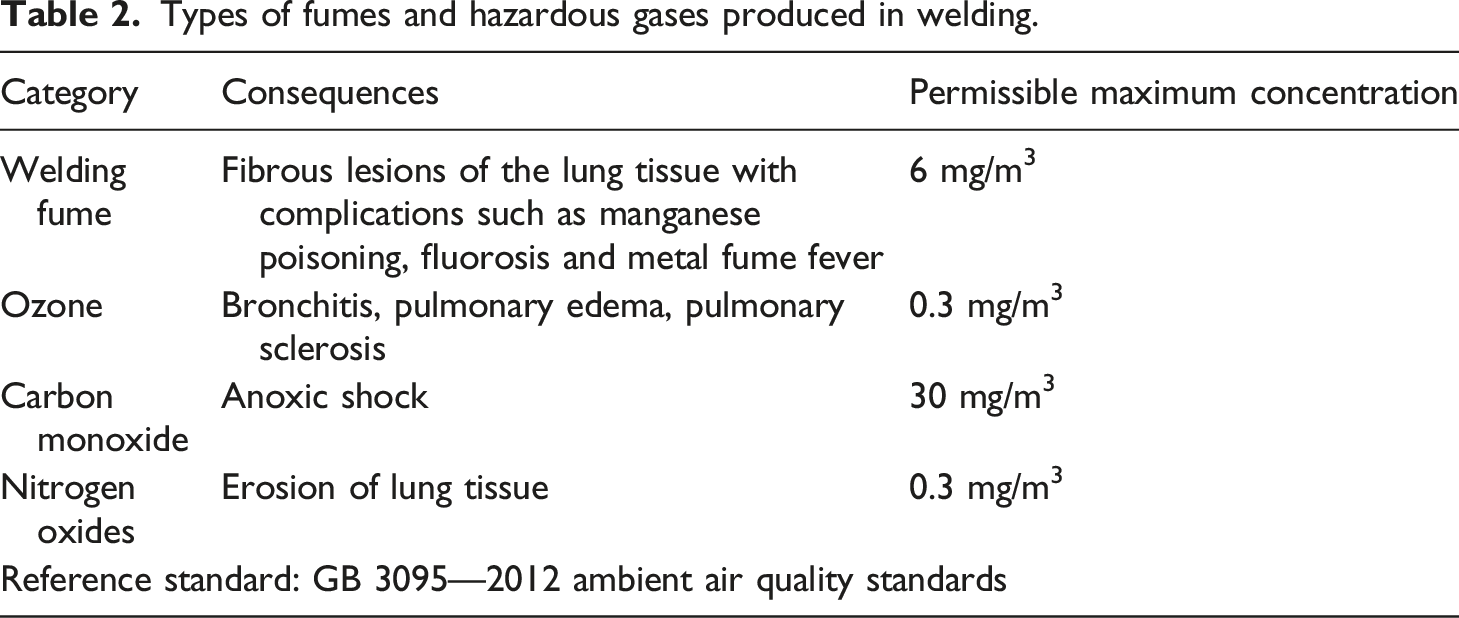
In this system, GP2Y1014AU sensor (SHARP, Japan), MQ-131 sensor (Winsen, China), MQ-7 sensor (Winsen, China), MQ-135 sensor (Winsen, China) were used to monitor the concentration of fume, ozone, carbon monoxide, nitrogen dioxide in the environment, respectively.
Wireless data transmission unit
The ESP32-PICO-KIT (Loxin, China) was used to implement the wireless data transmission function in order to remotely view and simultaneously monitor multiple people and multiple devices, as well as transfer data related to hazardous sources in the environment to the computer.
The ESP32-PICO-KIT supports two wireless communication means, Wi-Fi and Bluetooth, and is the smallest development board developed by Loxin, which can achieve multiple functions with minimum components. The Internet of Things (IoT) platform was constructed using the ESP32 and Lilypad modules, and the MQTT (Message Queuing Telemetry Transport) protocol was used to implement one-to-many data transmission and distribution (as shown in Figure 4). Schematic diagram of data transmission.
A front-end web interface was used for data reception and presentation in this study (as shown in Figure 5), and MQTT protocol was used to communicate between the ESP32 module and the web to obtain the environmental data detected by the sensors, MQTT is a communication protocol developed by IBM (International Business Machines Corporation) to provide a lightweight and reliable binary communication setting for sensors, which makes it very easy to develop communication between MQTT and the IoT and machines. WebSocket can be used on the web side to connect to the MQTT protocol and transfer messages, which has a quicker response time and better performance than conventional MQTT transfers and does not require the server where FastWeb is located to relay messages. At the same time, TTL(Time To Live) mode was used for the ESP32 module at the output. Design of the web page for data transmission.
Physiological monitoring unit
The high temperature, fumes and harmful gases generated during welding operations may damage human organs and cause heat stress, hypoxic shock and other symptoms, so it is also important to monitor the physiological indicators of welders. In this study, a self-developed electrocardiogram (ECG) and temperature monitoring device was used to monitor workers’ heart rate and body temperature. 31
Considering the impact of worker activity on signal stability, the module was fixed at the lower chest where the body activity is relatively low, and the Kalman filtering were used to preprocess the ECG data. Its main steps include initializing the state vector and covariance matrix before reading the data, predicting the state based on the previous state vector and covariance matrix using the state transition equation, updating the predicted state vector and covariance matrix based on the observation data and observation matrix, saving the updated results, and repeating the prediction and update steps (as shown in Equation (1)–(5)).
Prediction steps:
Status prediction:
Covariance prediction:
Update steps:
Kalman gain:
Status update:
Covariance update:
Considering that the module eventually needs to be equipped on the underwear, the ECG signal and body temperature data collected by the module were sent to the computer host computer by means of independent Bluetooth communication.
Alarm unit
From the perspective of enhancing the operational safety and psychological safety of welding workers, a buzzer (Risym, China) equipped at the collar of the garment was used to warn workers in timely when the concentration of fume or hazardous gases exceeds the standard. At the same time, in order to enable managers to understand the related information of the operating environment and to monitor multiple people and equipment at the same time, wireless transmission units were used to send the relevant data collected by the sensors to the front-end system.
Main control unit
Arduino Lilypad development board (Arduino, Italy) was used for this system to carry out the control of related functions. LilyPad is a microcontroller board designed for wearable technology and electronic fabrics, which supports Arduino development mode. The development board was equipped with Atmel-ATmega328 as the main control unit, which can work at 2.7∼5.5 V, with the advantages of small size, low power consumption and stable working condition.
The Arduino IDE and Visual Studio Code were used to compile and burn the code for the Arduino Lilypad and ESP32 respectively. The Arduino Lilypad development board was compiled in the Arduino language, which allows serial communication between the sensors and the board by calling the relevant libraries in the program. The ESP32 module was compiled in microPython, which allows the use of common API (Application Programming Interface) to control the underlying hardware, such as reading sensor information from the serial port and connecting to the network.
Power supply and connection unit
The 5 V Li-ion battery pack was used to power the above Arduino Lilypad, sensor unit, and ESP32. The buzzer was turned on and off by controlling the high level of the Lilypad pins, and the ground pins between each module were connected by Dupont wires (Telesky, China).
Tests and results
In order to evaluate the protective performance, comfort and function of protective clothing system, objective and subjective tests were conducted, respectively. To better characterize the superiority of the protective clothing proposed in this study, two different types of ordinary welding protective clothing were introduced for comparison. Both protective clothing used for comparison met the requirements of the corresponding national standards. The two ordinary welding protective clothing were numbered A (Purchased from Golden Bell Textiles Co., China) and B (Purchased from Dingxu Safety Equipment Co., China) and the new welding protective clothing proposed in this study was numbered C.
Objective tests
Objective tests include protective performance tests and air permeability tests for the fabrics used in the protective clothing and thermal, thermal and humidity comfort tests for the complete set of protective clothing (based on the warm body dummy test method).
Air permeability tests
Test results of air permeability tests.

Protective performance tests of fabric
Protective performance tests of fabric mainly include flame-retardant performance, light-resistance performance, and abrasion-resistance performance.
Flame-retardant performance
Indicators used to characterize the flame-retardant performance include after flame time, afterglow time, damaged length and thermal protection property. The standard used to guide the test was selected from GB/T 5455-2014 “Textiles – Burning behaviour – Determination of damaged length, afterglow time and after flame time of vertically oriented specimen”.
After flame time, afterglow time, damaged length were mainly tested through the vertical combustion method. Before the test, the clothing should be washed and treated. During the test, the fabric sample was placed on the vertical combustion apparatus (YG815-I, Shuangling Test Equipment Co., China, with an accuracy of 0.5%), and after 12 S of ignition time, the after flame time, afterglow time of the sample was recorded, observe whether there was melting and dripping during the combustion process, and the damaged length was tested after taking off the sample. Each group of experiment was repeated 10 times and the average value was recorded.
Thermal protection performance (TPP) refers to the thermal energy value that can pass through the fabric to cause second-degree burns to the human body. The higher the thermal protection performance, the better the thermal insulation performance of the fabric, the better the protection function of the human body. The standard used to guide the test was selected from GB/T 38302-2019 “Protective clothing—Thermal protective performance test method”. Before the test, the fabric sample (150 mm*150 mm) was placed horizontally over a mixed convection/radiation heat source at a certain distance, and when the heat transmitted was equal to the heat that caused secondary burns to human tissue, the exposure time was recorded and the heat protection performance value was obtained by multiplying the time with the energy value of the heat source. The test was performed using a pre-calibrated TPP thermal protection tester (Roachelab, China, with an accuracy of 0.5%) and each group of experiment was repeated 10 times and the average value was recorded.
Light-resistance performance
The light-resistance performance of the fabric was tested with reference to GB/T 8427-2019 “Tests for color fastness - Color fastness to artificial light”, the fabric sample (150 mm*150 mm) was stapled on the test hard cardboard with metal staples and put into the color fastness meter (YG611, Shenzhen Fangyuan Instrument Co., Ltd, China) together with the blue wool standard sample, and the irradiance, temperature and humidity of the instrument were set to 1.3 W/m2, 60°C and 40%, respectively. The specimen clamp inside the apparatus was rotated around the xenon arc lamp at a speed of 5 r/min, the color change of the tested samples and the standard blue wool samples were compared with the standard discoloration sample card, and the color fastness to artificial light of the specimens was evaluated, each group of experiment was repeated 10 times and the average value was recorded.
Abrasion-resistance performance
The abrasion-resistance performance of the fabric was tested with reference to GB/T 21196.3—2007 “Textiles-Determination of the abrasion resistance of fabrics by the Martindale method”, Martindale apparatus (YG401H, Shenzhen Fangyuan Instrument Co., Ltd, China, with an accuracy of 0.5%) was used to perform the test of abrasion-resistance. During the test, the pressure of the heavy hammer was adjusted to 9 kPa, the speed of the equipment was adjusted to 47.5 r/min, the diameter of the circular specimen was cut to 38 mm, the friction revolution was set to 5000 rpm, the end mass loss was measured, and the bursting strength and abrasion index were calculated. Each group of experiment was repeated 10 times and the average value was recorded.
Meanwhile, Electronic fabric strength meter (YG026B, Shanghai Ruifang Instrument Co., China, with an accuracy of 1%) was used to test the maximum breaking force and tear force of three fabrics with reference to GB/T 3923.1-2013 “Textiles -Tensile properties of fabrics. Part 1:Determination of maximum force and elongation at maximum force using the strip method” and GB/T 3917 5-2009 “Textiles - Tear properties of fabrics - Part 5: Determination of tear force of wing-shaped test specimens (Single tear method)”. For the measurement, the maximum breaking force was measured by holding the specimen with a pretension of 5 N, stretching the specimen until it broke off, and recording the maximum breaking force and elongation at maximum force. Before testing the tear force, one end of the specimen was cut into wing-shape and clamped with the wings tilted in the direction of the torn yarn, and a mechanical tension of 5 N was applied to test the tearing strength. Each group of experiment was repeated 10 times and the average value was recorded.
Results of protective performance tests
Test results of flame-retardant properties of fabrics.

Test results of light-resistance performance and abrasion-resistance performance of fabrics.

Thermal manikin tests
Experimental steps and test index
The clothing comfort test was conducted by comparing the differences in comfort between the new protective clothing proposed in this study and the ordinary protective clothing, and thus determining whether the comfort of the new protective clothing was improved.
Tests were conducted using a thermal manikin in a climate chamber at 30°C, 65% humidity, and 0.1 m/s wind speed. The test subjects were polyester-cotton fabric protective clothing (Group A), aramid fabric protective clothing (Group B), and new welding protective clothing (Group C) presented in this study, and the size of the three sets of protective clothing was kept the same. Before the experiment, the three sets of clothes were washed and dried under the same conditions and left in the climate chamber for at least 24 h (as shown in Figure 6). The test indexes contained the thermal resistance and vapor resistance of the protective clothing and skin temperature change of the thermal manikin. Each set of protective clothing was tested three times and five data were obtained for each test (one data could be calculated every hour during the test) and the final results were averaged. The calculation methods of thermal resistance and vapor resistance are shown in Equations (6) and (7). Schematic diagram of heat and humidity comfort test of clothing.


Results of thermal manikin tests
Results of thermal manikin tests.

Note: SD: Standard Deviation (SD).

Temperature changes on the skin surface of the manikin. (a) average temperature; (b) armpits; (c) back; (d) chest; (e) arms; (f) thighs.
Subjective tests
The purpose of setting up the subjective test was to further verify whether the comfort of the new welding protective clothing system was improved, as well as to evaluate the difference in the welders’ subjective perception of the new welding protective clothing system compared to ordinary protective clothing during actual working. The test objects were the newweldding protective clothing proposed in this study and the ordinary weldding protective clothing available in the market. The numbering of the protective clothing was the same as that of the above tests.
Participants
A total of 34 healthy welders with at least 6 years of experience in the field were invited to participate in the experiment. Their (M ± SD, mean and standard deviation) age, height and weight were 33.7 ± 5.1 years, 173.5 ± 4.3 cm and 71.3 ± 6.3 kg, respectively. The participants of the experiment were all senior practitioners with welding licenses, and they were informed of the steps, purpose and precautions before the experiment.
Evaluation indicators
Subjective evaluation scale.
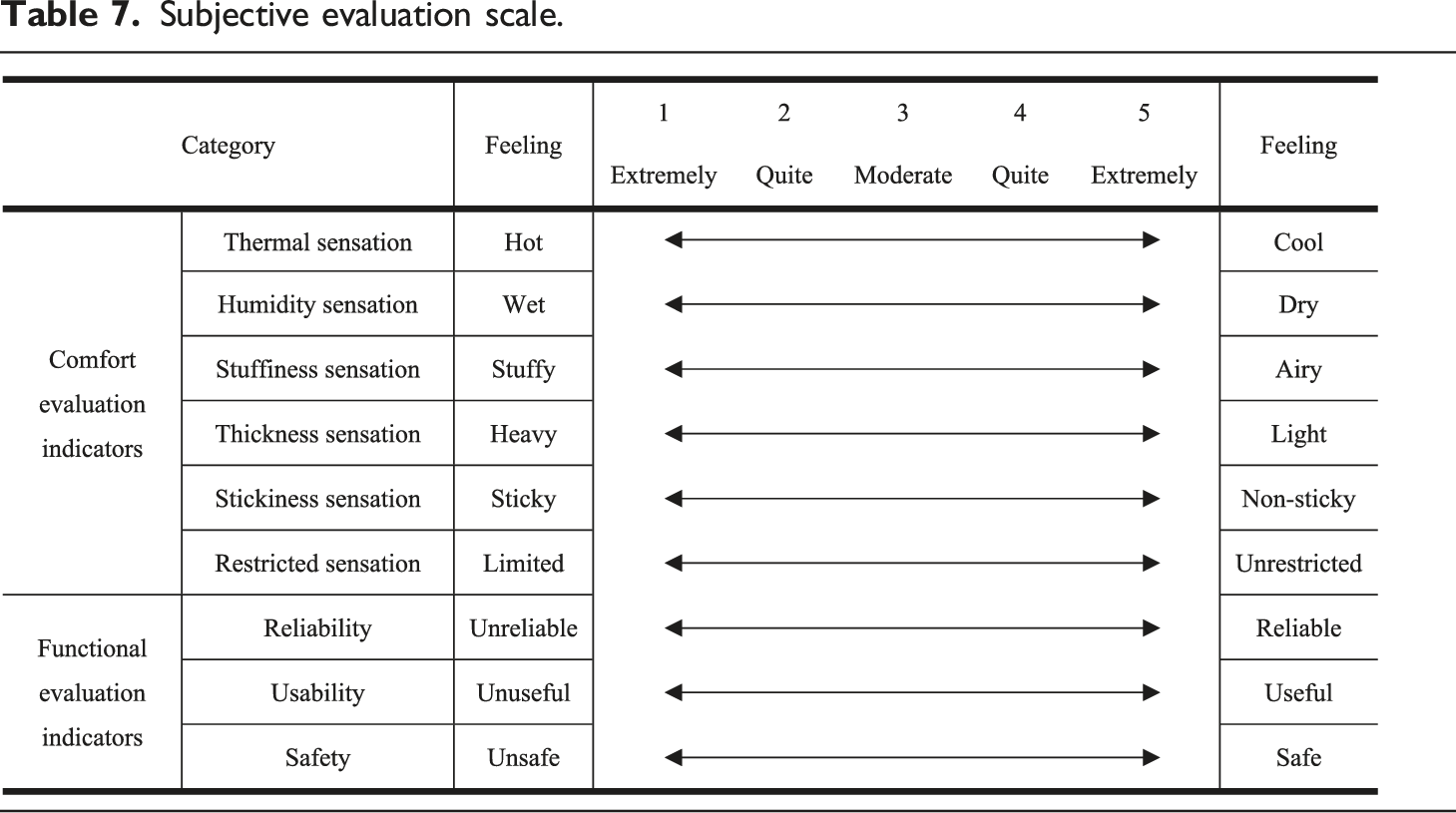

Experimental workflow
Subjective tests on the new and ordinary welding protective clothing were carried out in an artificial climate chamber. To test the stability of the electronic components under high temperature and humidity, the temperature, humidity and wind speed of the artificial climate chamber were set at 35°C, 65% and 0.1 m/s, respectively. Before the experiment, the three groups of welding protective clothing were washed and dried under the same conditions and placed in the climate chamber for 24 h in advance.
Experimental workflow.

Prior to the operation stage, each participant was asked if they could participate in the next phase of the experiment and was divided into groups of 3. Each group of participants was asked to perform the welding work at a different location (at least 3 m away from each other), while a staff member was asked to stand in the “command center” position outside the climate chamber. A computer (Xiaomi, China) was used to receive the wirelessly transmitted data (as shown in Figure 8). Schematic diagram of function test.
During the operation stage, three participants were asked to perform fusion welding (both electric and gas welding), crimping and brazing, and to pay attention to the working status of the buzzer. The ‘command centre’ was asked to observe the data transmission of the web page, i.e., the changes in data such as the concentration of the corresponding gases/fume in the environment and the physiological signals of the participants, and to provide appropriate measures based on the changes in the information on the web page.
Results of subjective tests
Subjective test results.

The results show that the concentration of hazardous gases and fume exceeded the permitted range during the test, which caused danger and damage to the personal safety of the workers. And the workers all experienced an increase in heart rate and body temperature. Figure 9 shows the electrocardiogram (ECG) of a participant monitored by the new welding protective clothing system during the sitting stage and operation stage and operation phases. It can be observed that the worker’s heart rate is significantly higher during the operating stage compared to the sitting stage, indicating the necessity of physiological monitoring for welding workers. ECG of a participant during the experiment. (a) Sitting stage; (b) Operation stage.
Meanwhile, the protective clothing system can transmit the data monitored by sensors to the webpage in real-time for the on-site commanding officers to view (as shown in Figure 10). The experiments have shown that the protective clothing system can issue timely warnings to the operators and management personnel in the event of dangerous situations. The monitoring unit in the protective clothing demonstrates a highly sensitive and complete feedback mechanism, and there were no problems with data transmission during the experiment. The system can improve the safety of welding operators and protect their physical and mental health. Receiving and displaying data on the web site.
Conclusion
In this study, a new welding protective clothing system was proposed to improve the protective performance, comfort, and safety of current welding protective clothing.
The carrier of this protective clothing system consists of a set of outerwear welding protective clothing and an inner garment. The welding protective clothing includes a long-sleeved jacket and full-length pants. In order to improve the protective performance and comfort of the protective clothing, the fabric and structure of the protective clothing were improved in this research. From the perspective of improving the occupational safety of welders, six main functional units were added to the protective clothing system: control unit, hazardous gas and smoke dust monitoring unit, physiological monitoring unit, wireless data transmission unit, alarm unit, and power supply unit.
Objective tests and subjective evaluations were conducted on the protective clothing system. The results of objective tests showed that compared to regular welding protective clothing, the new protective clothing exhibited significant improvements in flame resistance, light resistance, and mechanical performance, with relatively lower vapor resistance. In subjective evaluations, the subjective evaluation scores (on a 5-point scale) of the new welding protective clothing were 26.46% and 27.95% higher than those of regular welding protective clothing, respectively (p ≤ .05). Furthermore, the protective clothing system demonstrated a highly sensitive monitoring and feedback mechanism during testing, which can enhance workers’ ability to withstand risks and improve their psychological safety. The research on welding protective clothing with safety functions not only provides reference for innovative design of traditional welding protective clothing, but also lays a theoretical foundation for further research on other types of protective clothing.
Also, some limitations should be noted. Restricted by the experimental conditions, the service life of electronic components and the water vapor permeability of the fabric have not been measured directly, and the vapor resistance values measured by the thermal manikin indicate practical impermeability of the studied protective clothing for water vapor, these issues will be further addressed in future research.
Footnotes
Acknowledgments
The authors wish to acknowledge the volunteers for their assistance in this work.
Declaration of conflicting interests
The author(s) declared no potential conflicts of interest with respect to the research, authorship, and/or publication of this article.
Funding
The author(s) disclosed receipt of the following financial support for the research, authorship, and/or publication of this article: This work was supported by the Ministry of Education Humanities and Social Sciences Research Planning Fund Project (20YJAZH087).
